These letters were written by William Henry Hazlett (1843-1908), the son of Robert Hazlett (1816-1882) and Mary Ann Freeman (1824-1906). William served in Co. F, 105th Pennsylvania Infantry from September 1861 to July 1865.
William’s letters speak of the mortal wounds received by a relative, Adam Freeman (1833-1864) of Co. H, 105th Pennsylvania. Adam was wounded severely in the left leg on 13 May 1864 at Spottsylvania Court House and died on 28 May 1864 at Alexandria, Virginia. Adam was married in the mid-1850s to Sarah Ann Saylor (1838-1919) and had a son named Silas McMullen Freeman (1856-1928) when he left to serve his country.
Letter 1
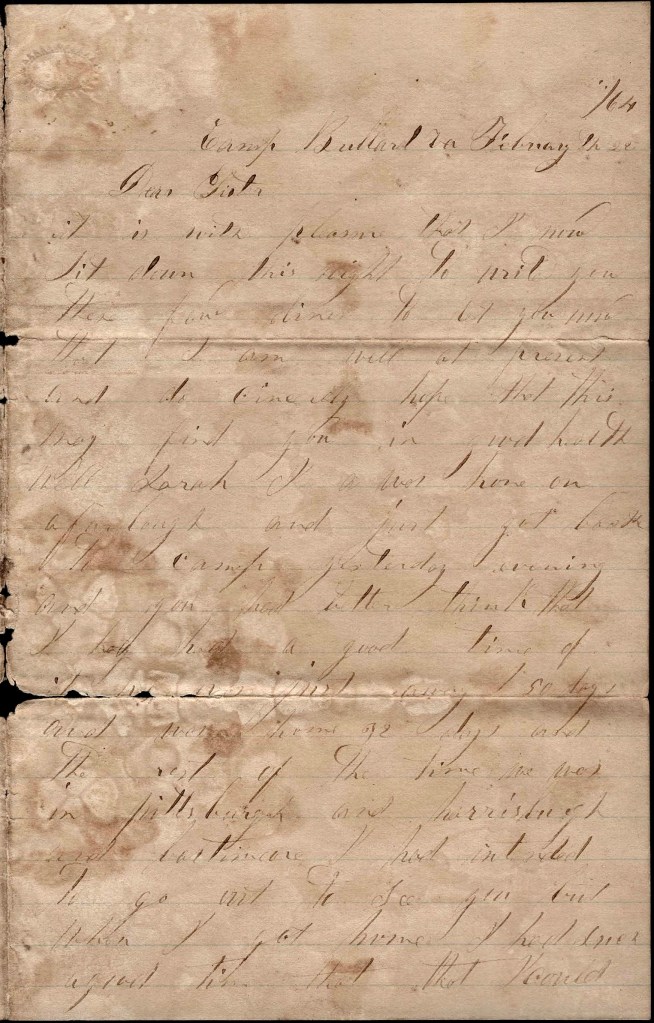
Camp Bullard February 22, 1864
Dear Sister,
It is with pleasure that I now sit down this night to write you these few lines to let you know that I am well at present and do sincerely hope that this may find you in good health.
Well, Sarah, I was home on a furlough and just got back to the camp yesterday evening and you had better think that I had a good time of it. I was just away 50 days and was home 32 days and the rest of the time we was in Pittsburgh and Harrisburg and Baltimore. I had intended to go out to see you but when I got home, I had such a good time that I could not get off very far but I think that when the next three years up that I will come to see you. Jane likes it at her [. ]. She says she would not go back on no account and she has growed [?] awfully since I saw her last.
Well, I have not much to write this time so I will stop by requesting you to write soon. Give my respects to Sam and tell him to write. — Wm. H. Hazlett
Letter 2
Annapolis, Maryland May 24th 1864
Dear Sister,
Now I set myself this beautiful afternoon to write these few lines to let you know that I am well at present and hope that this may find you the same. It has been some time since I have wrote to you and we have had some tough times since then but I got through middling well. I got shot through the left hand. It is very sore but it is nothing to what some of the boys got. Our regiment lost very heavy the first evening’s fight. We lost 203 men from four o’clock till dark.
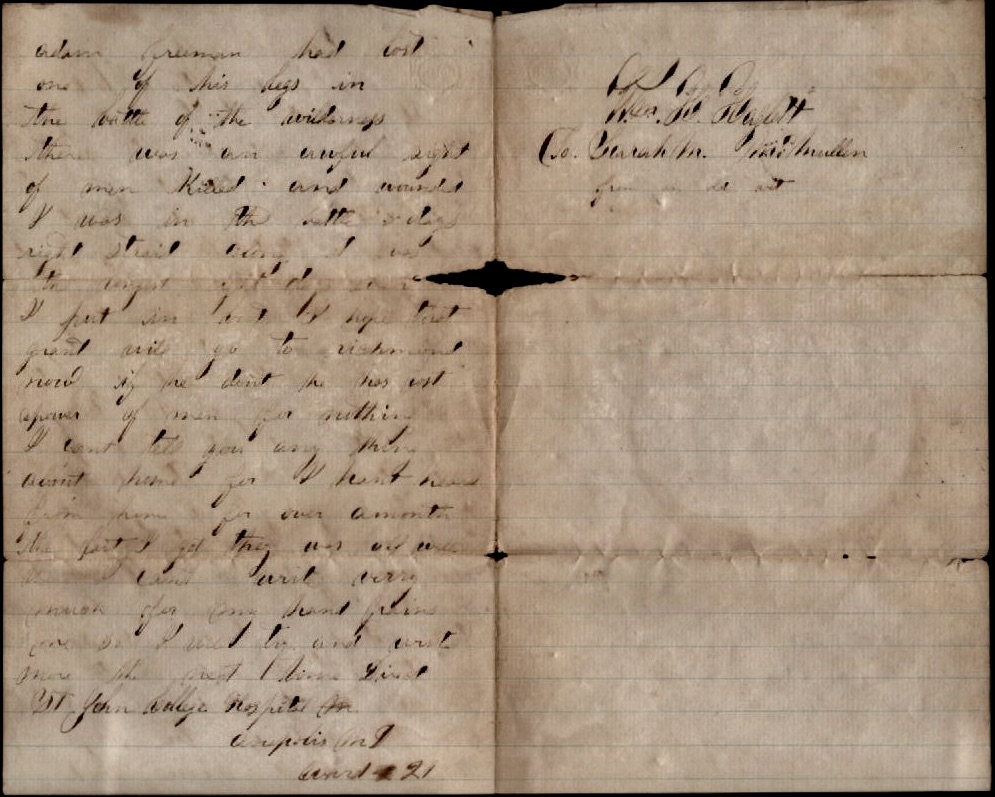
Well, I saw Sam on the 3rd of this month. He was hearty and soo was all the rest of the Boys and I heard since that Adam Freeman had lost one of his legs in the Battle of the Wilderness. There was an awful sight of men killed and wounded. I was in the battle 8 days right straight along. It was the longest eight days ever I put in and I hope that Grant will go to Richmond now. If he don’t, he has lost a power of men for nothing.
I can’t tell you anything about home for I han’t heard from home for over a onth. The last I got, they was all well.
I can’t write very much for my hand pains me so. I will try and write more the next time. Direct to St. John College Hospital, Annapolis, Maryland, Ward 21.
— Wm. H. Hazlett
To Sarah M. McMullen
Letter 3
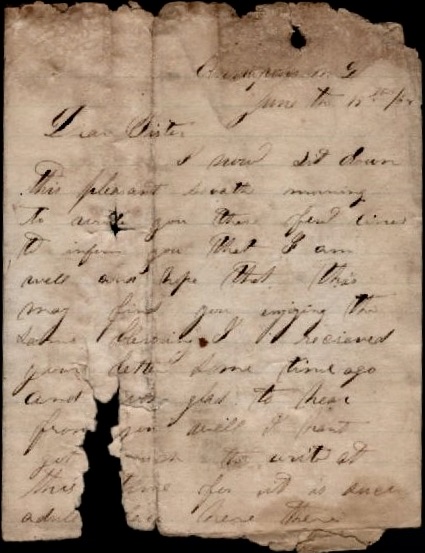
Annapolis, Maryland June 18, 1864
Dear Sister,
I now sit down this pleasant Sabbath morning to write you these few lines to inform you that I am well and hope that this may find you enjoying the same blessing. I received your letter some time ago and was glad to hear from you.
Well, I han’t got much to write at this time for it is such a dull place here.
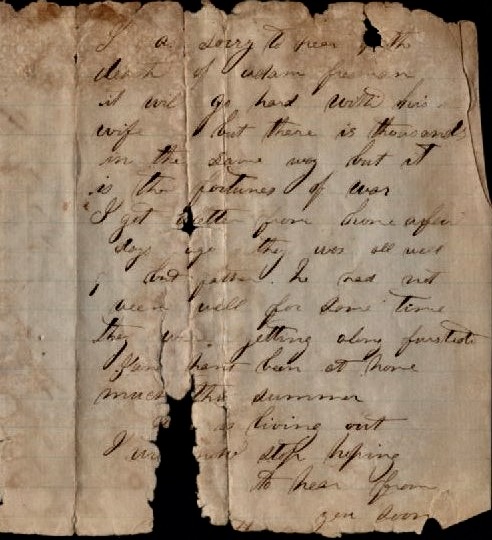
I am sorry to hear of the death of Adam Freeman. It will go hard with his wife but there is thousands in the same way. But it is the fortunes of war. I got a letter from home a few days ago. They was all well but father. He had not been well for some time. They were getting along first rate. Jane han’t been at home much this summer and is living out. I will now stop hoping to hear from you soon.
Robert Increase Boyington (1836-1920) was the son of David Davis Boyington and Melinda Jackson. Boyington served in Co. I of the 105th Pennsylvania Infantry — otherwise known as the “Wildcat Regiment.” Rising in rank from Private to Lieutenant, Robert I. Boyington fought in every battle (except Malvern Hill) in which the 105th Pennsylvania was engaged, up until he was severely wounded at Gettsyburg. His wife nursed him back to health. His early biography is on page 217-218 of the regimental history authored by Kate Scott in 1888. By the 1880s, he was farming in Kansas, and in 1886, made the Oklahoma Land Rush into the Cherokee Strip. The tombstone for his wife has on it the symbol for the Civil War Nurse Society. It is a beautiful pink marble. His tombstone is the standard issue Union Soldier tombstone. Both are in Carrier, OK.
Robert’s journal was published at one time under the title, “Robert I. Boyington’s Army Life Journal.” I have seen references to it but could not find it published on the internet, nor could I find any record of it in archives or even in rare books. It’s my belief that any copyright that might have been connected with it has expired by this time. The following transcript of the Journal was sent to me from Nancy Einfeld who informed me that it was given to her while home nursing a granddaughter of Robert Boyington in Columbia, Missouri. She has graciously made the transcription available to me hoping to share it with the Civil War history community. As I have not been able to find the published version, I have no idea if the transcript provided me was a copy of what was published or possibly a first draft. It yet retained many typographical errors which I have attempted to correct for readability.
Please note that I transcribed and published two of Robert’s letters nearly a decade ago. They were written in 1886 to Kate M. Scott at the time she was compiling the material for the history of the 105th Pennsylvania Regiment. See—1886: Robert Increase Boyington to Kate M. Scott.
Transcription
ROBERT I. BOYINGTON’S LIFE JOURNAL Commencing Nov. 25th, 1861 Dictated to My Dear Wife, Mary F. Boyington “Keep This in Remembrance of Me”
Blairsville, Wednesday, November 27, 1861. We bade adieu to our friends in Geistown on Monday the 25th at 2 o’clock p.m. The day was stormy & we had a cold, disagreeable time on our road to Whiteville. On arriving at Siler’s Store, we were met by the Boys of the school in charge of Joseph Brown with music and colors and escorted to the store by them. We were treated by Peter Siler to candies, nuts, and crackers. Three cheers were given by the Boys, then we returned them.
Bidding all goodbye, we started again and arrived in Whitesville just at dusk. Joseph Brown walked a short distance with me. I felt as I parted with him that I was leaving a dear friend & true. I hope we may meet again. I spent the evening in conversation & preparation for my departure. I dreamed of you, Mary, often during the night. I wondered how you had rested as I arose.
All were ready to start at 4:30 o’clock. I remained behind to bid farewell to my parents, brothers, sister, and such friends as had at that early hour come to take my hand. How hard it is to leave a dear Father, a kind & anxious Mother, loving brothers, sisters, and friends—perhaps never to meet them again on earth. Oh! for the hope—the blessed hope—of meeting “where all tears are wiped from our eyes,” meeting to part no more. Grant Oh God that this may be our happy end. May this hope, dear Mary, strengthen you.
The day grew brighter as it advanced and at 5 p.m. we reached [the town of] Indiana too late for the cars. We put up for the night at the Exchange. I rested well that night and at 6 the next morning, started for this place to visit my Uncle (who was lately moved here) & await the rest who will take the 3 o’clock train.
Harrisburg, November 28th. Well here I am in our State Capitol city. Many, very many, thoughts crowd themselves upon my memory as I think of its history, public buildings, &c. But time will not allow me to speak of them. We left Blairsville yesterday at 5:35 o’clock p.m. We crossed the mountains after night. I had hoped to have crossed in daylight so as to have had a view of the scenery which is said to be grand in the extreme. The latter part of the night was clear so that I could notice object at a distance. The face of the country appeared wild and much broken.
We arrived at this place [Harrisburg] at 4 o’clock this morning. Breakfasted at the United States Hotel—price 50 cents. We changed cars twice on the way. I have been around the city some this morning, seen the Capitol, and many other splendid buildings. We bought ourselves a tin cup, plate and spoon. I took supper at Until Morlin’s last night. The remainder of the crew had to wait until near midnight for supper.
I had no chance to sleep a moment last night, yet I do not feel at all exhausted. Uncle Morlin has just started for Baltimore. We must wait till 1 o’clock. Shall be mustered into the service in the meantime.
There are a great many men—soldiers I mean—on their way to their destination. Now, Mary, screw up your courage while I tell you how hundreds of them slept last night. When we came in we found them lying fast asleep on te platforms of the depot. The depot platforms are arranged somewhat like the steps on the porch in front of P. H. Shannon’s store if the railing was off. On this they were sleeping wrapped up in their blankets, their heads resting on their haversacks, and packed as close as chickens on a roost. It looked a little hard to me at first, but when they arose, they seemed as vigorous, refreshed and cheerful that I came to the conclusion that it was not so hard after all. They were on their way to Washington. They had bread and crackers with htem, but bought their coffee at our hotel, carrying it out in large wash tubs, then dipped out in tin cups by the soldiers. Of course the tubs were clean—ha, ha.
Camp Jamison [one mile south of Alexandria, Va.], Saturday, November 30th 1861. My journal finds me well, having seated myself to tell of my adventures since leaving Harrisburg. While there, we boarded at the National Hotel. Thanksgiving Day coming on the day of my sojourn there, I had an opportunity of seeing how it was spent in our State Capitol city. And truly I am sorry that I have no better account to give. Although most of the churches were opened and pretty well attended, yet the [theaters?] and drinking houses presented a sad spectacle. The soldiers almost without exception were either drunk or drinking with many of the citizens in a noisy & often helpless condition. There were shows & concerts in full blast. A splendid exhibition of the fire hose company on Market Street with their steam engine—they threw water up a steeple near 200 feet high with a force that would have sent a man off his feet and knocked him down.
We left Harrisburg on Friday the 28th of November. We reached Baltimore at 12 o’clock [noon], walked to the Washington Depot one and a half miles distant, and took the cars for the United States Capitol. I can say but little of Baltimore as I had no time to spend in that city but was fortunate enough to pass by and see the Battle Monument which is a large marble structure. Baltimore is a large and rather pretty city. The streets seemed to be thronged with negroes. We arrived in Washington about an hour after dark and made our way immediately to the Soldier’s Relief for our supper, having fasted since breakfast. We were served with a ration apiece which consisted of a piece of bread about 6 inches long, two thick and four wide, with a liberal slice of boiled beef—tongue cold, and all the coffee we wanted. No plate, fork, knife, or spoon. All we had was a tin cup for our coffee. Hungry and all as we were, we found our rations sufficient to satisfy us perfectly.
That night we were shown into a large room upstairs where I slept on the floor, wrapped in my blanket & rested well. During the night a company of the United States Regular Cavalry came in. They were from Utah Territory, had been in the regular service over seven years. They were rough-looking fellows. In the morning I took another ration with two or three hundred other men.
After breakfast I walked out a short time but as I was awaiting orders, I did not dare to go far. It was an outside view of the Capitol and other public buildings. It (the Capitol) is built of beautiful white marble and makes a splendid appearance.
At 10 o’clock a.m. we started for camp. We passed over the Long Bridge of the Potomac which is a bridge near three miles in length. Soldiers guard either end. No one can pass without a pass from headquarters. We arrived in camp at 3 o’clock—distance from Washington 12 miles. On the way we passed through Alexandria, a city of near 12,000 inhabitants and where Col. Ellsworth was killed. I have not seen a Rebel yet & my opinion is we shall not have an opportunity very soon.
Col. Samuel W. Black, a Mexican War Veteran, led the 62nd Pennsylvania Infantry until killed at the Battle of Gaines’s Mill in June, 1862.
On Sunday morning I arose much refreshed. This was the first night I had ever spent in a soldier’s camp. M. H. Shannon & I got passes to and from the 11th Regiment Pennsylvania Reserve [40th Penn. Vols] camp for four days. We reached Alexandria too late for the cars. We returned to camp for the night & started the next morning at 7:30 o’clock. Got to [Col. Samuel W.] Black’s [regiment] at 9 o’clock and to the 11th Regiment at noon. The Boys were all in good health and spirits. We returned the next, or rather I did; M. H. Shannon stopping at Black’s [regiment] over night. It is the 6th of December and I am in good health and spirits. Other particulars by next mail. Adieu.
Camp Jamison, December 7th 1861. I’m going to the 11th Regiment Pennsylvania Reserve camp. We passed through the 62nd [Pennsylvania]—Col. Black’s Regiment, and spoke with several with who I was acquainted among whom were George Richards, William Dess, William Turner, Jesse Smith, William Joseph Shick, Lieutenants [E. J.] Putney & Steck, also Capt. [Robert R.] Means & [William C.] Beck, with many others. We passed on to the 11th which we reached at 12 o’clock noon. Took dinner with William Kelley, William Coulter, and Thomas Love [of Co. K]. Spent the afternoon with [my brother] Myron [Lafayette Boyington] visiting old friends and I found after investigating the camps that they were not few. Took tea with Myron in his hut. It consisted of bread, crackers, beef, sausage, butter, coffee, tea, sugar, molasses, and mince pie. Cigars were handed round & we had a chat about old times, we having been joined by Harl Robison and Coulter & Samuel Chick. During the evening I was invited to an oyster supper by the Messers. Means which I accepted.
We repaired there at an early hour and had a merry time. we retired at a late hour. Was up at daylight. Spent the time until 8 o’clock in conversation. The regiment was then ordered under arms with 13 or 14 others to make a reconnoisance in force. We parted in good spirits—they to do their duty & I to my own camp. Yet we know not if we ever see each other’s face again on Earth. But such is the soldier’s life—full of uncertainties.
We got back to Black’s regiment at noon, ate dinner with George Richards at mess, spent the time with my friends of the regiment until 2 o’clock p.m.. and then I started for the 105th Regiment again. Missed the cars and had to walk a distance of 10 or 11 miles. Reached Alexandria an hour after dark and thus had a good deal of difficulty in passing the guards as I did not have the countersign. But with the aid of a lieutenant from Maine, I succeeded in reaching camp a little before 8 o’clock in the evening.
This Tuesday evening I led in our family worship, they having established it on my suggestion on the Sunday evening previous. The majority of the men of our tent being church members, we took our turns in leading worship. It seemed to cause a solemn feeling with all present. I felt that God was there & that “to bless” our feeble efforts.
Our tents are what are called “Sibley” tents. They are about 16 feet in diameter at the bottom; they are round, coming to a peak at the top and intended to accommodate 20 men. Our company not being full, we have but 16 in ours. We have a sheet iron stove which warms it pretty well.
On Wednesday morning, December 4th, I got my accoutrements for the army consisting of musket, cartridge box and bayonet, with haversack, knapsack, blanket, overcoat, frock coat, pair pants & shoes, & two pair drawers, two under shirts, 1 knit blouse, and two pair socks with a few other articles of less importance. Our rations consist of a certain quantity of bread and crackers, beef or pork, beans, rice or corn meal, sugar and molasses, coffee or tea, with vinegar, soap, salt, and occasionally potatoes, so that we have at all times a plenty to eat, drink & wear.
On Thursday, I went down to a large bottom or flat with the rest of the brigade one and a half miles to the Potomac to drill. There were some six or eight thousand men present. We went through the various evolutions & returned at sundown having been out since noon. It was a magnificent sight to me unaccustomed as I was to such sights.
We are called out at 5 o’clock a.m. by the beating of the reveille. The roll is called & we drill about one and a half hours and then breakfast. Go out again at 9 o’clock [and] in at 12 o’clock noon. Out again at 1 or 2; in at 4 p.m. Out again in 10 or 15 minutes afterwards for what is called dress parade. This lasts about half an hour. We are then dismissed until 9 o’clock in the evening when we are formed again in line in front of our tents for roll call. We then return to our beds to be up again at 5 o’clock a.m.
Our tents are placed in rows, each company forming a row—a street 40 feet in width between each company. There are five tents in each row. Captain’s tent or quarters at the head of each. Each regiment has a quartermaster department where the provisions, &c. are kept. A sutler’s tent where notions of all kinds are kept for to sell the soldiers. Many things are kept such as cheese, nuts, pies, raisons, and candies which are considered injurious to soldiers. Congress is now discussing the propriety of removing them. Oysters, apples, milk, butter, and other things are brought into camp every day by citizens to sell to the soldiers.
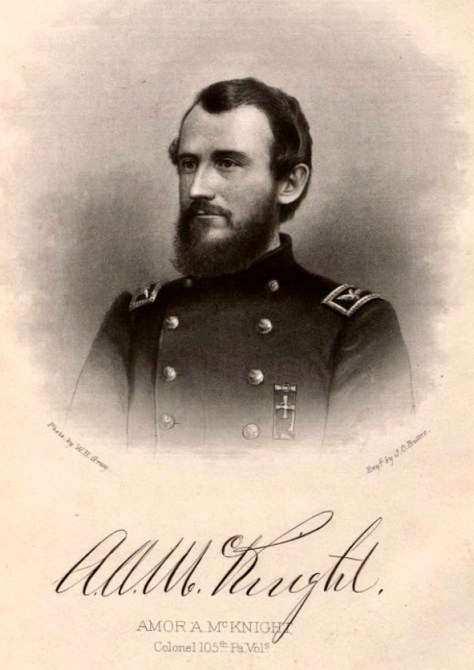
Col. Amor A. M’Knight, 105th Penn. Vols.
This morning I bade goodbye to Uncle Martin Shannon. He has started home. I had expected to be homesick in a week or two but find myself thus far happily disappointed. True, I often think of you and my friends, yet there is so much here to divert the attention that our minds do not remain long on any one thing. Capt. Freas & Capt. Dowling of Companies G & B have both resigned their offices on account of difficulties with Col. [Amor A.] McKnight. Other captains and officers are discussing the propriety of following their examples.
Saturday, December 7th 1861, I must mention as being in particular one of the most beautiful days I have ever seen at this period of the year. The atmosphere is clear so that we are able to discern objects clearly at a great distance. The weather is as warm as midsummer in Jefferson County. Flies are buzzing around and nearly all kinds of insects are yet alive. The United States Capitol is easily seen from our camp with a part of the cities of Washington and Alexandria. A most beautiful view id a portion of the Potomac is also to be had from our position with its crowd of ships, sloops, schooners, steam vessels, &c. at anchor or sailing on its waters.
The same routine of duties come day after day so that it is unnecessary to record them since giving a description of one day’s duties [suffices] unless something unusual transpires.
Sunday, December 8th 1861. Another warm & pleasant day has passed—the second Sabbath I have spent as a soldier. How changed! Instead of a quiet Sabbath such as I have spent heretofore, we are roused from our slumbers by the beating of the reveille. Then all is bustle. The soldiers form as usual in line in front of their tents to answer to roll call. We hear the discharge of pistols & musketry in every direction and now the thunder of a distant cannon comes with the echoes upon the ear. All around you, you can hear the shouts & laughter of our fellow soldiers. Some are singing, others writing, some cleaning their guns, others reading or in conversation on various subjects. All serves to remind me of my absent friends & the quiet Sabbaths spent with them in their quiet homes. The rolling drum gives the signal for guard mounting at intervals throughout the day. Now the brass band is filling the air with its soul cheering strains. Old Hundred comes floating to the ear from the distance or some other sacred hymn or melody, as regiment after regiment are summoned to divine services at different hours of the day.
Our hour today was 11 o’clock a.m. I was among the number & listed with much pleasure to a discourse by the Rev. Steadman from the 7th Chapter of Matthew, 14th verse. He was plain but brief, giving the soldiers much good advice concerning the vices incident to camp life, representing them as the Broad was to ruin. After service, the minister invited all to his tent in order to distribute tracts & other religious reading matter among them, and I am happy to say that many, very many, availed themselves of his kind offer.
In the afternoon we were called out for inspection. Our arms (guns), blankets, clothing, and tents were closely examined to see if they were clean or not. This is necessary for the health of the camp that they be made to keep clean. In the evening, prayer meetings were held in different places in the open air, and were well attended in general. Many prayers were offered up, nor were the loved ones at home forgotten.
Camp Jameson, Tuesday, December 10th, 1861. On Monday, nothing transpired of interest more than usual. We had in the afternoon a grand Brigade Parade on the bank of the Potomac in sight of the Capitol, Washington City, & part of Alexandria. I also on that day received the first letter from my wife. It is needless to describe the pleasure I had in its perusal. All who have absent friends can imagine them.
There were several ladies—wives of the officers—that were present at the parade. One of them was in a carriage with her husband a minister, and a another gentleman last evening when the horses took fright and ran off. They passed our camp at great speed but they became loosened from the carriage a short distance below our camp. No one was hurt. The horses kept on their headlong course. All were badly scared & came out trembling.
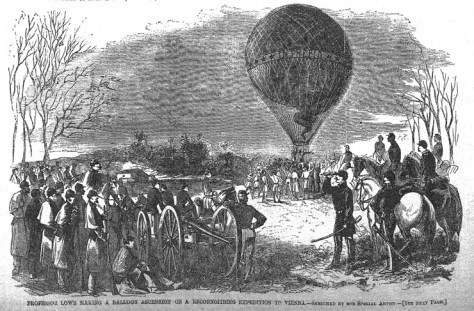
December 10, 1861. The day has closed—another beautiful day but excessively warm, so much so as to cause us to doff our coats. Another brigade moved ahead of us today. They have encamped near Mount Vernon, the burial place of our loved Washington. This evening while on drill, we saw a large balloon sailing high above us, no doubt a voyage of discovery. It was a pretty sight as it moved from us, falling in the vicinity of Washington City.
A lithograph appearing in Harper’s Weekly on 14 December 1861 depicting Professor Lowe’s balloon ascension on a “reconnoitering expedition to Vienna.”
This evening we were ordered to have 40 rounds of cartridges in our boxes and be ready at a moment’s warning. We may engage the enemy at any moment. As I now write, we can hear the booming of cannon in the direction of the enemy’s quarters. It does not disturb us much as it is not an uncommon occurrence. A Rebel prisoner was brought through our lines this afternoon. He was a large man and wore gray woolen breeches, black coat, black slouch hat, and an old pair of shoes. Rather a hard-looking fellow.
One half mile from us, on our right side, there are breastworks that were thrown up by the Rebels before our troops took Alexandria. They are merely breastworks thrown up in a line extending in different directions to a considerable distance. The forests have fallen as the Federal troops advanced. No trees have been allowed to stand on any of the hill tops. This has been done to avoid surprise and to give free sway to the cannons which are mounted on the different forts and batteries. And they are so placed that they can sweep the whole country for a distance of eight or ten miles around and have complete control of the Potomac as they (the Federals) could sink any ship that would attempt to pass either up or down the river. I have seen bomb shells thrown over three miles and then burst, tearing up the earth and knocking the branches off the trees, and playing Hob generally with everything in reach.
I have my gun in good order and I think if I can once draw sight on one of the causes of our troubles, I think he will take a fit of sudden aching. This is what I came for and I trust if God is willing, I shall be enabled to do my whole duty. Whenever called out, our guns are kept shining [and] ready for any emergency that may occur. There are bodies of cavalry and artillery near us ready for use whenever “Secesh” shows its ugly head. We do not know how near the Rebels may be to us but it is supposed to be 25 or 30 miles to any considerable force and it is understood that they are falling back. I do not believe their batteries in the neighborhood of Manassas will be disturbed by the Union forces. Their works will no doubt be turned by our forces (i. e., we shall march around them).
I have until today been in the best of health but today I have had a slight attack of the dysentery to which all new recruits are subject at first. I am better tonight.
December 14, 1861. Since last writing, so many things have occurred that I find it will be impossible to give a minute account of all. On Wednesday the 11th, to my great delight, Myron [Boyington] made his appearance in our camp on a visit. He reported the other Boys as being well & hearty. I spent what time I could with him that afternoon and the next morning I applied & obtained a pass to Alexandria and started early in the morning with Myron. We went by way of the hospital. And now a description of it, if I can give one.
This hospital was in a house once occupied by a secesh. As we entered, we saw Peter Slagle [of Co. G] busy writing, while on two or three side beds with a blanket or two beneath them lay four men with sunken eyes and countenances pale and haggard. One poor fellow I noticed in particular. He was from Clarion county and had been insane for some time & now was not expected to live through the day—but no one seemed concerned. All appeared to have lost that sympathy that characterizes our friends at home. There was no one to hold the aching head when wrenching with pain or casting up the food the weak stomach could not retain or digest. No cheering word by a near friend to soothe the mind or cheer the drooping spirit by referring to some good olden time “when all went merry.” The waiters perform their tasks as if compelled to do so & not with that cheerfulness that gives pleasure to the sufferer—the food often improperly cooked and the room poorly ventilated. I came to the conclusion as I left the place that this was a poor place to be sick in.
We went from there to Alexandria to get our likenesses taken. While in the city, I saw a sight the like of which I never wish to see again—viz: a man of the 11th Regt. Penna. Vols. (which is now guarding the city and quartered there) had deserted his company and regiment, returned home and joined another regiment. He then wrote a letter to the Colonel in command accusing him of many things and not couched in a very proper language. His first Colonel had him arrested, brought back to this place and regiment [where] he was then court-martialed and was, when I saw him, undergoing his punishment. They had bound a board to his back & handcuffed him. On the board was printed in large capital letters, “DESERTER AND A COWARD.” In this manner he was marched up and down the streets in front of his regiment. His hair had also been shaven in many places from his head. It was reported that he was to be drummed out of the regiment.
Having accomplished our object, we returned to camp about 2 o’clock p.m. Capt. Freas’ Co. [G] had just returned from picket duty and had made some captures in the shape of chickens, turkeys, and a few rabbits. They seemed to like picketing very much.
I spent the balance of the day with Myron and the Boys from Ringgold as my pass cleared me of drilling for that day and all other duties belonging to camp. The Boys spent a few merry hours talking, singing, or in other sport around the company camp fire. We sung the old songs we used to sing in Jefferson, told of our old pastimes, & a few other stories of our adventures since we left. We then retired to our respective quarters, there to dream of those at home. The next morning Myron started at an early hour for his own regiment.
This day was another warm and pleasant one. We have not had rain or snow since I came to camp. The health of the regiment seems to be improving.On this day the 12th December, I heard of a sad affair at Camp Franklin—distant from our two miles. A man had deserted us and gone over to the enemy & had also acted as a spy against us. He had been captured, tried and sentenced to be shot. His coffin was placed in a wagon and he made to walk behind. After passing through the regiment to a [hollow] square formed by the soldiers, he was blindfolded & made to kneel before his coffin. Twelve men had been detailed from one of the companies to execute him. THey stepped out, three of them fired but did not kill him. The other four men then fired. Their balls freed his guilt soul from his body. It was witnessed by near 10,000 people. But few of our regiment were there. I believe his name was Johnson. He belonged to the Lincoln Cavalry. He was deserving of his fate. Such men are dangerous to our cause.
Saturday, December 14th 1861. We cannot help but wonder at the weather. We continue to have [it] mild and pleasant. But we are expecting a change soon. This forenoon was given to such of our men as had washing to do. Many availed themselves of the privilege. Each Captain must give his men one or two half days each week to do their washing. I washed my clothes last week. You would laugh to see us rubbing, ringing, and otherwise cleansing our clothes. II think you would watch us as close as you thought I watched you, the last time I saw you wash.)
Sunday, December 15th 1861. It is hard to realize that this is the Lord’s day. The rolling drum beats as usual for roll call. At 8 o’clock a.m. we have an inspection of arms. At 11 o’clock divine service by the Chaplain. He preached from the 13th Chapter, 1st Corinthians. At two o’clock, a general inspection of arms & knapsacks (containing our clothing, &c.) by all the field officers consisting of Col. McKnight, Major Dick, Adjutant Gray, Dr. Highhold, Quartermaster Nicholson, and Rev. [D. S.] Steadman. Lieut.-Col. Robert is absent on a furlough at his home. At 4 p.m. there was an inspection of tents to see that they were kept clean and well ventilated. Our quarters were said to be in the best condition.
The men were obliged to keep their arms, clothes, and quarters in the best of order, neat and clean. Even their boots & shoes must be blackened if possible once in a week at least (or greased, no matter which). This is done at our own expense. This evening we had prayer meeting on the parade ground as usual on Sabbath nights. There was a goodly number present, among whom you could recognize Bros. Swisher, Houser, Nickle, Geist, Hilyard, Shaffer, our 2nd Lieutenant H. Brady, and many others whom time nor space will allow me to mention. There is now worship every evening in almost every tent in our company (so much for example). How cheering it is to be thus encouraged. I feel that God is with us. Oh that He may keep us firm unmovable.
Today our company police was excused from duty. A company police usually consists of three men who are detailed to cut wood, sweep the streets, or other work which is done in the camp. On last Sabbath three of our men refused to go. They were all from our tent. They were accordingly placed in the ring for punishment (the ring consists of a place like that made for horses in a thrashing machine. A guard stands in the middle of the ring to make the culprits walk around it a certain appointed time). These men had to walk an hour. After they came off, one of them wrote the Colonel a note couched in firm, yet proper language saying that his vows made at home to his friends and his God would not allow him to toil on that day more than was necessary. The Colonel called him to his quarters, talked to him respectfully on the subject, and dismissed him. Today no extra work was done.
December 16th 1861. We heard heavy firing down the river last night. We suppose it was the blockade. Nothing else of interest transpired during the day.
December 17th 1861. A letter from home by [M____]. Battalion drill as usual. In the evening about 7 o’clock orders were given to prepare arms, clothing, for a Grand Review the next day. But at 9 o’clock orders came to place one day’s rations in each haversack and prepare to march immediately. We were ready in 15 minutes after the order was received, in line of battle, with arms and provisions, and four minutes afterwards were on the road.
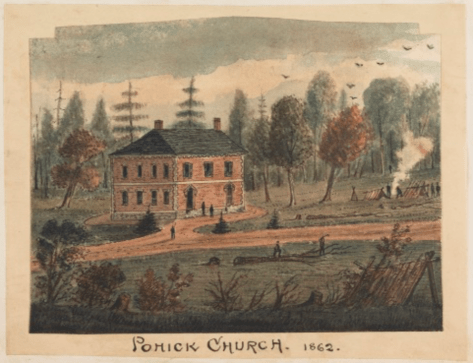
After starting we found that Pohick Church was our destination—if we could reach it. The night was lovely beyond description. The full moon brightened everything. Our arms gleamed in its beams. Tents, trees, houses, fields, and all other objects were as visible as at midday. A strange feeling came over me as we passed along. My position was both new and novel. We knew we were marching against an enemy as strong and perhaps more so than ourselves. Yet we felt no fear. All were eager for the expected fray. We marched on in silence. Nothing could be heard but the tramp of the men and horses, with now and then the click of the guns as they would sometimes strike against one another.
After going about four miles in this manner, a halt was made. Orders ran silently along the line (it being given in whispers) to load and fix bayonets. I placed a cartridge in my gun feeling that if opportunity was given, one Rebel at least should bite the dust. We then, after loading and fixing our bayonets, resumed our march. After marching three or four miles farther, we gain came to a halt at our picket’s headquarters. Here scouts were sent out to reconnoiter while the companies took different positions in battle array to receive the enemy. Our company was ordered to a position behind a fence on the right of the road. There we lay down with our guns resting on the fence ready to fire. Just before we had heard the reports of three guns, our pickets came running in having seen the enemy. We lay there a while. But as the enemy had evidently fallen back, we were allowed to kindle a fire and lie down around it. Nothing more was heard save the cry of the sentinels who, as dispatches came in or the scouts returned, would hail them at their different stations along the road with, “Halt! Who goes there?” The answer comes, “A friend.” The sentinel then commands, “Advance friend and give the countersign.” This is whispered in the sentinel’s ear and the man passes on. Then all is quiet again.
It was two o’clock in the morning when we stopped. We stayed there till six in the morning to cook our breakfast which consisted of a chuck of bread. Some had meat but the most had bread or crackers alone. I had slept only about an hour as the night was cold and we were without blankets and were in a perspiration when we halted.
After breakfast we started on, two companies being detailed as skirmishers. They scattered out on either side through the woods and fields. We finally reached the place, having neither seen nor heard the enemy. They had retreated. There were in the neighborhood the day before four or five hundred strong and had driven and pursued our cavalry two or three miles this side of Acquia Creek. This stream is about as large where we crossed it as Little Sandy is at Sprangle’s Mills, but deeper. At the mouth of this creek is their famous battery.
The church to which we marched was built by General George Washington. I cannot give a description of it except its outside appearance as I was not permitted to leave the ranks to look at it, but as our company was sent on ahead half mile past it, I had a chance of seeing how it looked outside. It is built of brick which are said to have come from England. The corners were of stone all the way up. The roof was four square coming to a point at the top. One of the artillery men had sent into it and had taken one of the banisters which was around the altar. He gave me a piece which I enclose to you.
Our company halted after going the half mile and six scouts were sent out in different directions. I requested the captain to let me also go, but was not allowed. In the course of half an hour they returned. Two of them had seen four of the enemy, but they were quite a distance off. There was a heavy fog which prevented us from seeing things clearly at a very great distance. When the scouts came in we returned back to the main body. We were allowed two hours rest but were not permitted to leave the ground.
At one o’clock p.m. we again formed in line. We marched back on another road and by way of Accotink—a small village with several fine buildings. The men kept the line in marching order two or three miles. Then as the day was very warm, some of the weaker ones sat down to rest or lagged behind. We kept passing those that had given up till finally our regiment had dwindled down to 75 or a hundred men.
After getting within two or three miles of camp, all were stopped by the Colonel. We sat and rested by the road side until the greater part came up with us. We then again formed in line and marched into camp about 5 o’clock p.m. We were a tired and sleepy set of boys, I assure you. We had been 34 hours on the road and marched 30 miles with little or no sleep. The country through which we passed was moderately hilly except the Mount Vernon farm which was generally level. There were many pretty farm houses to be seen but not a barn worth the name—being merely an open shed.
The next morning found me slightly “racked up.” My feet were rather sore and my joints quite stiff but after marching an hour or two, I felt somewhat “limbered up.” I spent most of this day (December 19th) in writing. December 20th—nothing of note. December 21st—Today I have been washing. Find I am getting pretty good on the “rub.”
Sunday, December 22, 1861. Last evening ten men came in as recruits from Jefferson county, Pennsylvania—quite filling up our company. They seem well pleased with their new situation.
At 11 o’clock a.m., I listened to a discourse by the Rev. Wallace of Westmoreland county, Pa. (who was here on a visit). He chose the words from St. Luke, 15th Chapter, 4th to 7th verse. His remarks were simple & plain, meeting the soldiers wants well. This evening it has commenced raining—the first we have had since I came to camp. And my washing is on the line yet. Poor me. So much for forgetfulness. Never mind. I will perhaps learn to remember by and by. How the rain sounds as it pats upon our company tent. It puts me in mind of the olfactory home song. Now I must expect a rougher time. The air is somewhat cool, yet not enough to cause sleet. I hear a singing and prayer in some of the tents adjoining us. How pleasant, how cheering, and yet how solemn to thus hear the people of God offering up praises and prayer under such circumstances.
Good news have come today of our success is different quarters. All are indulging the hope the strife will soon end. Now the rolling of the drum calls us to our 9 o’clock roll call. It is over now. We did not go out or form in line but answered to our names remaining in our tents on account of the rain which is now falling very fast. Our canvas sheds the rain well & I think everything will keep dry save my washing. I am now called to attend evening worship & will cease.
Monday, December 23rd 1861. It has been raining all day. I have been engaged making out a new roll list, arranging the men according to heights—the taller first. The tallest man id 6 feet 2 inches high. The shortest 5 feet, 2.5 inches 9in our company). I measure 5 feet, 7.5 inches and my description runs as being “fair complexion, blue eyes, brown hair, born in Olean, Cattaraugus county, N. Y.; enlisted at Brookville, Jefferson county, Pa. by S. J. Marlin; by occupation or profession a teacher and in for three years.” We take this description of every man in our company and so do all other companies as fast as they enlist men. They can thus be known by their friends if they die in battle or by disease.
December 24, 1861. Last night was remarkable for being one of the windiest ones I ever saw. Several of the tents blew over, breaking the ropes or chains which fastened them. The day has been cool but clear with wind.
I have felt quite unwell the past day. I was taken with vomiting about 3 o’clock in the morning but feel better now. How quick it sends my thoughts back (when sick) to those who have so kindly nursed me “when the fever burned my brow.” I hope and trust that God will grant me health while I stay in the army for such (the sick) have none of those comforts so desirable to the invalids. I am not in writing humor this evening so will cease and try to converse until I am better.
December 26th 1861. The Christmas has passed & the strangest one to me I have spent yet. At 4 o’clock on Christmas morn we were awakened and ordered to get our breakfast and place ine day’s rations in our haversacks & be ready to march by 5 o’clock. I felt quite unwell but a fight was on hand and my sickness was quite forgotten so that I had my harness on, musket, &c., ready at the proper time. Our destination we found after getting on the road was the Pohick Church again. It looked like fight this time truly for we had four pieces of cannon, one company of cavalry, and near 3,000 infantry. Nothing occurred of importance.
We ate dinner near the church, saw three or four Rebel scouts, sent a cannon ball some two or three miles over onto a hill beyond where some of the enemy were supposed to be posted, rested two hours and returned, reaching camp a little after night—a set of tired boys having marched 26 or 27 miles.
Today we were ordered to prepare winter quarters. This afternoon I with J. F. Hawthorn and George Vanvleit, went to the woods to prepare logs three feet in length, intending to build up a pen two feet high and place our tent over it. I shall thus leave the large tent for more comfortable quarters with the sergeants. I have quite recovered from my sickness. A dose of salts righted me up which I took the night before Christmas and finished up with the prospect of a fight. Yesterday in our absence several ladies arrived in camp from Brookville to act as nurses for the regiment. I have not as yet learned their names.
December 27th 1861. Last night Bro. Shaffer led in worship. Today another windstorm commenced which prevents us from raising our tents. It is not cold. The weather is about like one of our mild March months. We have had no snow as yet this winter. The sun is shining brightly. The gusts of wind often threaten to overturn our tents.
We commenced this morning to make over our pay roll. I have just been to the Post Office. The mail generally comes in shortly after dinner. No letter. It always makes me feel disappointed when I am used so. We have a mail here daily. It is amusing to see the men crowd around our orderlies asking for letters (none but Ord. Sergeants can draw for their companies). Nothing is done but read letters until they are all distributed. The lucky ones are easy known by the manner in which they draw off to read by themselves. Some can be seen laughing immoderately over their news, while others drop a silent tear which is soon brushed away.
The ladies from Brookville have made their first public appearance this evening at dress parade. Among them are the misses Scott, Frier, Allen, & McGuffey, with Mrs. Gillespie, Vandervort, and Winderlighter. The young ladies intend staying, also Mrs. Vandervort whose husband is now sick in the hospital. He was our company cook. Mr. James Nicholson, our quartermaster’s brother, died about an hour ago. He belonged to our company—the first that has as yet died from it. We fear he is not well prepared to meet his Maker.
I took supper in the tent which I have occupied since I have been here for the last—for sometime at least—as I have moved to a small tent. You would laugh to see us eat here. There are four of us generally in a mess (or perhaps I should say muss) together. Each mess have a sheet iron pan that will hold about 2 gallons. In this pan we receive our ration & if we wish, to cook them. One of the mess goes to the cook at meal time and draws the beans, rice, mush, potatoes, or soup as the case may be with the meat. It is then brought to the tent. We then sit down on the ground floor around it, take our shares out on our tin plates, and go to work with our coffee or tea, bread or crackers. If the meat is tender, we tear it between our teeth and fingers. If tough, we cut it with our pocket knives into smaller portions. We often have been soup, rice soup, pea soup, or beef and potato soup, but no butter or milk unless we buy it. Butter is worth 30 cents per lb., milk 10 cents per quart, water and all. The reason of this is it takes all the hay, &c. for the horses and thus the cows do without.
December 28, 1861. I have just returned from Alexandria having helped to escort our comrade [James] Nicholson’s body on its way to his family in Brookville, Pa. The brass band played the “Dead March” in front of the hearse while our company marched in procession behind it with our guns under our arms, the butts to the front. Mr. Nicholson was 5th Sergeant in our company. This day’s mail brought the first letter received from M. H. Shannon.
December 31st, 1861. Sunday has passed & with it I find myself filling the place of our comrade Nicholson. I can’t say how long it will last. I am still to act as clerk besides. Day before yesterday we had a pleasant & I trust a profitable hour in listening to a discourse by our chaplain from the 5th Chapter of Matthew, selecting the words “Blessed are the pure in heart,” &c. The ladies were present making it seem more social & homelike.
We are still busy at our winter quarters between drilling hours yet we do not know how soon we may move our camp. We know nothing of our future until we hear the command. Yesterday our messmate H. N. Steel was removed to the hospital. Truly I pity the sick. There are still many cases of fever in camp.
Tomorrow is the beginning of another new year. As I think of those I have spent & compare my prospects of spending it with those I have spent, I can’t say that it is very cheering. Still the thoughts of nice smoking turkey roasts, big apples, old dicer [?], pleasant conversation with friends, sleigh rides, &c. will intrude upon my mind, in spite of the glorious privilege of “fighting or dying for the Union.” Away roasts, apples, cider, friends, rides, &c. What are you compared with a soldier’s life? Away with such thoughts! “I’ll be gay and happy still” (if I can); in not, I’ll not “cry over spilt milk.” How I wish I could receive half a dozen letters as a New Year’s gift tomorrow.
Today we are mustered out for our pay. We expect it some time this week, yet nothing definite is known. The weather is somewhat cool yet pleasant. No snow as yet and but two days of rain. It astonishes me how time flies.
January 1st 1862. The New Year has come and no doubt the most eventful one our Nation’s history has ever yet recorded. May an all-wise Providence cause it to be a year of jubilee to us and the beginning of “Peace on earth & good will towards men.”
Yesterday I was with thirty or forty others mustered into the service of the United States, and also mustered out for my pay. The paymaster is expected any day to pay the troops for the last two months service. During the forenoon we were on Brigade Drill. The afternoon was given to the Boys to spend as they pleased. There were several games of ball started, creating considerable sport. I spent my time fixing up my quarters & clothes, considering it of most importance. I forgot to state that on the last day of December, I was examined by our army surgeon before I was mustered in.
The day is warm so that I have worked without coat or vest and would have been comfortable lying down in this manner. This evening we have spent debating and talking of the manner in which we spent our last New Year’s day & prospecting our chances of spending the next.
January 2nd 1862. Cooler this morning but a clear day. We have been drilling very busy today and I feel tired & will write no more. Only add that I received a letter from my old friend and fellow teacher Augustus Means of Punxsutawney, containing an account of the Institute for the 1st time this afternoon.
January 3rd 1862. Nothing new save this evening it has commenced to snow a little.
January 4th 1862. This has proved a big day to our regiment. Judge Shannon of Pittsburgh having presented us with a flag in the name of our loved State. The flag was a most beautiful one with yellow fringe on the edges, No. 105th Regiment in letters of gold with our State’s coat of arms and motto on the left corner and center. Appropriate speeches were made by our Colonel and the Judge. A flag was also presented to the 43rd Pennsylvania Regiment, Col. Hay commanding, at the same time. We have also received another new pair of pants for each man in the regiment—light blue for the privates and corporals, and blank & dark blue for the sergeants and non-commissioned officers.
This morning the ground was covered with snow for the first tie since I have been here in camp. It is not much more than one quarter inch in depth. It has cleared up now but is still quite cool.
January 5th, 1862. This is the coolest morning we have had this winter. It was a cold job to get up before daylight without fire or any way of making one to answer roll call. We have no stove in our new quarters as yet but shall have as soon as payday comes which we expect now any day as we have all run short of funds and find it is a poor place to obtain credit.
We are getting pretty well fixed up. Our hut or tent is 8 feet square, built of split logs, about 2.5 feet high and covered with our tent. We have two beds in it, one above the other. I can sleep in a bed. The cracks we have plastered with mud. In this small place four of us eat, drink, and sleep. The soldiers have all these things to fix up between drill hours. Boards are not to be had here except what the boxes make.
Today I have not time to hear more than half the sermon. His words was “Whatsoever thy hand findeth to do, do with thy might.” You may judge his discourse. His sermons are short but pointed and to the purpose. We have this afternoon to ourselves—the first Sabbath afternoon we have had to spend as we deemed proper. It is clear today but pretty cold. Another man dies this last week. He belonged to Co. A, Capt. [John] Hasting’s company. His name I believe was [Robert H.] Marsh from near Perryville.
January 6th 1862. The snow is about 2.5 inches deep and the ground froze to the depth of four to 5 inches. Rather cold nights for camping out.
January 7th 1862. Clear but cold.
January 8th 1862. Today I am on guard for the first time. I do not have to do much. I have 15 men under me and my business is to see that they come out at the proper time and discharge their duty. I am on the 3rd relief which goes on at two this afternoon; comes off at 4; on at 6, off at 10; on at 2 at night, off at 4 in the morning; on again at 8 and stay on till 10 o’clock tomorrow morning when we are relieved by another set of guards, each under a sergeant who is on guard two hours and off 4 for 24 hours.
Part of my duty today was to attend to a prisoner who is in the guard house. He is an old man. He was brought in yesterday and was suspected of giving intelligence to the enemy. He told me he was cold there last night so I got him a blanket and one of my men got him one which will make him pretty comfortable. Rogue as he is, I pity his gray hairs.
It commenced raining at 10 o’clock last night and rained nearly the whole time till I came off guard and is still raining. I did not get wet as sergeants do not have to stay out but go in the guard house when we wish. The guard house is a building about the size of the Ringgold blacksmith shop and nearly as dirty. Last night I became acquainted with R. F. Perry’s brother-in-law Berry. Had a good chat.
January 9th, 1862. It is raining, foggy, warm and muddy. I cannot sleep although I have not slept since yesterday morning. Our countersign last night was “Tybee.” Of course no person was permitted to pass the sentinel unless he could when halted give this word which is always whispered by the person (if he knows) in the sentinel’s ear. Our muster rolls came back this morning and we expect our pay this afternoon.
January 10th, 1862. No pay yesterday, A heavy fog hangs over us and is very damp. The doctors have advised the men to keep close to their quarters as the fog is considered unhealthy to inhale. This afternoon the paymaster arrived and commenced to pay off the regiment, each company according it its letter—A, B, C, &c. We marched up in line to the Colonel’s quarters and were called in one at a time as his name comes on the roll. It takes about 75 minutes to pay a company. Our turn will come about midnight.
The regiment has received its pay. I received $26.56, being a private’s wages for two months, Sent $15 home by Capt. Hastings. The camp is today with hucksters with almost everything a man would need for luxury or use. These characters follow close on the heels of the paymaster to get the money of the soldiers at an exorbitant price for articles they sell.
January 12th 1862. The weather has become cold again and this day is raw and windy. Mr. [Benjamin] Pollyard, one of our company, started home today on a furlough of twenty days to regain his health which has been bad for some time. He lives near Bell’s Mills above Brookville some two or three miles. This day I heard a sermon by Elder Flowers who is here on a visit. His text was chosen from 11th Timothy, “I have finished my course.”
January 14th 1862. Yesterday was cool but pleasant. This morning we are surprised to find some four inches of snow on the ground. It really looks like Old Jefferson. Yesterday six more Rebel prisoners were brought into our camp. They were taken by our cavalry 12 miles beyond Pohick Church. It created quite an excitement when they were brought in—the whole regiment running to see them.
January 15, 1862. Yesterday I was detailed as Sergeant of the Guard to take the prisoners who were captured this week down to Alexandria to the Provost Marshal. Some of them seemed loathe to go but with six bayonets gleeming around them, they concluded twas best to move on in a peaceful manner. In passing through the streets of the city, the people and soldiers would hurrah for the “Wild cats.” I took them safe & delivered them up to the Provost Marshal. Was invited to dinner with my men which we accepted. After dinner I was invited to the Marshal’s office to get my receipt. I then marched back with my men and took the receipt for the prisoners to General Jamison and was discharged.
On my return I found I had three letters from Jefferson—yours and mother’s, Perry’s and one from Brown’s. Having received no letter from you this week, you may judge my pleasure. Today it is raining very hard. George Richards [of Co. I] is here from Black’s [62nd Pennsylvania] regiment. He reports all well. He has [issued] with others of the regiment a beautiful Zouave suit of the best material. He will take “tea” (ha ha) with me this evening. My beef is now on the stove frying. We shall also have rice, sugar, molasses, bread and butter (the latter rather strong).
January 16, 1862. George Richards went back this morning. Our 2nd Lieutenant Hugh Brady came in and slept with us last night. He says we have the best quarters in the company (we knew it). Today I am on guard again. Have 21 men this time. Have just mailed a letter to my old and tried friend, Joseph Brown. Also receive a paper (Star) containing my account of matters here. It is dated January 8th 1862. Our countersign tonight is Linden.
January 17, 1862. Last night was beautiful—a full moon and a clear sky. Weather is somewhat cool. We have large stoves in our guard houses now which we bought by a subscription raised by the regiment. The cost was near $100. There are 4 of them, one for each house or room.
It was my painful duty to punish a man last night. He had been to Alexandria with a pass, had got drunk, and stayed away some three days. Our orders from the Colonel was to tie a block of wood on his back weighing not less than 40 lbs. and then cause him to walk around the ring. This he will have to do for four days succession. It seemed hard, yet just. He is a member of the brass band. His name is [Alex Ross] Taylor. He is a rather bad man. He helped me to put it on saying it was not my fault. He was quite merry about it, being still a little under the influence of liquor. It is not a hard job to do—the shame being the worst of it. At night he was allowed to go to bed after 3 o’clock to be put on at six tomorrow.
January 18, 1862. Commenced raining again. We will have Brigade Drill never-the-less this afternoon. Mud awful this evening. My friend, Jesse Smith came over on a visit to our regiment. He will stay with me tonight.
January 19, 1862. Sunday again. No preaching as it is raining and very muddy. Letters today from you, Mother, Laura & Thomas Geerheart. This evening our regiment received orders to go on picket, the whole regiment going at a time. We have no expectation of seeing the enemy as the mud is too deep for them to get around. The roads are almost impassable. We are to start tomorrow at 10 o’clock with three days rations in our haversacks, knapsacks with our blankets, and some extra clothing. We are to be out three days before we return. It has cleared up some and the prospect is we shall have fair and pleasant weather. It is not cold but quite mild.
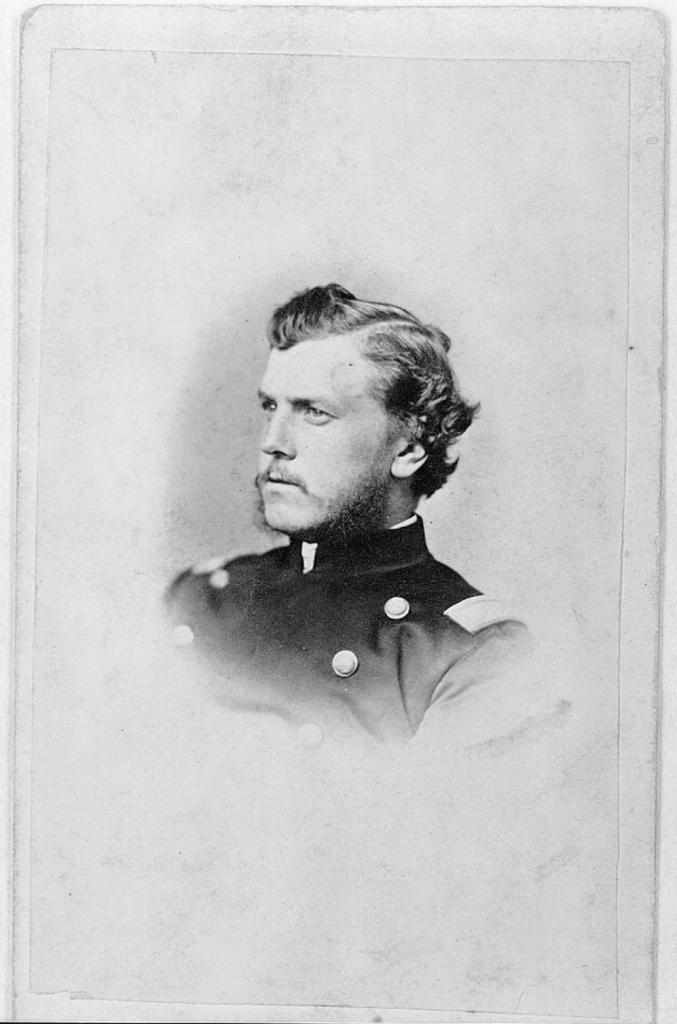
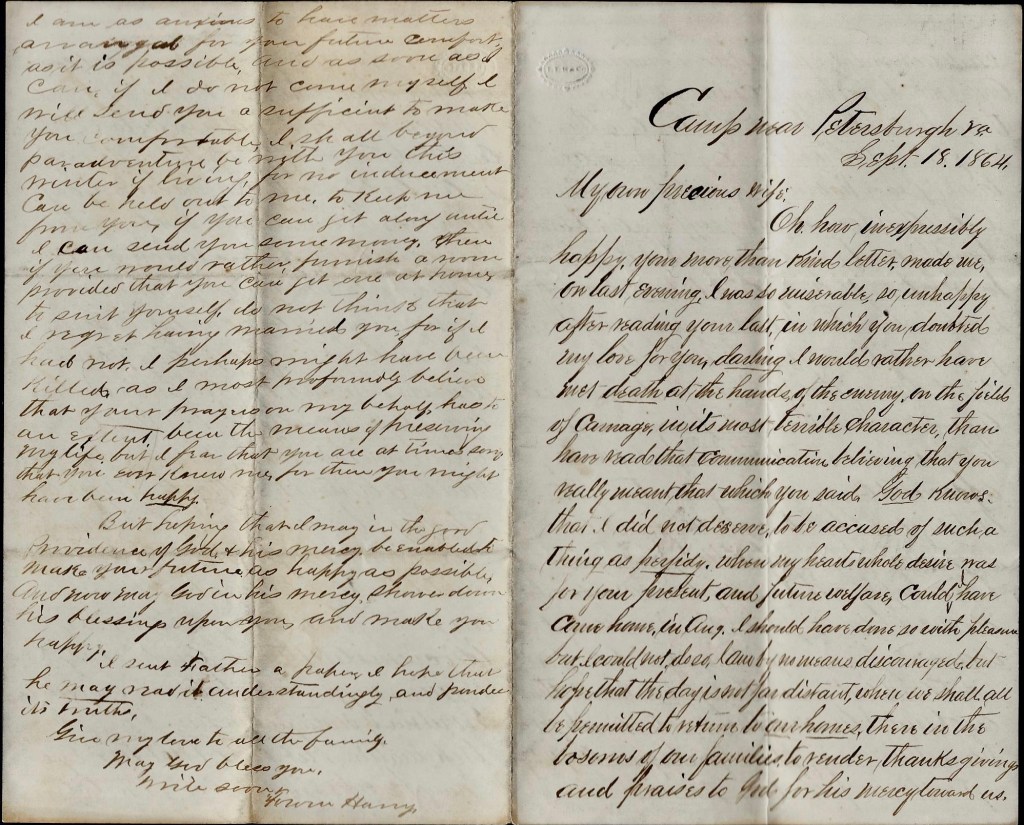
These letters were written by John Henry (“Harry”) Woodward (1837-1917) who enlisted as a private in Co. E, 105th Pennsylvania in August 1861 at Westmoreland, Pennsylvania. He was 24 years old when he enlisted and was described as standing 5 feet 9 inches tall, with blue eyes. In less than two months, he was promoted from private to fill the drum major position in the regimental band and then about a year later to serve as adjutant. Finally he filled the captain’s role in Co. G. but resigned his commission on 4 October 1864.
Harry wrote these letters to his wife, Mary (“Molly”) Christy Fleming (1838-1913.
The 105th Pennsylvania “Wildcats” had a long and illustrious record in the Civil War, participating more or less in all of the eastern battles. For a great summary of their record, I would refer readers to an article published by Jared Mike entitled, “105th PA ‘Wildcats’ at Gettysburg on July 2, 1863.” In one of Harry’s letters below he mentions the “Red Diamond” badge of the First Division, III Corps which the 105th Pennsylvania wore so proudly while fighting at Gettysburg and where Harry was one of the 17 officers wounded on the field.
Letter 1
Camp in the field near Petersburg July 2nd 1864
My dearest wife,
I shall take much pleasure to acknowledge the receipt of your most welcome letter which was received by me last night and with it a counterpart of your sweet self. This token of your kindness shall not be forgotten by me. As it is the first I have had, I shall prize it dearly. And oh! that I could but take you in my arms and bless you. My very heart yearns for your sweet caresses but I shall look forward with unbounded pleasure to the time when I shall be with you to have your kind sympathy in person. Everything now looks favorable and the time may pass more swiftly that it otherwise would had we been exposed to such severe marching & hard fighting both of which I think is nearly over, as our prospects are much brighter than when I came here. We have a fine position. The men are in most excellent spirits.
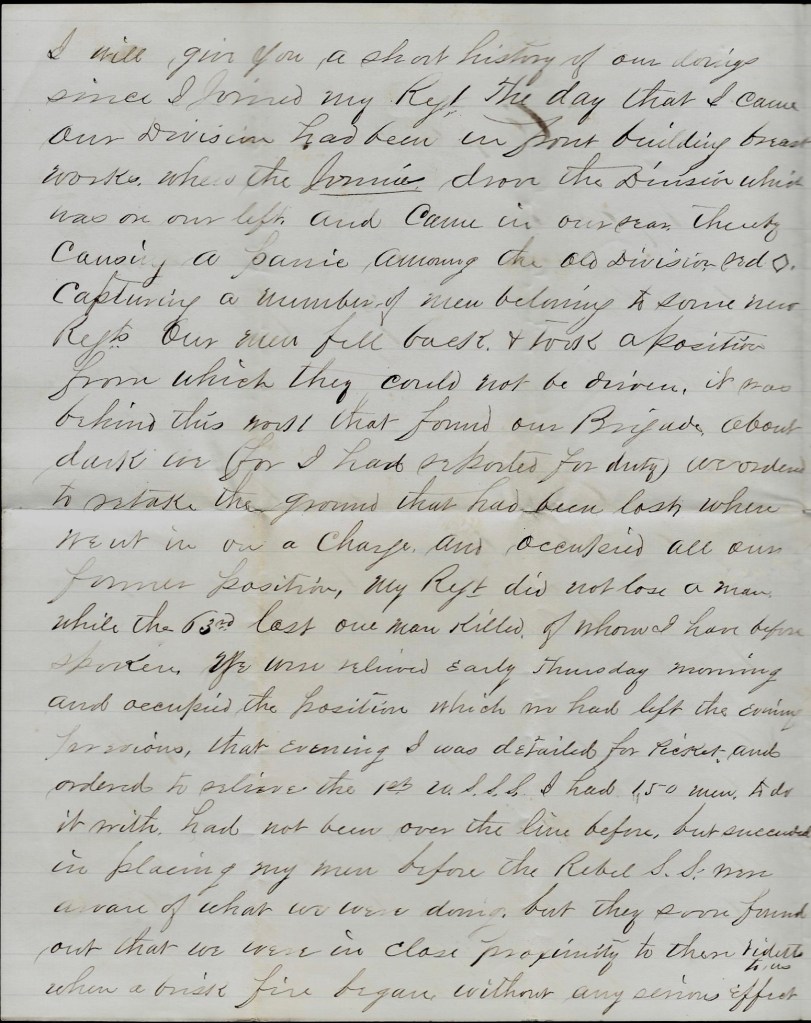
I will give you a short history of our doings since I joined my regiment. The day that I came, our Division had been in front building breastworks when the Johnnies drove the Division which was on our left and came in our rear thereby causing a panic among the old division Red Diamond, capturing a number of men belonging to some new regiments. Our men fell back & took a position from which they could not be driven. It was behind this work that [I] found our Brigade about dark. We (for I had reported for duty) were ordered to retake the ground that had been lost when [we] went in on a charge and occupied all our former position. My regiment did not lose a man while the 63rd lost one man killed of whom I have before spoken. We were relieved early Thursday morning and occupied the position which we had left the evening previous. That evening I was detailed for picket and ordered to relieve the 1st U.S. Sharpshooters. I had 150 men to do it with, Had not been over the line before but succeeded in placing my men before the Rebel sharpshooters were aware of what we were doing. But they soon found out that we were in close proximity to their vedettes when a brisk fire began without any serious affect to us.
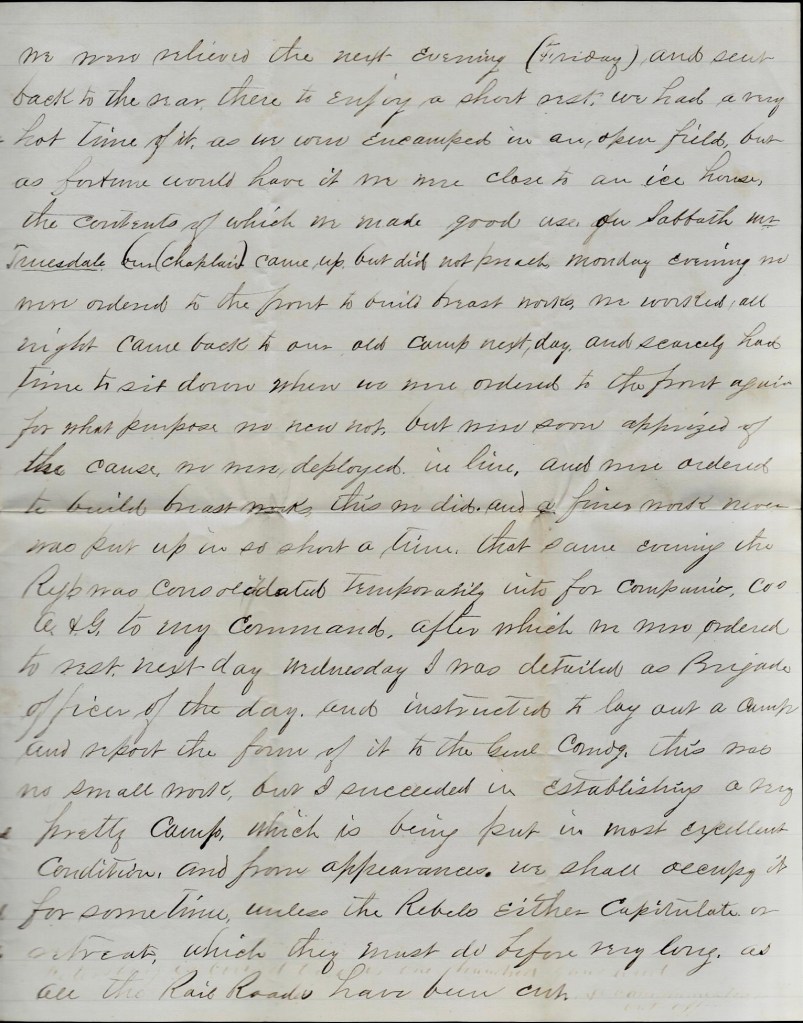
We were relieved the next evening (Friday) and sent back to the rear, there to enjoy a short rest. We had a very hot time of it as we were encamped in an open field but as fortune would have it, we were close to an ice house, the contents of which we made good use. On Sabbath, Mr. Truesdale (our chaplain) came up but did not preach. Monday evening we were ordered to the front to build breastworks. We worked all night, came back to our old camp next day and scarcely had time to sit down when we were ordered to the front again—for what purpose we knew not, but were soon apprised of the cause. We were deployed in line and were ordered to build breastworks. This we did and a finer work never was put up in so short a time.
That same evening the Rebs was consolidated temporarily after which we were ordered to rest. Next day Wednesday I was detailed as Brigade Officer of the Day and instructed to lay out a camp and report the form of it to the General Commanding. This was no small work but I succeeded in establishing a very pretty camp which is being put in most excellent condition and from appearances, we shall occupy it for some time unless the Rebels either capitulate or retreat, which they must do before very long as all the railroads have been cut.
We are getting a few deserters every day who say that Lee’s means of transportation is getting very bad. His artillery horses have no forage; wagon trains standing idle from the same cause. This we have no reason to doubt as with all the forage we have, our horses and mules are dying by the thousands from the heat and dust. I am beginning to think that the end is not far distant when we shall hear the welcome sound of peace on earth and god will to men.
I have found a warm friendship for our chaplain and think him a good man wishing to do all that he can toward furthering the good work in this regiment. I think that perhaps he will accomplish something here but it is a hard task for him as most of the men are addicted to the use of the most profane language.
I wrote to Kate yesterday giving her quite a long letter which I presume she will be tired of ere she gets through with it. I shall write to Frank this afternoon should nothing prevent my doing so.
While I am writing there is a good deal of cannonading on our right but nothing like hostilities in our front as both sides appear to have come to a tacit understanding in regard to the matter.
But I shall close committing you to the keeping of Him whose we are, and who will never leave nor forsake those who trust in Him. Give my love to Father, Mother, and sisters and write very soon. Goodbye.
From your own, — Harry
Letter 2
Camp near Petersburg, Virginia September 12th 1864
My dearest wife,
should think that ere this will have reached you, my letter bearing the date 9th ulto. shall have been read by you making you acquainted with affairs pertaining to my getting out of the service and coming home to my dearest and best of wives. In fact, I shall not be contented and happy until I shall again bask in the sunlight of thy smiles and tell you by my actions how entirely I do love, and more than love—yes, I adore you. For you darling I could endure all things. For you I could willingly sacrifice my position—aye, everything, even my honor. All, all, but my hopes of Heaven, did know that in so doing, I should add to your happiness, for you I would live and without you I care not what may be my fate on earth. These are not merely protestations but may life prove to you, darling, that mine are not idle words, for words are altogether too inadequate to express the thousandeth part of my great love for you.
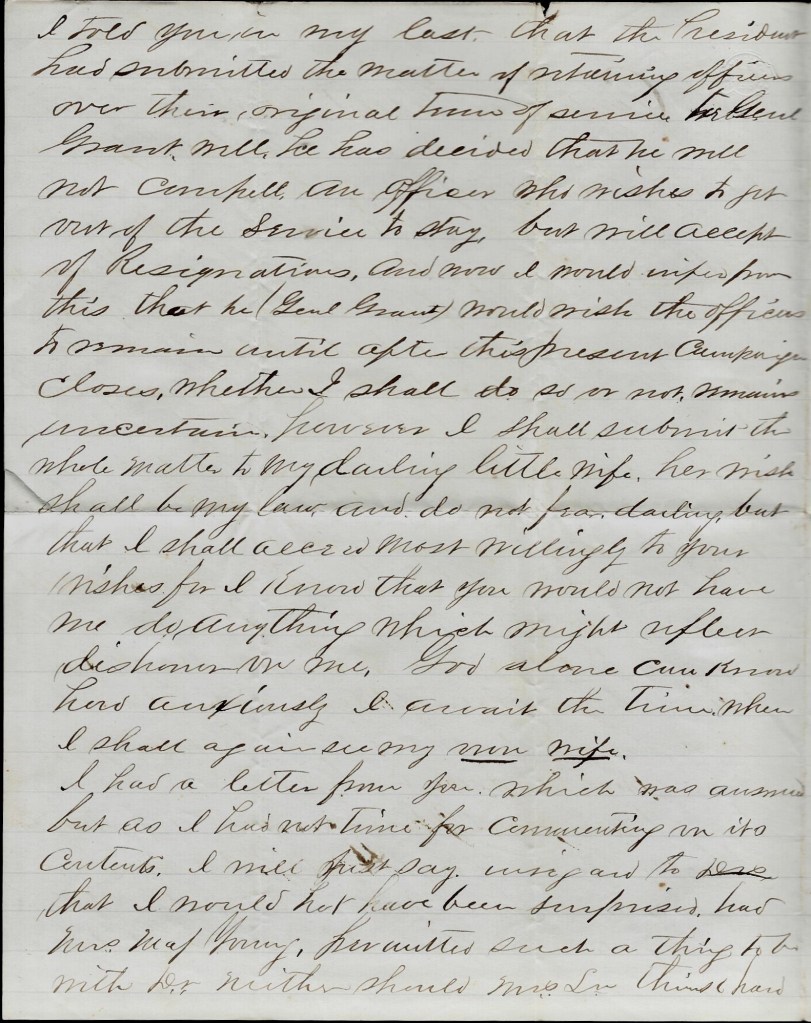
I told you in my last that the President had submitted the matter of returning officers over their original term of service to General Grant. Well, he has decided that he will not compel any officer who wishes to get out of the service to stay, but will accept of resignations. And now I would infer from this that he (General Grant) would wish the officers to remain until after the present campaign closes, whether I shall do so or not, remains uncertain. However, I shall submit the whole matter to my darling little wife. Her wish shall be my law and do not fear, darling, but that I shall accede most willingly to your wishes for I know that you would not have me do anything which might reflect dishonor on me. God alone can know how anxiously I await the time when I shall again see my now wife.
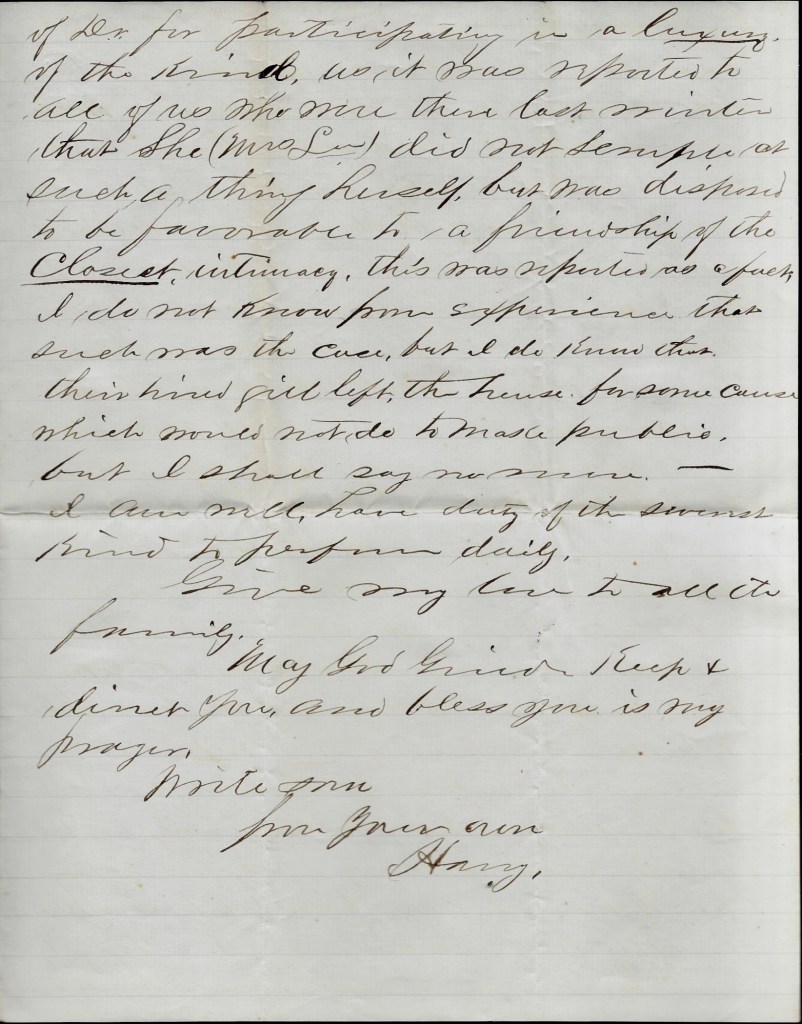
I had a letter from you which was answered but as I had not time for commenting on its contents, I will just say was good to see that I would not have been surprised had Mrs. Maj. Young permitted such a thing to be with Dr. Neither should Mrs. L’n think hard of Dr. for participating in a luxury of the kind as it was reported to all of us who were there last winter that she (Mrs. L’n) did not [ ] at such a thing herself but was disposed to be favorable to a friendship of the closest intimacy. This was reported as a fact. I do not know from experience that such was the case, but I do know this—their hire girl left the house for some cause which would not do to make public. But I shall say no more.
I am well. Have duty of the severest kind to perform daily. Give my love to all the family. May God keep and direct you and bless you is my prayer. Write soon. From your own, — Harry









 Spared & Shared 23