
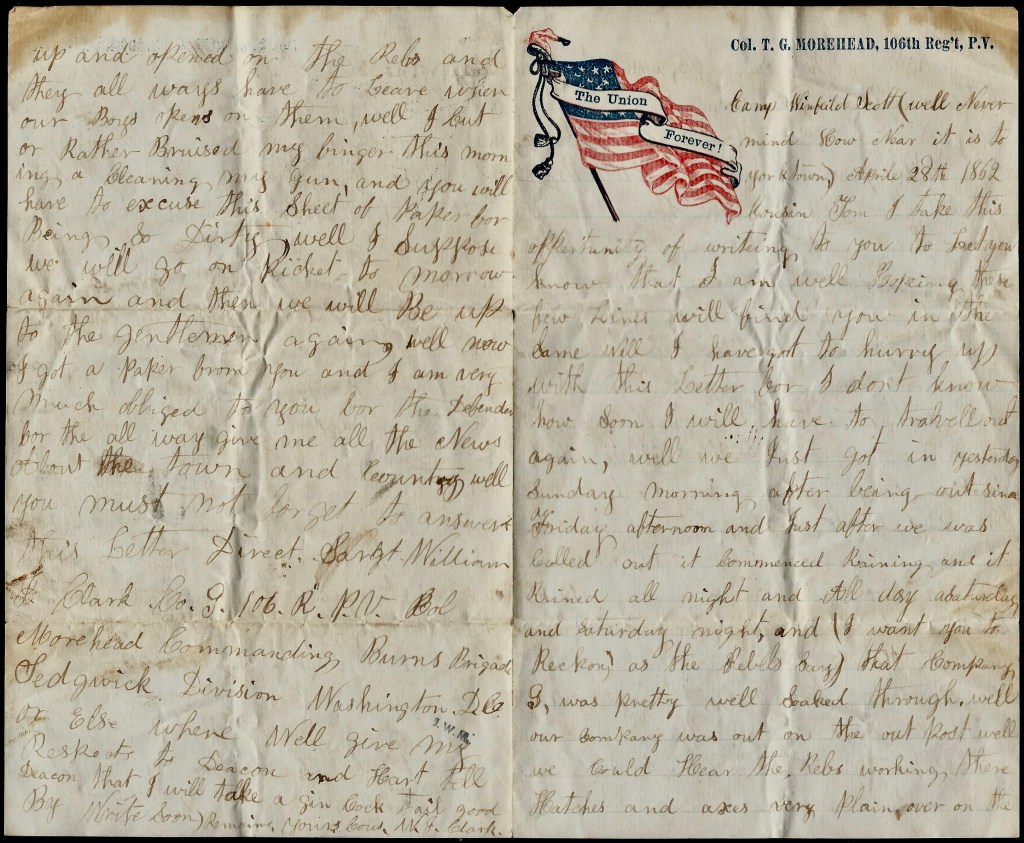
This letter was written by Myron T. Little of Co. H, 106th Pennsylvania Infantry that was organized and commanded by Col. Turner G. Morehead. It was first called the “Fifth California,” being part of of Col. Baker’s California Brigade, but later was one of the four regiments composing the Philadelphia Brigade. The 106th joined Col. Baker’s Brigade just prior to the disastrous Union defeat at Ball’s Bluff.
Myron informs his friend Wesley that he was in Co. H, but he must have been transferred into Co. F when the regiment became the 106th Pennsylvania because that is where he appears in the muster rolls which show his enlistment on 14 August 1861.
Myron was taken prisoner on 15 August 1863 (estimated) and died on 3 June 1864 in Andersonville Prison. He was buried there, grave No. 1588.
Census records reveal that Myron was the oldest son of at least 12 children born to Joseph Bloomfield Little (1820-1908) and Louisa C. Armes (1821-1898) of Forks, Sullivan county, Pennsylvania.
T R A N S C R I P T I O N
Camp Observation
December 15, 1861
Friend Wesley,
It is with pleasure that I take this opportunity of addressing you for the first time since I was from home, Sam Black [Co. F] told me some time ago that you wanted me to write to you. I did not for want of money to pay the postage with but we have now got our pay and I just thought that I would write a few lines to you. We are all well at present and I hope that this will find you the same.
Last Thursday night at about 10 o’clock we were all routed out in quick time for a march for Conrad’s Ferry, a distance of about 8 miles. Well there was four companies of us started down the river that night. We went about 5 miles that night when a halt was ordered and the Colonel said he would ride down to the ferry and see what was up. The Lieutenant Colonel Curry [said] we was to turn into a corn field and lay down and keep quiet until his return. We did not dare to build fire for fear the rebels could see it from the Virginia shore. We had nothing but our blankets and therefore we came darned near freezing to death and there we lay until morning when we was ordered back off the hill a short distance to wait for further orders and lay there until about noon today when we started back for camp. All I can find out that was going on was that the rebels was gathering on the opposite side of the river and we was to be there in that case to help the river pickets to keep them back. Whether I am correct or not, I know not. I only heard so but not from any officer so I do not put any dependence in it.
We lay there in suspense for fear we should not be called out in time for any of the fun—if there was any to be had—but there was none to be had so we was all disappointed. This was the second time we was disappointed on the same route but the first time I think it was best. The way it was, we could not get across the river and I am afraid if we should of got across, there would not been a great many left to tell the tale. But for all that, we all wanted to get across and try our old muskets. 1
Now for a little local intelligence. First I want you to take care of the girls and that good too for I expect to come back some time and I want them taken good care of, to be delivered unto me for I wat some pretty girl out of the lot.
I expect you had gay old times there at the Institute. I should liked to of been there for my share of the fun but I was in a place where I expected there would be some fun in making the rebels run. But they made our fellows run and that wasn’t much fun for us. But I expect it was fun for them.
I have gay old living down here. We had for the last three days anyhow. It was raw pork and crackers what we would despise up there but everything is palatable to a hungry soldier. But we do not live that way in camp but that don’t go bad to us poor devils when we are pretty hungry. I shall have to stop for want of time and room. Give my best respects to the folks in general—the girls especially. I remain your friend, — Myron Little
Bakers Brigade
Morehead’s Regiment
Company H
Adamstown, Maryland
1 Myron is probably referring to the Battle of Ball’s Bluff in which part of the regiment participated. The battle took place on 21 October 1861 near Leesburg, Virginia, and resulted in the death of Col. Edward D. Baker.



 Spared & Shared 23