Category Archives: 111th New York Infantry

1863: Soldier in Co. G, 111th New York Infantry to his Family

The following partial letter was written by a member of Co. G, 111th New York Infantry based on the stationery and the actions of the regiment described in the letter. Readers will remember that the 111th New York Infantry was one of the regiments branded as “Harpers Ferry Cowards” for their surrender—through no fault of their own—during the Antietam Campaign of 1862. Paroled but forced to spend a miserable winter in a Union prisoner of war camp in Chicago until exchanged, the brigade was looking for a chance to clear their name when the little action described in this letter took place.

Company G was raised at Auburn in Wayne county, New York, and mustered into the service on 20 August 1862. I attempted to winnow down the soldier’s identity by identifying all those soldiers in Co. G who were corporals at the time this letter was written. This left me with only six possibilities. Four of them were in their early 20s and two of them were only 18. My hunch is that it was one of these two younger soldiers—either Harry C. Kinnie who entered the service as a private but was promoted to a corporal (no date given). He was wounded in action, May 6, 1864, at The Wilderness, Va.; discharged for disability, February 17, 1865. The other soldier would have been Elijah Esty Wood, who actually mustered in as 1st Corporal of Co. G, and was later promoted to sergeant. My hunch is that it was the latter soldier. As 1st Corporal, I think it’s likely the duty of carrying the flag would have fallen to him. He was killed in action, July 2,1863, at Gettysburg.

I was unable to connect any woman named Elmira to any of the soldiers though she may not have been a family member or she might have been a sister-in-law.

T R A N S C R I P T I O N

11th Regt. New York S. Volunteers, Col. Jesse Segoin, Company G
Union Mills [Virginia]
January 5th 1863

Dear Parents, Brothers and Sisters,

Having been on guard yesterday and last night, and being at liberty today, I have again seated myself for the purpose of informing you of our whereabouts. January 1st, we had orders to be ready to march at 10.30 o’clock, January 2nd, for Alexandria. We then took the cars at about 12 o’clock and did not leave until after dark. It was pretty cold and as a large share of the regiment was on top of the cars, they suffered much with cold. We arrived at this. place—Union Mills—at about 12 o’clock at night. It is about 20 or 22 miles from Alexandria and about 30 from Washington and two or three from the Old Bull Run Battlefield. We are in the 3rd (Gen. D’Utassy’s Brigade, Gen. Casey’s Division. I do not think there is any danger of a fight here unless it should be a dash by a few cavalry such as was made a short time since in our cavalry pickets of which I. will tell you.
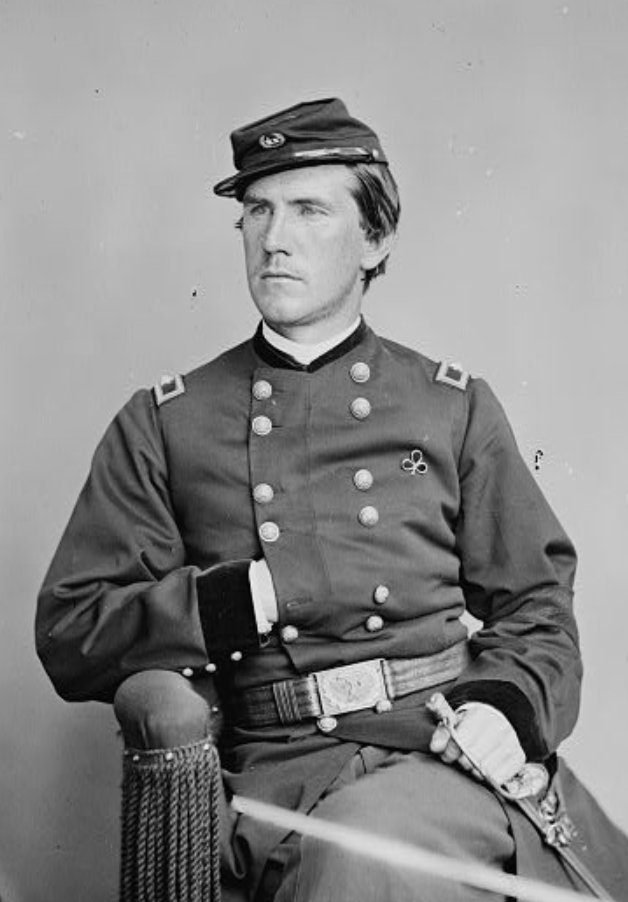
Col. Clinton D. McDougal, 111th NY Inf. (a.k.a “Fight to the Last McDougal”)

One week ago last Sunday, the news came to camp that our cavalry pickets had been driven in and that there was a great danger of an attack by a strong force. The Bloody 111th—as it is often called—was ordered to the field. We were loaded with 80 rounds of cartridges and drawn up in line. A corporal had to be detailed from each company for color guard. In our company, the lot fell on me. The most I had to regret was that I could not fire my piece unless by special order, thus depriving mr of the privilege of killing some one. After our line was formed in camp, our chaplain offered a prayer and our Colonel, C[linton] D. McDougal told us, we were going as he supposed to meet the enemy and he expected every man to fight to the last.

When we arrived at our picket line, they were much surprised and would have been equally surprised had the rebs made their appearance. We were placed in the best defensive manner possible and ordered to remain silent without fires. It was cold and we marched fast and got sweaty. It was rather tough. We had the privilege of laying down on the ground without any blankets but that was cold and frozen. No warm bed was there beside which to kneel with a little loving brother. No loving Mother’s hand was there to tuck the clothes around us. But God was there and those who trusted in him found comfort. We were not disturbed and the next day we went on picket in place of the 27th Maine Regiment.

We had been there two days when Elmira came to see me. She said it was about two weeks since she left home and that she had been all the time looking for me. I went back to camp with her. She gave me a satchel of good things that you sent to me and said that… [rest of letter is missing]

1862: George Richmond to Sibble (Gillett) Richmond

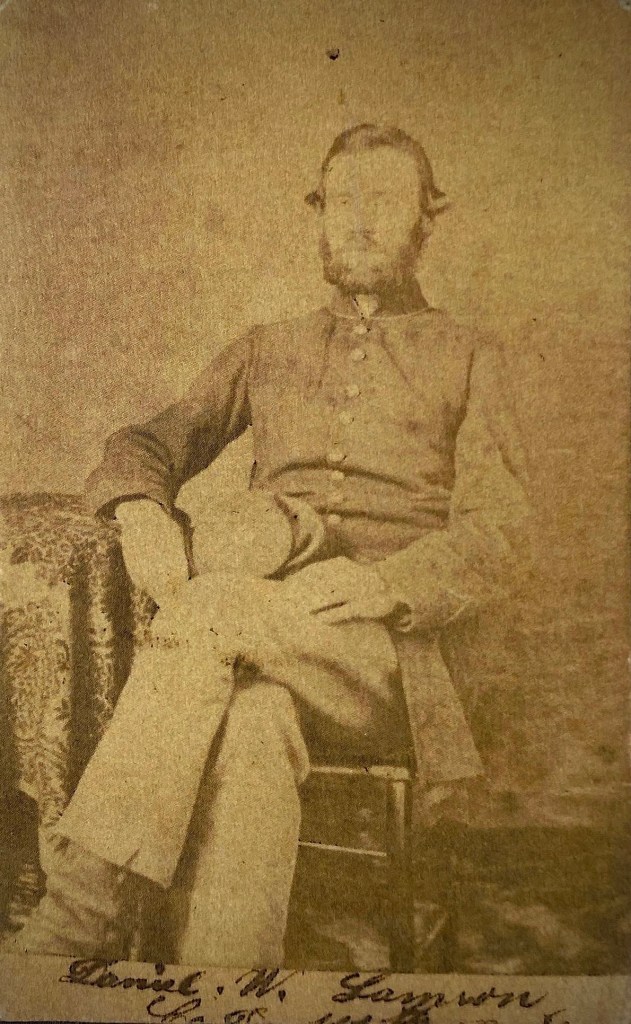
I could not find an image of George but here is Daniel W. Lamson who also served in Co. D, 111th New York. He was wounded by a shell at Gettysburg and taken captive at Cold Harbor where he would die a POW. (Cole Rutkowski Collection)

The following letter was written by 36 year-old George Richmond (1827-1863) of Sodus, New York, who enlisted on 28 July 1862 to serve three years as a private in Co. D, 111th New York Infantry. George wrote the letter to his wife from Camp Douglas near Chicago, Illinois, where he was a paroled prisoner of war awaiting exchange. He and most of his regiment had been taken prisoner at Harper’s Ferry when that government stronghold was surrendered to Stonewall Jackson’s men during the Maryland Campaign in September 1862. George would later be exchanged, survive two days of fighting at Gettysburg, but be wounded in action on 14 October 1863 at Bristoe Station, Virginia. According to Lieutenant Augustus Green, who was in command of Co. D at the time, George “was wounded through the calf of the left leg.” Taken from the field when the regiment retreated closer to Washington, DC, George was admitted to the Grosvenor Branch Hospital (Lee-Fendall House) in Alexandria. It was there that he died of traumatic gangrene on October 21st.

George’s wife was Sibble Gillett (1818-1883). When he left to join the 111th, George and Sibble had two living children—Samuel S. Richmond (1854-1926) and Harry O. Richmond (1857-1903). Two other children died young.

Transcription

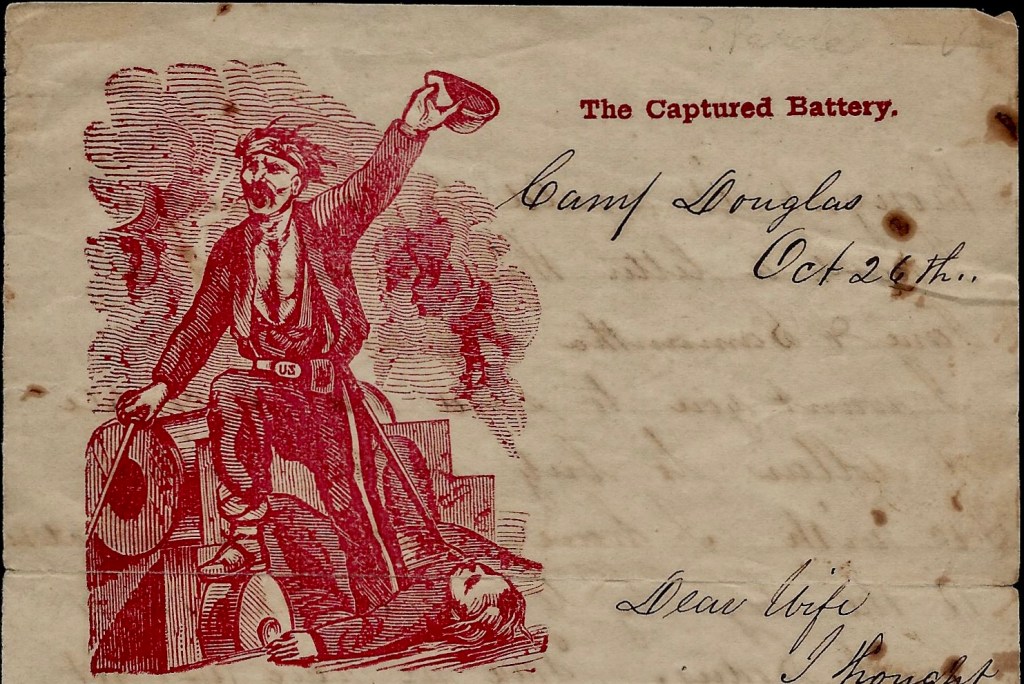
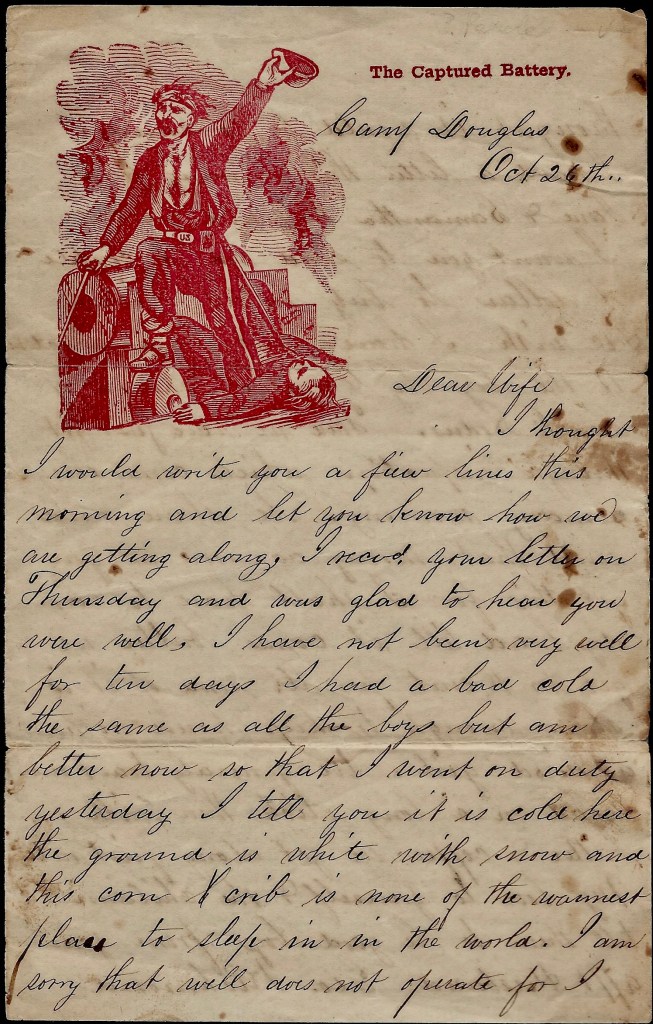
Patriotic Stationery “The Captured Battery”

Camp Douglas [near Chicago, Illinois]
Oct 26th [1862]

Dear Wife,

I thought I would write you a few lines this morning and let you know how we are getting along. I received your letter on Thursday and was glad to hear you were well. I have not been very well for ten days. I had a bad cold the same as all the boys but am better now so that I went on duty yesterday. I tell you, it is cold here. The ground is white with snow and this corn crib is none of the warmest place to sleep in the world. I am sorry that well does not operate for I thought it would be so handy.

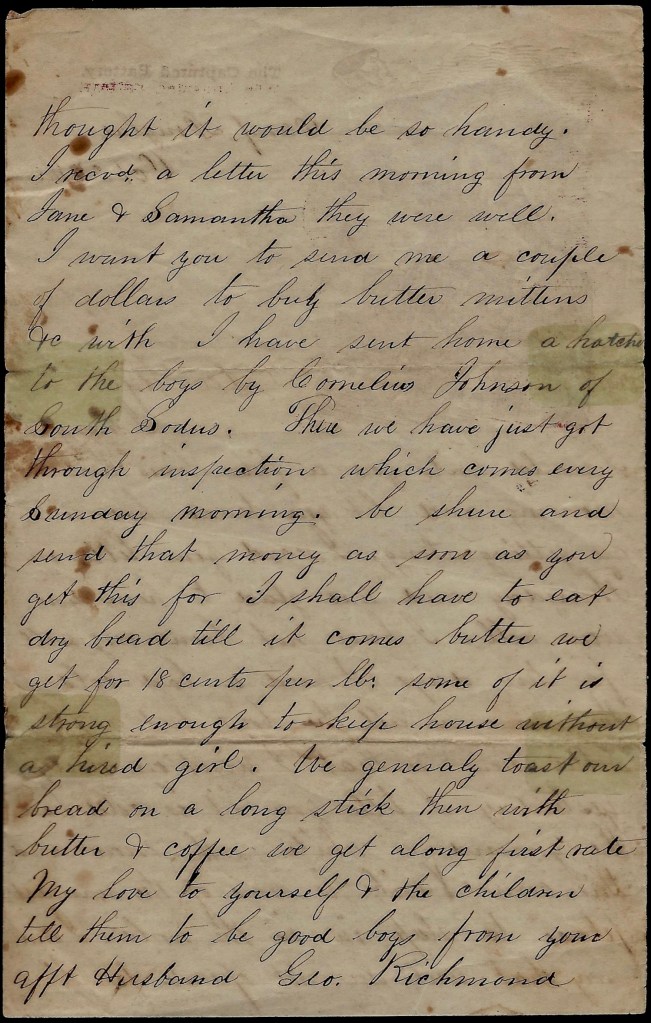
I received a letter this morning from Jane & Samantha. They were well.

I want you to send me a couple of dollars to buy butter, mittens, &c. with. I have sent home a hatchet to the boys by Cornelius Johnson of South Sodus.

There, we have just got through inspection which comes every Sunday morning. Be sure and send that money as soon as you get this for I shall have to eat dry bread till it comes. Butter we get for 18 cents per lb. Some of it is strong enough to keep house without a hired girl. We generally toast our bread on a long stick, then with butter & coffee, we get along first rate.

My love to yourself & the children. Tell them to be good boys. From your affectionate husband, — George Richmond

1863: John Balch to Holland Balch

The following letters were written by John Balch (1843-1916), the son of Ira Balch (1796-1861) and Margaret Baker (1804-1864) of Sodus, Wayne county, New York. He wrote the letter to his much older brother, Holland Balch (1825-1898).

In August 1862, when he was 19 years old, John enlisted as a private in Co. E, 111th New York Infantry. He was survived the war and mustered out with his company in June 1865 but was wounded in the fighting at Gettysburg in July 1863 and was absent from the regiment for a time. Eight of the regiment’s ten companies (totaling 390 men) fought at Gettysburg late in the day on 2 July in the charge of Willard’s Brigade against Barksdale’s Mississippians. This successful charge helped to erase the sobriquet “Harper’s Ferry Cowards” that had previously been applied to them.

In one of his letters, John mentions artillery shelling that reminded him of Harper’s Ferry. It was at Harper’s Ferry in September 1862 that the 111th New York first came under fire. They were among the Union troops surrendered there and sent to Camp Douglas in Chicago to await exchange. When they were returned to duty, they were posted as pickets near Centerville, Virginia, where both of these letters were written.

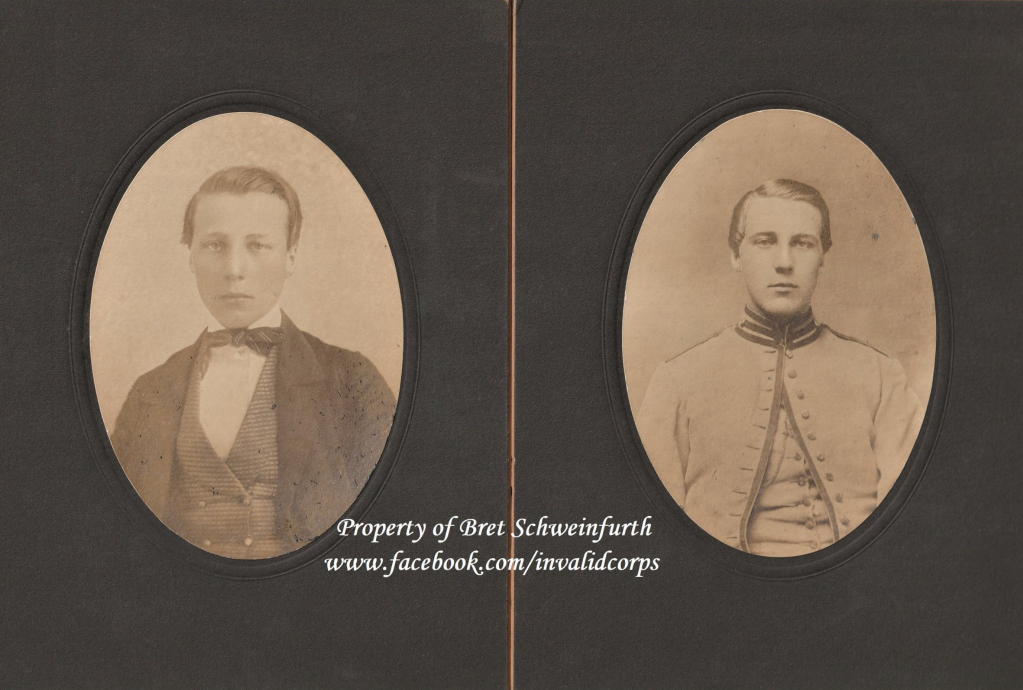
I could not find an image of John Balch but here is James Coons, who also served in Co. E, 111th New York Infantry. James was later transferred to 132nd Veteran Reserve Corps. (Bret Schweinfurth Collection)

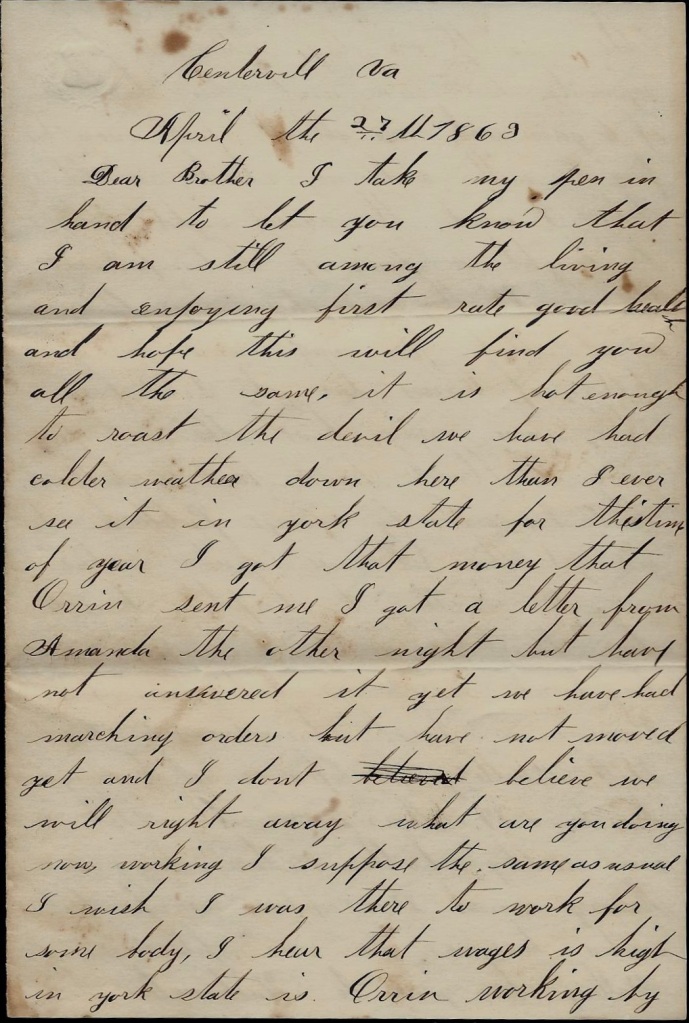
Letter 1

Centerville [Virginia]
April 27, 1863

Dear Brother,

I take my pen in hand to let you know that I am still among the living and enjoying first rate good health and hope this will find you all the same. It is hot enough to roast the devil. We have had colder weather down here that I ever see it in York State for this time of year.

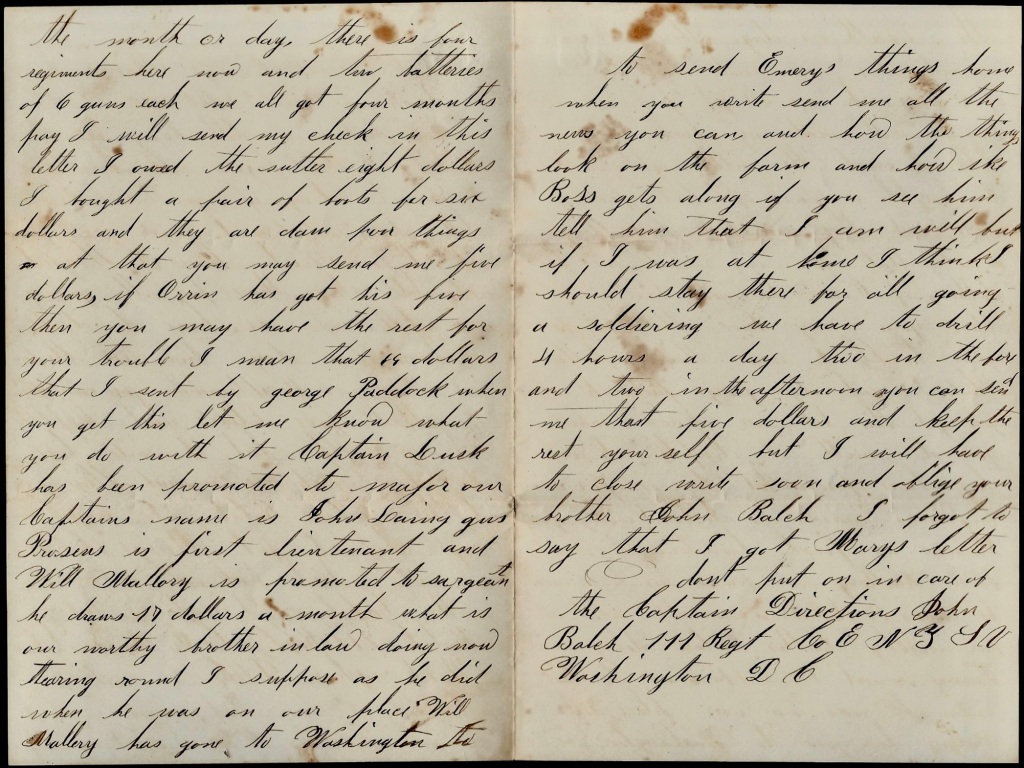
I got that money that Orrin sent me. I got a letter from Amanda the other night but have not answered it yet. We have had marching orders but have not moved yet and I don’t believe we will right away.

What are you doing now? Working, I suppose, the same as usual. I wish I was there to work for somebody. I hear that wages is high in York State. Is Orrin working by the month or day?

There is four regiments here now and two batteries of six guns each. We all got four month’s pay. I will send my check in this letter. I owed the sutler eight dollars. I bought a pair of boots for six dollars and they are damn poor things at that. You may send me five dollars. If Orrin has got his five, then you may have the rest for your trouble. I mean that 14 dollars that I sent by George Paddock. When you get this, let me know what you do with it.

Captain [Isaac M.] Lusk has been promoted to Major. Our captain’s name is John [A.] Laing. Gus Proseus is 1st Lieutenant and Will Mallery is promoted to sergeant. He draws 17 dollars a month. What is our worthy brother-in-law doing now? Tearing around, I suppose, as he did when he was on our place. Will Mallery has gone to Washington to send Emery’s things home. When you write, send me all the news you can and how the things look on the farm and how Ike Boss gets along. If you see him, tell him that I am well but if I was at home I think I should stay there for all going a soldiering. We have to drill four hours a day, two in the fore and two in the afternoon.

You can send me that five dollars and keep the rest yourself. But I will have to close. Write soon and oblige your brother, — John Balch

I forgot to say that I got Mary’s letter. Don’t put on in care of the Captain.

Directions: John Balch, 111th Regt. Co. E, N. Y. S. V., Washington D. C.


Letter 2

Centerville, Virginia
May 22, 1863

Dear Brother,

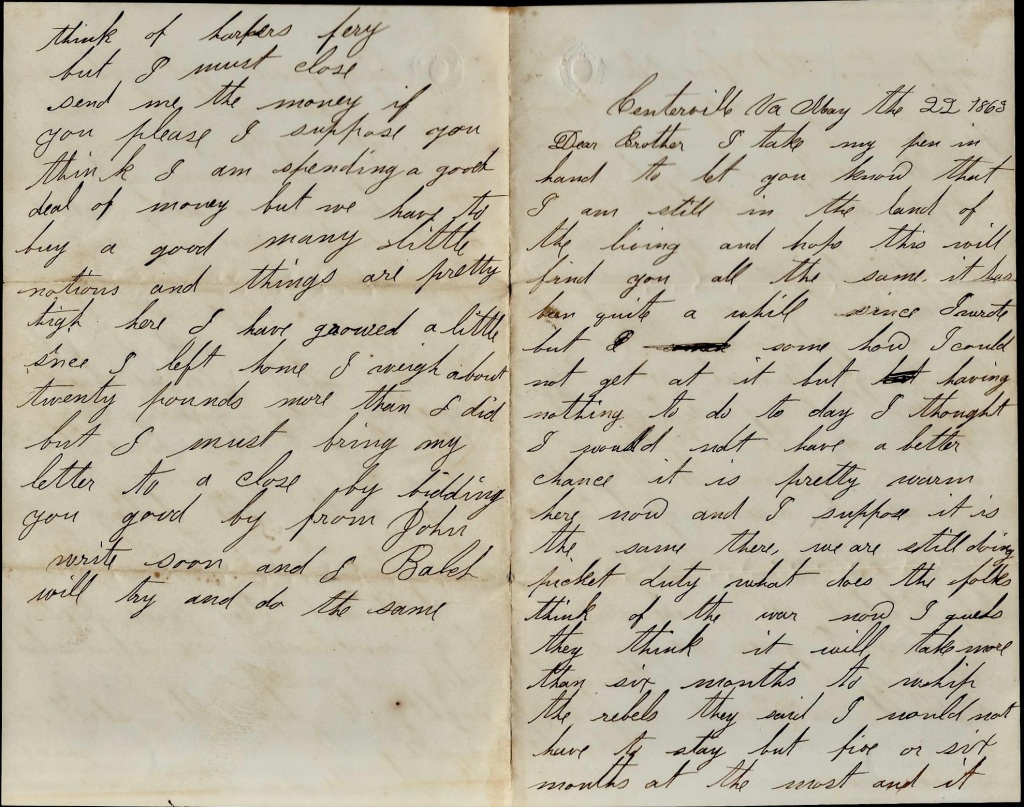
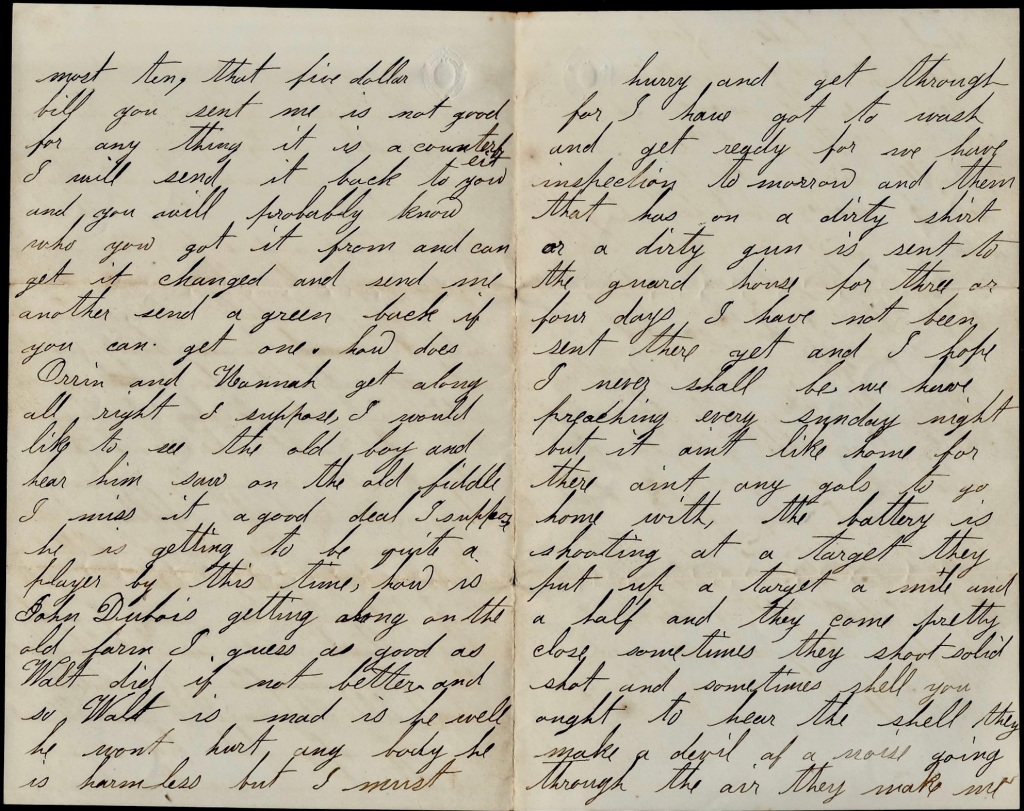
I take my pen in hand to let you know that I am still in the land of the living and hope this will find you all the same. It has been quite a while since I wrote but somehow I could not get at it. But having nothing to do today, I thought I would not have a better chance. It is pretty warm here now and I suppose it is the same there. We are still doing picket duty.

What does the folks think of the war now? I guess they think it will take more than six months to whip the rebels. They said I would not have to stay but five or six months at the most ten.

That five dollar bill you sent me is not good for anything. it is a counterfeit. I will send it back to you and you will probably know who you got it from and can get it changed and send me another. Send a green back if you can get one.

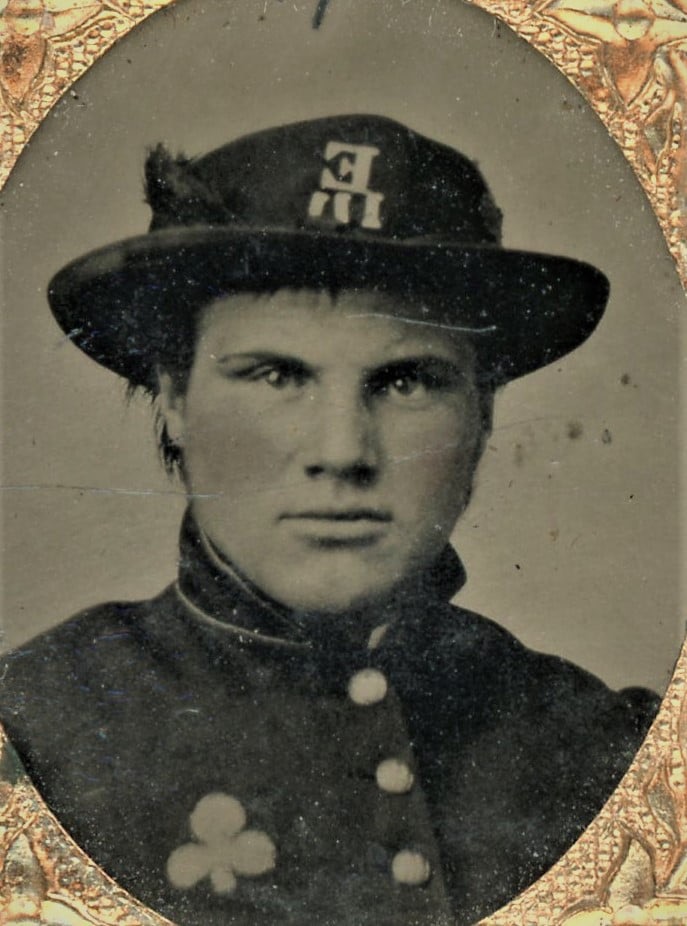
An unidentified soldier from Co. E, 111th New York Infantry (Dick Valentinetti Collection)

How does Orrin and Hannah get along? All right, I suppose. I would like to see the old boy and hear him saw on the old fiddle. I miss it a good deal. I suppose he is getting to be quite a player by this time. How is John Dubois getting along on the old farm? I guess as good as Walt did, if not better. And so Walt is made, is he? Well he won’t hurt anybody. He is harmless.

But I must hurry and get through for I have got to wash and get ready for we have inspection tomorrow and them that has on a dirty shirt or a dirty gun is sent to the guard house for three or four days. I have not been sent there yet and I hope I never shall be. We have preaching every Sunday night but it ain’t like home for there ain’t any gals to go home with.

The battery is shooting at a target. They put up a target a mile and a half and they come pretty close sometimes. You ought to hear the shells. They make a devil of a noise going through the air. They make me think of Harper’s Ferry. But I must close.

Send me the money if you please. I suppose you think I am spending a good deal of money but we have to buy a god many little notions and things are pretty high here. I have growed a little since I left home. I weigh about twenty pounds more than I did but I must bring my letter to a close by bidding you goodbye from, — John Balch

Write soon and I will try and do the same.

1862: Edward Seymour Holcomb to Harriet M. Holcomb

Edward’s grave or cenotaph.

The following letter was written by Edward Seymour Holcomb (1826-1865) of Williamson, New York, who enlisted at the age of 35 to serve three years in Co. E, 111th New York Regiment on 12 August 1862. He was later transferred to Co. B, 12th Veteran Reserve Corps and discharged from the service on 22 March 1865 at the Armory Square Hospital in Washington D. C., but died of disease before leaving the hospital. He was buried at Arlington according to their records; another source says his body was sent home.

In his letter, Edward describes the journey from Auburn, New York, to Harper’s Ferry where they arrived just some two or three weeks after they were mustered into service, with little or no drilling to prepare them for duty. Being at Harper’s Ferry, they were one of the unfortunate regiments surrendered to Stonewall Jackson’s men the following month when Lee made his invasion into Maryland. The men were paroled at Camp Douglas, Chicago, and in Dec., 1862, were declared exchanged and went into winter quarters at Centerville, Va. 

Edward was the son of Chester Holcomb (1804-1865) and Catherine Beebe (1800-1841.

Transcription

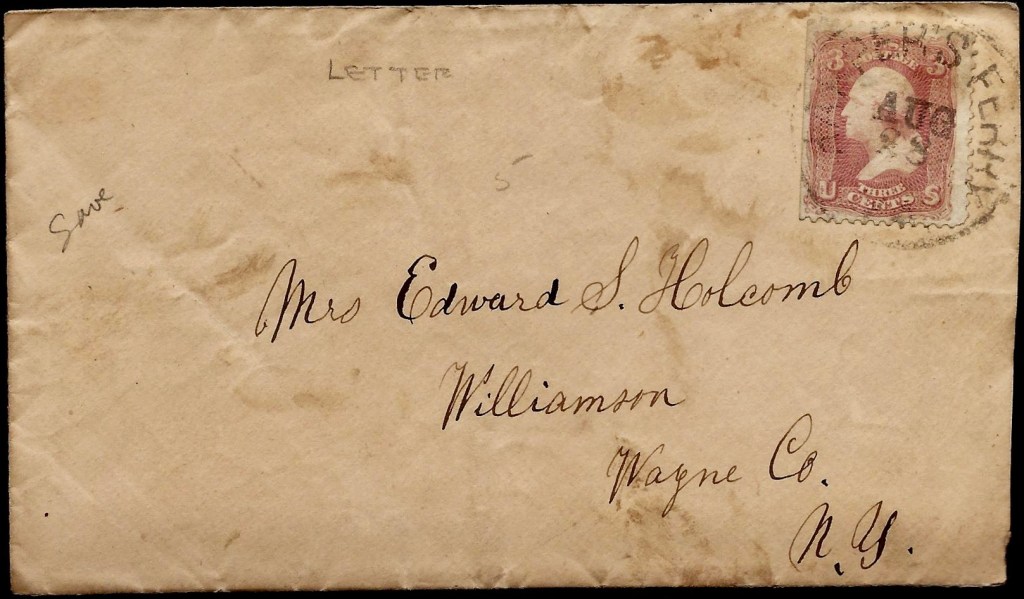
Addressed to Mrs. Edward S. Holcomb, Williamson, Wayne county, New York

Camp Halleck near Auburn
August 19th 1862

My dear wife,

have sent you by the hand of Mr. Stanton of Marion seventy-five dollars and the key to the satchel on a ring with another key. I expect now I shall have to send the satchel by Express. Have not received our 13 & 2 dollars yet. Expect it every moment by Mr. Standton is ready to go. I will send you more by mail.

I want two of those coarse shirts, the small ones, but how can I get them & there are lots of things I want but must go without.

5 o’clock. Well we have received thirteen dollars more in United States bills everybody that can is here today. Colonels, Adjutants, Commissioners, & I do not know what else among the rest.

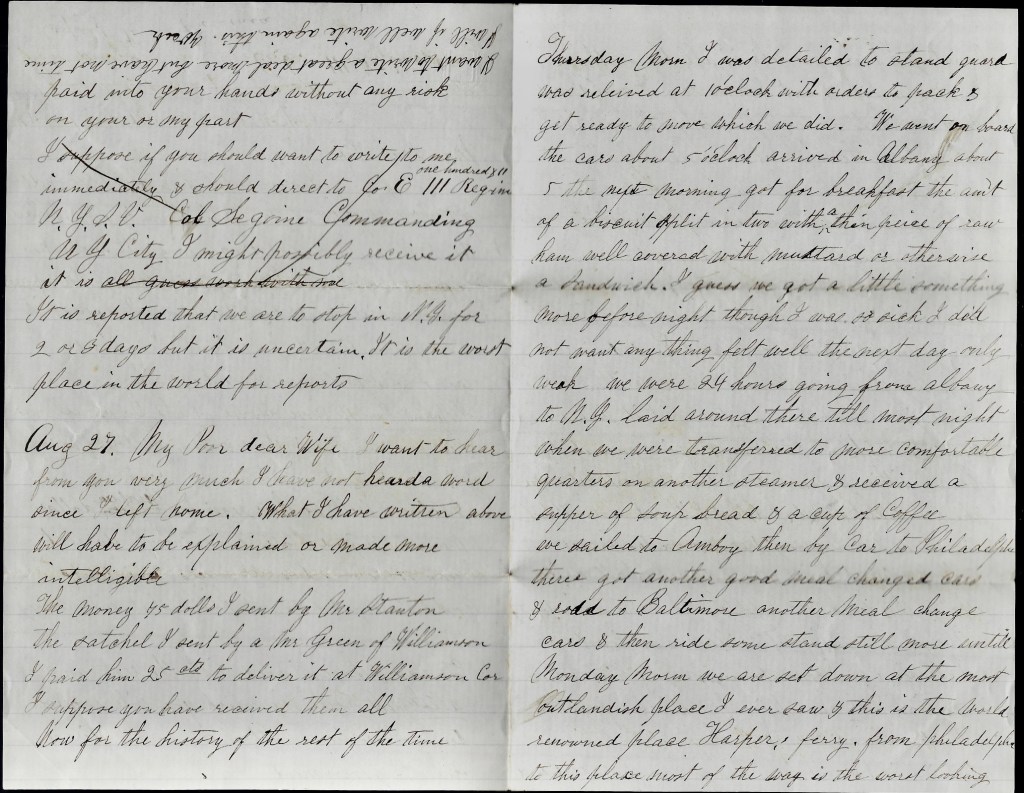
Today I have signed with the rest an allotment roll by which you will receive ten dollars per month of my wages direct from the government paid into your hands without any risk on your or my part.

It is reported that we are to stop in New York [City] for two or three days but it is uncertain. It is the worst place in the world for reports.

August 27. My poor dear wife, I want to hear from you very much. I have not heard a word since I left home. What I have written above will have to be explained or made more intelligible.

The money 75 dollars I sent by Mr. Stanton, the satchel I sent by a Mr. Green of Williamson. I paid his 25 cents to deliver it to Williamson Cor. I suppose you have received them all.

Now for the history of the rest of the time. Thursday morn I was detailed to stand guard. Was relieved at 1o’clock with orders to pack and be ready to move which we did. We went on board the cars about 5 o’clock, arrived at Albany about 5, the next morning got for breakfast the amount of a biscuit split in two with a thin piece of raw ham, well covered with mustard or otherwise a sandwich. I guess we got a little something more before night though I was so sick I did not want anything. Felt well the next day—only weak.

We were 24 hours going from Albany to New York [City], laid around there till most night, when we were transferred to more comfortable quarters on another steamer & received a supper of soup, bread, and a cup of coffee. We sailed to Amboy, then by cars to Philadelphia. There we got another good meal, changed cars, and rode to Baltimore. Another meal, change cars, and then ride some, stand still more, until Monday morn we are set down at the most outlandish place I ever saw & this is the world renowned place, Harper’s Ferry. From Philadelphia to this place most of the way is the worst looking country I ever saw. Why, if all the southerner’s country is like what I have seen, I would not pay one half of the expenses of the war if I could have the whole of it—negroes and all.

Well, to sum up. We came from Auburn here starting Thursday towards night and getting into our camping ground Monday afternoon, following receiving some days one and some[times] two meals a day. There is probably a great glory in war but I say good Lord, deliver me from the glory.

Perhaps I have written too much in a complaining tone but it makes me mad to think of—500 men staying on a dirty barge within a few rods of the largest city on the continent all day without a mouthful to eat, or I should say 1,000 men on two barges. Well, I cannot write all today. I shall write again this week & I hope to make a more interesting letter or a more intelligible one at least. I shall send you some money in my next letter if nothing happens.

Kiss the children for me & keep up good courage. I shall come home in the spring if I do not before, I hope. Yours affectionately, — Edward

Direct to E. S. H., Co. E, 111th [New York] Regiment, Harper’s Ferry, Virginia