
These letters were written by Dr. Alonzo Harlow (1811-1888), an 1851 graduate of Allegheny College, Pennsylvania, who was practicing medicine in Chagrin Falls, Cuyahoga county, Ohio in 1860 when he enlisted to serve as the assistant surgeon of the 113th Ohio Volunteer Infantry (OVI). He was in the service from 1 September 1862 until 11 May 1863 when he resigned. After leaving the service, he practiced medicine in Detroit.
Dr. Harlow informs us that his reason for resigning was “ostensibly” for poor health but clearly there was another reason that likely had to do with personnel issues. Since he and other asst. surgeons all resigned in the spring and summer of 1863, my hunch is that he and others had difficulty working under the direction of Surgeon James Rush Black (1827-1895) who resigned himself in July 1863.
He wrote all three letters to his friend and former comrade in the 113th OVI, Capt. David Taylor (1837-1919) who was severely injured in an accident in February 1863 and was sent home to Ohio to recuperate but he never fully recovered.
Letter 1
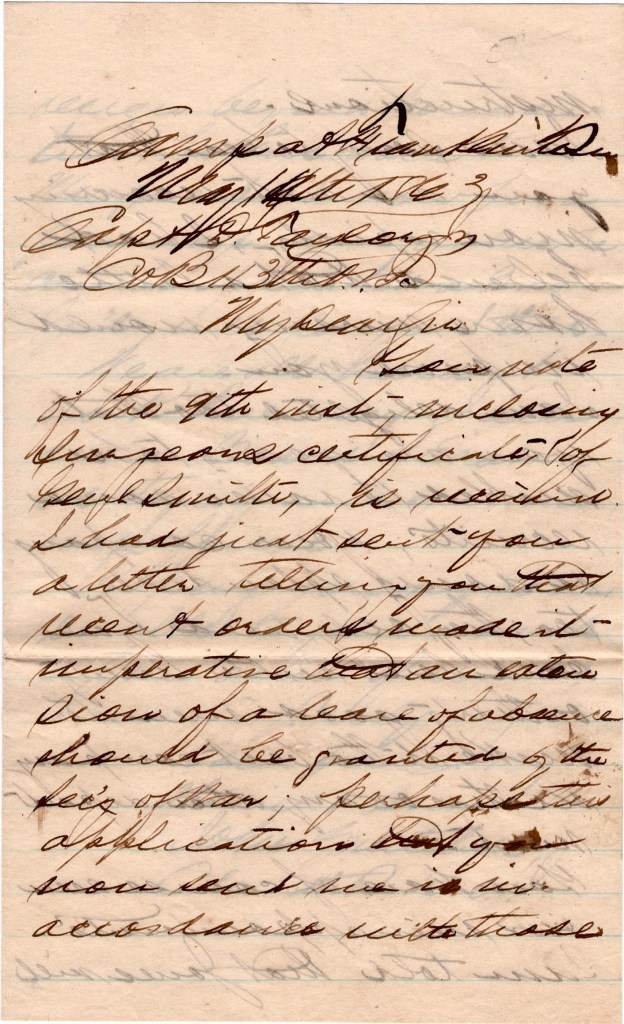
Camp at Franklin, Tennessee
May 12, 1863
My dear captain,
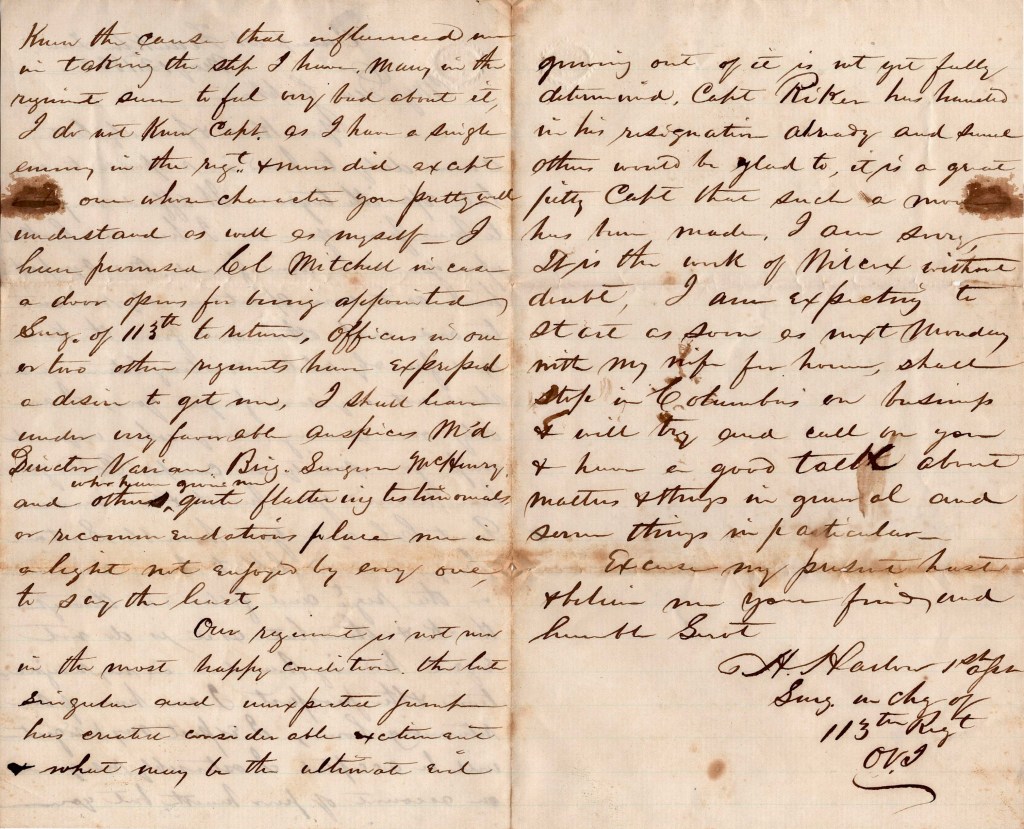
Your kind & friendly letter came duly to hand in response to my late epistle [ ]. It affords me pleasure to hear from you as I have ever looked upon you as a kind friend. Our sympathies have as it were spontaneously run out toward each other adn from the kind and friendly relation existing between us, shall not very soon forget you. I am only one among many who very much miss your society in camp. Could you have recovered your health & been made Lieut. Colonel and your humble servant Surgeon would like to have remained in the regiment and followed it through thick and thin, but as it is, do not regret having handed in my resignation & the prospect I now have of soon returning home. I expect my resignation will be accepted. I ostensibly resigned on account of poor health, but you know the cause that influenced me in taking the step I have. Many in the regiment seem to feel bad about it.
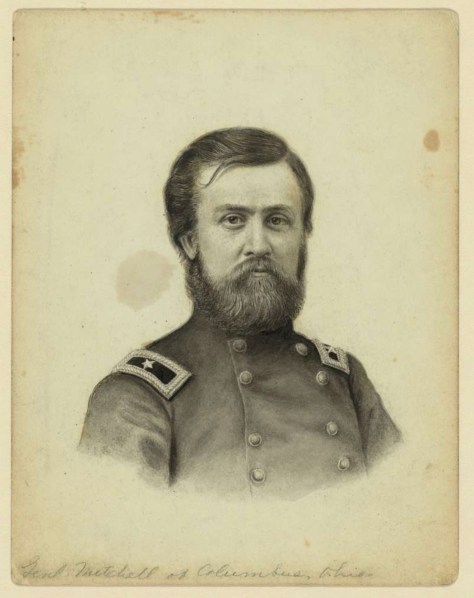
I do not know, Captain, as I have a single enemy in the regiment & never did except one whose character you pretty well understand as well as myself. I have promised Col. Mitchell in case a door opens for being appointed Surgeon of the 113th to return. Officers in one or two other regiments have expressed a desire to get me. I shall leave under very favorable auspices. Medical Director Varian Brig. Surgeon McHenry and others who have given me quite flattering testimonials or recommendations place me in a light not enjoyed by everyone to say the least.
Our regiment is not now in the most happy condition. The late singular and unexpected jump has created considerable excitement. What may be the ultimate evil out of it is not yet fully determined. Capt. Riker has handed in his resignation already and several others would be glad to do it. It is a great pity, Captain, that such a move has been made. I am sorry. It is the work of Wilcox without doubt.
I am expecting to start as soon as next Monday with my wife for home. Shall stop in Columbus on business & will try and call on you & have a good talk about matters and things in general and some things in particular.
Excuse my present haste and believe me your friend and humble servant. —A. Harlow, Asst. Surgeon in charge of 113th Regt. O. V. I.

Letter 2
Chagrin Falls, [Ohio]
July 21, 1863
Dear Capt.
After waiting some little time, will attempt to respond to yours of 2nd instant hoping these few hasty lines may find you in the enjoyment of improved health and strength preparatory to the girding on the sword and entering the field to meet the foe of our land. Things look much brighter and more prosperous than when I last wrote you and the prospect is certainly quite flattering for a speedy termination of this rebellion.
We can now rejoice over and celebrate the capture of Vicksburg and many other places in reality. Would it not been quite a glorious achievement if Meade had taken old Lee’s army as there was once a good prospect? It seems that Morgan is completely routed and scattered with his force and one thousand of them at least taken prisoners. It certainly is to be hoped that he & the balance may never be permitted to get over the Ohio River again.
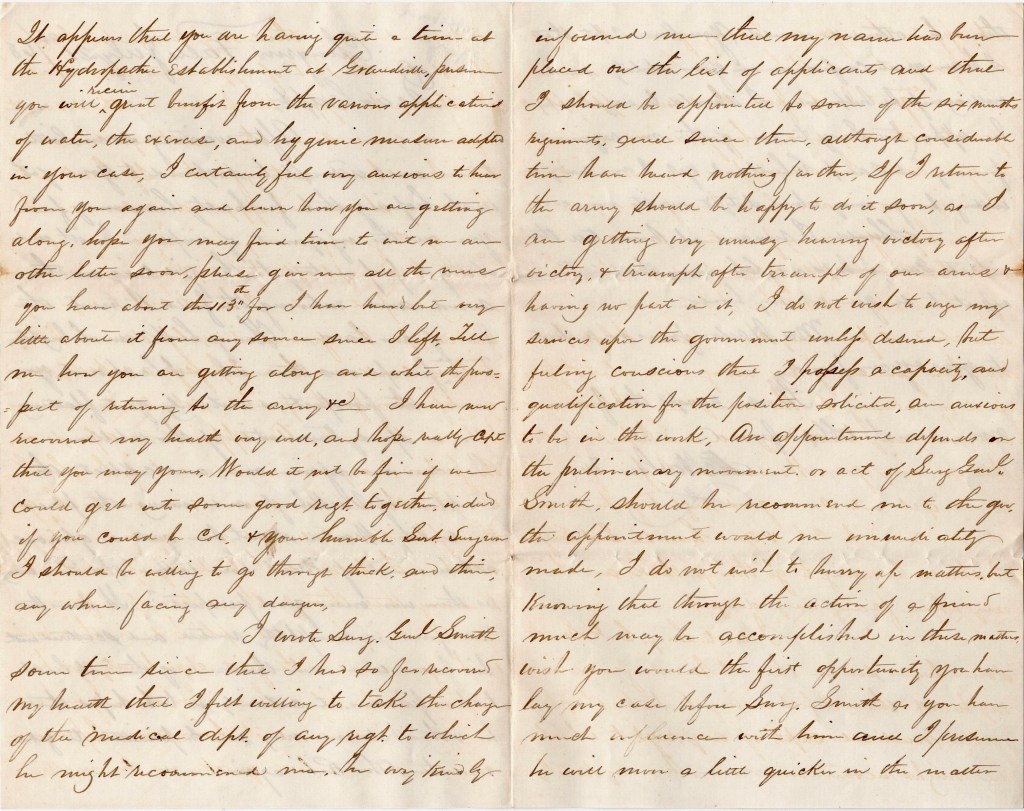
It appears that you are having quite a time at the Hydropathic Establishment at Granville. Presume you will receive great benefit from the various applications of water, the exercise, and hygienic measure adopted in your case.

I certainly feel very anxious to hear from you again and learn how you are getting along. Hope you find time to write me another letter soon. Please give me al lthe news you have about the 113th OVI for I have heard but very little about it from any since I left. Tell me how you are getting along and what the prospect of returning to the army, &c. I have now recovered my health very well and hope, really Captain, that you may yours. Would it not be fine if we could get into some good regiment together. Indeed, if you could be Colonel & your humble servant Surgeon, I should be willing to go through thick and thin, anywhere, facing any danger.
I write Surgeon General Smith some time since that I had so far recovered my health that I felt willing to take charge of the Medical Department of any regiment to which he might recommend me. He very kindly informed me that my name had been placed on the list of applications and that I should be appointed to some of the six-month’s regiments, and since then, although considerable time have heard nothing further. If I return to the army, should be happy to do it soon as I am getting very uneasy hearing victory after victory, and triumph after triumph of our arms & having no part in it. I do not wish to urge my services upon the government unless desired, but feeling conscious that I possess a capacity and qualification for the position solicited, am anxious to be in the work.
An appointment depends on the preliminary movement or act of Surgeon General Smith. Should he recommend me to the Governor, the appointment would be immediately made. I do not wish to hurry up matters but knowing that through the action of a friend much may be accomplished in these matters, which you would the first opportunity you have, lay my case before Surgeon Smith as you have much influence with him and I presume he will move a little quicker in the matter than he otherwise would. You know, Captain, that I have great confidence in your ability and willingness to help me. I should be very happy to be appointed Surgeon to one of the new regiments forming at Camp Cleveland yet I am ready & willing to go anywhere duty and necessity may call.
Should I remain at home till the State Fair is held in Cleveland, shall certainly expect to see you at my house. Mrs. Harlan joins in respects to you and your family. Please accept this from you much obliged friend, — A. Harlow, M. D.

Letter 3
Detroit [Michigan]
May 23, 1864
My dear Captain & Friend,
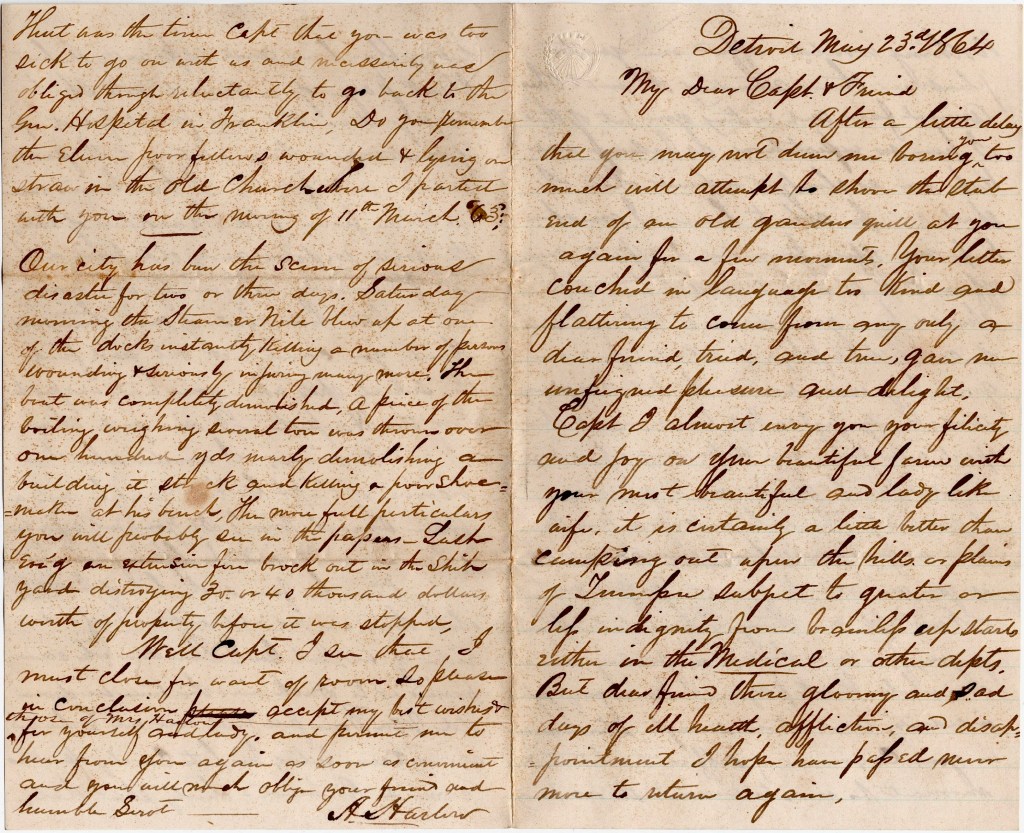
After a little delay that you may not deem me boring you too much, will attempt to show the stub end of an old gander’s quill at you again for a few moments. Your letter couched in language too kind and flattering to come from any only a dear friend, tried and true, gave me unfeigned pleasure and delight. Captain, I almost envy your felicity and joy on your beautiful and lady-like wife. It is certainly a little better than camping out upon the hills or plains of Tennessee subject to greater or less indignity from brainless up starts either in the Medical or other departments. But dear friend, these gloomy and sad days of ill health, affliction, and disappointment I hope have passed never more to return again.
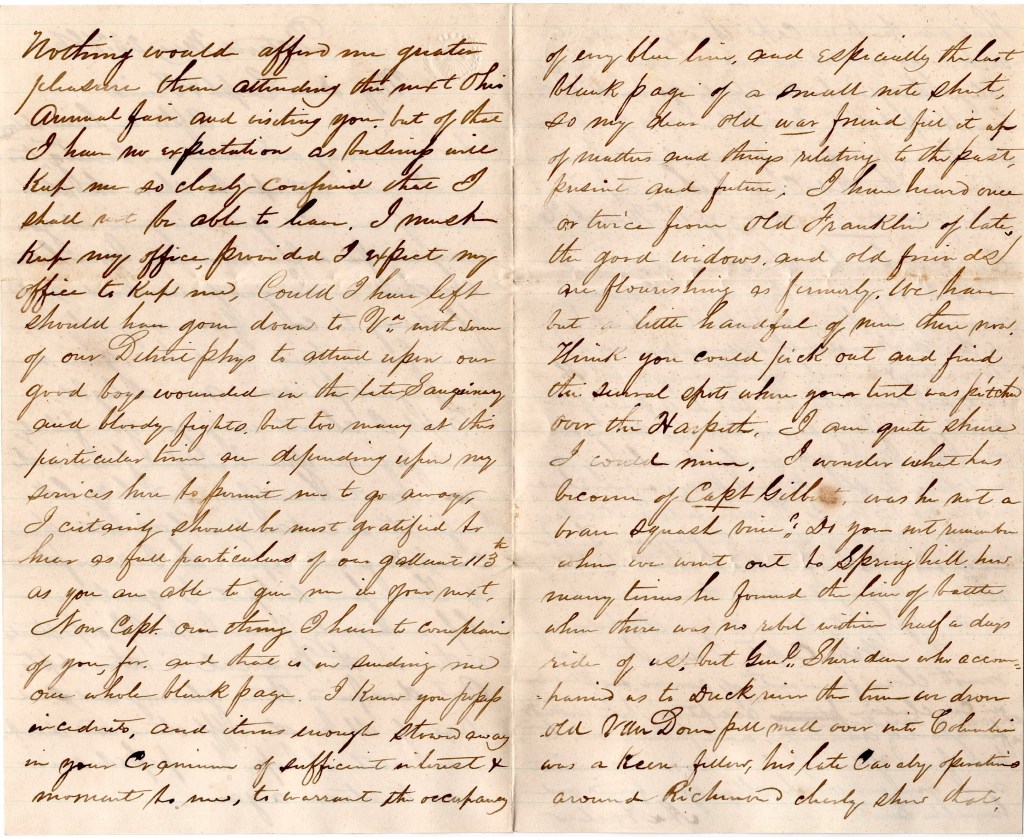
Nothing would afford me greater pleasure than attending the next Ohio Annual Fair and visiting you but of this I have no expectation as business will keep me so closely confined that I shall not be able to leave. I must keep my office, provided I expect my office to keep me. Could I have left, should have gone down to Virginia with some of our Detroit physicians to attend upon our good boys wounded in the late sanguinary and bloody fights but too many at this particular time are depending upon my services here to permit me to go away. I certainly should be most gratified to hear as full particulars of our gallant 113th as you are able to give me in your next.
Now Captain, one thing I have to complain of you for and that is in sending me one whole blank page. I know you possess incidents and items enough stowed away in your cranium of sufficient interest & moment to me, to warrant the occupancy of every blue line and especially the last blank page of a small note sheet. So my dear old war friend, fill it up of matters and things relating to the past, present, and future. I have heard once or twice from Old Franklin [Tennessee] of late, the good widows and old friends are flourishing as formerly. We have but a little handful of men there now. Think you could pick out and find the several spots where your tent was pitched over the Harpeth. I am quite sure I could mine.
I wonder what has become of Capt. [Charles Champion] Gilbert? Was he not a brain squash vine? Do you not remember when we went out to Spring Hill how many times he found the line of battle when there was no rebel within half a day’s ride of us? But General Sheridan who accompanied us to Duck River the time we drove old Van Dorn pell mell over into Columbia was a keen fellow. His late cavalry operations around Richmond clearly shows that. That was the time, Captain, that you was too sick to go out with us and necessarily was obliged though reluctantly to go back to the General Hospital in Franklin. Do you remember the eleven poor fellows wounded and lying on straw in the Old Church where I parted with you on the morning of the 11th March ’63.

Our city has been the scene of serious disaster for two or three days. Saturday morning the steamer Nile blew up at one of the docks, instantly killing a number of persons, wounding and seriously injuring many more. The boat was completely demolished. A piece of the boiler weighing several ton was thrown over one hundred yards nearly demolishing a building it struck and killing a poor shoemaker at his bench. The more full particulars you will probably see in the papers. 1
Last evening an extensive fire broke out in the ship yard destroying 30 or 40 thousand dollars worth of property before it was stopped.
Well, Captain, I see that I must close for want of room so please, in conclusion, accept my best wishes & those of Mrs. Harlow for yourself and lady, and permit me to hear from you again as soon as convenient and you will much oblige your friend and humble servant, — A. Harlow
1 The wooden, 650-ton screw steamer Nile was destroyed when her boiler exploded while docked in Detroit, Michigan, on 21 May 1864. She was carrying passengers, household goods and livestock. Eight crew members were killed along with a handful of passengers. Most of the shore damage was to houses on the Canadian side of the Detroit River in Windsor, Ontario.


 Spared & Shared 23