The following letter was written by Adelbert M. Spencer (1840-1902), the son of Jeremiah and Anna (Blackstone) Spencer of Woodstock, Windham county, Connecticut. Adelbert enlisted on 25 October 1861 to serve in Co. H, 11th Connecticut Infantry. He was a private in the ranks until December 1863 when he was reassigned as a wagoner. He mustered out on 21 December 1865 at Hartford, Connecticut.
The 11th Connecticut has been with Burnside on his expedition to the Carolinas early in the war and returned to Virginia and the Army of the Potomac to participate in the Battle of Fredericksburg and the Mud March, although we learn that Adelbert avoided much of the latter by being on guard duty. Adelbert’s letter speaks of the demoralization of the army after its setbacks on the Rappahanock and of the thinning of the ranks.
Transcription
Camp near Fredericksburg, Virginia January 25, 1863
Dear Uncle,
I received a letter in Sarah’s from you and was glad to get one from you and I hope these few lines will find you well and all the rest of the folks. I am in good health but I have got tired of this humbug war and there is a good many more than I. There was two or three Corps went down to the river about six miles from the city and the pontoons, got one boat in the river and soon then got stuck in the mud so they could not get along and the Rebels happened to get their artillery planted for us and our men lost horses and broke their wagons down. They had to hitch 30 horses on one gun to get along and they found out that they could get along and the officers told their men to break ranks and they started for their camps.
The 11th [Connecticut] Regiment was on picket and we had a wet time and hain’t got our blankets dry yet. We expected to march when we got to the camp. I guess we shall have to stay here a spell. I guess that we won’t get to Richmond this winter. The Rebels blackguard our men about Burnside stuck in the mud and they told our boys that if they wanted any help, that they would come over and lay the bridge so that we could get along. It is hard work to face those breastworks. If they could come out in an open field, we could give them all they wanted.
Our army is getting small very fast. There is a good many of our men [who] desert every day and there is a good many of their times run out in the spring and then this war has got to come to a close. I wish it could be today.
I am on guard today and when I get off guard tomorrow, I will go over to the 12th [Connecticut] Regiment and see the boys. I have been thinking of going over. Is William Burdick in Greenwich. If he is, give him my best respects.
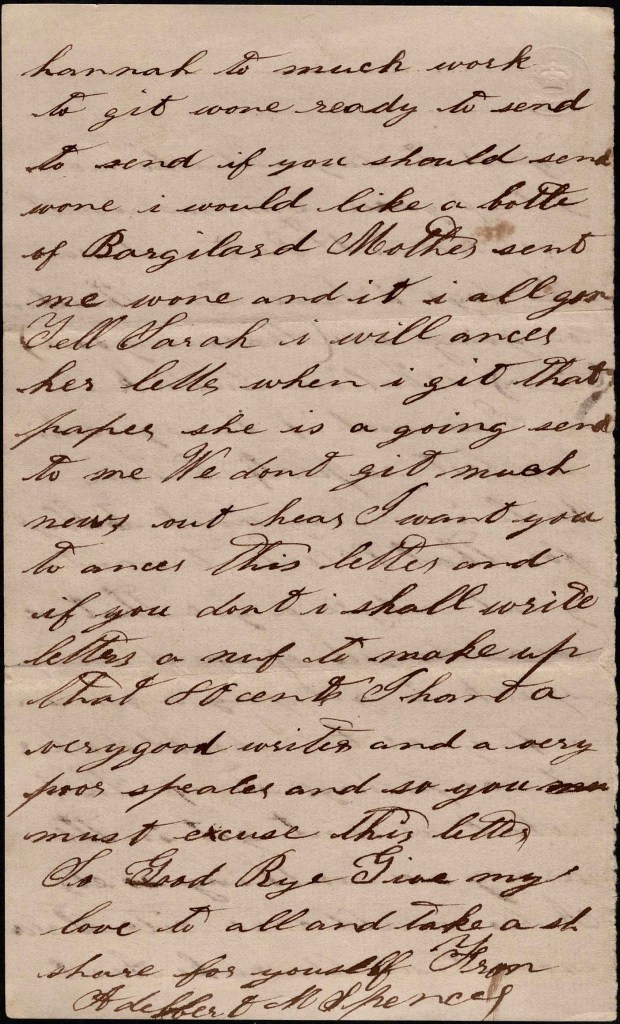
Uncle, I am very much obliged for that 80 cents. It wasn’t a great while ago that we were paid off and we expect to get pay again in a day or two. I should rather it was postage stamps. That’s what we can’t get in the army, or something else. A box would come right through now. It would make Aunt Hannah too much work to get one ready to send. If you should send one, I would like a bottle of Borgilard. Mother sent me one and it is all gone.
Tell Sarah I will answer her letter when I get that paper she is a going to send to me. We don’t get much news out here. I want you to answer this letter and if you don’t, I shall write letters enough to make up that 80 cents. I hain’t a very good writer and a very poor speller and so you must excuse this letter. So goodbye. Give my love to all and take a share for yourself. From Adelbert M. Spencer
The following letter was written by Eber L. Robinson (1828-1903), the son of Eber Robinson (1792-1863) and Alzade Lee (1807–Bef1860) of East Windsor, Hartford county, Connecticut.
Eber was 31 years old when he enlisted as a private in Co. B, 11th Connecticut Infantry. He was discharged for disability on 22 October 1862 after one year’s service.
Eber’s letter gives a description of the battle and battlefield on Roanoke Island though his regiment was not engaged in the actual fighting. The battle took place on February 7-8, 1862.
Transcription
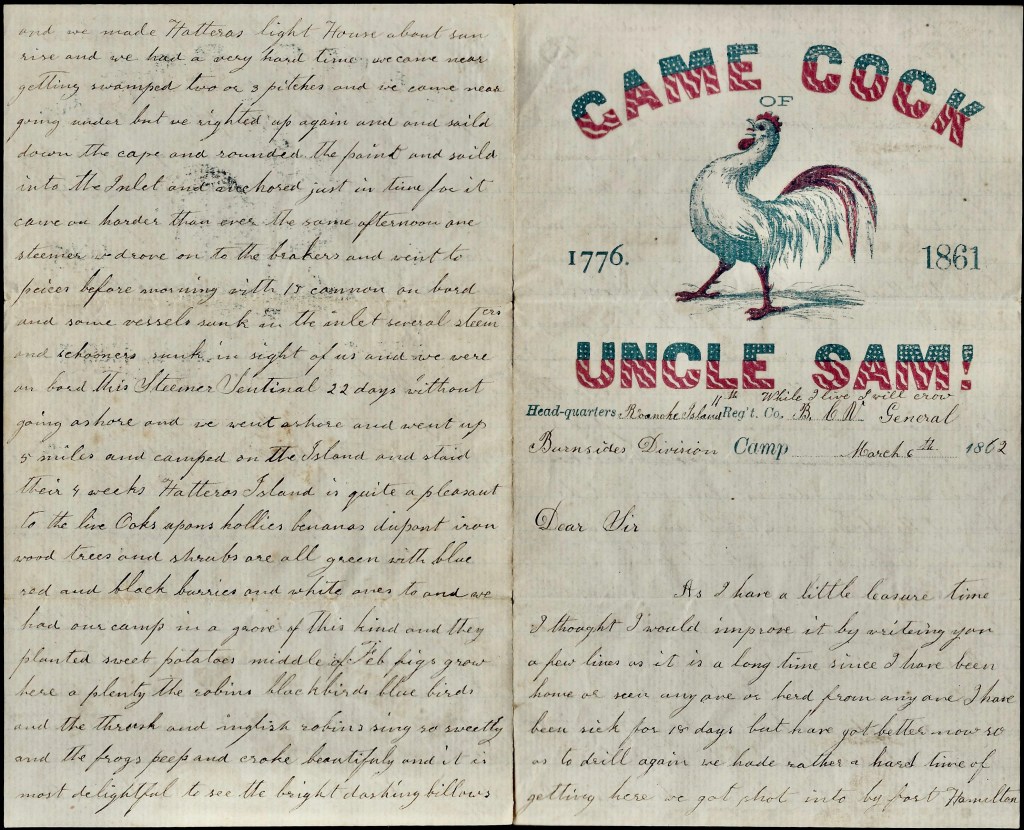
Headquarters Roanoke Island 11th Regiment, Co.B, Connecticut Vols. Gen. Burnsides Division March 6, 1862
Dear Sir,
As I have a little leisure time, I thought I would improve it by writing you a few lines as it is a long time since I have been home or seen anyone or heard from anyone. I have been sick for 18 days but have got better now so as to drill again.
We had rather a hard time of getting here. We got shot into by Fort Hamilton down below New York with a 24-pound ball 3 miles from the fort and the shot struck the steamer just under the walking beam and we went back to New York and staid till about 11 o’clock at night. Gen. Burnside and an engineer ran and pronounced it safe to go to sea and then we set sail again for Annapolis. The ball came just over the wheel house right over my head and broke the thick iron plate under the brasses and broke that and the rod that the bell hung on—an 2½ inch iron—and glanced and went through a waste box down through the deck into the state room and it was saved and weighed 24 Ibs. But it made our hair stick up, I reckon. It did not do any damage of any account. The name of the steamer is New Brunswick and its running trips was Boston to St. Johns, New Brunswick. 1
After the shot, we had a pleasant trip to Annapolis. We were 48 hours going. We landed on Thursday and went ashore Friday and went into camp and staid there 3 weeks on Maryland shores. Annapolis is a hard-looking place—abut 100 years behind the times. We had a little snow Friday before we left about 2 inches deep. The night before we left, some of the soldiers set fire to a house about 300 yards of the camp and burnt up thrashing machines, wagons, carts and the like of that, and burnt 500 bushels of corn, 5 mules and pigs and poultry and [the] loss [was] about 3 thousand dollars.
We left the next morning and went down to Fortress Monroe. We got stuck in the mud and lay all night and the next day till 2 o’clock that night and we left the New York Zouaves fast in the mud and started again for Fortress Monroe and we got in there Saturday about 4 o’clock.
We set sail again at 10 in the evening and put out to sea and sailed all the rest of the night and Sunday morning we were out [of] sight of land at sunrise and we kept sailing all day and a heavy sea and fog came on and the wind blew a gale and we fired cannon several times through the day to get some report from the rest of the fleet but herd nothing. No Sunday in war times at all.
We anchored Sunday about sundown—it was so foggy—and staid till about 2 o’clock in the morning [when] it cleared off and then we started again [although] the wind blew harder and the sea heavier than before and we made Hatteras light house about sunrise. We had a very hard time. We came near getting swamped two or 3 pitches and we came near going under, but we righted up again and sailed down the cape and rounded the point and sailed into the Inlet and anchored just in time for it came on harder than ever. The same afternoon, one steamer was drove onto the breakers and went to pieces before morning with 15 cannon on board, and some vessels sunk in the inlet. Several steamers and schooners sunk in sight of us.
We were on board this Steamer Sentinel [for] 22 days without going ashore. We went ashore and went up 5 miles and camped on the Island and staid there 4 weeks. Hatteras Island is quite a pleasant [place]. The live oaks upon holly berries, ironwood trees and shrubs are all green with blue, red, and black berries and white ones too. We had our camp in a grove of this kind and they planted sweet potatoes middle of February. Figs grow here a plenty. The robins, blackbirds, bluebirds, and the thrush and English robins sing so sweetly and the frogs peep and croak beautifully, and it is most delightful to see the bright dashing billows roll and heave. We had to go to drill on the beach and there were 7 or 8 regiments here on the Island.
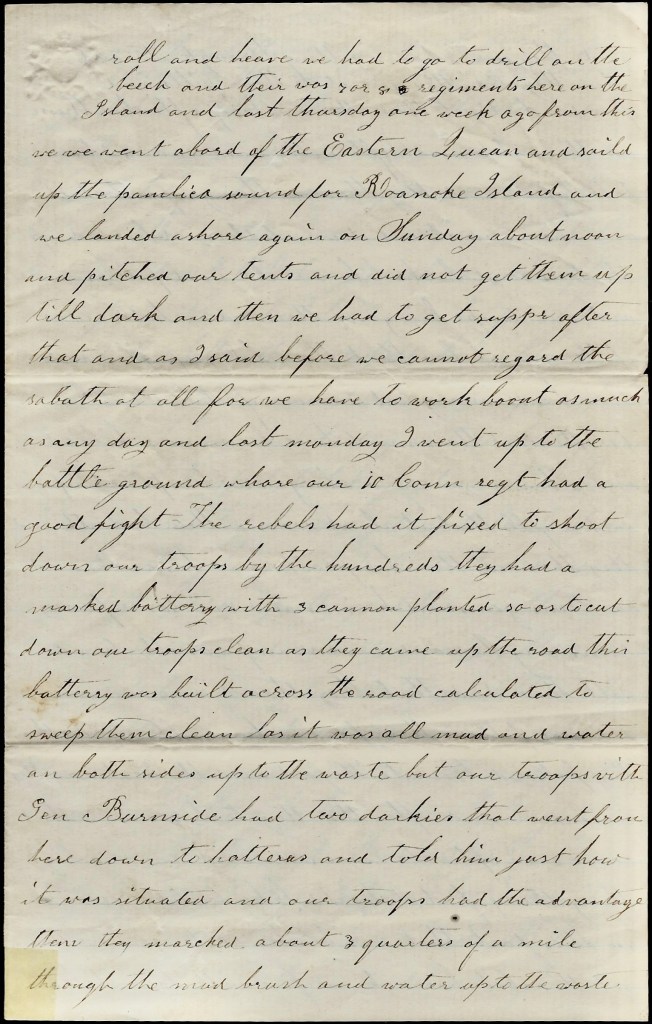
Last Thursday, one week ago from this, we went aboard of the Eastern Queen and sailed up the Pamlico Sound for Roanoke Island and we landed ashore again on Sunday about noon and pitched our tents and did not get them up till dark. Then we had to get supper after that, and as I said before, we cannot regard the Sabbath at all for we have to work about as much as any day.
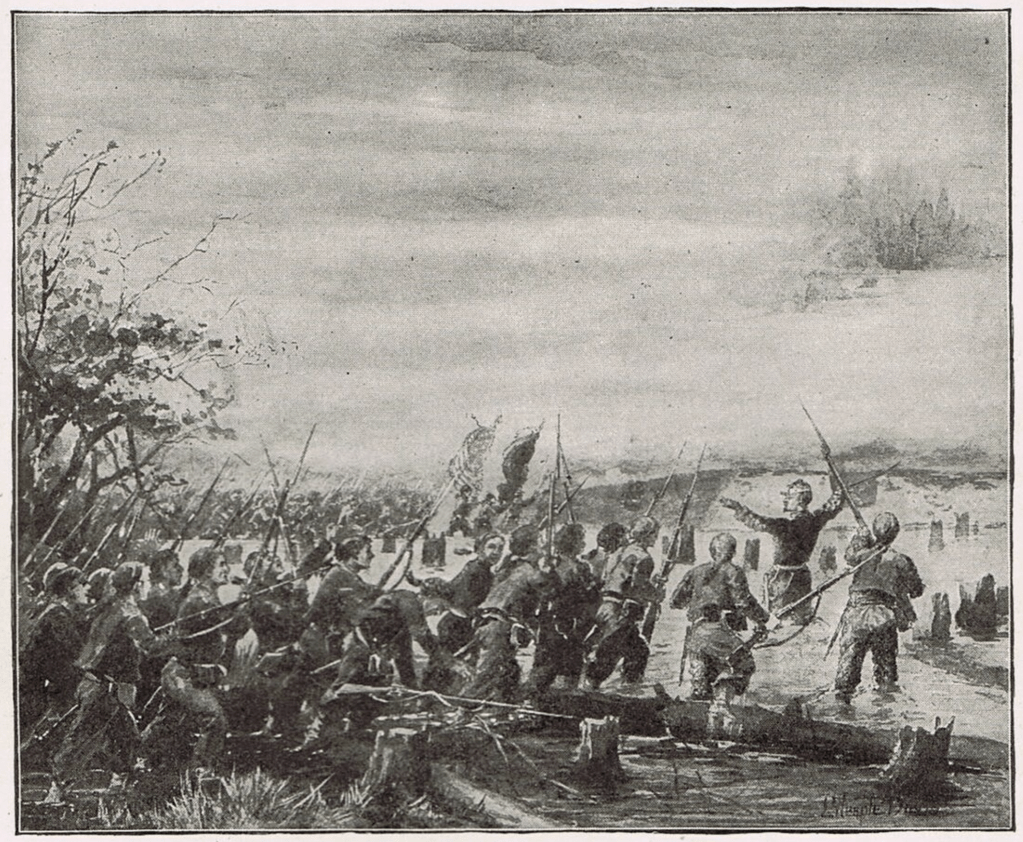
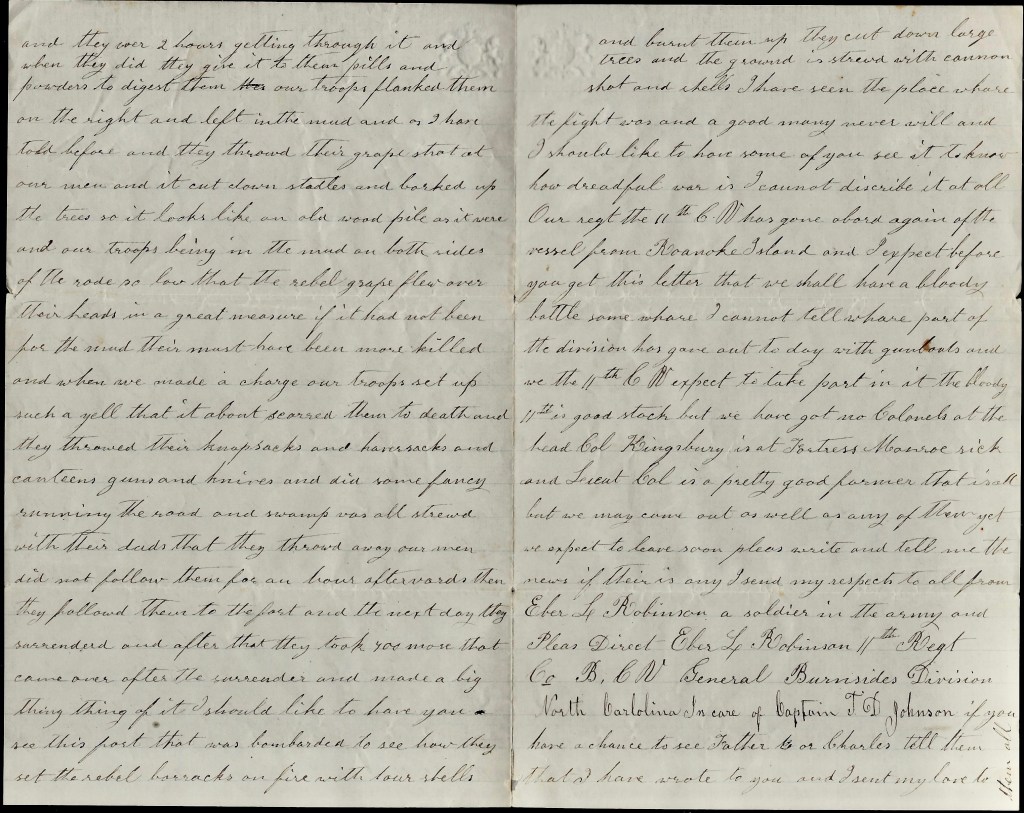
Last Monday I went up to the battle ground where our 10th Connecticut Regiment had a good fight. The rebels had it fixed to shoot down our troops by the hundreds. They had a masked battery with 3 cannon planted [on Supple’s Hill] so as to cut down our troops clean as they came up the road. This battery was built across the road calculated to sweep them clean for it was all mud and water on both sides up to the waist, but our troops with Gen. Burnside had two darkies that went from here down to Hatteras and told him just how it was situated and our troops had the advantage then. They marched about 3 quarters of a mile through the mud, brush, and water up to the waist and they were 2 hours getting through it, and when they did, they give it to them pills and powder to digest them. Our troops flanked them on the right and left in the mud. As I have told before, they throwed their grape shot at our men and it cut down stodles [?] and barked up the trees so it looks like an old wood pile as it were. Our troops, being in the mud on both sides of the road so low that the rebel grape flew over their heads in a great measure. If it had not been for the mud, there must have been more killed.
Titled, “Capture of Roanoke Island” 1899 Historical Print by Jones Bros. Publishing Co., Cincinnati, Ohio
When we made a charge, our troops set up such a yell that it about scared them to death and they throwed their knapsacks and haversacks and canteens, guns, and knives, and did some fancy running. The road and swamp was all strewed with their duds that they throwed away. Our men did not follow them for an hour afterwards. Then they followed them to the fort [Fort Barstow] and the next day they surrendered and after that they took 700 more that came over after the surrender and made a big thing of it. I should like to have you see this fort that was bombarded to to see how they set the rebel barracks on fire with our shells and burned them up. They cut down large trees and the ground is strewed with cannon shot and shells. I have seen the place where the fight was and a good many never will. I should like to have some of you to see it to know how dreadful war is. I cannot describe it at all.
Our regiment—the 11th Connecticut Volunteers—has gone aboard again of the vessel from Roanoke Island and I expect before you get this letter that we shall have a bloody battle somewhere. I cannot tell where. Part of the division has gone out today with gunboats and we, the 11th C. V., expect to take part in it. The Bloody 11th is good stock but have got no colonel at the head. Col. Kingsbury is at Fortress Monroe sick and Lieut. Col. is a pretty good farmer [but] that is all. But we may come out as well as any of them yet. We expect to leave soon. Pleas write and tell me the news, if there is any. I send my respects to all. From Eber L. Robinson—a soldier in the army and please direct to Eber L. Robinson, 11th Regt., Co. B, C. V., General Burnside’s Division, North Carolina, in care of Captain T. D. Johnson.
If you have a chance to see Father or Charles, tell them that I have wrote to you and I send my love to them all.
1This incident was reported in the New York Times as follows: “STEAMER NEW BRUNSWICK, AT ANCHOR OFF ANNAPOLIS, Friday, Dec. 20, 1861. The Connecticut Eleventh, which arrived in New-York on Tuesday, en route for Annapolis, reembarked on the afternoon of that day on the transports New-York and New-Brunswick–the right wing of the regiment upon the former, the left upon the latter. The fortunes of the left wing are those of your correspondent, and they iuclude a one-sided naval engagement which took place at about 6 o’clock in the evening, near Fort Hamilton, and which ended in the ignominious defeat of our transport, which was obliged to return to her anchorage off the “Battery,” the Captain and engineers supposing her to be disabled.
The facts in the case are simply these: The transport left the pier at about dusk and steamed down the bay. When near Fort Hamilton she was challenged by a Government vessel, in the usual manner — i.e., a shot across her bow. For reasons as yet unknown the transport held her course, regardless of the challenge. Another shot from the vigilant sentinel, and a ball whistles over our devoted heads; still the transport holds her course; a signal rocket from the sentinel vessel and Fort Hamilton opens upon us with a 24-pounder, the shot crashing through the machinery and passing out of a state-room. This had the desired effect, and the transport hove to. It is hardly less than a miracle that not one of the five hundred on board was injured. Had the ball entered the boat in any other direction, or a few feet higher or lower, many lives must have been sacrificed to the criminal carelessness of whoever is responsible for the safe conduct of the troops. How does it happen that there are men employed by Government on transports so stupidly ignorant of their profession? With the exception of those in charge, who were directly responsible, I believe it would be difficult to find a man among us who did not understand the meaning of the first shot. This accident (if such it can properly be called) occasioned a delay of some six hours, and these hours cost the Government at the rate of about seven hundred dollars per day.”
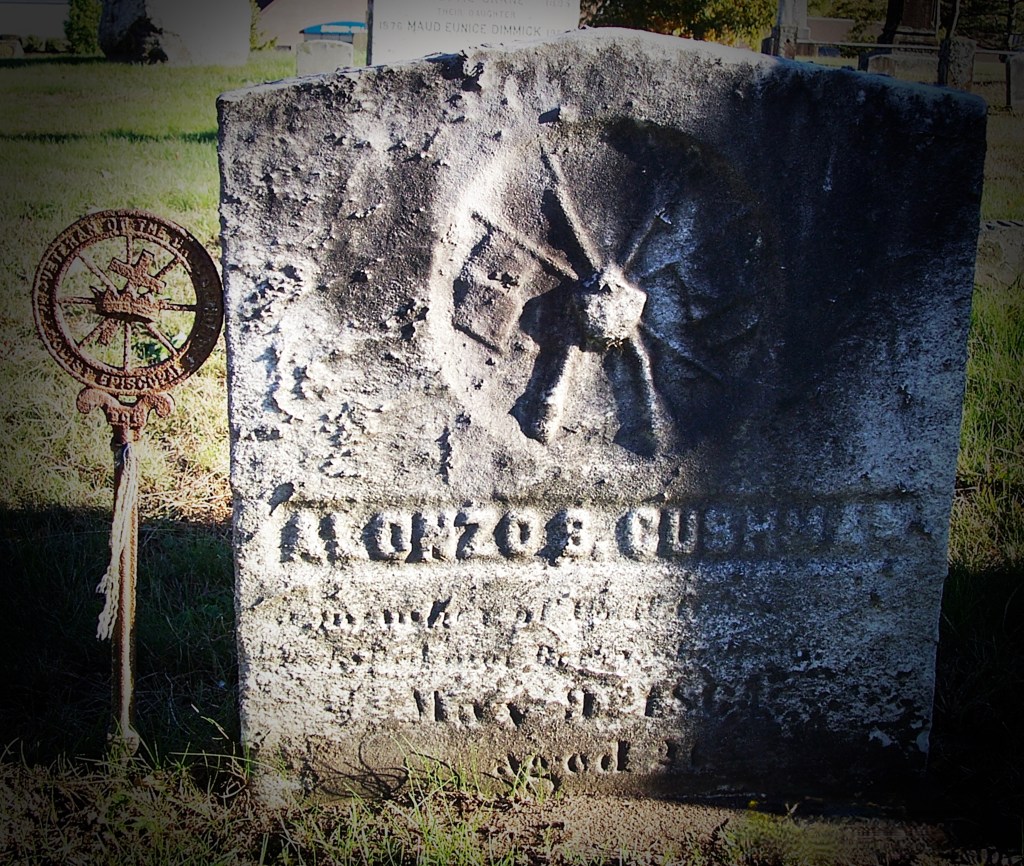
The following letter was written by Alonzo S. Cushman (1843-1864), the son of Lemuel Cushman (1800-1866) and Polly Sisson (1802-1886) of New London county, Connecticut.
Alonzo enlisted as a private in Co. H, 11th Connecticut Infantry in December 1861 and by the time this letter was written in April 1864 he was a veteran of many battles and campaigns. Little could he have realized as he penned this letter on 21 April and fancied himself home “rolling lemons” with his friends Betsy and Mary that he would be dead a little more than two weeks—killed on the battlefield of Swift Creek in Powhatan county, Virginia, in what would be Maj. Gen. Benjamin Butler’s last attempt to isolate Petersburg from Richmond on 9 May 1864. Union casualties that day were estimated at 128 killed, wounded or missing.
I believe the Mary J. McNeely to whom Alonzo addressed his letter was 18 year-old Irish-born daughter of the widow Nellie McNeely. Mary worked as a housekeeper and later in the woolen mills at Lisbon.
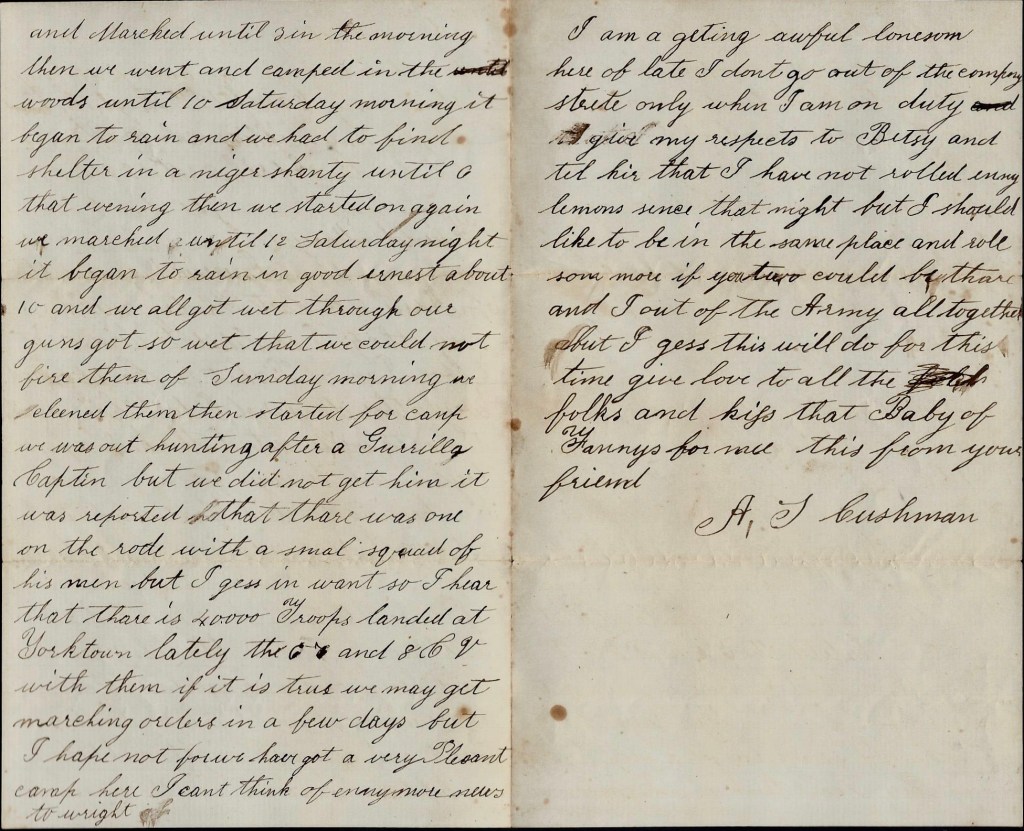
Transcription
Addressed to Miss Mary J. McNeely, Yantic, Connecticut
Camp 11th Regt. Connecticut Volunteers Williamsburg, Virginia April 21st 1864
Friend Mary,
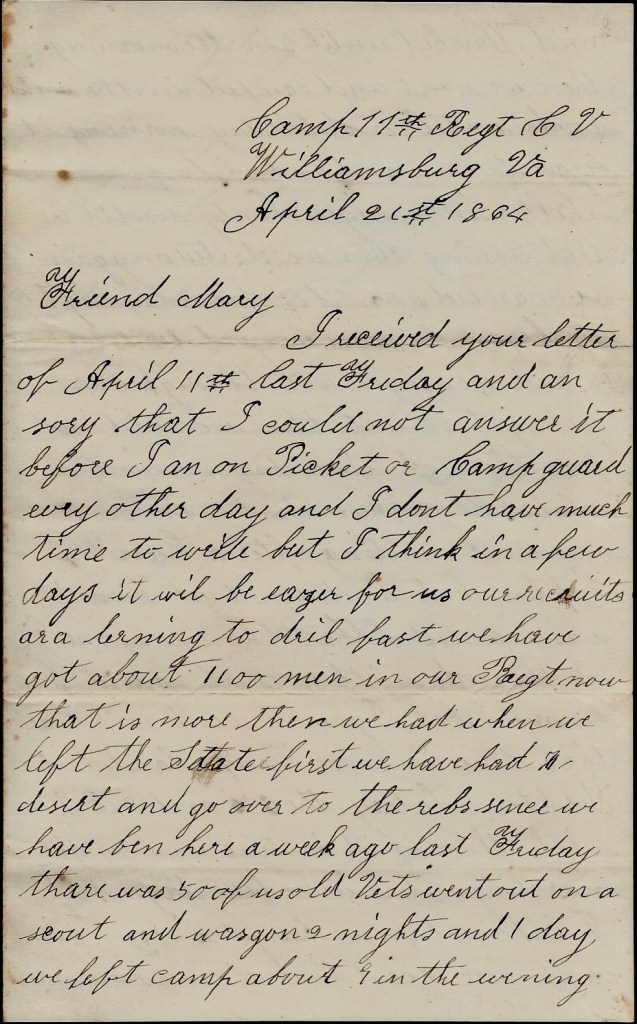
I received your letter of April 11th last Friday and am sorry that I could not answer it before. I am on picket or camp guard every other day and I don’t have much time to write. But I think in a few days it will be easier for us. Our recruits are learning to drill fast. We have got about 1100 men in our regiment now. That is more than we had when we left the state first. We have had 7 [?] desert and go over to the rebs since we have been here.
A week ago last Friday there was 50 of us old vets went out on a scout and was gone two nights and 1 day. We left camp about 9 in the evening and marched until 3 in the morning. Then we went and camped in the woods until 10 Saturday morning [when] it began to rain and we had to find shelter in a nigger shanty until that evening. Then we started on again. We marched until 12 Saturday night. It began to rain in good earnest about 10 and we all got so wet that we could not fire them off.
Sunday morning we cleaned them [and] then started for camp. We was out hunting after a guerrilla captain but we did not get him. It was reported that there was one on the road with a small squad of his men but I guess it wasn’t so.
I hear that there is 40,000 troops landed at Yorktown lately. The 6th, 7th, and 8th Conn. Vol. with them. If it true, we may get marching orders in a few days but I hope not for we have got a very pleasant camp here.
I can’t think of any more news to write. I am getting awful lonesome here of late. I don’t go out of the company street, only when I am on duty.
Give my respects to Betsy and tell her that I have not rolled any lemons since that night but I should like to be in the same place and roll some more if you two could be there and I out of the army altogether. But I guess this will do for this time. Give my love to all the folks and kiss that baby of Fanny’s for me.
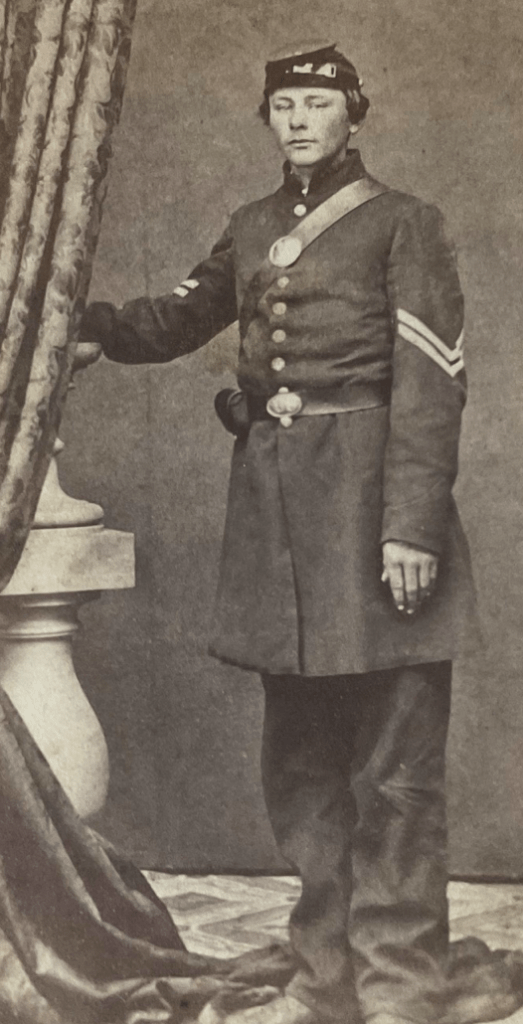
I could not find an image of David but here is one of Corp. Daniel Tarbox who also served in the 11th Connecticut and was mortally wounded at Antietam. (Claudia & Al Niemiec Collection)
This letter was written by David M. Ford (1841-1862), the son of Benjamin Ford (1792-1868) and his 2nd wife, Ann P. Osborn (1808-1874) of Greenville Post Office, Norwich, Connecticut. Receiving 25 dollars bounty which he gave to his mother, David enlisted in Co. H, 11th Connecticut on 25 October 1861. He was promoted to a corporal in the summer of 1862 but was killed in action on 17 September 1862 during the Battle of Antietam.
We learn from the pension application filed by David’s mother that prior to his enlistment, David supported her with his earnings at the mill in Greenville and that when he went into the service, he continued to support her by sending money home until his death. David’s father, it seems was unable to work due to his “rheumatism” and was therefore indigent. I’m not certain that David’s parents actually lived together at the time of David’s death as both parents apparently tried independently to obtain a pension for David’s service.
The letter suggests, perhaps, that David may have picked up a few of the bad habits of his father. David also mentions John W. Wood, a comrade and hometown friend who served with him in Co. H. with whom he occasionally had “a good bum” (drinking spree).
Transcription
Addressed to Mr. William Menerly. Greenville, Norwich, Connecticut
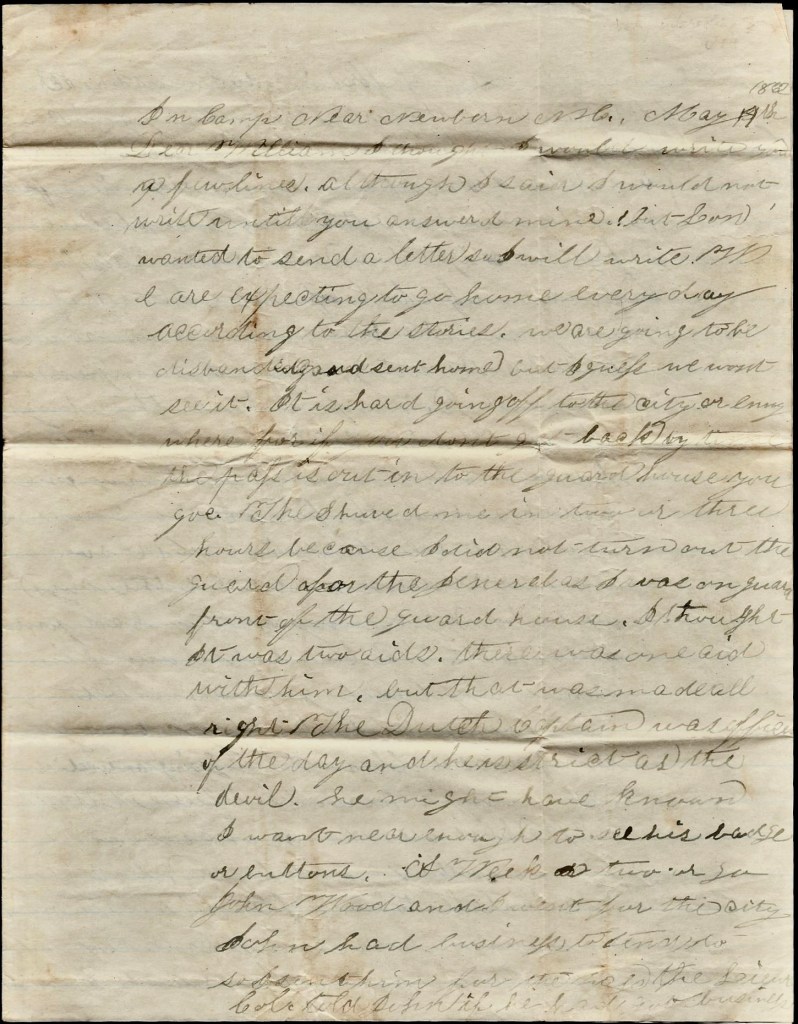
In camp near Newbern, North Carolina May 14th 1862
Dear William,
I thought I would write you a few lines although I said I would not write until you answered mine. But Lon wanted to send a letter so I will write. We are expecting to go home every day according to the stories. We are going to be disbanded and sent home but I guess we won’t see it. It is hard going off to the city or anywhere for if we don’t get back by time the pass is out, into the guard house you go. They shoved me in two or three hours because I did not turn out the guard for the general as I was on guard in front of the guard house. I thought it was two aides. There was one aide with him. But that was made alright.
The Dutch Captain was officer of the day and he is strict as the devil. He might have known I wasn’t near enough to see his badge or buttons. A week or two ago John Wood and I went for the city. John had business to tend to so I sent him for the pass. The Lieutenant-Colonel told John if he had got business, he would sign the pass for him but must scratch off the friend as they was so many going on passes. We just went and called on our friend Reab from a place about six miles from Norwich. You lived up that way once, I believe. He just sat right down and wrote a pass for two hours more and for both of us. We started for the city and the bridge was down so we straddled the string piece and jumped ourselves across. We promised the boys we would bring back some whiskey but we got a bottle and had to pay one dollar and a half for it and we couldn’t see the point of it so we put it down and told the boys we couldn’t get any as they had put a stop to it. We bummed around in some gay places you can bet, came home, told the boys everything was dull, nothing going on, and we did not go anywhere. They believed it all.
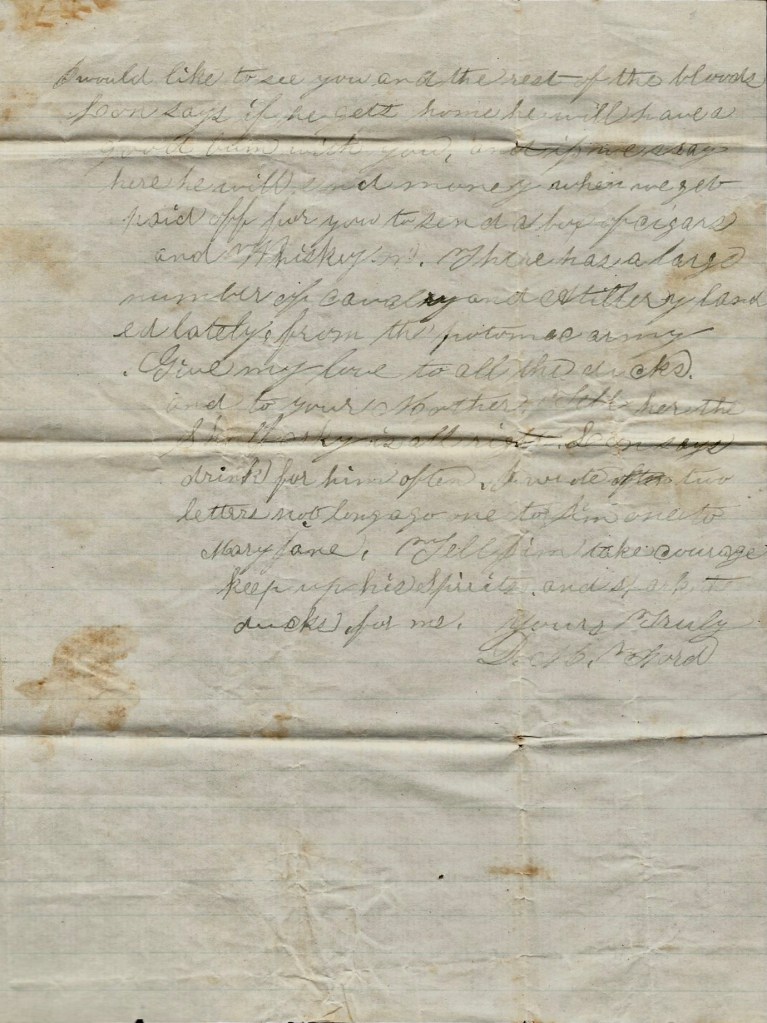
We have been down once since on another good bum but I don’t calculate to bum often. I have been steady ever since I enlisted, more so than when I was at home. I would like to see you and the rest of the bloods. Lon says if he gets home, he will have a good bum with you, and if we stay here, he will send money when we get paid off for you to send a box of cigars and whiskey in.
There has a large number of cavalry and artillery landed lately from the Potomac Army. Give my love to all the ducks and to your Mother. Tell her the Sh____ky is all right. Lon says drink for him often. I wrote two letters not long ago—one to Jim, one to Mary Jane. Tell Jim to take courage. Keep up his spirits and spark the ducks for me.
The following letter was written by Charles Warren (1835-1920) who entered the service as a sergeant in Co. B, 11th Connecticut Infantry, and soon after their first Battle of Newbern, described here, was promoted to 1st Sergeant. Warren later (July 1863) became Captain of Co. G, then Major (November 1864) and in command of the entire regiment in the last stages of the war. He was mustered out as the Colonel of the 11th Connecticut and after the war published a regimental history. Indeed, near the end of this letter he confesses, “It seems to me that I could write a volume about what I see.”
An obituary published on 4 November 1920 in The Press (Stafford Springs, Connecticut) informs us that Warren was “one of the most respected men in Stafford” when he died, having lived most of his life in the town. It says he worked as a young man in a local mill until 1850 when he entered into a partnership with Henry Thrall in the whole sale leather business in Boston which is where he worked until the Civil War began. He then returned home to join the 11th Connecticut, rose through the ranks to lead it by war’s end, and proudly asserted that he had participated in each and every battle in which the regiment was engaged.
After the war, Warren returned to Stafford where he entered the mercantile business and carried on with it until he sold out in 1881 to take a position as President of the Stafford Savings Bank.
In this letter, Warren gives us an incredible, eye-witness account of the Battle of Newbern in which the 11th Connecticut played a prominent role in what would be the first of many battles. We learn that it made quite an impression on him, as he related to his Boston friend, “It was a sickening sight that met us—dead horses, mangled men, broken cannon, knapsacks, guns, &c. were strewn in every direction. I shall never forget that sight—never, never. It is the sad side of a victory & no one knows anything about it until they see it as it is.”
[Note: This letter is from the personal collection of Richard Weiner and was transcribed and published on Spared & Shared by express consent.]
Transcription
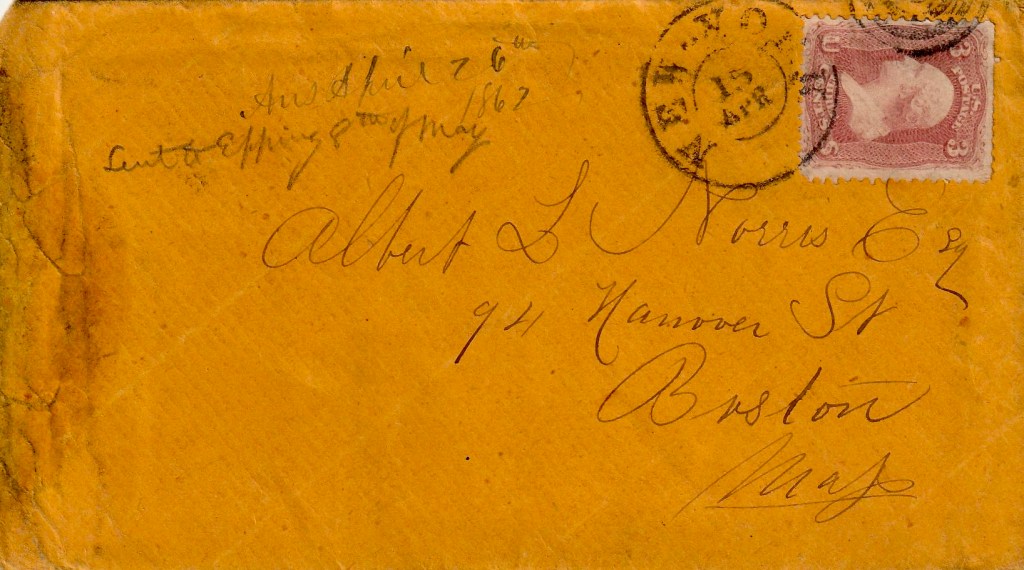
Addressed to Albert L. Norris, Esq., 94 Hanover Street, Boston, Mass.
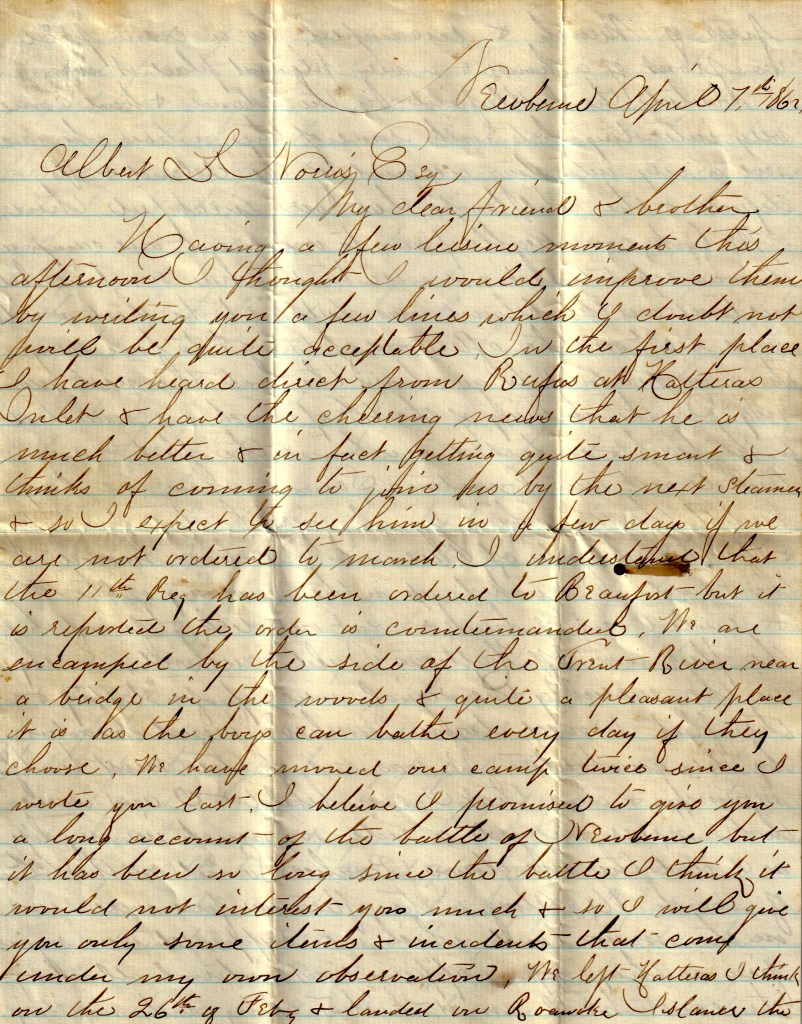
Newbern [North Carolina] April 7, 1862
Albert L. Norris, Esq. My friend and brother,
Having a few leisure moments this afternoon, I thought I would improve them by writing you a few lines which I doubt not will be quite acceptable. In the first place, I have heard direct from Rufus at Hatteras Inlet & have the cheering news that he is much better & in fact, getting quite smart & thinks of coming to join us by the next steamer & so I expect to see him in a few days if we are not ordered to march. I understand that the 11th Regiment has been ordered to Beaufort but it is reported the order is countermanded. We are encamped by the side of the Trent River near a bridge in the woods & quite a pleasant place it is as the boys can bathe every day if they choose. We have moved our camp twice since I wrote you last.
I believe I promised to give you a long account of the Battle of Newbern but it has been so long since the battle, I think it would not interest you much & so I will give you only some items & incidents that came under my observation.
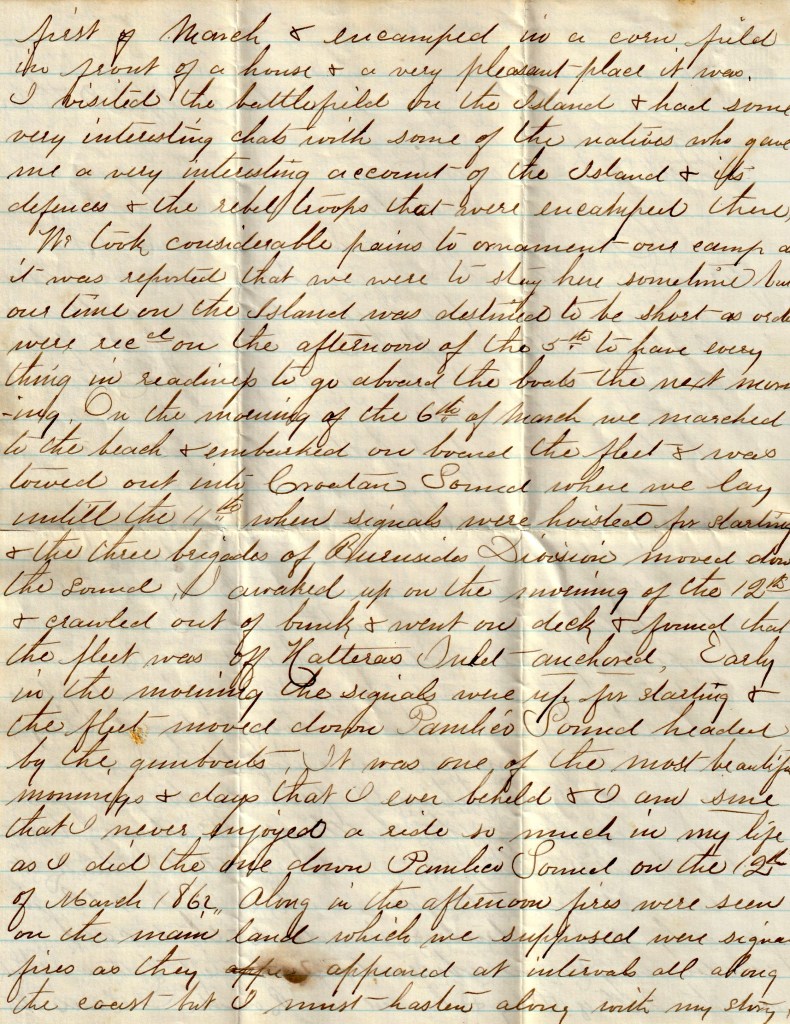
We left Hatteras I think on the 26th of February and landed on Roanoke Island the first of March & encamped in a corn field in front of a house & a very pleasant place it was. I visited the battlefield on the island and had some very interesting chats with some of the natives who gave me a very interesting account of the island and its defenses and the rebel troops that were encamped there. We took considerable pains to ornament our camp as it was reported that we were to stay here some time but out time on the island was destined to be short as orders were received on the afternoon of the 5th to have everything in readiness to go aboard the boats the next morning.
On the morning of the 6th of March, we marched to the beach and embarked on board the fleet and was towed out into Croatan Sound where we lay until the 11th when signals were hoisted for starting & the three brigades of Burnside’s Division moved down the Sound. I awaked up on the morning of the 12th and crawled out of bunk & went on deck & found that the fleet was off Hatteras Inlet anchored. Early in the morning the signals were up for starting & the fleet moved down Pamlico Sound headed by the gunboats. It was one of the most beautiful mornings & days that I ever beheld & I am sure that I never enjoyed a ride so much in my life as I did the one down Pamlico Sound on the 12th of March 1862.
Along in the afternoon, fires were seen on the mainland which we supposed were signal fires as they appeared at intervals all along the coast but I must hasten along with my story.
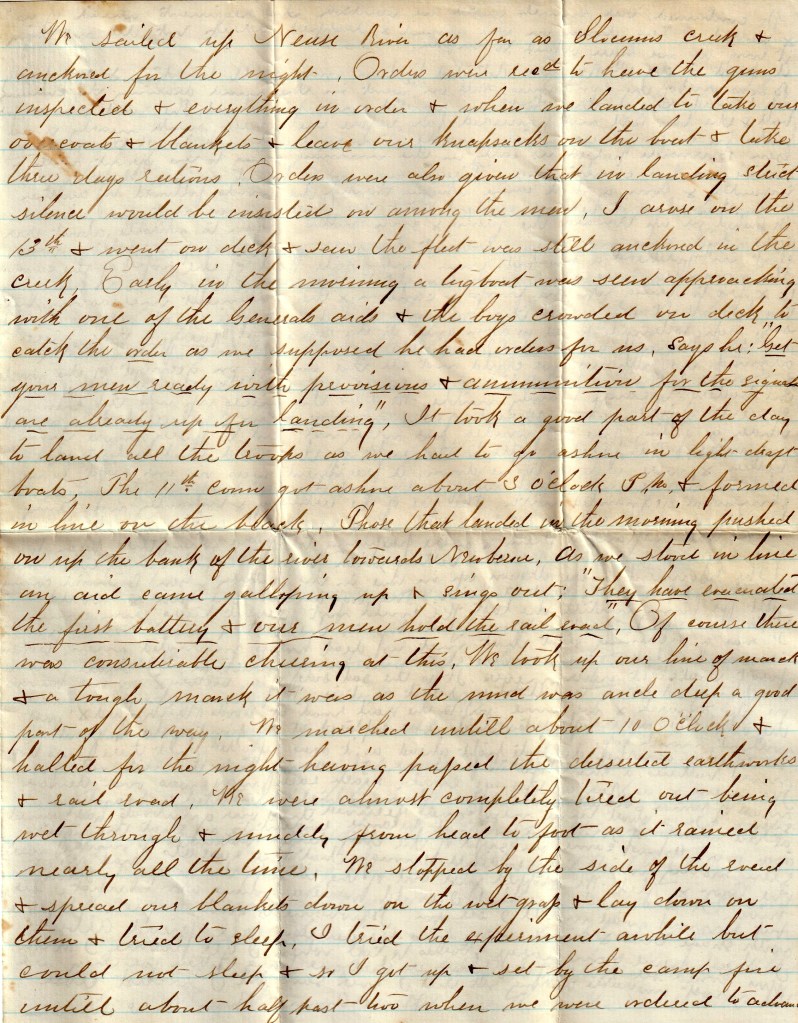
We sailed up Neuse River as far as Slocum’s Creek and anchored for the night. Orders were received to have the guns inspected & everything in order & when we landed to take our overcoats & blankets & leave our knapsacks on the boat & take three days rations. Orders were also given that in landing, strict silence would be insisted on among the men. I arose on the 13th & went on deck & seen the fleet was still anchored in the creek. Early in the morning a tugboat was seen approaching with one of the Generals aides & the boys crowded on deck to catch the order as we supposed he had orders for us. Says he, “Get your men ready with provisions and ammunition for the signals are already up for landing.” It took a good part of the day to land all the troops as we had to go ashore in light draft boats.
The 11th Connecticut got ashore about 3 o’clock p.m. and formed in line on the beach. Those that landed in the morning pushed on up the bank of the river towards Newbern. As we stood in line, an aide came galloping up and sings out, “They have evacuated the first battery & our men hold the railroad.” Of course there was considerable cheering at this.
We took up our line of march & a tough march it was as the mud was ankle deep a good part of th way. We marched until about 10 o’clock & halted for the night having passed the deserted earthworks and railroad. We were almost completely tired out, being wet trough and muddy from head to foot as it rained nearly all the time. We stopped by the side of the road and spread our blankets down on the wet grass and lay down on them and tried to sleep. I tried the experiment awhile but could not sleep and so I got up and sat by the camp fire until about half past two when we were ordered to advance.
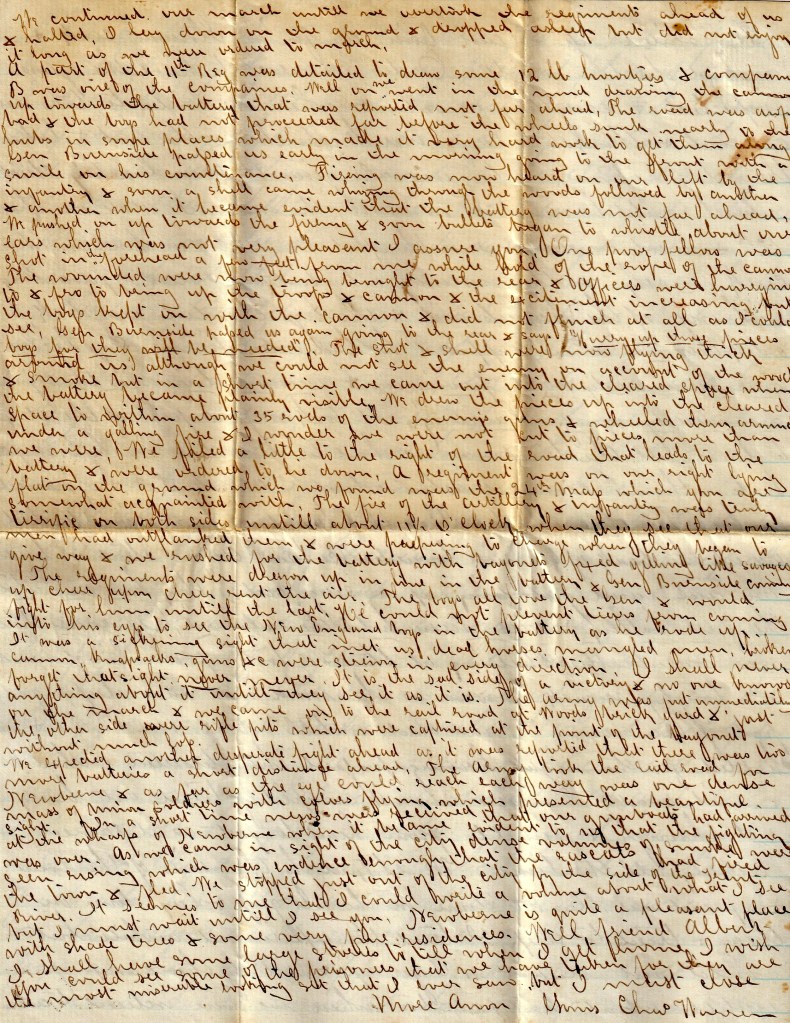
We continued our march until we overtook the regiments ahead of us and halted. I lay down on the ground & dropped asleep but did not enjoy it long as we were ordered to march. A part of the 11th [Connecticut] Regiment was detailed to draw some 12-pound howitzers & Co. B was one of the companies. Well, on we went in the mud drawing the cannons up towards the battery that was reported not far ahead. The road was awful bad & the boys had not proceeded far before the wheel sunk nearly to the hubs in some places which made it very hard work to get them along.
Gen. Burnside passed us early in the morning going to the front with a smile on his countenance. Firing was now heard on our left by the infantry and soon a shell came whizzing through the woods followed by another and another. When it became evident that the battery was not far ahead, we pushed on up towards the firing and soon bullets began to whistle about our ears which was not very pleasant, I assure you. One poor fellow was shot in the forehead a few feet from me while he had hold of the rope of the cannon. The wounded were now being brought to the rear & officers were hurrying to and fro to bring up the troops and cannon & the excitement increasing but the boys kept on with the cannon & did not flinch at all as I could see.
Gen. burnside passed us again going to the rear and says, “Hurry those pieces, boys, for they will be needed!” The shot and shell were now flying thick around us although we could not see the enemy on account of the woods and smoke but in a short time we came out into the cleared space where the battery became plainly visible. We drew the pieces up into the cleared space to within about 35 rods [200 yards] of the enemy’s guns and wheeled them around under a galling fire & I wonder we were not cut to pieces more than we were.
We filed a little to the right of the road that leads to the battery and were ordered to lie down. A regiment was on our right lying flat on the ground which we found were the 24th Massachusetts which you are somewhat acquainted with. The fire of the artillery and infantry was truly terrific on both sides until about 11:30 o’clock when they see that our men had outflanked them and were preparing to charge when they began to give way & we rushed for the battery with bayonets fixed, yelling like savages.
Map shows the 11th Connecticut Infantry advancing by the railroad and then ordered to the right to replace the 27th Massachusetts (under the “S” in FOSTER), on the left side of the Old Beaufort Road, the 24th Massachusetts on the right side of that same road. The two howitzers are planted in the middle of the road near the edge of the clearing.Directly opposite the swampy clearing ahead lay the Confederate works anchored by the 16 guns of Brem’s and Latham’s Batteries.
The regiments were drawn up in line of the battery and Gen. Burnside coming up, cheer upon cheer rent the air. The boys all love the General and would fight for him until the last. He could not prevent tears from coming into his eyes to see the New England boys in the battery as he rode up.
It was a sickening sight that met us—dead horses, mangled men, broken cannon, knapsacks, guns, &c. were strewn in every direction. I shall never forget that sight—never, never. It is the sad side of a victory & no one knows anything about it until they see it as it is.
The army was just immediately on the march and we come on to the railroad at Woods brick yard and just the other side were rifle pits which were captured at the point of the bayonet. We expected another desperate fight ahead as it was reported that there was two more batteries a short distance ahead. The army took the railroad for Newbern and as far as the eye could reach each way was one dense mass of Union soldiers with colors flying which presented a beautiful sight.
In a short time, news was received that our gunboats had arrived at the wharf at Newbern when it became evident to us that the fighting was over. As we came in sight of the city, dense volumes of smoke were seen rising which was evidence enough that the rascals had fired the town and fled. We stopped just out of the city by the side of the Trent River. It seems to me that I could write a volume about what I see but I must wait until I see you.
Newbern is quite a pleasant place with shade trees and some very fine residences. Well, friend Albert, I shall have some large stories to tell when I get home. I wish you could see some of the prisoners that we have taken for they are the most miserable looking set that I ever saw. But I must close. More anon.








 Spared & Shared 23