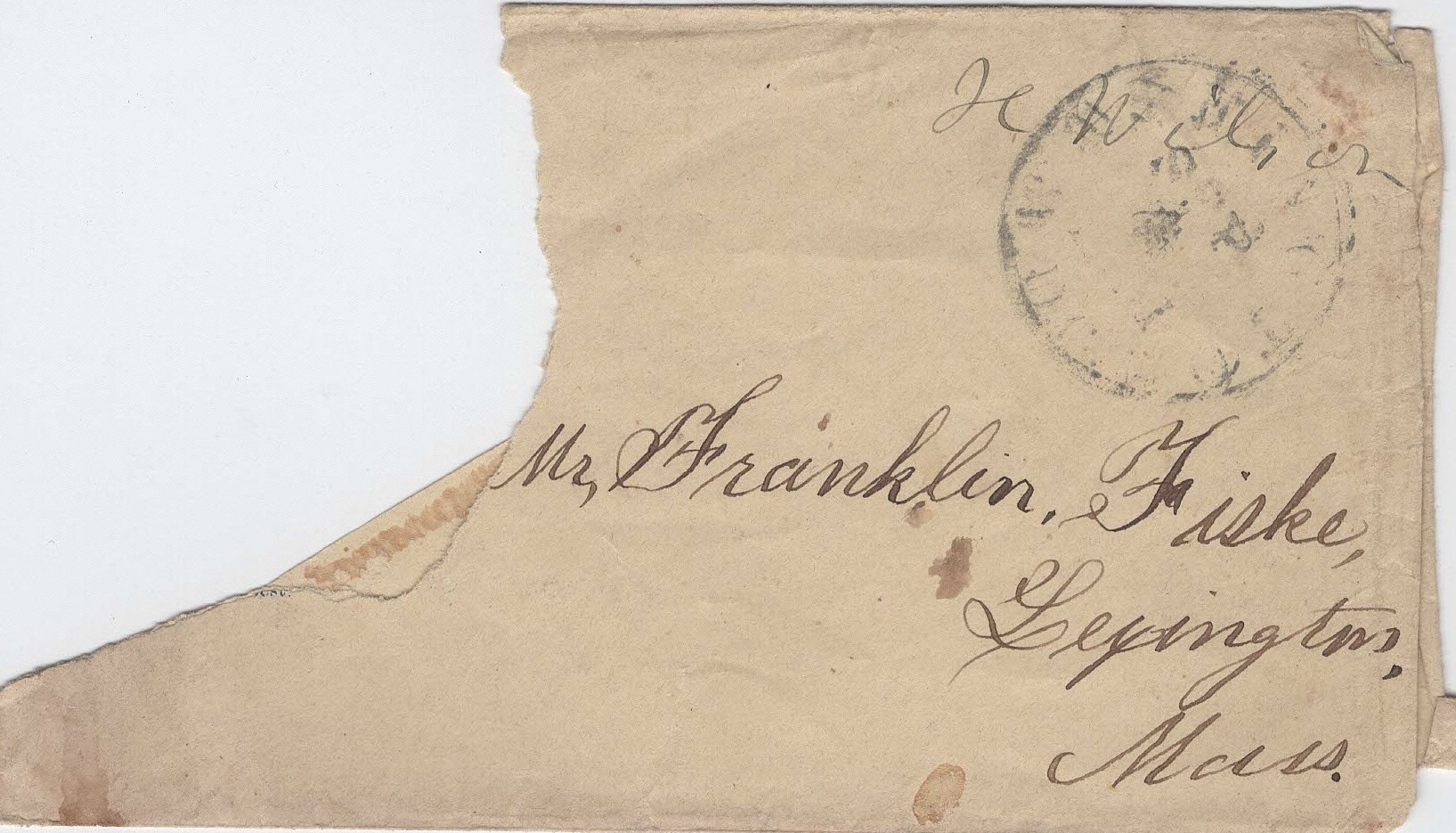
The following letter was written by Joseph Henry Peters Fiske (1843-1870), the son of Franklin Fiske (1804-1868) and Hannah Peters (1801-Aft1868) of Lexington, Middlesex, Massachusetts. He enlisted on 13 June 1861 at Lexington, Massachusetts in Co. G, 11th Massachusetts, at the same time as his older brother Charles Albert Bowers Fiske (1842-1910) who served in Co. K. Joseph was discharged for disability on 20 May 1863. The Register of Enlistments informs us that Joseph died in February 1870 and that he suffered from rheumatism.
T R A N S C R I P T I O N
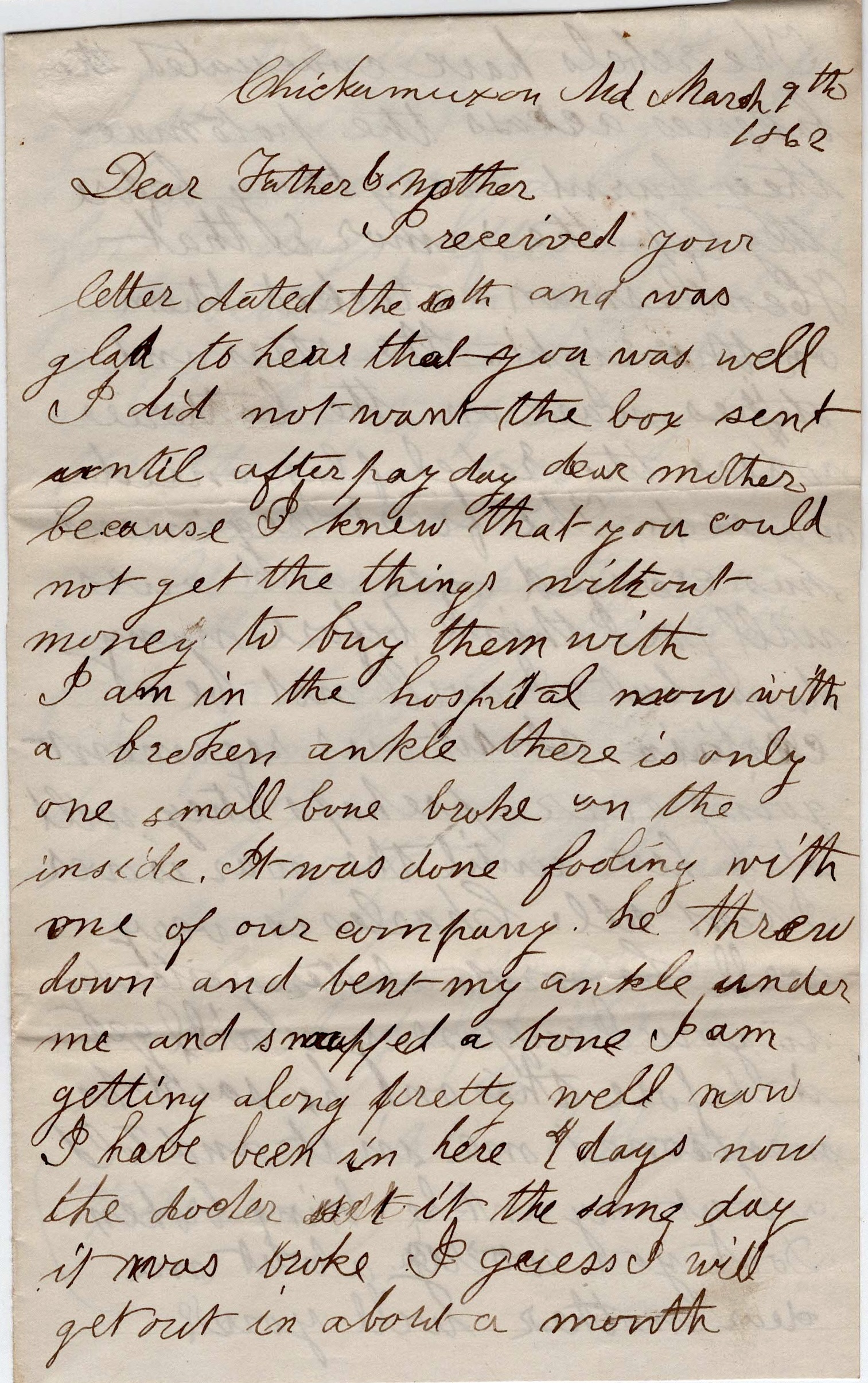
Chicamuxen, Maryland March 9, 1862
Dear Father & Mother,
I received your letter dated the 6th and was glad to hear that you was well. I did not want the box sent until after pay day, dear Mother, because I knew that you could not get the things without money to buy them with.
I am in the hospital now with a broken ankle. There is only one small bone broke on the inside. It was done fooling with one of our company. He threw [me] down and bent my ankle under me and snapped a bone. I am getting along pretty well now. I have been in here four days now. The doctor set it the same day it was broke. I guess I will get out in about a month.
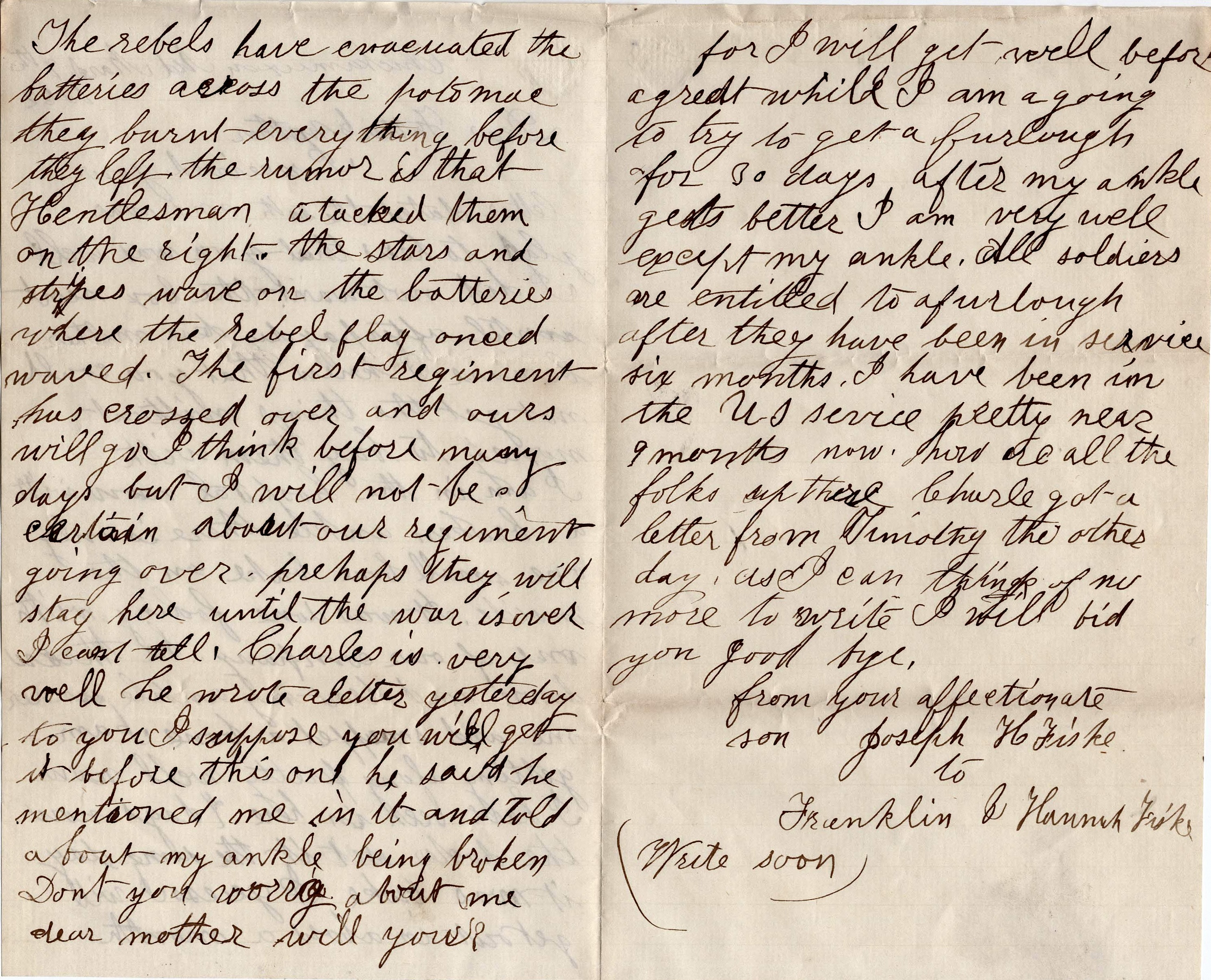
The rebels have evacuated the batteries across the Potomac. They burnt everything before they left. The rumor is that Heintzelman attacked them on the right. The stars and stripes wave on the batteries where the rebel flag once waved. The first regiment has crossed over and ours will go, I think, before many days. But I will not be certain about our regiment going over. Perhaps they will stay here until the war is over. I can’t tell.
Charles is very well. He wrote a letter yesterday to you. I suppose you will get it before this one. He said he mentioned me in it and told about my ankle being broken. Don’t you worry about me, dear Mother, will you? for I will get well before a great while. I am a going to try to get a furlough for thirty days after my ankle gets better. I am very well except my ankle. All soldiers are entitled to a furlough after they have been in the service six months. I have been in the service pretty near nine months now.
How are all the folks up there? Charlie got a letter from Timothy the other day. As I can think of no more to write, I will bid you goodbye. From your affectionate son, Joseph H. Fiske
The following letter was unsigned and the envelope has long been separated from the letter so it is not possible to say with certainty who wrote it based on the limited clues within it. The description of troop movements and his reference to his company as the “Bunker Hill” boys initially lead me to conclude that he was a member of the 11th Massachusetts Infantry, Co. I being known as the Bunker Hill Company. The letter was written on 5 September 1862, a few days after the Battle of 2nd Bull Run when the regiment was bivouacked at Fort Lyon, just south of Alexandria, Virginia. All of these clues led me to the 11th Massachusetts until I read an account of the battle by their captain who claimed they were paid off in late July 1862 and the author of this letter claims they were yet owed four months pay.
In the 2nd Battle of Bull Run, the 11th Massachusetts fought in Grover’s Brigade and were part of the force making a bayonet charge against the Confederate position along an unfinished railroad bed. They managed to break through the Confederate line at this point but were ultimately repulsed with heavy loses. The 11th Massachusetts suffered 40% casualties in less than 20 minutes.
Transcription
Camp near Alexandria September 5, 1862
Dear Sister,
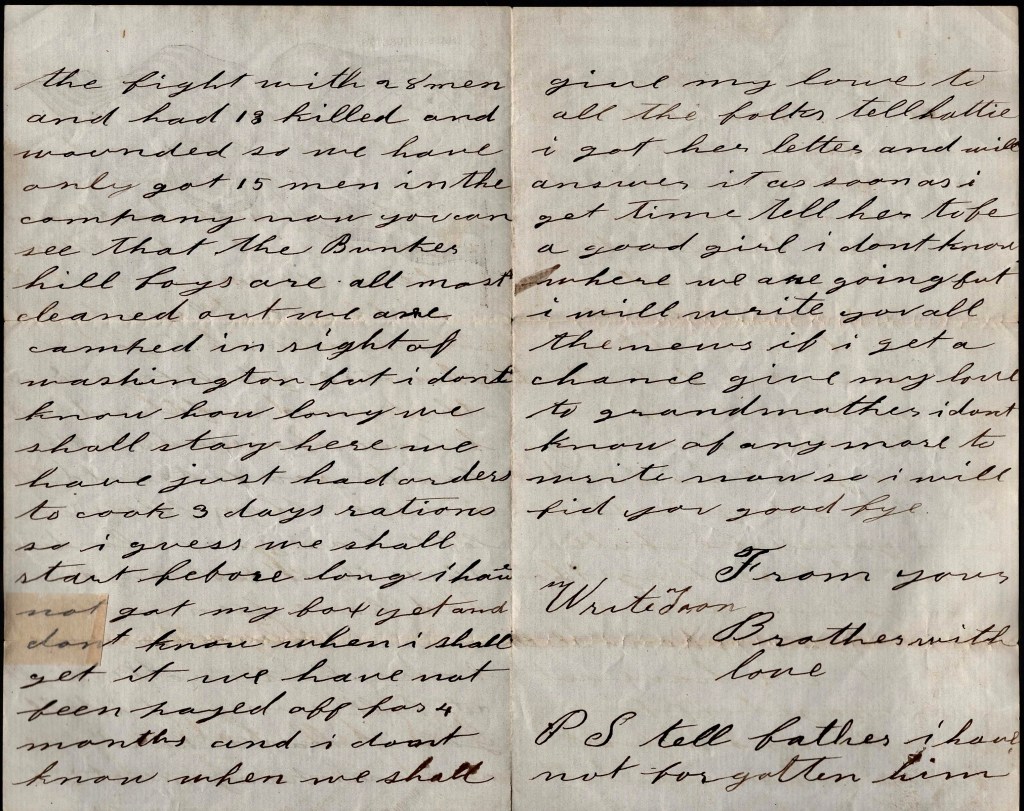
I now take my pen to write you a few lines to let you know that I am safe and well. I have received 2 letters from you but could not answer them before we left Harrison’s Landing the 15th of last month and have been on the march ever since. We have had another fight at Bull Run and I tell you, it was a hard one. Our company went into the fight with 28 men and had 13 killed and wounded so we have only got 15 men in the company now. You can see that the Bunker Hill boys are almost cleaned out.
We are camped in sight of Washington but I don’t know how long we shall stay here. We have just had orders to cook three days rations so I guess we shall start before long. I have not got my box yet and don’t know when I shall get it. We have not been paid off for four months and I don’t know when we shall.
Give my love to all the folks. Tell Hattie I got her letter and will answer it as soon as I get time. Tell her to be a good girl. I don’t know where we are going but I will write you all the news if I get a chance. Give my love to grandmother. I don’t know of any more to write now so I will bid you goodbye. From your brother with love
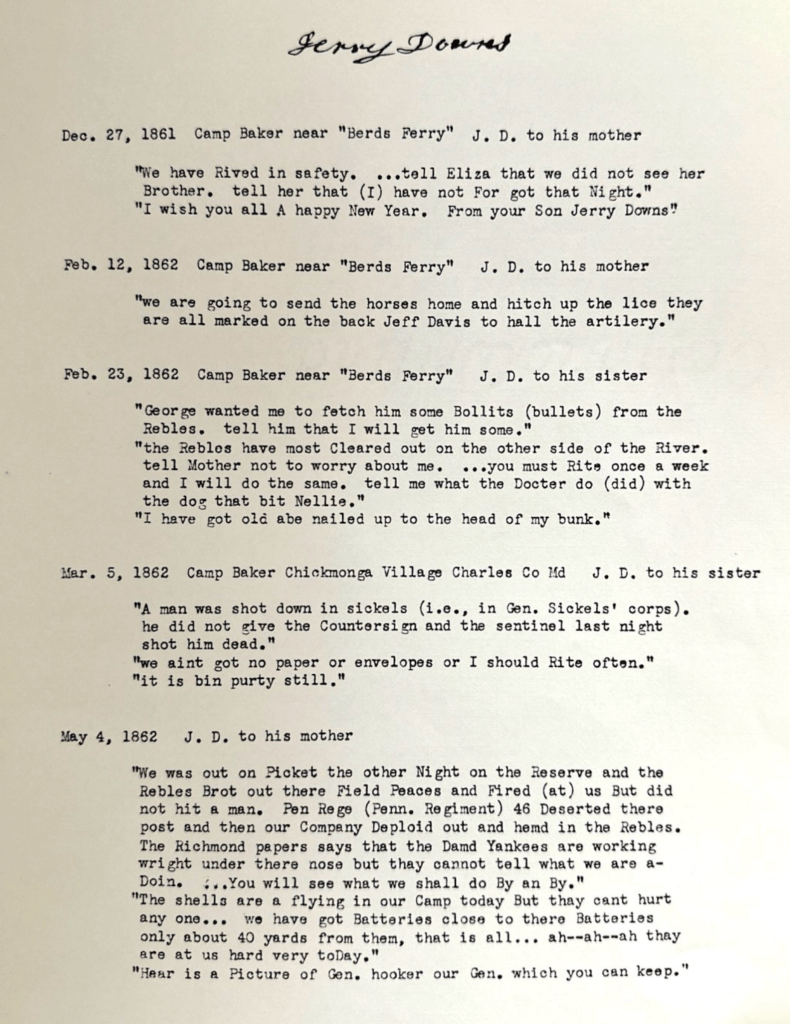
“I have got old abe nailed up to the head of my Bunk,”—the title of a brief biographical sketch of Pvt. Jeremiah Downs prepared by historian Patrick Leary decades ago after perusing and taking notes on eight of Jeremiah’s war time letters. Leary’s sketch reads:
Pvt . Jeremiah Downs
A self-described “mariner” from Newburyport, Mass., Jerry Downs enlisted in the Eleventh Regiment Massachusetts Volunteer Infantry on November 1, 1861, aged 25. Barely three months before, the “Boston Volunteers”—as the regiment was locally known—had lost 8 men at the first Battle of Bull Run, where Union forces had been ignominiously routed. After spending the winter of 1861-62 on picket duty along the Potomac south of Washington, the regiment moved south to join the forces being gathered under General McClellan at Fortress Monroe on the tip of the peninsula formed by the James and York Rivers. McClellan’s plan was to move up the peninsula with an overwhelming body of men and lay siege to Richmond, capturing the Confederate capital and ending the war in one bold stroke. Beginning the march on April 2, the Union army had got only twenty miles along when it was checked at Yorktown by a force of 13,000 men under Confederate General John B. Magruder. By skillfully deceiving McClellan as to the size of the city’s garrison, Magruder prompted his opponent to settle down for a careful siege, thus tying up the 53,000-strong Union forces for an entire month. On May 3, under command of the newly arrived General Johnston, the Rebels evacuated the city, pursued by the Yankees. After brisk skirmishing before Williamsburg on May 4—described by Private Downs in his letter of that date, written in the middle of the all-day artillery exchange—the Union divisions of Generals Hooker and Smith attacked the Confederate earthworks the following morning. Hooker’s division, of which the 11th Mass. was a part, was then attacked by a large force of Rebels; holding its position alone under constant fire for the rest of the day, the division was finally relieved by General Kearny’s division, after having suffered 1,700 casualties and the capture of five pieces of artillery.
After the Battle of Williamsburg, the Confederate forces moved northwest behind the Richmond defenses, while McClellan deployed his forces north and south of the Chickahominy, with his headquarters at West Point, at the head of the York River. Seeing the Union forces thus split, straddling the Chickahominy, Confederate General Johnston attacked the 19,000 Yankees south of the river at Fair Oaks with a Rebel force of 32,000 men. This battle—mentioned by Private Downs in his letter of July 24—lasted two days (May 31-June 1), ended in a draw after Union reinforcements arrived, and cost each side about 6,000 casualties. The rest of that remarkable letter describes in graphic detail the Seven Days’ Battles—Mechanicsville, Gaines’s Mill, Glendale, and Malvern Hill—in which Robert B. Lee’s army, beginning its attack on June 26, pushed the Union forces down the peninsula in a series of ferocious encounters that ended with McClellan’s retreat to the fever-ridden marshes of Harrison’s Landing. Jerry Downs calls it, simply, the “hard times we had coming from Fair Oaks.” The particular battle he describes is probably Malvern Hill on July 1, where Union batteries and infantry repulsed wave after wave of Rebel charges. One of the most severe artillery barrages of the war left 5,000 Rebel dead and wounded lying on the slopes—“sawed ends out” like stacks of wood, in Downs’ painfully graphic phrase.
Jerry Downs was one of many Union soldiers of the Peninsula Campaign to survive fierce combat unscratched only to be felled by malaria and dysentery at the Harrison’s Landing camp. He was eventually moved to the large Federal hospital at Alexandria near Washington; he was discharged from the army for disability on December 5, 1862, and returned home.”
Jeremiah Downs was the son of Jeremiah (b. ca. 1815) and Abigail L. Downs (b. ca. 1809). According to the 1850 Census, he had one brother, George (b. ca. 1840) and two sisters, Sarah Smith (b. ca. 1832) and Mary Colton (1827). It should be noted that there are other letters by Downs written while he was in the service. Several of his letters appear on Private Voices under Authored Letters although they are transcripts only.
Transcription
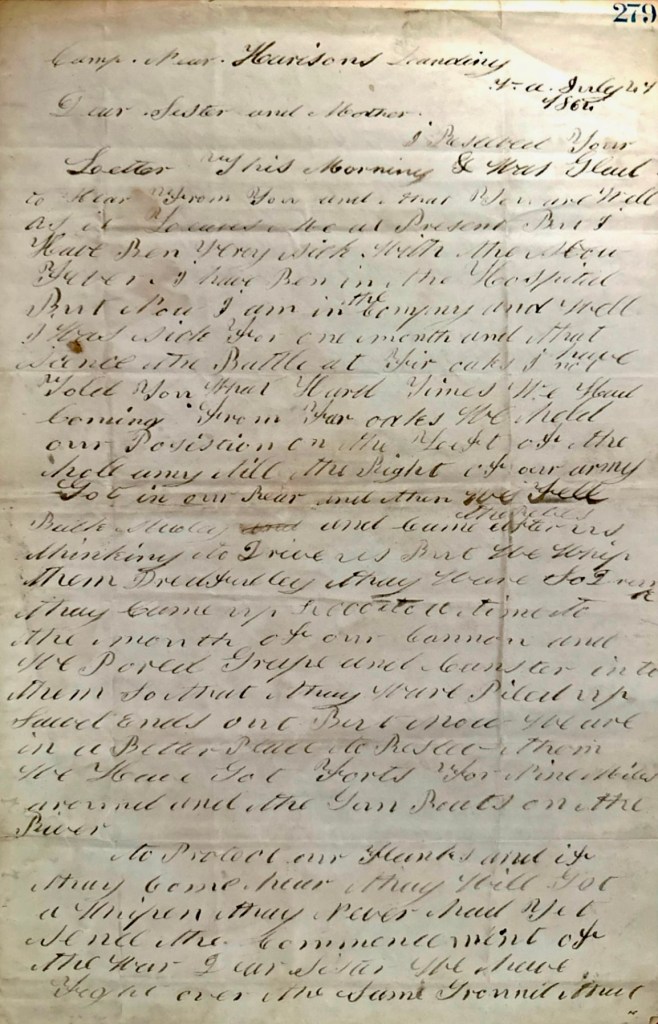
Camp near Harrison’s Landing, Va. July 24th 1862
Dear sister and mother,
I received your letter this morning & was glad to hear from you and that you are well as it leaves me at present. But I have been very sick with the slow fever. I have been in the hospital but now I am in the company and well. I was sick for one month and that since the Battle at Fair Oaks. I have not told you what hard times we had coming from Fair Oaks. We had our position on the left of the whole army till the right of our army got in our rear and then we fell back slowly and the Rebs came after us thinking to drive us, but we whipped them dreadfully. They were so drunk, they came up 1,000 at a time to the mouth of our cannon and we poured grape and canister into them that they were piled up sawed ends out. But now we are in a better place to receive them. We have got forts for nine miles around and the gunboats on the river to protect our flanks and if they come here, they will get a whipping [like] they never had yet since the commencement of the war.
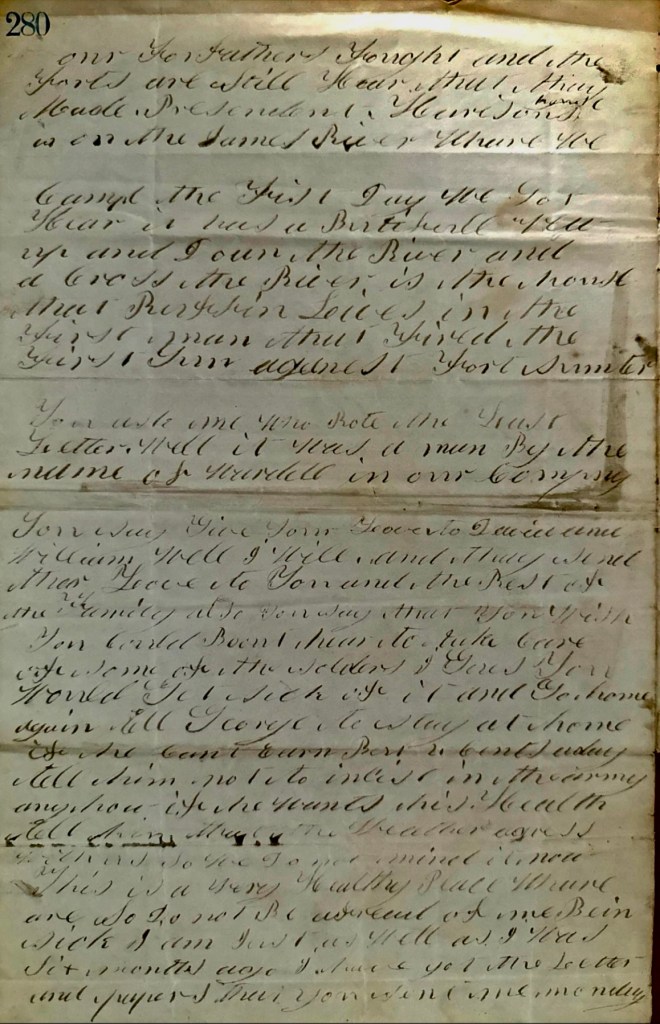
Dear sister, we have fought over the same ground that our forefathers fought and the forts are still here that they made. President Harrison’s house is on the James River where we camped the first day we got here. It has a beautiful view up and down the river, is the house that [Edmund] Ruffin lives in—the first man that fired the first gun against Fort Sumter.
You ask me who wrote the last letter. Well, it was a man by the name of Wordell in our company.
You say give your love to David and William. Well, I will, and they send their love to you and the rest of the family. Also you say that you wish you coulda been here to take care of some of the soldiers. 1 I guess you would get sick of it and go home again. Tell George to stay at home if he can’t earn but 4 cents a day. Tell him not to enlist in the army anyhow if he wants his health. Tell him that the weather agrees with us so we do not mind it now. This is a very healthy place where we are so do not be worried of me being sick. I am just as well as I was six months ago. I have got the letter and paper that you sent me Monday. When you send the box, put anything in that you have a mind to. Please do put in a salt fish and some whiskey.
Ask the expressman to be sure. That is all that I can think [of] now. I will close. Give my love to all. Goodbye. Write soon. From your brother, — Jeremy Downs
1 Jeremiah’s sister, Sarah E. (Downs) Smith volunteered her services as a nurse during the Civil War. She began her nursing early in 1862. Her husband, George, had died in 1854 in St. Thomas, so at 32 yeas of age and a widow, she was readily accepted into the nursing corps. She became a matron in the Trinity Church Hospital in Washington D. C. She eventually died of tuberculosis at the age of 42 which she probably contracted during the war.
Notes from Patrick Leary’s perusal of all eight of Downs’ letters.
The following letters were written by Abel Starkey (1816-1864) of Boston who enlisted on 13 June 1861 as a private in Co. F, 11th Massachusetts Infantry—one of only three Massachusetts regiments to participate in the First Battle of Bull Run. The regiment spent the early fall of 1861 helping to build fortifications around Washington. In October, the 11th was stationed at Budd’s Ferry in Indian Head, Maryland where they remained on picket duty for the winter of 1861–1862. The 11th Massachusetts Infantry saw its first combat during the Peninsular Campaign in the spring of 1862. They were heavily engaged during the Second Battle of Bull Run, participated in the Battle of Fredericksburg, and suffered severe casualties at the Battle of Chancellorsville and the Battle of Gettysburg.
Presumably Abel was with his regiments throughout these engagements and was with them as well when the regiment marched into the Wilderness in May 1864 in Hancock’s Second Corps where they were engaged heavily on the Plank Road on 5 and 6 May 1864. It was Abel’s last fight. He died of wounds on 7 May 1864.
Abel wrote these letters to his older brother, Horace Starkey (1814-1872), a farmer near Rockford, Winnebago county, Illinois.
Other letters I’ve transcribed by members of the 11th Massachusetts:
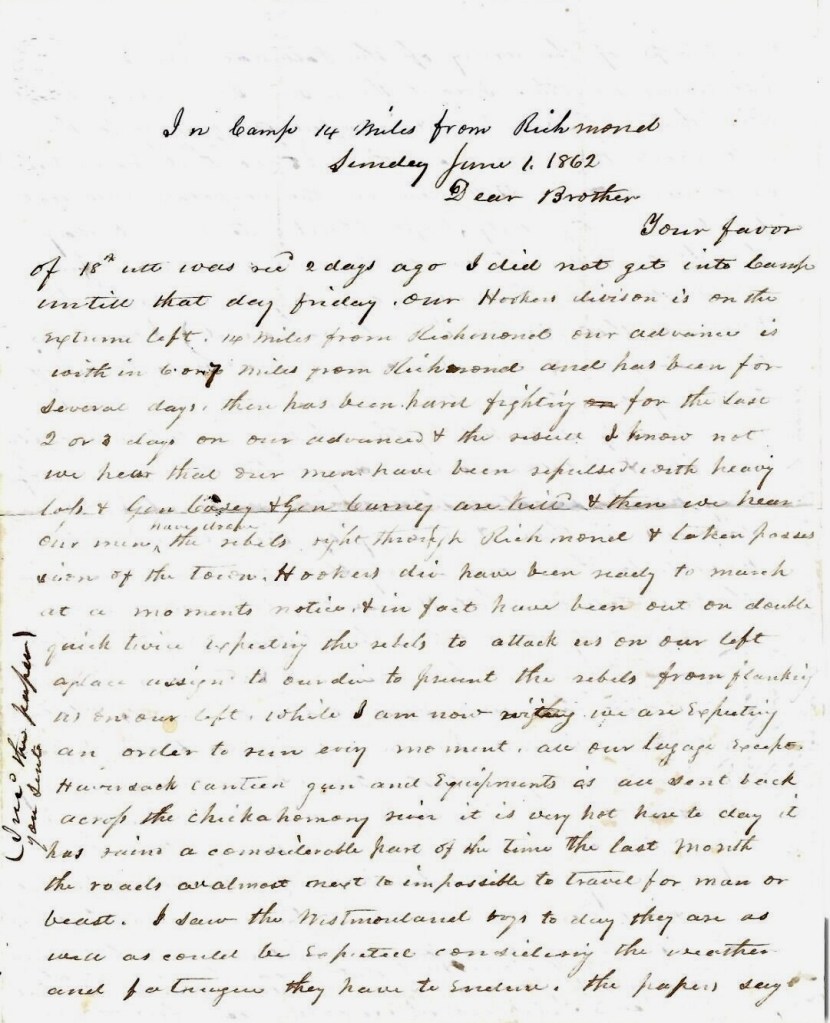
In Camp 14 miles from Richmond Sunday, June 1, 1862
Dear Brother,
Your favor of the 18th instant was received 2 days ago. I did not get into camp until that day Friday. Our (Hooker’s) division is on the extreme left, 14 miles from Richmond. Our advance is within 6 or 7 miles from Richmond and has been for several days. There has been hard fighting for the last 2 or 3 days on our advance & the result I know not. We hear that our men have been repulsed with heavy losses & Gen. Casey & Gen. Carney are killed. And then we [also] hear our men drove the Rebels right through Richmond & taken possession of the town. Hooker’s Division have been ready to march at a moments notice & in fact have been out on double quick twice expecting the Rebels to attack us on our left—a place assigned to our division to prevent the Rebels from flanking us on our left. While I am now writing, we are expecting an order to run any moment.
All our luggage, except haversack, canteen, gun and equipments, is all sent back across the Chickahominy river. It is very hot here today. It has been raining a considerable part of the time the last month. The roads are almost next to impossible to travel for man or beast. I saw the Westmoreland boys today. They are as well as could be expected considering the weather and fatigue they have to Endure. The papers say our troops of the Army of the Potomac are in excellent health. I don’t think so—to say nothing about those that have been killed or wounded on our right last week. There is more than 25,000 that have been sent home or are still in the hospitals and not fit to do any duty. Capt. Barker told me today that the 2d New Hampshire Regiment could not muster over five hundred men that were able to go into battle (He told me that Abijah French was dead).
I came in the rear from Williamsburg and was 11 days coming. Took my own time. The houses on the main road were mostly deserted by the white population excepting families & seldom I saw any of them and nearly every house vacated. There were more or less sick soldiers in them & many of them turned into hospitals.
There was nearly three thousand sick in the hospitals at White House landing and more arriving daily and taking the steamboat for Fortress Monroe, Baltimore, Philadelphia, New York &c. News has just come in that we had drove the Rebels & taken lots of prisoners. I have not heard from home since I wrote you last. Two or three letters came in my absence & were sent back to White House Landing in our Captain’s trunk. I am well & hearty. Tell [your daughter] Ella I am very much obliged to her for the letter she sent me & tell her to write again. Tell her also that Jeff Davis was not quite patriotic to hang himself. Stanton’s Michigan Regt. encamped near us at Yorktown. They are away in the advance now. I will see Lewis Webster when we come near them again. Give my regards to your family and write again. Respectfully yours—Abel Starkey.
We are Off.
Letter 2
Addressed to Mr. Horace Starkey, Rockford, Illinois
Camp Fair Oaks 6 Miles below Richmond June 21, 1862
Dear Brother,
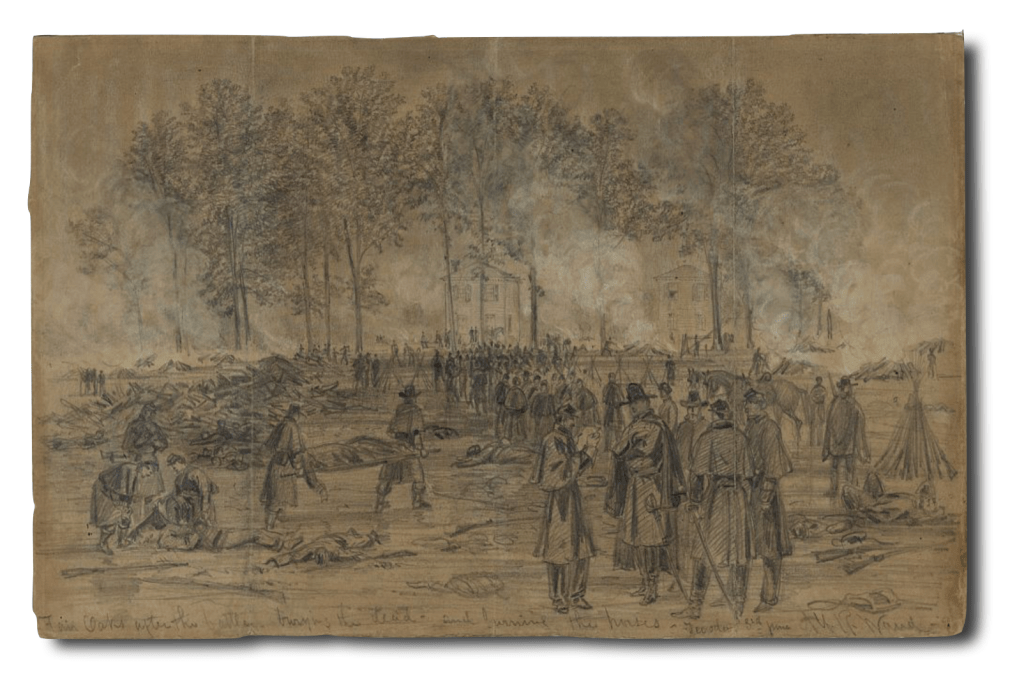
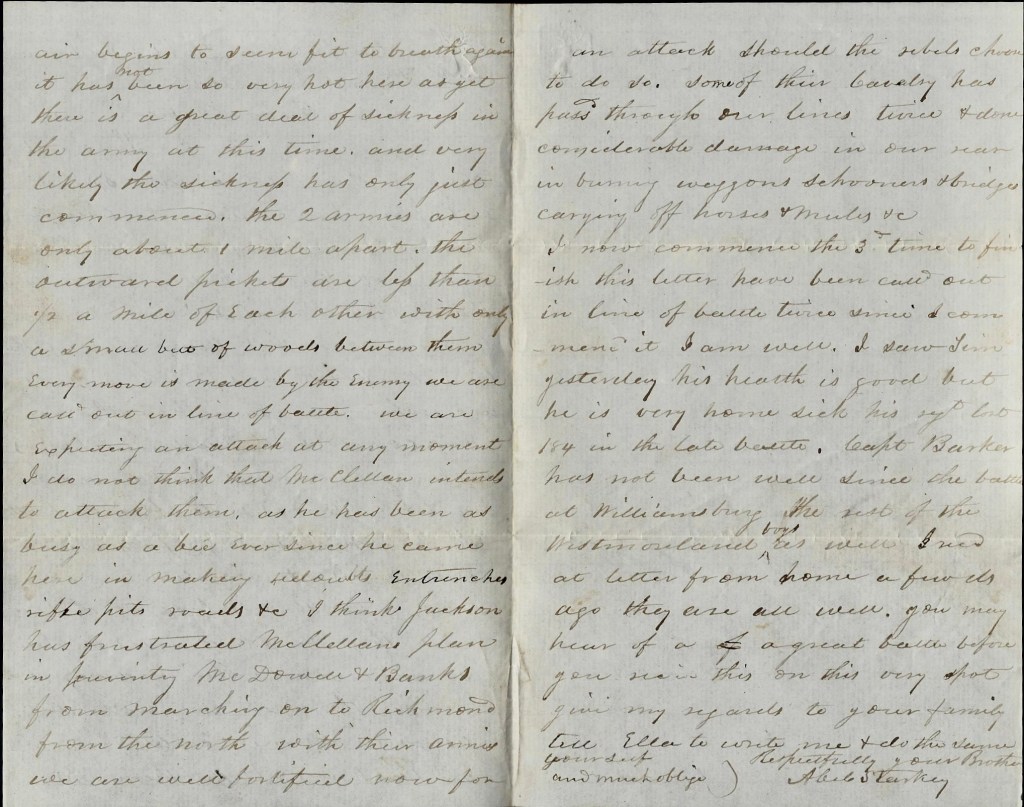
The Grand Army of the Potomac are spread out from James River to Chickahominy River & how much further I do not know, but quite a distance. Hooker’s Division is encamped on the same ground that Casey’s was at the time the battle was fought 3 weeks ago. When we came here, the ground was covered with dead men and horses, broken gun carriages, muskets, accoutrements, &c. It was 4 days after the battle. The men and horses were perfectly alive with maggots. It would make a well man spew to look at them and then the smell was enough to knock a whole regiment end ways. We covered the men over with dirt as well as we could & piled wood on the horses & burnt them. The air begins to seem fit to breathe again.
Burying the dead and burning the horses on the battlefield of Fair Oaks
It has not been so very hot here as yet. There is a great deal of sickness in the army at this time and very likely the sickness has only just commenced. The two armies are only about 1 mile apart. The outward pickets are less than half a mile of each other with only a small bit of woods between them. Every move [that] is made by the enemy, we are called out in line of battle. We are expecting an attack at any moment. I do not think that McClellan intends to attack them as he has been as busy as a bee ever since he came here in making redoubts, entrenches, rifle pits, roads, &c. I think [Stonewall] Jackson has frustrated McClellan’s plan in preventing McDowell and Banks from marching on to Richmond from the North with their armies.
We are well fortified now for an attack should the rebels choose to do so. Some of their cavalry has passed through our lines twice and done considerable damage in our rear in burning wagons, schooners, & bridges, carrying off horses and mules, &c.
I now commence the 3rd time to finish this letter. Have been called out in line of battle since I commenced it. I am well. I saw Tim yesterday. His health is good but he is very homesick. His regiment lost 184 in the late battle. Capt. Barker has not been well since the battle at Williamsburg. The rest of the Westmoreland boys are well. I received a letter from home a few days ago. They are all well. You may hear of a great battle before you receive this on this very spot. Give my regards to your family. Tell Ella to write me & do the same yourself and much oblige. Respectfully your brother, — Abel Starkey







 Spared & Shared 23