Category Archives: 11th New Hampshire Infantry

1862: Samuel Alexander Richards to Harriet (Rundlett) Richards

I could not find an image of Samuel but here is Joseph A, Brown who also served in Co. H, 10th New Hampshire Infantry (Dave Morin Collection)

The following letter was written by 50 year-old Samuel Alexander Richards (1812-1882) who enlisted at Goffstown as a private on 8 August 1862 to serve in Co. H, 10th New Hampshire Infantry. Samuel remained in the service until 21 June 1865.

Samuel was married in 1844 to Harriet Rundlett (1828-1899). The couple lived at Goffstown, Hillsboro county, New Hampshire, where he earned a living as a farmer and carpenter.

The 10th New Hampshire Infantry left New Hampshire and moved to Washington, D. C., in late September 1862. They then moved to Frederick, Maryland. and about the 1st of October to Sandy Hook, Maryland, and on October 4th to Pleasant Valley October 6 where this letter was finished. They had duty at Pleasant Valley until October 27, 1862 when they made the march to Falmouth, Va., October 27-November 19 and where they fought their first battle at Fredericksburg, December 12-15.

Transcription

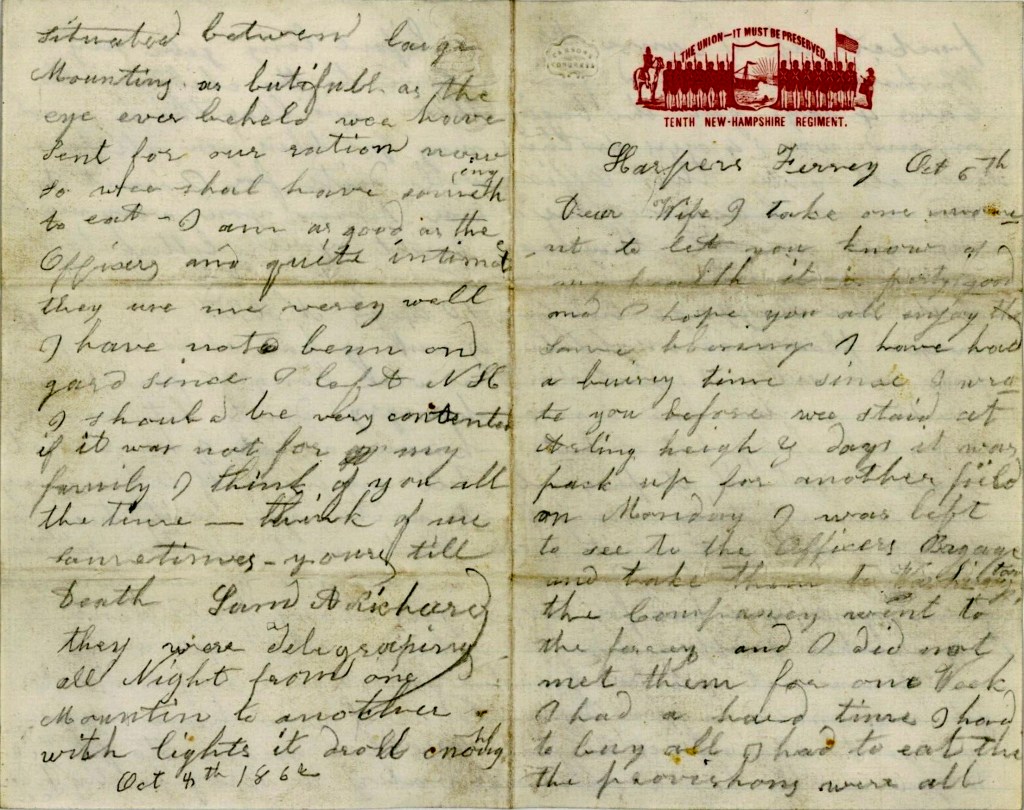
Patriotic letterhead of Samuel’s letter, “Tenth New Hampshire Regiment.”

Harpers Ferry [Virginia]
October 6th 1862

Dear Wife,

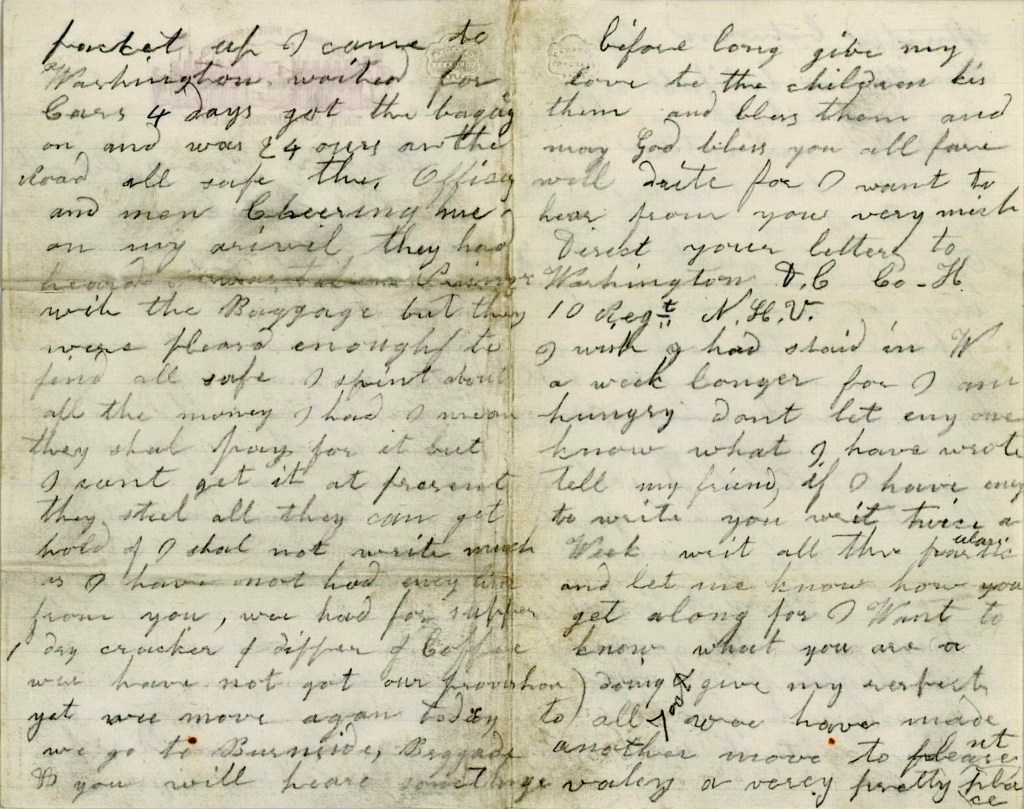
I take one moment to let you know of my health. It is pretty good and I hope you all enjoy the same blessing. I have had a busy time since I wrote to you before. We stayed at Arlington Heights two days. It was pack up for another field on Monday. I was left to see to the officer’s baggage and take them to Washington. The company went to the Ferry and I did not meet them for one week. I had a hard time. I had to buy all I had to eat. The provisions were all packed up. I came to Washington [and] waited for the cars four days, got the baggage on and was 24 hours on the road all safe, the officers and men cheering me on my arrival. They had heard I was taken prisoner with the baggage but they were pleased enough to find all safe. I spent about all the money I had. I mean they shall pay for it but I can’t get it at present. They steal all they can get hold of.

I should not write much as I have not had any line from you. We had for supper 1 dry cracker, 1 dipper of coffee. We have not got our provisions yet. We move again today. We go to Burnside’s Brigade & you will hear something before long.

Give my love to the children. Kiss them and bless them and may God bless you all. Farewell. Write for I want to hear from you very much. Direct your letters to Washington D. C., Co. H, 10th Regt. New Hampshire Volunteers.

I wish I had stayed in Washington a week longer for I am hungry. Don’t let anyone know what I have wrote. Tell my friends—if I have any—to write. You write twice a week. Write all the particulars and let me know how you get along for I want to know what you are a doing. Give my respects to all.

We have made another move to Pleasant Valley—a very pretty place situated between large mountains as beautiful as the eye ever beheld. We have sent for our rations now so we shall have something to eat. I am as good as the officers and quite intimate. They [treat] me very well. I have not been on guard since I left New Hampshire. I should be very contented if it was not for my family. I think of you all the time. Think of me sometimes. yours till death, — Sam A. Richards

They were telegraphing all night from one mountain to another with lights. It [ ] enough October 4th 1862
1864: Henry French to Mary Amelia Smith

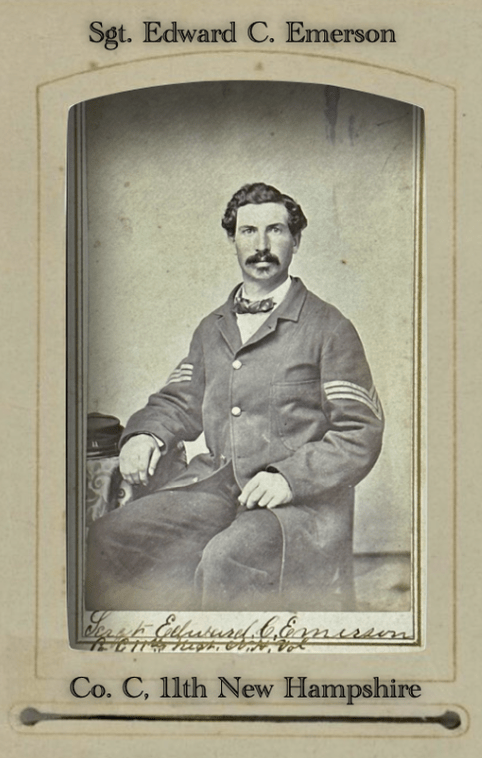
I could not find an image of Sgt. Henry French but here is Sgt. Edward Emerson of Co. C, 11th New Hampshire
(Al & Claudia Niemiec Collection)

The following letter was written by Sgt. Henry French (1834-of Co. H, 11th New Hampshire Infantry. Henry enlisted as on 20 August 1862 and was mustered in as the 1st Sergeant. He was wounded on 13 December 1862 at the Battle of Fredericksburg and was reduced in ranks to a private in May 1863 but a year later was wearing sergeant’s stripes again. He survived the war and mustered out of the service in June 1865.

In his letter, Henry describes the movements of his regiment from the Rapidan to the James River in May 1864.

Henry was the son of Jesse French (1795-1892) and Ann Chamberlain (1813-1897) of Plainfield, Sullivan County, New Hampshire. Henry’s brother, Elias French (1838-1933) also served in the same company. Henry was married to Emma Smith and working as a carpenter/joiner in Plainfield, Grafton county, New Hampshire, when he enlisted. He wrote the letter to his sister-in law, Mary Amelia Smith (b. 1839).

Transcription

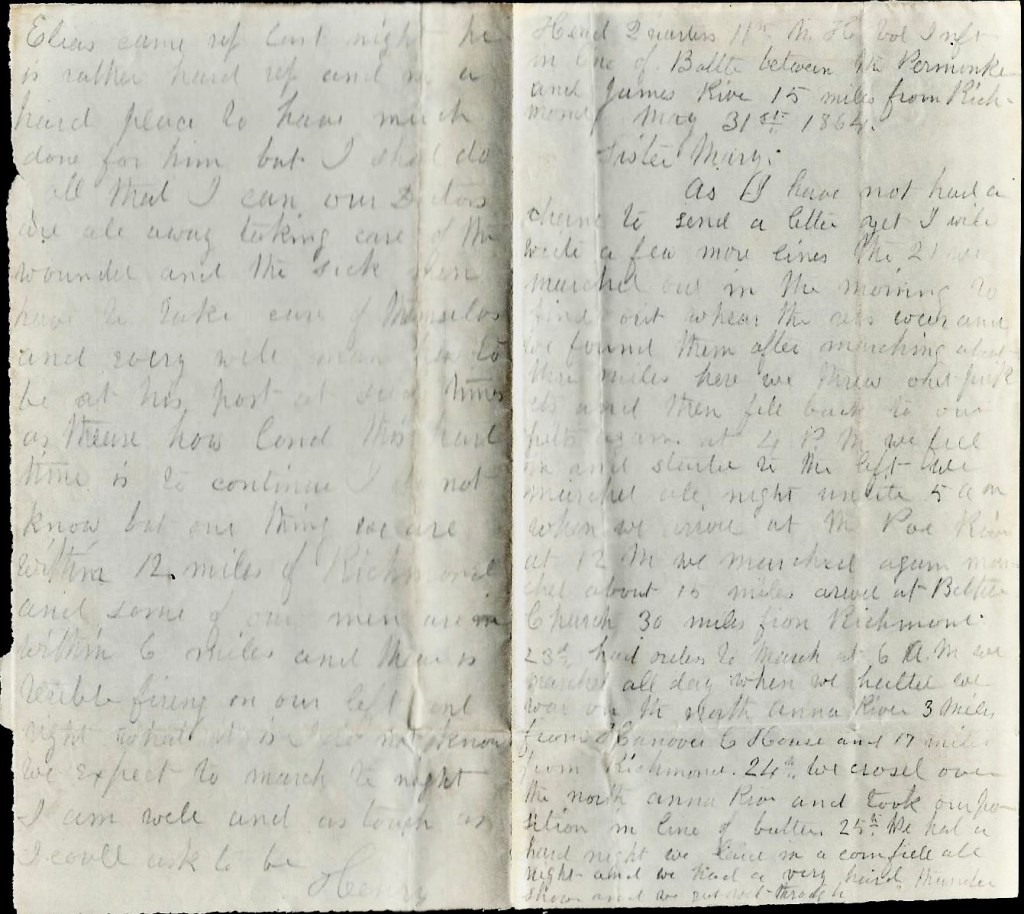
Headquarters 11th N. H. Vol. Infantry
In line of battle between the Pamunkey and James River
15 miles from Richmond [Virginia]
May 31st 1864

Sister Mary,

As I have not had a chance to send a letter yet, I will write a few more lines. The 21st we marched out in the morning to find out where the rebs were and we found them after marching bout three miles. Here we threw out pickets and then fell back to our pits again. At 4 p.m. we fell in and started to the left. We marched all night until 5 a.m. when we arrived at the Po River. At 12 M we marched again. Marched about 15 miles. Arrived at Bethel [?] Church, 30 miles from Richmond.

23rd, had orders to march at 6 a.m. We marched all day. When we halted, we was on the North Anna River 3 miles from Hanover Court House and 17 miles from Richmond.

24th, we crossed over the North Anna River and took our position in line of battle. 25th, we had a hard night. We laid in a cornfield all night and we had a very hard thundershower and we got wet through.

May 26th. Moved out of the cornfield and took our position between two lines of works. We laid here until 9 p.m. when we got orders to fall in. We fell in very still and started when the Rebs rose up and gave us a hard volley and our brigade went out in a hurry but we had no one hurt. When we had got most down to the river, we met Elias. He had just come up with 1100 other men. We marched this night until 2:30 a.m.

27th, today we marched all day until 2 a.m. 28th, file in at daybreak and marched until 11:30 marching 30 miles—the hardest march that our regiment ever had. We crossed the Pamunkey river and marched about 1.5 miles and went into camp. Elias did not come up. It was a very cold night. 29th, 6 a.m. fell in and marched about three miles and halted and commenced a line of rifle pits. Worked on them until about 12 M when we fell in and marched back about 1.5 miles and went into camp to await orders. We laid here all night and had a good time. Got a plenty of fresh meat to eat and had a good woods to sleep in. Have not seen Elias today. Do not know where he is.

30th, today we have laid in line of battle all day but have not been in but some some of the troops have been fighting some all day. Elias has not come up yet. Since I commenced writing this, we have moved to the front about one mile and now lay in the front and expect to go in soon. 31st, last night we had a good night.

May [June] 1st, last night we worked all night throwing up works. We lay about 30 rods from the Rebs works and are banging away at them all of the time. A lot of them are in a house in front of our regiment and we are trying to get them out. We shall give them a try tonight. We drove them one mile yesterday. Our regiment did not lose a man. The 9th lost a few.

Elias came up last night. He is rather hard up and in a hard place to have much done for him but I shall do all that I can. Our doctors are all away and the sick have to take care of themselves and every well man has to be at his post. At such times as these, how hard this hard time is. To continue, I do not know but one thing. We are within 12 miles of Richmond and some of our men are within 6 miles and there is terrible firing on our left and right. What it is, I do not know. We expect to march tonight. I am well and as tough as I could ask to be, — Henry