Category Archives: 11th New York Cavalry

1861-63: Alonzo Freeman to Eliza Marshall Folsom

These letters were written by Alonzo Freeman (1843-1888), the son of Joseph Freeman (1815-1873) and Mary Emeline Folsom (1815-1874). He wrote the letters to his cousin, Eliza Marshall Folsom (1843-1868), the daughter of Levi Folsom (1804-1883) and Eliza A. Freeman (1812-1899). In the 1860 Census, the Folsom’s resided in New York City’s 8th Ward where Levi was employed as the proprietor of a saloon/restaurant. Levi’s wife was employed as an artist.

Alonzo wrote the first two letters while serving in Co. A, 1st New Jersey Infantry—part of the 1st New Jersey Brigade. The third letter was written while a member of Co. C, “Scott’s 900” — the 11th New York Cavalry. He was discharged on 21 July 1865 with the rank of “hospital steward.” The regimental history indicates he was captured at Doyal’s Stockade on 5 August 1864. His father, Joseph, also served in the 11th New York Cavalry. He enlisted at age 43 on 3 January 1862 at New York City in Company G and was discharged on 1 March 1864 due to disability. His rank was “saddler’s sergeant.”

There is a tragedy connected with this family. When Alonzo’s father (Joseph, Sr.) died in 1873, he left his sizable fortune to Alonzo’s mother, Mary Emeline (Folsom) Freeman. When she did not distribute the money to her sons, one of them — Joseph, Jr. (b. 1847) — became disgruntled and threatened to shoot himself with a pistol if she did not give him $2,000 for a business venture. When she refused, he turned the gun on her and shot in her in the back as she was exiting the room, killing her almost instantly. The defense attorney argued that the shooting was accidental, and that the defendant was of “unsound mind” but the jury did not believe it. We learn from the coverage of this incident in the newspapers that Alonzo Freeman used his hospital experience to become a physician after the Civil War. A search of the catalogue for the College of Physicians & Surgeons at Columbia University reveals that Alonzo graduated in 1869.

Letter 1

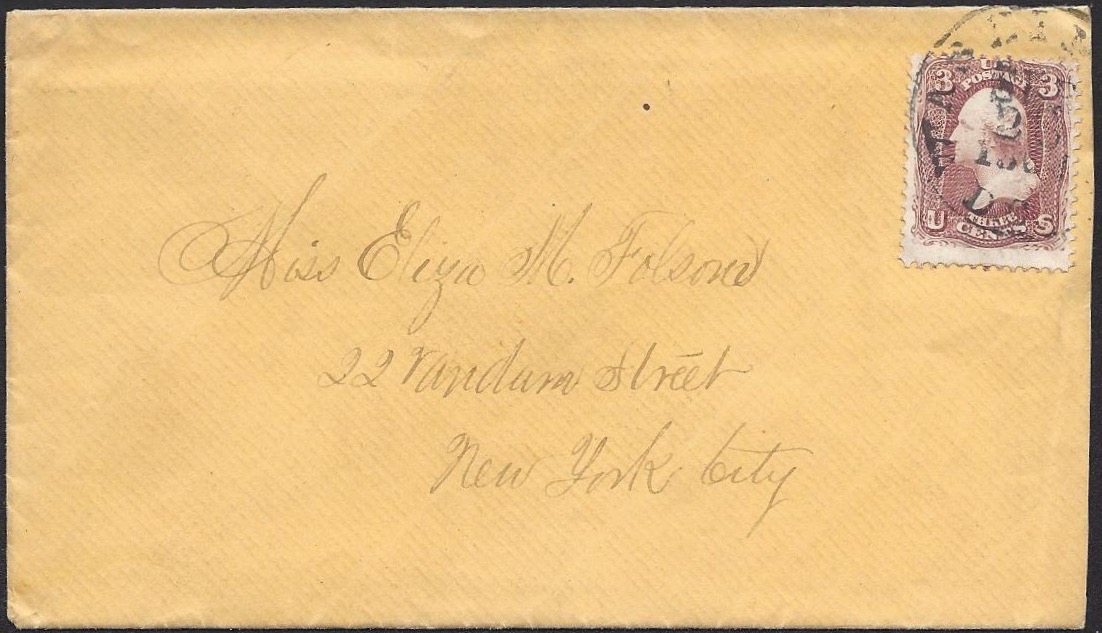
Addressed to Miss Eliza M. Folsom, Care of Levi Folsom, Over Clinton Market, New York City

Camp Seminary, Virginia
September 8th 1861

Dear Cousin,

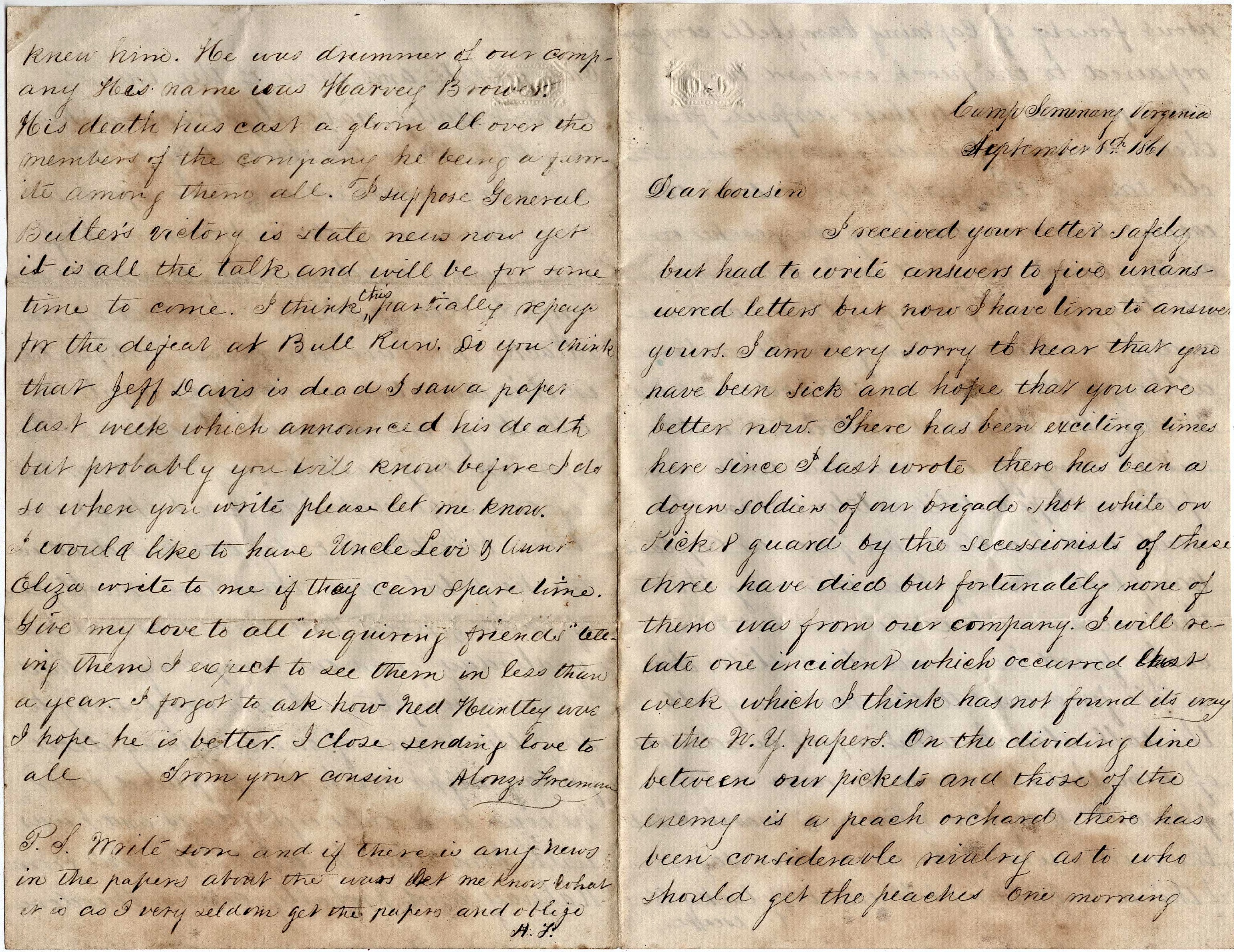
I received your letter safely but had to write answers to five unanswered letters but now I have time to answer yours. I am very sorry to ear that you have been sick and hope that you are better now.

There has been exciting times here since I last wrote. There has been a dozen soldiers of our brigade shot while on picket guard by the secessionists. Of these, three have died but fortunately none of them was from our company.

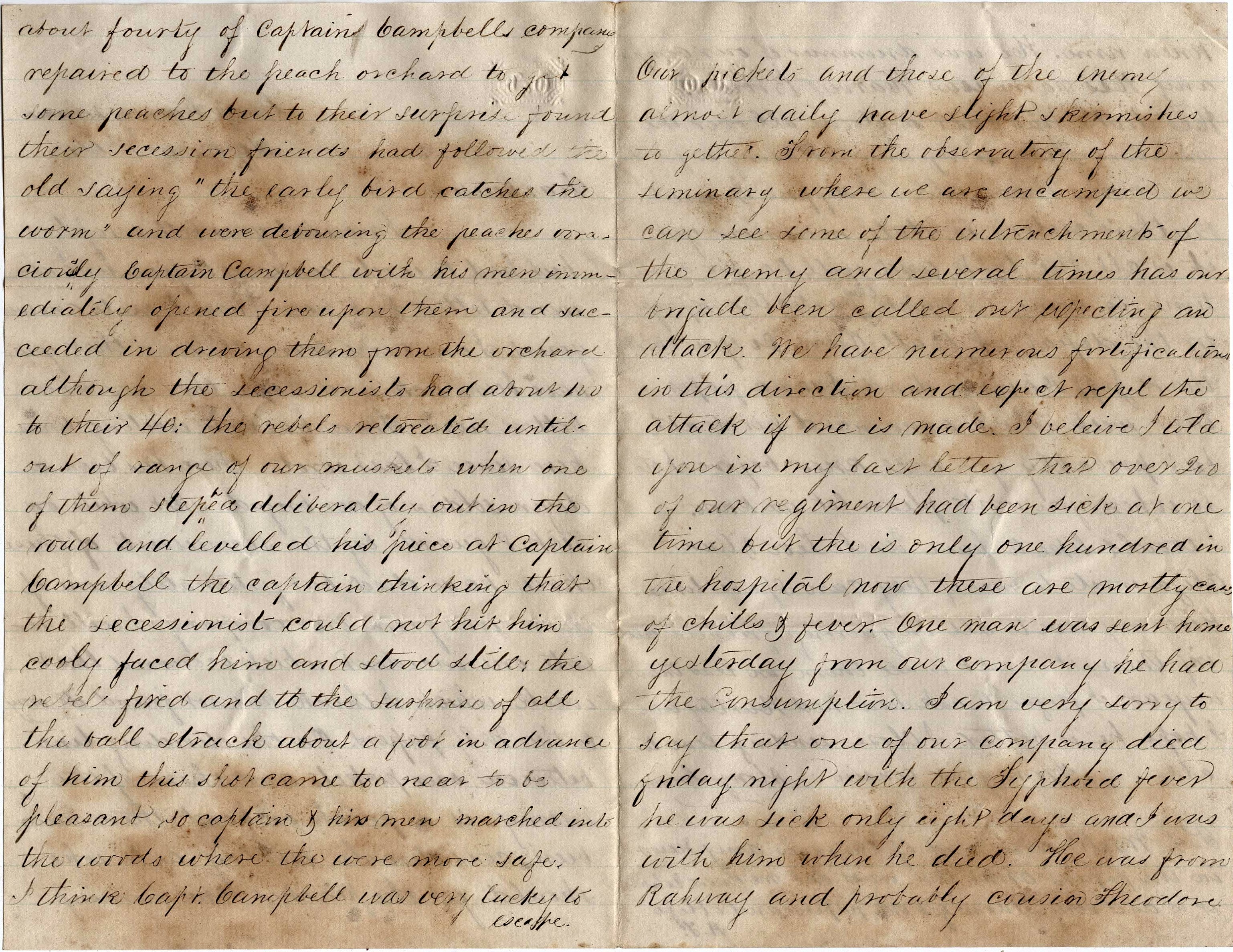
I will relate one incident which occurred that week which I think has not found its way to the N. Y. papers. On the dividing line between our pickets and those of the enemy is a peach orchard. There has been considerable rivalry as to should get the peaches. One morning about forty of Captain [Edward Livingston] Campbell’s company repaired to the peach orchard to get some peaches but to their surprise found their secession friends had followed the old saying, “the early bird catches the worm” and were devouring the peaches voraciously. Captain Campbell with his men immediately opened fire upon them and succeeded in driving them from the orchard although the secessionists had about 100 to their 40. The rebels retreated until out of range of our muskets when one of them stepped deliberately out in the road and leveled his piece at Captain Campbell. The captain, thinking that the secessionist could not hit him, cooly faced him and stood still. The rebel fired and to the surprise of all, the ball struck about a foot in advance of him. This shot came too near to be pleasant so captain and his men marched into the woods where they were more safe. I think Capt. Campbell was very mucky to escape.

Our pickets and those of the enemy almost daily have slight skirmishes together. From the observatory of the Seminary where we are encamped we can see some of the entrenchments of the enemy and several times has our brigade been called out expecting an attack. We have numerous fortifications in this direction and expect to repel the attack if one is made.

I believe I told you in my last letter that over 200 of our regiment had been sick at one time but there is only one hundred in the hospital now. These are mostly cases of chills and fever. One man was sent home yesterday from our company. He had the consumption.

I am very sorry to say that one of our company died Friday night with the Typhoid Fever. He was sick only eight days and I was with him when he died. He was from Rahway and probably cousin Theodore knew him. He was drummer of our company. His name was [Daniel] Harvey Brower. His death has cast a gloom all over the members of the company, he being a favorite among them all.

I suppose Gen. Butler’s victory is stale news now yet it is all the talk and will be for some time to come. I think this partially repays for the defeat at Bull Run. Do you think that Jeff Davis is dead? I saw a paper last week which announced his death but probably you will know before I do so when you write, please let me know. I would like to have Uncle Levi and Aunt Eliza write to me if they can spare time. Give my love to all inquiring friends, telling them I expect to see them in less than a year. I forgot to ask how Ned Huntley was. I hope he is better. I close sending love to all. From your cousin, — Alonzo Freeman

P. S. Write soon and if there is any news in the papers about the war, let me know what it is as I very seldom get the papers and oblige. — A. F.
Letter 2

Baltimore [Maryland]
September 17, 1862

Dear Cousin,

I intended to have written to you before this time but have had no opportunity to do so. You must not think I have neglected to write from want of desire for with the exception of Mother & Sister, there are none to whom I would rather write.

I am getting along very well but [my] wound is not quite well. I have a very pleasant place here in the hospital as druggist, but it is rather confining. However, I get an opportunity sometimes to see the city. There are four Medical cadets here—residents of this city—with whom I am very intimate and through them I have made a number of valuable acquaintances.

Advertisement for “Our American Cousin” playing at the Holliday Street Theater in Baltimore. Asa Trenchard played by John S. Clarke; Mary Meredith played by Fanny Browne. Fanny became famous after her cdv was found on John Wilkes Booth’s dead body. The Baltimore Sun, 20 September 1862.

I was out one evening last week and went to the Holliday Street Theatre. The play was “Our American Cousin” but it appeared very poorly represented when compared with Laura Keene’s version of that piece. Still it was very good.

Baltimore is a very pretty city and resembles New York more than any other place I have been in. Federal Hill is within the city limits and mounts about thirty cannon. This was the quarters of the famous 17th N. Y. Regiment. In case the rebels should attack Baltimore, Federal Hill could shell them from any direction. The Cathedral is a beautiful edifice and is the finest Roman Catholic church in United States.

The people of this city have been much excited about the Confederates. The Union [citizens]—fearing that Baltimore would be attacked; the secesh hoping Jackson would get possession of it. But thank fortune, Jackson can never get to Baltimore. About one half the people of this city are secesh and a riot has been expected.

I understand Charlie [Henry] Bliven has received a commission in the 13th New Jersey Regiment as a first Lieutenant. I am glad of it and wish him success.

I am glad that Brother Joe has escaped so far but I am afraid I shall never see him again. I shall try to get a leave of absence or furlough to come home the last of October but cannot tell whether I wall be successful or not. But I shall have to close this poor letter sending my best wishes and love to all hoping to hear from you soon. I remain your affectionate cousin, — Alonzo Freeman


Letter 3
Hospital, Scotts “900”
September 25th 1863

Dear Cousin,

I received your letter safely — also one from Theodore — and am very sorry to hear that you and Uncle Levi are so sick. It was too bad that Rinalds & Egerton had to leave New York so soon. I suppose they have joined the “Army of the Potomac” again.

What do you think of the war out West? I think that Rosencranz [William Rosecrans] did first rate [at the Battle of Chickamauga] but it was strange that General [Ambrose] Burnside did not reinforce him. At Charleston we are getting along very slowly. Fort Sumter is in possession of the rebels yet. We have seven companies stationed about sixteen miles from here. They are skirmishing with the rebels almost every day.

Father was up there this week but came back the next day. The Doctor says he thinks he will send me there with medicine for the sick. I hope he will do so. Our hospital is filled with sick. We are very busy.

I have enclosed a letter to Harriet which is important and I would like to have her get it as soon as possible. This only an apology for a letter as I am in a great hurry. I will write again on Monday. Father and I are both well and send love to all.

From your cousin, — Alonzo Freeman

1863-65: William Wallace Andrus to Eliza Ann (Andrus) Butler

The following letters were written by William Wallace Andrews [Andrus] (1845-1907) who enlisted on 30 November 1863 at Malone, New York, to serve in Co. M, 11th New York Cavalry. William’s enlistment records inform us that he was born in Malone, New York; that he was a farmer by occupation; and that he stood 5 feet 8.5 inches tall, with blue eyes, brown hair, and a light complexion. For William, this was his second tour of duty. He first enlisted as a private in Co. G, 92nd New York Infantry, on 30 December 1861 but was discharged for disability less than four months later. When he enlisted that time he claimed to be 19 years old but his birth record tells us he had really only just turned 16.

I couldn’t find a picture of William but here is one of James Jones of Co. K.

While serving in the 11th New York Cavalry, William was taken prisoner at New Orleans by guerrillas in August 1864 and he was held for 17 days before he was exchanged and returned to his regiment. He was then taken prisoner a second time near Memphis on 19 April 1865 and soon after exchanged.

William was the son of Winant Andrus (1812-Bef1850) and Eliza A. Vaum (or Vaughan) (1823-1898). By the time of the Civil War, Eliza had taken John C. Butler (1812-1864) as her second husband and had three or four children with him. John Butler also served in the war, volunteering in December 1863 as a private in Co. M, 6th New York Heavy Artillery. Unfortunately he did not survive the war. He died of disease on 26 December 1864 at the Judiciary Square Hospital in Washington D. C. when he was 52 years old. John Butler is referred to as the “Old Man” in these letters.

William died in 1907 and was buried in Hillcrest Cemetery, Parishville, St. Lawrence county, New York.

Letter 1

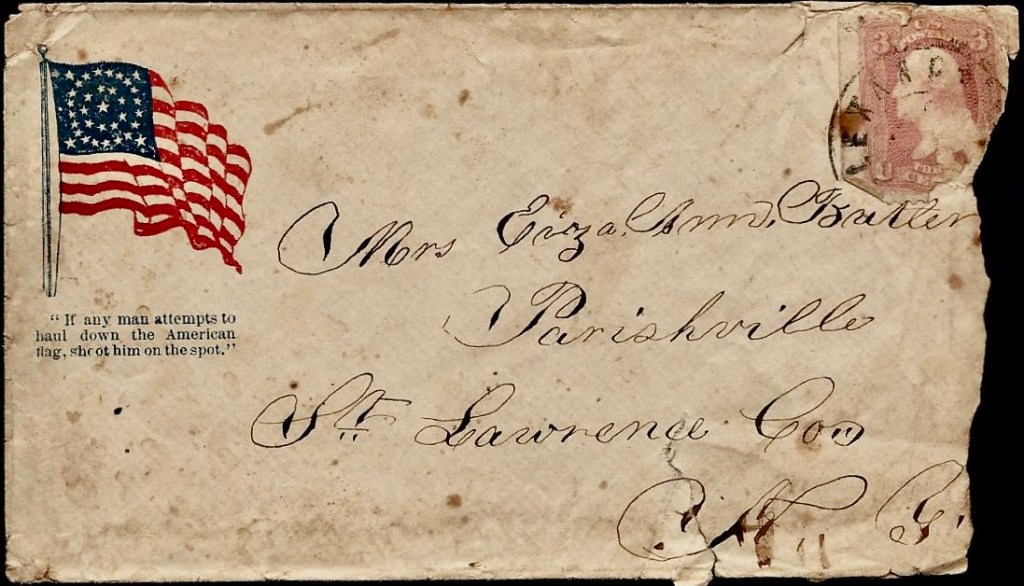
Addressed to Mrs. Elizabeth Ann Butler, Parishville, St. Lawrence Co., New York

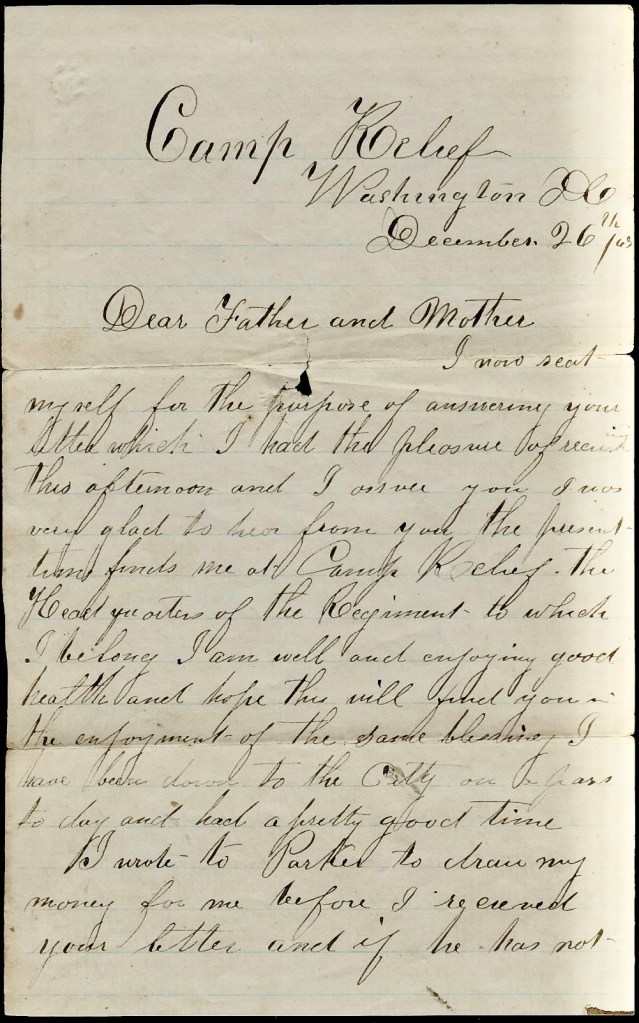
Camp Relief
Washington D. C.
December 26, 1863

Dear Father & Mother.

I now seat myself for the purpose of answering your letter which I had the pleasure of receiving this afternoon and I answer you. I was very glad to hear from you. The present time finds me at Camp Relief, the headquarters of the regiment to which I belong. I am well and enjoying god health and hope this will find you in the enjoyment of the same blessing. I have been down to the city on a pass today and had a pretty good time.

I wrote to Parker to draw my money for me before I received your letter and if he has not got it, I want you to get it for me and buy that piece of land you spoke about for me. I am about out of money down here and if you get that 300, please send me 5 or $10 and some postage stamps. If Parker has drawn the money, you take the line to him that I have wrote on the other side of this sheet and get the money.

Father, if you enlist, come down here in this regiment. It is one of the best regiments there is. We have plenty to eat and nothing to do. I have had no duty to do yet. I will close now hoping to hear from you soon. So goodbye. From your son, — William A. [W.] Andrus

To my Father and Mother

Direct your letter the same as before and write as soon as you get this.


Letter 2

[Camp Relief, Washington D. C.]
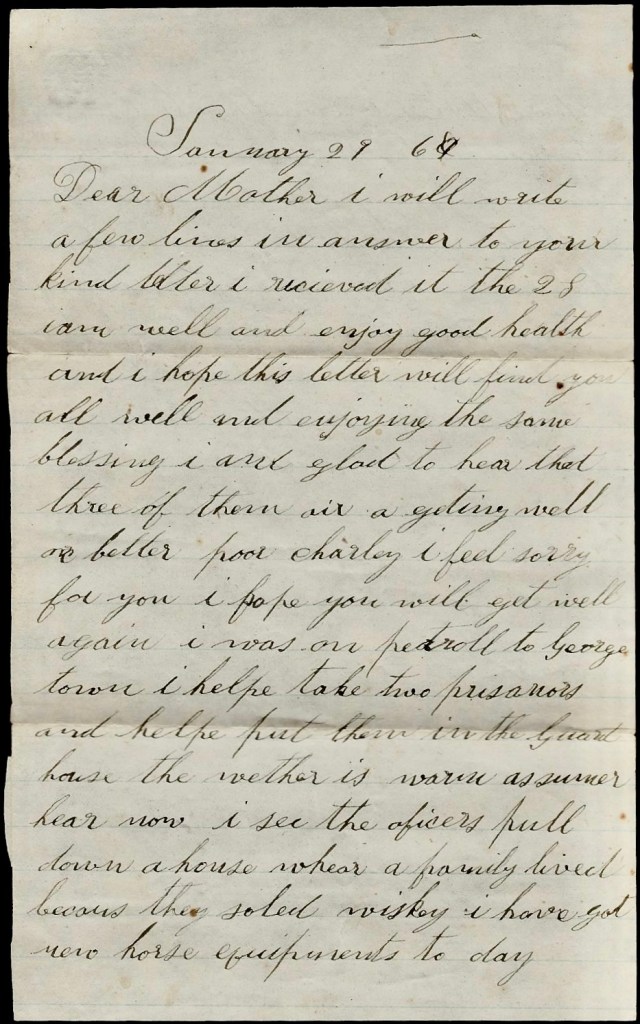
January 29, 1864

Dear Mother,

I will write a few lines in answer to your kind letter. I received it the 28th. I am well and enjoy good health and I hope this letter will find you all well and enjoying the same blessing. I am glad to hear that three of them are a getting well or better. Poor Charley. I feel sorry for you. I hope you will get well again.

I was on patrol to Georgetown. I helped take two prisoners and helped put them in the guard house.

The weather is warm as summer here now. I see the officers pull down a house where a family lived because they sold whiskey. I have got new horse equipments today.

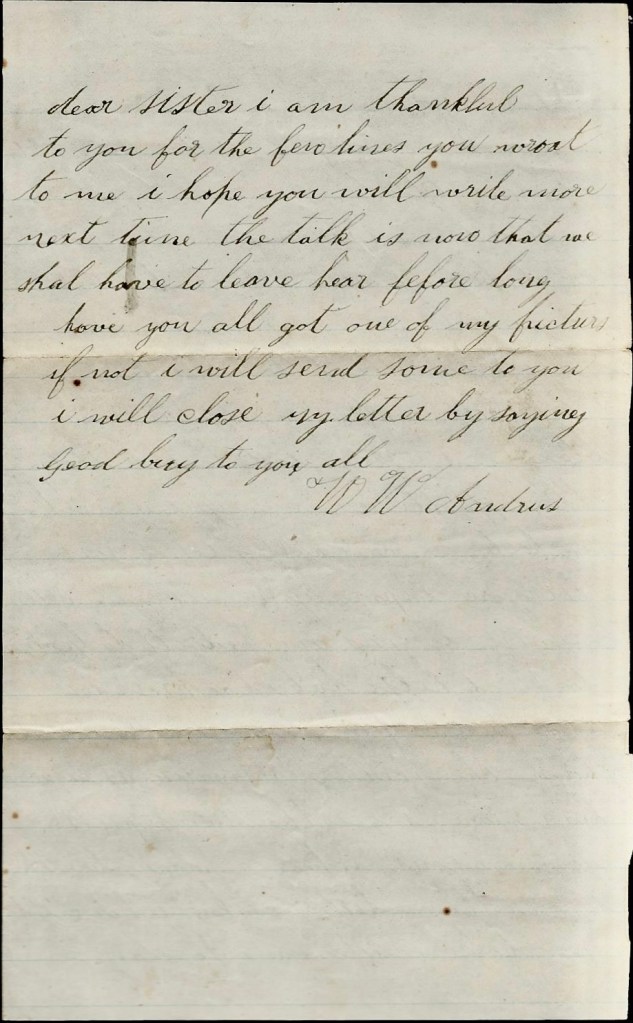
Dear sister, I am thankful to you for the few lines you wrote to me. I hope you will write more next time. The talk is now that we shall have to leave here before long. Have you all got one of my pictures? If not, I will send some to you. I will close my letter by saying goodbye to you all. — W. W. Andrus


Letter 3

[Camp Relief, Washington D. C.]
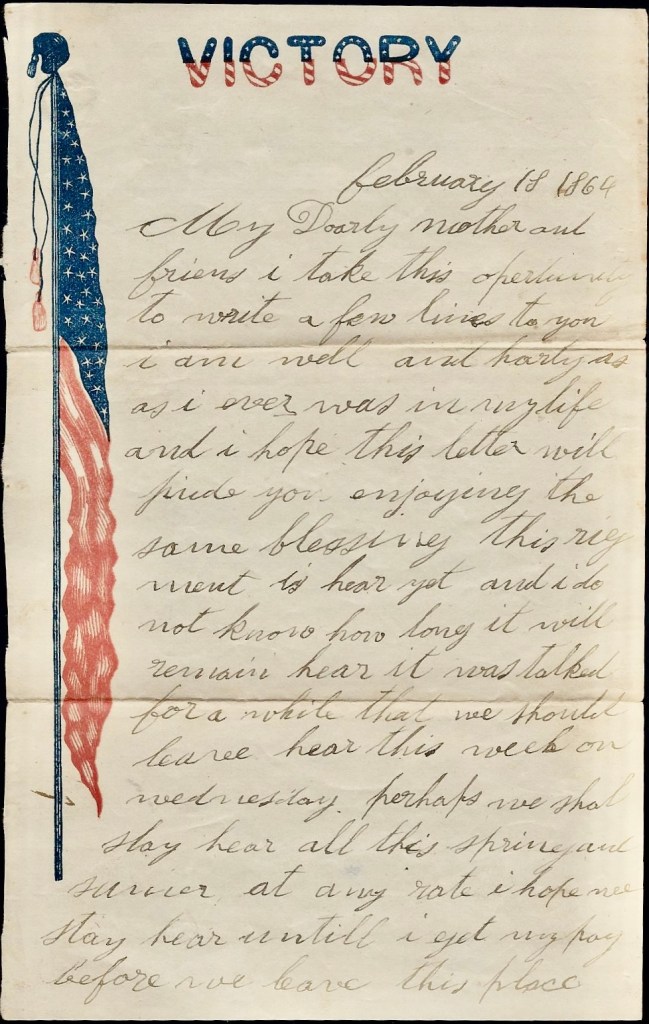
February 18, 1864

My dearly mother and friends,

I take this opportunity to write a few lines to you. I am well and hearty as I ever was in my life and I hope this letter will find you enjoying the same blessing. This regiment is here yet and I do not know how long it will remain here. It was talked for a while that we should leave here this week on Wednesday. Perhaps we shall stay here all this spring and summer. At any rate, I hope we stay here until I get my pay before we leave this place.

Mother, I wish you could send me eighteen or twenty dollars and I will get a furlough and come home. All of the old soldiers got their pay but the new recruits did not get paid this time. If you ever want to see me again, now is your only chance for if I have to go to Texas, I think it will be a chance if we ever see each other’s faces again on earth. You cannot imagine how I want to see all of you.

I have written to the Old Man and have not got any answer from him yet. Now I want you should answer this letter as soon as you can without delay. From — William W. Andrus


Letter 4

[New Orleans, Louisiana]
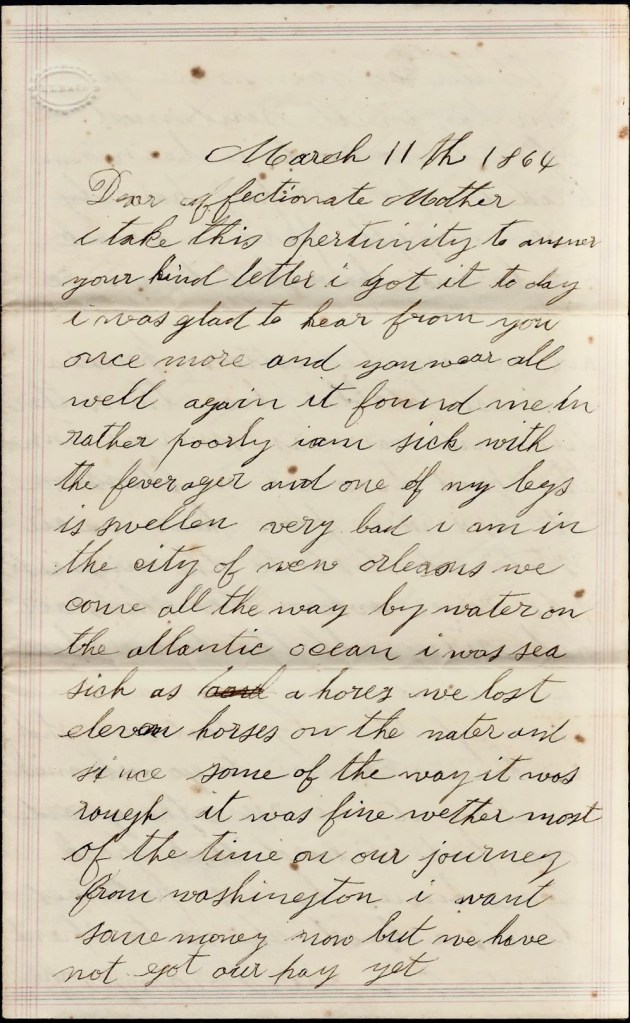
March 11th 1864

Dear affectionate mother,

I take this opportunity to answer your kind letter. I got it today. I was glad to hear from you once more and you were all well again. It found me in rather poorly. I am sick with the fever ague and one of my legs is swollen very bad. I am in the city of New Orleans. We came all the way by water on the Atlantic Ocean and I was seasick as a horse. We lost eleven horses on the water and since. Some of the way it was rough. It was fine weather most of the time on our journey from Washington.

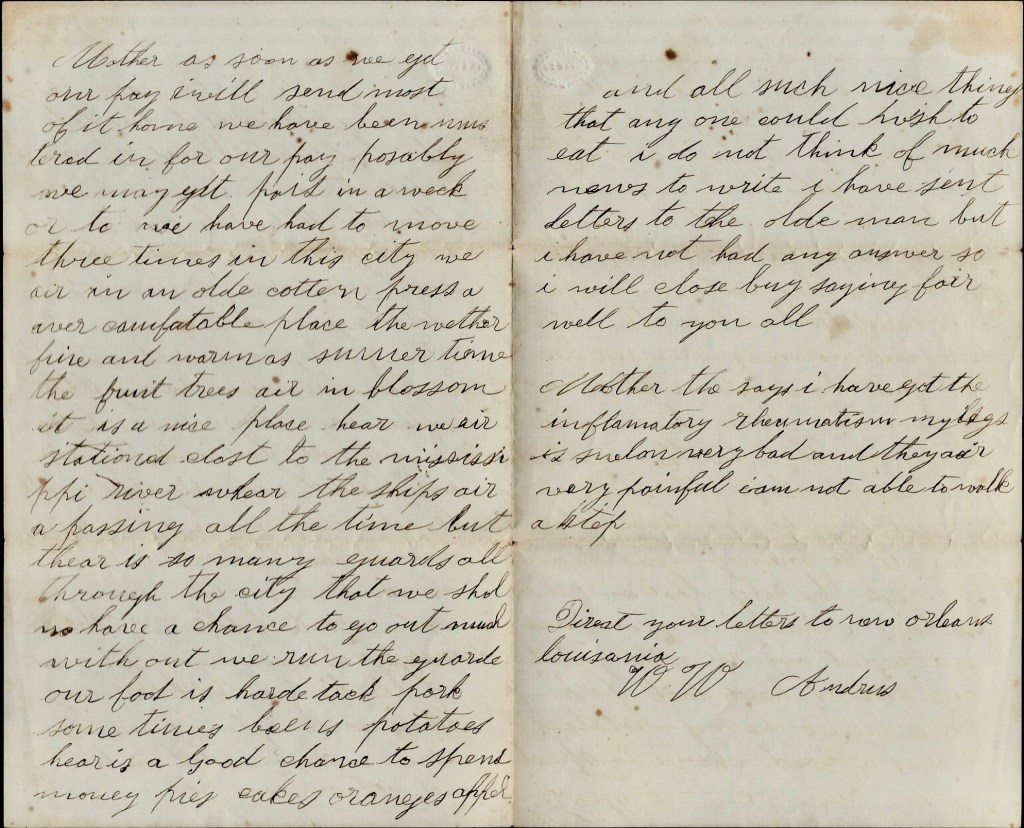
I want some money now but we have not got our pay yet. Mother, as soon as we get our pay I will send most of it home. We have been mustered in for our pay. Possibly we may get paid in a week or two. We have had to move three times in this city. We are in an old cotton press—a very comfortable place. The weather is fair and warm as summer time. The fruit trees are in blossom. It is a nice place here. We are stationed close to the Mississippi river where the ships are a passing all the time but there is so many guards all through the city that we shall not have a chance to go out much without we run the guards.

Our food is hard tack, pork, sometimes beef and potatoes. There is a good chance to spend money [on] pies, cakes, oranges, apples, and all such nice things that anyone could wish to eat. I do not think of much news to write. I have sent letters to the Old Man but I have not had any answer so I will close by saying farewell to you all.

Mother, the [doctor] says I have got the inflammatory rheumatism. My legs is swollen very bad and they are very painful. I am not able to walk a step. Direct your letters to New Orleans, Louisiana.

— W. W. Andrus


Letter 5

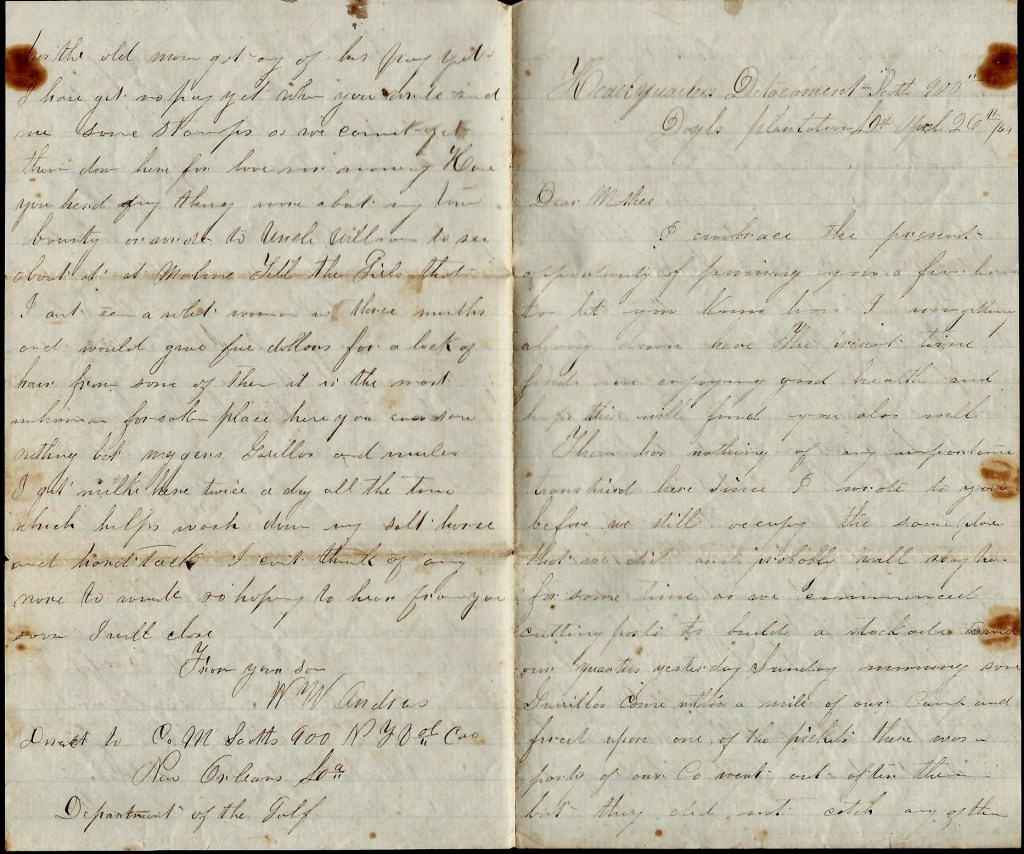
Headquarters Detachment “Scott’s 900”
Doyles Plantation, Louisiana
April 26th, 1864

Dear Mother,

I embrace the present opportunity of penning you a few lines to let you know how I am getting along down here. The present time finds me enjoying good health and hope this will find you also well.

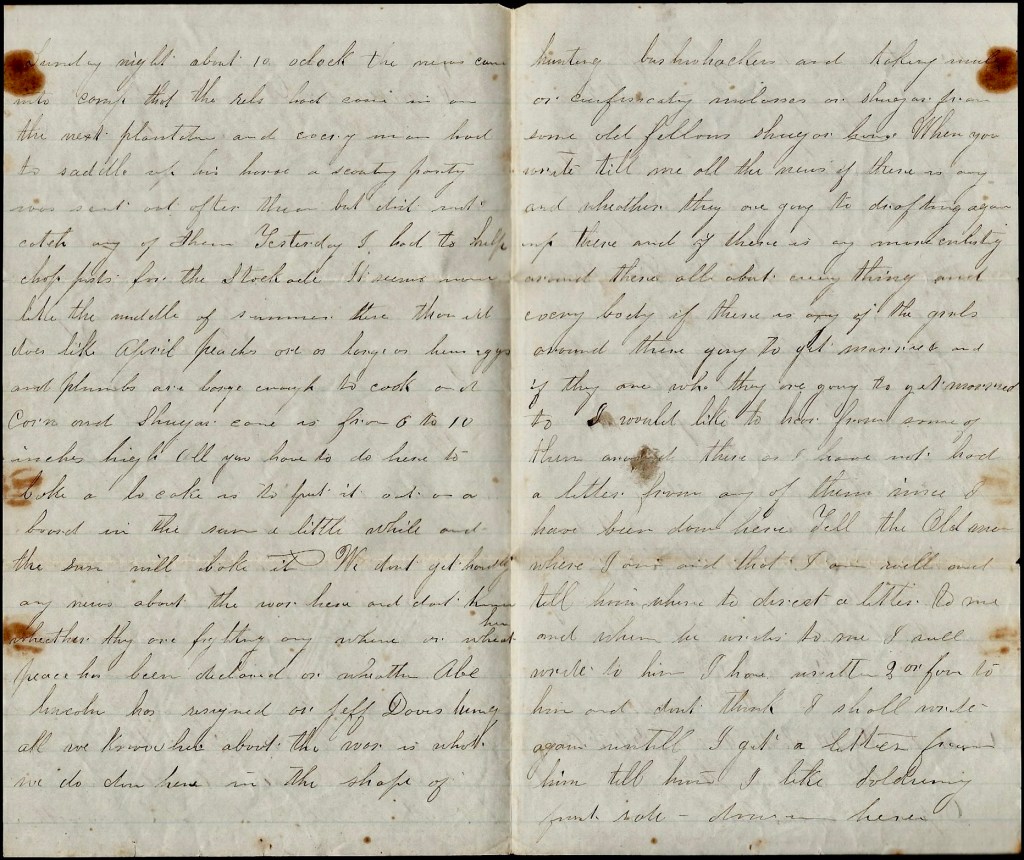
There has nothing of any importance transpired here since I wrote to you before. We still occupy the same place that we did and probably will stay here for some time as we commenced cutting posts to build a stockade around our quarters yesterday. Sunday morning some guerrillas came within a mile of our camp and fired upon one of the pickets. There was parts of our company went out after them but they did not catch any of them.

Sunday night about ten o’clock the news came into camp that the rebs had come in on the next plantation and every man had to saddle up his horse. A scouting party was sent out after them but did not catch any of them. Yesterday I had to help chop posts for the stockade. It seems more like the middle of summer here than it does like April. Peaches are as large as hen eggs and plums are large enough to cook and corn and sugar cane is from 6 to 10 inches high. All you have to do here to bake a cake is to put it out on a board in the sun a little while and the sun will bake it.

We don’t get hardly any news about the war here and don’t know whether they are fighting anywhere or whether peace has been declared or whether Abe Lincoln has resigned or Jeff Davis hung. All we know here about the war is what we do down here in the shape of hunting bushwhackers and taking mules or confiscating molasses or sugar from some old fellow’s sugar house.

When you write, tell me all the news if there is any, and whether they are going to drafting again up there and if there is any more enlisting around there, all about everything and everybody, if there is any of the girls around there going to get married, and if they are, who they are going to get married to. I would like to hear from some of them around there as I have not had a letter from any of them since I have been down here. Tell the Old Man where I am and that I am well and tell him where to direct a letter to me and when he writes to me, I will write to him. I have written 3 or 4 to him and don’t think I shall write again until I get a letter from him. Tell him I like soldiering first rate down here.

Has the old man got any of his pay yet? I have got no pay yet. When you write, send me soe stamps as we cannot get them down here for love no money. Have you heard anything more about my town bounty? or wrote to Uncle William to see about it at Moline? Tell the girls that I ain’t seen a white woman in three months and would give five dollars for a lock of hair from some of them. It is the most inhuman, forsaken place here you ever saw. Nothing but niggers, guerrillas and mules.

I get milk here twice a day all the time which helps was down my salt horse and hard tack. I can’t think of anything more to write so hoping to hear from you soon, I will close. From your son, — W. W. Andrus

Direct to Co. M, Scott’s 900, NYS Vol. Cavalry, New Orleans, La., Department of the Gulf


Letter 6

Memphis, Tennessee
March 14th 1865

Dear Mother,

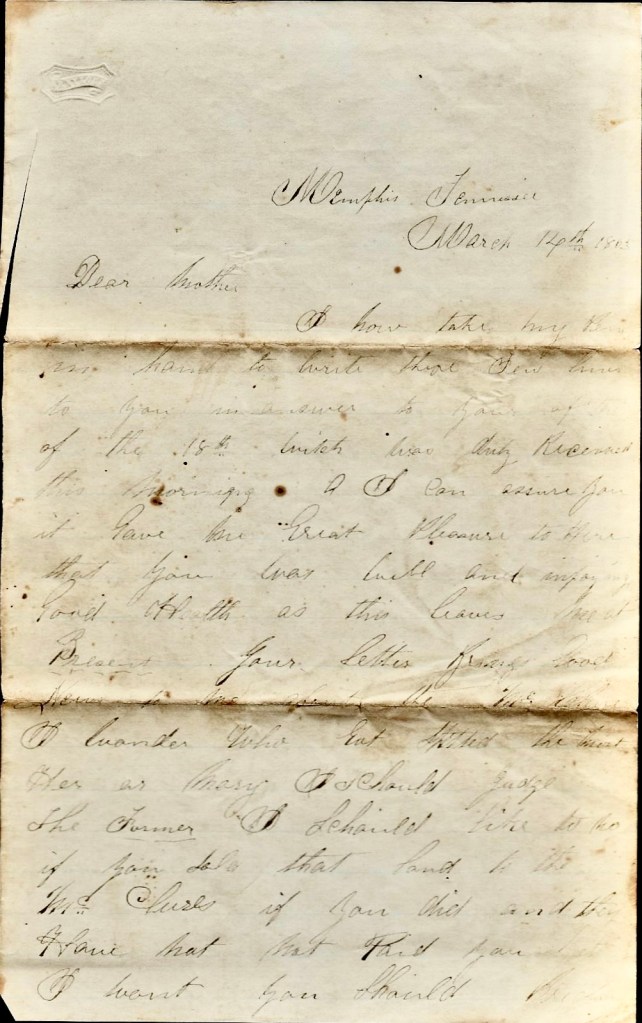
I now take my pen in hand to write these few lines to you in answer to yours of the 18th which was duly received this morning. I can assure you it gave me great pleasure to hear that you was well and enjoying good health as this leave me at present.

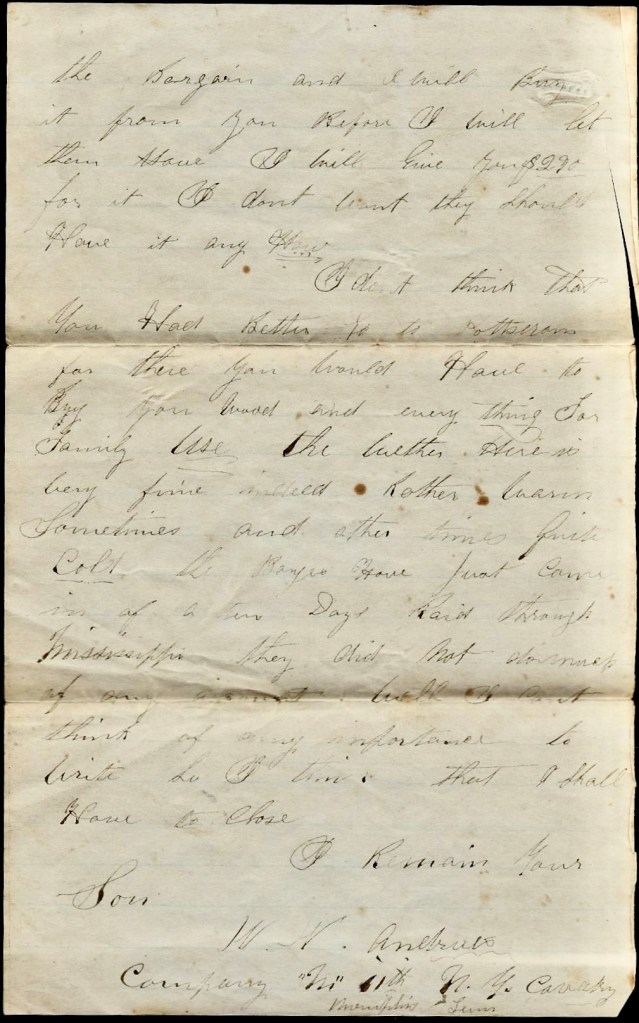
Your letter brings good news to me [illegible]. I wonder who got [ ] the most—her or Mary? I should judge the former. I should like to know if you sold that land to the McClure’s. If you did and they have not yet paid you, I want you should [ ] the bargain and I will buy it from you before I will let them have. I will give $290 for it. I don’t want they should have it anyhow.

I don’t think that you had better go to Potsdam for there you would have to buy your wood and everything for family use. The weather here is very fine indeed. Rather warm sometimes and other times quite cold.

The boys have just come in off a ten days raid through Mississippi. They did not do much of any account. Well, I can’t think of any importance to write so I think that I shall have to close. I remain your son, — W. W. Andrus

Company M., 11th N. Y. Cavalry, Memphis, Tenn.