
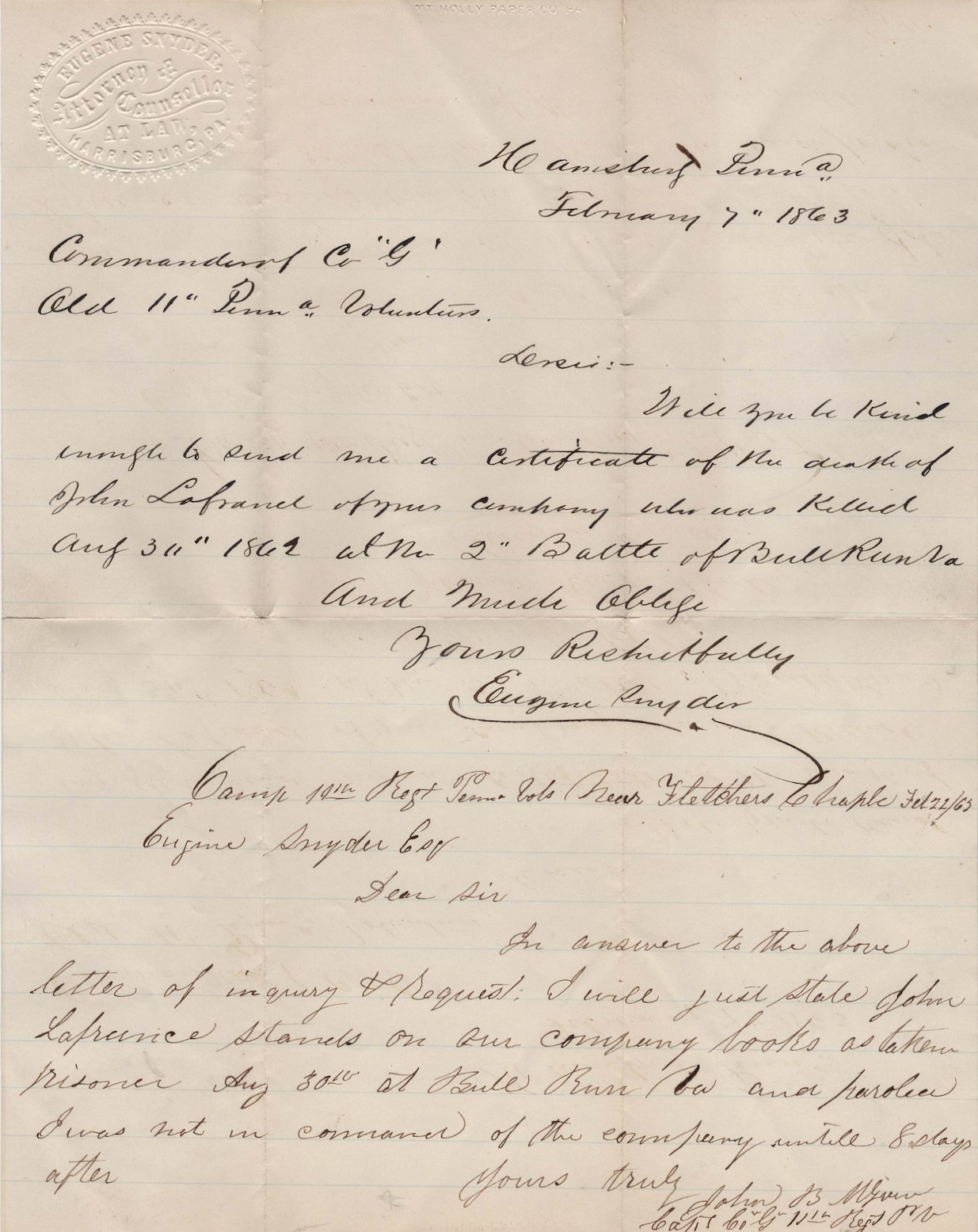
The following letter was written by Eugene Snyder, a 26 year-old attorney practicing in Harrisburg, Dauphin county, Pennsylvania, in 1863. He was the son of Charles Albright Snyder (1799-1868) and Barbara Ann Keller (1807-1892). His letter requests a death certificate for John La France, a private in Co. G, 11th Pennsylvania Infantry. Presumably he was engaged by some family member who had been informed of John’s death in the Battle of 2nd Bull Run. Responding to Eugene on the same sheet of paper, the soldier’s captain, John B. McGrew, informed the attorney that John La France had not actually died, but had been taken prisoner and was paroled though his cryptic response does not provide any details as to the soldier’s present location or state of health. His response would leave us to believe that the soldier was not yet with the company, however.
Curiously, according to muster roll records, John La France appears twice. One entry does not provide a service entry date and reports that he died of wounds received at Bull Run on 30 August 1862. The other records his service entry date as July 10, 1862 and states that he was discharged on Surgeon’s Certificate on 12 October 1863. To further muddy the waters, there is a Veterans Card File entry for John La France of Co. G, 11th Pennsylvania Infantry that claims he “died by reason of gunshot received in action at Antietam on 17 September 1862.”
Unfortunately I could not find any more information on John La France though one war-time record claims his residence was Allegheny county. I could find no pension record for him either.
John B. McGrew (1826-1884) enlisted in August 1862 and was commissioned the Captain of Co. G at that time. He was wounded on 13 December 1862 during the Battle of Fredericksburg and was discharged on 15 March 1865 for disability. He lived in Allegheny county, Pennsylvania.
The 11th Pennsylvania was recruited from several counties in Pennsylvania as a three-month regiment on April 26, 1861, and sent to Camp Curtin, Harrisburg for training and organization. Phaon Jarrett served as its first colonel, with Richard Coulter as lieutenant colonel and William D. Earnest as major. It was assigned to Robert Patterson’s Army of the Shenandoah. The regiment received the nickname “The Bloody Eleventh” at the Battle of Hoke’s Run, Virginia, July 2, 1861.
The 11th was reorganized as a three-year regiment in the August of the same year at Camp Curtin in Harrisburg. After a few weeks of drill, the regiment was given garrison duty at Annapolis, Maryland. In April, it was moved to Mannassas Junction, where it guarded the railroad. It was again transferred, this time to the Shenandoah Valley, in late May as part of Irvin McDowell’s Corps. They fought in the Battles of Cedar Mountain and Second Bull Run. After the Army of Virginia was merged into the Army of the Potomac, the reconstituted regiment became part of the I Corps.
T R A N S C R I P T I O N
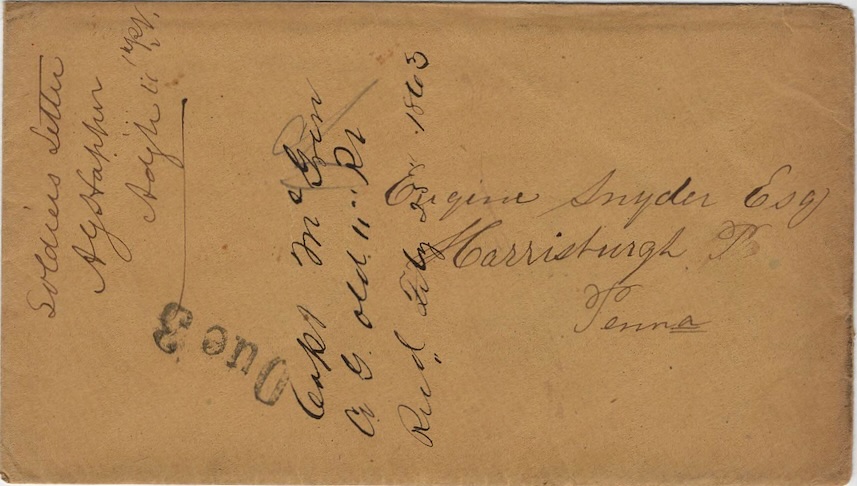
Harrisburg, Pennsylvania
February 7, 1863
Commander of Co. G
Old 11th Pennsylvania Volunteers
Dear Sir,
Will you be kind enough to send me a certificate of the death of John Lafrance of your company who was killed August 30th 1862 at No. 2 Battle of Bull Run, Virginia. And much oblige.
Yours repectfully, — Eugene Snyder
[in different hand writing]
Camp 11th Regt. Penna. Vols. near Fletchers Chapel
February 22, 1863
Eugene Snyder, Esq.,
Dear Sir, in answer to the above letter of inquiry & request, I will just state John Lafrance stands on our company books as taken prisoner August 30th at Bull Run, Va., and paroled. I was not in command of the company until 8 days after. Yours truly, —John B. M’Grew, Capt. Co. G, 11th Regt. P. V.
 Spared & Shared 23