

The following letter was written by Pvt. Willard Morse (1833-1864) who enlisted in Co. F, 11th Vermont Infantry in the summer of 1862. Being assigned duty in the defenses of Washington D. C., this regiment was soon changed to heavy artillery and renamed the 1st Vermont Heavy Artillery. Once in Washington, this regiment remained for the next 20 months garrisoning Federal forts. Following the Battle of the Wilderness in May 1864, the regiment was sent sent to the field as infantrymen, joining the Old Vermont Brigade in Grant’s army at Spotsylvania.
Willard was the son of David Sunderland Morse (1805-1882) and Mary Willard (1805-1845). He was married to Martha “Elizabeth” Cummings (1838-1906) in October 1847, had two young daughters, and was living in Morgan, Orleans county, Vermont when he enlisted. He was taken prisoner “while on a raid on the Weldon Railroad near Petersburg” on 23 June 1864 and held at Andersonville Prison in Georgia where he died of chronic diarrhea and starvation some six weeks later on 3 August 1864. Willard’s death on 2 August was described in George W. Dewey’s diary.
The letter was addressed to Willard’s cousin whom he called “Ford.” I believe this was Hobart Bradley Ford (1826-1910) who married Lucy Ann Morse (1829-1908), Willard’s cousin.
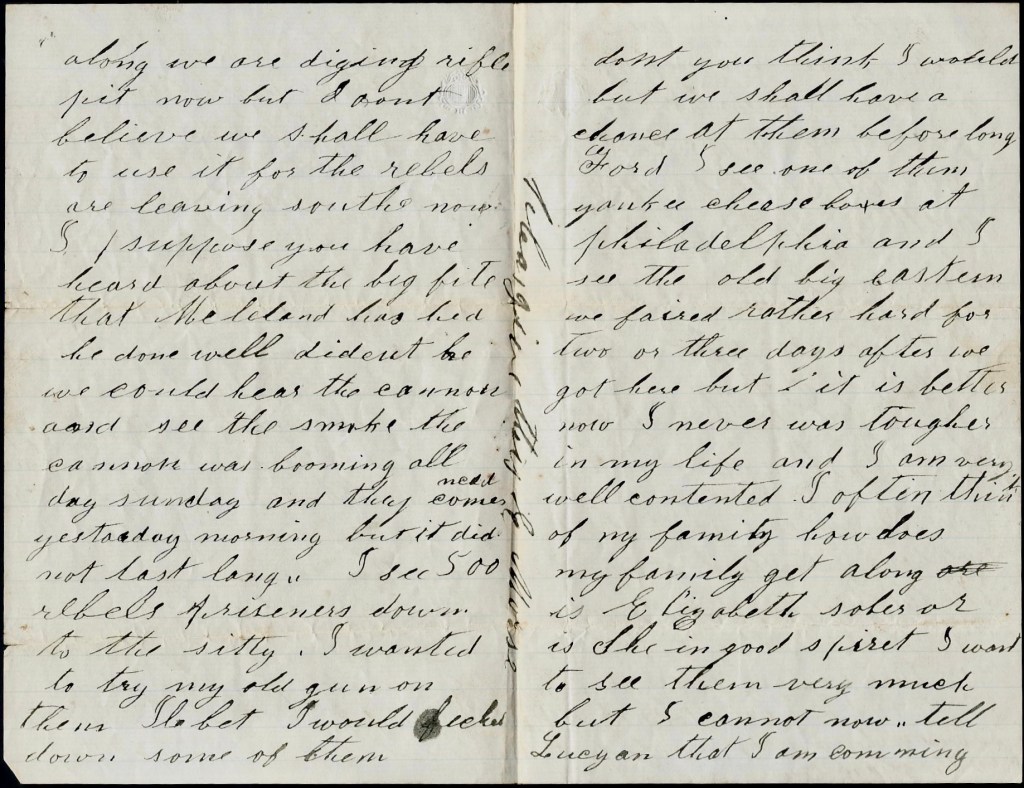
Willard’s letter was written from Fort Lincoln where they had recently been digging rifle pits to augment the fort’s defenses in the event that Lee’s army had turned on Washington rather than attacking Harper’s Ferry and heading into Western Maryland. Willard praises McClellan’s performance at South Mountain (“He done well, didn’t he?”) and describes seeing the smoke and hearing the artillery 70 miles away from their defenses at Fort Lincoln. Little could he have imagined the carnage that would occur at Sharpsburg the day after this letter was written.
Transcription
Fort Lincoln, Washington [City]
Tuesday morning, September 16, 1862
Absent cousin,
I now take my pen to write a few lines to you to let you know that I am yet alive and well and hope this will find you the same. I guess you began to think that I was not agoing to write to you but we have had so much to do that I could not write so you must excuse me this time. I guess Elizabeth has forgot me for I have not had a letter from her for a long time.
I suppose you want to know how we are getting along. We are digging rifle pits now but I don’t believe we shall have to use it for the rebels are leaving south now. I suppose you have heard about the big fight that McClellan has had. He done well, didn’t he. We could hear the cannon and see the smoke. The cannon was booming all day Sunday and they commenced yesterday morning but it did not last long. I see 500 rebel prisoners down to the city. I wanted to try my old gun on them. I’ll bet I would [have] fetched down some of them, don’t you think I would. But we shall have a chance at them before long.
Ford, I see one of them Yankee cheese boxes at Philadelphia and I see th old big Eastern. We fared rather hard for two or three days after we got here but it is better now. I never was tougher in my life and I am very well contented. I often think of my family. How does my family get along? Is Elizabeth sober or is she in good spirit? I want to see them very much but I cannot now tell Lucyann that I am coming in with my dirty feet to step on her clean floor. How does Orren and Townsend get along? I wrote to Orren and Elizabeth Sunday.
Well, Ford, I must close for we have got to go to work. Write as soon as you get this. Direct to Washington, 11th Regiment, Co. F, in care of Capt. [James] Rice. We have got the best captain in the regiment. The first day we dig rifle pits, they said we dug more than any regiment ever dug in 3 days and our captain told us if [we] worked so another day, he would put us in the guard house.
Goodbye, — W. Morse
Write soon.


 Spared & Shared 23