Category Archives: 120th New York Infantry

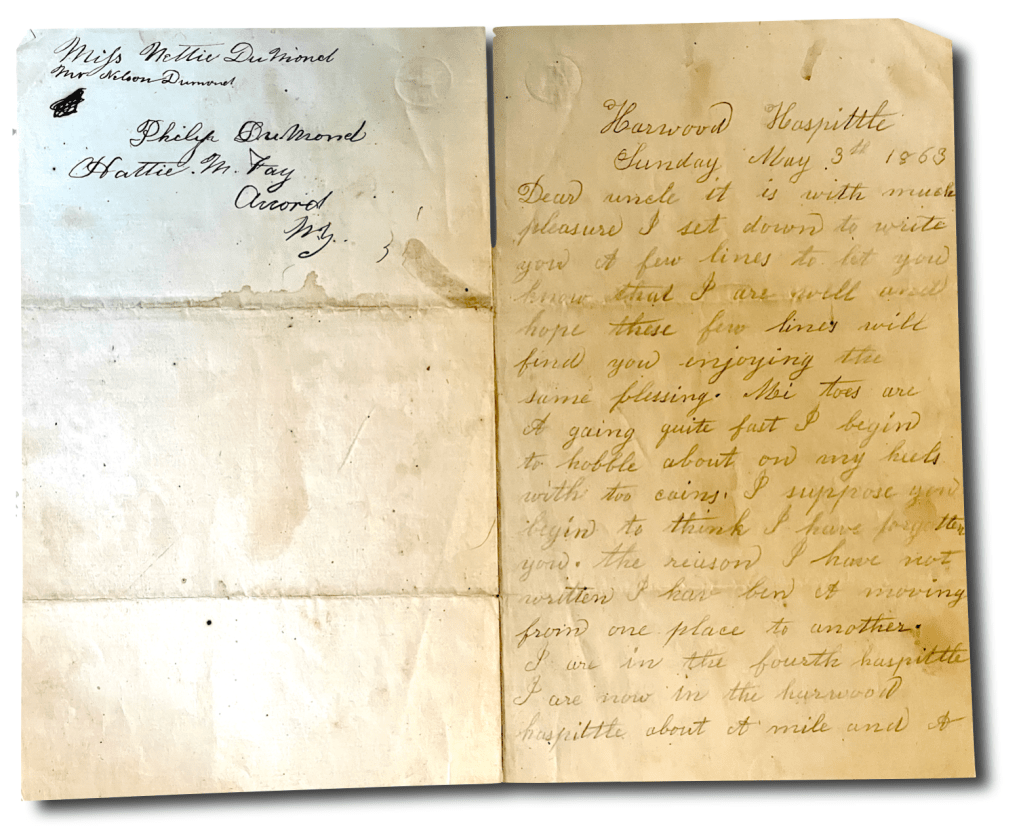
1863: Conrad Dumond, Jr. to Philip Dumond

The following letter was written by Conrad Dumond, Jr., the son of Johannes Conrad Dumond (1799-1877) and Jane Van Benschoten (1812-1839) of Kingston, Ulster county, New York. After his mother died, his father remarried to Silvia Warren. By the time of the 1860 US Census, Conrad was working as a farm laborer in Hurley, New York.
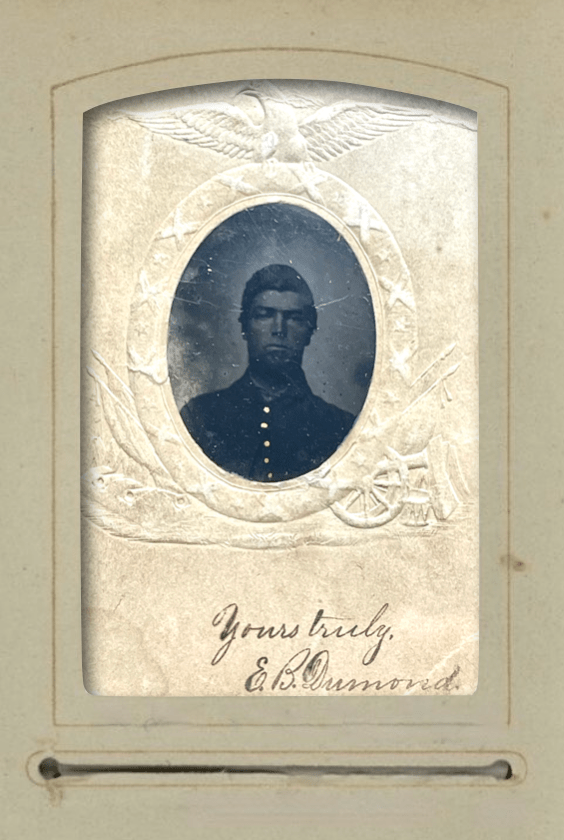
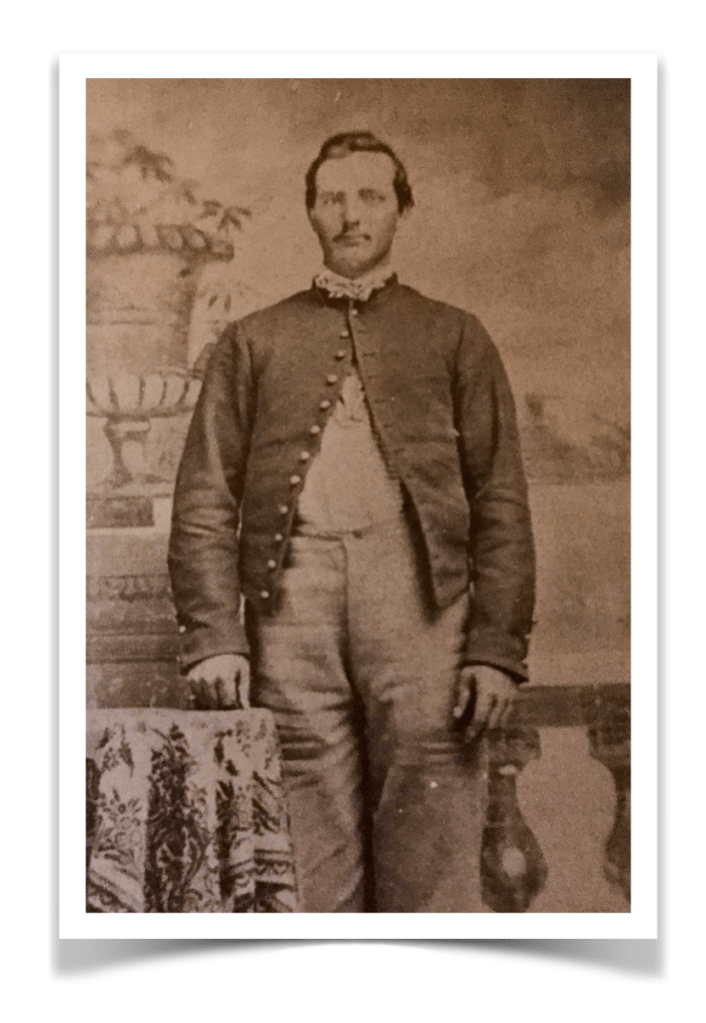
I could not find an image of Conrad but here is one of Edward B. Dumond, his cousin, who served in the same company (Kyle A. Williams Collection)

In August 1862, when he was 24 years old, he enlisted as a private in Co. A, 120th New York Infantry. When Conrad wrote this letter from Harewood Hospital in early May 1863, we learn he had suffered some type of injury that momentarily crippled him. His muster record confirms his absence from the regiment in April and May 1863 but yields no additional information. The following year, on 10 October, he was taken prisoner in action at James City, Virginia, and sent to Andersonville where he literally starved to death on 14 August 1864.

Conrad wrote the letter to his Uncle Phillip Dumond (1817-1892), a farmer of Hurley, Ulster county, New York. Phillip’s son, Edward Brown Dumond (b. 1843), also served with Conrad in the same company. Edward was wounded during the siege of Petersburg on 31 August 1864 and lost his left arm.

[Note: This letter is from the personal collection of Kyle A. Williams and was offered for transcription and publication on Spared & Shared by express consent.]

Transcription

Harewood Hospital
Sunday, May 3rd 1863

Dear Uncle,

It is with much pleasure I sit down to write you a few lines to let you know that I am well and hope these few lines will find you enjoying the same blessing. My toes are a gaining quite fast. I begin to hobble about on my heels with the canes.

I suppose you begin to think I have forgotten you. The reason I have not written, I have been a moving from one place to another. I are in the fourth hospital. I are now in the Harewood Hospital about a mile and a half from the village of Washington. It is a very nice place. I have good care taken of me and a plenty to eat. I have not been paid off yet. I have six months pay due now. I have not heard from Eddy in quite a while.

The news is the Army of the Potomac are a fighting. I would like to see you all very much. I wish I was there while I was lame. Tell grandfather I would like to see him very much and to have a smoke with him. I could tell him something about war if I was there but I live in hopes this time will soon come when I can come home and see peace again and to hear the sound of the church bell again and to be seated around the communing table again.

I must close by asking an interest in your prayers. Give my love to all my enquiring friends and keep a god share for yourself. Write as soon as you get this. So goodbye for this time. Hoping to hear from you soon.

From Conrad Dumond, Jr. to Philip Dumond

Direct your letters to Harewood Hospital, Barracks Number 2, Washington D. C.
1863: Frederick P. Rowe to Catharine C. Rowe

Frederick P. Rowe, Co. A, 120th New York

The following letter was written by Frederick P. Rowe (1842-1907), the son of John N. Rowe (1807-1880) and Sarah Electa Wilson (1813-1889) of Hurley, Ulster county, New York. At the time of his enlistment, he was described as a 5 foot, 10 inch tall farmer, with dark eyes, dark hair, and a dark complexion.

Frederick mustered into Co. A, 120th New York Infantry on 22 August 1862 as a private. He was mustered out of the regiment on 3 June 1865 as a corporal. According to muster roll records he was taken prisoner at Gettysburg on 2 July 1863 and was sent to Camp Parole at Annapolis to await exchange where he wrote the following letter in May 1864.

At Gettysburg, the 120th New York fought in Humphrey’s division. It became involved in the disaster of the second day’s battle on the Union left, but like the rest of the 3d corps, it fell back in good order to the second line, fighting as it went. Its casualties in this battle aggregated 30 killed, 154 wounded and 19 missing; total, 203. Eight officers were killed and 9 wounded in that battle. 

Transcription

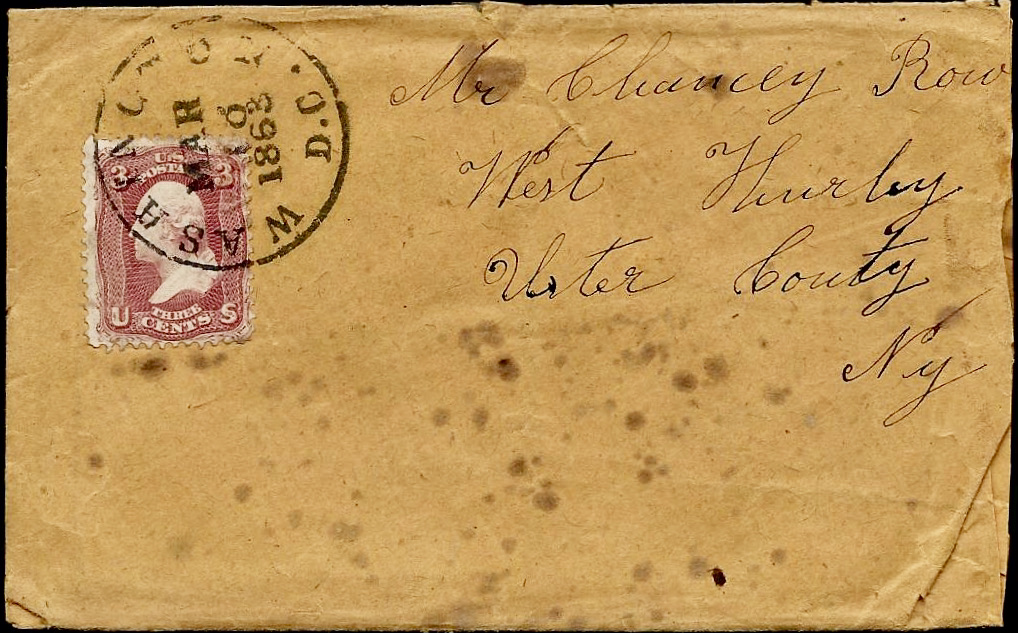
Addressed to Mr. Chauncey Rowe, West Hurley, Ulster county, New York

Camp Parole
Annapolis, Maryland
May 7th 1864

Dear cousin,

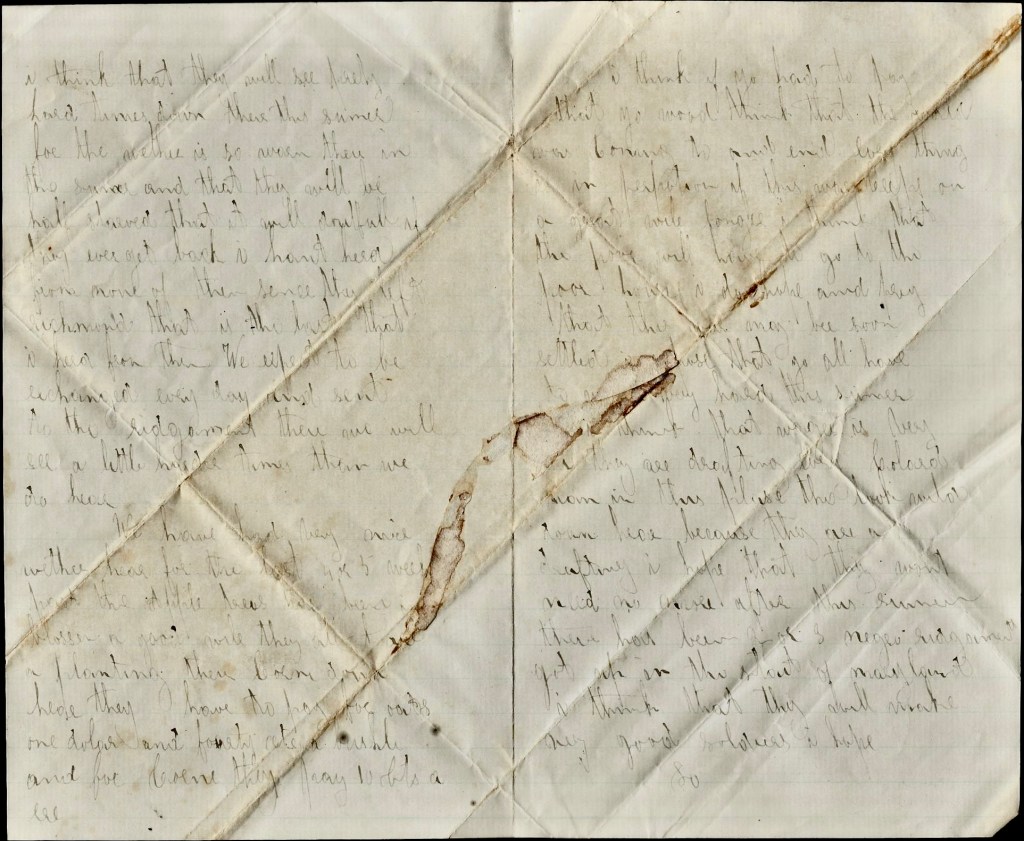
I now sit down to answer your welcome letter which I received the other day. I have neglected writing on the account of cleaning house. I have had my house painted and it makes lots of work for me. I have a barracks all alone by myself and I have got to keep that clean. The reason that I took it was because it was getting rather warm weather and there was so many in the old barracks that it wasn’t healthy.

There is a great many soldiers that dies here. There was 15 buried yesterday. They was those that just came from Richmond. There is more or less buried every day. I wish that those boys that is in Georgia was here. It think that they will see pretty hard times down there this summer for the weather is so warm there in the summer and they will be half starved. It will be doubtful if they ever get back. I hain’t heard from none of them since they left Richmond. That is the last that I heard from them. We expect to be exchanged every day and sent to the regiment. Then we will see a little harder times than we do here.

We have had very nice weather here for the last 4 or 5 weeks past. The apple trees has been in blossom a good while. They are out a planting their corn down here. They have to pay for oats one dollar and forty cents a bushel and for corn they pay 10 bits an ear. I think if you had to pay that, you would think that the world was coming to an end. Everything is in proportion. If this war keeps on a great while longer, I think that the poor [soldier] will have to go to the poor house. I do hope and pray that the war may be soon settled. I suppose that you all have to work very hard this summer. I think that wages is very high.

They are drafting every colored man in this place. Thy look wild down here because they are a drafting. I hope that they won’t need no more after this summer. There has been two or three negro regiments got up in the State of Maryland. I think that they will make very good soldiers. I hope so.

I have written you all the news so I shall have to close. Give my love to Chancy and Mary and all the rest. Please write just as soon as you get this. This is from your affectionate cousin, — Fred P. Rowe

Camp Parole

1863: William J. Rowe to his Cousin

The following letter was written by William J. Rowe (1840-1904), the son of Jacob and Jane (Campbell) Rowe of Kingston, Ulster county, New York. William enlisted at the age of 22 on 9 August 1862 to serve as a private in Co. B, 120th New York Infantry. At the time of his enlistment, William was described as a 5 foot 11 inch tall farmer with gray eyes, brown hair, and a dark complexion.

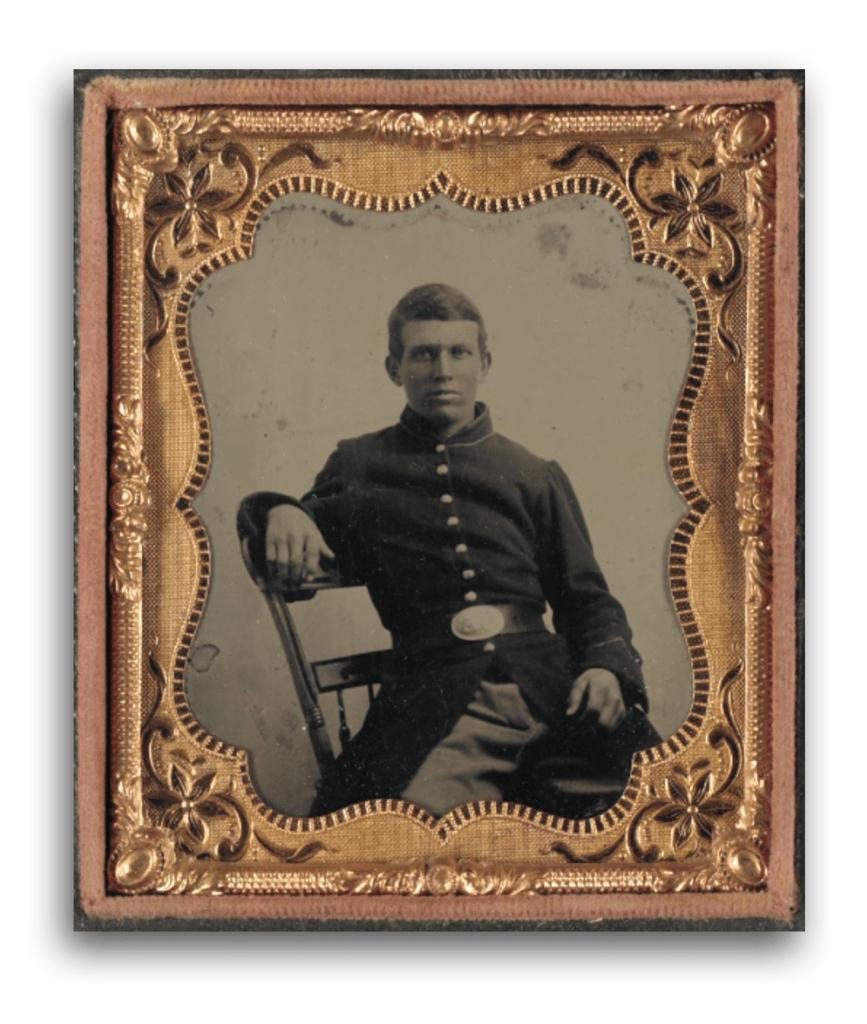
I could not find an image of William but here is one of Gordon B. Swift who also served in the 120th New York Infantry (Photo Sleuth)

He was taken prisoner at the Battle of James City, Virginia, on 10 October 1863 and eventually taken to Andersonville Prison in Georgia where he died of disease on 13 June 1864. He was buried in Grave No. 1940.

During the time that William was with the regiment, they fought in several important battles, including Fredericksburg, Chancellorsville, Gettysburg, Mine Run, Spottsylvania, North Anna, Totopotomy, and Cold Harbor. During its service the 120th New York Infantry lost by death, killed in action, 10 officers, 87 enlisted men; of wounds received in action, 1 officer, 54 enlisted men; of disease and other causes, 3 officers, 181 enlisted men; total, 14 officers, 322 enlisted men; aggregate, 336; of whom 69 enlisted men died in the hands of the enemy—including William.

William wrote the letter to his cousin, William Rowe (b. 1840), the son of William and Margaret Rowe of Hurley, Ulster county, New York.

Transcription

February 28, 1863

Dear Cousin,

I now take my pen in hand in order to answer your kind letter which I just received. We are both enjoying good health at present and I hope that when this reaches you, it will find you the same. I enjoy a soldier’s life very well but I think I like home the best. You wanted to know how I or what I had to sleep on. You don’t think Uncle Sam would have his brave soldiers sleep on feathers, do you? No siree horsefly. We sleep on mahogany sofas and have pie and cake and sweet meats. But the best thing we get is pork and hard tack. We get coffee and sugar too.

You talk about girls. There is none out here where we are now but I saw lots of them at the Battle of Fredericksburg. I saw a fine black wench there that weighed about 300. I think I shall go in for her if I can get her. That is all the nice girls that I have seen since I have been out here.

The weather is rather unsettled out here. It storms most every day. The most of the boys are well now but they have been quite sickly. I don’t think we will stay here long. We have been building corduroy roads for the army to move. I think I am able to stand the blunt and get home yet.

So no more at present. From your affectionate cousin, — W. J. R.

Write as soon as you get this. Yours truly, — William J. Rowe

My love to all.