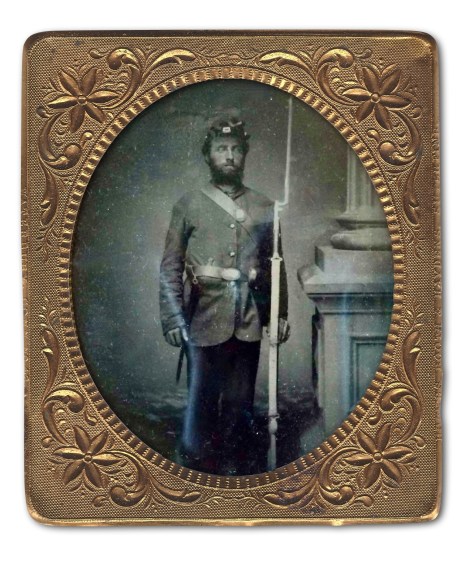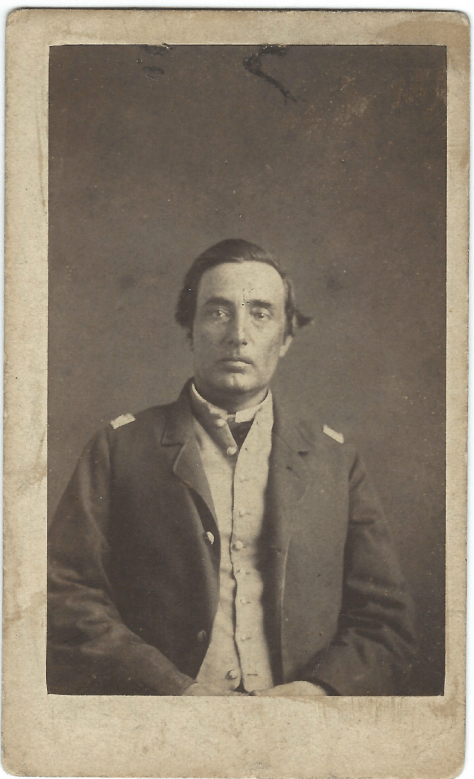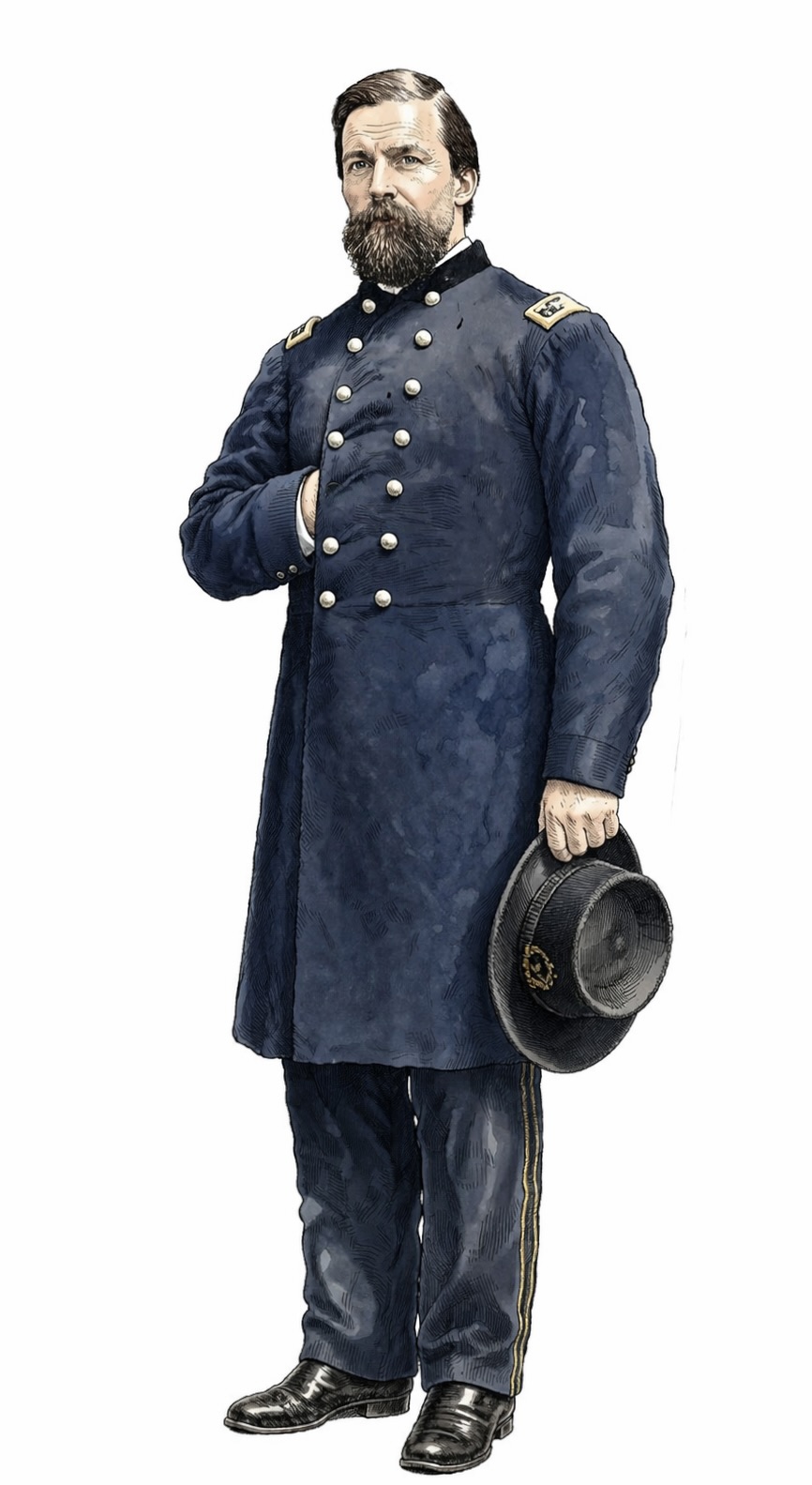
I could not find an image of Martin but here is one of Ezra Joseph Davy of Co. D, 121st OVI
This letter was written by Martin G. Modie (1840-1911), the son of William Modie (1799-1872) and Margaret Gates (1811-1880) of Chester, Morrow County, Ohio. Martin enlisted as a private in Co. G, 121st Ohio Volunteer Infantry (OVI) in August 1862 and served until April 1865 when he was discharged for disability.
Martin wrote the letter to his brother, George W. Modie (1838-1913) of Company A, 20th Ohio Infantry. George served with the 20th Ohio from October 1861 until July 1865 — nearly the entire four years of the war.
T R A N S C R I P T I O N
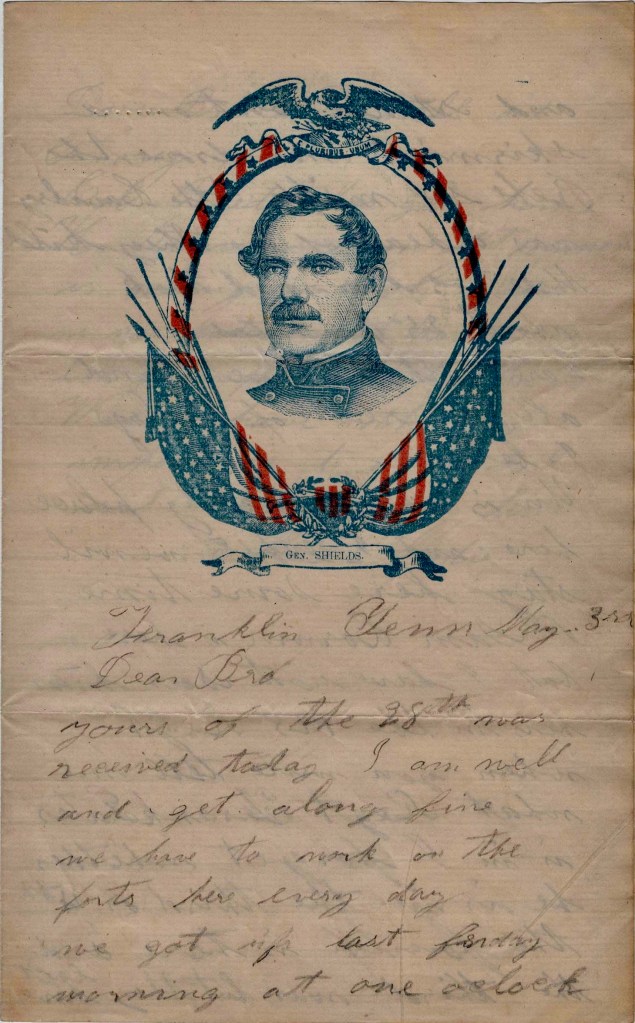
Franklin, Tennessee May 3rd [1863]
Dear Brother,
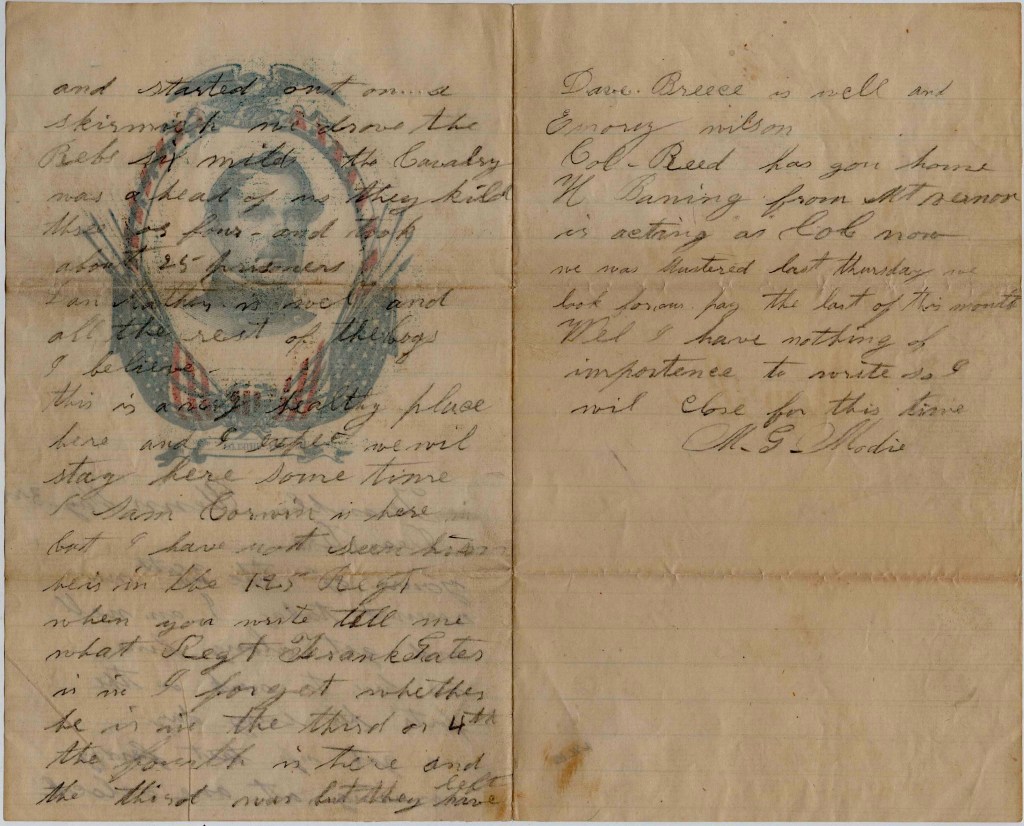
Yours of the 28th was received today. I am well and get along fine. We have to work on the forts here every day. 1 We got up last Friday morning at one o’clock and started out on a skirmish. We drove the Rebs six miles. The cavalry was ahead of us. They killed three or four and took about 25 prisoners.
Col. William Pitt Reid (1825-1879)
Dan Mathew is well and all the rest of the boys I believe. This is a very healthy place here and I expect we will stay here some time. Sam Corwin is here but I have not seen him. He is in the 125th Regiment. When you write, tell me what regiment Frank Gates is in. I forget whether he is in the 3rd or 4th. The 4th in here and the 3rd was but they have left. Dave Breece is well and Emory Wilson [too].
Col. [William Pitt] Reid has gone home. H[enry] Banning from Mt. Vernon is acting as Colonel now. We was mustered last Thursday. We look for our pay for the last of this month. Well, I have nothing of importance to write so I will close for this time. — M. G. Modie
1 Martin does not name the forts but he was likely referring to Fort Granger which was erected in late 1862 and early 1863 under the command of General Gordon Granger. It was located on Figuer’s Hill, northeast of town, overlooking the town, the Harpeth river, and the railroad supply lines.
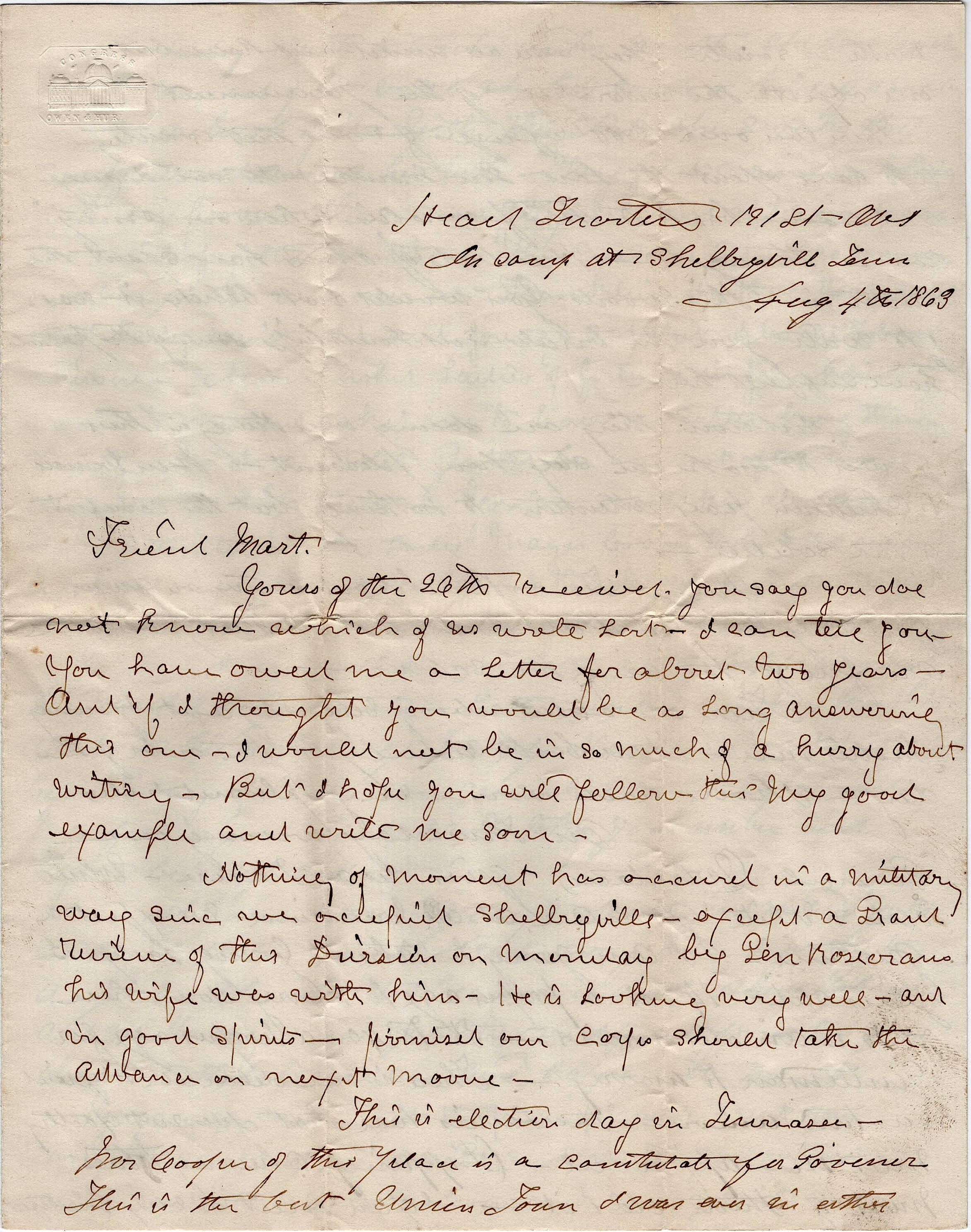
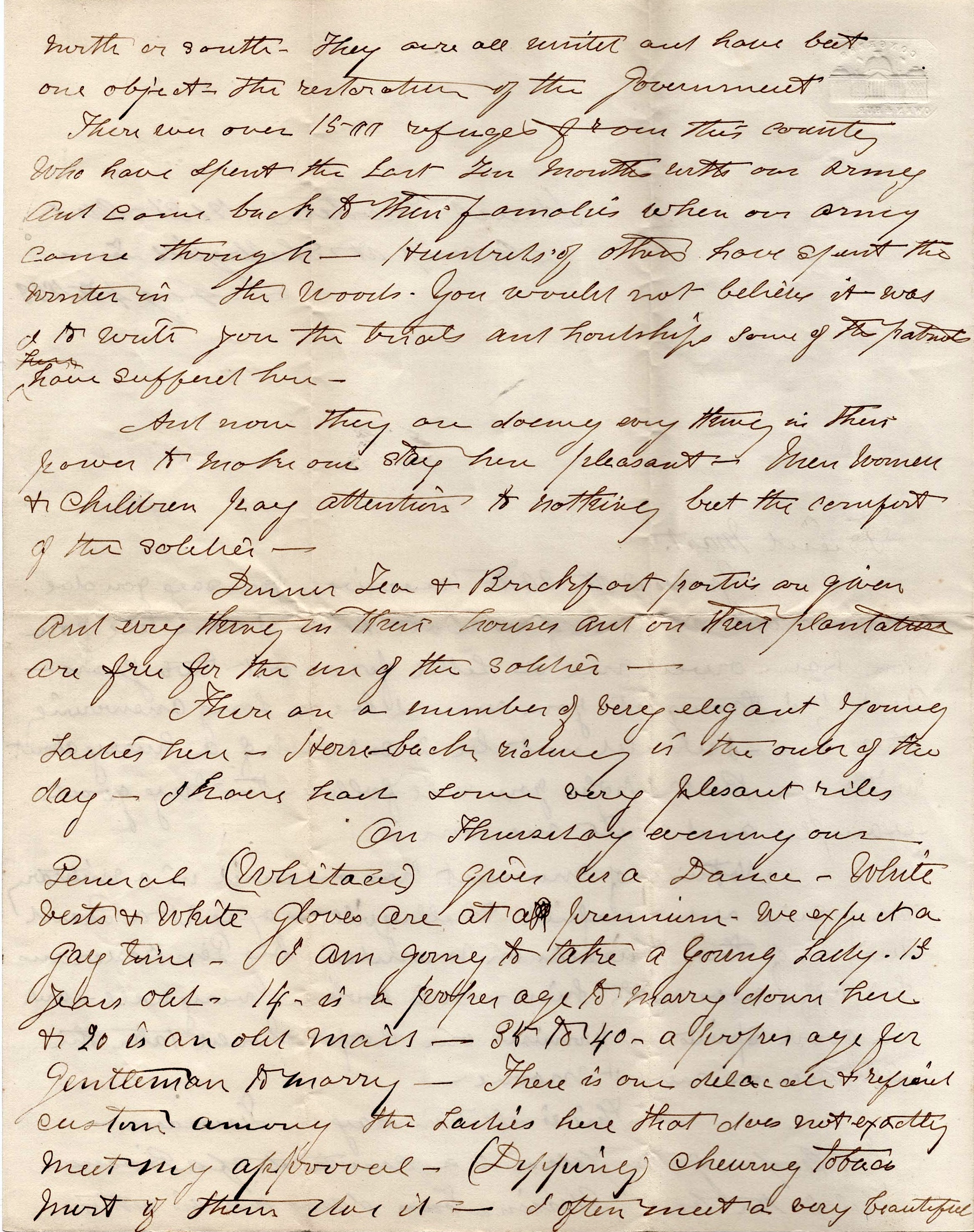
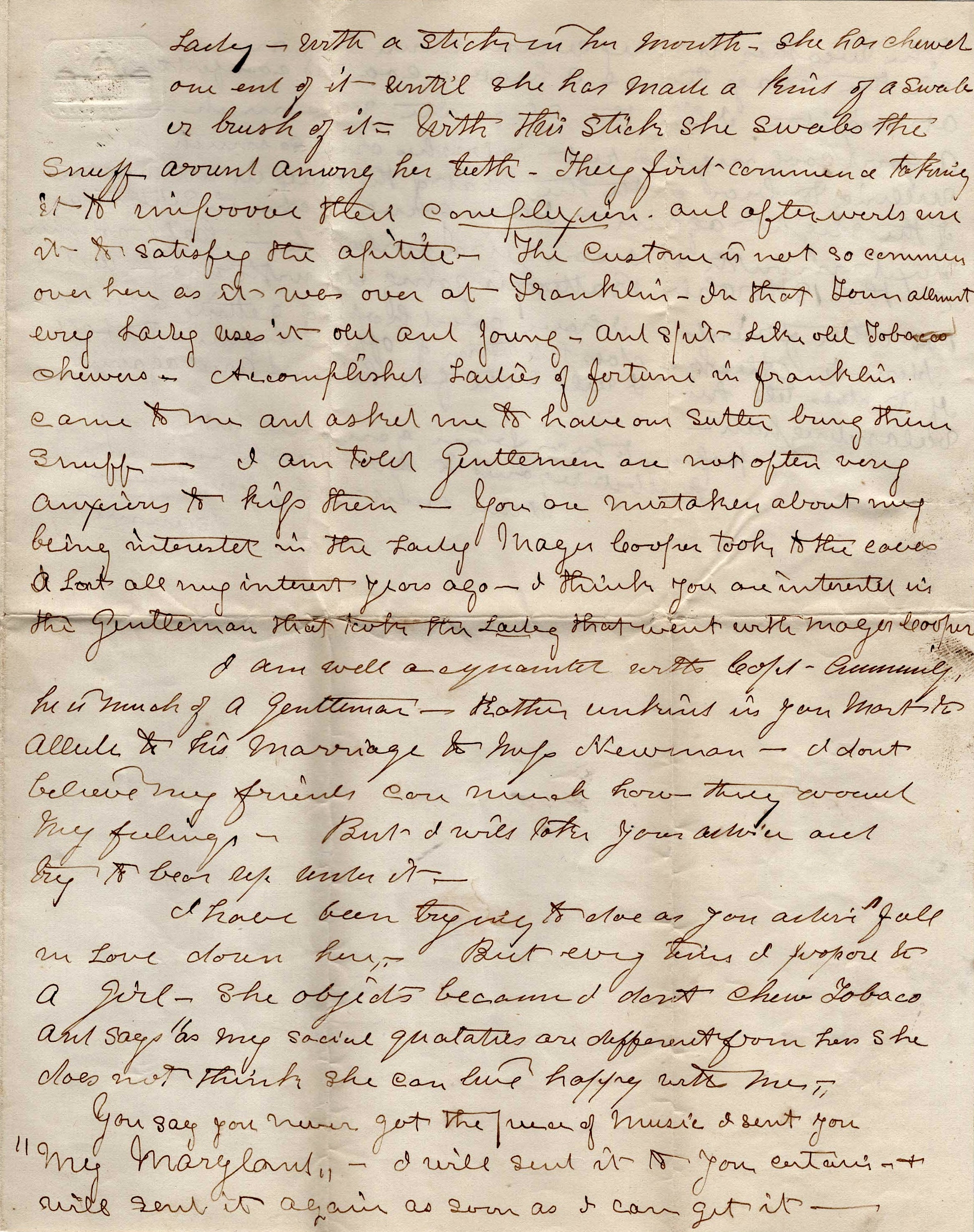
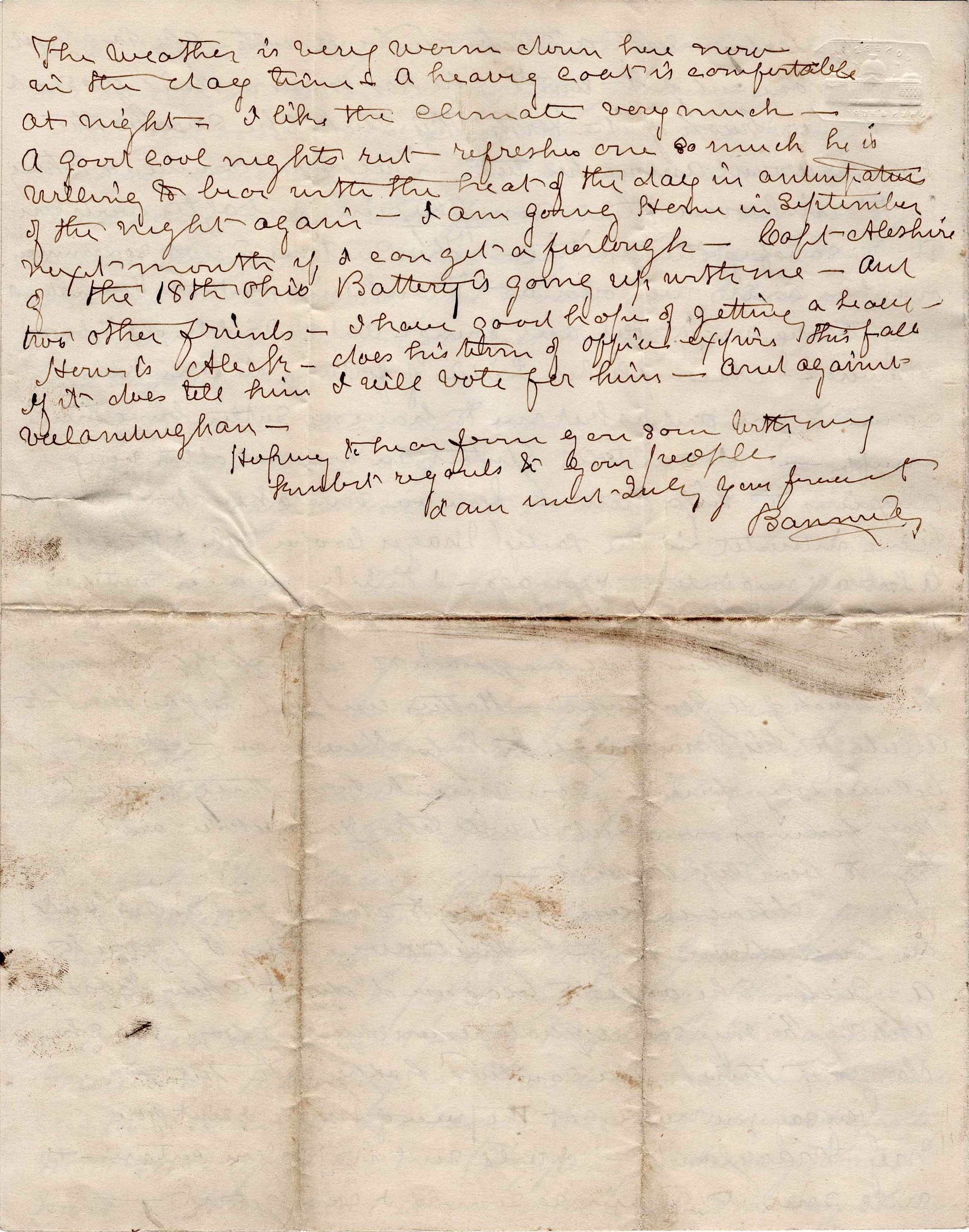
Unfortunately there is no signature on the following letter and I have not been able to identify him based on the content except to note that he addressed it to someone named “Adah” and we can also confirm that he served in Co. D, 121st Ohio Infantry. His writing skills were subpar so I would not think him highly educated. No doubt he worked at a trade with his hands, not his pen.
His letter is dated 8 [or 9th] October 1862, coinciding with the day of [or day after] the Battle of Perryville that he recounts. The regiment had served for scarcely a month when they were hastily dispatched to Cincinnati to defend against Bragg’s impending invasion, armed with antiquated Prussian muskets and lacking adequate training in their usage. Their subpar performance at Perryville is not unexpected, and morale sank further when assigned the grim task of remaining in Perryville to inter the fallen soldiers from both sides. For an in-depth exploration of the 121st Ohio’s experience at Perryville, I recommend the article, “Wipe out Perryville!” The 121st Ohio’s Redemption at Chickamauga by Dan Masters.
T R A N S C R I P T I O N
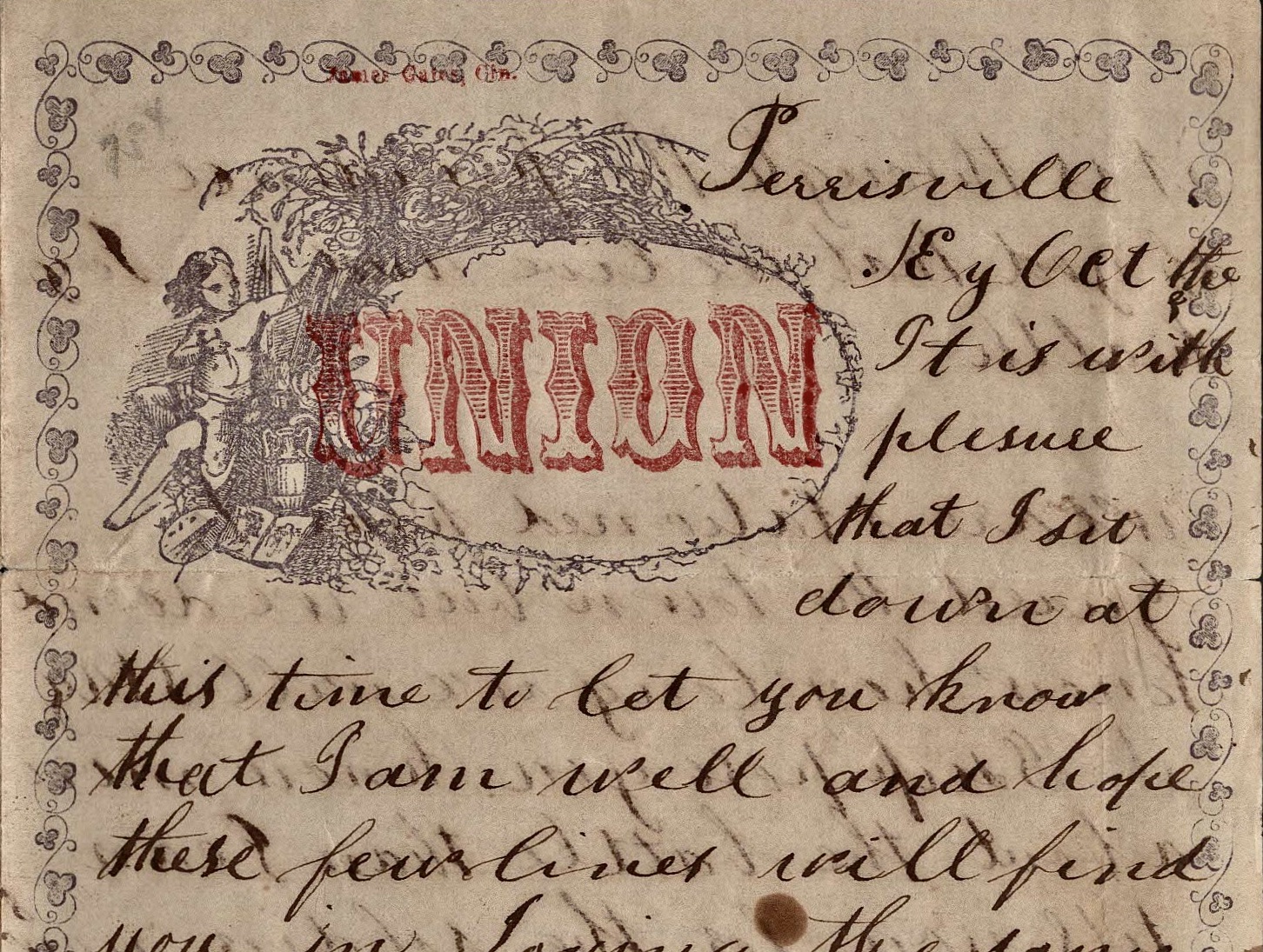
Patriotic letterhead of soldier’s letter.
Perryville, Kentucky October 8, [1862]
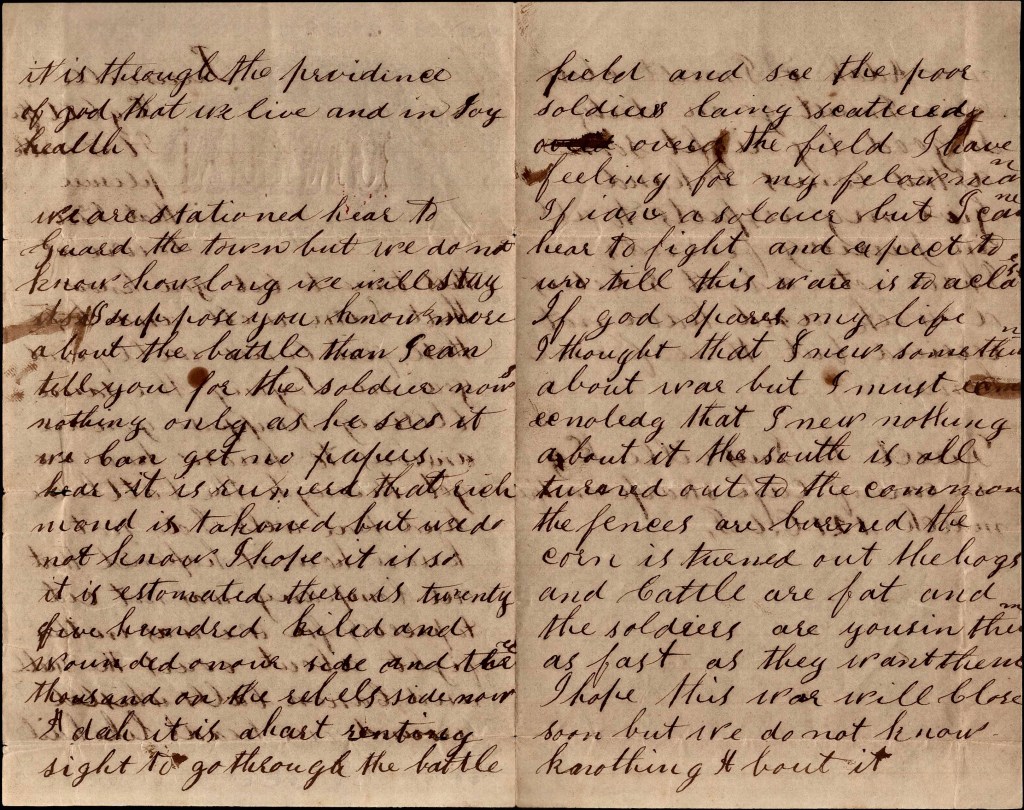
It is with pleasure that I sit down at this time to let you know that I am well and hope these few lines will find you enjoying the same blessing. I suppose you are anxious to know how we got through the battle we had here. Well, I do not know how it happened that our company was not cut to pieces for we was in the fight about six hours. The shell and cannon balls whistled over our heads like hail. It is through the Providence of God that we live and enjoy health.
We are stationed here to guard the town but we do not know how long we will stay. I suppose you know more about the battle than I can tell you for the soldier knows nothing—only as he sees it. We can get no papers here. It is rumored that Richmond is taken but we do not know. I hope it is so.
It is estimated there is twenty-five hundred killed and wounded on our side and three thousand on the Rebel’s side. Adah, it is a heart-rending sight to go through the battlefield and see the poor soldiers laying scattered over the field. I have feeling for my fellow man. I am a soldier but I came here to fight and expect to until this war is [brought] to a close, if God spares my life. I thought that I knew something about war but I must acknowledge that I knew nothing about it.
The South is all turned out to the common. The fences are burned, the corn is turned out, the hogs and cattle are fat and the soldiers are using them as fast as they want them. I hope this war will close soon but we do not know nothing about it.
Now Adah, I must close soon. I must go on duty. So goodbye. Write soon as this comes to hand. Give my respects to all inquiring friends. I have wrote about three letters a week and have not received but three from home. Direct to Louisville, Kentucky, in care of Capt. [Samuel L.] Sharp on the march. 121st OVI
I could not find an image of William but here is one of Ezra Joseph Davy of Co. D, 121st OVI
The following letters were written by William Y. Joslin (1836-1923), the son of Jonas Joslin (1807-1886) and Lucy Butterfield (1807-1886) of Liberty, Delaware county, Ohio. William was married to Rachel S. Case (1837-1905) in 1855 and they had two children, Jenette (“Netty”) and Irvin by the time William enlisted in August 1862 as a private in Co. C, 121st Ohio Volunteers (OVI). In the 1860 US Census, the Joslin’s were enumerated in Dublin, Delaware county, Ohio.
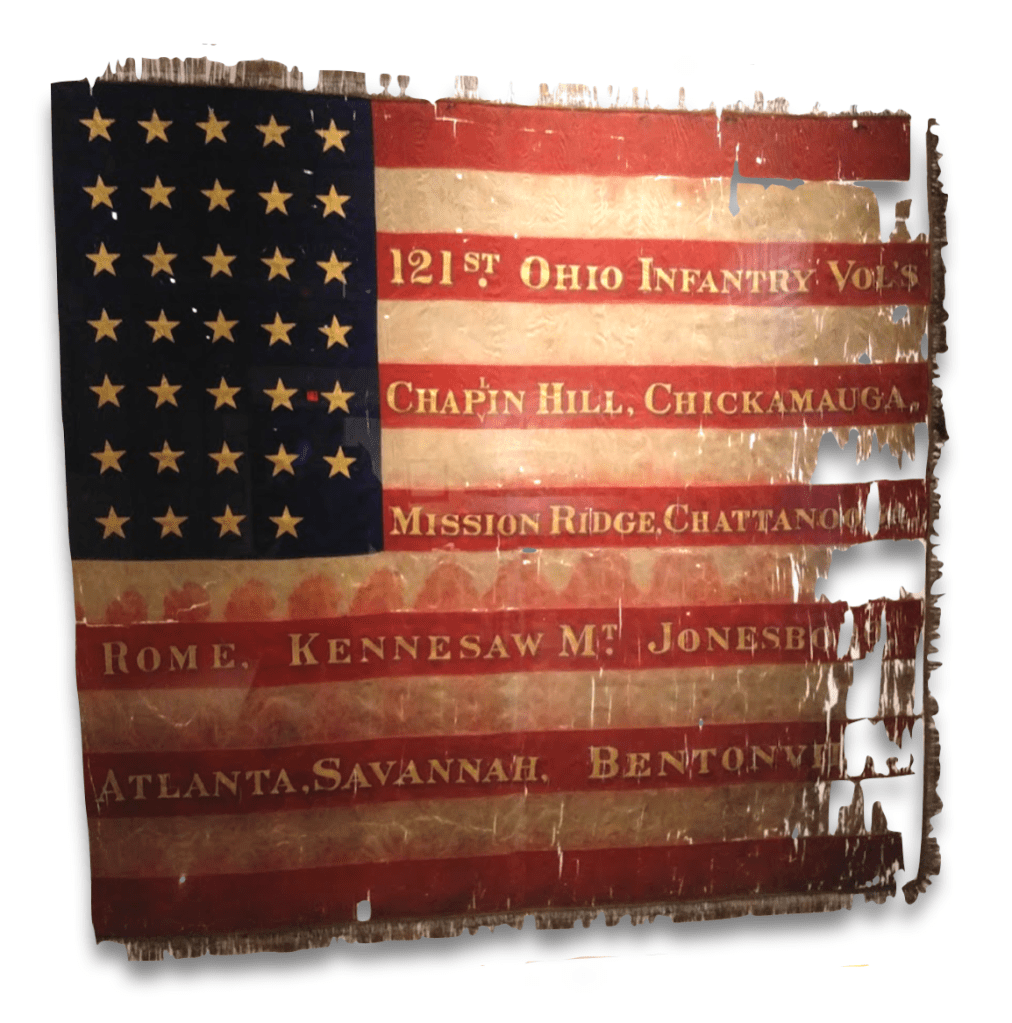
The 121st OVI participated in the battle of Perryville in October 1862. Then, in January, 1863, it moved into Tennessee, joined Rosecrans, and was actively employed until September, when it participated in the hard fought battle of Chickamauga, with a loss of 87 men. The Regiment took part in the battles of Lookout Mountain and Mission Ridge, and in May, started on Sherman’s Atlanta campaign, taking part in all of the battles along the way. In the fall of 1864, it operated against Hood in Alabama and then joined Sherman’s march to the Sea and through the Carolinas. After Johnston’s surrender it marched via Richmond to Washington, participated in the Grand Review, and was mustered out at Columbus, Ohio, June 12, 1865. William mustered out with his company as a corporal at war’s end.
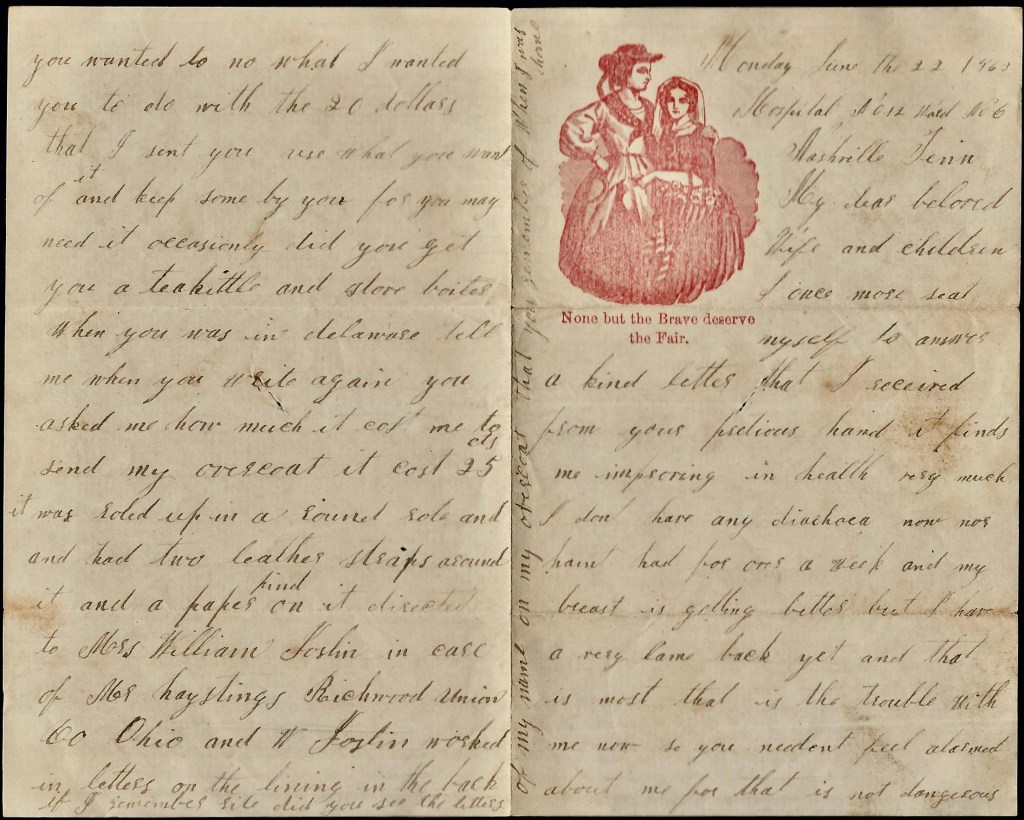
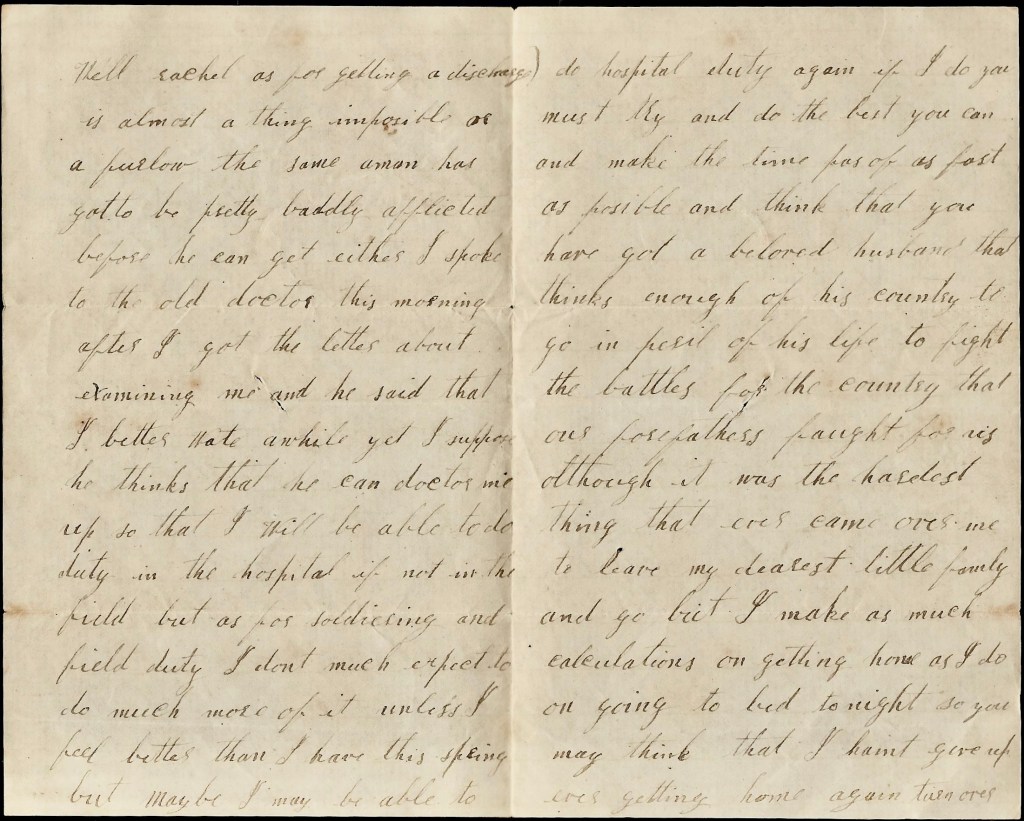
I once more seat myself to answer a kind letter that I received from your precious hand. It finds me improving in health very much. I don’t have any diarrhea now nor have had for over a week and my breast is getting better but I have a very lame back yet and that is most that is the trouble with me now so you needn’t feel alarmed about me for that is not dangerous.
Well, Rachel, as for getting a discharge is almost a thing impossible or a furlough the same. A man has got to be pretty badly afflicted before he can get either. I spoke to the old doctor this morning after I got the letter about examining me and he said that I better wait a while yet. I suppose he thinks that he can doctor me up so that I will be able to do duty in the hospital, if not in the field. But as for soldiering and field duty, I don’t much expect to do much more of it unless I feel better than I have this spring. But maybe I may be able to do hospital duty again. If I do, you must try and do the best you can and make the time pass off as fast as possible and think that you have got a beloved husband that thinks enough of his country to go in peril of his life to fight the battles for the country that our forefathers fought for us, although it was the hardest thing that ever came over me to leave my dearest little family and go. But I make as much calculations on getting home as I do on going to bed at night. So you may think that I hain’t give up ever getting home again.
You wanted to know what I wanted you to do with the 20 dollars that I sent you. Use what you want of it and keep some by you for you may need it occasionally. Did you get you a tea kettle and stove boiler when you was in Delaware? Tell me when you write again. You asked me how much it cost me to send my overcoat. It cost 25 cents. It was rolled up in a round roll and had two leather straps around it and a paper pinned onit directed to Mrs. William Joslin in care of Mr. Hastings, Richwood, Union county, Ohio. And W. Joslin worked in letters on the lining in the back of it if I remember right. Did you see the letters of my name on my overcoat that you remember of when I was home?
Letter 2
Camp of the 121st OVI near the Chattahoochie river July the 14th, 1864
My dear wife & children.
I seat myself this morning to write a few lines in answer to yours of the 5th of July. It came to hand last evening and found me quite unwell. I have had the headache and a lame back and the diarrhea for the last two days but I have been taking some medicine and feel some better this morning. I have received that letter that Lucretia sent to me but I haven’t answered it yet. But I think I must today. You spoke about sending me some envelopes. I would be very glad if you would send about two or three packages of envelopes and a whole ream of the best kind of letter paper and let me hear what it cost you there so if I want to sell any of it that I will know what to ask a quire for it. You can send it by mail and it won’t cost more than ten or fifteen cents.
Well, Rachel, we have been in this camp about three days but I don’t know how long we will stay here—maybe a week or two and maybe not longer than today. We drawed some new clothes yesterday and there is some talk of getting our pay before we leave here but there ain’t nothing certain about it. If we do, I don’t expect to get more than four months pay this time.
Well, Rachel, you said that you wanted to know what I thought about you taking in some boarders. I don’t know anything about the folks in Lewisburg but I expect they are like they are in all other little towns. There would be some that would have something to say about it so I would not advise you to keep any for I don’t want anyone to have a chance to start any of their lies on you. But as for renting a part of the house, I have no objections to that if you think the family would be company for you and if he is good for the rent. You can do what you think best about it. What can you rent a part of it for? Let me know when you write to me again.
You asked me if I was with my cousin when he was shot. I was not. I was about a half a mile from him. He only lived about 5 or 6 minutes after he was shot and his messmate was with him and he said that he was sensible and talked as rational as a well person and he said that he wanted to be buried decent and where his folks could find him.
Well, I believe I have wrote all the news for the present and as for the news of the fight, you can see that in the papers plainer than I can tell you. So now, I will close hoping to hear from you once a week anyhow. Direct as before to Co. C, 121st OVI, Chattanooga, Tenn. Goodbye for now, — William Joslin
to Rachel S. Joslin
Letter 3
[Before Atlanta] August 16th 1864 Mrs. Rachel S. Joslin
My kind and affectionate wife,
I seat myself this afternoon to inform you that I am well and hoping this may find you and the dear little children enjoying the same blessing—good health. Well, you spoke in your letter about Mr. William Hunter in the 17th Ohio Vols. I went and saw him this forenoon and found him well and hearty. He is a very genteel appearing young man and a good-looking fellow. I think that he will be over to see me in a day or two and if we stay close together, I shall go and see him often. He told me that he received a letter from his sister last evening.
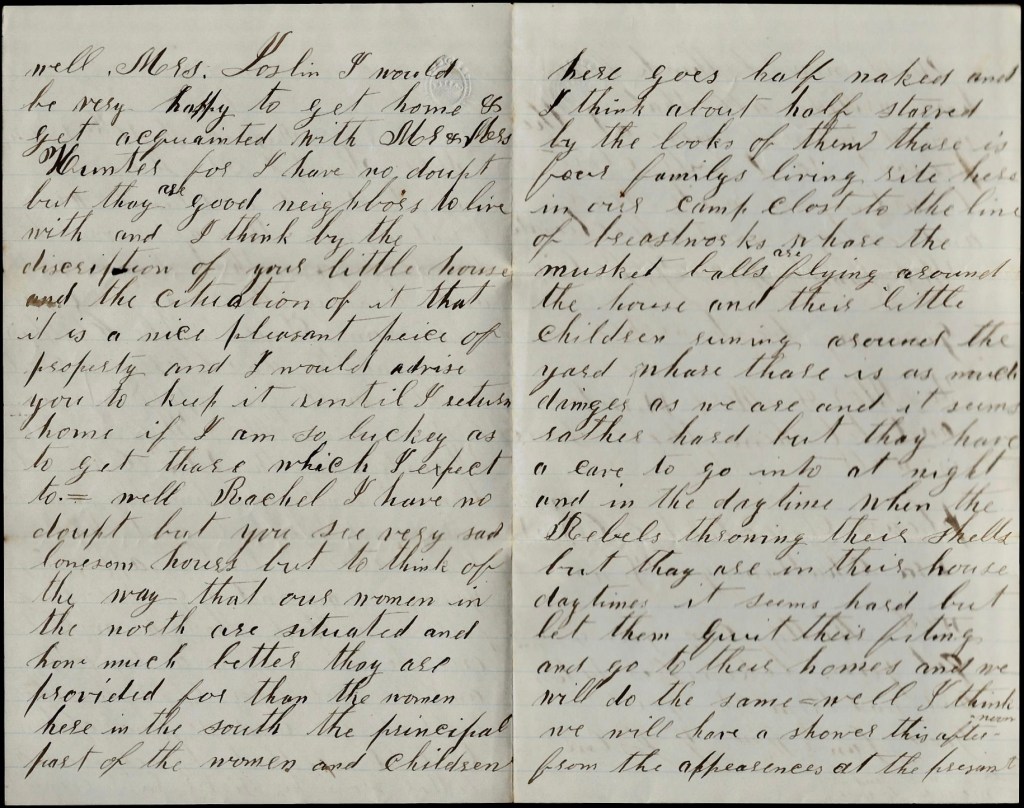
Well, Mrs. Joslin, I would be very happy to get home & get acquainted with Mr. and Mrs. Hunter for I have no doubt but they are good neighbors to live with and I think by the description of your little house and the situation of it, that it is a nice, pleasant piece of property and I would advise you to keep it until I return home, if I am so lucky as to get there, which I expect to.
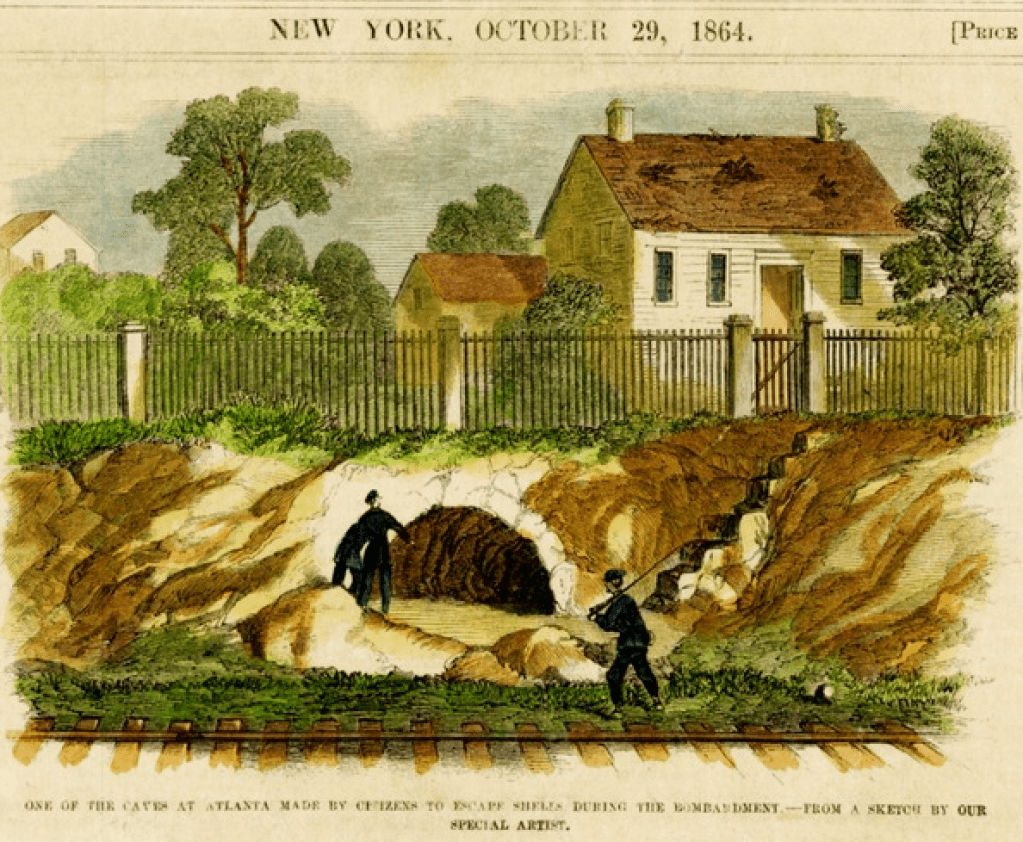
Well, Rachel, I have no doubt but you see very sad, lonesome houses but to think of the way that our women in the North are situated and how much better they are provided for than the women here in the South—the principal part of the women and children here goes half naked and I think about half starved by the looks of them. There is four families living right here in our camp close to the line of breastworks where the musket balls are flying around the house and their little children running around the yard where there is as much danger as [where] we are and it seems rather hard. But they have a cave to go into at night and in the daytime when the Rebels [are] throwing their shells. But they are [mostly] in their house daytimes. It seems hard. But let them quit this fighting and go to their homes and we will do the same.
“One of the caves at Atlanta made by citizens to escape shells during the bombardment—from a sketch by our special artist”
Well, I think we will have a shower this afternoon from the appearances at the present. Well now, I think I have written all that would interest you at the present so I will close by asking to write soon and oblige your affectionate husband, — William Y. Joslin
Give my best wishes to Mr. and Mrs. Hunter and tell them their son is well. Please direct to Co. C, 121st OVI via Chattanooga, Tennessee
Well, Netty, can you and Irvin get your likenesses taken and send them to your good pa if he will send the money to you? — Wm. Y. Joslin
I could not find an image of William but here is one of Pvt. Ezra Joseph Davy of Co. D, 121st Ohio Infantry (Ancestry.com)
The following letter was written by 23 year-old William E. Scott (1839-1911), the youngest son of Francis Scott (1791-1860) and Nancy Gadd (1793-1873) of Leesburg, Union county, Ohio. William enlisted in August 1862 to serve as a private in Co. I, 121st Ohio Volunteer Infantry (OVI).
William had two brothers who served with him in the same company—Norton (“Nort”) Scott (1820-1905) who was the 1st Sergeant in Co. I, and Ross Scott (1828-1901) who was also a private. Nort was discharged for disability on 9 May 1863, no doubt as a result of the chronic diarrhea mentioned in William’s letter. Ross was discharged for disability as well.
The 121st OVI was organized at Delaware, Ohio, and ordered to Kentucky to pursue confront Bragg on his northern invasion. They participated in the Battle of Perryville and then pursued Morgan in the winter of 1862-63. After spending some time in Nashville, they were ordered to Franklin, Tennessee, where this letter was penned in mid-March 1863. They went on to participate in in the Battle of Chickamauga, the Atlanta Campaign, the March to the Sea, and the Carolina Campaign.
Transcription
Camp at Franklin, Tennessee March 16, 1863
Dear Mother and Sisters,
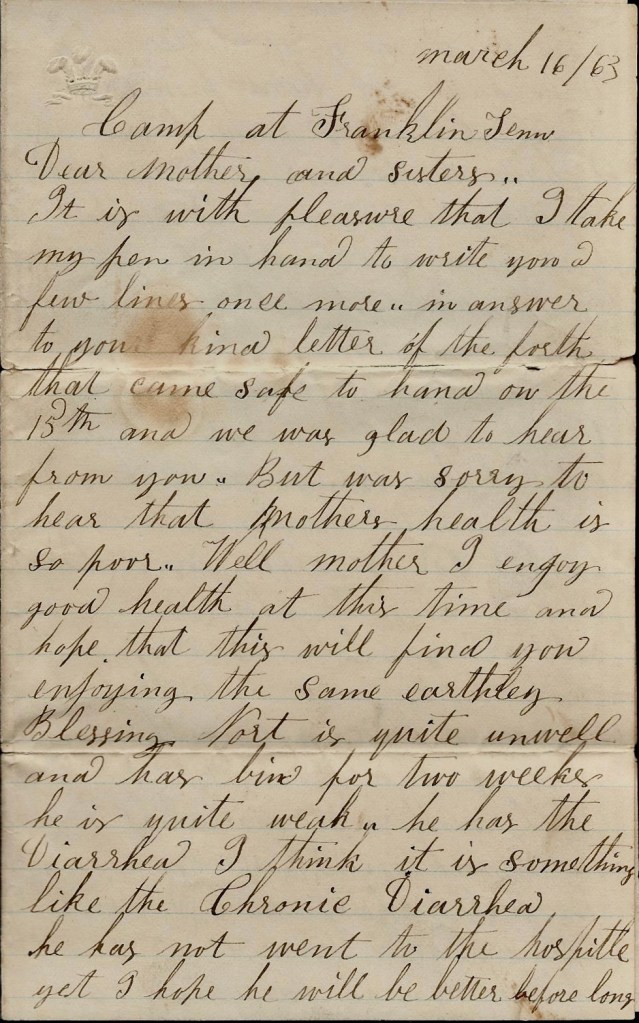
It is with pleasure that I take my pen in hand to write you a few lines once more in answer to your kind letter of the fourth that came safe to hand on the 15th and we was glad to hear from you but was sorry to hear that Mother’s health is so poor. Well, mother, I enjoy good health at this time and hope that this will find you enjoying the same earthly blessing.
Nort is quite unwell, and has been for two weeks. He is quite weak. He has the diarrhea. I think it is something like the chronic diarrhea. He has not went to the hospital yet. I hope he will be better before long.
You said in your letter that you had not heard from us since Charles came home. I have wrote one letter since he went home but I suppose that you never got it for there is hundreds of letters that never reach their destination. I am glad to hear that Ross’s cough is better. I think he had better stay where he is for I don’t think he ever will be fit for service as it takes a well man to stand soldering. Tell Gerry’s mother that he is well and that he stands soldering with the best of the Boys.
Well, Mother, we are still here at Franklin, Tennessee. How long we will stay here, I can’t tell. We have moved our camp five times since we came here, and have to move again tomorrow. We have not moved one mile in all. One more move and we will be where we started from.
I want you to write and tell me whether you got the money I sent home or not, and if you have not got it, go and get it for it is there for you as I never heard whether you got it or not. The folks is making garden here now. The peach trees is in bloom. The sun shines so hot, it makes me lazy. So I will bring my letter to a close for this time, write oftener and I will answer them.