Category Archives: 123rd New York Infantry

1863: William A. Tooley to Eber Tooley

William Tooley of Granville, NY, enlisted in Company K of the 123rd New York Volunteer Infantry Regiment in the summer of 1862, just after turning 21. His older brother Horace joined the regiment as well. The 123rd fought at Chancellorsville, VA in 1863, where William was captured and then paroled. After the Battle of Gettysburg, the 123rd was sent west to join General William T. Sherman’s Atlanta Campaign and March to the Sea. William lost his older brother at the Battle of New Hope Church, GA, on May 25, 1864. By the time William and the 123rd reached North Carolina in early 1865, they began to sense that the end of the war was near. On April 1st, William penned a letter to his brother Eber back home in which he expressed his anticipation of being soon “done with Uncle Sam” and pursuing a girl he liked when he returned home. General Lee surrendered to General Grant on April 9th, but word did not immediately reach Sherman’s troops. On the 10th, the 123rd was engaged in fighting in the swamps near Goldsboro, NC, where the final casualty of the regiment would fall, it was 23-year-old William Tooley. It was a couple of days later that the regiment would learn of the great surrender in Virginia and celebrate the impending end of the war and return to home and loved ones. It is for soldiers like William and his brother Horace, who gave the last full measure of devotion, that we celebrate Memorial Day. [Source: The Last to Fall]

William’s letter provides us with a first account of Burnside’s Mud March in mid-January 1863.

See also—1863: William Tooley to Eber Tooley
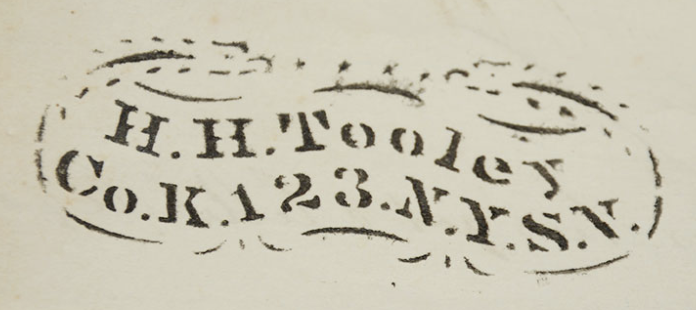
A stencil belonging to Horace H. Tooley who served with his brother William in Co. K, 123rd New York State Volunteers (Horse Soldier)

T R A N S C R I P T I O N

Camp near Stafford Court House
Sunday, February 1, 1863

Eber Tooley,

Dear brother, your letter came to hand Friday night and I was very glad to hear from you. I am well and should have written before but have been waiting to get my dog type [photograph] taken to send to you. Went over to the Court House yesterday to get it but there were so many there waiting that I came back to camp. This morning, F. Cook and myself were the first ones there and got them taken. It is just as well that you did not send that money for we were paid Thursday. I received eight dollars and twenty cents which pays us up to the first of November.

We left Fairfax on the 19th of January which was Monday. The roads were then in fine condition and [made] splendid marching. We arrived at Dumfries Tuesday night—a small village which looks as if it may have seen better days before the war. But like all the villages in Virginia, it shows too plainly the effects of the war on individual property as well as national. Most of them have but one street left, building blackened with smoke, some burned, some torn down, others without any roof, &c. But I will not attempt to describe it with pen and ink. It is too tedious for me. But I had began to give you a description of the march.

As I said before, the roads continued to be in good condition until Tuesday night. We encamped half a mile south of Dumfries. Soon after we halted for the night, it commenced to rain and rained all night. All we had to shelter us was our little shelter tents which we always carry with us. Even the officers did not fare any too well, but better than they did the next night. Well, in the morning we were marched off in the mud and rain, for one night’s rain makes it very muddy here. It did not rain much in the afternoon. We marched four or five miles when they found the train so far in the rear that we were obliged to halt for the night. But the roads were so bad that the train could not get up with us until the day at noon. Consequently we were obliged to go without supper and breakfast and the officers had to take their chances on the ground with the rest of us, their baggage being with the wagons. And so it kept on raining nights for three days. But, however, we managed to get through the mud somehow and arrived at our present camp which is situated half a mile north of the Court House. In the whole, it was a very hard march for both man and Jackass. Several mules and horses were left dead on the road.

The Army of the Potomac’s doomed winter campaign across the Rappahannock River would become known as the Mud March. Alfred Waud, Library of Congress

Eber, I wish you would send me some stamps. I thought I wrote to you for some in my last letter but I must have forgotten it as you did not send them. I had my picture taken twice for you and once for mother. I do not know which one would suit her the best. I think of sending them by Asa Fish. He is going to start home tomorrow. If he carries them, you will find them at the office. Yours truly, — William

Eber, I cannot write any more until I get some stamps. Mother, I have not written to you in a good while for I have not had much time to write but I think of you very often. I received a letter from Mary last night. She said her folks were over to see you and that you were going over there. You will see by my picture that I am not very thin in flesh yet. If I had money to spare, I would send enough to get a case but I have not. Write soon, mother. — William

1863: William Tooley to Eber Tooley

The following letter came to me for transcription identified as having been written by William (“Billy”) Pooley (1839-1864), wgo served as a private in Co. A, 127th Illinois Infantry. He was Killed on 7/28/1864 at Atlanta, GA. The letter was only signed “William” and it was written to his brother “Eber.” There is a surname following Eber’s name and though one might construe it to be Pooley, I don’t believe it is. There are a number of reasons why I don’t think this letter was written by William Pooley of the 127th Illinois Infantry.

First and foremost, William fought in the western theatre for most of the war and because he was beloved by his company and killed in the fighting before Atlanta, his comrades eulogized him and never once mentioned his being taken prisoner in 1863. Further, they claimed he was with the regiment all of the time and fought in all of the battles until his death. Second, William had no brother named Eber that I could find. He did have a brother named John—a name that appears in the letter—but John served in the same company as William and would not have been at home farming in 1863 as he indicates. Third, the writer expresses concern for “Horace,” an apparent comrade in his company (or regiment), and there was only one Horace in the 127th Illinois but he was a Lieutenant in another company so I doubt seriously this was who he referred to.

So if it wasn’t William Pooley, who wrote the letter? The date and circumstances of the letter suggest to me that it was written following the author’s exchange as a prisoner of war who was captured during the Battle of Chancellorsville. Though he doesn’t give his location, most likely he wrote it from a paroled prisoners camp in Virginia or Maryland, where Union POWs were billeted until their exchange could be negotiated and they were allowed to return to their regiments. Also, if he was in Virginia or Maryland, his suggestion that farmers would be planting “up there” suggests his home was in a location much further north, like New York or one of the Northeastern states—not “out there” in Illinois. In my opinion, William was probably among the roughly 4,000 Union troops taken prisoner at the Battle of Chancellorsville and taken to Richmond.

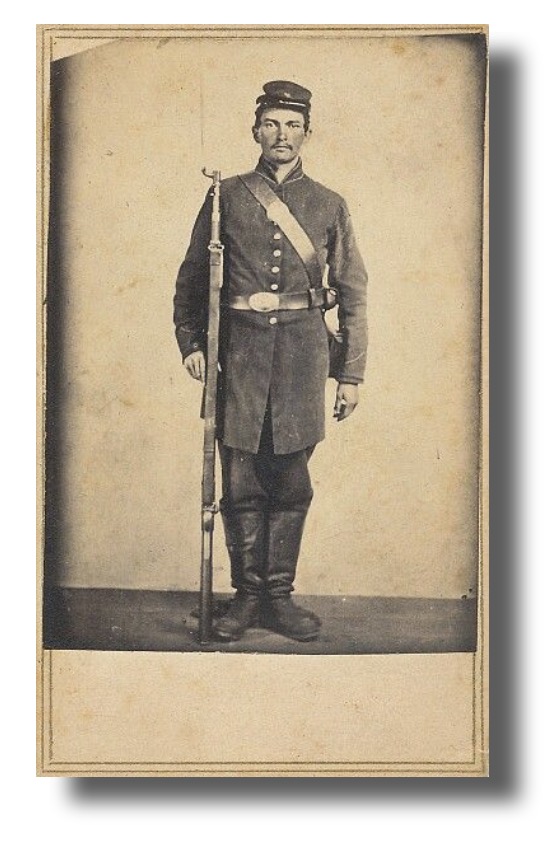
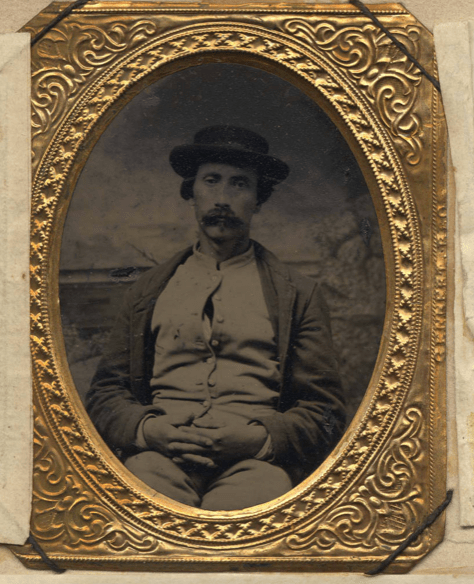
I could not find an image of William but here is a CDV of William Knickerbocker who served in the 123rd New York Infantry.

Seeking help on my Spared & Shared Facebook page, Rose Lynn Beyke correctly deciphered William’s surname as Tooley (not Pooley) which led me to his identity as William Tooley (1840-1865) writing to his younger brother, Eber Tooley (1842-1914). William and Eber were the sons of Cyrus F. Tooley (1802-1880) and Sophronia (“Mary”) Lumbard (1804-1891) of Granville, Washington county, New York. William’s older brother, Horace Tooley (1836-1864), also served in the same company as William, which was Co. K, 123rd New York Infantry. William and Horace enlisted together on August 19, 1862. Horace survived Chancellorsville but was wounded in action on 25 May 1864 and died near Dallas, Georgia, on 8 June 1864. His remains are in the Marietta National Cemetery (Plot A, 449) William was captured in action on 3 May 1863 at Chancellorsville and paroled but was killed in a late-war skirmish on 10 April 1865 at Aiken’s Creek near Raleigh, North Carolina. His remains are in the Wilmington National Cemetery (Plot 2, 739).

The 123rd New York Infantry entered the Battle of Chancellorsville as part of the 2nd Brigade, 1st Division, of Slocum’s XII Corps. Here is a roster of the soldiers in Co. K of that regiment with a brief description of their service. Though I have not read it, apparently Sgt. Rice C. Bull of the 123rd New York Infantry taken prisoner at Chancellorsville and left an account of it in the book, “Soldiering, the Civil War Diary of Rice C. Bull.”

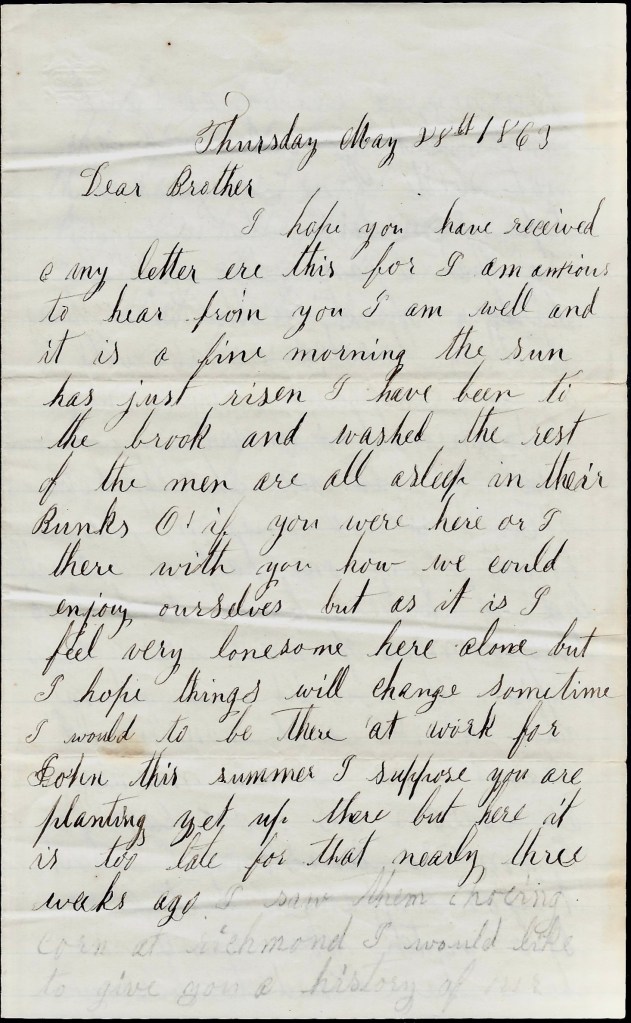
Transcription

[Paroled prisoners camp, Alexandria, Virginia]
Thursday, May 28th 1863

Dear Brother,

I hope you have received my letter ere this for I am anxious to hear from you. I am well and it is a fine morning. The sun has just risen. I have been to the brook and washed. The rest of the men are all asleep in their bunks. O! if you were here or I there with you, how we could enjoy ourselves. But as it is, I feel very lonesome here alone. But I hope things will change sometime. I would [like] to be there at work for John this summer. I suppose you are planting yet up there. But here it is too late for that. Nearly three weeks ago I saw them hoeing corn at Richmond.

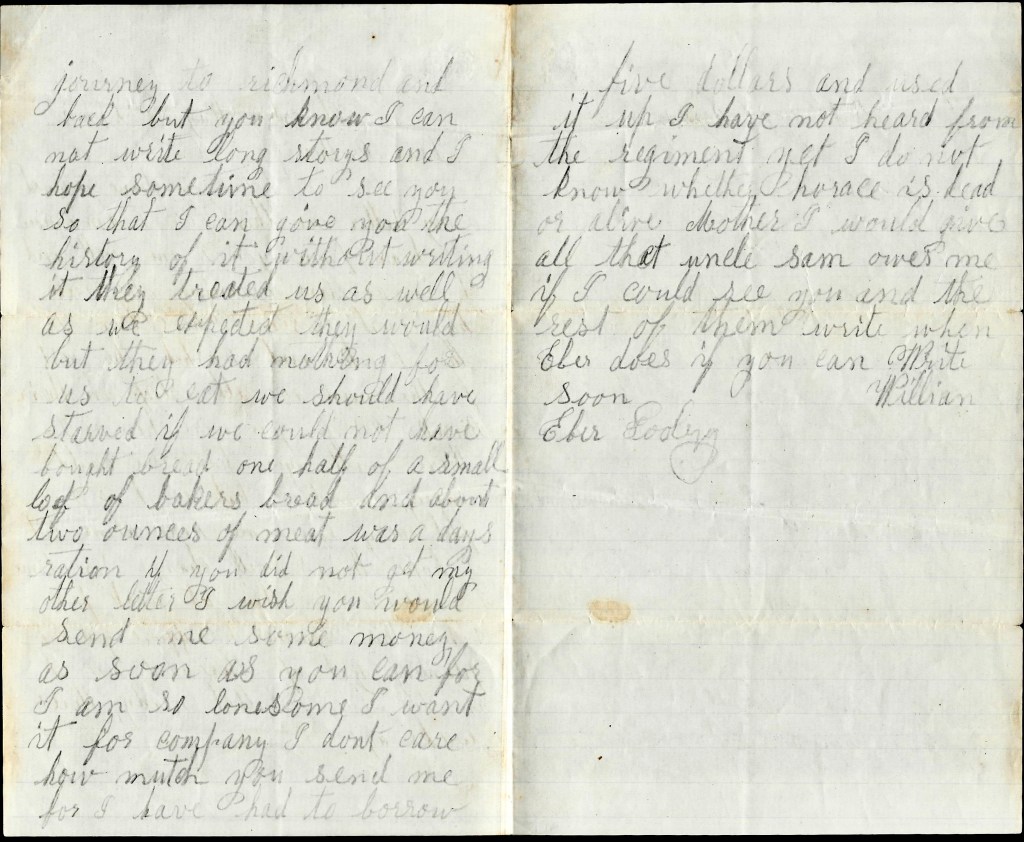
I would like to give you a history of our journey to Richmond and back but you know I can not write long stories and I hope sometime to see you so that I can give you the history of it without writing it. They treated us as well as we expected they would but they had nothing for us to eat. We should have starved if we could not have bought bread—one half of a small loaf of baker’s bread—and about two ounces of meat was a day’s ration. If you did not get my other letter, I wish you would send me some money as soon as you can for I am so lonesome I want it for company. I don’t care how much you send me for I have had to borrow five dollars and used it up.

I have not heard from the regiment yet. I do not know whether Horace is dead or alive. Mother, I would give all that Uncle Sam owes me if I could see you and the rest of them. Write when Eber does if you can. Write soon. — William

[to] Eber Tooley

1864: George Robinson to Elizabeth (Wright) Robinson

Lt. George Robinson, 123rd NYV

The following letter was written by George Robinson (1829-1885) who enlisted at the age of 31 as a 1st Sergeant in Co. A, 123rd New York Infantry. He was promoted to a 2nd Lieutenant on 4 September 1862 and to a 1st Lieutenant on 18 July 1863. He mustered out of the regiment as Captain (by Brevet) of Company A on 13 March 1865.

George wrote the letter to his wife, Elizabeth (Wright) Robinson (1838-1912). The couple lived in Greenwich, Washington county, New York. After the war, George worked in the Coal industry.

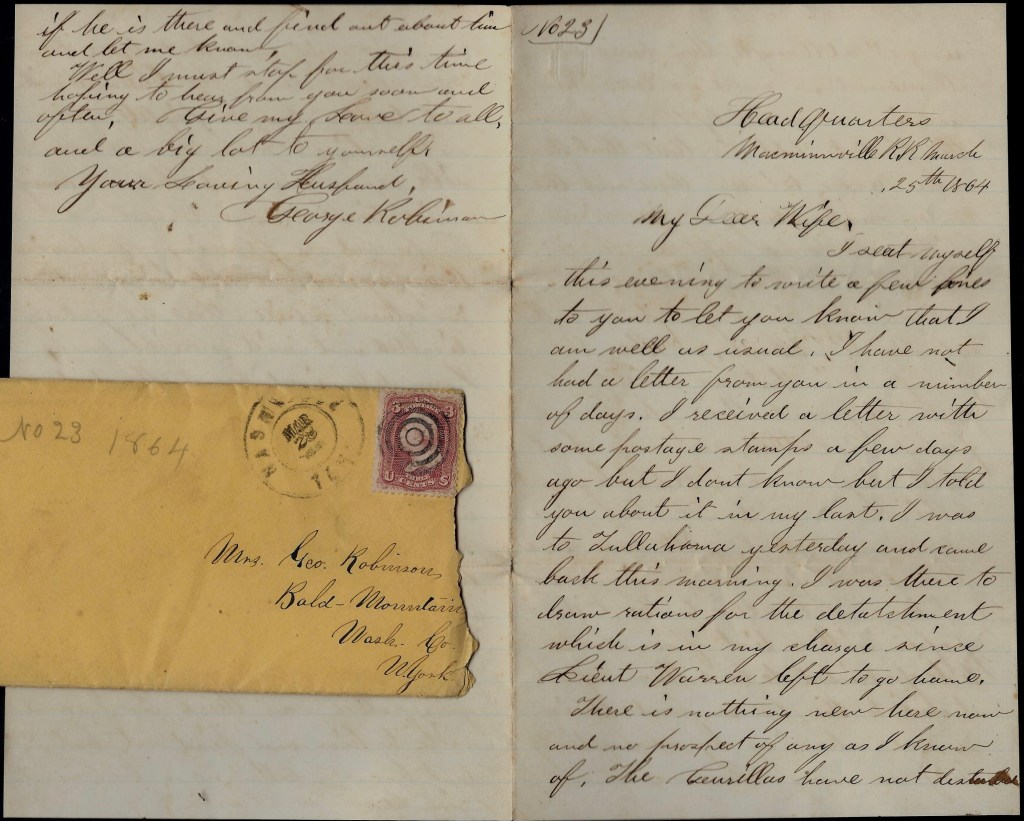
Transcription

Headquarters
McMinnville RR Branch [Tennessee]
[March] 25th 1864

My Dear Wife,

I seat myself this evening to write a few lines to you to let you know that I am well as usual. I have not had a letter from you in a number of days. I received a letter with some postage stamps a few days ago but I don’t know but I told you about it in my last. I was to Tullahoma yesterday and came back this morning. I was there to draw rations for the detachment which is in my charge since Lieut. Warren left to go home.

There is nothing new here now and no prospect of any as I know of. The guerrillas have not disturbed us yet although they have been all around us more or less. This morning when we left Tullahoma, the pickets told us that that there were Rebels between there and the water tank about four or five miles out, so we kept a sharp lookout for them but we did not see any, so we got down without any disturbance. The prospect is that we shall not go to the front this spring and perhaps not this summer but will stay on some RR to guard. I think we will not stay where we are now but will have some other road for our division.

I have sent a letter to the village paper with a list of our absentees to be published to have them report at once to the company or send their excuse, showing by what authority they are away. There are quite a number of men that have been absent since the Chancellorsville and Gettysburg fights—some with slight wounds and others with severe ones, and they are having a nice time at some convalescent camp and are playing off, claiming their pay regular, and doing nothing in return while others are probably disabled and will never be back. I am determined to get the dead beats back if there is any such thing. If you hear anything about any of them anywhere laying off, let me know and I will take measures to bring them back. I have heard that Caleb Tefft was in New York and I don’t know what he is doing there and I would like to know for certain if he is there. If I knew your father was there now I would write to him and find out but I don’t know whether he is there or not. I wish you would write to your Father if he is there and find out about him and let me know.

Well, I must stop for this time hoping to hear from you soon and often. Give my love to all, and a big lot to yourself. Your loving husband, —George Robinson

1862: William M. & Noah G. Hill to Jane (Foster) Hill

I could not find an image of either William or Noah but here is one of Josiah Fletcher who served in Co. I, 123rd New York Infantry (Photo Sleuth)

This letter was written in part by Pvt. William M. Hill (1839-1878) and the other part by his brother, Pvt. Noah G. Hill (1843-1902) of Co. K, 123rd New York Infantry. The regiment was mustered into service in September 1862 and served in the defenses of Washington D. C. until October 1862 when they were posted at Sandy Hook, Maryland. Both brothers served through “the whole campaign” and were described as “good & faithful soldiers.” The whole campaign would have included Chancellorsville, Gettysburg, the Atlanta Campaign, and the Carolinas Campaign.

William and Noah were the sons of George W. Hill (1816-Unk) and Jane Foster (1824-1911) of Granville, Washington county, New York.

[Note: This letter is from the personal collection of Greg Herr and was transcribed and published on Spared & Shared by express consent.]

Transcription

October 19 [1862]
Sandy Hook Camp

Dear Mother,

I thought I would write a few lines to you to let you know that we are all well here at present and I hope these few lines will find you all the same. I have sent a letter to father but if he don’t get, you must tell him not to enlist for he would not stand it very long. He is not tough enough to come down here for it needs tough men down here.

Tell John I wouldn’t cut that tree down if I had to hear John [ ] to help me. We don’t stand about trees down here. You must write and tell me how you all get along up there.

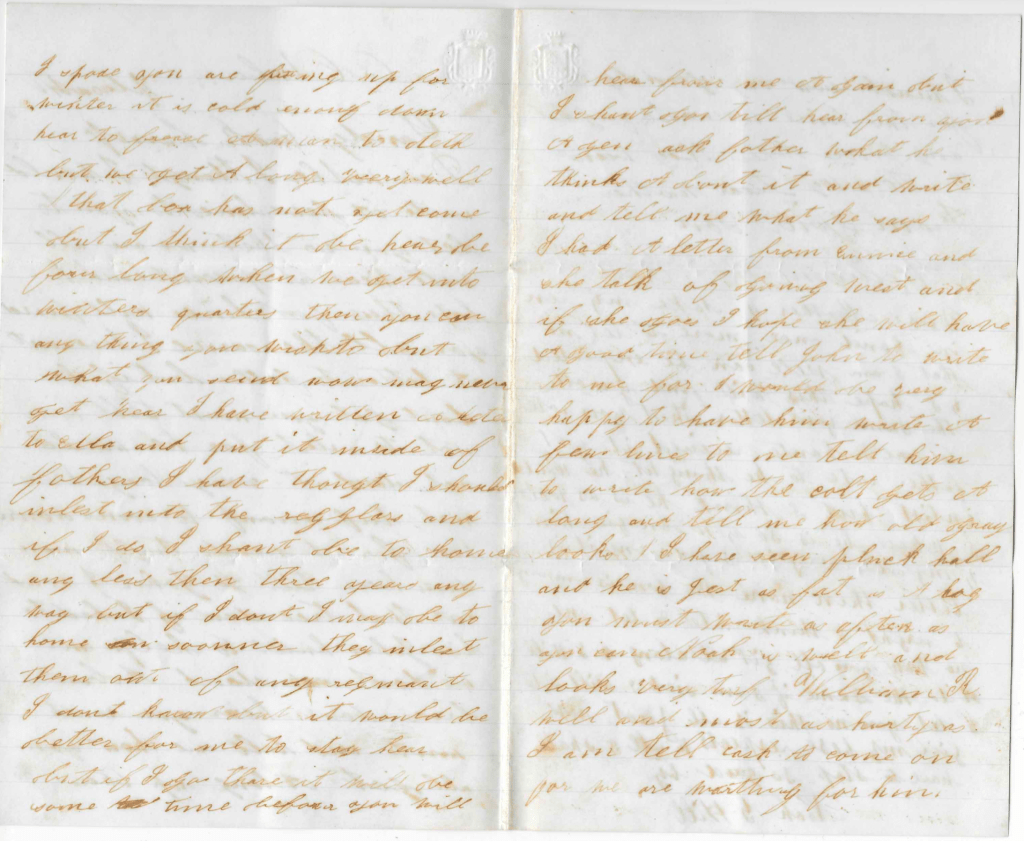
I suppose you are fixing up for winter. It is cold enough down here to freeze a man to death but we get along very well. That box has not yet come but I think it [will] be here before long. When we get into winter quarters, then you can [send] anything you wish to but what you send now may never get here. I have written a letter to [sister] Ella and put it inside of father’s. I have thought I should enlist into the Regulars and if I do, I shan’t be to home any less than three years anyway but if I don’t, I may be to home sooner. They enlist them out of any regiment. I don’t know but it would be better for me to stay here but if I do go there, it will be some time before you will hear from me again but I shan’t go till I hear from you again. Ask father what he thinks about it and write and tell me what he says.

I had a letter from Eunice and she talked of going West and if she goes, I hope she will have a good time. Tell John to write to me for I would be very happy to have him write a few lines to me. Tell him to write how the colt gets along and tell me how old gray looks.

I have seen Pluck Hall and he is just as fat as a hog. You must write as often as you can. Noah is well and looks very tough. William R. is well and most as hearty as I am. Tell cash to come on for we are waiting for him.

I must now say goodbye for this time. We are to fight any time when they want us to, my dear mother.

From your son, — William M. Hill

Dear Mother, I take my pen in hand once more to let you know that I am well [as] can be expected & I hope this will find you all the same. Your letter that you wrote to me, I hain’t received it yet. Father wrote too. He thought he would enlist but I think he is as well off where he is so you can give him my advice [even] if it is a poor one. It is better than none. The box is coming tonight, I think.

Write and let me know how you all get along & I will do the same. If I am sick, I will write & let you know. This is all just now. Give my best respects to all. I shall have to stop. So goodbye. — Noah G. Hill