The following letter was penned by a hospital nurse, identified solely as “E. B. Butler,” likely a fellow soldier who had fallen ill or was wounded and spent considerable time at the hospitals in Murfreesboro and Chattanooga, where he formed an acquaintance with Festus G. Tylee of Co. C, 125th Ohio Volunteer Infantry (OVI). Festus endured several months of hospitalization in Murfreesboro during the autumn of 1863 due to a severe inflammation in his leg. He subsequently rejoined his regiment in 1864; however, this letter reveals that he succumbed to dysentery, which necessitated his admission to the hospital at Chattanooga for treatment. Unfortunately, he was too gravely affected to regain his health and quickly passed away after his admittance.
Festus and his wife had only one child names Lyman E. Tylee, born 7 October 1859 at Lafayette, Medina county, Ohio. Harriet was remarried in 1869 to Charles A. Goodwin, 26 years her senior.
T R A N S C R I P T I O N
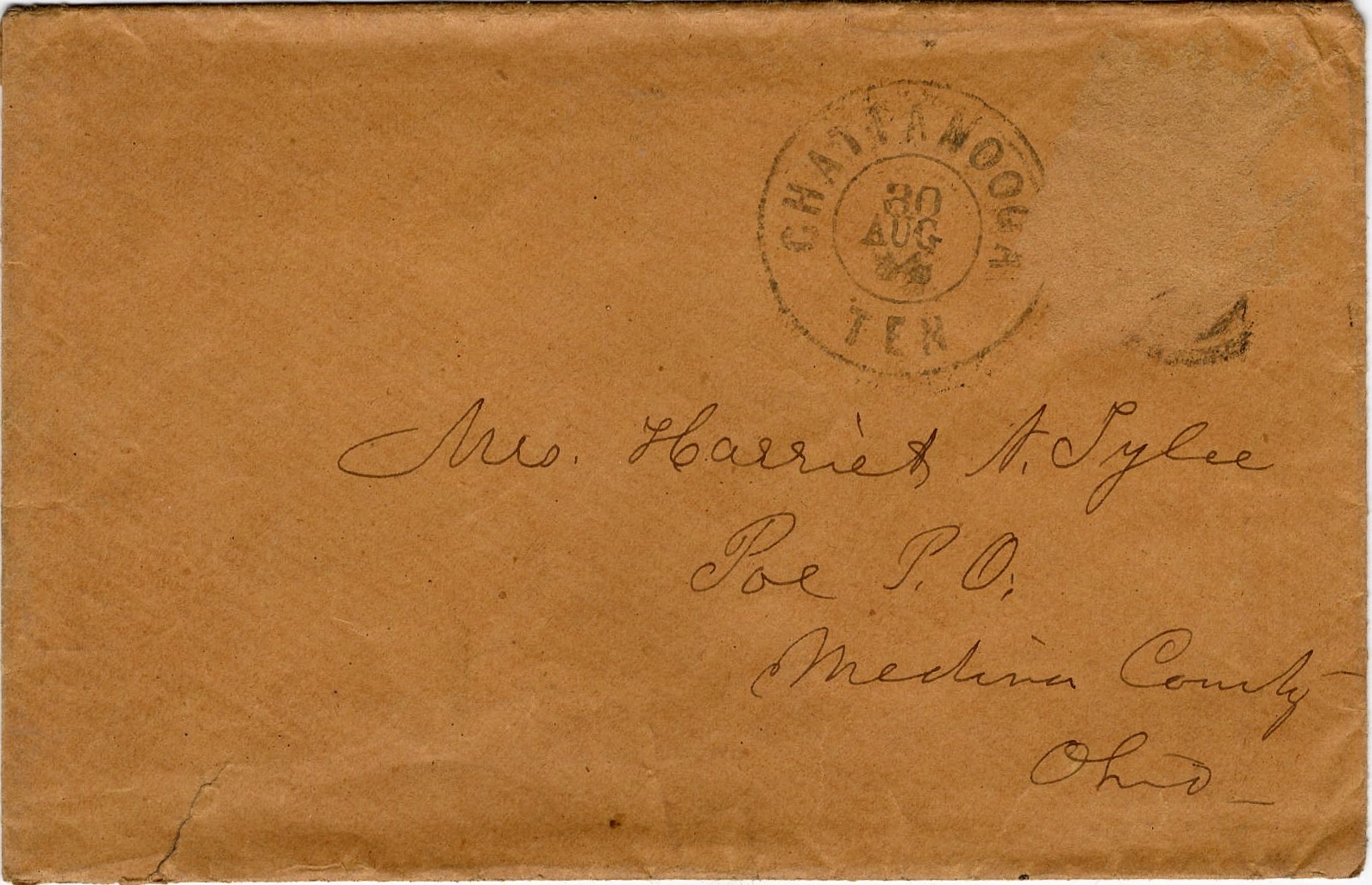
Addressed to Mrs. Harriet N. Tylee, Poe P. O., Medina county, Ohio
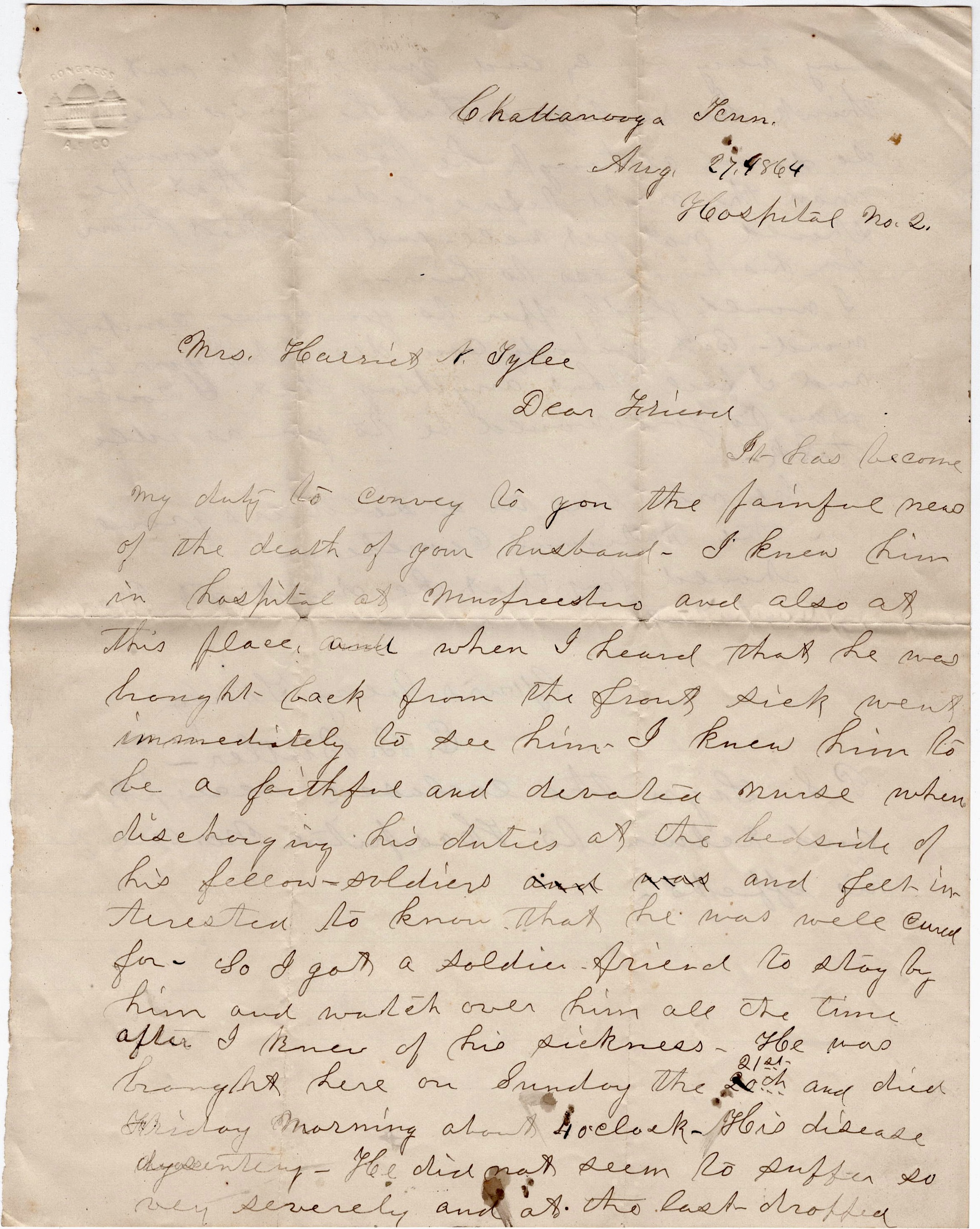
Hospital No. 2 Chattanooga, Tennessee August 27, 1864
Mrs. Harriet N. Tylee Dear friend,
It has become my duty to convey to you the painful news of the death of your husband. I knew him in hospital at Murfreesboro and also at this place, and when I heard that he was brought back from the front sick, went immediately to see him. I knew him to be a faithful and devoted nurse when discharging his duties at the bedside of his fellow soldiers and felt interested to know that he was well cared for. So I got a soldier friend to stay by him and watch over him all the time after I knew of his sickness.
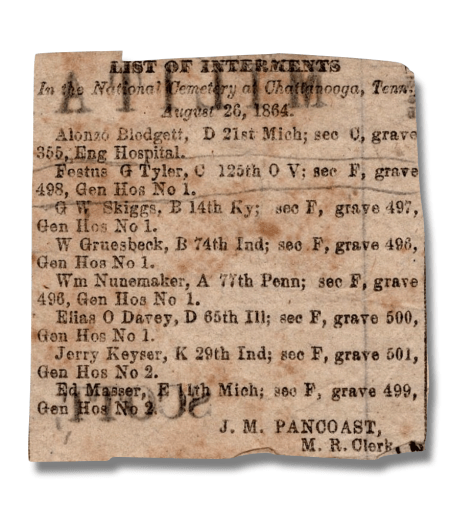
List of Interments clipped from newspaper
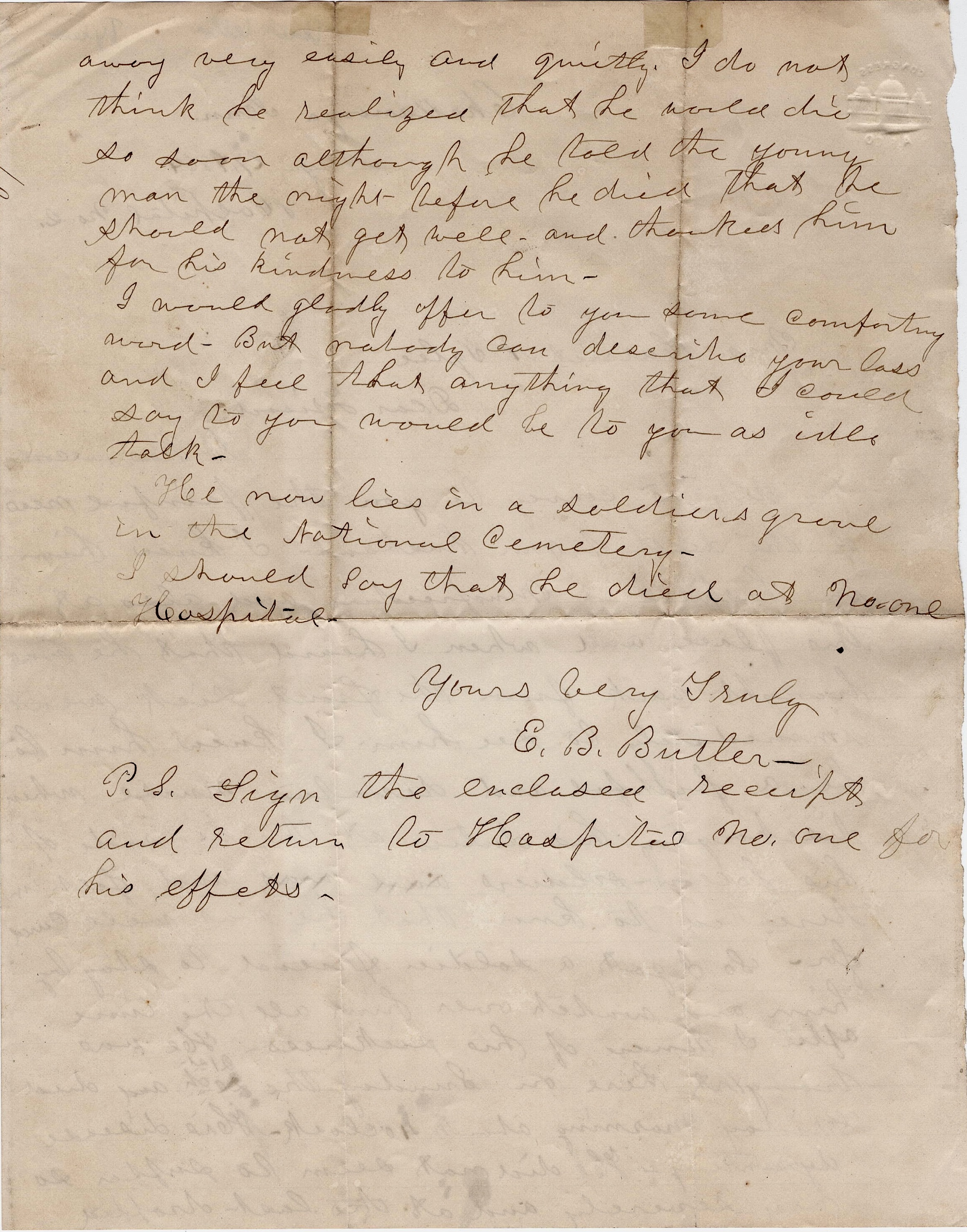
He was brought here on Sunday the 21st and died Friday morning at 4 o’clock. His disease [was] dysentery. He did not seem to suffer so very severely and at the last dropped away very easily and quietly. I do not think he realized that he would die so soon although he told the young man the night before he died that he should not get well and thanked him for his kindness to him.
I would gladly offer to you some comforting word but nobody can describe your loss and I feel that anything that I could say to you would be to you as idle talk. He now lies in a soldier’s grave in the National Cemetery. I should say that he died at No. 1 Hospital.
Yours very truly, — E. B. Butler
P. S. Sign the enclosed receipt and return to Hospital No. 1 for his effects.
Personal effects included a pocket book [with] 15 cents, knapsack, shirt, socks, Bible, Ambrotype.
The following letters were written by Festus Giddings Tylee (1834-1864), the son of Samuel Tylee (179801875) and Harriet Giddings (1805-1860) of Hubbard, Trumbull county, Ohio. Festus was married to Harriet Muriel Downing in 1858 and was farming in Poe, Medina county, Ohio, at the time of his enlistment in Co. C, 125th Ohio Volunteer Infantry (OVI) in October 1862. He did not survive the war. He died of disease on 25 August 1864 at a Chattanooga Hospital.
Festus composed all three of these letters to his wife during his convalescence in a hospital located in Murfreesboro, Tennessee, where he was treated for a condition that resulted in significant swelling and severe pain in his leg. He remained there for several months in the autumn of 1863, serving as a nurse, which led to his absence from the combat at Chickamauga and the ensuing engagements around Chattanooga later that year.
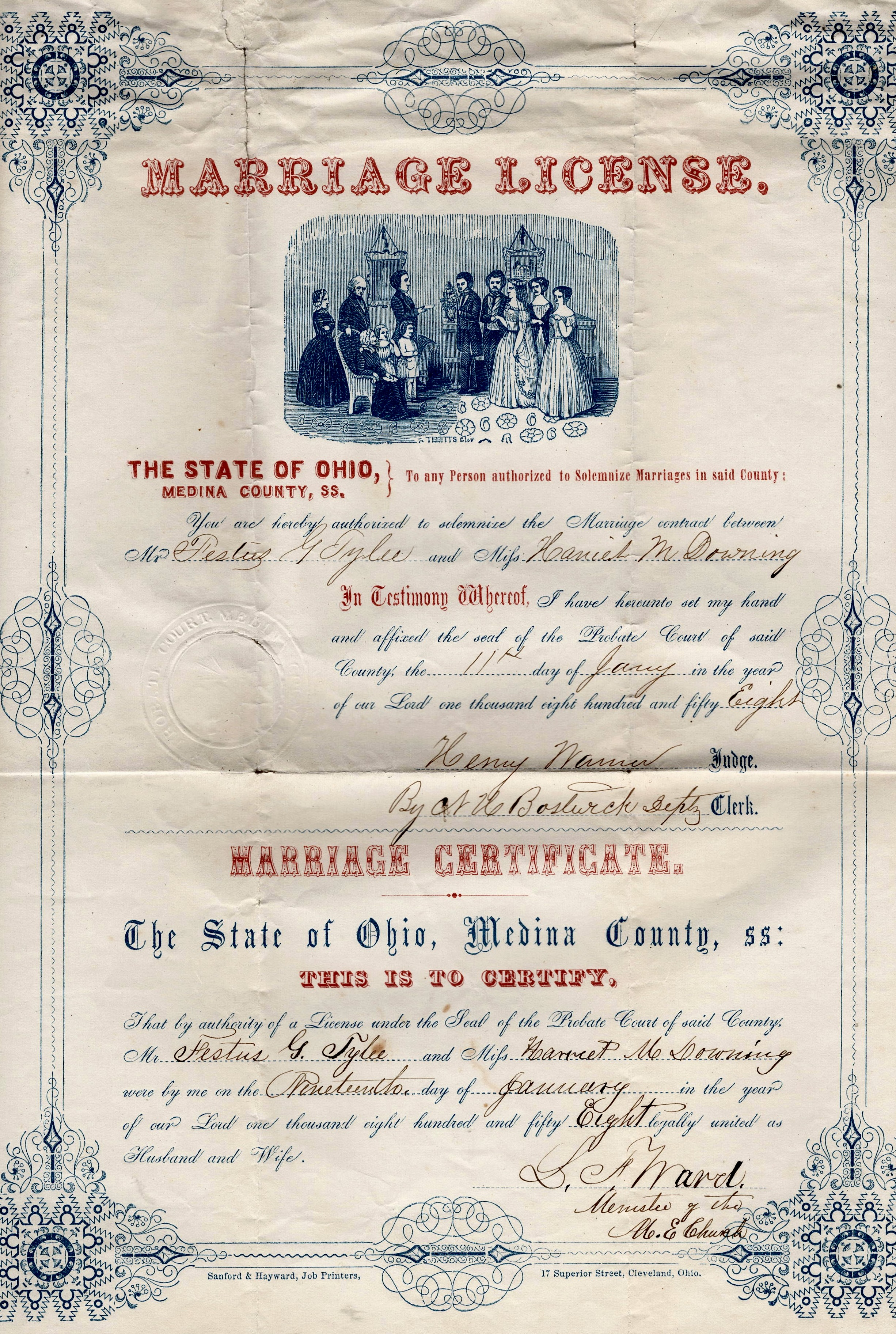
Marriage Certificate of Festus G. Tylee and Harriet M. Downing, dated 19 January 1858 in Medina county, Ohio
Letter 1
Addressed to Mrs. Harriet Tylee, Poe, Medina county, Ohio
Murfreesboro, Tennessee September 14, 1863
My dear companion,
I received a letter from you and Daniel today and glad to hear from you both. I got such a good letter from brother Daniel. I shall answer it immediately. I am gaining slowly but am not well yet. My back is weak and my left leg is swelled up yet. Some say it will not get well for a long time but I am in hopes it will. It is some like Thomas Heath’s. It is very weak in the ankle joint. It had been over two months since it first swelled up but the swelling has gone down some. I was swelled clear to the thigh at first and was very painful. I don’t know whether I told you anything about it or not. I can’t remember from one week to another what I do write hardly but my dear Hat, I do not intend to deceive you in anything.
The first letter I wrote to you I could not think what I wanted to write. You spoke about me laying on my back so long and not being changed nor taken care of. But you are mistaken. I was changed twice a week and my nurse was good and kind to me but he had 16 to tend to and it kept him pretty busy. He failed to see my sore but i never asked him for anything but he would run and do whatever I wanted. He said he would rather tend a docsin like me that one like some he had to send for I would take anything he brought to me and never grumble at anything. I think I had good care to go through what I did. I know that I have had the best of care since I came to myself and what I have seen take care of others.
There was a man came here that was just like I was and he was changed every two days and was washed with a sponge so you see that I know I had good care. Because I did not write it to you, you must not think I tried to deceive you because I did not. When I am writing, I want to write so much that I can’t think of it all at once but I hope I have given you a full detail of my sickness. You need not look for me home this fall for they don’t give sick men furloughs if they think he will get well. But wounded men will get furloughs. The surgeon in charge received a letter from Governor [David] Tod but he said that I was doing so well that he thought best to keep me here. I have the best of care here and they won’t let me go to my regiment till I am well. You and Daniel wrote about a murder in Medina. I want you to write me all the particulars about it—who was murdered and where. I never heard anything about it…
I wrote you a letter this week with twenty dollars in it. You must write and let me know whether you get it or not. I shall send you as much more when I hear from that. How does your corn so and the cows? I must know all the particulars you know. How is my little heiffer looking and how do you expect to get along with her when she come in? You must be careful and not get hurt with her. Take care of yourself and Jenia and mother tell her I should like to see her but it is otherwise ordered. But I hope and pray for the best. I think of you often but I shall not worry. They tell me I am the most contented of any of them and that is the reason I get along so well. My love to all. From your husband, — Fet
Letter 2
Murfreesboro, Tennessee October 25, 1863
My dear companion,
I received your letter of 14th last Friday. I was a little disappointed to hear that my box could not come but I shall be contented as it is. You done the best you could, I am sorry to put you to so much trouble for nothing. I shall not try to have one sent now for it is too much for you to do. If we had a horse of our own it would be different and then you live so far from the station that it is too hard for a woman to go so far. you must not worry about me for I shall get along first rate. I should liked to have had that box come through for there was several things that I wanted such as the paper and envelopes and the tobacco, besides the other things that is too numerous to mention. I think you had a very nice box full for me if it had come but you must not feel bad about it for it is no account anyway. Maybe I will come home some day and then we can take comfort together and that will be better than sending me a box.
I hope this terrible war will close before long so that the soldiers can go home and see their families and take comfort. It seems that it was so ordered that we should be separated. I can lay here and think over the many happy days and years that we enjoyed together but we are separated now and it makes me think of the past, But if God wills it, we will meet again and then we can take comfort again and I hope we shall.
I have written to Sam some time ago but have not heard any answer yet. I do not know what is the reason for the last time I wrote to him he answered it right off. I have written to Nat and I hope to get a letter from her before long. I have not got an answer from brother Nichols. He had better write to me, you can tell him, or I will have a settlement to make with him. I saw Mono Bushon yesterday. His regiment left here yesterday. He said he would write to me when they halted. He is as fat and chubby as ever. It does me good to see anyone that I was acquainted with and I like to hear from those that are at home. You know I like to get letters from your own experience and good long ones too. I have several letters do me from friends and I am waiting with patience to get them. I have not heard from the regiment for a long time. Communication has been cut off and we cannot write to the regiment so I do not know how they got along in the fight [at Chickamauga]. If you can get hold of a paper that has an account of the battle with our regiment in, I wish you would send it to me for I should like tp know how they got along.
The Chaplain of the 124th Regiment preached here last Sabbath. He preached a good sermon. I asked him if he knew anything about the regiment and he said that they was in the fight and lost two captains and a good many men. The Colonel of the 124th was wounded and several of the officers. I do not know who is going to preach today but we expect to have preaching at two o’clock. We have a first rate Chaplain here. He went out as a private in the 49th Pennsylvania Regiment and was promoted to Corporal and after that they sent him a Chaplain’s commission. He is a good preacher and tends to his business.
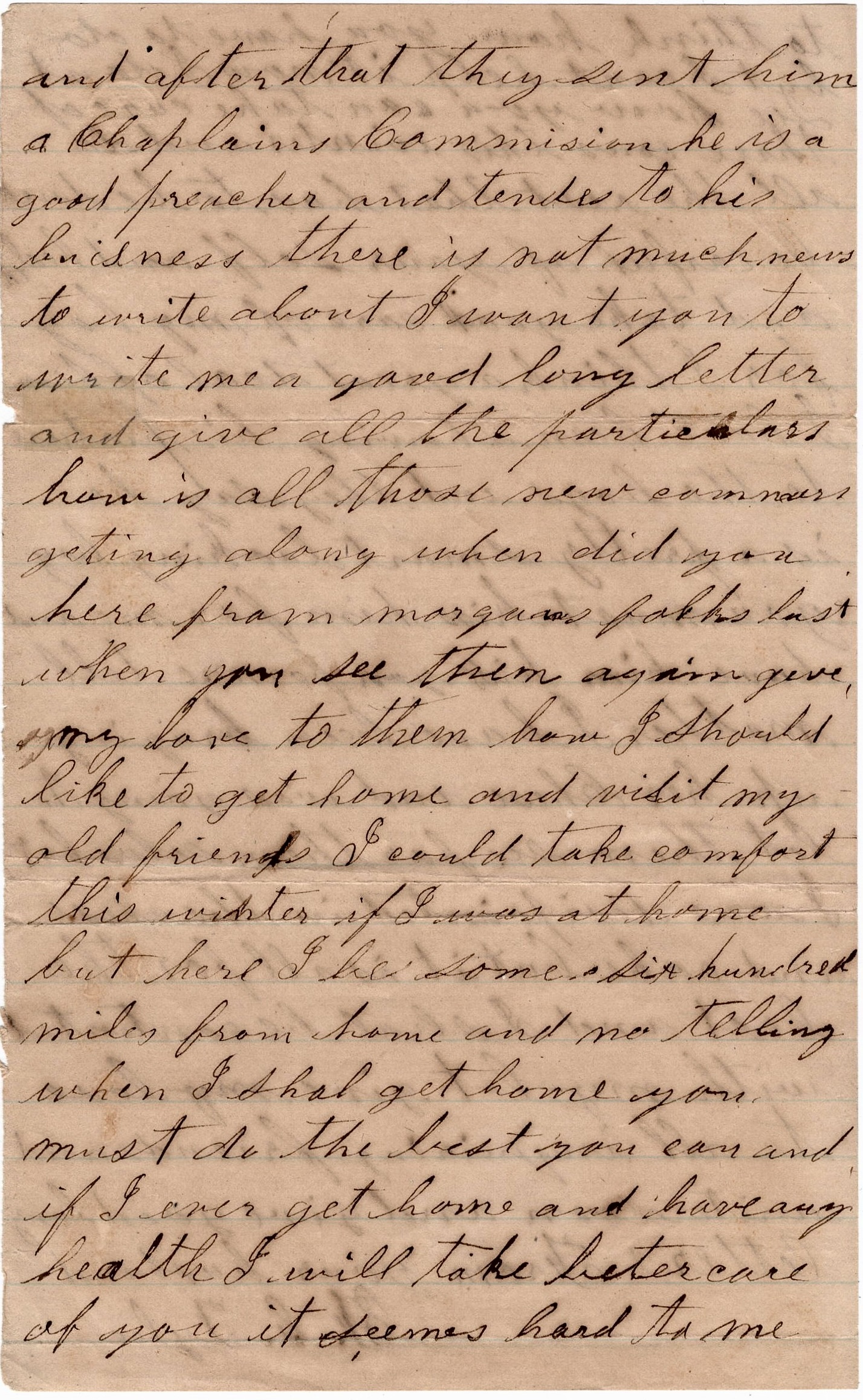
There is not much news to write about. I want you to write me a good long letter and give all the particulars. How is all those newcomers getting along? When did you hear from Morgan’s folks last? When you see them again, give my love to them. How I should like to get home and visit my old friends. I could take comfort this winter if I was at home but here I lie some six hundred miles from home and no telling when I shall get home. You must do the best you can and if I ever get home and have any health, I will take better care of you. It seems hard to me to think how you have to do but I can’t help it now. I don’t see how you can take care of three cows this winter and do all the rest that has to be done. Be careful of yourself and health and take good care of my boy for I think a great deal of him. I have been showing his picture to the boys and they say he is a pretty smart looking boy. You must kiss him for me and have him kiss you for me.
Tell Mother I have been bragging up her cheese and was going to let them see for themselves but I was disappointed in the cheese and cake. But it is all for the best and I shall be contented with my lot. Give my love to all inquiring friends and write soon and give good long letters. From your husband, – F. G. Tylee
Letter 3
Murfreesboro, Tenn. November 13th 1863
My dear companion,
I received your welcome letter yesterday and was glad to hear from you. I am pretty well now, My leg is getting a great deal better and I am gaining strength pretty fast. I am nursing yet. It is not very hard. There is two of us to a room and only eight to take care of and most of them can wait upon themselves so you see that it is not very hard for us. I have to carry the victuals around in this ward. That is the hardest work I have to do.
I received a letter from Ira and a paper from you. It had an account of my regiment in the Battle of Chickamauga. They done well for a new regiment but how could they help it with such a man as Col. Opdycke for their leader. I have heard him say many a time that if the boys would stick to him, he would lead them to a glorious victory or an honorable grave and I guess that the boys stuck to him pretty well for they were in the hottest of the fight. There was but one boy killed in my company. He was a good little boy. There [were] several wounded in my company—some of the best boys we had. I am glad I was not in the fight for it was terrible to see the wounded come in the hospital. It is enough to make a man sick to think about it. To think how much they have to suffer on the field before they are taken care of, I should think more would die than does. They have to lay sometimes two or three days before they are taken up off the damp ground.
There is some talk of another big fight down here soon. I hope they will drive them this time into the Gulf below. I should like to see this rebellion crushed so that I could come home to my family. How I should like to get home. But we must have patience and hope for the best. There is one year of my time in and I am in a good place so I must be contented.
If I could only get a box from you it would seem so good. I was down to the Express office yesterday and they told me boxes come through now. Several of the boys got boxes here since you tried to send mine. But it will be too much trouble for you and maybe they would not let it come. You need not worry about me. I do not want my drawers anyway for I have two pairs and when I am in the hospital, they furnish drawers and shirts and socks too so you see that I do not want much. Your socks I would not wear as long as I am in the hospital, I have got my woolen shirts on and wear a white shirt over and then they have woolen gowns to wear in place of a blouse. They almost furnish a man here. All I wear that don’t belong to the hospital is my shoes, shirts and pants [and] hat—that is woolen shorts. They will last me all winter. The owe me almost 16 dollars this year for clothing and they will owe me more next year if I stay here for I have clothes enough to last me six months yet for I do not wear out clothes very fast here. I have had but two pairs of pants and these that I have now will last me a good while and my blouse is very good and I have had that over a year. It was a first rate one. I have a very good hat—almost new. It did not cost me anything. I got it over to the field hospital, They had a lot that they did not know what to do with.
If you take a notion to send me a box, you need not send my drawers and you may make three or four mince pies—good ones—and whatever you think best. Some paper and envelopes—we get such poor paper down here and it costs 50 cents a quire, envelopes 25 cents a package. I would think more of some good paper and envelopes than anything else. I will send you some money before long. How much have you got all together now? I want you to tell me. I don’t want you to be afraid to spend it for you. Get what ever you want while you have the money for maybe you won’t have the opportunity after a while. I spend a good deal more than I had orta but if I have enough for you to live on it is all I care for.
What is the reason I do not hear from my folks? It is over two months since I heard from Mat and I wrote her two letters and Sam one and father one. I want you to write to them and let me know if you hear from them. I did not get that letter that you spoke about in this letter about the Medina murder. I have never heard anything about it. Who was murdered? and what did they do with the man that they had in jail? Write soon. My love to all. Kiss Jemy for me and have him kiss you for me. Tell him to be a good boy and mind his manners. From your husband, — F. G. Tylee
This letter was written by Capt. Edward Payson Bates (1838-1916) of Co. C, 125th Ohio Volunteer Infantry (OVI). Earlier in the war he had served in Co. D, 19th OVI. The 125th OVI was stationed around Murfreesboro and Hillsboro throughout the summer of 1863 before starting the march for Chattanooga in August. They arrived there by September and saw their first major battle at Chickamauga, as part of the 3rd Brigade (Harker’s), First Division, XXI Corps, Army of the Cumberland. The regiment was engaged on both days of the battle, literally earning a good name for themselves.
A little over a year later they also distinguished themselves in the Battle of Franklin. Infuriated by the sight of the Federal troops flying to the rear, Capt. Edward P. Bates reportedly shouted, “Come on boys, we have always whipped them and always will.” The 125th was to the west of the pike and met head-on with the advancing Confederates at the Carter House. After a quick but vicious melee, the Rebs fell back to the ditch outside the main line of works. The 125th took position around the Carter buildings, both sides just yards apart and keeping up the fire until after dark, neither able to advance across the Carter garden that lay between. Despite being in the thick of the action, acting commander Capt. Bates listed the losses as 2 killed, 21 wounded, and 8 missing. He reported that the regiment saved two artillery pieces and captured two flags and 85 prisoners.
Bates was the son of Daniel Bates and Harriet Newell Hungerford (1805-1875) of Trumbull county, Ohio. He was a graduate of Hillsdale College (Michigan).
The letter was addressed to Harriet M. (Downing) Tylee, the wife of Festus G. Tylee who enlisted in Co. C, 125th OVI on 23 October 1862. Festus did not survive the war. He died of disease on 25 August 1864.
T R A N S C R I P T I O N
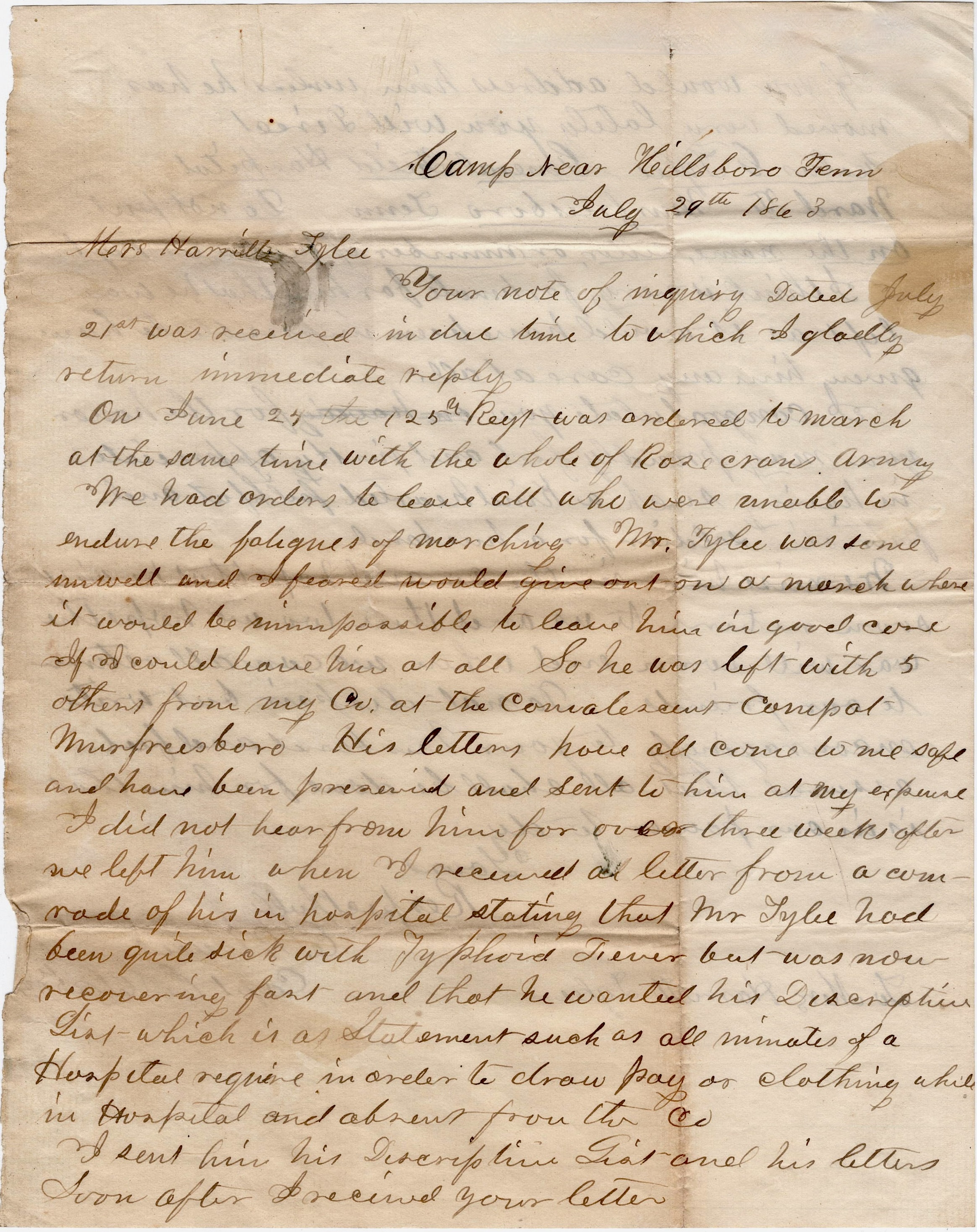
Camp near Hillsboro, Tennessee July 29th 1863
Mrs. Harriett Tylee
Your note of inquiry dates July 21st was received in due time to which I gladly return immediate reply.
On June 24, the 125th Regiment was ordered to march at the same time with the whole of Rosecrans Army. We had orders to leave all who were unable to endure the fatigues of marching. Mr. Tylee was some unwell and I feared would give out on a march where it would be impossible to leave him in good care if I could leave him at all so he was left with 5 others from my company at the Convalescent Camp, Murfreesboro. His letter have all come to me safe and have been preserved and sent to him at my expense. I did not hear from him for over three weeks after we left him when I received a letter from a comrade of his in hospital stating that Mr. Tylee had been quite sick with typhoid fever but was now recovering fast and that he wanted his Descriptive List, which is a statement such as all inmates of a hospital require in order to raw pay or clothing while in hospital and absent from the company.
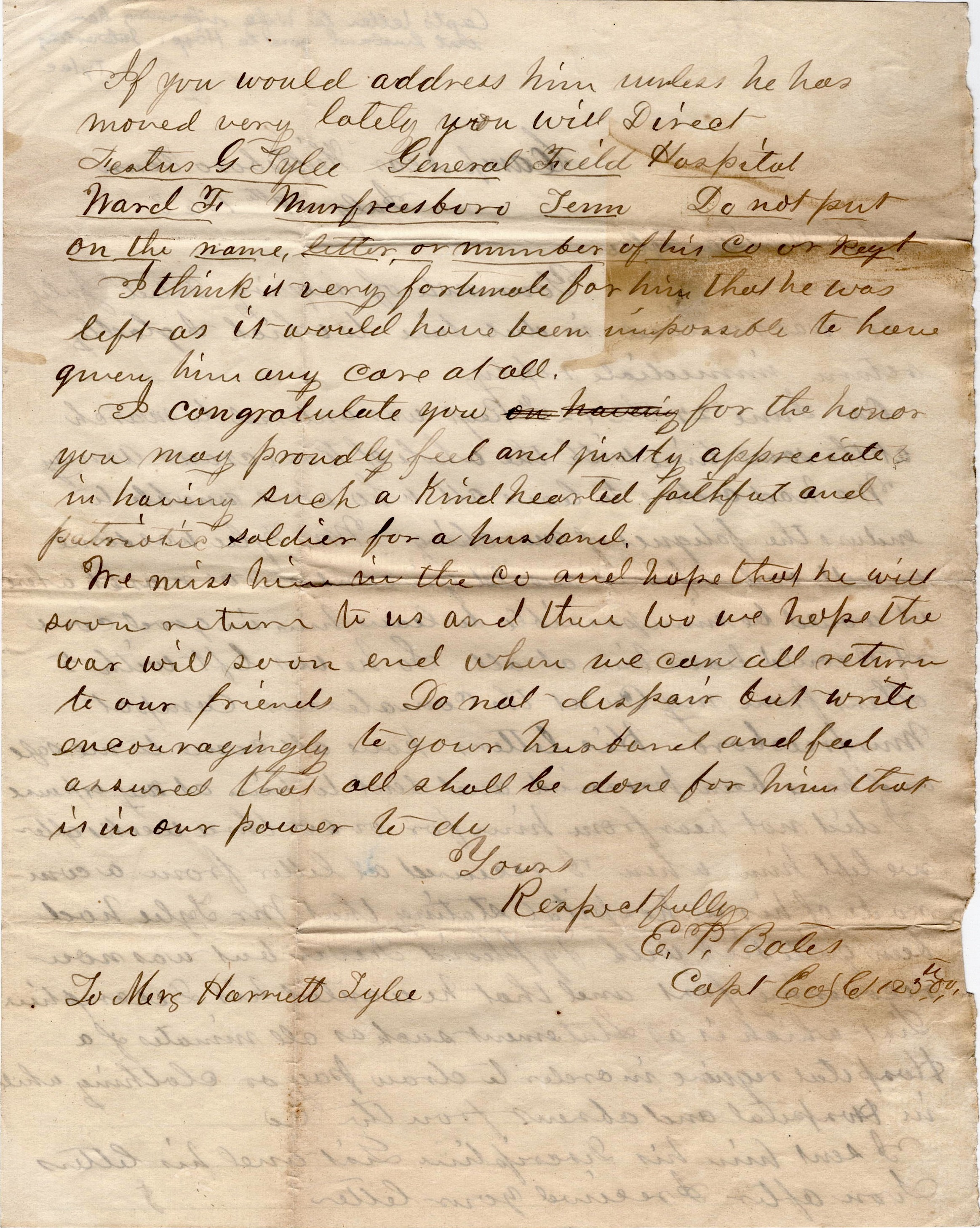
I sent him his Descriptive List and his letters soon after I received your letter. If you would address him unless he has moved very lately, you will direct Festus G. Tylee, General Field Hospital, Ward F, Murfreesboro, Tenn. Do not put on the name, letter or number of his company or regiment. I think it very fortunate for him that he was left as it would have been impossible to have given him any care at all.
I congratulate you for the honor you may proudly feel and justly appreciate in having in having such a kind-hearted, faithful and patriotic soldier for a husband. We miss him in the company and hope that he will soon return to us and then too we hope the war will soon end when we can all return to our friends. Do not despair but write encouragingly to your husband and feel assured that all shall be done for him that is in our power to do. Yours respectfully, — E. P. Bales, Capt., Co. C, 125th OVI






 Spared & Shared 23