Category Archives: 126th New York Infantry

1863: Edgar A. Warner to Calvert C. Warner

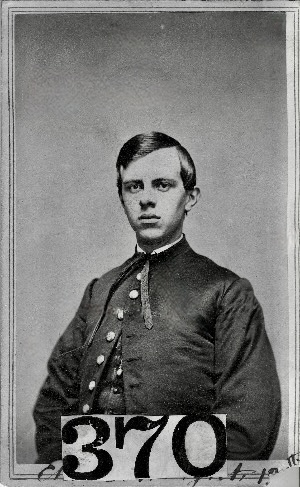
I could not find an image of Edgar but here is one of Charles C. Wright of Co. H, 126th NYV. (Photo Sleuth)

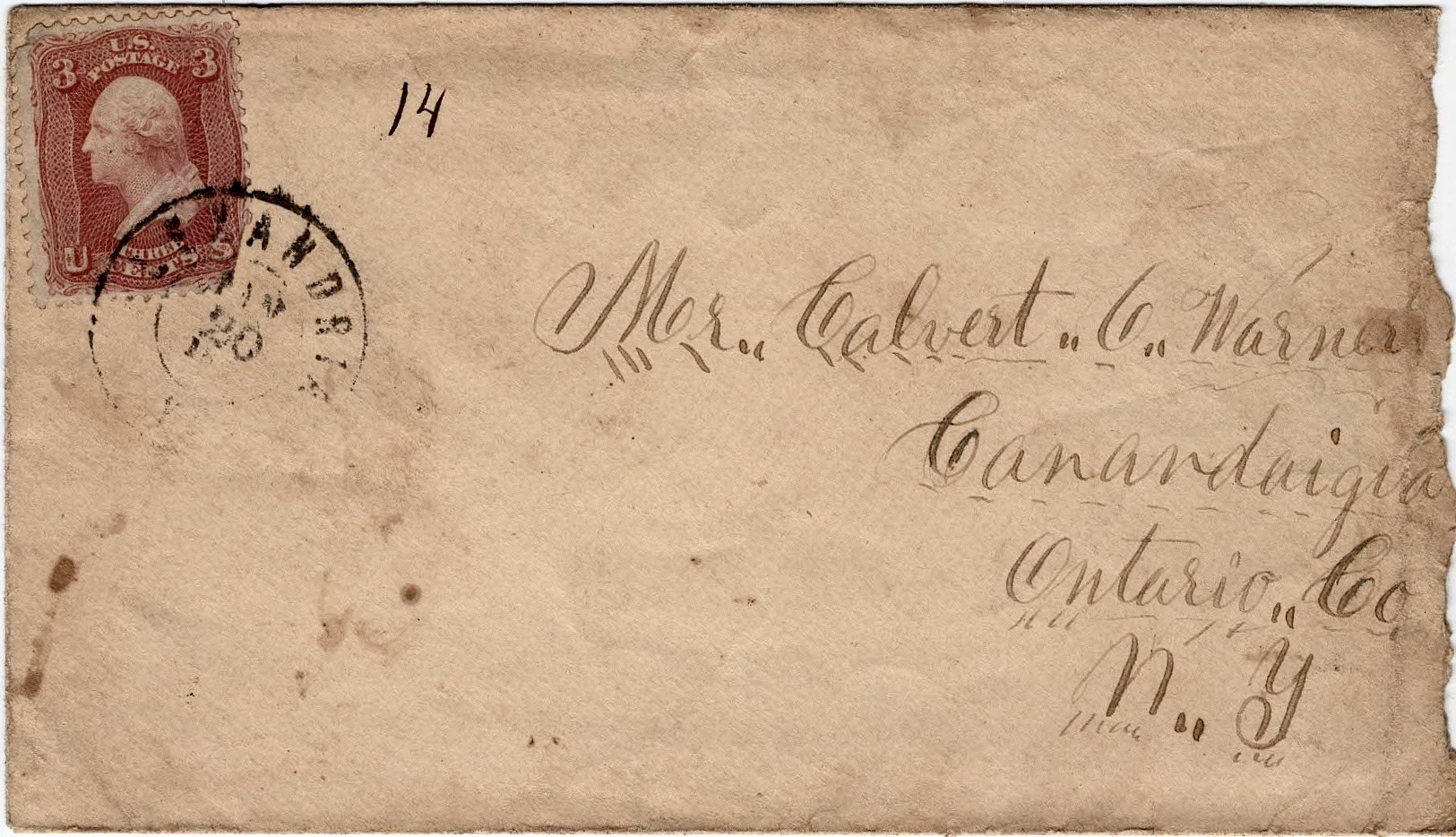
These letters were written by Pvt. Edgar A. Warner (1841-1863) of Co. K, 126th New York Infantry. He was born in Hopewell, New York, and was a farmer by occupation. He enlisted 31 July 1862, aged twenty-one years, and was in the battles of Harper’s Ferry, Gettysburg, and Auburn Ford before being mortally wounded in the Battle of Bristoe Station on 14 October 1863. Pvt. Warner was taken to 2nd Division Hospital in Alexandria (in a Baptist Church) where he was treated for a gunshot wound to the lungs but he died on 16 October 1863 and was buried initially in Alexandria National Cemetery, Section A, Plot 1014. It seems that his body was later exhumed and probably returned to his home in upstate New York.

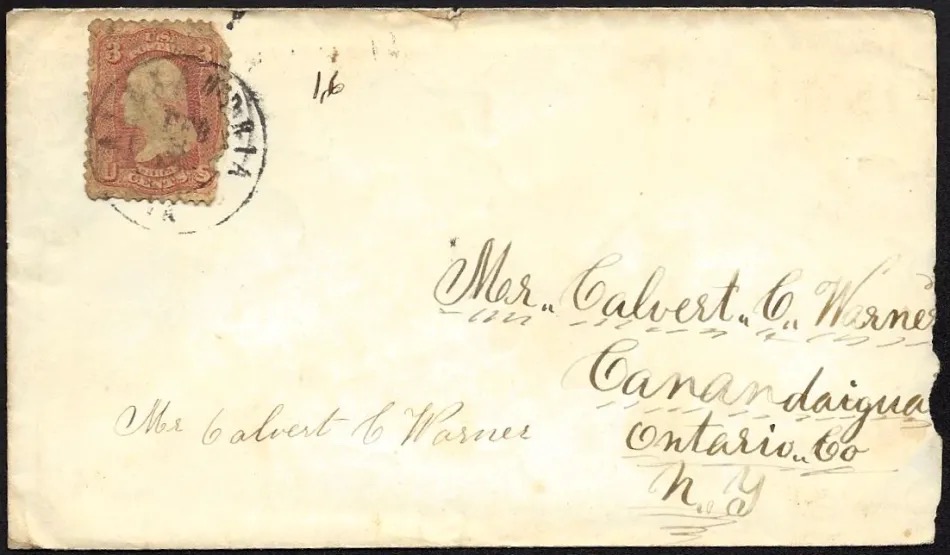
Edgar was the son of Calvert C. Warner (1821-1897) and Eunice V. Latting (1823-1887) of Canandaigua, Ontario County, New York. Calvin was a miller by trade. Edgar wrote this letter to his parents as well as his sister, Caroline E. Warner (b. 1845).

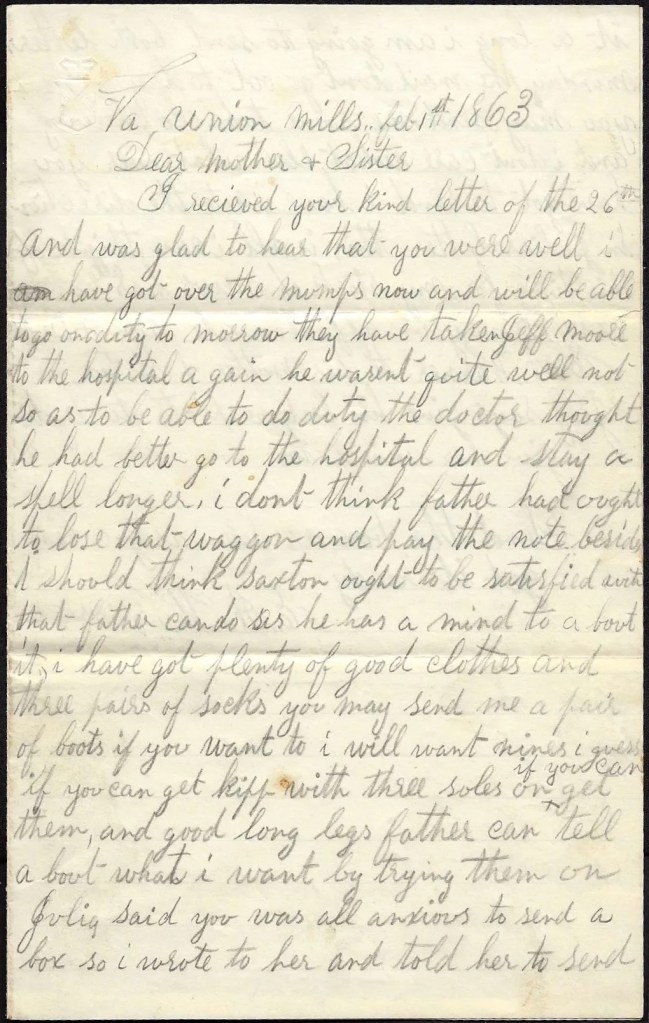
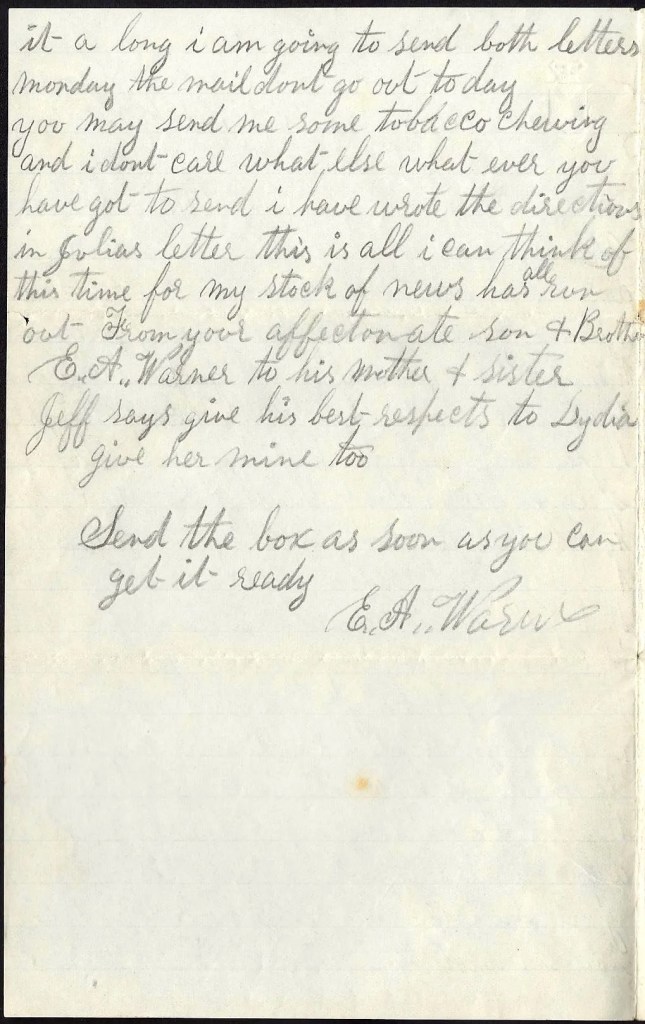
Letter 1
Union Mills, Virginia
February 1st 1863

Dear Mother & Sister,

I received your kind letter of the 26th and was glad to hear that you were well. I have got over the mumps now and will be able to go on duty tomorrow. They have taken Jeff Moore ¹ to the hospital again. He warent quite well — not so as to be able to do duty. The doctor thought he had better go to the hospital and stay a spell longer.

I don’t think father had ought to lose that waggon and pay the note besides. I should think Saxton ought to be satisfied with that. Father can do as he has a mind to about it.

I have got plenty of good clothes and three pairs of socks. You may send me a pair of boots if you want to. I will want nines, I guess. If you can get ki__ with three soles on if you can get them, and good long legs. Father can tell about what I want by trying them on. Julia said you was all anxious to send a box so I wrote to her and told her to send it along. I am going to send both letters Monday. The mail don’t go out today. You may send me some tobacco chewing and I don’t care what else — whatever you have got to send. I have wrote the directions in Julia’s letter. This is all I can think of this time for my stock of news has all run out.

From your affectionate son & brother, — E. A. Warner to his mother & sister

Jeff says give his best respects to Lydia. Give her mine too. Send the boxes soon as you can get it ready. E. A. Warner

¹ Thomas Jefferson (“Jeff”) Moore enlisted in Company K of the 126th New York on 12 August 1862 at Canandaigua to serve three years. He was taken prisoner on 15 September 1862 and paroled the following day at Harper’s Ferry when the entire garrison surrendered to Stonewall Jackson’s men on their way to Antietam. We learn from this letter that Jeff was seriously ill in early February 1863; he died of “lung inflammation” on 10 April 1863 at the Fairfax Street Hospital — a former hotel called the Mansion House — in Alexandria, Virginia.
Letter 2

[Editor’s Note: This transcription was done by The Excelsior Brigade and I cannot vouch for its accuracy. The letter remains for sale on that site as of this date, 3/1/2026.]

Camp at Centreville, VA
April 30th 1863

Dear Mother,

I received your most welcome letter yesterday and was glad to hear that all the folks were well. I am enjoying very good health at present. We are having some very nice weather nowadays. The farmers have commenced to plough and sow. 

I received a letter from Julia and Uncle Dick yesterday. Julia said that she had got well again. I forgot to tell you before that Walter Cook had got back. He returned the fourth day of April but left again the 28th through. I guess he is caught. We heard yesterday that the Maine boys that are doing picket duty on the right of us took a prisoner night before last. And I think it was Walter. He has been lame every since he came back. He had a sore on his leg. He said that he got drunk and a horse run away with him. But I have heard since that he has been binding pennies on it to make it sore. I am afraid if he is caught again it will go hard with him. He told me sometime ago that he was going to try and get to Pennsylvania and go as a substitute for somebody and then get to Washington and get his discharge. I cannot tell you what has become of Jeff Moore. He and McKechnie and Fred Root went to Washington to the general hospital about the first of the month. And I have not heard from him since.

Mr. Hillman got a letter from home the other day and his folks said they was sorry to hear that Jeff was dead. That is all I have heard about it. Though I don’t think it is so. If it was so, the captain would know something about it. I don’t know as you can send me any tobacco. I can but it as cheap here as you can get it there and send it to me. We got our pay last Sunday. Enclosed you will find the allotment check for forty dollars. You can draw the money on it and put it in the bank. You never told me how much of the other you put in the bank. We got four months pay this time. I owed the sutler six dollars and had five dollars and fifty-six cents left. We were mustered for pay again today. But I don’t know when we will get paid again. This is all I can write this time for it is bedtime. We all have to be in bed and our lights out at 9 o’clock. If they find a light burning in the tent after that, away you go to the guardhouse.

Write soon and let me know if you get this and a picture. I guess I will send that in a separate envelope. It is the best I could get for a dollar. From your affectionate son. Send some stamps.

E. A. Warner

To E. Van Warner

Write soon.

P. S. I got the bill of my box the same day I got the letter a week before I got the box.


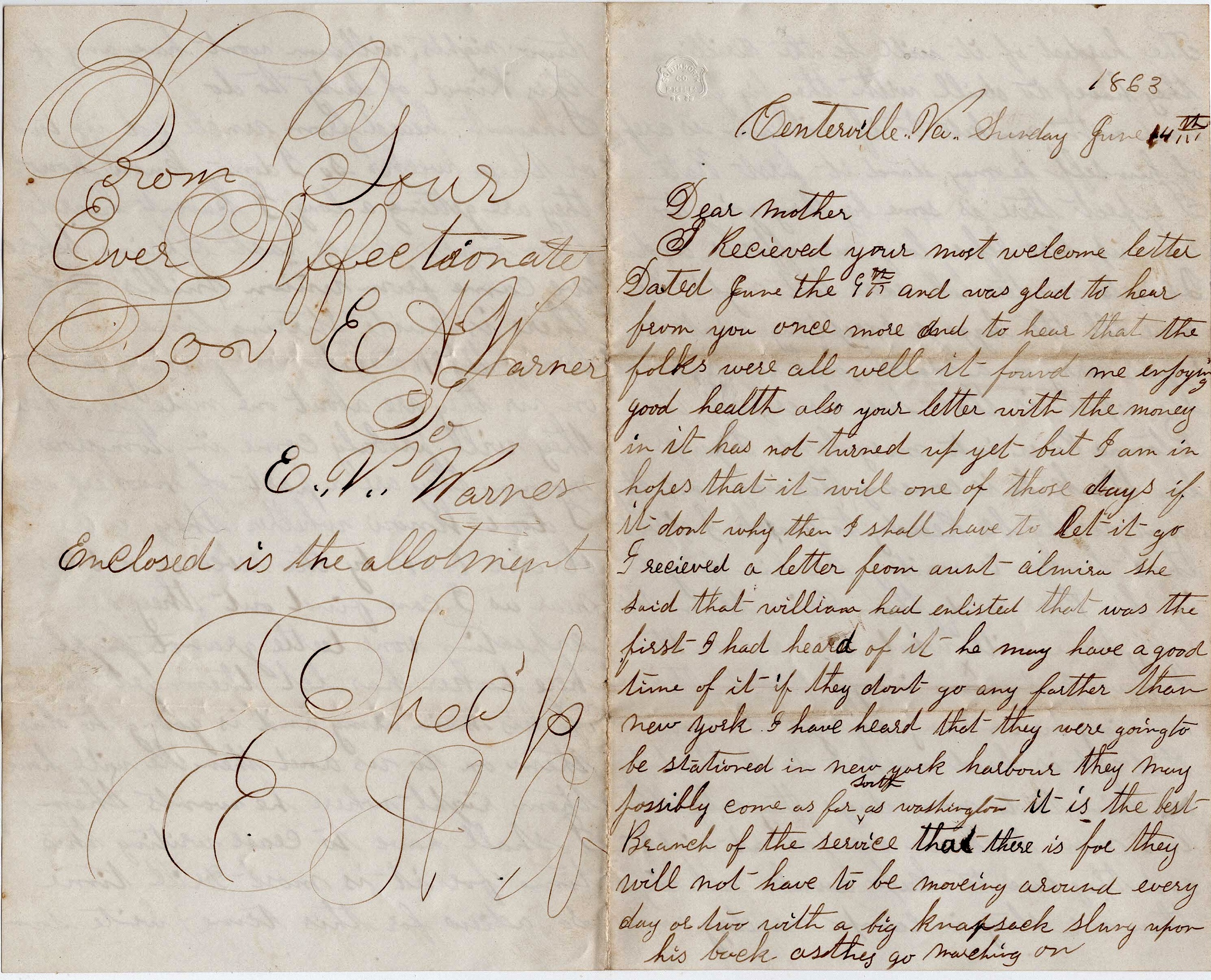
Letter 3
Centerville, Virginia
Sunday, June 14th 1863

Dear Mother,

I received your most welcome letter dated June the 9th and was glad to hear from you once more and to hear that the folks were all well. It found me enjoying good health also.

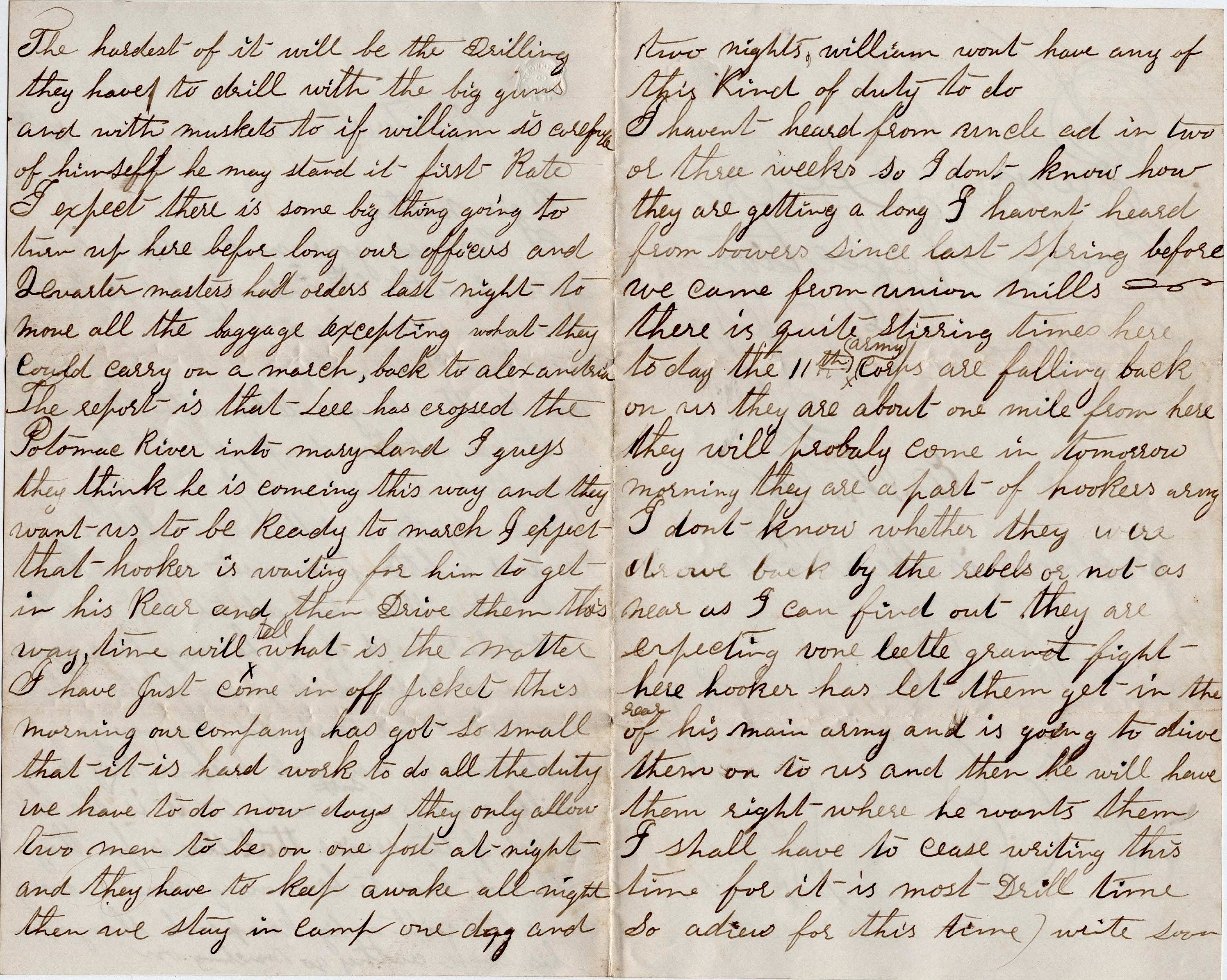
Your letter with the money in it has not turned up yet but I am in hopes that it will one of these days. If it don’t, why then I shall have to let it go. I received a letter from Aunt Almira. She said that William had enlisted. That was the first I had heard of it. He may have a good time of it if they don’t go any farther than New York. I have heard that they were going to be stationed in New York harbor. They may possibly come as far south as Washington. It is the best branch of the service that there is for they will not have to be moving around every day or two with a big knapsack slung upon his back as they go marching on. The hardest of it will be the drilling. They have to drill with the big guns and with muskets too. If William is carefull of himself, he may stand it first rate.

I expect there is some big thing going to turn up here before long. our officers and quartermasters had orders last night to move all the baggage excepting what they could carry on a march back to Alexandria. The report is that Lee has crossed the Potomac River into Maryland. I guess they think he is coming this way and they want us to be ready to march. I expect that Hooker is waiting for him to get in his rear and then drive them this way. Time will tell what is the matter.

I have just come in off picket htis morning. Our company has got so small that it is hard work to do all the duty we have to do nowadays. They only allow two men to be on one post at night and they have to keep awake all night. Then we stay in camp one day and two nights. William won’t have any of this kind of duty to do.

I haven’t heard from Uncle Ad in two or three weeks so I don’t know how they are getting along. I haven’t heard from Bowers since last spring before we came from Union Mills.

There is quite stirring times here today. The 11th Army Corps are falling back on us. They are about one mile from here. They will probably come in tomorrow morning. They are a part of Hooker’s army. I don’t know whether they were drove back by the rebels or not. As near as I can find out, they are expecting vone leetle grand fight here. Hooker has let them get in the rear of his main army and is going to drive them on to us and then he will have them right where he wants them.

I shall have to cease writing this time for it is most drill time. So adieu for this time. Write soon. From your ever affectionate son, — E. A. Warner

To E. V. Warner. Enclosed is the allotment.

[Editor’s note: There is a page of a letter that seems to have come from another letter by Warner which reads, in part….]

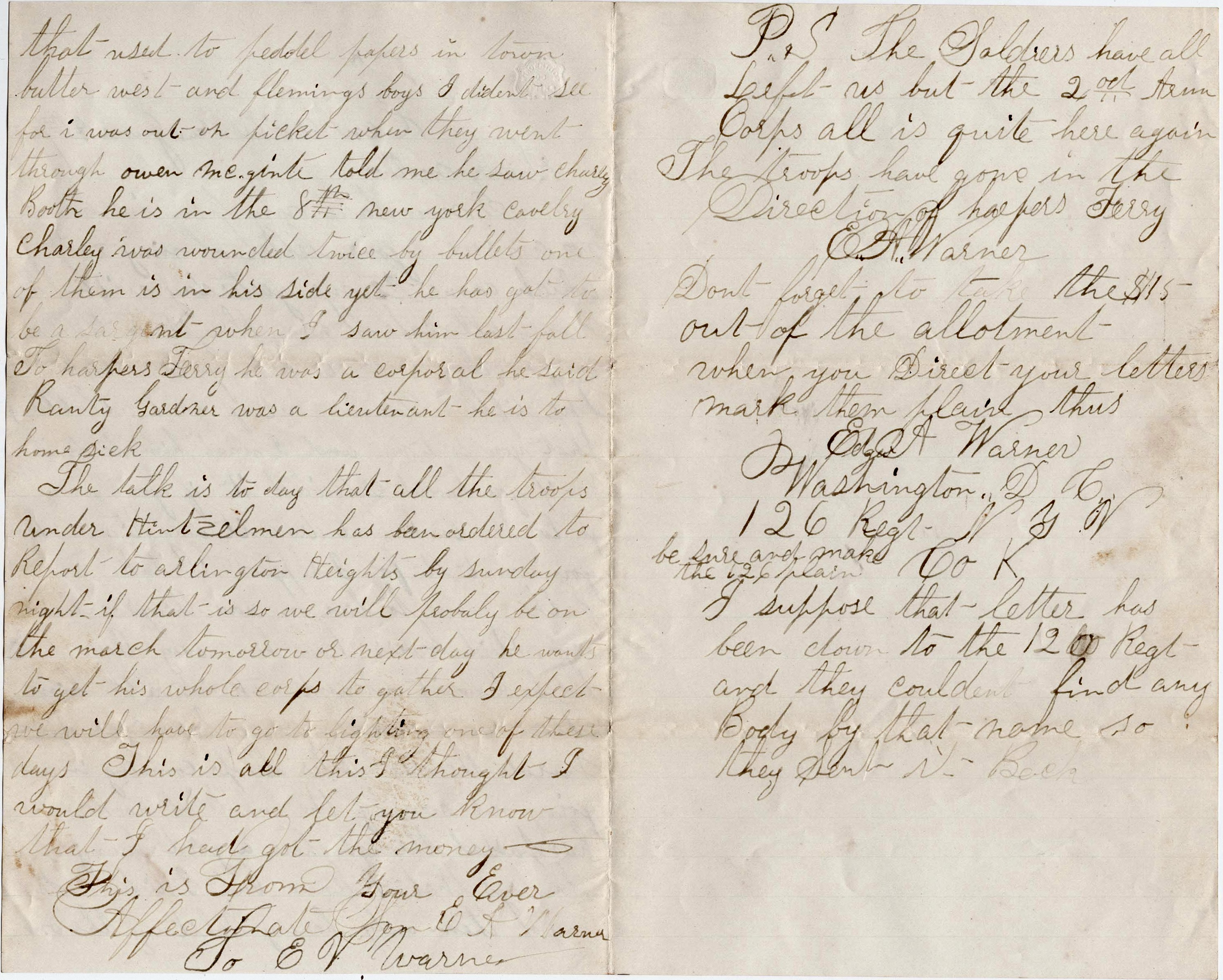
Owen McGinte told me he saw Charles Booth. He is in the 8th New York Cavalry. Charley was wounded twice by bullets. One of them is in his side yet. He has got to be a sergeant. Ehen I saw him last fall at Harpers Ferry he was a corporal. He said Ranty Gardiner was a lieutenant. He is to home sick.

The talk is today that all the troops under Heintzelman has been ordered to report to Arlington Heights by Sunday night. If that is so, we will probably be on the march tomorrow or next day. He wants to get his whole corps together. I expect we will have to go to fighting one of these days. This is all. I thought I would write and let you know that I had got the money. This is from your ever affectionate son, — E. A. Warner

To E. V. Warner

P. S. The soldiers have all left us by the 2nd Army Corps. All is quiet here again. The troops have gone in the direction of Harpers Ferry…

When you direct your letters, make them plain thus. E. A. Warner, Washington D. C., 126th N. Y. V., Co. K. Be sure and make the 126 plain. I suppose that letter has been down to the 12th Regiment and they couldn’t find anybody by that name so they sent it back.
1864: George Storrs Youngs to Louisa Youngs

I could not find an mage of George, but here’s one of Corp. Charles H. Dunning who also served in the 126th New York. Dunning was wounded in action at Gettysburg on July 2. (Charles Joyce Collection)

This letter was written by George Storrs Youngs (1843-1822), the son of James and Effie (Garner) Youngs at Waterloo, Seneca County, New York. George was one of four children; his siblings being Harriet (b. 1840), Louisa (b. 1842) and Thomas (b. 1847). George enlisted for three years at Waterloo on 15 August 1862, mustering into Co. G, 126th New York Infantry on 22 August of that same year. At the time of his enlistment, he was a 19-year-old carpenter living at home.

George was taken prisoner when the commander of Harper’s Ferry surrendered the 12,000+ troops stationed there to Stonewall Jackson’s army on September 15, 1862 during Lee’s norther invasion of Maryland. Members of the regiment were paroled and sent to Camp Douglas in Chicago where they remained until late November when they were declared exchanged.

Once returned to service, the regiment put the shame of the Harper’s Ferry surrender and subsequent imprisonment behind them at Gettysburg where they fought with distinction in Hancock’s 2nd Corps, suffering 231 casualties on the 2nd and 3rd day of the fighting. After the Bristoe Campaign and the Mine Run Campaign, the 126th New York wintered near Brandy Station. In March, 1864, of the remaining 300 men in the regiment, 100 were detailed as Headquarters and provost guard. By the time of the Battle of Cold Harbor in June 1864, George was datelining his letters, “Headquarters 2nd Corps” which informs us that he was among these 100 men.

In the following letter, begun on 2 June and ending on 6 June, George captured each day’s events as he traveled with the Headquarters of Gen. Hancock’s 2nd Corps during the Battle of Cold Harbor. During this time, the remainder of the 126th New York Infantry—some 200 men—were consolidated under the command of Brig Gen. Francis C. Barlow in three brigades (the 126th being in the 3rd Brigade).

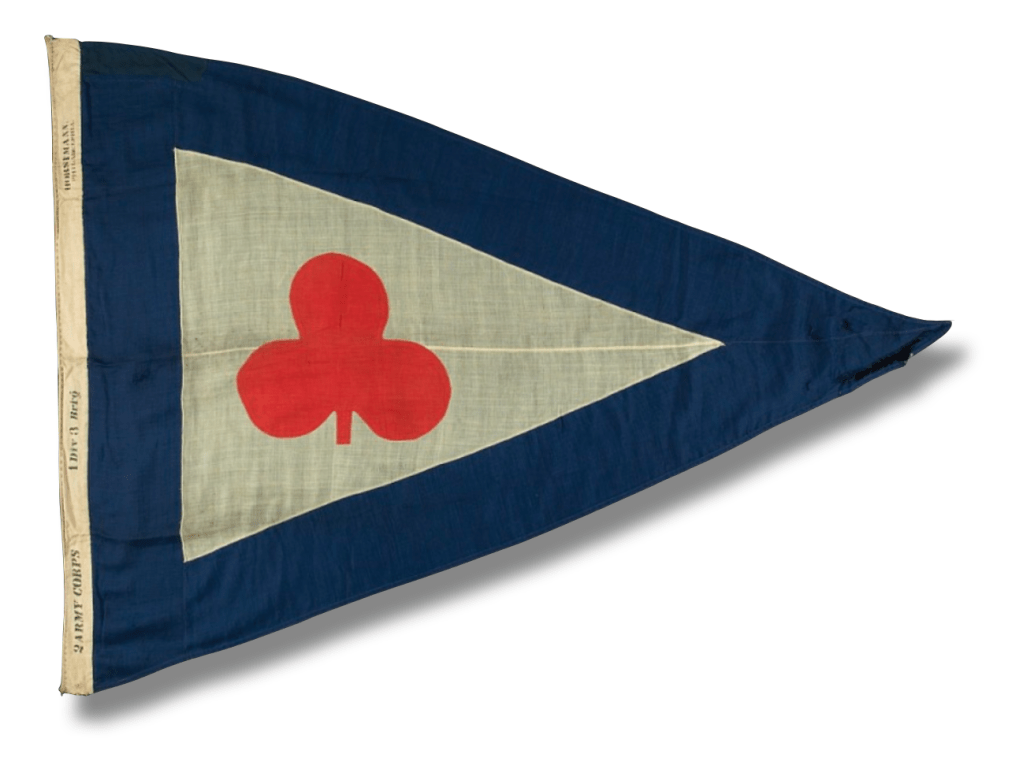
The Second Corps Headquarters Flag carried by Major-General Hancock in 1864

This letter is from the personal collection of Richard Weiner and is published on Spared & Shared by express consent. To read 29 others letters by George Storrs Youngs published by Spared & Shared in December 2016, see: Jeff’s Prayers are as Effective as Abe’s.

Transcription

Addressed to Miss Louisa Youngs, Waterloo, Seneca county, New York

Headquarters 2nd Corps
Near Cold Harbor, Virginia
Thursday, June 2nd 1864

The rear of the Corps passed us (with the exception of the pickets who were left behind as rear guard) about one o’clock, and we immediately fell in and marched about a mile through the sand at almost double quick. The dust was so thick that it was difficult breathing. At that distance from our starting point, we found the troops massed and resting and we lay down and I, at least, slept till we moved on again at daybreak.

Near Salem Church or Haw’s Shop, I saw the first negro soldiers I have ever seen. They belonged to Burnside’s Corps and were on picket. About seven o’clock we came up with the ammunition supply and ambulance trains which were parked in a clearing at the side of the road. Here we halted again waiting for the trains to move out, and it being a very favorable opportunity, we made coffee. I boiled mine within two yards of two dead men for whom the Pioneers were then digging a grave. I presume they died in the ambulances but they may have been brought in from the front which is not far distant as we are moving in a parallel line with our line of battle and skirmishing is going on all along the line so far.

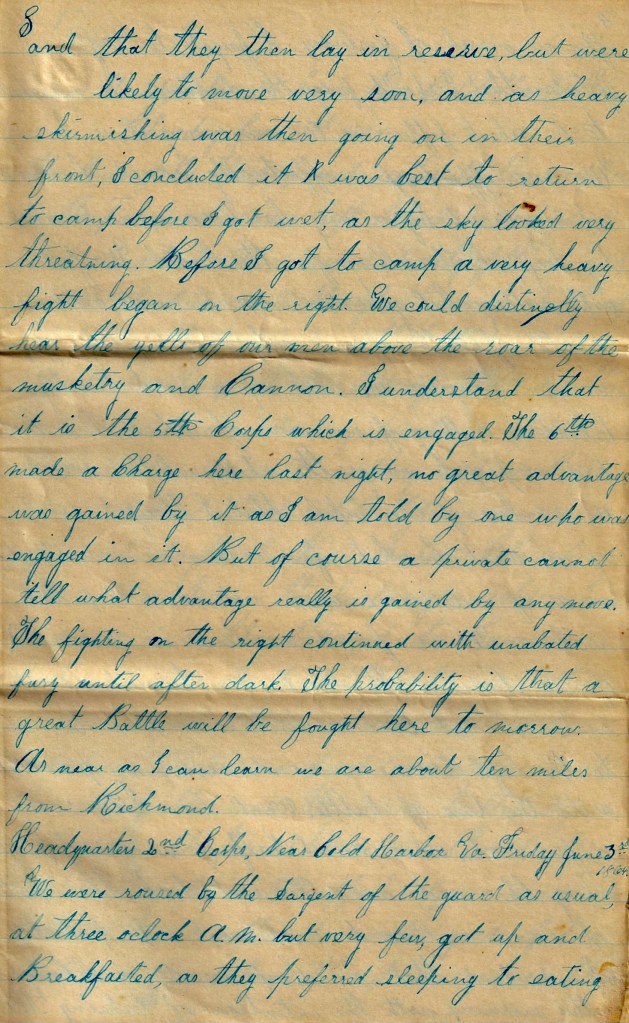
We rested here about an hour and a half. Have had some very hard marching. The roads are very dusty and the weather is hot. Considerable straggling. Arrived at Corps Headquarters about three o’clock p.m. very much fatigued. 1 Soon after our arrival here we learned that the 148th [Pennsylvania Infantry] was lying within a mile and a half of us on our right. Our Corps is now on the extreme left and is rapidly getting into position. About six o’clock, it having been decided to establish Headquarters here, we moved into the woods and pitched our tents. I started to find the 148th as soon as we got our tent up. Got about a quarter of a mile from camp and was caught in a heavy rainstorm and took refuge in a dry goods box near 6th Corps Headquarters. Here I saw a lieutenant who informed me that he belonged to the same brigade as the 148th and that they then lay in reserve but were likely to move very soon, and as heavy skirmishing was then going on in their front, I concluded it was best to return to camp before I got wet as the sky looked threatening.

Before I got to camp a very heavy fight began on the right. We could distinctly hear the yells of our men above the roar of the musketry and cannon. I understand that it is the 5th Corps which is engaged. The 6th made a charge here last night. No great advantage was gained by it as I am told by one who was engaged in it. But of course a private cannot tell what advantage really is gained by anymore. The fighting on the right continued with unabated fury until after dark. The probability is that a great battle will be fought here tomorrow. As near as I can learn, we are about ten miles from Richmond.

Headquarters, 2nd Corps, near Cold Harbor, Va. June 3rd 1864

We were roused by the sergeant of the guard as usual at three o’clock a.m. but very few got up and breakfasted as they preferred sleeping to eating after our march of yesterday. I forgot to say yesterday that I should judge the distance we marched to be about fifteen miles—some say it is twenty. We were effectually roused, however, at daybreak by a very brisk cannonade and by Major [James M.] Bull calling for the guard. We fell in with nothing but guns and accoutrements and started for the front where a desperate fight was in progress. We went up a road directly behind a battery of ours and of which the Rebs had a perfect range. The shells whistled round us so close for awhile that I though some of us must be hit. From some misunderstanding of orders, we were advanced up this road until we found ourselves in advance of the Division Provo.

We then turned round and marched back a little way and turned to the left down a road running parallel with the line of battle. Went down this road a few rods when about half of us were deployed along the road and the rest took the shelter of some earthworks and sent out patrols. I understand that our Corps made a charge this morning with the intention of taking the Rebels by surprise but they were found ready to receive us and we only succeeded in driving in their skirmishers, capturing a part of them, and taking possession of their rifle pits.

A very heavy musketry fire was kept up for an hour and a half or two hours. It then died away in a measure and was only severe at intervals from that time till noon. The shelling, however, was almost incessant all through the forenoon and they flew over our heads with their diabolical “which one”—“which one”—-“which one” in a very uncomfortable manner. A drizzling rain which continued nearly all day added nothing to the comfort of the wounded though preferable to a hot day.

During the forenoon, Gen. Grant and staff passed us and rode out to the extreme front but he soon returned and one of the orderlies following him told me that the Johnnies got sight of him and sent a perfect shower of minie bullets after him. From the way they were singing over the road when he went back, I judged they did get sight of him. He rode along very slowly, smoking as usual.

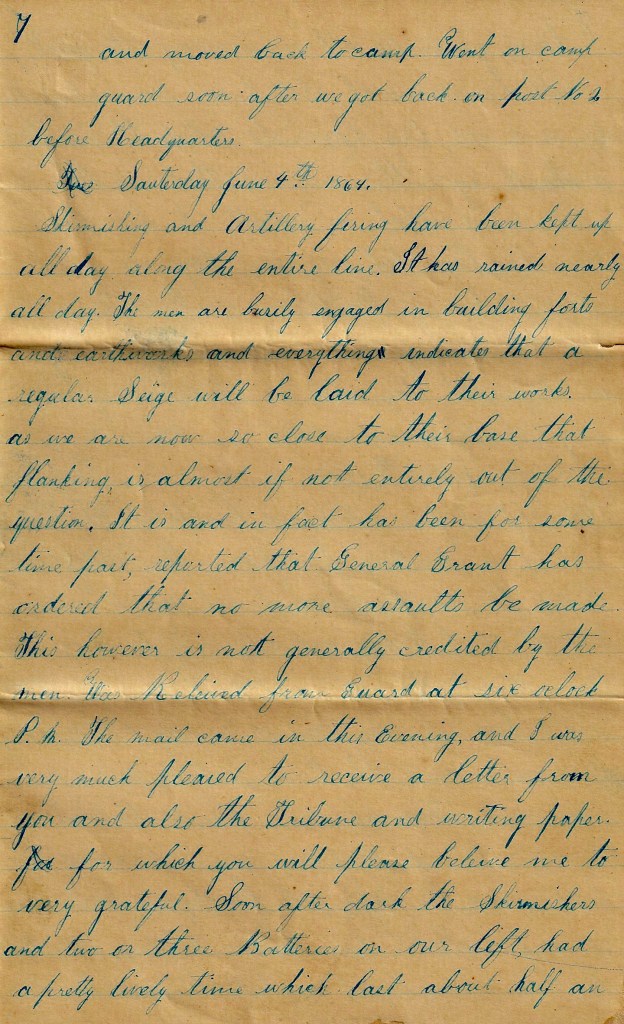
About noon we were brought in behind the works with the rest of the Guard. With the exception of going out on a patrol occasionally, we remained there till nearly dark. We then returned to camp. We had almost an hour of uninterrupted quiet this afternoon but the sharpshooters and cannoneers cannot keep quiet long at a time. We had just got supper ready and had sat down to eat it when the rebels made an attack on our Corps but were repulsed. We of course had to dig out again and went back to the place we left an hour before. The shells did look beautiful with their trail of fire and still more so when they burst but they are a kind of fireworks not generally approved of. We did not remain here long but moved up to the right behind the battery where we first went his morning. Here we stacked arms and remained half an hour when the firing nearly ceased, and about 30 prisoners being brought in, we took charge of them and moved back to camp. Went on guard soon after we got back on Post No. 2 before Headquarters. 2

Saturday, June 4th, 1864

Skirmishing and artillery firing have been kept up all day along the entire line. It has rained nearly all day. The men are busily engaged in building forts and earthworks and everything indicates that a regular siege will be laid to their works as we are now so close to their base that flanking is almost if not entirely out of the question. It is—and in fact has been for some time past—reported that General Grant has ordered that no more assaults be made. This however is not generally credited by the men.

Was relieved from guard at six o’clock p.m. The mail came in this evening and I was very much pleased to receive a letter from you and also the Tribune and writing paper for which you will please believe me to [be] very grateful.

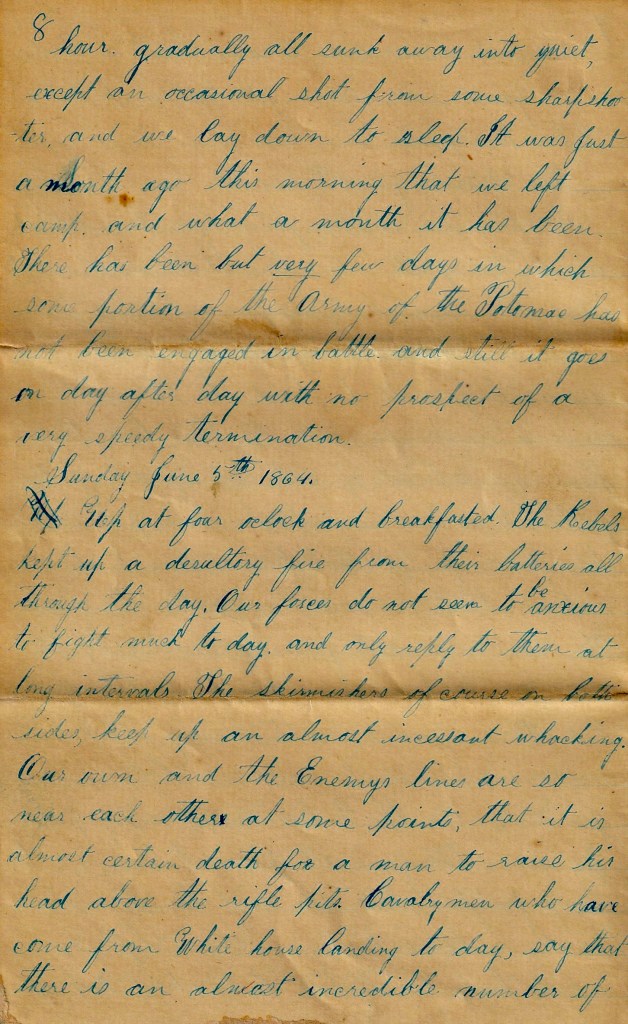
Soon after dark the skirmishers and two or three batteries on our left had a pretty lively time which last[ed] about half an hour. Gradually all sunk away into quiet except an occasional shot from some sharpshooter and we lay down to sleep. It was just a month ago this morning that we left camp and what a month it has been. There has been but very few days in which some portion of the Army of the Potomac has not been engaged in battle and still it goes on day after day with no prospect of a very speedy termination.

Sunday, June 5th 1864

Up at four o’clock and breakfasted. The Rebels kept up a desultory fire from their batteries all through the day. Our forces do not seem to be anxious to fight much today and only reply to them at long intervals. The skirmishers of course on both sides keep up an almost incessant whacking. Our own and the enemy’s lines are so near each other at some points that it is almost certain death for a man to raise his head above the rifle pits. Cavalrymen who have come from White House Landing today say that there is an almost incredible number of stragglers from the 18th Corps. Abe Schott 3 of the 148th [New York Infantry] is wounded and at the Corps (18th) hospital. I hear that B[enjamin] Hood 4 and W[illiam] Edwards 5 are also wounded. You probably have heard or read of it ere now.

I was sent up to Birney’s Headquarters this afternoon with about fifty stragglers. A flag-of-truce was sent out this p.m. on our left in charge of a colonel from Army Headquarters and Major [William G.] Mitchell of Gen. Hancock’s staff. There are large numbers of dead and wounded lying between the lines which it is impossible for either side to get at, and I presume that the flag is sent with the object of procuring a cessation of hostilities long enough to bury the dead and remove the wounded who have lain there since Friday. I am inclined to think that either the flag was not seen or if the object was what I supposed it to be, the armistice could not be agreed on as the firing has not slackened in the least.

About half past eight p.m. when the firing had nearly ceased and we had begun to think of going to bed, a heavy musketry fire suddenly commenced on the left and was soon accompanied by the artillery. We fell in again and started out in the dark. The shells and bullets whistled very close to us but fortunately no one in the guard was injured. We drew up in the road where we did the night before last and stacked arms. The firing was kept up half an hour and after waiting half an hour longer to see if any prisoners were brought in, we returned to camp without any.

I am very sorry to say that Capt. McCune [of Gen. Hancock’s staff] 6 lost a leg by a shell while standing in front of Headquarters and but a few feet from Gen. Hancock’s tent. He was just preparing to mount his horse to accompany us. He was a good fellow and well liked by the whole guard. When we came here Friday, Capt. [Edward C.] Cauvet said he hoped they would not pitch Headquarters there as it was a low, disagreeable place. Capt. McCune said he hoped they would not either for if they did, when the Johnnies opened their batteries, it would be so hot there that it would make some of us sick. It was thought by some that an attack had been made with the intention of breaking our line at that point, and the heavy firing—both musketry and artillery—would seem to justify that supposition. It is said, however, that no attack was made on either side and the firing was all caused by the relieving of the videttes. Some noise was made and the boys—thinking the Rebs were advancing—rose up in the breastworks and commenced firing. They (the Rebs) of course returned the compliment and the artillery followed suit.

There is something terrible about this fighting in the night. It is bad enough in the daytime but it seems a great deal worse at night. After we returned to camp, I made another cup of coffee, drank it, and lay down to sleep.

Monday, June 6th 1864

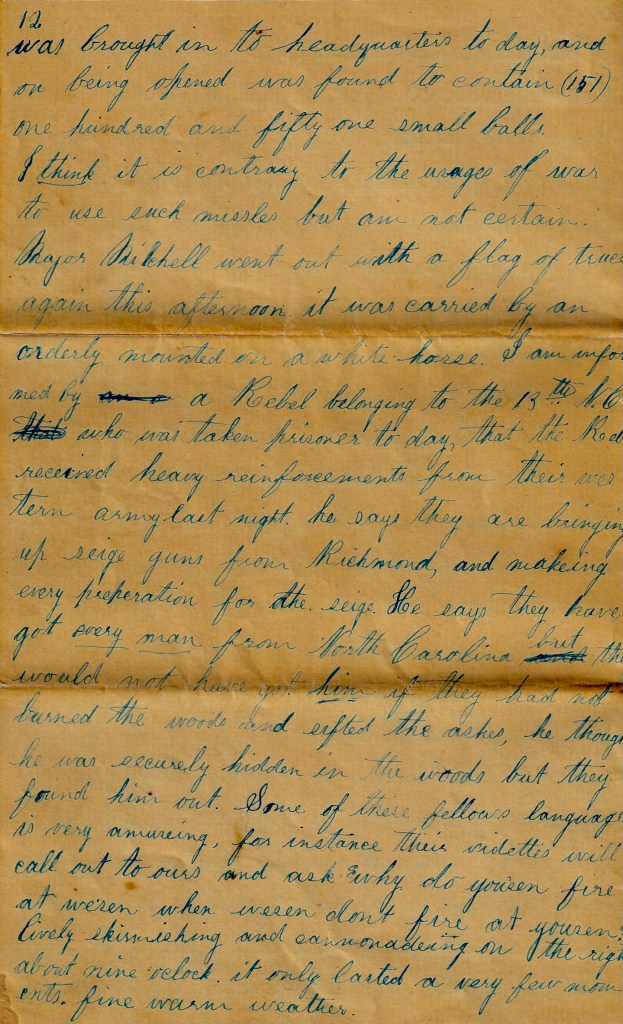
Up at four o’clock and got breakfast. Considerable artillery firing as well as skirmishing all day. One shell struck a few rods from Headquarters killing two men and a horse. The men were engaged in eating their suppers. A shell thrown by the Rebels was brought into Headquarters today and on being opened was found to contain one hundred and fifty-one (151) small balls. I think it is contrary to the usages of war to use such missiles but am not certain. Major Mitchell went out with a flag-of-truce again this afternoon. It was carried by an orderly mounted on a white horse. 7 I am informed by a Rebel belonging to the 13th North Carolina who was taken prisoner today that the Rebs received heavy reinforcements from their western army last night. He says they are bringing up siege guns from Richmond and making every preparation for the siege. He says they have got every man from North Carolina but they would not have got him if they had not burned the woods and sifted the ashes. He thought he was securely hidden in the woods but they found him out. Some of these fellow language is very amusing. For instance, their videttes will call out to ours and ask, “Why do you’ns fire at we’n when we’n don’t fire at you’ns?”

Lively skirmishing and cannonading on the right about nine o’clock. It only lasted a very few moments. Fine warm weather.


1 George’s comment regarding the state of exhaustion of members of the 2nd Corp is consistent with other reports. In fact, Meade had ordered an early morning attack for June 2 but Smith refused and when Hancock’s men finally got into position on the extreme left, they were tired from their long march and it was decided to wait until June 3rd to launch the attack.

2 According to the American Battlefield Trust [ABT] website, the 2nd, 6th, and 18th Corps “launched the main attack [on June 3rd] through the darkness and fog. As the attack began, the soldiers became caught in the swamps, ravines, and heavy vegetation, losing contact with each other. Angles in the Confederate works allowed Lee’s men to easily enfilade the Federal ranks as they advanced. An estimated 7,000 men were killed or wounded within the first thirty minutes of the assault and the massacre continued through the morning. In Hancock’s sector, elements of the II Corps managed to seize a portion of the Rebel works only to be bombarded by Confederate artillery that turned the trenches a deathtrap. Smith’s corps was unfavorably funneled into two ravines and subsequently mowed down when they reached the Confederate’s position. Pinned down by the tremendous volume of Confederate fire, the remaining Federals dug trenches of their own, sometimes including bodies of dead comrades as part of their improvised earthworks. At 12:30 pm, after riding the beleaguered Union lines himself, Grant suspended his attack at the advice of the corps commanders.”

3 Abram M. Sholt [or Schott] was 18 years old when he enlisted in Co. H, 148th New York Infantry on 27 August 1862 at Waterloo. He was wounded in action on 3 June 1864 at Cold Harbor. Later, he was captured in action at Fair Oaks, Virginia, on 27 October 1864 and paroled in March 1865.

4 Benjamin F. Hood enlisted at the age of 26 at Benton on 28 August 1862 to serve in Co. I, 148th New York Infantry. He was wounded in action on 15 May 1864 “at Drewry’s Bluff, Virginia.” He died of his wounds on 8 June 1864 at Point Lookout, Maryland.

Grave Marker of McCune at Greewood Cemetery in Brooklyn.

5 William Edwards enlisted at the age of 24 at Waterloo on 27 August 1862 to serve in Co. H, 148th New York Infantry. He was wounded in action on 9 May 1864 “near Petersburg ” and again on 15 August 1864. He died of his wounds on 16 August 1864 near Petersburg.

6 “Capt. Alexander M. McCune [spelled McEwen in newspapers] (1832-1864) of the Fifth Excelsior (74th NY) Regiment served on Gen. Hancock’s staff as Assistant Provost Marshal of the 2nd Corps. He was struck on the leg by a solid shot while standing in front of his tent at headquarters. His leg was amputated below the knee and he was reported to be still be alive. on 8 June 1864 though newspapers reported there were “no hopes are entertained of his recovery.” [NYT] He died of his wounds on 20 June 1864 at Armory Square Hospital in Washington D. C. McCune’s body was laid to rest in a public vault for many months until his widowed mother was able to obtain a pension for her son’s service, enabling her to have his body taken to Brooklyn for burial.

7 “From June 4 to June 12, the days were filled with minor attacks, artillery duels, and sniping. On June 7, Lee and Grant agreed to a two-hour truce to allow the Federals a chance to retrieve their wounded. However, by then few of the wounded were found alive as thousands had died under the summer sun during those five days.” [ABT]