Category Archives: 143rd New York Infantry

1864: Bruce Elmore to Ann Elizabeth (Hill) Elmore

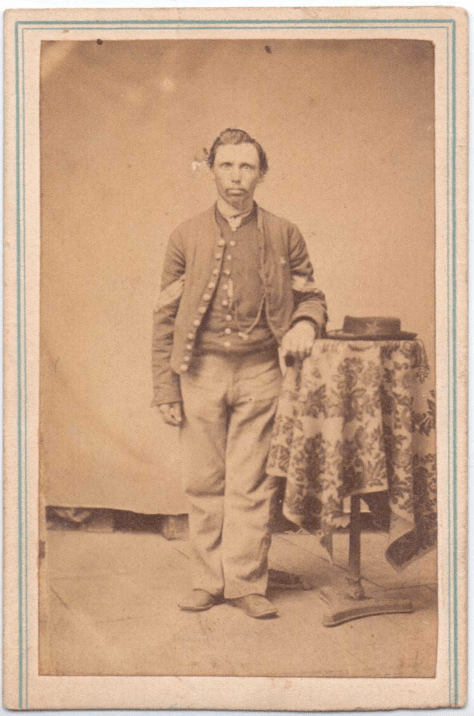
I could not find an image of Bruce but here is a cdv of Sgt. Robert Cantrell of Co. B, 143rd New York Infantry (Ancestry.com)

The following letter was written by Bruce Elmore (1835-1876), the son of Alexander and Mary (Divine) Elmore of Fallsburg, Sullivan county, New York. He wrote the letter to his wife, Ann Elizabeth (Hill) Elmore, in July 1864 while serving as a sergeant in Co. C, 143rd New York Infantry. He enlisted in August 1862 and mustered out on 20 July 1865. Auburn University Digital Library has Bruce’s Civil War Diary on-line. The “Willard” he mentions in his letter was his younger brother, born in 1838.

The 143rd New York had a distinguished service record, particularly while participating in the 20th Army Corps under General William Sherman They saw action in major battles and campaigns from Chattanooga to Raleigh, including the Atlanta Campaign. The regiment also suffered significant casualties, with heavy losses at Kennesaw Mountain and Peachtree Creek.

T R A N S C R I P T I O N

Addressed to Mrs. Bruce Elmore, Fallsburg, Sullivan county, New York

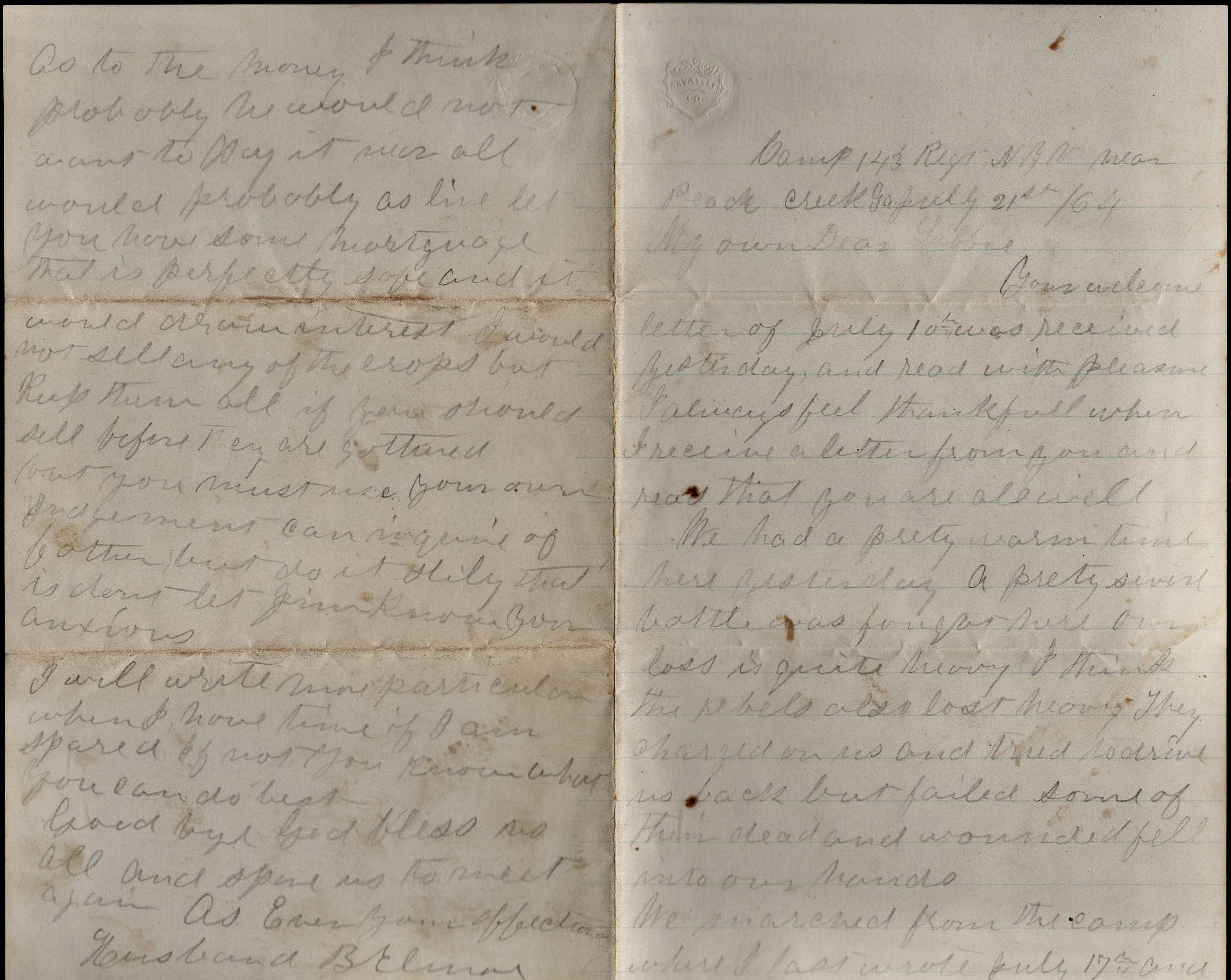
Camp 143 Regt. N. Y. V.
near Peach Creek, Ga.
July 21st 1864

My Own Dear Libbie,

Your welcome letter of July 10th was received yesterday and read with pleasure. I always feel thankful when I receive a letter from you and read that you are well.

We had a pretty warm time here yesterday. A pretty severe battle was fought here. [See Battle of Peach Tree Creek] Our loss is quite heavy. I think the Rebels also lost heavy. They charged us and tried to drive us back but failed. Some of their dead and wounded fell into our hands.

We marched from the camp where I last wrote July 17th and crossed the River Chattahoochie since which time the army has been getting its position. We are now about 4 miles from Atlanta, although some of our line is closer, being within two miles.

Our regiment lost forty-five killed and wounded—7 or 8 killed, 2 of our own company were wounded—Gilbert B. Lawrence severely. The doctor says he thinks he may get well. I hope he may and Sergt. McKendree N. Dodge (of Rockland) quite severely wounded, though not dangerously—a flesh wound in the leg. Lieut. Wm. M. Ratcliff, Adjutant, is also killed and Lieut. Waterbury of our regiment also killed. I am well, have not received a scratch, and I feel to fervently thank my Heavenly Father for mercifully sparing me amid peril and danger so imminent.

[My brother] Willard is to the field hospital. He is not well enough to be on the march. W. H. Newman has returned to the company. Also James W. Stewart.

You say you think J. V. B. Reynolds would like to buy the farm and would give 1200. I think I would sell for that if I could get no more. Maybe he would give more. Get all you can. It almost ought to fetch more according to the price of other things, but if this war settles, everything falls again, and then I think land will be as low as ever again. As to the money, I think probably we would not want to pay it near all. Would probably as leave let you have some mortgage that is perfectly safe, and it would draw interest. I would not sell any of the crops but keep them all. If you would sell before they are gathered but you must use your own judgment. Can inquire of father but do it slyly—that is, don’t let Jim know you’re anxious.

I will write more particular when I have time if I am spared. If not you know what you can do best. Good bye. God bless us all and spare us to meet again. As ever your affectionate husband, — B. Elmore

All well at half past 12. Have heard a little cannonading. Hard to tell whether there will be any hard fighting in any part of the line today or not. Lieut. Waterbury is not yet dead.
1864: Gilbert Keene to Sophie Adorah Wheeler

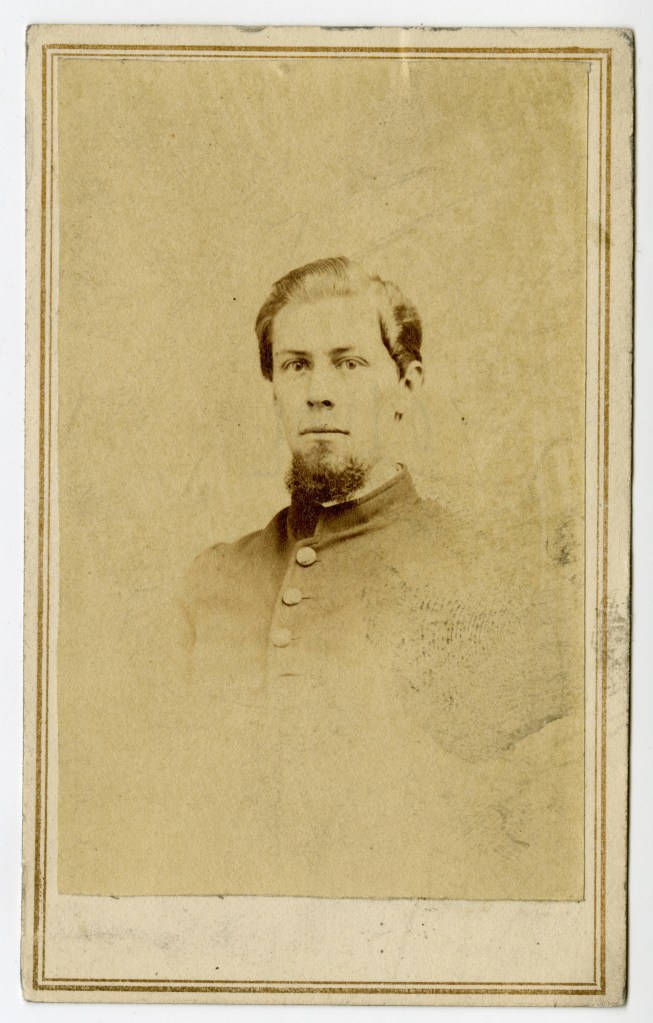
I could not find an image of Gilbert but here is one of Aldebert A. Carrier of Co. H, 143rd New York Infantry (Tenn. State Library & Archives)

The following letter was written by Gilbert (“Gib”) Keene (1841-1888), the son of Joseph Keene (1815-1894) and Hannah Gray (1824-1899) of Rockland, Sullivan county, New York. Gilbert’s military records informs us that he enlisted on 15 August 1862 as a private in Co. A, 143rd New York Infantry. He served nearly three years, mustering out on 6 July 1865. Following his discharge he married Emma L. Rose (1844-1922) and the couple had at least five children before his death in 1888.

The 143rd New York served in the Eastern Theater of the Civil War until the fall of 1863 when they were transported to the Western Theater to serve in the Army of the Cumberland. They participated on Sherman’s Atlanta Campaign and the March to the Sea but Gilbert was apparently on detached duty at Moccasin Point, Tennessee, serving on the cracker line in the quartermaster’s office.

Gibert wrote the letter to Sophie Adorah Wheeler (1847-1887), the daughter of Leroy Moore Wheeler (1806-1880) and Martha Reed (1817-1887) of Rockland.

Transcription

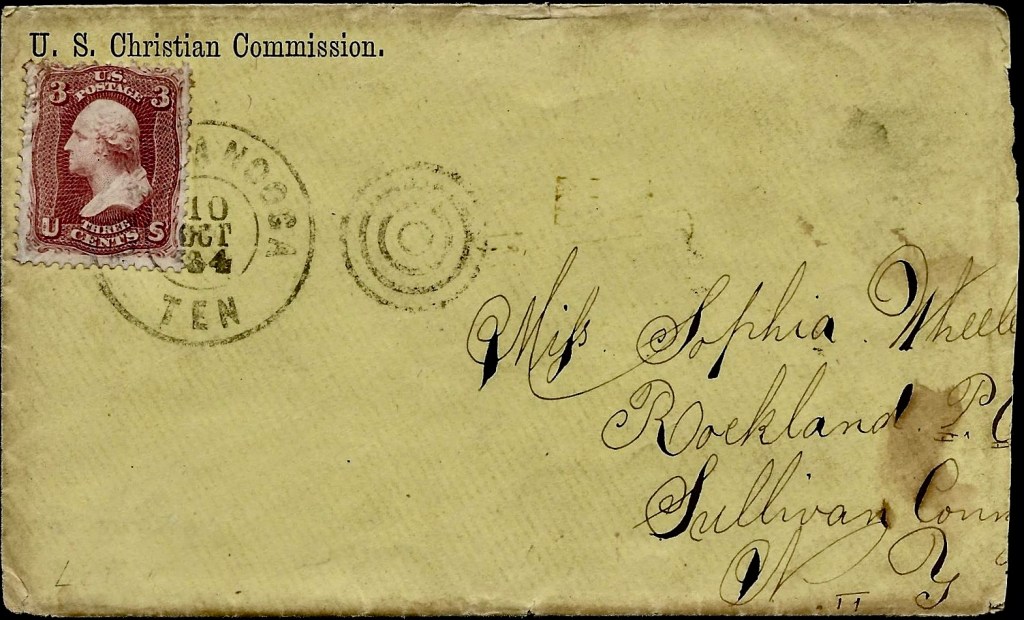
Addressed to Miss Sophia Wheeler, Rockland P. O., Sullivan County, New York

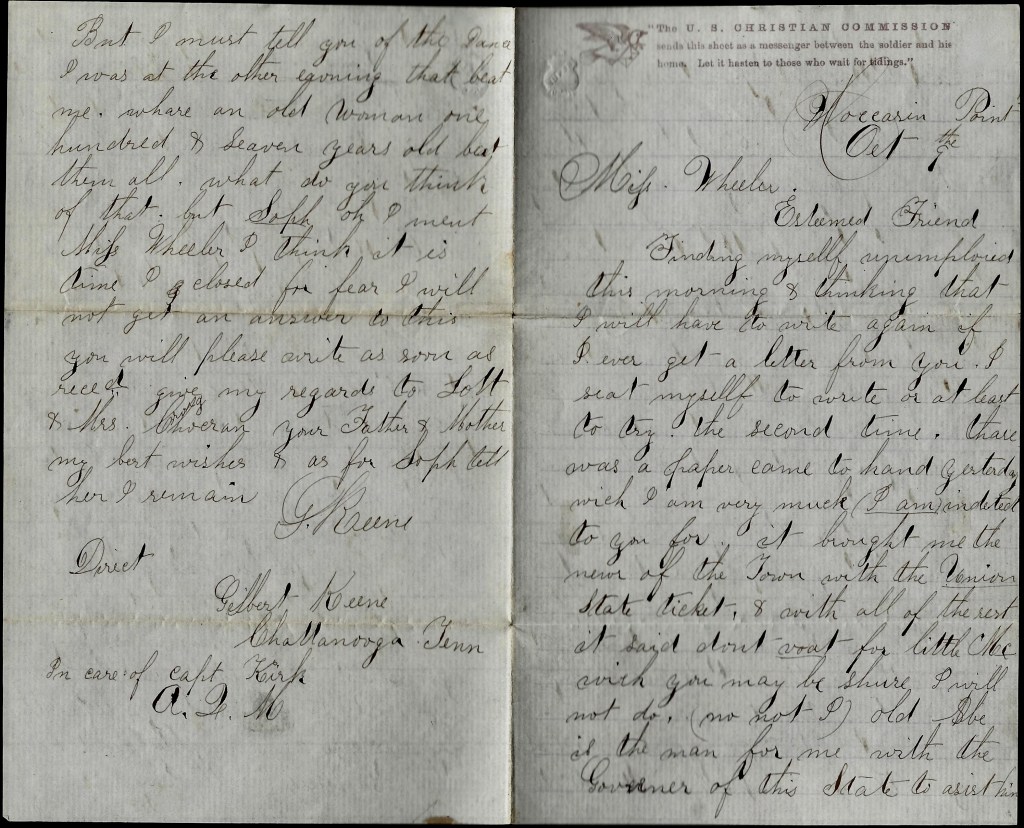
Moccasin Point [Tennessee]
October 9th [1864]

Esteemed Friend,

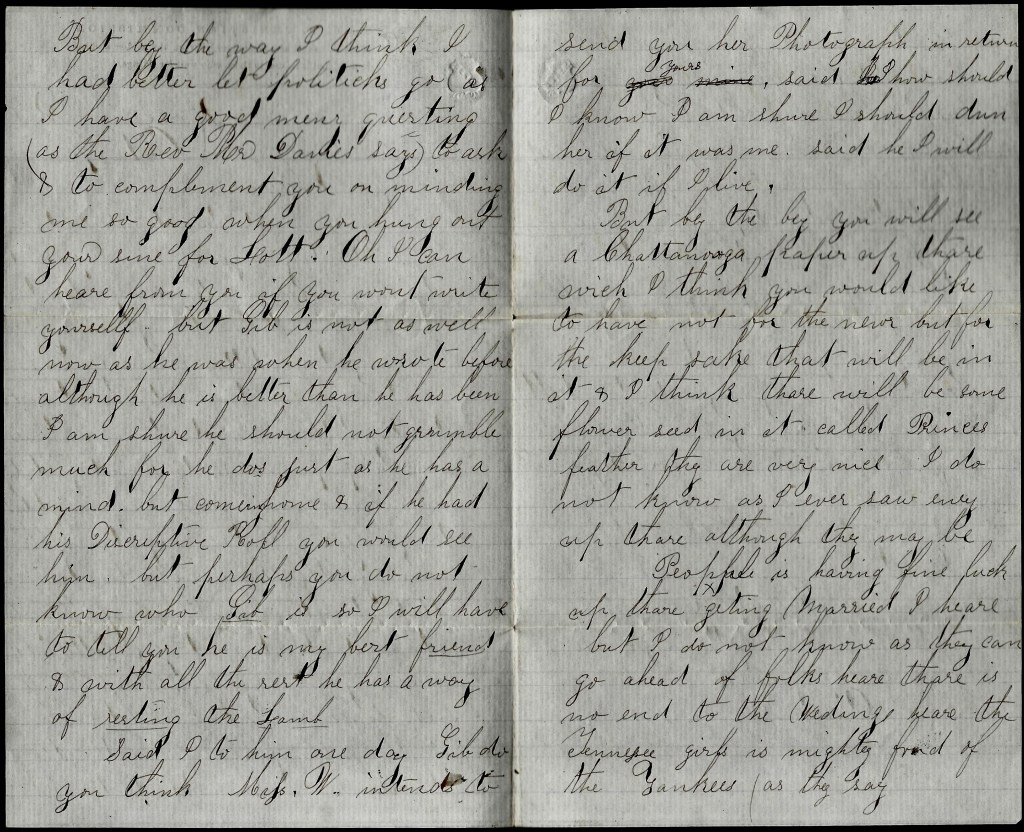
Finding myself unemployed this morning & thinking that I will have to write again if I ever get a letter from you, I seat myself to write or at least to try the second time. There was a paper came to hand yesterday which I am very much (I am) indebted to you for. It brought me the news of the town with the Union State Ticket, & with all of the rest it said don’t vote for Little Mac which you may be sure I will not (no, not I). Old Abe is the man for me with the Governor of this State [Andy Johnson] to assist him. But by the way, I think I had better let politics go as I have a good mens questing [?] (as the Rev. Mr. Davies says) to ask & to compliment you on minding me so good when you hung out your sign for Lott. Oh, I can hear from you if you won’t write yourself, but Gib is not as well now as he was when he wrote before although he is better than he has been. I am sure he should not grumble much for he does just as he has a mind but coming home, & if he had his Descriptive Roll, you would see him. But perhaps you do not know who Gib is so I will have to tell you. He is my best friend & with all the rest, he has a way of resting the lamb.

Said I to him one day, “Gib, do you think Miss W. intends to send her photograph in return for yours?” Said I, “How should I know. I am sure I should dun her if it was me.” Said He, “I will do it if I live.” But by the by, you will see a Chattanooga paper up there which I think you should like to have—not for the news but for the keepsake that will be in it. And I think there will be some flower seed in it called Prince’s Feather. They are very nice. I do not know as I ever saw any up there though they may be.

People is having fine luck up there getting married I hear but I do not know as they can go ahead of folks here. There is no end to the weddings here. The Tennessee girls is mighty fond of the Yankees (as they say). But I must tell you of the dance I was at the other evening that beat me where an old woman one hundred and eleven years old beat them all. What do you think of that? But Soph, Oh, I meant Miss Wheeler, I think it is time I closed for fear I will not get an answer to this. You will please write as soon as received. Give my regards to Lott & Mrs. Choeran, your Father & Mother my best wishes, & as for Soph, tell her I remain — G. Keene

Direct to Gilbert Keene, Chattanooga, Tenn. In care of Capt. Kirk, A. Q. M.

1863: William Matthew Ratcliff to Elias Champlin

The following letter was written by William Matthew Ratcliff (1833-1864), the son of William Ratcliff (1801-1895) and Lucinda Buckley (1809-1892) of Liberty, Sullivan county, New York. William was a graduate of Union College and Albany Law School in Albany, New York. He served as a lawyer and clerk for the Board of Supervisors for Sullivan County from 1857-1858. He was elected a Judge for Sullivan County on January 1, 1862. Yet, to serve his country, William joined the 143rd New York in August 1862, was commissioned 1st Lieutenant of Co. A, and was made the regimental adjutant in February 1863. He participated in the skirmishing at Suffolk and later at Lookout Valley. He was in the Battle of Chattanooga and at Dallas, Georgia. He was killed in the Battle of Peachtree Creek on 20 July 1864.

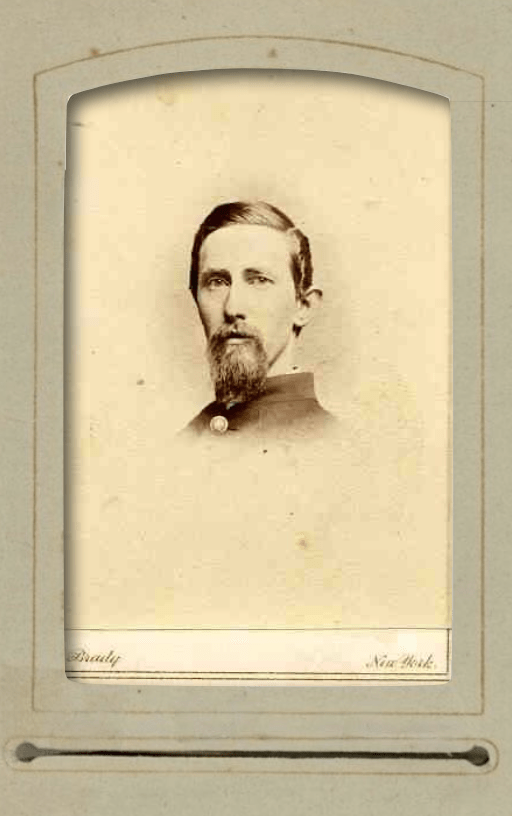
Adj. William M. Ratcliff, 143rd New York Infantry

“On July 20th, while attempting to cross Peach ‘Tree Creek, the 20th Corps was furiously assaulted by hard pressed southern forces seeking to break out of the relentless iron cordon that was enveloping them. The 143rd, having established itself on a slight elevation covered with dense underbrush, was hit three times, but refused to give ground. Failing to force back the 20th Corps, the rebel forces now began an orderly retreat toward Atlanta. The victory was not obtained without a price, for “while encouraging the line” Adjutant William Radcliffe “was shot squarely in the front of the neck and killed instantly.” He was “Beloved by everyone,’ wrote the bearer of these sad tidings, Hezekiah Watkins. “Just as I was sitting here,” continued Watkins, “a German officer of the 82 Illinois Regiment, Captain Bruen, remarks: ‘I loved that man more than anyone else in this army’ and his testimony is the testimony of everyone who knew him. If possible his body will be embalmed and sent home, if not he will be buried here with those who loved him so well.'” [page 18, Brass Buttons and Leather Boots; Sullivan County and the Civil War, by Dr. Nathan Weiss.]

Likewise, a diary kept by Isaac Jelliff of the 143rd New York contained the following entry for 20-21 July 1864—the day that Adjutant Radcliffe was killed:

July 20th Wednesday. Hot. Marched forward at 7 A.M. Crossed Peach Tree creek & passed through the Breastwork put up last night by 2nd Div. Grary – Halted behind price of woods – artillery drill – took place for short time. No loss on our side. Marched little further & rested in woods – took dinner. Heavy picket firing in front all A.M. and about noon more rapid fire and charging – Four wounded carried by – 4 P.M. still lay in woods 2nd Div. have passed by – 4 ½ heavy firing with musketry & cannon. Loud yelling – fight increases – We ordered forward in double quick. Went short distance in woods & formed line. E. & W. moved a little forward, down the slope from ridge – bushes thick. Rebels got close to us on right we thought another line of battle in front of us – thought the rebel firing was of our men. We ordered not to fire. Did not till after many of 143rd – been killed or wounded. Rebels came close to our Regt. Our line moved about 8 rods back to the ridge and reformed. The fight became desperate. Firing rapid the 143d lost the most of their men on the first lineThe rebels used many explosive balls – when they would strike a bone they would burst and tear a terrible hole in the part struck. In the engagement the 2nd Division was forced back to a line with 1st Div. The battle was hard along the center line. And loss heavy. 1st Div. held its ground. Many rebels were killed & many left on field. Three killed within 2 rods of our line. One of them hit by John Wales of Co. “A”. Regt. behaved well. All feel deeply the loss of Ratcliff. He died at his post. A true soldier. A noble office. One Ball through the Flag Sergt. Morgan’s carried it. His conduct was very commendable —A perfect soldier. The right wing was heavily exposed & suffered most...

July 21 Thursday Hot. All quiet this A. M. Our pickets advanced – many dead rebels still laying in woods in front of us. Ratcliff’s body is to be embalmed and sent home. Busy bringing dead. McWilliams Co. “A” died last night. Rec’d notice H.C. Lybolt Co. B. Entered Hospt. Genl. No General engagement today. Wrote home. The 31st Wisconsin joined our Brig. 750 strong.

There is an epitaph on Ratcliff’s gravestone that was written by him in an article prior to his death. It says; ‘There is something worse than to pay heavy taxes to support the Government – it is to have no Government, and there is something even better than to live – it is to fall in defense of all that makes life valuable.’” 

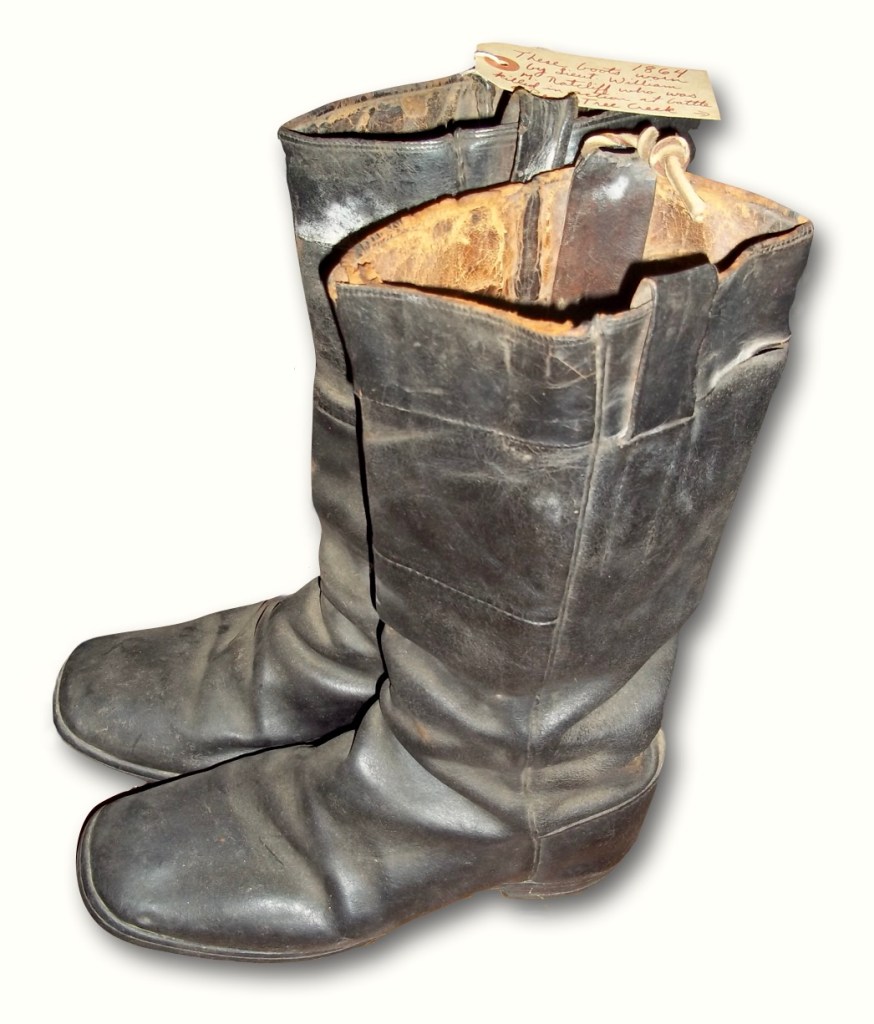
The tag on this pair of boots reads, “1864, these boots worn by Lieut. William M. Ratcliff who was killed at Battle of Peach Tree Creek” See “They Died with their Boots On.” [Museum Village]

William wrote the letter to Elias Champlin (1810-1881) of Liberty, Sullivan county, New York.

Transcription

Camp 143 Regt. N.Y.S. Vols.
Near Upton Hill, Va.
January 22, 1863

Elias Champion, Esq.

Dear Sir,

Yours of the 15th inst. came to hand last Tuesday while doing picket duty about eight miles from camp on the Orange & Alexandria R. R. Since returning to camp, I have carefully examined the amount of Mrs. Buckley and have also consulted the boys whom she boarded. Her claim, according to the figures sent to me, is too large. The bill as returned and certified to by me allows her all that she ought to ask, and I am satisfied with all that she is entitled to. Because the government is to pay it, there is no reason that it should be larger than if coming from a private citizen. I do not in the least suppose that you know anything of the correctness of her account.

We have had a few days of cold weather, but it has turned off warmer and I am afraid the rainy season has commenced, as it is getting time and we have had two days steady rain and it is still cloudy. The health of the regiment is generally good. The second death in the regiment at camp was Thomas Abberley—a member of our company who died [at Upton’s Hill] on the 13th inst. Captain [Ira] Dorrance [of Co. E] lost a man two or three days ago. Altogether we have sent six men from our camp to the hospital at Washington. Of these, three have returned to duty, one regularly sent back, and two skedaddled from Convalescent Camp and joined us because they fared better in camp with the regiment than at the Convalescent Camp.

We have exchanged our old muskets for the Springfield Rifle, considered the best piece in the service. The Colonel [David P. Dewitt] effected the exchange without going to our Brigadier and he was much surprised to learn that we had them, as we are the only regiment in the brigade furnished with them.

How is the Fire Co.? I must make arrangements with someone to keep me up on dues. Remember me to all friends. Yours very truly, — Wm. M. Ratcliff