
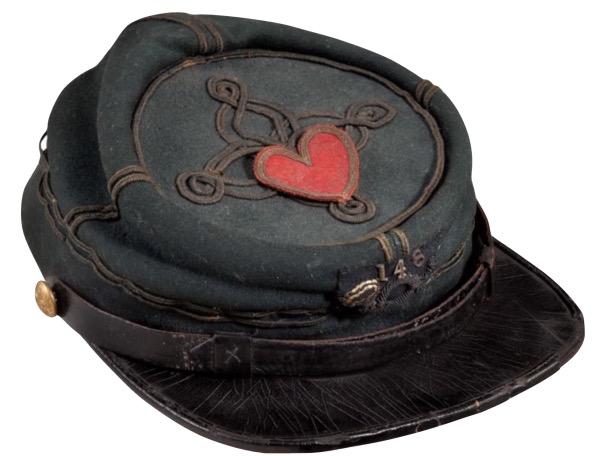
I feel reasonably certain the following letter was written by Corp. Augustus E. Crosby (1836-1895) of Co. C, 148th New York Infantry. The content of the letter is sufficient to confirm the regiment and the signature “Gus” allows us to narrow down the possible authors to just a handful of soldiers. He speaks of leading a picket squad which means he would have to be at least a corporal, further winnowing down the possible authors to just two soldiers; and one was born in 1844 and the other (Crosby) in 1836—the latter being the same age as the “friend” he was writing to.
Gus wrote the letter to his friend George J. Serven (1836-1919), the son of Abram Serven (1811-1897) and Maria Serven (1818-1886) of Waterloo, Seneca county, New York. George was married to Eliza Swarthout (1837-1914) in 1857 and had three children by the time his letter was written in 1863.
To read letters by other members of the 148th New York that I have transcribed and published on Spared & Shared, see:
Richard Chapman, Co. B, 148th New York (2 Letters)
Foster P. Cook, Co. B, 148th New York (1 Letter)
Benjamin Grace, Co. B, 148th New York (1 Letter)
George Roy Tubbs, Co. B, 148th New York (1 Letter)
Ezra Alphonso Wilson, Co. D, 148th New York (1 Letter)
Shadrack Kitson, Co. E, 148th New York (14 Letters)
Charles Ambrose Gillet, Co. K, 148th New York (6 Letters)
Transcription

Portsmouth, Virginia
June 14, [1863]
Friend George,
I received your very welcome letter in due time and rest assured I was glad to hear from you once more. We have moved down into the city where we don’t have quite so much to do. We are doing guard duty now and I am on duty about once a week.
Last week there was a party of us went out on a scouting expedition where the citizens had never seen a Yankee soldier before and if we did not have a fine time. I would like to have had you with us. You would have enjoyed being a soldier for once if you never did before. In the first place, we started about six o’clock in the morning and marched 25 miles—which by the way was not the pleasantest part of the job—when we halted and took up our quarters in a courthouse for the night. And as luck would have it it, fell on me to take a squad and go out on picket. But of course no one came along for why the poor things were almost scared to death when they found that real live Yankee soldiers were amongst them who they had been told had horns and would hook. Well, perhaps some of them would, or did, I will not attempt to say. But will say this—they all knew how to find chickens and geese, hams, &c., whatever we wanted to eat beside a load to bring back. 1
Major Murray went with us. We went all over and found a rebel mail collected ready to send off to Richmond in a man’s parlor stove which of course we had to take and read. I know it was most too bad for Yankee soldiers to read those dear little missives of love. We wanted to burn a large salt work that we found, but the Major said it would not answer for us to attempt [it] as we had only about 100 men, and in the afternoon the Major told us to scatter and collect all the teams we could find for we should not march back, which we did, and got 19 carts and wagons and started that night back. And once in the night the front cart, while crossing a bridge, went down with all of the boys in about 12 feet into the mud, and by looking at the bridge we knew that it had been on purpose for us. But there was no one hurt. We tore down a rail fence and filled up the ditch and went on more cautious for we had to go through the woods for about ten miles where the road was not more than 15 or 20 feet wide and the barks so thick that you could not see more than ten feet ahead. Once in the night the old Major sang out to turn out the guard double quick and the way the boys did scratch out was a caution. But it proved to be nothing but some of our own cavalry.
I got a letter from Frank. He was wounded in the late cavalry fight in the left foot. The [ball] struck on the top of the big toe and came out about the middle of his foot on the other side.
Give my love to all your folks and write soon and much oblige your sincere friend — Gus
About the dog, the fellow told me I might have him if I could keep him was all there was about it.
1 This same scouting party was described in a letter datelined from Portsmouth on 15 June 1863 by Shadrack Kitson of Co. E, 148th New York Infantry: “There was one hundred of the men out of the regiment chosen to go out on a scouting party Thursday morning. We went 25 miles the first day. We stopped to a place called Prince Court House. We then got our supper. We then took the team and went to a rebel house. We took hams, 6 geese, 10 hens, one barrel of pork, one feather bed, one mattress, pillows, sheets, wool, and a great many things more. We then went back to where the rest of our company were sleeping. Twas twelve o’clock at night. We was very tired. We then went to sleep till morning. Morning comes, thank God, we are all alive yet. We then got our breakfast. We then went to a place called the Ocean Blue. Tis a very nice place. We then started for home. The Major [John B. Murray] told us to stop to every house and take all the horses and carts we could find till we got enough to carry us all home. We got 20 horses and carts. We made the negroes go with us to take the carts back. We got back Saturday all well.”



 Spared & Shared 23