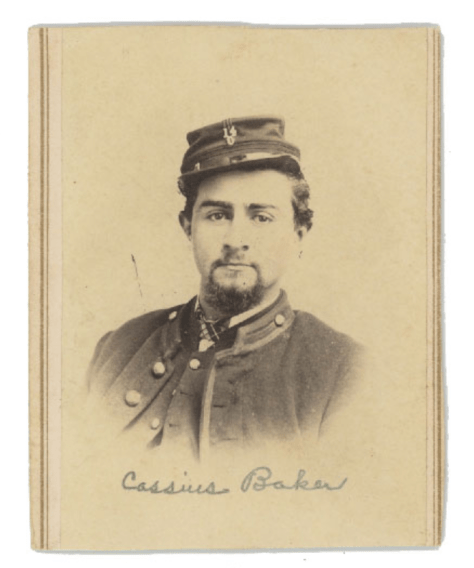
The following letter was written by Cassius Newell Baker (1844-1919), the son of Harris Porter Baker (1801-1879) and Emily C. Baker (1806-1852) of Mesopotamia, Trumbull county, Ohio. Cassius enlisted as a bugler on 8/20/61 in the 14th Ohio Independent Battery of Light Artillery. He reenlisted in 1864 and mustered out of the Battery on 8/9/65 at Camp Dennison.
After his service, Cassius married and relocated to Pottawattomie county, Kansas, where he worked as a retail grocer in Louisville. He later moved his grocery to Wamego.
T R A N S C R I P T I O N
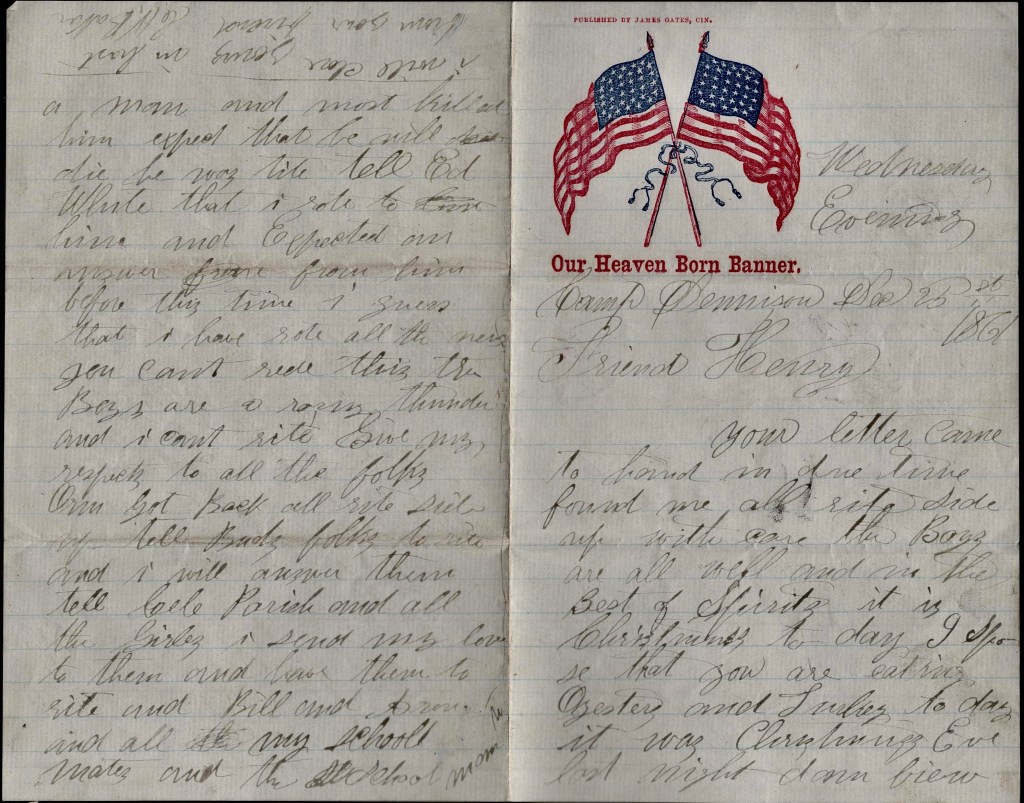
Camp Dennison Wednesday evening, December 25, 1861
Friend Henry
Your letter came to hand in due time [and] found me all right side up with care. The Boys are all well and in the best of spirits. It is Christmas today. I suppose that you are eating oysters and turkey today. It was Christmas eve last night. Few were the things that I got in my stocking but we had a hell of a dance you may bet.
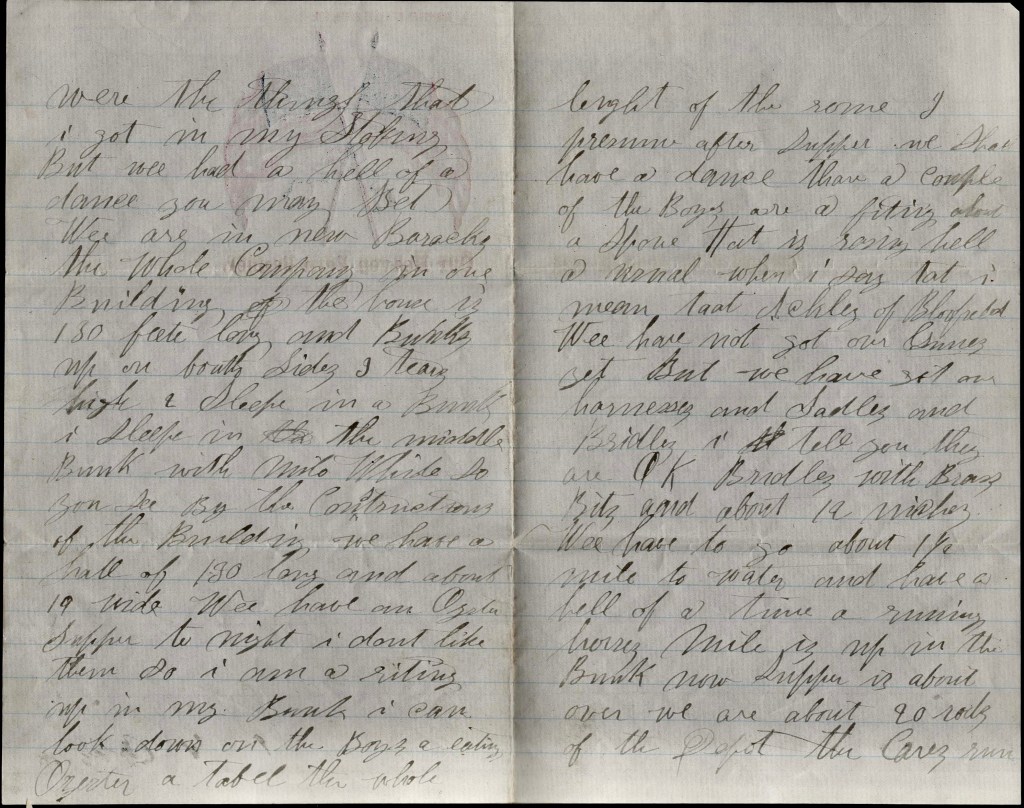
We are in new barracks—the whole company in one building. The house is 130 feet long and bunks up on both sides three tiers high. Two sleep in a bunk. I sleep in the middle bunk with Milo White so you see by the construction of the building we have a hall of 130 [feet] long and about 19 wide. We have an oyster supper tonight. I don’t like them so I am a writing up in my bunk [while] the boys [are] eating oysters [at] a table the whole length of the room. I presume after supper we shall have a dance. Then a couple of the Boys are a fighting about a spoon [?]—that is, [?]. When I say that, I mean taat [?] Ackley of Bloomfeld.
We have not got our guns yet but we have got our harnesses and saddles and bridles. I tell you, they are O. K. Bridles with brass bits and about 12 inches.
We have to go about 1.5 miles to water and have a hell of a time a running horses. Miles is up in the bunk now. Supper is about over. We are about 20 rods (~100 yards) off the depot. The cars run [over] a man and most killed him. Expect that he will die. He was tight.
Tell Ed White that I wrote to him and expected an answer from him before this time. I guess that I have wrote all the news. You can’t read this. The boys are a raining thunder and I can’t write. Give my respects to all the folks. Orm got back all right side up. Tell Bud’s folks to write and I will answer them, Tell Cele Parish and all the girls I send my love to them and have them to write, and Bill and Aaron and all my school mates and the school mom too.
The following letter was written by William Oren Ensign (1841-1918), the son of Caleb Wadhams Ensign (b. 1790) and Orpha Deming (b. 1795) of Madison, Lake county, Ohio. William enlisted on 20 August 1862 to serve as a corporal in the 14th Ohio Independent Battery—a light artillery unit. He was in the battery for three years, mustering out in August 1864. Serving with him in the same battery was his younger brother, Herbert Dwight Ensign (1844-1898).
“Removing to Illinois in 1865, he again engaged in teaching, after which, in June, 1866, he entered the office of Dr. Henry A. Almy, of Rutland, Ill., …During the lecture course of 1867-’68, he matriculated in the Charity Hospital Medical College, now University of Wooster, Cleveland, Ohio, pursing the study of medicine between courses, until graduation, …After graduation, Feb 25, 1868, Dr. Ensign returned to Rutland, Ill., where he has since been engaged in the general practice of medicine …Married, in 1869, Miss Frances J., second daughter of the late Dr. Henry A. Almy, of Rutland, Ill.” [Source: Find-A-Grave]
Transcription
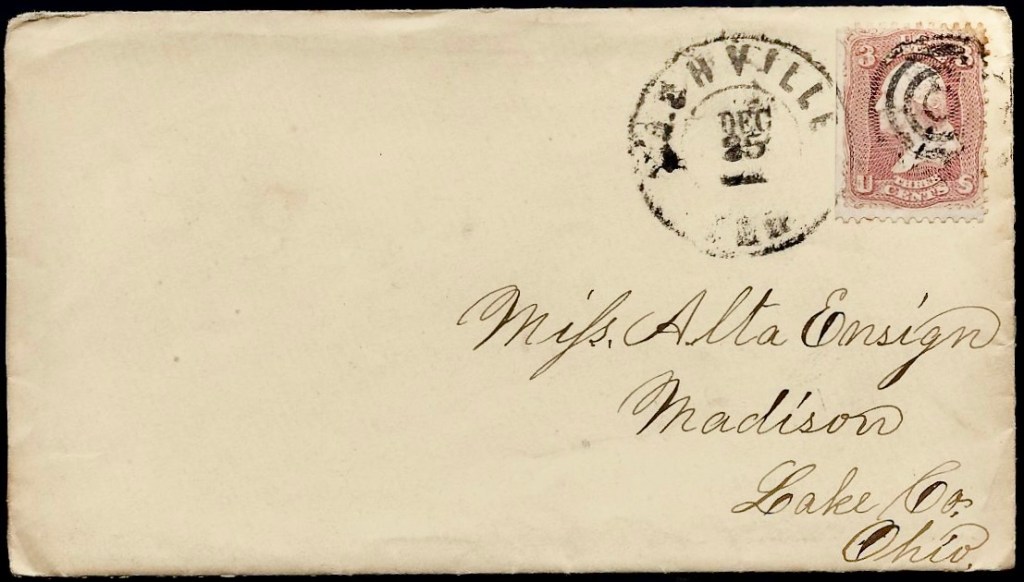
Addressed to Miss Alta Ensign. Madison, Lake county, Ohio
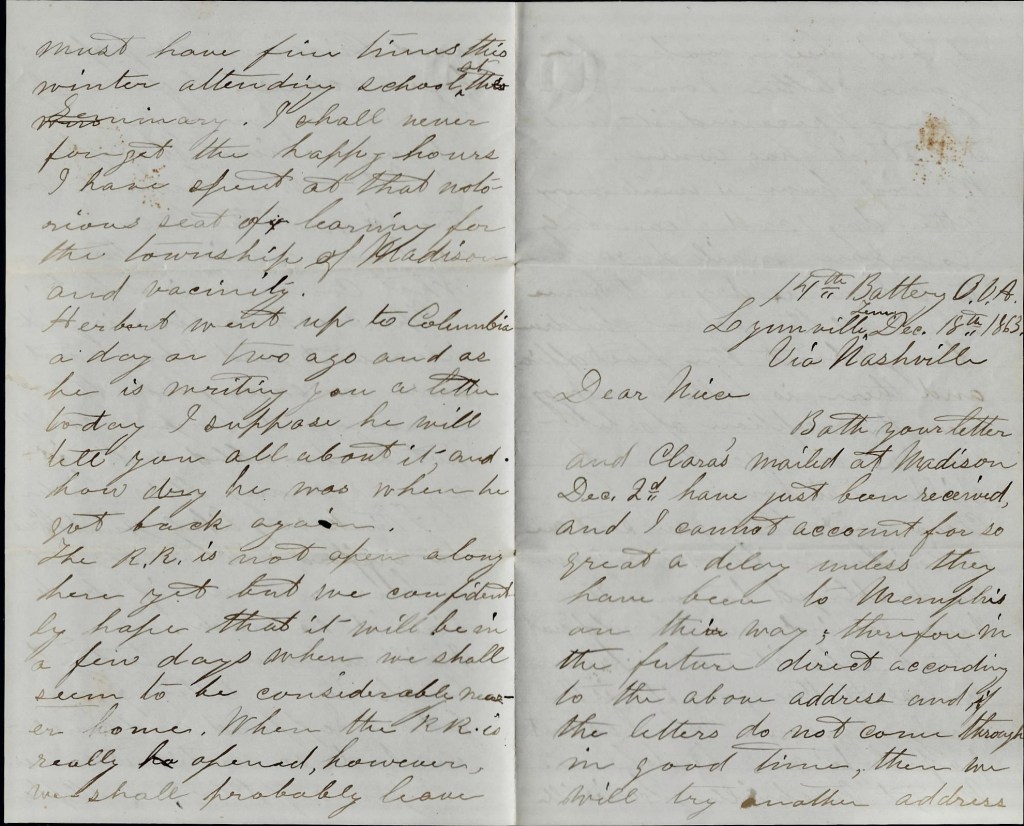
14th Battery, OVA Lynnville, Tennessee December 18, 1863 Via Nashville
Dear Niece,
Both your letter and Clara’s mailed at Madison December 2nd have just been received, and I cannot account for so great a delay unless they have been to Memphis on their way; therefore in the future, direct according to the above address and if the letters do not come through in good time, then we will try another address. I have been looking for your letter some time before I received it and at last it has come. We now have a mail every other day and I can only compare mail days here to Valentine’s Day at home when all the school children hang about the post office and there is full as much joy over the reception of a letter here as a valentine by children at home.
Clara says that you sent me a Tribune for which I am much obliged to you. It has been received and I could not think who it came from unless Hattie for she is the only person who has sent papers to me heretofore. We Nashville, Louisville, and Cincinnati papers here occasionally for only ten cents per copy. I have serious thoughts of taking the Tribune for the six monthsto come as I am anxious to know what Congress is up to.
The weather here is quite pleasant and I have not seen a snowflake this season and I hope I shall not be troubled with a great many this winter. I think very likely Aunt Augusta Safford will be very apt to hear from me if she desires it so much. I will commence today to look for a letter from John Safford and continue to do so until it comes.
Yourself, Clara, and Orpha must have fun times this winter attending school at Seminary. I shall never forget the happy hours I have spent at that notorious seat of learning for the township of Madison and vicinity.
Herbert went up to Columbia a day or two ago and as he is writing you a letter today, I suppose he will tell you all about it, and how dry he was when he got back.
The railroad is not open along here yet but we confidently hope that it will be in a few days when we shall seem to be considerable nearer home. When the railroad is really opened, however, we shall probably leave here to go to Columbia or the other side of Pulaski—I hope to the former.
I am sorry that our own state is not able to keep John H. Morgan after he was captured and duly turned over to the authorities for safekeeping. Canadian conspiracies seem to be checked for the present and I hope forever. The President’s Annual Message has been lain before Congress and it is sound to the core. We ought to be thankful that we have such an honest, upright and able man in the Presidential chair.
Knoxville is safe and Longstreet fleeing from pursuit. His East Tennessee campaign is an utter failure. Good! I see that Mr. Foote of Tennessee, a member of the Rebel Congress, has offered some resolutions before that body in regard to the exchange of prisoners which looks towards a recognition of our colored soldiers as such. I like the President’s determination not to exchange unless every man who wears the blue uniform is recognized as a soldier of the United States.
Well, I must come to a close. Write often. Remember me to your parents and all the friends also to Grandmother Safford. I will write to Clara so as to have it go out with mail.
The following six letters were written by Herbert Dwight Ensign (1844-1898), the son of Caleb Wadhams Ensign (b. 1790) and Orpha Deming (b. 1795) of Madison, Lake county, Ohio.
Herbert enlisted on 13 August 1862 to serve as a private in the 14th Ohio Independent Battery—a light artillery unit. He was in the battery for three years, mustering out in August 1865. Serving with him in the same battery as a corporal was his older brother, William Oren Ensign (1841-1918).
To read letters by other members of the 14th Ohio Independent Battery that I’ve transcribed and published on Spared & Shared, see: Jerome B. Burrows, 14th Ohio Independent Battery (13 Letters), and Timothy Dwight Root, 14th Ohio Independent Battery (1 Letter).
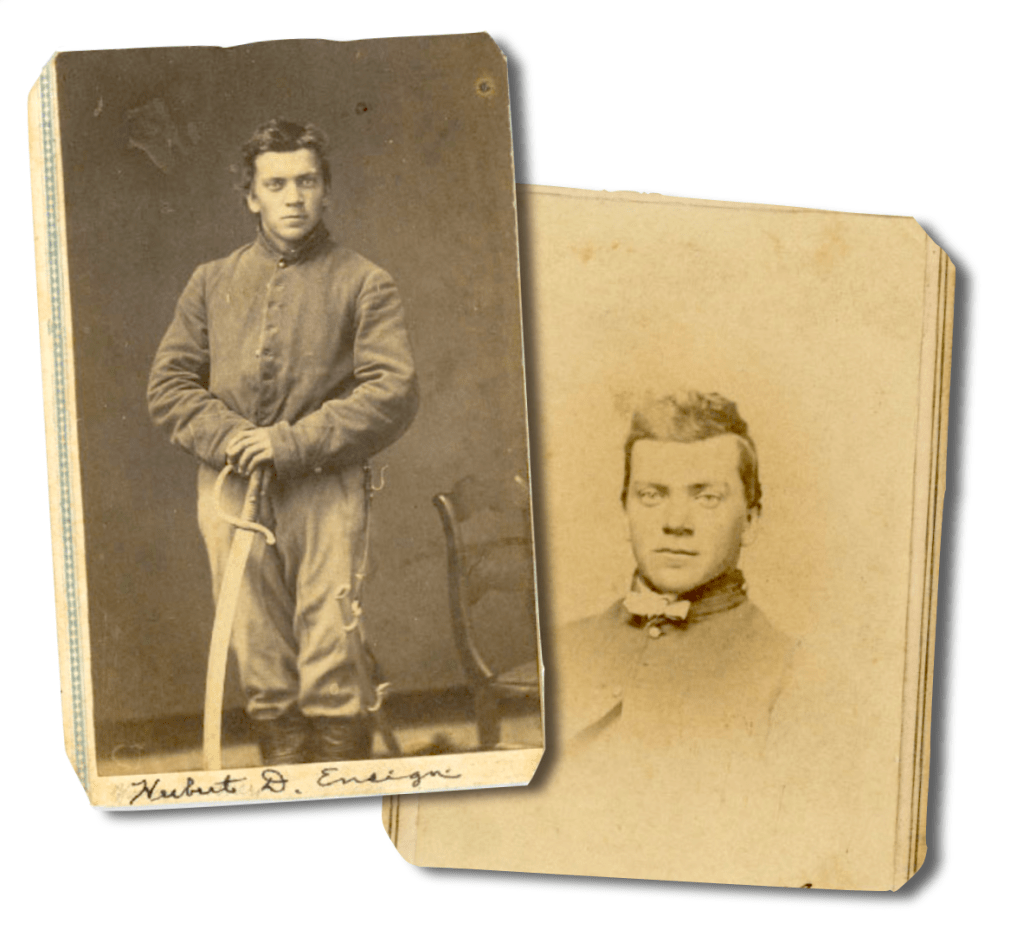
The image at left is identified as Herbert D. Ensign; the one at right is not identified but also looks like Herbert, though it might be his brother William Oren Ensign who served in the same Battery (from album with images of 14th Ohio Independent Battery.)
Letter 1
Camp on Lynn Creek Lynnville, Tennessee November 19, 1863
Dear Niece Alta,
Sometime since I wrote a letter to you and the next day I received one from you. so it seems that I have written two for one and now I will answer the last one from you.
I suppose you know all about our march from Corinth here by William who wrote a very long letter to Clara a day or two since. We left Corinth on the second instant and marched to Eastport where we crossed the Tennessee river on the sixth. We arrived at Pulaski on the eve of the 11th. Next morning we took the Nashville Pike and arrived at Lynnville in the afternoon, a distance of 15 miles. We are about 20 miles from Columbia and 64 from Nashville. Lynn Creek is a pretty little stream and is as clear as a crystal. Lynnville is a very pretty little town of about 300 inhabitants, but war has left its footprints here. There are a good many old chimneys left standing. The buildings were burnt by A. D. McCook. His command was fired on while passing through the place from the hills on the east side of the town and his brother Robert was killed on this same road, just across the Alabama line. By the appearance of things now, I guess we will stay on this line of railroad this winter though it is not working any further than Columbia at present.
The country here is very much broken. Some of the hills look like mountains. The soil is very rich and they raise some of the biggest corn that I ever saw and they have some good fruit, but potatoes do not do very well, being small and watery. We have not drawn very good rations since we came here (I mean from the commissary) but the fresh meat that we have had since we came here is heeps. The boys have helped themselves to so many hogs that there is some talk of fining the battery to pay for them. But it is all talk I guess.
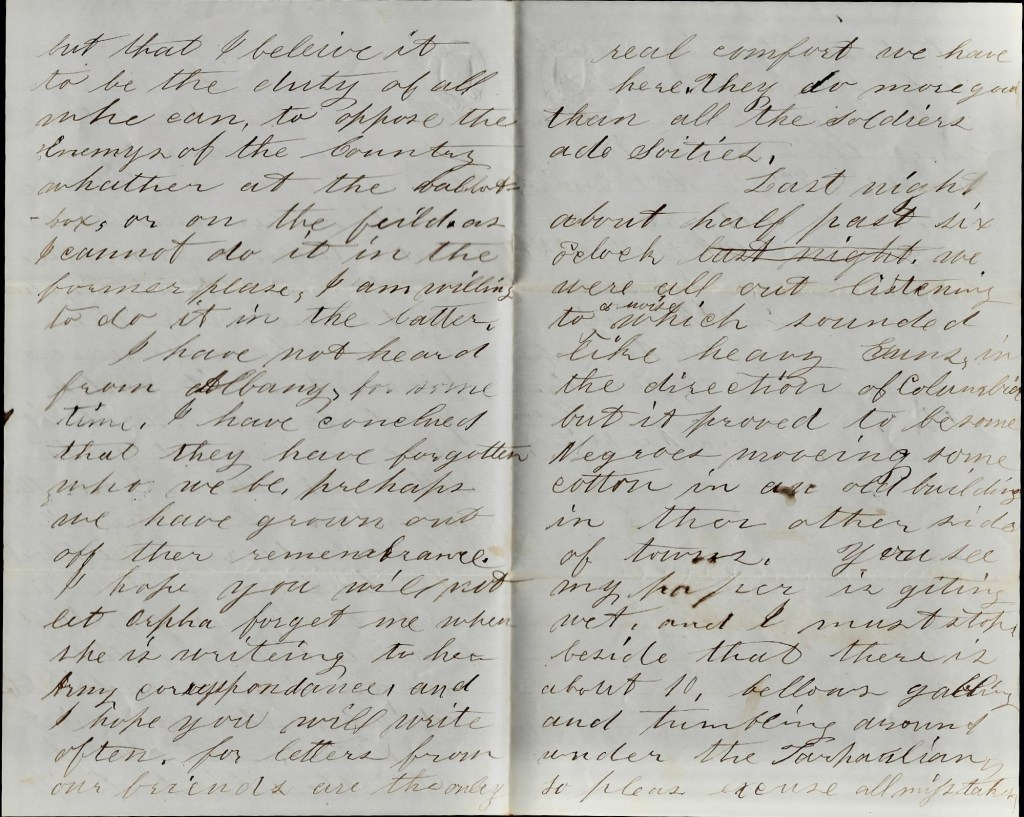
November 20th. We have had very pleasant weather until last night when it commenced raining and has rained ever since and it is so damp that I can hardly write legible. I received a letter from Clara a day or two ago in which she said Father and Mother had returned from the West and that Orpha had come with them. I hope she will have a pleasant visit and a good school. I wish it was so I could go to school at the Sem. this winter, but the life of a soldier is a school of itself, and I am no sorry as yet that I enlisted when I did. I only wish I had enlisted when the war first broke out, not that I like the kind of life, but I believe it to be the duty of all who can to oppose the enemies of the country, whether at the ballot box or on the field. As I cannot do it in the former place, I am willing to do it in the latter.
I have not heard from Albany for some time. I have concluded that they have forgotten who we be. Perhaps we have grown out of their remembrance. I hope you will not let Orpha forget me when she is writing to her army correspondences and I hope you will write often for letters from our friends are the only real comfort we have here. They do more good than all the soldiers aid societies.
Last night about half past 8 o’clock, we were all out listening to a noise which sounded like heavy guns in the direction of Columbia but it proved to be some Negroes moving some cotton in an old building in the other side of town/ You see my paper is getting wet and I must stop. Besides that, there is about 10 fellows jabbering and tumbling around under the tarpaulin so please excuse all mistakes and write soon and tell me all about what you are studying this winter and oblige, — H. D. Ensign
Address 14th Battery, O. V. Artillery, 4rd Brigade, 2nd Division, 16th Army Corps, Columbia, Tennessee via Nashville
Letter 2
14th Ohio Battery Lynnville, Tennessee February 10, 1864
My Dear Niece Alta,
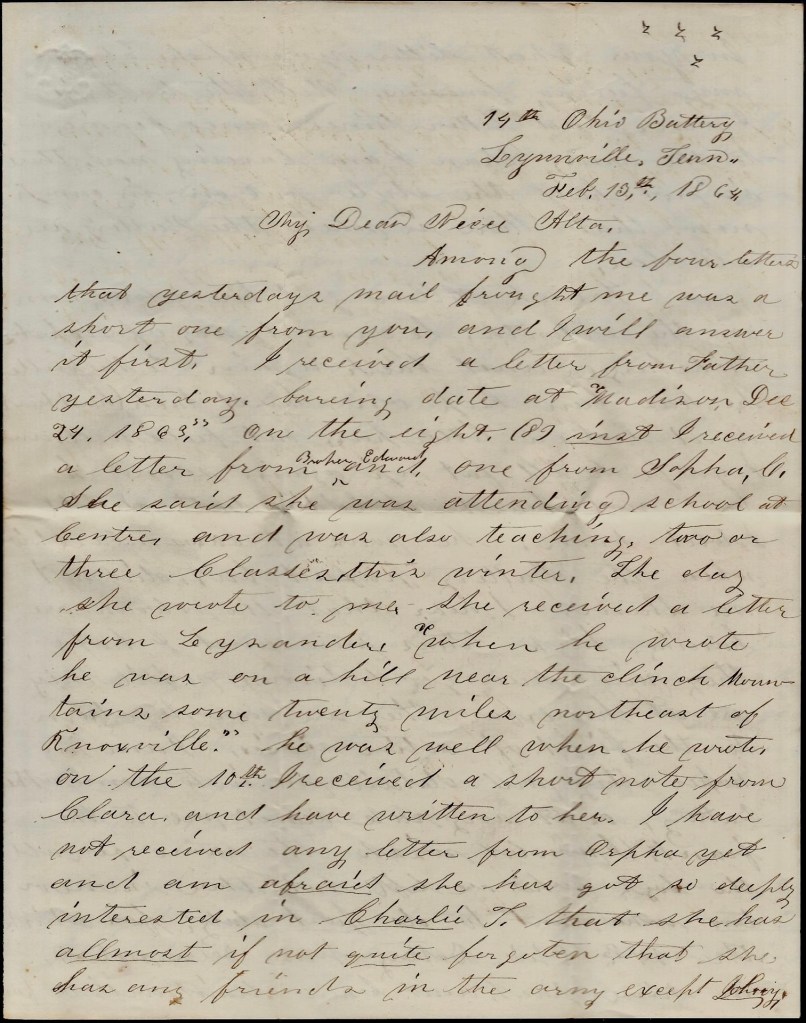
Among the four letters that yesterday’s mail brought me was a short one from you, and I will answer it first. I received a letter from Father yesterday, bearing date at Madison, December 24th 1863. On the 8th instant I received a letter from brother Edward, and one from Sopha C. She said she was attending school at Centre, and was also teaching two or three classes this winter. The day she wrote to me she received a letter from Lysander. When he wrote, he was on a hill near the Clinch Mountains some twenty miles northeast of Knoxville. He was well when he wrote. On the 10th I received a short note from Clara and have written to her, I have not received any letter from Orpha yet and am afraid she has got so deeply interested in Charlie T. that she has almost if not quite forgotten that she has any friends in the army except Johnny.
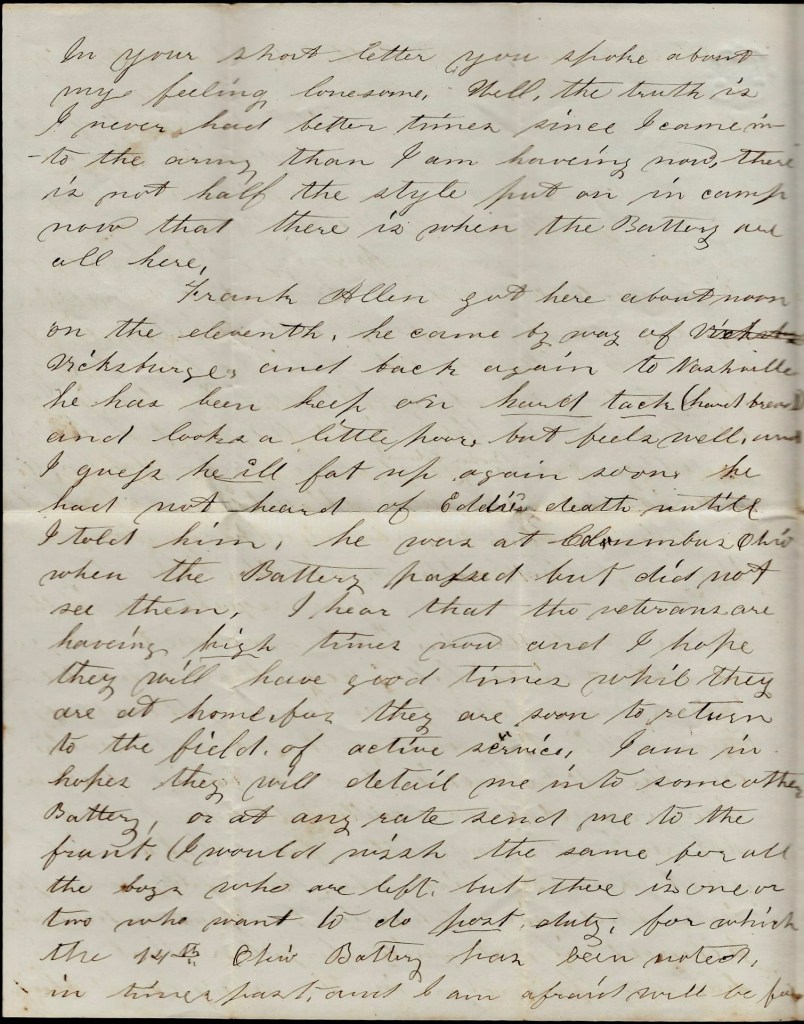
In your short letter you spoke about my feeling lonesome. Well, the truth is I never had better times since I came in to the army than I am having now. There is not half the style put on in camp now that there is when the Battery are all here.
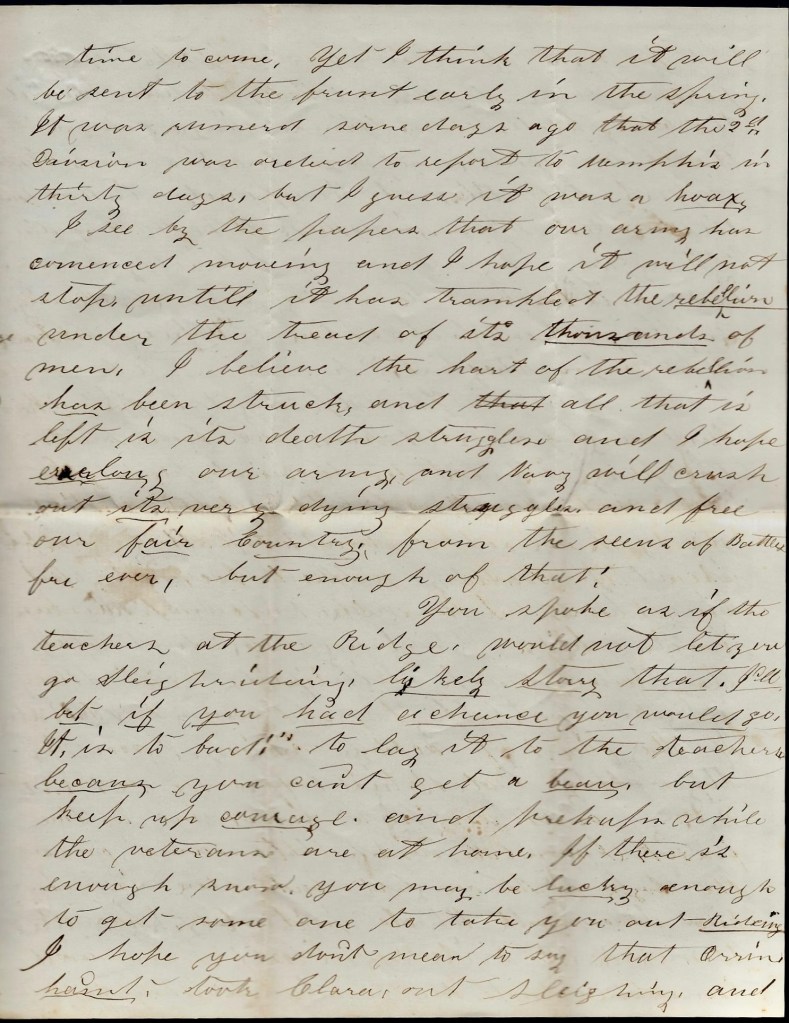
Frank Allen got here about noon on the 11th. He came by way of Vicksburg and back again to Nashville. He has been kept on hard tack (hard bread) and looks a little poor, but feels well and I guess he’ll fat up again soon. He had not heard of Eddie’s death until I told him. He was at Columbus, Ohio, when the Battery passed but did not see them. I hear that the veterans are having high times now and I hope they will have good times while they are at home for they are soon to return to the field of active service. I am in hopes they will detail me into some other Battery, or at any rate send me to the front. I would wish the same for all the boys who are left, but there is one or two who want to do post duty for which the 14th Ohio Battery has been noted in times past and I am afraid will be for time to come. Yet I think that it will be sent to the front early in the spring.
It was rumored some days ago that the 2nd Division was ordered to report to Memphis in thirty days, but I guess it was a hoax. I see by the papers that our army has commenced moving and I hope it will not stop until it has trampled the rebellion under the tread of its thousands of men. I believe the heart of the rebellion has been struck and all that is left its its death struggle, and I hope ere long our army and Navy will crush out its very dying struggles and free our fair country from the scenes of battles forever. But enough of that!
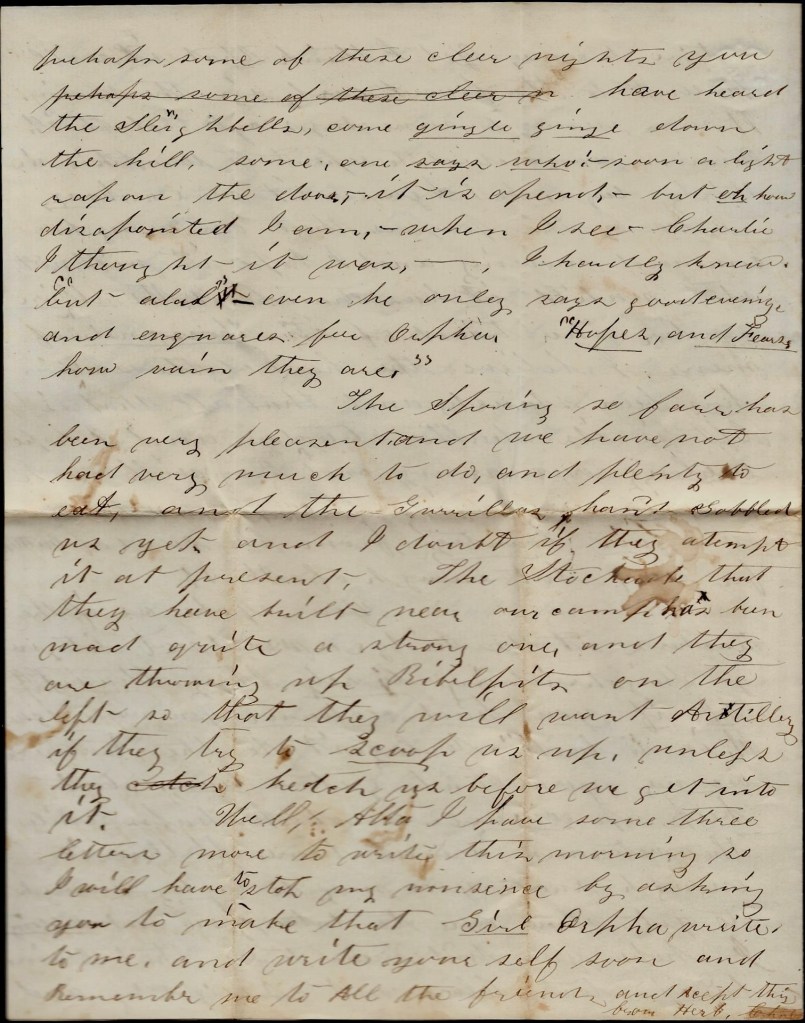
You spoke as if the teachers at the Ridge would not let you go sleigh riding. Likely story that. I’ll bet if you had a chance you would go. It is too bad to lay it to the teachers because you can’t get a beau, but keep up good courage and perhaps while the veterans are at home—if there is enough now—you may be licky enough to get some one to take you out riding. I hope you don’t mean to say that Orrin hain’t took Clara out sleighing and perhaps some of these clear nights you have heard the sleigh bells come jingle jing down the hill. Someone says, who! Soon a light rap on the door. It is opened, but Oh! how disappointed I am when I see Charlie. I thought it was ——. I hardly knew but, alas, even he only says good evening and enquires for Orpha. “Hopes and fears, how vain they are.”
The spring so fair has been very pleasant and we have not had very much to do and plenty to eat, and the guerrillas hain’t gobbled us yet, and I doubt if they attempt it at present. The stockade that they have built near our camp has been made quite a strong one and they are throwing up rifle pits on the left so that they will want artillery if they try to scoop us up unless they catch us before we get into it.
Well, Alta, I have some three letters more to write this morning so I will have to stop my nonsense by asking you to make that girl Orpha write to me and write yourself soon and remember me to all the friends and accept this from, — Herb
Letter 3
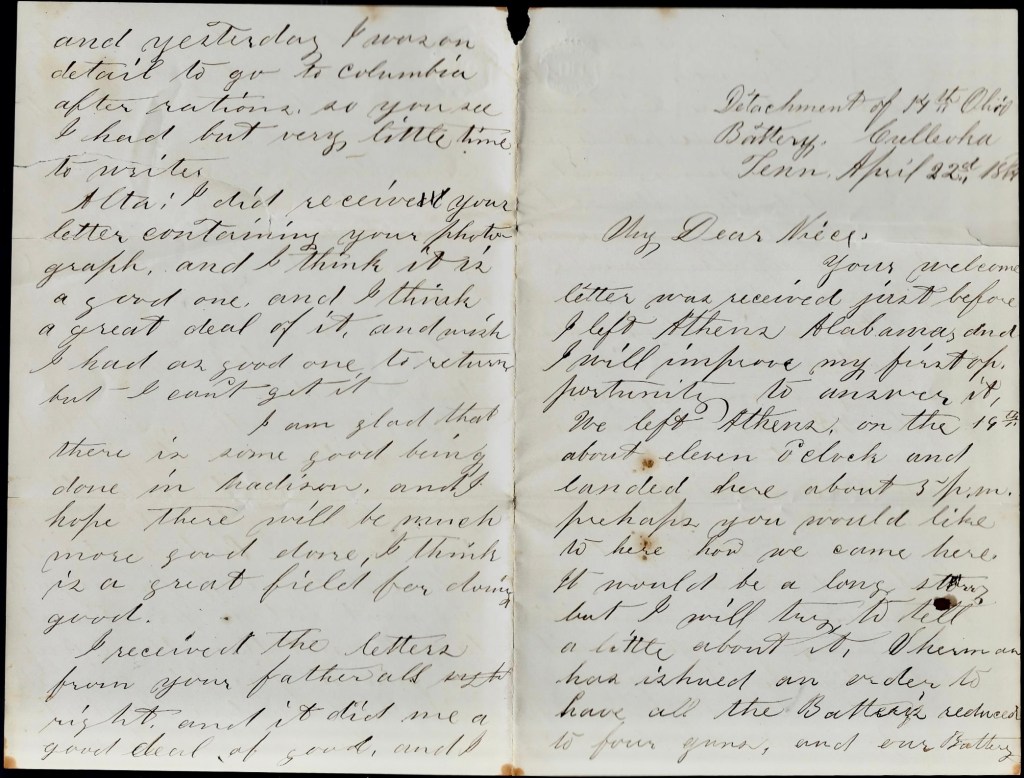
Detachment of 14th Ohio Battery Culloeoka, Tennessee April 22, 1864
My dear niece,
Your welcome letter was received just before I left Athens, Alabama, and i will improve my first opportunity to answer it. We left Athens on the 19th about eleven o’clock and landed here about 5 p.m. Perhaps you would like to hear how we came here. It would be a long story but I will try to tell a little about it. Sherman had issued an order to have all the Batteries reduced to four guns and out Battery was ordered to turn over our brass guns and detail 25 men and one lieutenant to report to Culleoka to man a couple of guns and so they detailed the old boys who did not reenlist and made up the number of the recruits who were not well. There is about three hundred men here in all—most of them are recruits of for the 7th Pennsylvania Cavalry and greener, dutcher set of men (or rather boys) I never saw.
We have two old 6-pounders. They are not extra good guns. We tried them at a target 850 yards. The ammunition was poor but the solid shot struck it once or twice but the shell (most of them) burst short. I expect we will try it again today and I will have to go on guard soon. My accommodations for writing are poor and my pen and ink are far from being the best so if I can write this so that it can be read, I shall think I am doing well.
April 24. Well, Alta, I guess you think I don’t care much about your letters but that is not the case. They are always looked for with pleasure and welcome when they come. But last Friday when I came off from guard, we went out to practice at target and then there was so much jumping around in the quarters that it was near impossible to write and yesterday I was on detail to go to Columbia after rations so you see I had but very little time to write.
Alta, I did receive your letter containing your photograph and I think it is a good one and I think a great deal of it, and wish I had as good one to return but I can’t get it.
I am glad that there is some good being done in Madison and I hope there will be much more good done. I think it is a great field for doing good. I received the letters from you father all right and it did me a good deal of good and I wrote to Clara some time ago and hope she will not forget to write to me if Orren does come to see her every week.
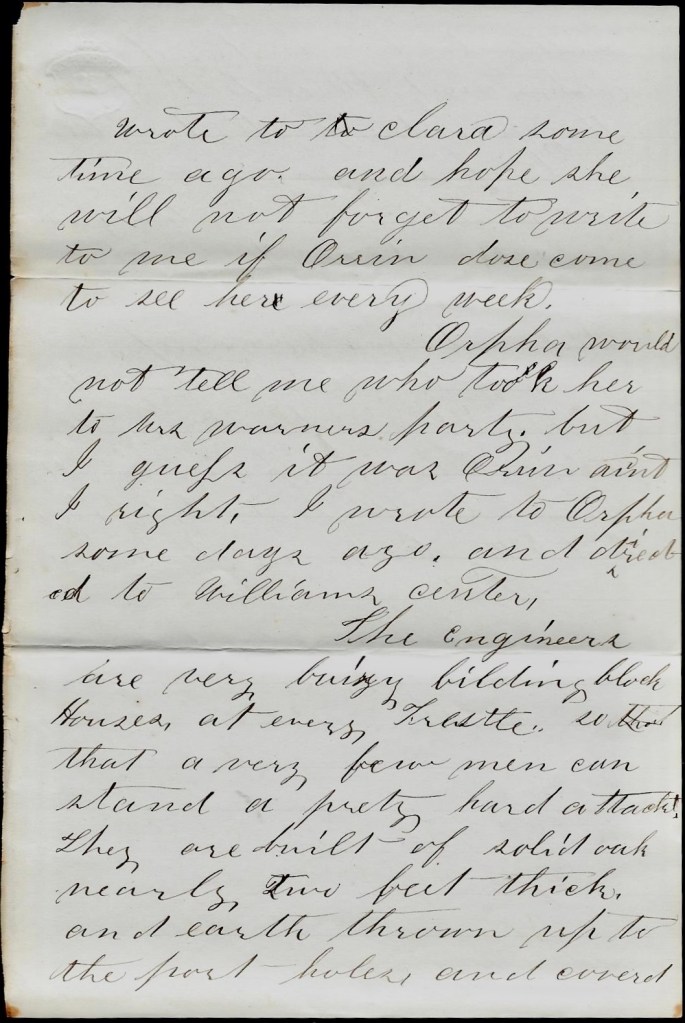
Orpha would not tell me who took her to Mrs. Warner’s party but I guess it was Orrin—ain’t I right? I wrote to Orpha some days ago and directed to Williams Center.
Example of blockhouse constructed by the Engineers (LOC)
The Engineers are very busy building block houses at every trestle so that a very few men can stand a pretty hard attack. They are built of solid oak nearly two feet thick and earth thrown up to the port holes and covered with twelve inches of oak and three feet of earth. They are the prettiest little forts I ever saw.
One of our Dutch pickets got scared last night and run into camp.
Well, Alta, this is a dry letter but is it just as dry times here. Please write soon to Herbert D. Ensign, Post Battery, Culleoka, Tennessee
[to] Miss A. C. Ensign, Madison, Ohio
Letter 4
Post Battery Decatur, Alabama July 7th 1864
My dear Niece
I received your letter night before last and I do assure you that I was very glad to hear from you. I had hoped to hear that your Father was much better. Still I was thankful to hear that he was no worse. I am glad you and Clara have such good success in milking and in feeding the calves. Hope you will not get any ore of their love pats in your face. Will says he answered your letter if he received it. He received one from Clara day before yesterday and will answer it soon. On the 3rd I received a letter from Hattie Burget and answered it on the 5th. It has been some time since I heard from the Farmer friends. I am looking for a letter from Milo Carnes.
The 171st O. N. G.’s from our country were indeed lucky in not being with the regiment when it was captured. As for Vallandigham, I believe he is like a dead tree that is soon to be used for kindling wood and if there is no place in—-, hotter than another. It will be kept for him (Alta, I had almost forgotten the command judge not lest you be judged) but I will say he has played out, unless he can get the nominee for Vice President at the Chicago Convention. What a pretty ticket they can have. For President—George B. McClellan of Ohio, for Vice President—C. L. Vallandigham of Ohio. Alta, you are right! there are some that would grumble of they had everything to suit themselves, but such people never amount to much, or at least I think so. The only ticket that loyal men can support is Lincoln & Johnson. Fremont may be all right in his place, but when he accepted the nomination of the Cleveland Convention, he strayed far, far out of the place and has politically killed himself forever. I always had thought he was a good man but now I do not. When I first heard that Vallandigham had come back to Ohio, I was in hopes they would hang him, but now I say leave him be, but keep your eye on him and the soldiers will tend to his case when they get him.
For my part, I have no reason for caviling at the movements of Grant and Sherman so far in their campaign. We cannot under any circumstance expect single success to our army and haven’t. I think the news from the front of both of our armies of late is encouraging and the Lincoln administration is not so bad as might be, and the cry of the army is Lincoln & Johnson for President and Vice President. What is going to be worth anything of money is not.
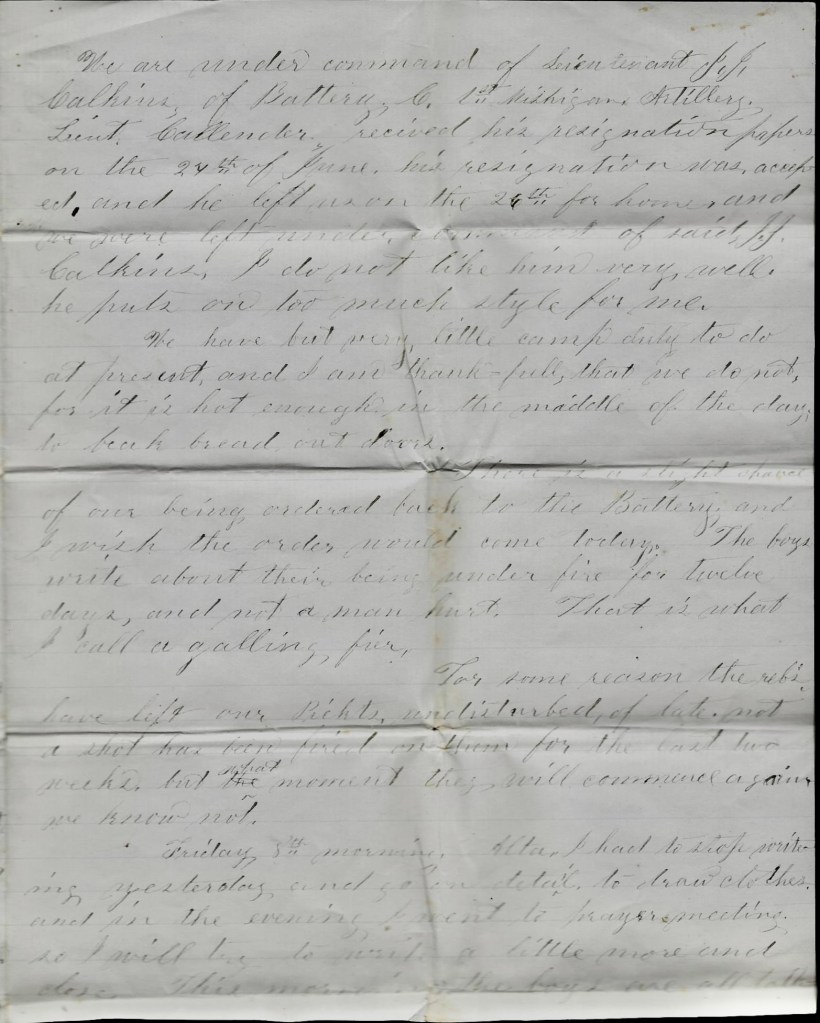
We are under command of Lieutenant J. J. Calkins of Battery C., 1st Michigan Artillery. Lieut. Callender received his resignation papers on the 24th of June. His resignation was accepted and he left us on the 26th for home, and we were left under command of said J. J. Calkins. I do not like him very well. He puts on too much style for me.
We have but very little camp duty to do at present and I am thankful that we do not for it is hot enough in the middle of the day to bake bread outdoors.
There is a slight chance of our being ordered back to the Battery and I wish the order would come today. The boys write about their being under fire for twelve days and not a man hurt. That is what I call a galling fire. For some reason the rebs have left our pickets undisturbed of late. Not a shot has been fired on them for the last two weeks but at what moment they will commence again, we know not.
Friday 8th morning. Alta, I had to stop writing yesterday and go on detail to draw clothes and in the evening I went to prayer meeting so I will try to write a little more and close. This morning the boys are all talking about moving. What new reason they have for doing so, I do not know but expect that have heard something from the Lieutenant which makes them think we are going to leave soon. Alta, I told Frank Allen last evening that I would go over to the hospital this morning so I will close,
Please remember me to all the friends and do, write soon to me. — Herbert D. Ensign
P. S. Enclosed is a photograph which I send you to keep for me. If we move, I cannot take good care of it.
Letter 5
14th Ohio Battery Rome, Georgia October 28, 1864
My dear Niece,
Your letter of October 8th arrived some days ago but I have had no chance to write for a long time. We left East Point on the 4th and since then we have been marching day and night until the evening of the 25th when we came here and encamped near the depot. Our Battery and a section of Battery F, 2nd U. S. left the army at the river near Gaylesville, Alabama, and came here and turned over what horses and mules we had left which was not half of the number we should have. They had died on the road of strarvation. as soon as we can get transportation, we are going to Nashville, Tennessee, to get a new fitting out.
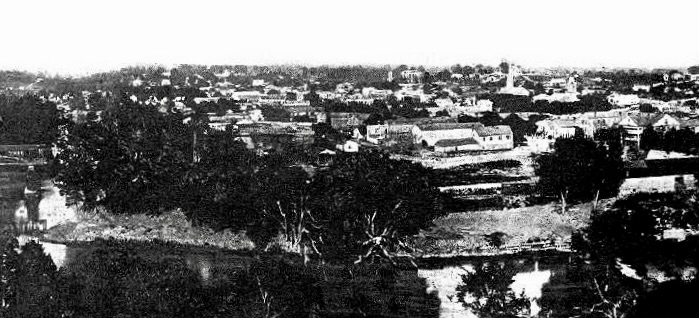
Rome, Georgia, in 1864 (LOC)
Now, to pay for the long delay, I am going to write a long letter [even] if it is not very interesting. I would have written [more] often if I could have done so. Did you ever read about Rome of olden times. How her armies went forth to conquer? if so, you know more about it than I do, but I will tell you about modern Rome whose armies went out of town in a hurry and were badly whipped at Atlanta. Rome is situated at the junction of the Oostanaula with the Etowah River, and they two form the Coosa. It had once been a very beautiful town and its buildings and streets were neat and well lighted with gas. But the gas works have been destroyed and the shade trees, lamp posts, &c. are badly destroyed. The hills at the upper end of town have been dug and throw up into ugly forts and cemetery hill on the south bank of the Etowah has shared the same fate. In this hill have been laid many citizens and rebel soldiers but there is one slope which is whitened with head boards marking the resting places of many a brave defender of this country’s honor.
Wildflowers collected from top of Cemetery Hill at Rome, Georgia, in October 1864. The cemetery was Myrtle Hill Cemetery, established in 1857.
Enclosed you will find a few leaves taken from the top of this hill. The flowers are wild ones which grow on the fill and are the only ones in bloom now. From this hill is to be obtained one of the prettiest scenery I ever saw (I wish you could be here just long enough to see it). It would pay you well for climbing its steep sides.
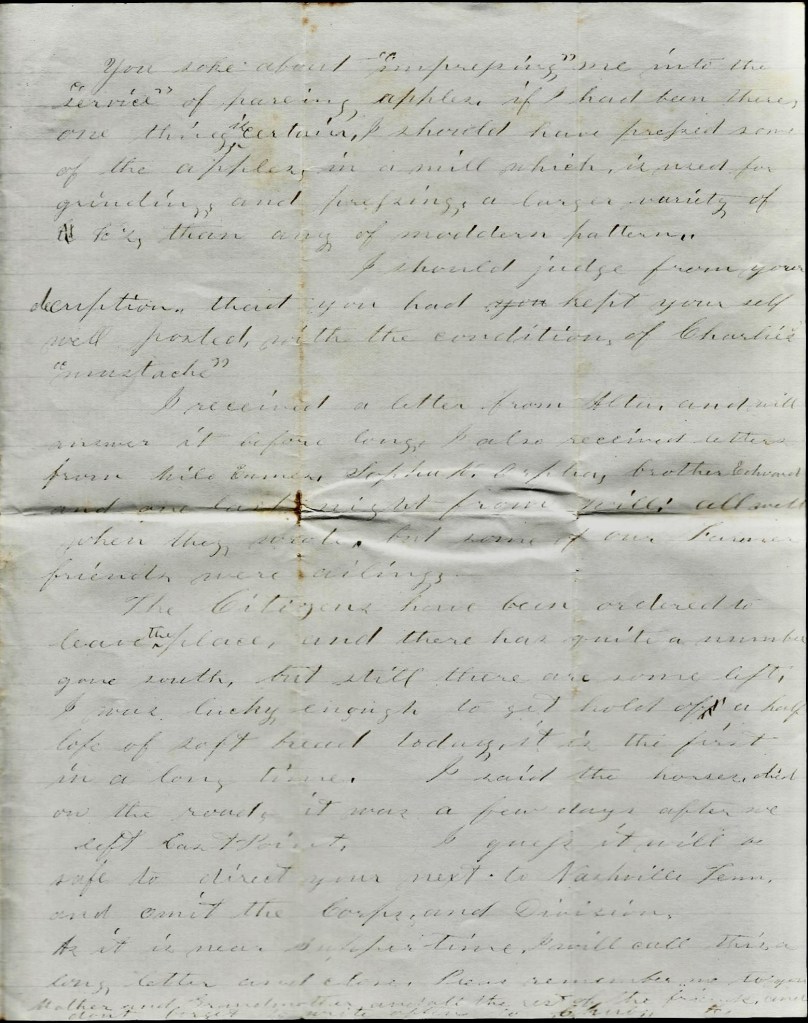
You spoke about “impressing” me into the “service” of paring apples. If I had been there, one thing is certain, I should have pressed some of the apples in a mill which is used for grounding and pressing a larger variety of [ ], than any of modern pattern.
I should judge from your description that you had kept yourself well posted with the condition of Charlie’s mustache.
I received a letter from Alta and will answer it before long. I also received letters from Milo Enmer, Sphia K., Orpha’s brother Edward, and one last night from Will. All well when they wrote but some of our former friends were ailing.
The citizens have been ordered to leave the place and there has quite a number gone south, but still there are some left. 1 I was lucky enough to get hold of a half loaf of soft bread today. It is the first in a long time. I said the horses died on the road. It was a few days after we left East Point. I guess it will be safe to direct your next to Nashville, Tenn. and omit the Corps & Division. As it is near supper time, I will call this a long letter and close. Please remember me to your Mother and Grandmother and all the rest of the friends and don’t forget to write often to [ ] — H.
1 Sherman burned Rome on November 10-11, 1864, four days before burning Atlanta, just prior to embarking on the March to the Sea.
Letter 6
In Camp Nashville, Tennessee Thanksgiving evening, November 24th 1864
My dear Niece,
It has been some time since I wrote to you or received a letter from you, but I thought I would improve this beautiful evening in writing to you. This is the first evening for a long, long, time that it has been possible to write. In fact, we have had the most disagreeable weather that I ever saw. First it rained steady for three weeks, then it snowed a day or two, and wound up with a hard wind which would nearly cut one in two. And we could only draw our rations of wood which is only one six part of a cord per month to a man and we had no quarters except our tarpaulins which are very poor ones and will leak very bad. It does seem rather hard that we should live thus while staying at the very bas of supplies and in a loyal state too. What do you think?
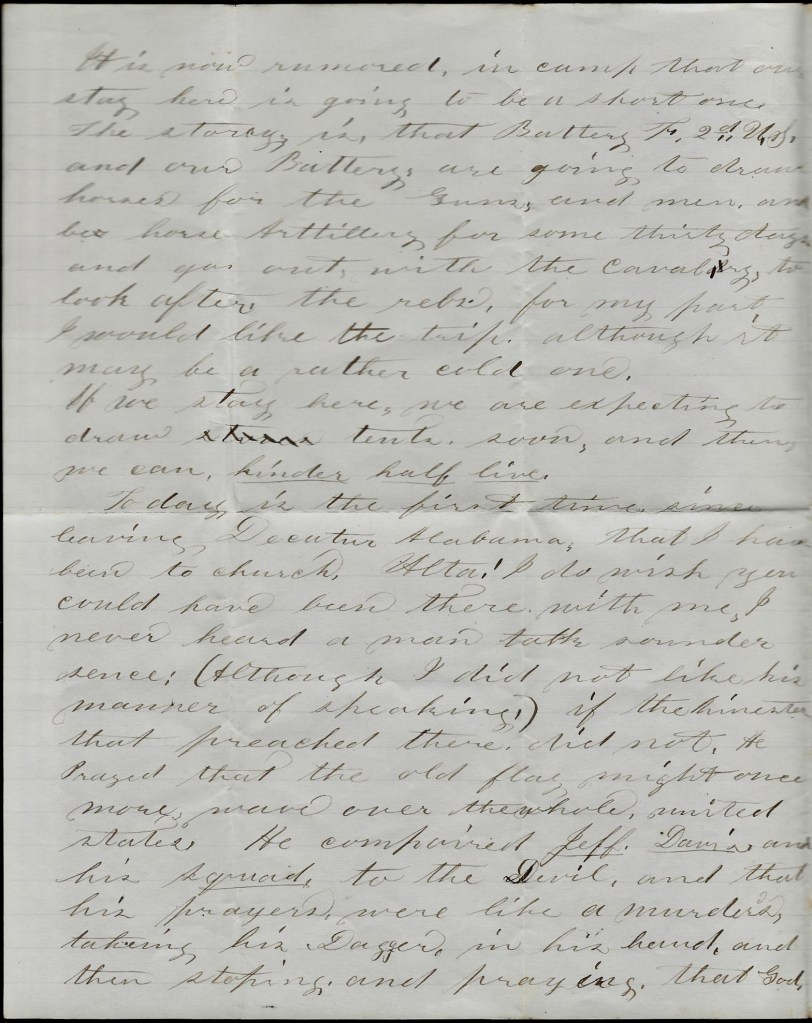
It is now rumored in camp that our stay here is going to be a short one. The story is that Battery F 2nd U. S., and our battery are going to draw horses for the guns and men and be horse artillery for some thirty days and go out with the cavalry to look after the rebs. For my part, I would like the trip although it may be a rather cold one. If we stay here we are expecting to draw tents soon and then we can kinder half live.
Today is the first time since leaving Decature, Alabama, that I have been to church. Alta, I do wish you could have been there with me. I neber heard a man talk sounder sense (although I did not like his manner of speaking) if the minister that preached there did not. He prayed that the old flag might once more wave over the whole, united states. He compared Jeff Davis and his squad to the Devil and that his prayers were like a murderers, taking his dagger in his hand and then stopping and praying that God would help him yp carry out his wicked plans. There was not a very large turn out of citizens but that were there seemed to day amen to what the minister said.
Last Wednesday night I received letters from brother William and brother Edward. When Will wrote, he was in Cleveland and was well. Edward and family were well and had another little boy. Gideon’s people were well. But it was not so at Center. Sopha was buried on the 8th inst. Frank was very sick and Celia was not much better. I have not heard from Albany for some time. The last I heard all the friends were well.
Alta, I guess I must stop for I hear Tattoo sounding and I must go. I have been to roll call and now I must put out my light. So goodbye and don’t forget to write often to Herbert, 14th Ohio Battery, Nashville, Tenn.

















 Spared & Shared 23