Category Archives: 15th Illinois Cavalry

1863: Sereno Bridge to Alice (Winchester) Bridge

This letter was written by Sereno Bridge (1820-1888), a native of Wilmington, Vermont, who lived there until 1848 when he came to Bureau county, Illinois, with his wife, the former Alice S. Winchester. The letter is only signed, “S. B.” but it came from a collection of his letters.
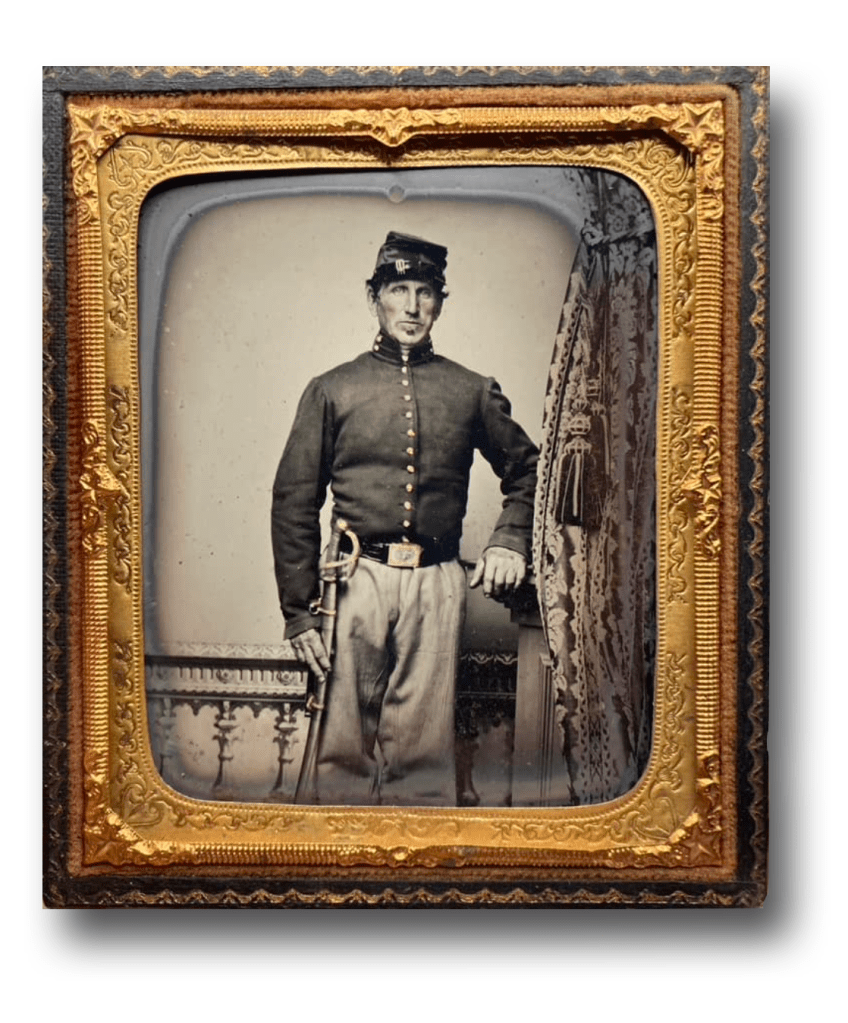
I could not find an image of Sereno but here is an unidentified Union trooper about the same age (Kolt Massie Collection)

In September 1861, he enlisted in Co. B, 52nd Illinois Infantry, his muster records describing him as a 5 foot 9 inch tall, black-haired, blue-eyed farmer. Shortly after he must have transferred into Gilbert’s Independent Cavalry. In February he was transferred again into Co. H of the 12th Illinois Cavalry, and then transferred one more time in December 1862 into Co. G of the 15th Illinois Cavalry when that unit was formed. He remained with the 15th Illinois Cavalry until late October 1864 when his three year enlistment expired. This letter was written during the period he was in the 15th Illinois Cavalry which was attached to the 1st Cavalry Division, 16 Corps, Dept. of the Tennessee, though it appears to have been detached and assigned duty in hunting down Confederate guerrillas in eastern Arkansas along the Mississippi River. 

The letter was written in diary form and relates his past week’s activities. Chasing Confederate guerrillas (many of whom were local inhabitants) though the swamps, forests, and plantations of rural Arkansas, Bridge is exposed to the ‘human’ side of war as he comes into contact with the families of captured guerrilla soldiers. Digressing from his story of the scout he was on, Sereno wrote his wife: “You at the North can hardly realize what an amount of suffering this war is causing.” 

[This letter is from the personal collection of Richard Weiner and was transcribed and published on Spared & Shared by express consent.]

Transcription

Helena, Arkansas
November 9, 1863

Dear Wife,

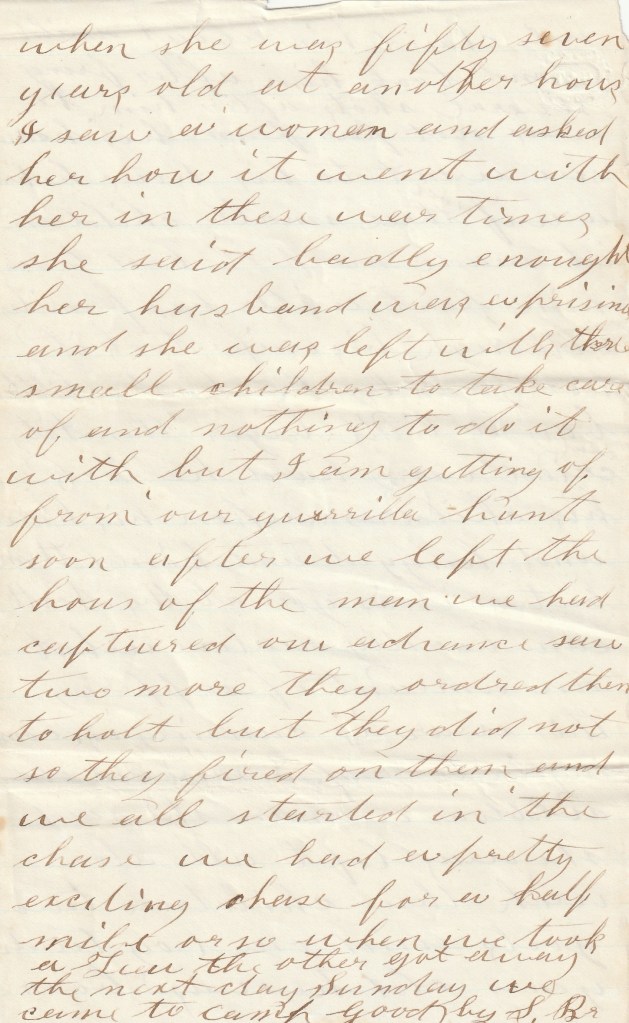
Another week has passed since I wrote you and now I will record some of the events that have transpired during the time. On Sunday, the 1st day of the present month, I had to help load hay for the horse. On Monday, we had review of the regiment in the forenoon. In the afternoon, we chased three guerrillas about five miles. They came in among the darkey  wood choppers. On Tuesday and Wednesday, was on picket. 

On Thursday, started on a scout. Went down the river [and] got on the track of about thirty guerrillas. Rode till night, camped on a deserted plantation, stood picket that night by the side of a big swamp and by the noises that the owls, coons, cranes, geese, ducks, and other wild vermin made, reminded me of what I have read about the dismal swamps.  

On Friday morning, we started on the trail again. Rode about six miles when the advance came up with some of the guerrillas. They fired some shots at them, then we all gave chase. Run them two or three miles but did not get any of them. They went in amongst the cane brakes and hid. Then we rode on for about four hours through the most dismal looking place that I ever saw. The mud was ankle deep a good part of the way and cane brakes so thick that a bird could not fly through it and so high that we could not see a man on his horse unless we was close on to him.

About noon we came to a crick where the rebels had camped the night before. We followed them so close that they had to leave their wagon, camp kettles, corn meal and some ammunition. We kept after them till we came to a large plantation that stood on the bend of the river. They broke up there and we lost track of them. We had now got forty-five miles from Helena. We camped there for the night. The planter was a strong secesh and had a plenty of corn, cattle, hogs, hens, ducks, geese, honey, &c., so the boys just went in on their nerve and you better believe the feathers flew, hogs squealed, the geese and ducks fluttered, the bee hives disappeared, butter milk was in demand. The women and children cried and I think the old man would have sworn if he had dared to. But let that be as it would, we lived high and slept on corn fodder that night. 

Saturday, we came back twenty miles to another plantation that was owned by one of the guerrillas. There was none but blacks on the place but there was what was better for us that was corn, hogs, sweet potatoes, molasses, &c. We camped about noon. In the afternoon, about thirty of us was sent out to reconnoiter. We had not gone far when we came in sight of a guerrilla. We chased him about a mile and took him after firing several shots after him. He was not far from his home. We went to his house. He had a wife and three small children. It made me feel bad to see him part with his family although his wife took it very calmly. He had a little boy a little bigger than Arty 1 that cried very hard. He took his children upon his horse and hugged and kissed them—but so it is.  You at the North can hardly realize what an amount of suffering this war is causing.

In coming into camp, I saw an old widow woman. She said she was left all alone with three children, two girls and one boy twelve years old. He was born when she was fifty-seven years old. At another house I saw a woman and asked her how it went with her in these war times. She said badly enough—her husband was in prison and she was left with three small children to take care of and nothing to do it with. But I am getting off from our guerrilla hunt.

Soon after we left the house of the man we had captured, our advance saw two more. They ordered them to halt but they did not so they fired on them and we all started in the chase. We had a pretty exciting chase for half mile or so when we took a lieutenant. The other got away. The next day Sunday we came to camp.

Goodbye, — S. B.


1 Sereno’s son, Arthur (“Arty”) M. Bridge, was born on 14 February 1860.

1862-63: Benjamin Franklin Roberts to George Washington Roberts

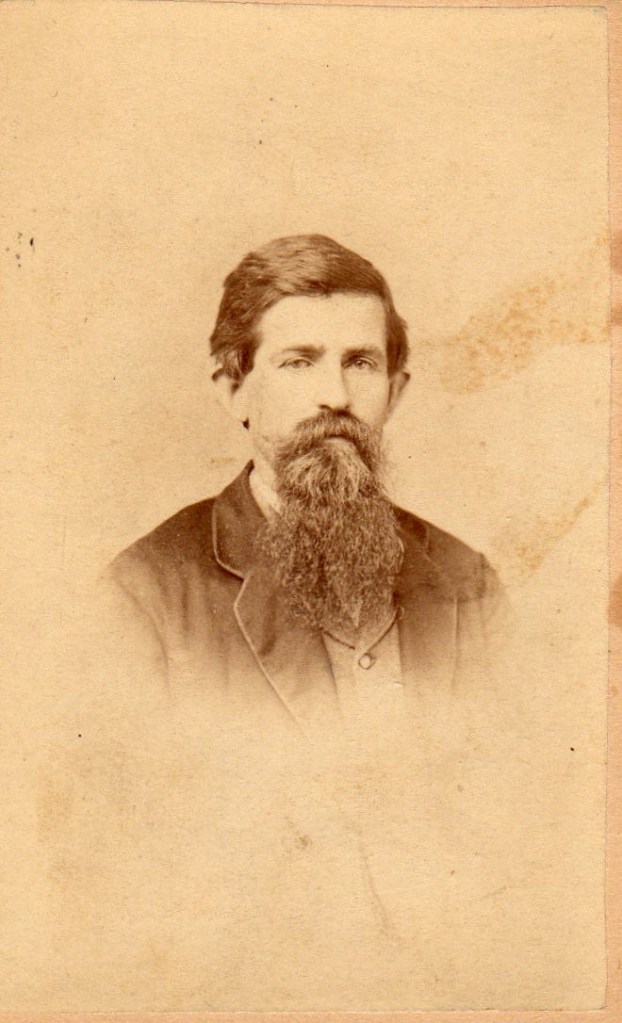
A post war image of Benjamin F. Roberts

The following letters were written by Benjamin Franklin Roberts (b. 1835), the son of Morehouse (“Morris”) Roberts (1790-1847) and Susannah (“Susan”) Newman (1806-1898) of Sunbury, Delaware county, Ohio. Ben was 26 years old when he enlisted as a sergeant in Co. D, 20th Ohio Volunteer Infantry (OVI). He was with the regiment until the spring of 1862 when he became ill and had so much difficulty regaining his health that he was actually discharged from the regiment in July 1862.

In the first letter that follows, written from Sunbury, Ohio, in September 1862 to his older brother George Washington Roberts (1829-1900) of Ottawa, Illinois, Ben expresses some desire to return to his regiment though feels his health won’t allow it yet. In the second letter datelined from Helena, Arkansas, in mid-November 1863, we learn that Ben has regained his health and is serving as a Sergt. Major in the 15th Illinois Cavalry. He later served as Sergt. Major of the 4th Louisiana Colored Cavalry and left the service in October 1865.

In his letters, Ben mentions several brothers: Giles Hartley Roberts (1845-1908) who enlisted at the age of 18 in Co. G, 96th Ohio Vol. Infantry (OVI) in August 1862. He was transferred to Co. D of the 17th Veteran Reserve Corps in January 1864. He also mentions brothers Lord Byron Roberts (1827-1889), Edward Henry Roberts (1841-1912) who also served in the 20th OVI, and John L. Roberts (b. 1838) in the 18th Illinois Infantry, later the VRC.

After the war he eventually moved to Labette county, Kansas, where he lived out his days.

Letter 1

Home [Sunbury, Delaware county, Ohio]
September 15, 1862

Dear Brother,

I thought I would try and answer your letter for Mother although I am in a dull mood for writing. I have been quite unwell for the last two weeks. I had the ague one week. Have got it broke but don’t feel any better.

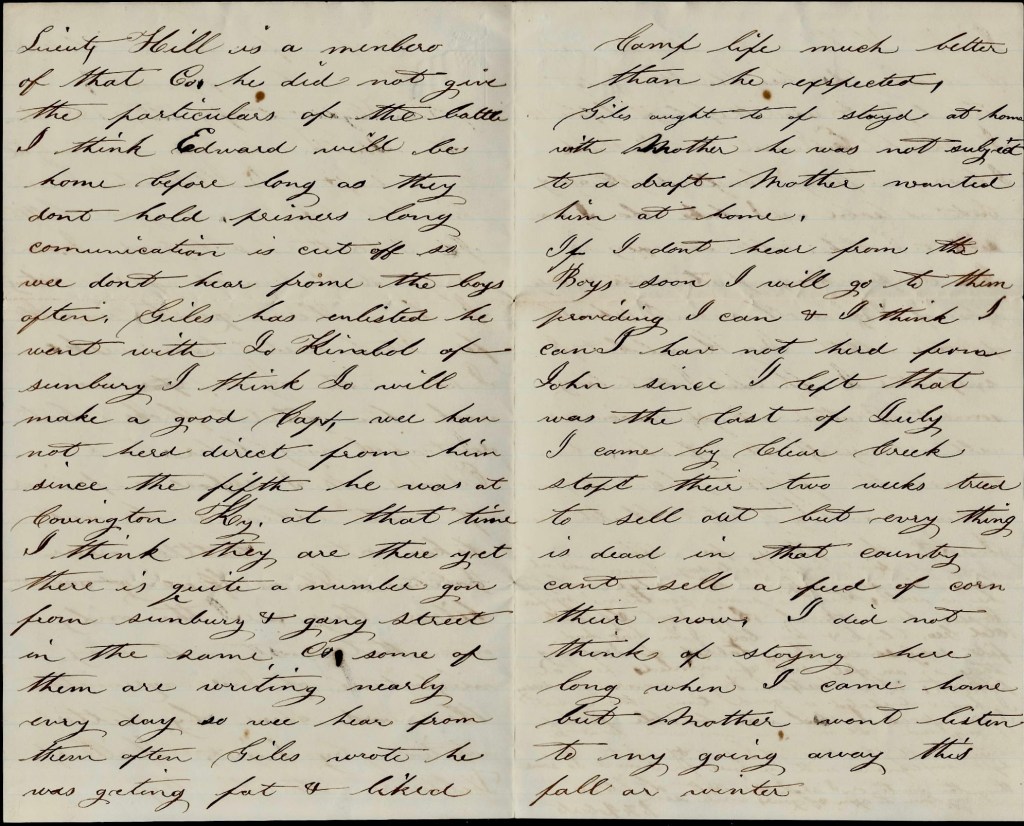
[Brother] Edward is, I suppose, a prisoner if not released. He was taken at a battle near Bolivar. James Herring was killed. They are the only ones that met with any misfortune of our acquaintance. The word came by letter written by Lieut. Hill of Delaware to his wife. Lieut. Hill is a member of that company. He did not give the particulars of the battle. I think Edward will be home before long as they don’t hold prisoners long. Communication is cut off so we don’t hear from the boys often.

[Brother] Giles has enlisted. He went with Joe Kimball of Sunbury. I think Joe will make a good captain. We have not heard direct from him since the fifth. He was at Covington, Kentucky, at that time. I think they are there yet. There is quite a number gone from Sunbury & Gang Street in the same company. Some of them are writing nearly every day as we hear from them often. Giles wrote he was getting fat and liked camp life much better than he expected. Giles ought to of stayed at home with mother. He was not subject to a draft. Mother wanted him at home.

If I don’t hear from the boys soon, I will go to them providing I can & I think I can. I have not heard from [brother] John since I left. That was the last of July. I came by Clear Creek, stopped there two weeks, tried to sell out, but everything is dead in that country. Can’t sell a feed of corn there now. I did not think of staying here long when I came home but mother won’t listen to my going away this fall or winter. I don’t know how it will be yet. It is owing how my health gets. I shall try and see the boys before long anyhow. I sometimes think I am going to get well right away but as soon as I take cold, I am sick and I take cold so easy.

I will promise again to come and see you if I go west soon. I should of come that way home but I expected to go back that way soon & mother was so anxious as well as myself to get home. The excitement is pretty high here at present.

Mother is washing today. Her health is good. Burt is plowing for wheat. I was at Aunt Julie’s yesterday. Vance was at home. He saw [brother] Byron the night before. He is well. There is some southern sympathizers here—Searles, Cigs Drent, Squire Wilson, Old George Clark & his boys. Jim has had fits every day since they talked of drafting. There is an awful sight of invalids here at present. The Hartford Fair commences Wednesday. I had anticipated a good time there but I am afraid I shall not be able to keep up my end.

Tell me when you write what the chance will be there this fall and winter for light employment with indoors for I must do something this winter or I shall die with the blues. My love to you and yours. write son. — B. F. Roberts


Letter 2

Headquarters 15th Illinois Cavalry
Helena, Arkansas
November 15th 1863

Dear Brother,

Your letter has just come to hand but not until it went the rounds from Memphis. It was sent to Vicksburg & back here ere it reached me. My health has got quite good again. We have a good deal of duty to do of late—scouting and guard duty.

I forget whether I told you or not in my last letter I expected to go into an American Regiment of African Descent. The adjutant and I have positions offered us providing we will accept which we have. Maj. Wilson, formerly of this regiment, is Colonel with the privilege of choosing his own officers and has chosen the adjutant and myself from this regiment. It is a cavalry regiment. Col. Wilson is now in Texas with Banks. He expects to fill his regiment there.

I received a letter from [brother] Ed not long ago. He had got to his regiment. Said he was fat and in as good health as ever. The other boys was well. I hear from [brother] John quite often. He is well. Wants to go with me. The adjutant and I will do all we can to get him in. I suppose you have heard that John has a commission but can’t get mustered as the company is so reduced that they are not entitled to but two officers.

We are having beautiful weather here now—very warm and dry—but the citizens say when it begins to rain that it don’t quit until it rains out & the soil is such that when it gets muddy, there is no bottom.

We have some gay times running guerrillas around here of late & with pretty good success too. We have caught a good many lately. We are going out tomorrow or the next day with three rations. I anticipate a good time going where the bushwhackers are thick and lots of chickens, any amount of girls. Such scouts make a soldier fat. Write soon. My compliments to family. Yours, &c.

— B. F. Roberts, Sergt. Major, 15th Illinois Cavalry