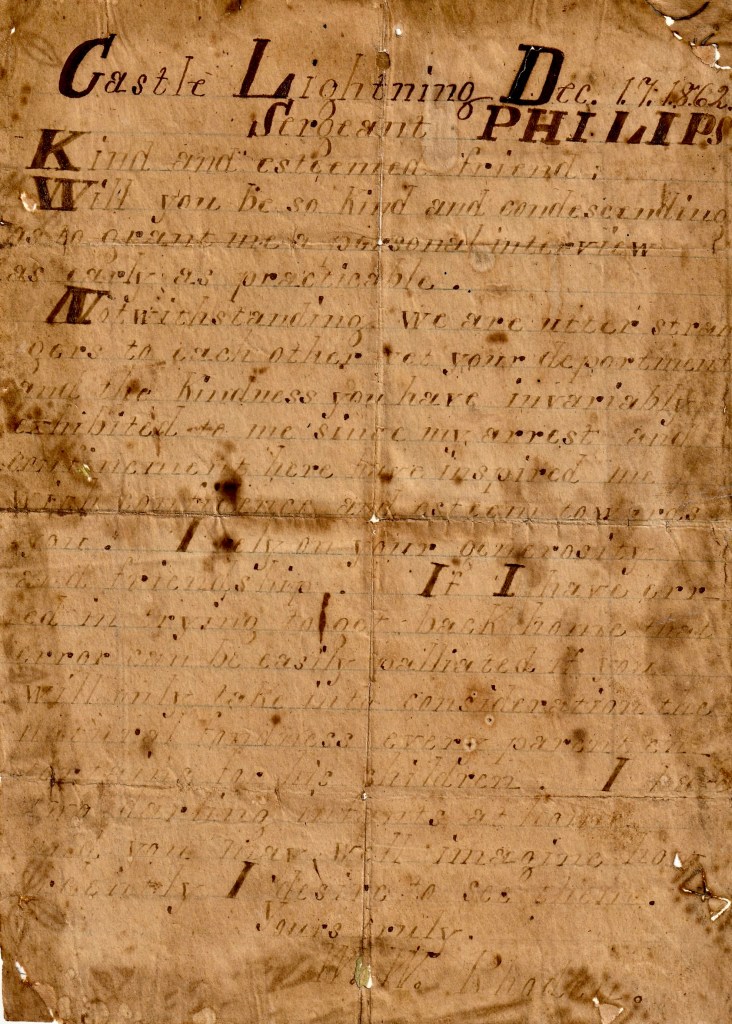
The following letter was written by a Confederate deserter named William W. Rhoden (1840-1864) who enlisted on 12 September 1862 in Co. G, 16th Georgia Infantry. He wrote the letter while under guard at Richmond’s Castle Lightning, addressing it, and most likely hand delivering it to “Sergt. Philips.” The recipient is speculated to be Sgt. John R. Phillips of the 25th Bn. VA infantry. Though the author’s calligraphy appears crude, the composition and spelling in the letter suggests he had an above-normal education.
No record could be found showing the date of William’s release but he clearly was permitted to return to his regiment where he served until 25 May 1864 at which time he was taken prisoner and transferred to the prison at Elmira, New York. He died “in the hands of the enemy” at Elmira on 8 September 1864 of chronic diarrhea.
In his letter, William infers that he deserted in a weak moment to see his “two darling infants” at home in Lowndes county, Georgia. William was married to Keziah Drawdy (1834-1900), the daughter of Levi Drawdy and Rebecca Carter. Their children were Emanuel (b. 1860), Sarah Jane (b. 1861) and William (b. 1863).
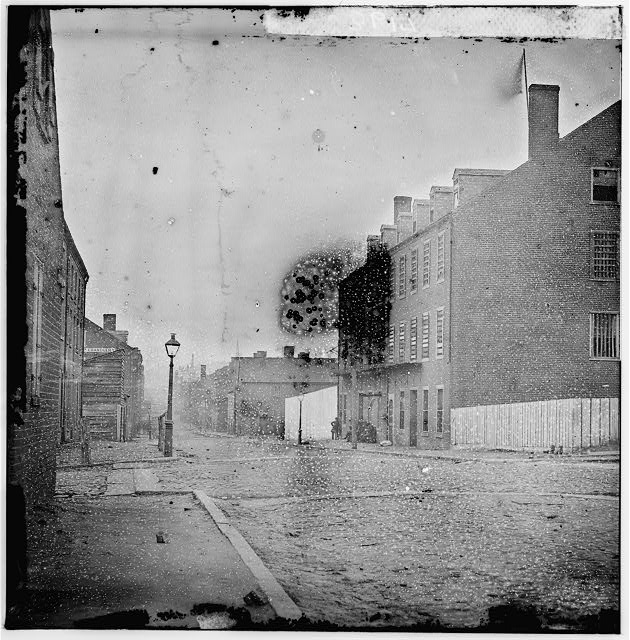
Castle Lightning Prison was located on the corner 6th and Cary street. At various times, it was known as Western District Military Prison, Castle Booker, Castle Griswold, and Castle Lightning. It stood across the street from Castle Thunder and was established to hold criminally accused Confederate soldiers and civilians. This prison primarily housed deserters from the Confederate Army as well as overflow prisoners from Castle Thunder. Castle Lightning appears to have closed in 1863 and was converted into barracks for the accommodation of several companies engaged in guard duty within the city. The prisoners confined here were removed and most likely placed in Castle Thunder.
Castle Thunder (at right) and Castle Lighting (at left near lamp post) stood opposite each other at the corner of 6th and Cary in Richmond.
[Note: This letter is from the personal collection of Richard Weiner and was transcribed and published in Spared & Shared by express consent.]
Transcription
Castle Lightning December 17, 1862
Sergeant Philips, Kind and esteemed friend;
Will you be so kind and condescending as to grant me a personal interview as early as practicable?
Notwithstanding we are utter strangers to each other, yet your deportment and the kindness you have invariably exhibited to me since my arrest and confinement here have inspired me with confidence and esteem towards you. I rely on your generosity and friendship. If I have erred in trying to get back home, that error can be easily palliated if you will only take into consideration the natural fondness every parent entertains for his children. I have two darling infants at home and you may well imagine how dearly I desire to see them.
These letters were written by William Colley Crumley (1840-1862), the son of Charles H. Crumley and Susannah Wheeler of Hamersham county, Georgia. William was married to Nancy Lavina Ivester (1845-1898) in Habersham county, Georgia, on 7 April 1860. The couple had one child who was born just before William’s enlistment; her name was Melinda (“Linny”) Crumley (1861-1934).
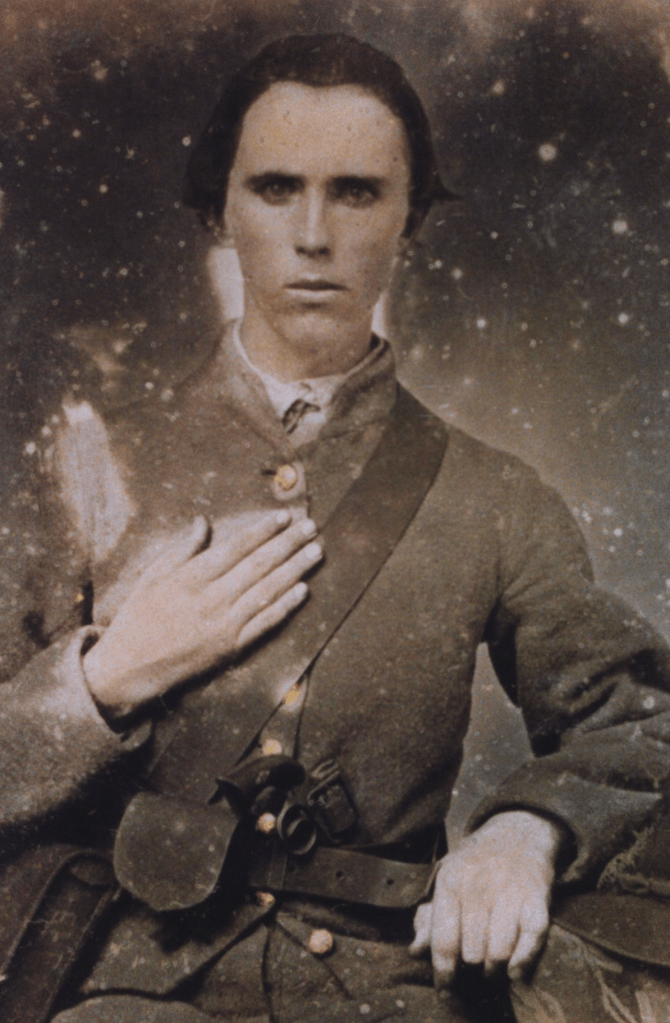
I could not find an image of William but here is Pvt. Eli Pinson Landers of the 16th Georgia Infantry. He died of disease in October 1863. (Tim Talbott Collection, Civil War Faces)
The following biographical sketch comes from Find-A-Grave:
William Crumley enlisted as a private in Company E 16th Georgia Volunteer Infantry. The 16th GA Infantry Regiment (also called Sallie Twiggs Regiment) was originally organized during the summer of 1861. The ten companies were raised in the counties of Columbia, Elbert, Gwinnett, Habersham, Hart, Jackson, Madison, and Walton (although there were members from other counties). Company E was organized at Habersham County, Ga. by Captain Benjamin Edward Stiles (Find A Grave Memorial# 6607225. Stiles became a Lieutenant Colonel and was killed at Front Royal/Deep Bottom, Va Aug 16, 1864.) Sent to Virginia, the 16th Regiment was assigned to General Howell Cobb’s Brigade. They were encamped at Richmond from July 19, 1861 until October 20, 1861, when they were ordered to Yorktown. The Regiment fought with Magruder at Yorktown, Lee’s Mill (Dam No. 1), and Williamsburg.
William Colley Crumley enlisted December 23, 1861 at “Camp Lamar” which was the nickname for one of the encampment areas of Cobb’s Brigade near Yorktown. Camp Lamar was named after Howell Cobb’s brother in law, John B. Lamar. The Brigade remained in the area throughout the winter of 1861-62 before returning to Richmond.
William Colley Crumley was admitted to General Hospital Camp Winder Richmond, Va on May 13, 1862 with chronic diarrhea and died May 22, 1862. According to family statements, he was buried in Hollywood Cemetery on May 23, 1862.
[Note: These letters are from the private collection of Chase Milner and are published on Spared & Shared by express consent.]
Letter 1
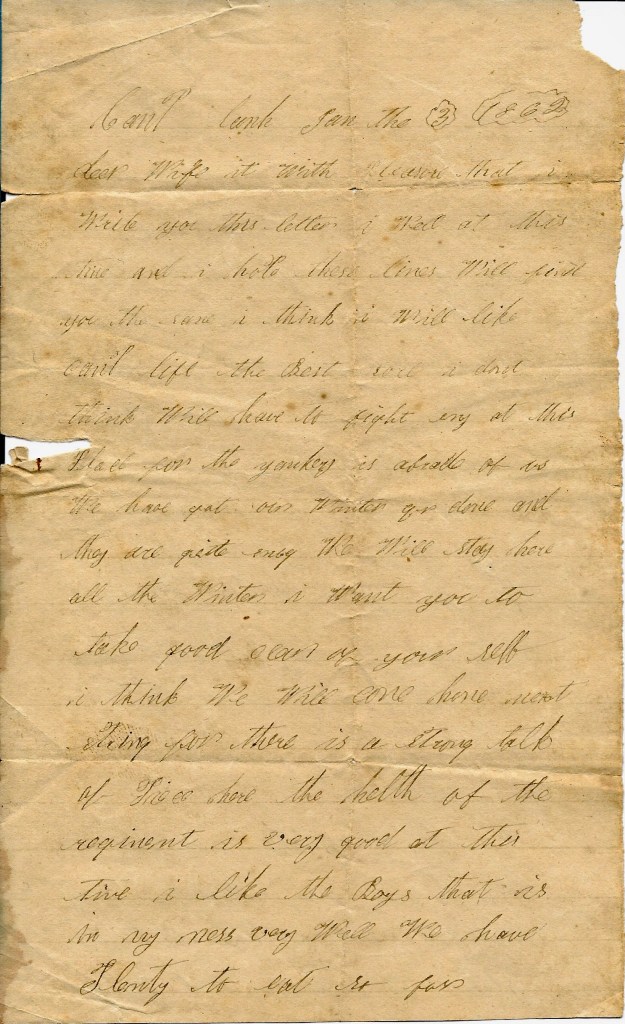
Camp Cobb 1 January 3, 1862
Dear Wife,
It’s with pleasure that I write you this letter. I [am] well at this time and I hope these lines will find you the same. I think I will like camp life the best sort. I don’t think [we] will have to fight any at this place for the Yankees is afraid of us. We have got our winter quarters done and they are quite [ ]. We will stay here all the winter.
I want you to take good care of yourself. I think we will come home next spring for there is a strong talk of peace here. The health of the regiment is very good at this time. I like the boys that is in my mess very well. We have plenty to eat so far.
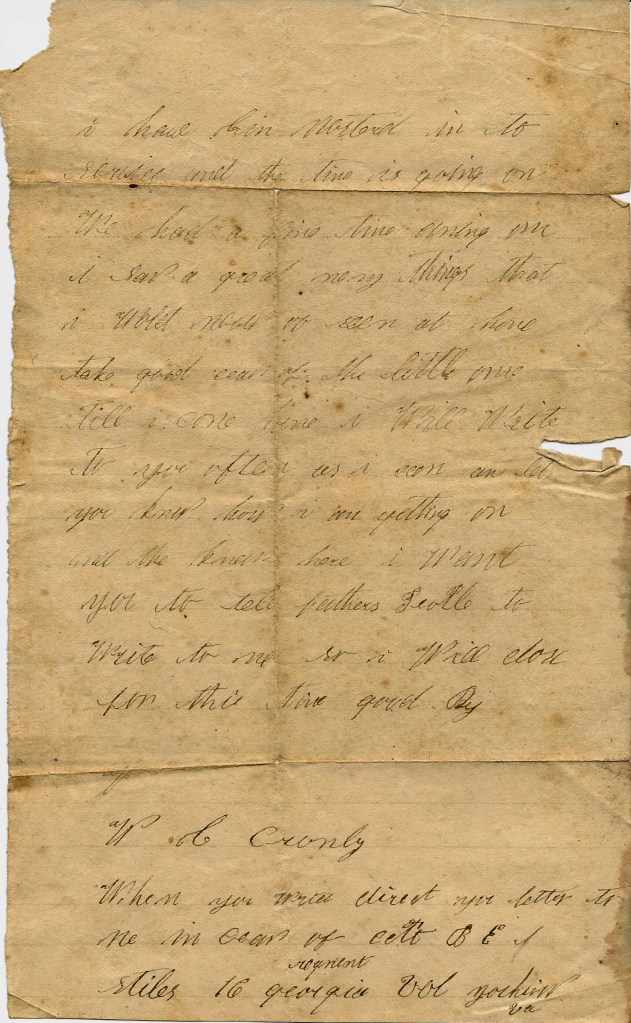
I have been mustered in to the service and the time is going on. We had a fine time coming on. I saw a great many things that I would never of seen at home. Take good care of the little one till I come home. I will write to you often as I can and let you know how I am getting on and the news here. I want you to tell Father’s people to write to me. So I will close for this time. Goodbye.
— W. C. Crumley
When you write, direct your letter to me in care of Capt. B[enjamin] E. Stiles, 16th Georgia Regiment Volunteers, Yorktown, Va.
1 Crowley’s handwriting is somewhat difficult to decipher at time but I think he means Camp Cobb, named after General Howell Cobb. The regiment had been organized during the summer of 1861 and sent to Richmond, Virginia, where they remained until mid-October when they were sent on to Yorktown which was being fortified at the time of William’s arrival. The regiment wintered there and were manning Magruder’s defenses at Dam No. 1 when the Union army approached up the Pensinsula in the spring of 1862.
Letter 2
Headquarters 16th Independent Georgia Volunteers Camp Lamar near Yorktown, Va. February 17, 1862
Dear Wife,
I seat myself to let you know that I am well at this time hoping these few lines will come safe to hand and will find you all well and doing well. I received your letter which gave me great joy to hear from you all that you was well. I was sorry to hear of [ ] losing his child.
I hant much to write to you but all your cousins are well. Young [John W.] Fry 1 is getting tolerable stout. John [N.] Ivester is here with us and he is well. I received your things that you sent to me. I thank you for them. I wish I was there with you. I had rather see you than any other thing on earth. I hope I will live to see you one more time but it is a narrow chance looking to be called off every moment to fight the Yankees. If we should happen to get in a battle, I want to be prepared to die. If I should happen to be killed, I want you to meet me in heaven if we should never meet no more on earth.
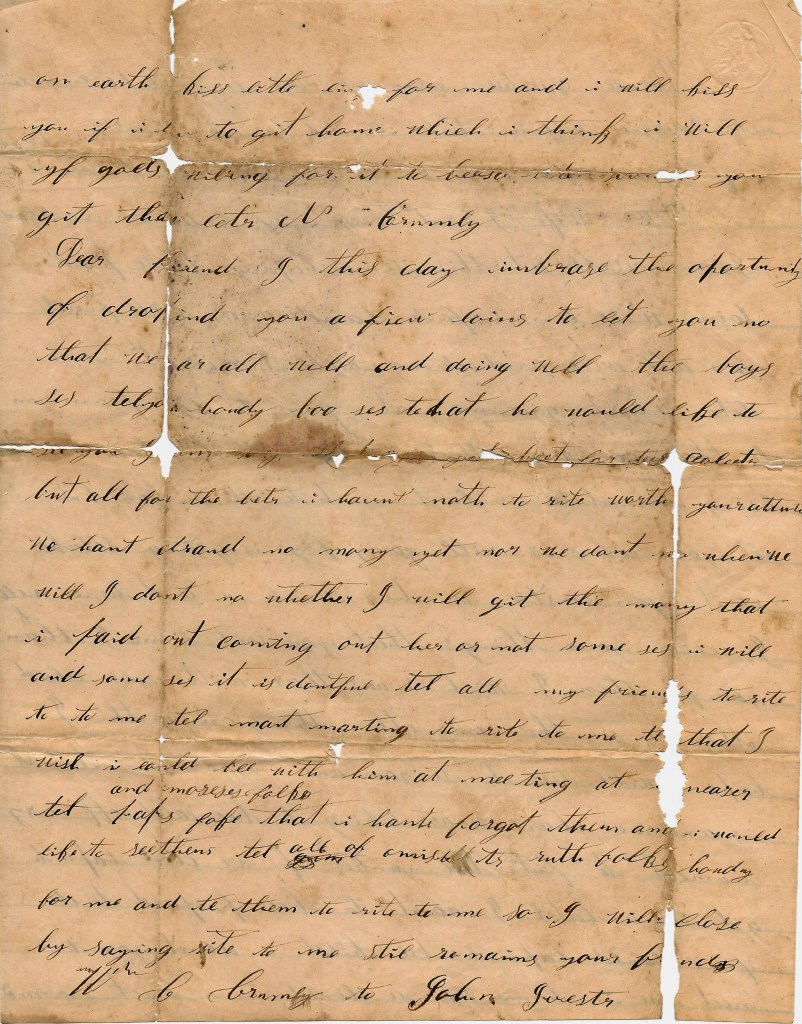
Kiss little Linny for me and I will kiss you if I do get home which I think I will, if God’s willing for it to be so. Write when you get this letter.
[to] N. Crumley
Dear friend, I this day embrace the opportunity of dropping you a few lines to let you know that we are all well and doing well. The boys says tell you howdy. Boo says that he would like to see you [paper creased] but all for the better. I hant nothing to write worth your attention. We hant drawed no money yet nor we don’t know when we will. I don’t know whether I will get the money that is paid out coming out here or not. Some says I will and some says it is doubtful. Tell all my friend to write to me. Tell Mat Marting to write to me. Tell that I wish I could be with him at meeting. Tell Pap’s and Morse’s folks that I hant forgot them and I would like to see them tell all of [ ] Ruth’s folks howdy for me and tell them to write to me. So I will close by saying write to me. I still remain your friend, — W. C. Crumley to John Ivester
1 John W. Fry of Co. E, 16th Georgia Infantry, died on 10 August 1862. His father was David Fry of Clarkesville, Georgia.
Letter 3
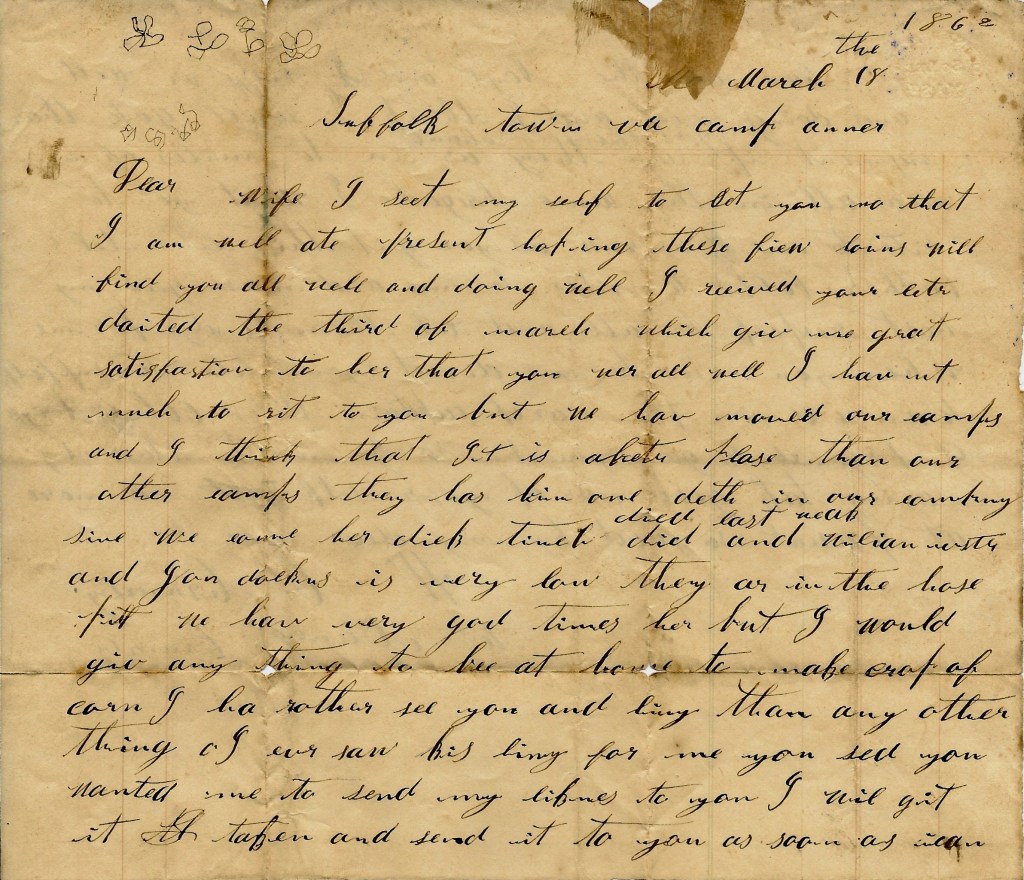
Suffolk Town, Virginia March 18, 1862
Dear Wife,
I seat myself to let you know that I am well at present hoping these few lines will find you all well and doing well. I received your letter dated the third of March which gave me great satisfaction to hear that you were all well. I haven’t much to write to you but we have moved our camps and I think that it is a better place than our other camps. There has been one death in our company since we came here. [Richard] “Dick” Tinch [Tench] died last week and William Wester [?] and John Dockins is very low. They are in the hospital.
We have very good times here but I would give anything to be at home to make a crop of corn. I had rather see you and Linny than any other thing I ever saw. Kiss Linny for me.
You said you wanted me to send my likeness to you. I will get it taken and send it to you as son as I can.
I have saw the boys and they are well and doing well and I think I will go to their regiment if I can get the chance. They are [within] two miles of us. We are all in the same brigade. I want you to write to me as soon as you get this letter. Tell brother’s folks to write to me and Mose. Give my respects to all and tell them howdy for me.
When you write to me, direct your letters to Suffolk Town, Va. in the care of Captain Stiles, Commanding Georgia Brigade, 16th Georgia Regiment. So I must close by saying take good care of yourself. No more at present. So goodbye my dear wife.
— W. C. Crumley
Letter 4
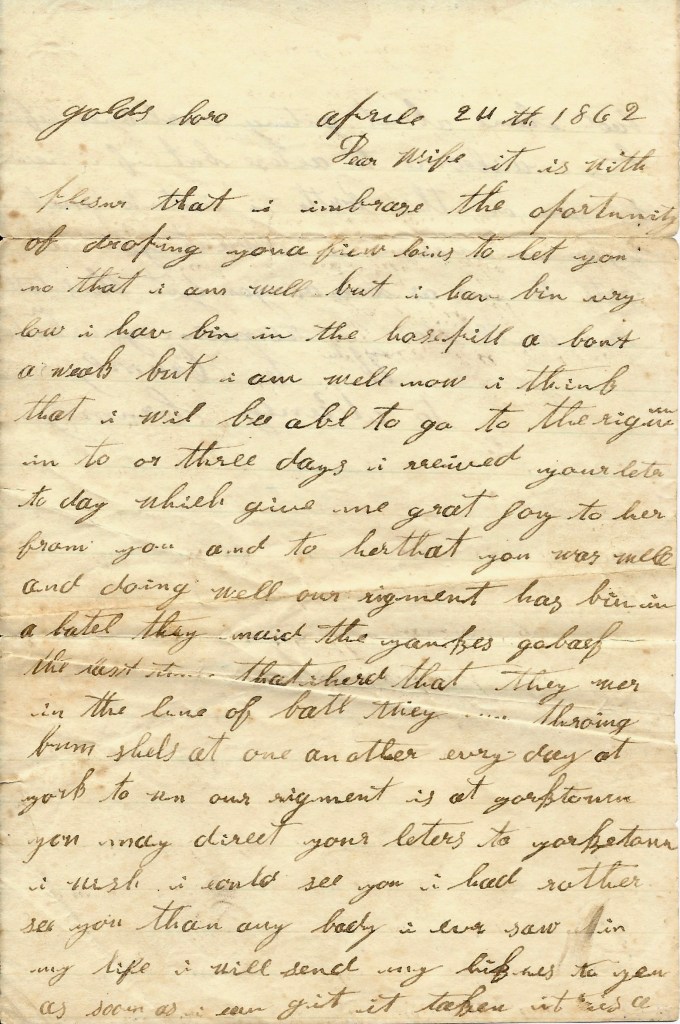
Goldsboro April 24, 1862
Dear Wife,
It is with pleasure that I embrace the opportunity of dropping you a few lines to let you know that I am well but I have been very low. I have been in the hospital about a week but I am well now [and] I think that I will be able to go to the regiment in two or three days.
I received your letter today which gave me great joy to hear from you and to hear that you were well and doing well.
Our regiment has been in a battle. 1 They made the Yankees go back. The last time that I heard, they were in the line of battle [and] they were throwing bob shells at one another everyday at Yorktown. Our regiment is at Yorktown. you may direct your letters to Yorktown.
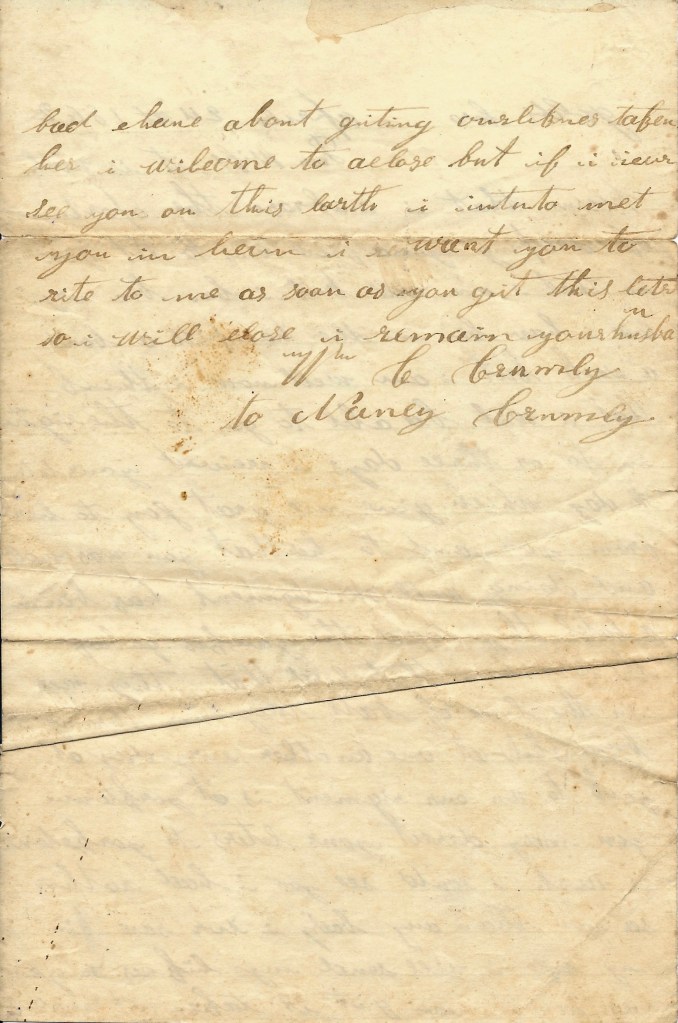
I wish I could see you. I had rather see you than anybody I ever saw in my life. I will send my likeness to you as soon as I can get it taken. It is a bad chance about getting our likeness taken here.
I will come to a close but if I ever see you on this earth, I intend to meet you in heaven. I want you to write to me as soon as you get this letter. So I will close. I remain your husband, — W. C. Crowley
to Nancy Crowley
1 This is probably a reference to the fight at Dam No. 1 in which McClellan’s forces tried to break the Confederate line at the Warwick River near Yorktown.
Letter 5
[Not datelined]
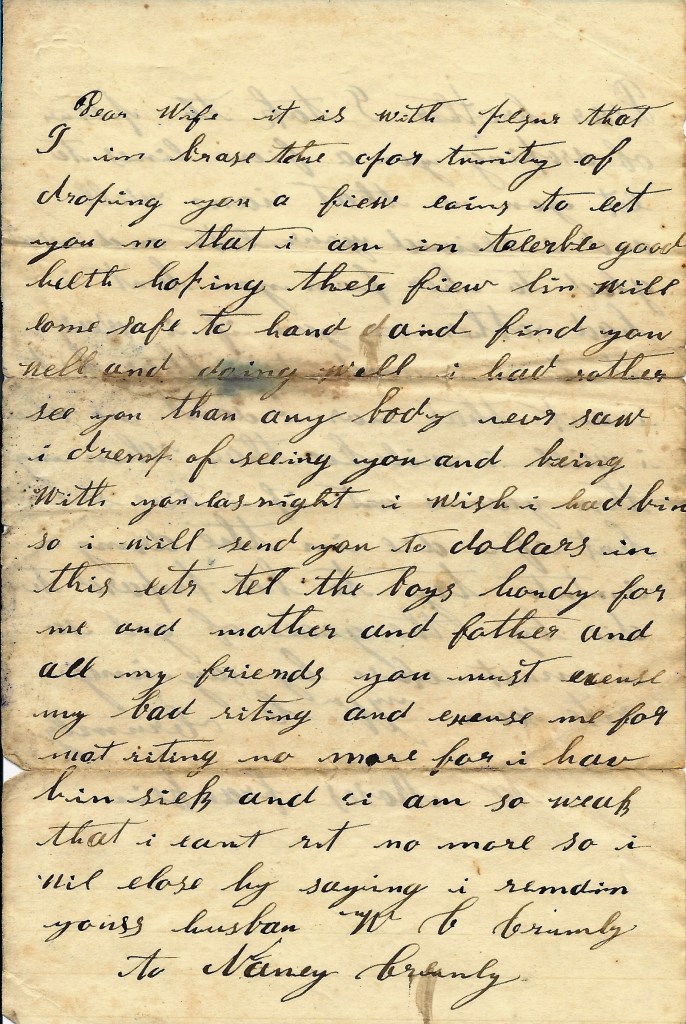
Dear Wife,
It is with pleasure that I embrace the opportunity of drafting you a few lines to let you know that I am in tolerable good health, hoping these few lines will come safe to hand and find you well and doing well. I had rather see you than anybody I ever saw. I dreamed of seeing you and being with you last night. I wish I had been.
So I will send you two dollars in this letter. Tell the boys howdy for me and mother and father and all my friends. You must excuse my bad writing and excuse me for not writing no more for I have been sick and I am so week that I can’t write no more. So I will close by saying I remain your husband. — W. C. Crumley
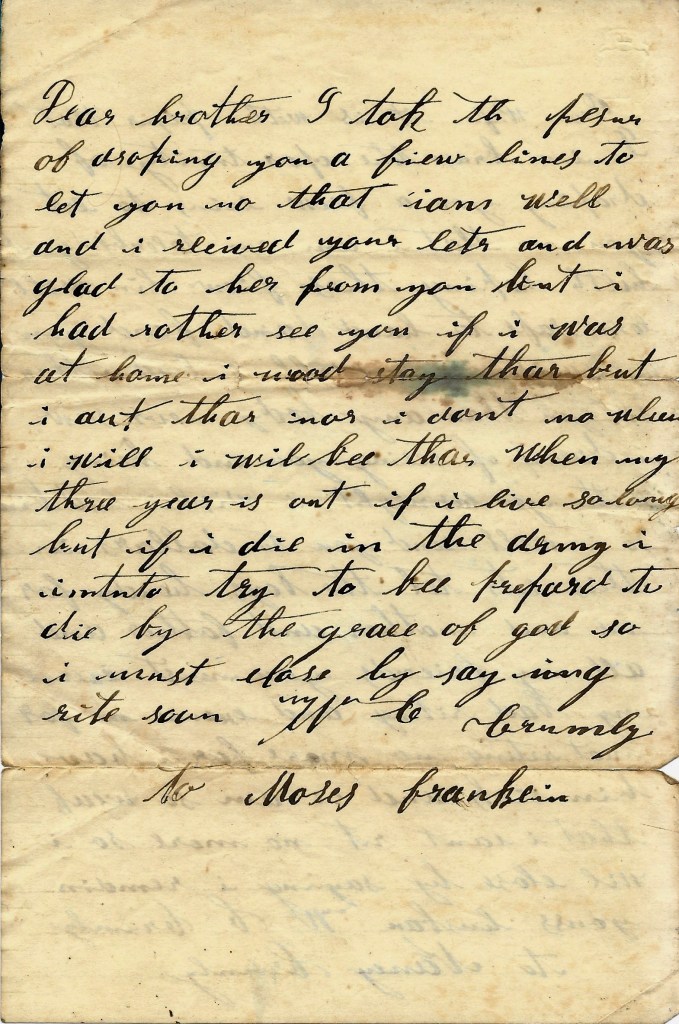
Dear Brother,
I take the pleasure of dropping you a few lines to let you know that I am well and I received your letter and was glad to hear from you but I had rather see you. If I was at home, I would stay there but I ain’t there nor I don’t know when I will be there. When my three years is out if I live so long, but if I die in the army I intend to try to be prepared to die by the Grace of God. So I must close by saying write soon. — W. C. Crumley



 Spared & Shared 23