
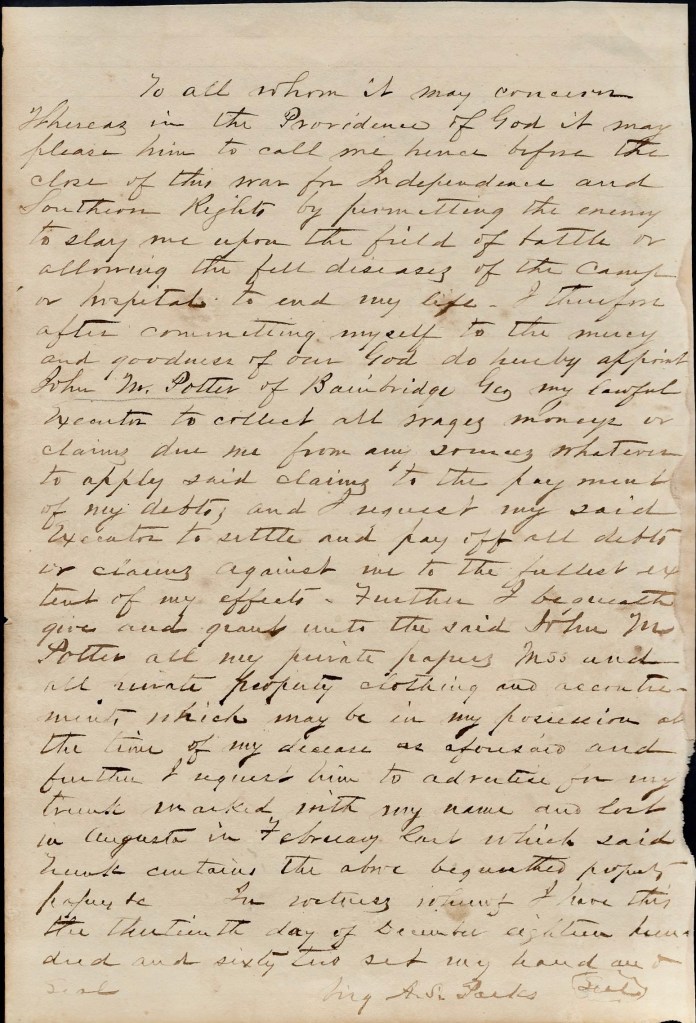
The following document appointing an Executor to his Estate was composed and signed by Capt. Virgil Adam Stewart Parks of Co. D, 17th Georgia Infantry in December 1862. Parks was killed on the second day’s fight at Gettysburg—shot through the head. The following biographical sketch was posted on Civil War Talk:
Born in 1836 and while yet a small boy, Virgil A. S. Parks moved with his family from Georgia to Texas. His mother died soon after reaching Texas. His father remarried, but he also died a short time later. His step-mother took him to Arkansas, but then she departed for the North, leaving Virgil behind. Poor and sickly, with only a few cents in his pocket, he still succeeded in reaching relatives in Georgia. Virgil reportedly had one brother and two sisters, although there is no indication that they were close either physically or emotionally. But something in Virgil’s personality or demeanor must have been engaging, since he made some powerful friends in Georgia, including Judge Linton Stephens, who came to his assistance and helped him get through school and into college.
In 1861, Virgil graduated from Franklin College (now the University of Georgia) with a law degree. A college catalog entry states simply: “Cuthbert, Ga., Editor, Teacher, Andrew Female Coll.” The Andrew Female College (now Andrew College) was chartered in 1854. Affiliated with the Methodist Episcopal Church, South, it was only the second college in the United States to confer degrees on women. His association with the Andrew Female College is unclear, because in early 1861 Virgil moved to Bainbridge, Georgia and began a practice with law partner William O. Fleming (who afterwards became a field officer in the 50th Georgia and served at Gettysburg as captain of Company F). At this time Virgil also met John M. Potter, who later described him as a “high minded, modest, honorable man, and a consistent Christian.” Virgil had previously received favorable attention from the Hon. A. H. Stephens (afterwards Vice President of the Confederacy), and T. R. R. Cobb (afterwards a Confederate officer and brother of statesman Howell Cobb). Powerful and influential friends indeed.
If Virgil found some measure of happiness and contentment in his new profession, it was tragically all too brief. On August 13, 1861, he enlisted at Bainbridge as the 1st Lieutenant of Company D, 17th Georgia, which became part of Brig. Gen. Henry L. Benning’s brigade. He received a promotion to Captain on January 20, 1863.
Capt. Virgil A. S. Parks had a natural gift for writing, and during his military service he regularly submitted well-received articles to the Savannah Republican newspaper, becoming one of their finest correspondents attached to Gen. Robert E. Lee’s army. See @lelliott19 posts on his experiences: https://civilwartalk.com/threads/17…-usmr-stolen-4-july-1862.149223/#post-1880155, https://civilwartalk.com/threads/50…-foxs-gap-and-sharpsburg.159534/#post-2083409 and https://civilwartalk.com/threads/2nd-and-20th-georgia-at-burnside-bridge.168585/#post-2192710. Parks’ final contribution was written from Chambersburg, Pennsylvania on June 28, 1863, which the paper published on July 20. He described the men being compelled to wade the Potomac without being allowed to strip, but receiving a ration of whiskey upon reaching the Maryland side, which made everyone either jolly or troublesome. While passing through Greencastle, Pennsylvania, the band of the 2nd Georgia played “Dixie,” while quartermasters and commissary officers scoured the countryside for horses, mules and cattle. He called out the 38th Virginia, assigned to provost guard duty in Chambersburg on June 27, for entering the stores and taking everything they wanted, although members of his own brigade completed the looting the next morning. Parks also wrote of a “respectable young man in the 15th Georgia,” who informed him that the streets were “strewn with gloves and fragments of goods.” Parks was evidently appalled and he expected Gen. Lee to punish those responsible.
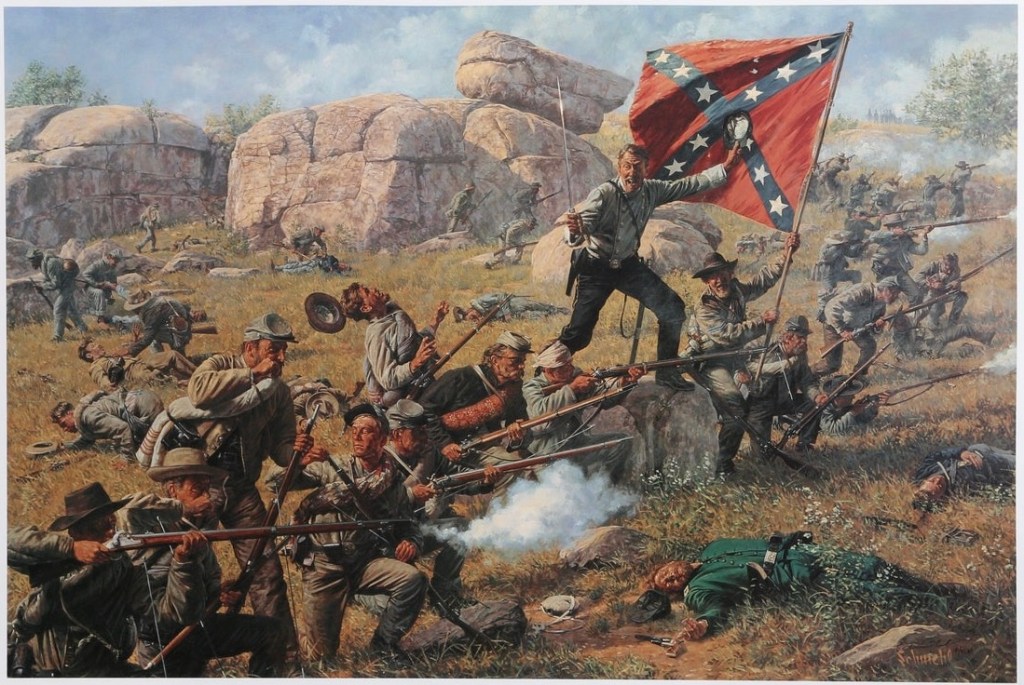
Following Parks’ death on the second day at Gettysburg, the paper printed three testimonials on August 7 and 11, from Linton Stephens, John M. Potter and Lt. John Henry Martin. Martin succeeded Parks as captain of the company, and related his last hour or so among the living: “Capt. Parks was wounded when we first entered the field [likely by artillery fire], but remained in command until we had charged the battery [Smith’s 4th New York at Devil’s Den] and ran the Yankees off the hill [Houck’s Ridge]. He was then persuaded to go to the rear. He started back, saying that he would shelter himself behind a rock; that was the last that any of the company saw of him until after the firing had almost ceased, when we were informed that he was killed – he was found in the most dangerous and exposed spot on the field. He was shot through the head. I have been told by one who saw him fall that he was instantly killed – having fallen without speaking. His loss to the company is great, and in conjunction with his friends and relatives we mourn his loss. He was truly a Christian soldier, and exerted a beneficial influence in the circle in which he moved.”
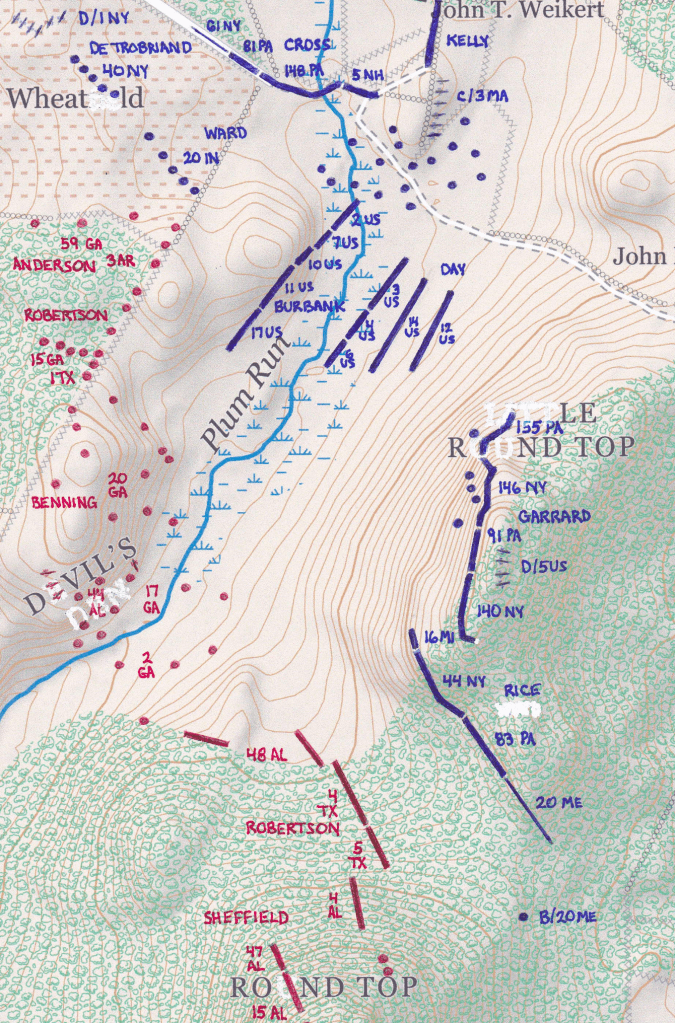
Virgil A. S. Parks’ remains were never identified. The attached map depicts the situation at 6:10 p.m. on July 2, a few minutes after Brig. Gen. Ward’s brigade was driven from Houck’s Ridge, when Capt. Parks sought refuge behind one of the many scattered boulders that covered the exposed eastern slope of the ridge.
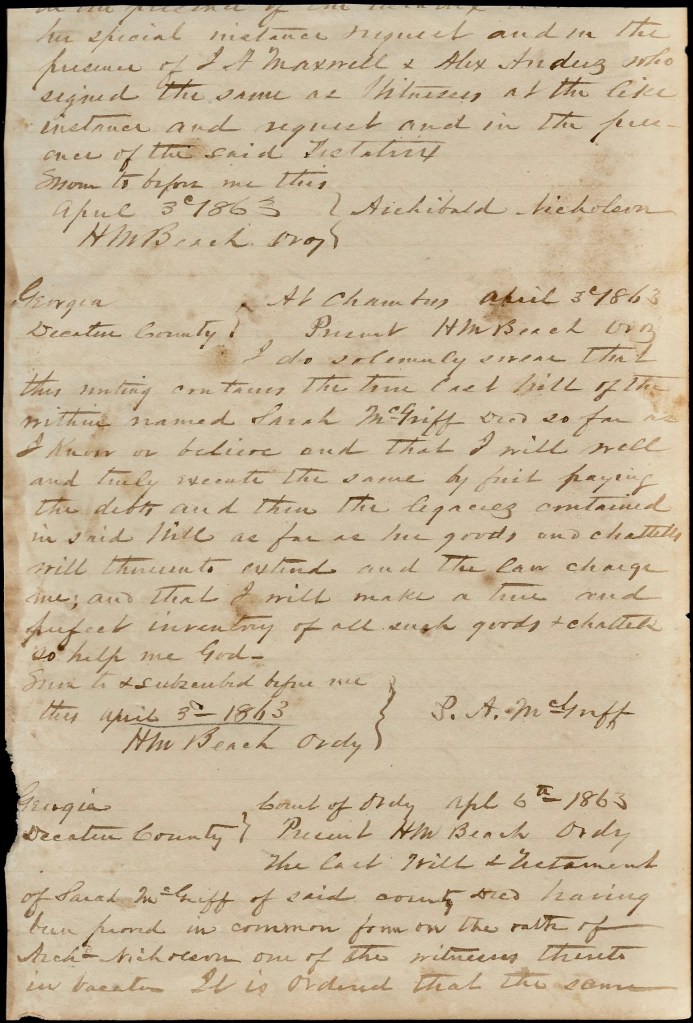
Curiously, this document appears to have been excised from a Decatur county ledger book. There are partial entries on the back side pertaining to the Last Will and Testament of Sarah McGriff, dated April 1863. The court house was located in Bainbridge, Georgia, where Parks practiced law before the war.
Transcription
To all whom it may concern. Whereas in the Providence of God it may please Him to call me hence before the close of this War of Independence and Southern Rights by permitting the enemy to slay me upon the field of battle or allowing the fell diseases of the camp or hospital to end my life, I therefore after committing myself to the mercy and goodness of our God, do hereby appoint John M. Potter of Bainbridge, Ga., my lawful Executor to collect all wages, moneys, or claims due me from any sources whatever to apply said claims to the payment of my debts, and I request my said Executor to settle and pay off all debts and claims against me to the fullest extent of my efforts.
Further, I bequeath, give and grant unto the said John M. Potter all my private papers MSS and all private property, clothing, and accoutrements which may be in my possession at the time of my decease as aforesaid and further I request him to advertise for my trunk marked with my name and lost in Augusta in February last which said trunk contains the above bequeathed property, &c. In witness whereof I have this the thirteenth day of December, eighteen hundred and sixty-two set my hand and seal. Virg. A. S. Parks (Seal)
 Spared & Shared 23