
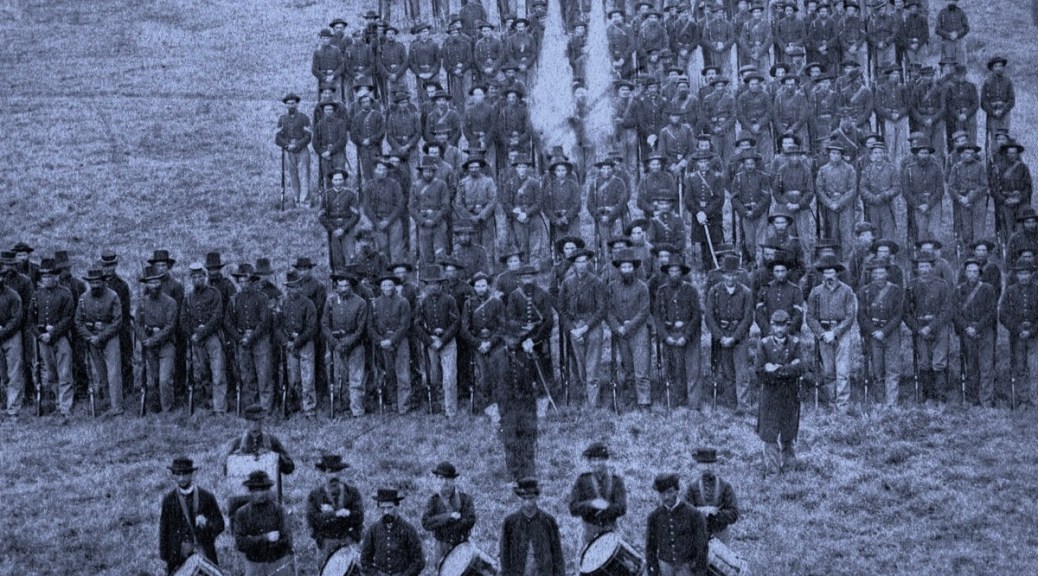
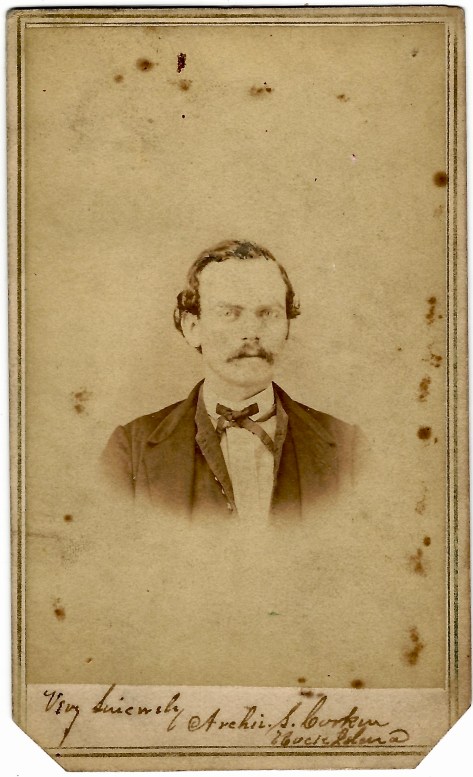
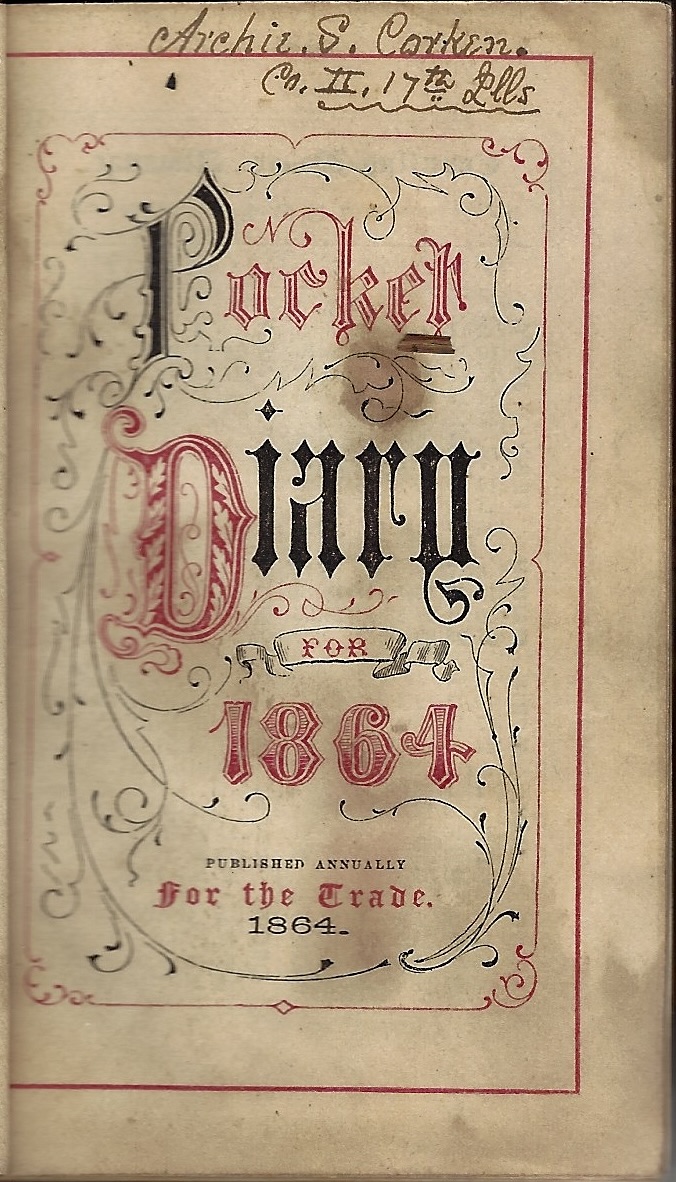
The following diary was kept by Archibald Simpson Corken, Jr. (1843-1890), an emigrant from Liverpool, England. “Archie” came to the United States in the mid 1850s with his father, Archibald Sr.—a clock and watch maker, jeweler who set up his shop in Rock Island, Illinois. His January 1857 advertisement in the Rock Island Advertiser claimed 20 years experience in some of the “principal Watch Manufactory houses of Europe” and that he was capable of offering “perfect satisfaction” to the the people of Rock Island at his shop on Illinois Street.
No doubt Archie learned the jeweler’s trade from his accomplished father in the Rock Island shop but three years later, at the time of the 1860 US Census, the Corken family was enumerated in the little town of Aledo in western Illinois, with a promising future as the newly named county seat of Mercer county. Here, 46 year-old Archibald worked as a “jeweler” and his 18 year-old son Archie worked as a “druggist.” Other members in the household included Archie’s presumed mother, 35 year-old Mary Ann, and three younger sisters, 14 year-old Ellen, 10 year-old Agnes, and 4 year-old Emma, all born in England except the youngest.

While working in Aledo, Archie was recruited to serve as a private in Co. I, 17th Illinois Infantry, his term of service being three years from June 1861 to June 1864. During the period of this diary, he was mostly stationed in the occupation of Vicksburg after the Union’s successful siege of 1863.
Supply lines were tenuous during the early part of the occupation. On 2 January 1864 he wrote “Commissary stores are getting very scarce. There is no whiskey at the post, since the potatoes have all frozen.” Tensions with the locals also ran high; the next day he wrote “Provost marshal issued an order banishing five ladies from this place for insulting our government by leaving church on Christmas Day when the prayer for the president of the United States was made.” General Sherman passed through the base twice, on 16 January and 28 February. Corken noted the regiment’s poor discipline and morale: “Every evening the town is crowded with officers and men, many of them drunk and disorderly, swearing, drinking & carousing the whole night long” (16 March).
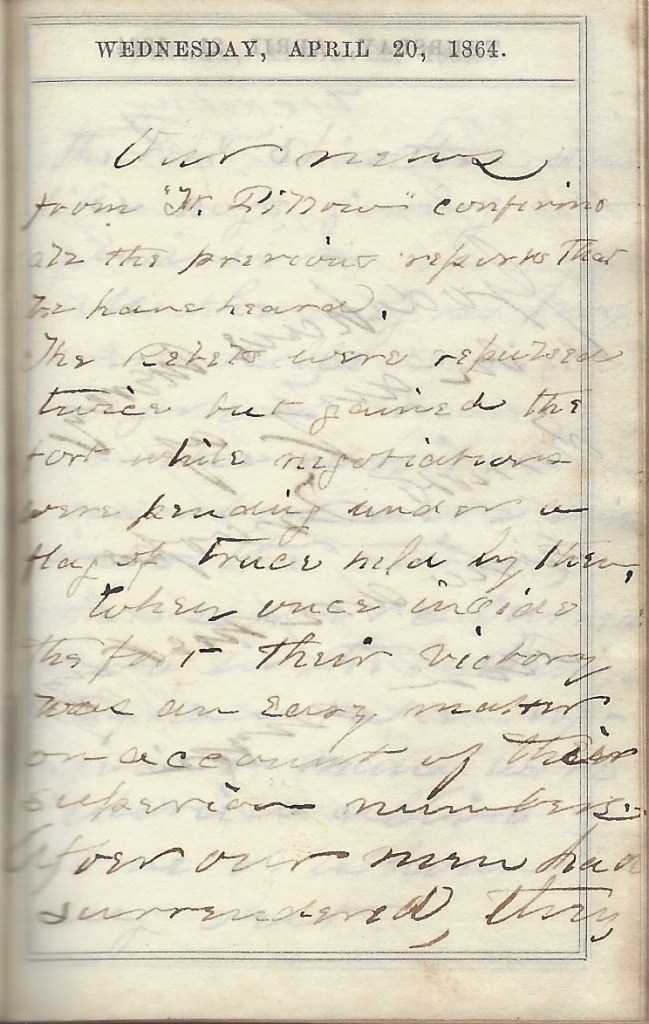
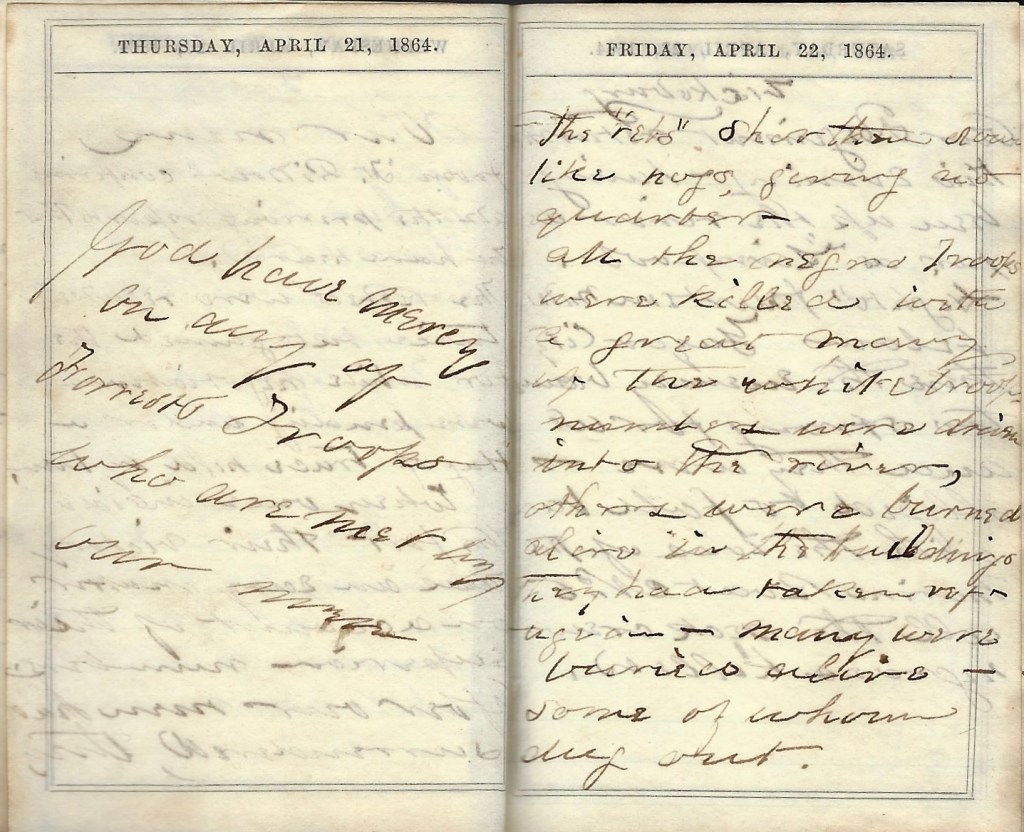
The most dramatic entry is a meditation on the notorious Fort Pillow Massacre which fills the 20-22 April pages: “Our news from Ft. Pillow confirms all the previous reports that we have heard. The Rebels were repulsed twice but gained the fort while negotiations were pending and a flag of truce held by them. . . . After our men surrendered, the Rebs shot them like hogs, giving no quarter. All the Negro troops were killed with a good many of the white troops. Numbers were driven into the river, others were burned alive in the buildings they had taken refuge in. Many were buried alive, some of whom dug out. God have mercy on any of Forrest’s troops who are met by our men.”
Corken began the process of mustering out on 17 May, and returned home to Rock Island, IL on 26 June. The diary includes a handful of civilian entries; he heard Schuyler Colfax speak in Davenport, Iowa on 31 October. After the war, Corken sold clocks and watches in Iowa, and was a jeweler in Rock Island, IL.
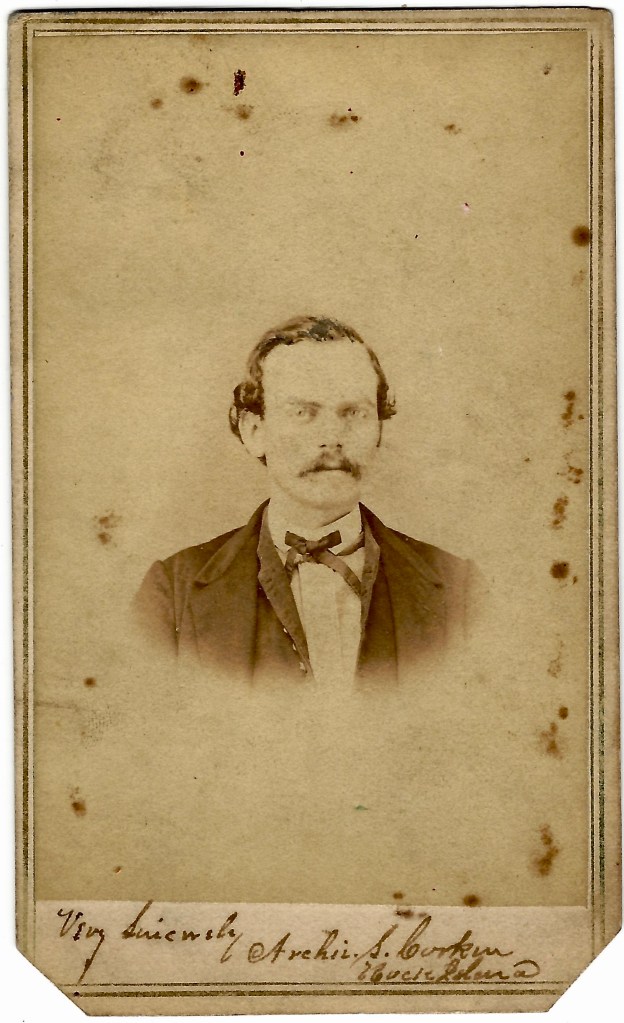
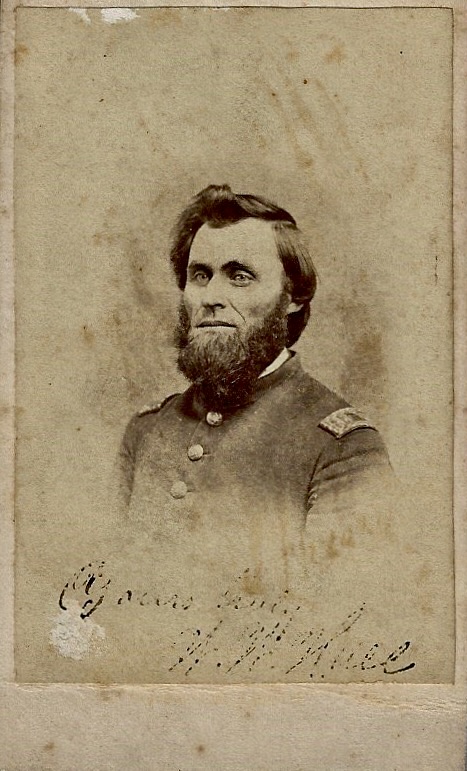
Tucked in the back of the volume are two signed cartes-de-visite: one of an unidentified Union soldier taken in the studio of William Owen of Evansville, WI; and a circa 1864 signed portrait of Corken by Cook & Newberry of Rock Island, IL. Also included is Corken’s Davenport, IA Knights Templar, Masonic Card.

T R A N S C R I P T I O N
[Editor’s note: If Archie made no entry on a given date, that date is skipped in this transcription.]
Friday, January 1, 1864—Vicksburg, Miss. Gen. Jas. B. McPherson commanding District. Gen. McArthur commanding Post. Lt. Col. Wardell P. M. [Provost Marshall]. Weather very cold—ice forms every night from one to two inches thick. It is feared the river will close at some point between Memphis and Cairo and stop our supplies and mail.
Saturday, January 2, 1864—Vicksburg, Miss. Lt. E. E. Ryan is acting R. Q. M. [Regimental Quartermaster]. H. T. Smith sentenced to suspension of rank and pay proper for three months, one month of time probably expired. Commissary stores are getting very scarce. There is no whiskey at the Post and the potatoes have all frozen.
Sunday, January 3, 1864—Vicksburg, Miss. Weather remains cold. We have to keep fire up all night in order to keep warm. Provost Marshall issued an order banishing five ladies from this place for insulting our government by leaving church on Christmas day when the prayer for the President of the United States was made.
Monday, January 4, 1864—Vicksburg, Miss. Review ordered but weather entirely disagreeable for it. Lt. E. E. Ryan, Acting Q. M., vice Glancy returned to duty.
Tuesday, January 5, 1864—Mertie F. Buck
Friday, January 8, 1864—Vicksburg, Miss. Troops at this post reviewed and inspected by Maj. Gen. David Hunter who appeared to be well satisfied with the appearance of them.
Saturday, January 9, 1864—Vicksburg, Miss. Weather moderated somewhat today although the ice on the ponds is strong enough to bear a person easily.
Sunday, January 10, 1864—Vicksburg, Miss. Received marching orders during the night & embarked on board the S. S. Northerner. Troops consisting of two Batteries and the 17th, 8th, and 30th Illinois. Also the 81st Illinois & 7th Missouri. Commanding officer Gen. [Mortimer Dormer] Leggett. Left at 3 p.m. for up the river.
Monday, January 11, 1864—S. S. Northerner. Laid up and wooded all night. We accompanied by the transports “Era” and “Madison.” We make very poor time as our vessel is a coal burner and has to burn green wood. Judge Morgan’s Plantation.
Tuesday, January 12, 1864—S. S. Northerner. Laid up last night at “Skipwith’s Landing” above Lake Providence. Wooded up again and started, assisted by a tow boat. Picked up a forlorn looking individial who commenced waving a white flag as soon as we hove in sight. He turned out to be a cotton speculator who had been captured by guerrillas but had succeeded in escaping.
Wednesday, January 13, 1864—S. S. Northerner. Old River Lake, Arkansas. Reached here last night. Our regiment went on picket. One boat and one company went up to Greenville five miles above. Fine country for foraging. The boys are getting lots of swine and chickens, beef cattle, &c. &c.
Thursday, January 14, 1864—Made a mistake of one day in the date. It was last night we reached Old River Lake, Arkansas. Lt. [Theodore] Glancey crossed the lake & visited the plantation of Mr. Dunn where we found four very good looking young ladies. Folks all conservative.
Friday, January 15, 1864—S. S. Northerner, below Skipwith’s. Made very good time & reached Vicksburg at 3 p.m. Laid at anchor last night just below Skipwith’s. Boys all glad to get back. A fruitless expedition. Captured but two prisoners.
Saturday, January 16, 1864—Vicksburg, Miss. Everything here is very quiet. Gen. Sherman arrived here this morning on his way to the Dept. of New Orleans where he is ordered to report for duty. It is rumored that his Corps—the 15th—is to come down here to New Orleans. The weather is damp but pleasant. Sergt. [George B.] Millard returned to the regiment for duty.
Monday, January 18, 1864—Vicksburg, Miss. [Thomas A.] Causey and [Alford S.] Grooms returned to day. Wrote to Schenck.
Tuesday, January 19, 1864—Vicksburg, Miss. Bill Henderson returned today. Folks all well at home. McPherson made a speech to our Brigade to encourage enlistments in the Veteran service.
Thursday, January 21, 1864—Vicksburg, Miss. Weather remarkably warm today. The paymaster with funds arrived yesterday. Will commence paying probably tomorrow. All the paymasters are engaged in paying off veterans.
Friday, January 22, 1864—Vicksburg, Miss. Today our Brigade drilled for the purpose of selecting a regiment to drill against the Division for an Excelsior flag. Our regiment was the best one present and is to drill tomorrow against the 124th Illinois and the 78th Ohio, the crack regiments of the other two Brigades. We do not expect to win because we have bot drilled during the winter.
Saturday, January 23, 1864—Our Division drill came off today resulting in our defeat and the success of the 124th [Illinois]. We have to rest satisfied on best of the Brigade.
Sunday, January 24, 1864—Vicksburg, Miss. It is reported that the 15th Army Corps is on the way down the river and that when they arrive we are to move towards Jackson or Meridian.
Wednesday, January 27, 1864—Vicksburg, Miss. Today 15 steamboats loaded with troops arrived and will move probably tomorrow or next day towards Jackson, Miss. Not yet known if our regiment will go or not.
Thursday, January 28, 1864—Vicksburg, Miss. Paid off today two months pay. Up to January 1st.
Sunday, January 31, 1864—Vicksburg, Miss. Gen. Smith’s Division, 16th Army Corps arrived here during the last days. The rest of the Corps will be here shortly. An expensive move is on foot. We shall very probably go along.

Wednesday, February 3, 1864—Vicksburg, Miss. Regiment marched this morning. I remained behind in charge of the Q. M. [Quartermaster] Dept. 16th and 17th Army Corps are moving toward Jackson, Miss.
Sunday, February 7, 1864—-Vicksburg, Miss. Everything very dull. No news from the front except rumors of a fight at Yazoo City.
Sunday, February 14, 1864—Vicksburg. Peach trees and Magnolias in full bloom.
Monday, February 15, 1864—Vicksburg. H[enry] C. Moorhead just arrived from home.
Wednesday, February 17, 1864—Vicksburg. Nothing new. Drew from 18th to 22nd.
Thursday, February 18, 1864—We were very much surprised to find the ground covered with snow this morning when we woke up. It soon went off though to the great delight of these southerners who can’t stand our climate. This southern climate has been putting on northern airs.
Sunday, February 28, 1864—Vicksburg. Gen. Sherman arrived here this afternoon and went down the river on the Diana. No news from the front.
Wednesday, March 2, 1864—Vicksburg. Adams, our sutler, arrived this evening from the front. He left the regiment bivouacked at Canton. They had been to Meridian and have captured a great man horses, mules, &c. & have destroyed about 200 miles of railroad. Our acting Regimental Quartermaster was taken prisoner while out with a forage train. One man killed and two wounded.
Thursday, March 3, 1864—Vicksburg, Miss. Met with an old friend today—Schenck—who is under [ ] going home. Ranks as paymaster in the Regular Navy and will probably be assigned to some vessel as soon as he reports.
Friday, March 4, 1864—Vicksburg. Regiment returned.
Saturday, March 12, 1864—Vicksburg, Miss. Today is my twenty-first birthday by the Providence of God.
Monday, March 14, 1864—We have been inside the works at this place nearly eight months and with the exception of an occasional scout have led a miserable, dreary, and monotonous existence. Camp life will do well [ ] but this life in garrison would demoralize the best Regulars in the world much more our loosely disciplined volunteers. I begin to believe that [the war correspondent William Howard] Russell was more than half right when after reviewing the troops on the Potomac that [ ] Army of McClellan’s, he said, “That is no army—nothing but an armed mob.” It will apply well to our army here. A regiment is scarcely ever seen drilling and even the garrison guard duty is miserably conducted. Every evening the town id crowded with officers and men, many of them drunk and disorderly, swearing, drinking, and carousing the whole night long. There is hardly that respect paid to an officer that is due from one gentleman to another. What this will end in remains to be seen. Our successes are making us careless.
Tuesday, March 22, 1864—Vicksburg, Miss. For the last three days it has been quite chilly and last night we had a light snow which rather astonished us. Remarkable weather for the “Sunny South.” There is a probability of our moving up the river. We have had orders to turn over all our transportation to the division quartermaster who is to move it up the river to Cairo.
Friday, March 25, 1864—Headquarters Dept. of the Ohio, Office of Board of Examiners, No. 145 Broadway, Cincinnati, Ohio. Appointment does not necessarily follow examination even when favorably passed on by the Board. Appointments being governed by the demands of the service. Examined in tactics, Army Regulations, Arithmetic, Geography, General knowledge & history. H. Van Rensselaer, Inspector General USA
Thursday, March 31, 1864—Vicksburg, Miss. Today we had a rain and hail storm. Hailstone the size of an ounce ball falling and some few much larger.
Wednesday, April 6, 1864—Vicksburg, Miss. Our regiment is now in [Brig. Gen. Jasper A.] Maltby’s command—the last and defense of Vicksburg. There is not many regiments of white troops remaining here.
Saturday, April 9, 1864—Vicksburg, Miss. The 124th Illinois moved in from Black River and camped on Veteran Hill just west of us, the former campground of the 30th Illinois.
Sunday, April 10, 1864—Vicksburg, Miss. Our regimental band and all the veterans with seven commissioned officers are to be sent up the river recruiting.
Monday, April 18, 1864—Vicksburg, Miss. This morning our regiment received [orders] to report to Gen. [John M.] Schofield at Haines Bluff to go from there to Yazoo City, Rebs permitting. Schitz & I remain behind. He sick and me to attend to the business of the regiment while absent.
Wednesday, April 20, 1864—Our news from Ft. Pillow confirms all the previous reports that we have heard. The Rebels were repulsed twice but gained the fort while negotiations were pending and a flag of truce held by them. When once inside the fort, their victory was an easy matter on account of their superior numbers. After our men had surrendered, they—the Rebs—shot them down like dogs, giving no quarter. All the negro troops were killed with a great many of the white troops. Numbers were driven into the river, others were burned alive in the buildings they had taken refuge in. Many were buried alive, some of whom dug out. God have mercy on any of Forrest’s troops who are met by our men.
Saturday, April 23, 1864—Vicksburg. Our regiment returned this evening having been up the river as far as Liverpool Heights, fourteen miles below Yazoo City. There the enemy became too strong for us and they were obliged to fall back with the loss of the Marine Boat No. 5. All the deck crew negroes killed.
Tuesday, May 17, 1864—Vicksburg. received marching orders at last and expect to go to Springfield to be mustered out.
Wednesday, May 18, 1864—Got on board the Steamboat Mollie Able at 9 o’clock this p.m.
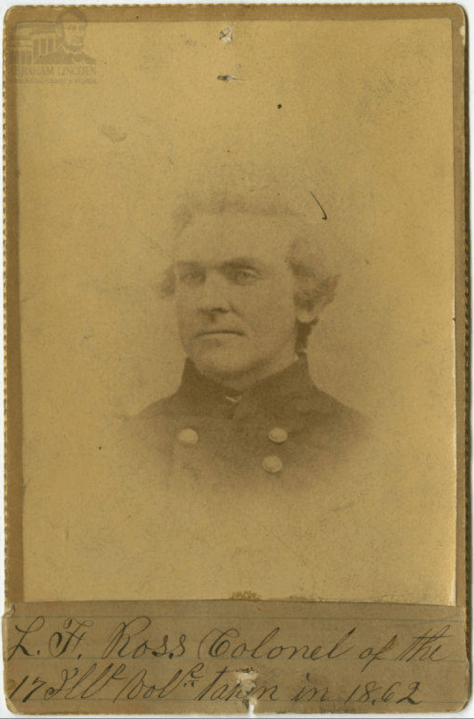
Thursday, June 2, 1864—Descriptive List. Archibald S. Corken, Private I Co., 17th Illinois. Born in Liverpool, England. Enlisted and mustered at Alton, Ills. by L[eonard] F. Ross, Col. Last paid by Maj. Jamison to Dec. 31st 1863
Friday, June 3, 1864—Sent to Camp Yates with Descriptive List.
Saturday, June 4, 1864—Regt. mustered out of the service this afternoon.
Friday, June 24, 1864—Springfield. Discharged today. Paid in full $100 bounty.
Sunday, June 26, 1864—Rock Island, Ills. Arrived home this morning.
Monday, July 4, 1864—New Boston, Ills.
Tuesday, July 5, 1864—Keithsburg, Ills.
Thursday, July 7, 1864—Aledo, Ills. 12 a.m. Remember E. M. M.
Sunday, July 16, 1864—Aledo, Ills. Heard Mr. Ashburgh in the morning and Mr. Williams in the evening. Went to see Duty Green at Derryton.
Tuesday, July 12, 1864—Rock Island, 6 p.m.
Wednesday, July 20, 1864—Commenced going to Commercial College in Davenport.
Sunday, October 30, 1864—Went to Methodist Church in the evening with Adair.
Monday, October 31, 1864—Heard Schuyler Colfax speak at Davenport, Iowa.
Tuesday, November 1, 1864—Adair Blue left this morning after a visit of five days.
Tuesday, November 8, 1864—Election Day.
Wednesday, November 30, 1864—Rock Island Barracks. Engaged by Asst. Quartermaster of this post as forage master. Wages to be $60 or $75 per month, not definitely settled which. Engaged board at Sergt. ___ for $1 per week.
Thursday, December 1, 1864—Rock Island Barracks. Commenced work today as forage master.
Thursday, May 18, 1865—This evening I was admitted to the First Degree in Free Masonry at Trio Lodge, No. 257, State of Illinois.
Memoranda.
Caspar Schenck, Asst. Pay Master, U. S. N.
U .S .Sloop of War, Portsmouth, Gulf Blockading Squadron.
Jus. Robinson, Old Bank, Chester, England
Jno. Donald, Woodside, Aberdeenshire, Scotland
Williw Donld, Merchant Man Callao, South America, and Glagow, Scotland.
S. H. Coombs, Oswestry, Shropshire, England
Denbigh, North Wales










 Spared & Shared 23