
I have not conducted an exhaustive search on the identity of these correspondents who are identified only by their initials. But I transcribed the letter because I found the content interesting.
The letter includes a discussion of two events affecting Charleston and the State of South Carolina. The first part of the letter pertains to the calling out of the state militia in both Rhode Island and in South Carolina in response to the United States declaring war on Great Britain in June 1812. Apparently, the author had previously held a commission with the militia in Rhode Island that he believes should exempt him from service in South Carolina where marching off into the country and camping in the swamps would most certainly result in his inglorious death. As part of that discussion he reveals the current efforts by South Carolina’s Governor, Joseph Alston, to strengthen the state’s militia laws and levy hefty penalties upon those who fail to report for duty. Period newspaper accounts of the Governor’s support for a doctrine that would enable him to declare martial law in time of peace caused South Carolinians to express “surprise, indignation, and horror at the revival of this question in this free country. Before we consent to put it at issue, let us tear up the History of the Revolution, cancel the memory of the achievement of our Fathers, and burn the Declaration of Independence, for they will but shame our degeneracy and satirize our unworthiness.” [Charleston Courier, September 15, 1813]

The second part of the letter shares news of some of the disastrous impacts of a hurricane that pummeled Charleston during the evening hours of Friday, August 27, 1813. Locals referred to it simply as “The Gale.”
“Although brief, the cyclone was fierce, “one of the most tremendous gales of wind that ever was felt upon our coast,” with a constant deluge of rain. For six hours, wind blew at hurricane force, driving in the storm surge at midnight. The rush of water equaled the horrific flood of 1752; the high water mark was reported to have been eighteen inches higher than during the “great gale” of 1804. By morning, the fast-moving storm had traveled up the coast. The litany of damage was familiar. In every part of the city, trees were uprooted or snapped. Buildings had blown down, fences washed away, animals lost or drowned. Water and wind had wrecked some houses and damaged many more, toppling chimneys and tearing away roofing…The wharves and docks were a “melancholy scene of distress, of vessels crushed on against the other, or thrown up high and dry.” Commercial losses were heavy, but, as the Charleston Times remarked, “had it not been for the present state of things, that left little merchandise and less shipping here, the loss would have been immense.” The “state of things” was the War of 1812…By far the most expensive single loss was the New Bridge across the Ashley River, completed in July 1810 at an estimated cost of $175,000.” [Source: 1813 Cyclone]
T R A N S C R I P T I O N
[Charleston, South Carolina]
August 28, 1813
T. L. H.,
I expected ere this to have had the pleasure of seeing you in Providence but having some very important business still unfinished, I shall be obliged to sacrifice my inclination to my interest and incur that risk of health which this climate presents in a very formidable aspect to strangers. At this season of the year, the danger of traveling from the city by land, or even of remaining one night in the country, is to such as are unaccustomed to the climate, extremely great. To give you an instance, of 64 back woodsmen in the U. S. service stationed near Savannah, 62 were either numbered with the sick or the dead, and of 100, 60 had died. The climate is more destructive than the sword and its victims fell without glory. An exposure by ,e to such a foe would probably be both fatal and inglorious.
In June a detachment of 450 were ordered to march into the country from Charleston, and we may expect that order soon to be repealed. It is in the power of Providence friends to exempt me from a liability to such a call, But I am almost afraid to trouble them on such an occasion. I am already under too many obligations to request another. I plead no merit of my own. But if a near relation animated by patriotism, bravely sacrifices his life in the achievement of his county’s liberties; that country may evince in a manner grateful to the feeling of his offspring, the sense it entertains of such services.
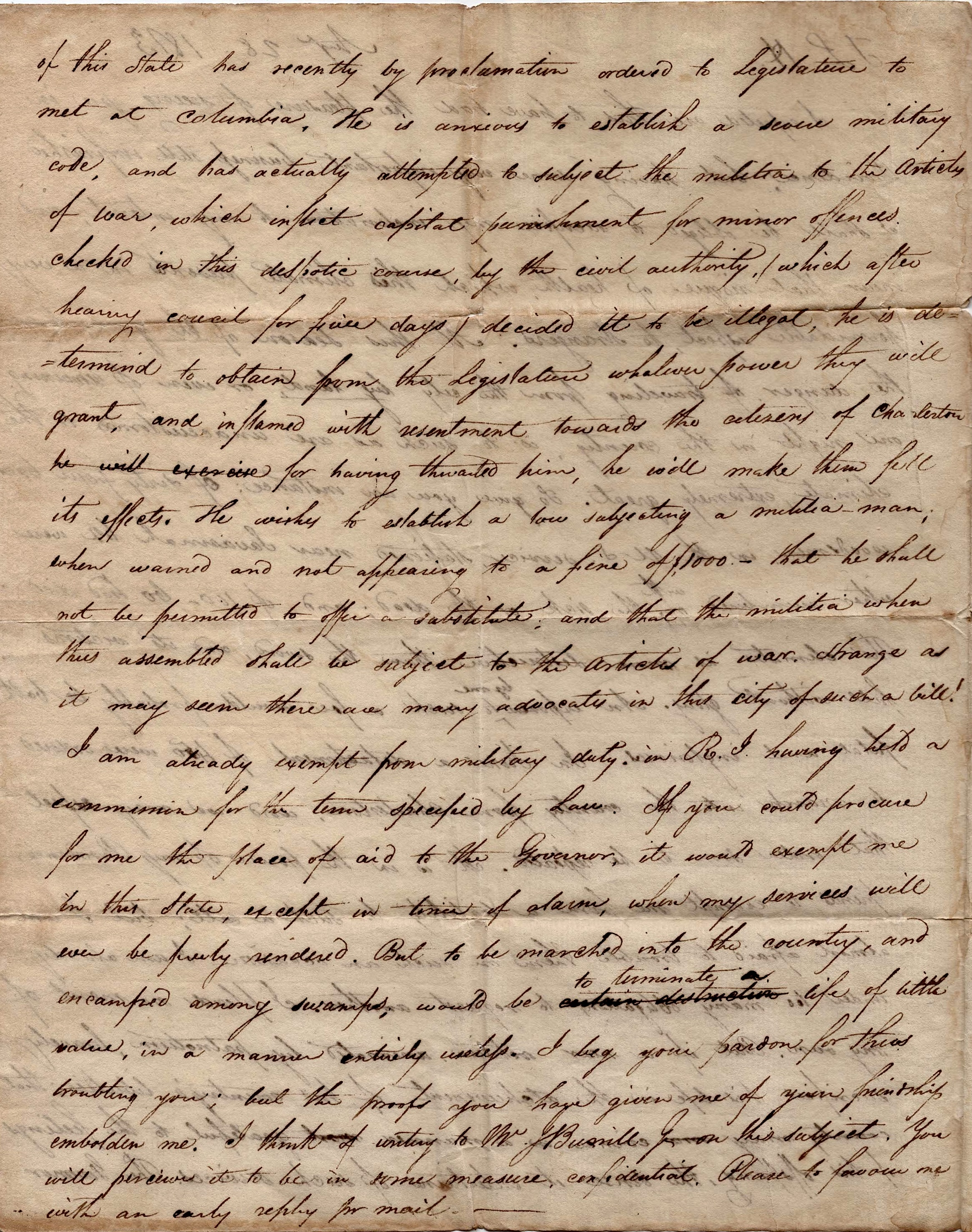
The Governor of this state has recently by proclamation ordered the Legislature to meet at Columbia. He is anxious to establish a severe military code and has actually attempted to subject the militia to the Articles of War, which inflict capital punishment for minor offenses. Checked in this despotic course by the civil authority (which after hearing council for five days) decided it to be illegal, he is determined to obtain from the Legislature whatever power they will grant and inflamed resentment towards the citizens of Charleston for having thwarted him. He will make them feel its effects. He wishes to establish a law subjecting a militia man, when warned and not appearing to a fine of $1000 that he shall not be permitted to offer a substitute and that the militia when thus assembled shall be subject to the articles of war. Strange as it may seem, there are many advocates in the city of such a bill!
I am already exempt from military duty in Rhode Island having held a commission for the time specified by law. If you could procure for me the place of aide to the Governor, it would exempt me in this state, except in time of alarm, when my services will ever be freely rendered. But to be marched into the country and encamped among swamps, would be to terminate a life of little value, in a manner entirely useless. I beg you pardon for thus troubling you, but the proofs you have given me of your friendship embolden me. I think of writing to Mr. J. Busvill Jr. on the subject. You will perceive it to be in some measure confidential. Please to favor me with an early reply per mail.
This city was last night visited by the most tremendous gale storm I ever experienced. The wind was at Northeast and the damage sustained incalculable. All the wharves are in ruins. The tide was one or two feet higher than ever before known. The beautiful new bridge was in a great degree swept away. The shipping in the harbor much injured and the large ship Canton is sunk. It is feared the sea island cotton adn rice crops are materially injured by the tide and those of corn &c. by the wind. Many chimneys are blown down. Capt. Cross’ house escaped without injury.
Be pleased to make my affectionate regards to your amiable family, and accept the assurances of my esteem and friendship. — C. R. G.


 Spared & Shared 23