Category Archives: 1860 Presidential Election

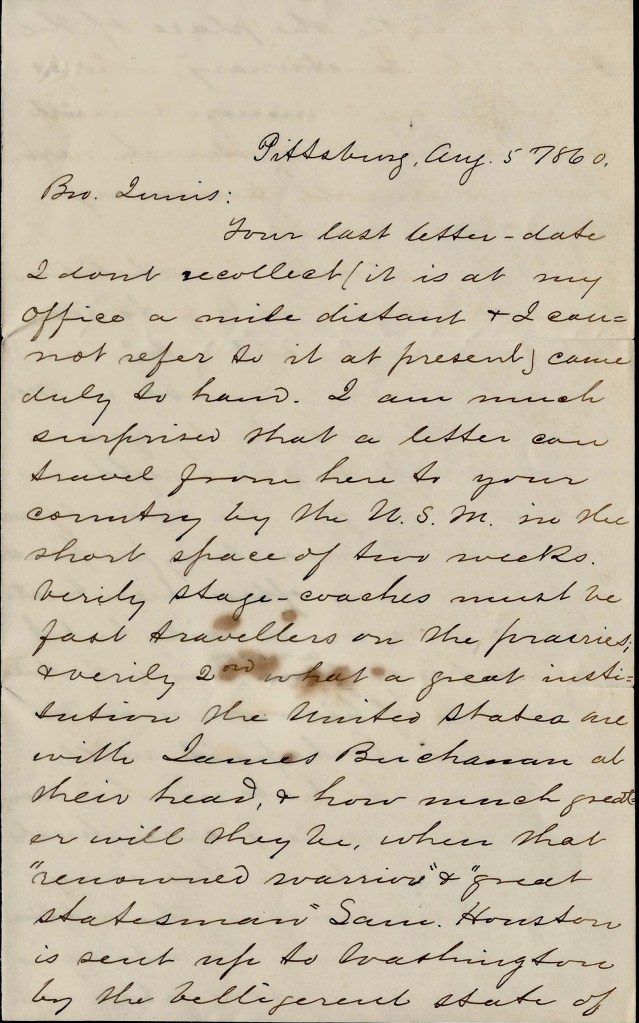
1860: Levi Bird Duff to Sardis Tunis Duff

The following letter was penned by Levi Bird Duff (1837-1916), the son of Samuel Duff (1807-1890) and Catherine Eckelberger (1810-1880) of Huntingdon County, Pennsylvania. Raised in the Saltsburg area, after graduating from Allegheny College, Levi moved to Pittsburgh to study and practice law upon his admittance to the Allegheny Bar Association in April 1860. One year later and just weeks after the start of the Civil War, Duff enlisted in Co. A, Ninth Regiment, Pennsylvania Reserve Corps. His acumen as a soldier and leader led to his rapid rise through the ranks, from corporal to captain to major to lieutenant-colonel. Duff led his troops in over twenty battles during his enlistment, such as Fredericksburg and Gettysburg. During his military career, he survived bullet wounds through the right lung and right thigh, though when the latter led to the amputation of his leg in 1864, he received an honorable discharge.

Duff’s war-time letters

Duff returned to Pittsburgh to continue his law practice and start a family with his wife Harriet (Nixon) Duff, whom he married during the war and whom he exchanged dozens of letters during those years. He allegedly would send Harriet flowers or leaves from the battlefields he traveled to along with the letters. Duff displayed a strong passion for politics and inciting change, especially in regards to slavery and racial subjugation. He maintained the same political platforms throughout his law career, including his three-year term as district attorney of Allegheny County until 1868. Duff had two children with Harriet prior to her death in 1877. He remarried Agnes F. Kaufman in 1882. After Agnes’ death in 1913, he decided to close his law practice and move to Lansing, Michigan to spend his final years with his son Hezekiah’s family until his death in 1916. His legacy lives on through his letters recounting his war triumphs and tribulations, which 150 years later are now preserved and available to view at his alma mater Allegheny College.” [Source: Union Dale Cemetery]

Duff’s Civil War letters were edited by Jonathan E. Helmreich in 2009 and published under the title: To Petersburg with the Army of the Potomac, the Civil War Letters of Levi Bird Duff, 105th Pennsylvania Volunteers.

The letter was sent to his younger brother, Sardis Tunis Duff (1840-1930) who had apparently gone to Texas but not before being enumerated in his father’s household in Clarion, Pennsylvania, where his father was a merchant in the borough. When he registered for the draft in 1863, he was identified as a “student” in Indiana county, Pennsylvania.

Transcription

Pittsburg[h], Pennsylvania
August 5, 1860

Bro. Tunis,

Your last letter—date I don’t recollect (is at my office a mile distant & I cannot refer to it at present) came dult to hand. I am much surprised that a letter can travel from here to your country by the U. S. mail in the short space of two weeks. Verily stage coaches must be fast travelers on the prairies & verily, 2nd, what a great institution the United States are with James Buchanan at their head, & how much greater will then be when that “renowned warrior” & “great statesman” Sam Houston is sent up to Washington by the belligerent State of Texas to take the place of the “Old Public Functionary,” who is to retire by common consent on the Fourth of March next. Indeed then will Cumming’s time have come.

Hereabouts the abolition Rail-splitters threaten to ride Lincoln to Washington on a rail which he made in Macon county, Illinois, thirty years ago. 1 Won’t this be a righteous retribution for the indulgence of his rail-mauling propensity! Men have often been treated to a ride on a rail but I never heard of a man being tortured by one of his own manufacture. Perhaps it will not come to pass in this case; but they make fierce threats & low boasts up this way of making Lincoln the victim of his own rail. The riding is to take place in November next. We want our Southern brethren to come up & aid us to ride this man Lincoln on his own rail, but they demur & say it shan’t be done; & that if, contrary to their orders, it should be done, they will dissolve the Union. Herein we think our Southern brethren are a little inconsistent. For should the same Lincoln be foolish enough to visit his native place down in Hardin county, Kentucky, how the inhabitants “round about” would long for an Illinois rail to give him a ride. Yet they won’t come up here & help us to do it. They want to do all the rail-riding themselves. We wish to partake of the fun & they object. Our fellows, notwithstanding these protests, are making the “necessary preparation” for the ride & I have no doubt it will take place next November as I before said.

But I must drop this subject for the present to ask you how Texas is getting along. Wonderful reports have reached us that the Abolitionist are burning up the State & doing many other things. I cannot recollect them all just now. How is this? Give me some information respecting these things if you can.

I see by the reports from your country & also by your letter that the weather has been very warm there this summer. This warmth may convince you that the climate is not so pleasant as you anticipated. You are, I think, a little too far south.

Let me know how the political fight goes on down there. It is now said that Sam Houston is declining & that his state will go for Breckinridge.

Your friend & bro. — Levi Bird Duff
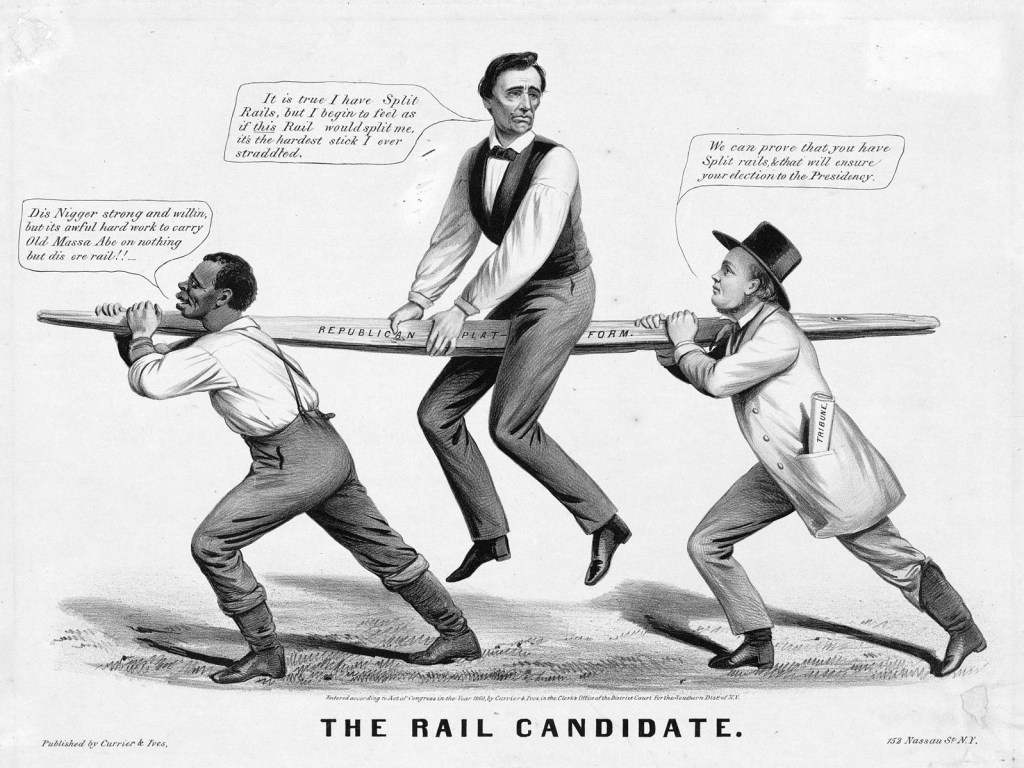
“The Rail Candidate”, anti-Republican political caricature published by Currier and Ives in September 1860, showing Abraham Lincoln being carried on a fence-rail labeled “REPUBLICAN PLATFORM” by a black man and Horace Greeley (editor of the New York Tribune), alluding to Lincoln’s nickname of the “rail-splitter”.

1 The Chicago History Museum informs us that Abraham Lincoln acquired the sobriquet “The Railsplitter” in May 1860 when Illinois Republicans convened at Decatur to endorse a favorite son for president. “Lincoln was the likely choice but his supporters felt he needed a catchier nickname than ‘Old Abe’ or ‘Honest Abe.’ Thus, Richard J. Oglesby and John Hanks, a first cousin of Lincoln’s mother, located a split-rail fence supposedly built by Lincoln in 1830. When they walked into the hall carrying two of the rails—decorated with flags, streamers, and a sign that read, ‘Abraham Lincoln/The Rail Candidate’—the crowd went wild.”
1860: William T. Early to Septimus D. Cabaniss

The following interesting letter was written by William T. Early (1817-1874), the son of Joab B. Early (1792-1845) and Betsy Thompson (1792-18xx) of Fredericksburg Parish, Virginia. William was a well-educated lawyer, politician, and owner of the Pen Park plantation of 410 acres near Charlottesville on the Rivanna river. The slave schedules of 1860 inform us that he was the owner of 36 slaves. At the time this letter was written in November 1860, he was serving as the mayor of Charlottesville.

From William’s letter, we learn that he considered the results of the 1860 Presidential election ruinous, believing that it would only lead to secession and the destruction of the Union. William’s political leanings were with the Whigs until the Republican Party emerged, strengthened by the anti-slavery extremists of the party. Though he hated to see the Union dissolved, he makes it clear in the letter that “my destiny is with the South, come what may.” Indeed, he remained in Virginia during the Civil War and in the summer of 1864 served as the captain of Co. A, 1st Battalion Virginia Reserves in the trenches near Chaffin’s Farm near Richmond. The Daily Progress July 11902 issue listed Capt. W. T. Early among the Confederate Soldiers interred in Maplewood Cemetery.

Apparently William did his best to bind up the wounds of the Nation after the war. In a post-war article he was quoted as saying, “The sentiment of the people throughout this region is one of entire submission to the result of the contest. Slavery is universally regarded as extinct, and there is a general and absolute acquiescence in its fate. Indeed, may people rather rejoice at this result, as it cuts the Gordian knot of a vexed question, which morally, socially, and politically, like Banquo’s ghost, appeared before us everywhere, and frightened us from our propriety, and which swallowed up every other question, as Aaron’s rod swallowed up all other rods. Of course, at first, there will be much disorganization of labor, but not so much as anticipated, and the result will be that the negro will make a very good laborer, and will take his proper place in the social scale, or he will go elsewhere, which is probably his fate. There is no spirit of further resistance…disunionists are now perfectly satisfied with the experiment made.” [27 September 1865, The New Hampshire Patriot & Gazette.]

William wrote the letter to Septimus (“Sep”) Douglass Cabaniss (1815-1889), the son of Charles Cabaniss (1773-1825) and his wife Lucy Ingram (1775-1827), who moved from Lunenberg County, VA to Madison County, AL in 1810. In his early years, Septimus was educated at Green Academy in Huntsville, AL. He attended the University of Virginia between 1832-1835, and returned to Huntsville to read law with a local attorney. He passed the Alabama Bar in 1838 and practiced law, primarily dealing with estates, in Huntsville until his death. Septimus served the Confederacy as a member of the Alabama State Legislature from 1861-63 and a Colonel in the Confederate Intelligence Division during the Civil War.

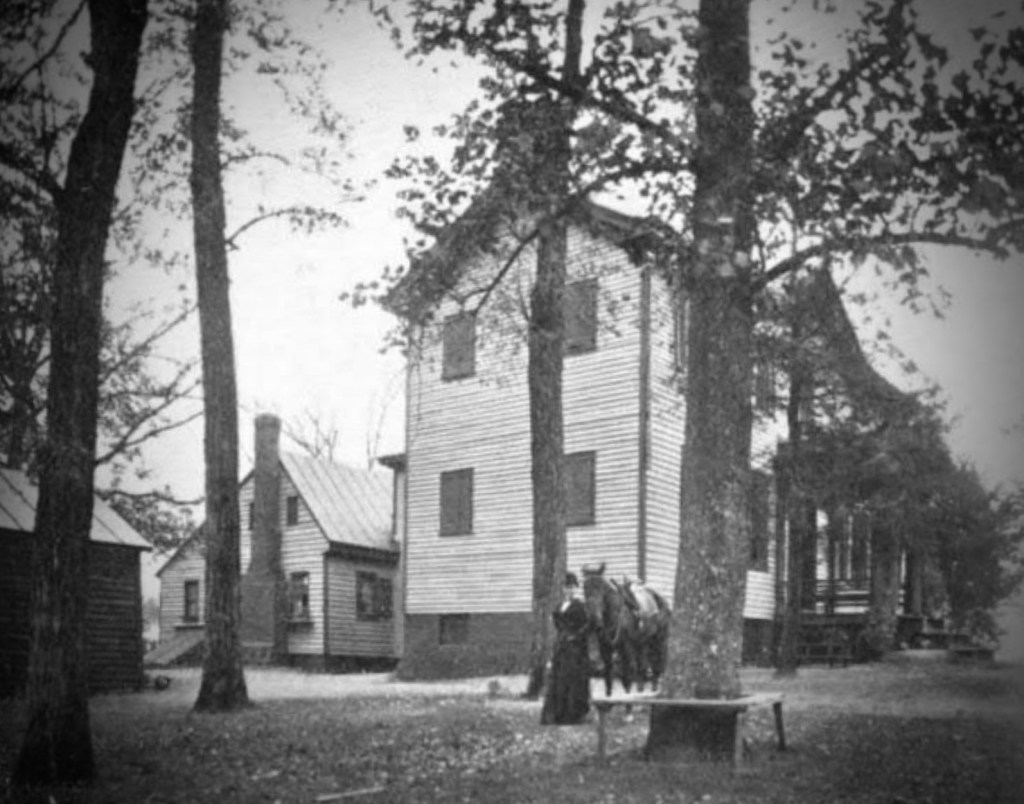
Pen Park Plantation House at it appeared in the late 19th Century. The older part of the house is the smaller structure behind the newer addition.

Transcription

Pen Park near Charlottesville
November 10th 1860

S. D. Cabaniss, Esqr.

My dear friend—I have delayed answering your very highly esteemed favor of the 18th ultimo in the hope of being able to attend your sale in Jackson county. But the result of the Presidential election has made it impossible. The effect of that disastrous event is to chain everybody here to the soil for the present as fast as Prometheus was chained to the rock. In the course of a few months, I hope to change my location for Huntsville, or its vicinity. So far as I can see now, I can’t discern any probable satisfactory solution of our present troubles without many throes and convulsions.

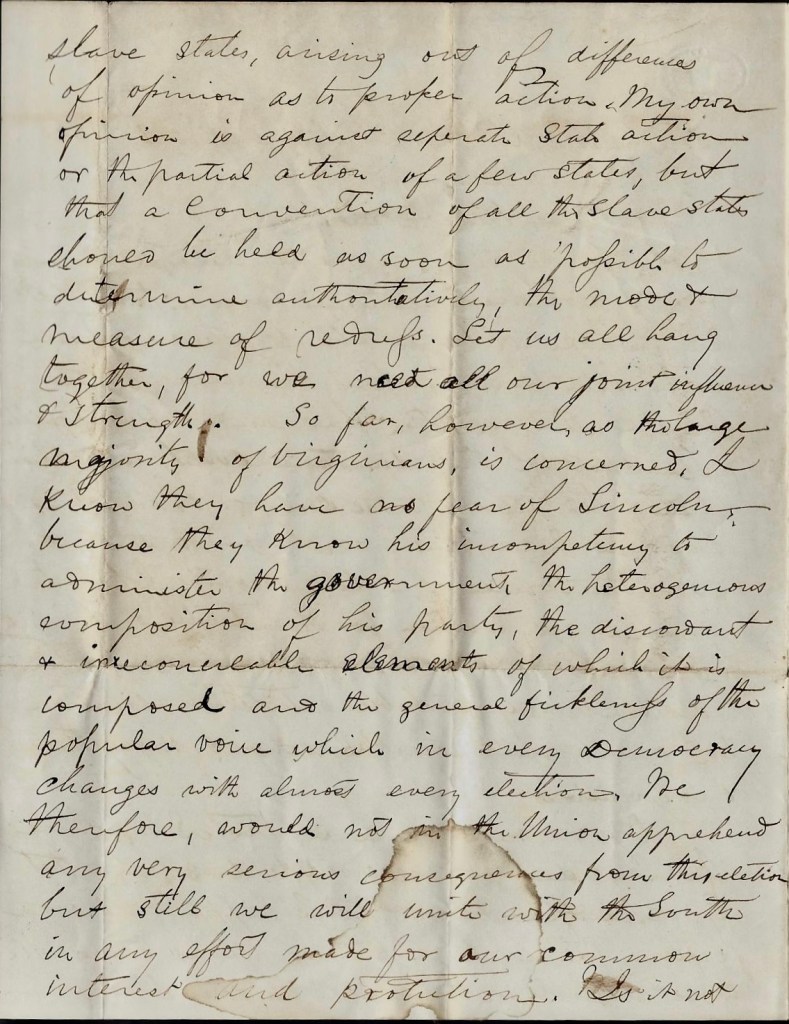
Our news here is that South Carolina has seceded—or resolved to do so—and that Georgia, Alabama, & Mississippi will soon follow. In such a state of affairs, there will be great trouble in this and the other border slave states arising out of differences of opinion as to proper action. My own opinion is against State action or the partial action of a few states, but that a Convention of all the slaves states should be held as soon as possible to determine authoritatively the mode and measure of redress. Let us all hang together, for we need all our joint influence and strength.

So far, however, as the large majority of Virginians is concerned, I know they have no fear of Lincoln because they know his incompetency to administer the government, the heterogenous composition of his party, the discordant & irreconcilable elements of which it is composed, and the general fickleness of the popular voice which in every Democracy changes with almost every election. We, therefore, would not in the Union apprehend any very serious consequences from this election, but still we will unite with the South in any effort made for our common interest and protection. Is it not therefore all important that our counsels should be joint and our action the same?

I fear that there are extremists at the South who will precipitate action and thus introduce the seeds of division at the South, whereas there should be unanimity from the Pennsylvania border to Mexico on that part of every state; and there will be, if a southern Convention is held, and firm, and at the same time, judicious measures adopted.

Before this reaches you, however, the die may be definitively cast and states committed to instant or unqualified secession. In that event, though I can see nothing but ruin ahead, my destiny is with the South come what may. With a melancholy but firm & undaunted spirit, I will take up arms against the sea of troubles trusting that Providence will vouchsafe us a happy issue out of all our afflictions. Such will be the sentiment of Eastern Virginians but I fear that west of the Blue Ridge we should have trouble for there the slaves are few and far between.

I regret much my inability to attend the sale, and indeed suppose it will be impossible to effect one in the present condition of the public mind, but hope in the course of a month or two to get some funds that will enable me to visit Alabama and invest at least enough to buy a home in or near Huntsville.

The public sentiment here is extremely feverish and excited and I would like to know your opinion of the action of Alabama. Hoping to hear from you at an early day. I am truly your friend, — W. T. Early

1860: John Wilson to James William Denver

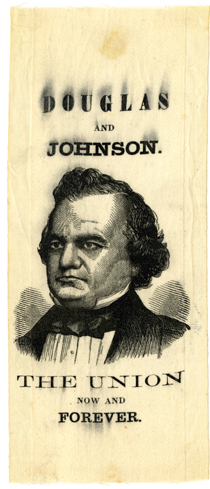
1860 Campaign Ribbon

The following letter was written by Gen. John Wilson (1790-1877), a native of the Shenandoah Valley, who came to California in 1849 as Indian Agent, then as Navy Agent in San Francisco. He soon settled down to practicing law in San Francisco, becoming somewhat of a specialist in land claim cases. Wilson was active in the Whig party in California but when that party dissolved in the 1850’s, he joined other old conservatives to join the Constitution Union Party that selected John Bell and Edward Everett as their nominees for President and Vice President in 1860.

Wilson wrote this letter to his old friend, James William Denver (1817-1892) who had previously filled several military and civilian posts with the US government, most recently as the Commissioner of Indian Affairs. A life-long Democrat, Denver supported the Democratic party’s nominee, Stephen A. Douglas, for the office of President in the 1860 Election.

In this letter, recognizing there was little alternative to preventing Abraham Lincoln from winning the State of California in the Election of 1860, Wilson proposes to Denver that an attempt be made to unite the conservative members of their two party’s slates of electors to cast their ballots for either Douglas (Democratic Party) or Bell (Constitutional Union Party), but not for both. If “divided at the polls, victory will perch upon abolition,” warned Wilson.

Transcription

San Francisco, [California]
26th September 1860

Hon. Jas. W. Denver, Sir:

Allow me to suggest a matter that I at least think of great importance. There ought & must be—to save the state to conservatism—a combination between the Douglass & B & E [Bell & Everett] men. I think I can answer for the latter that they will agree to a fair one. You are fully informed how I stand. I have attended no public meeting od any party. My views have been expressed to you and are generally known. I feel the negotiation ought to be prompt & more than secret—if one is made that it should be sprung upon the public like a meteor.

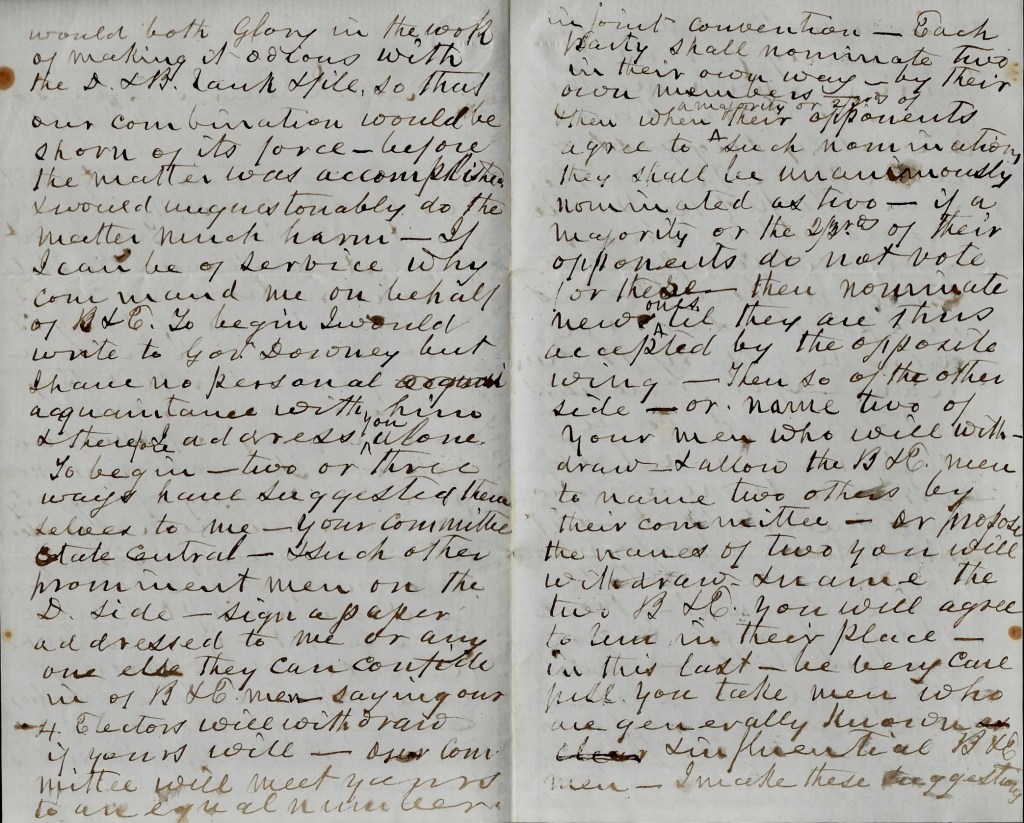
Let it be supposed one was in embryo & all factionists the slave dealer & slave liberator would both glory in the work of making it odious with D & B [Douglass & Bell] rank and file, so that our combination would be shorn of its force—before the matter was accomplished & would unquestionably do the matter much harm.

If I can be of service, why command me on behalf of B & E [Bell & Everet]). To begin, I would write to Gov. Downey but I have no personal acquaintance with him & therefore I address you alone. To begin—two or three ways have suggested themselves to me—your committee State Central—& such other prominent men on the D [Democratic] side—sign a paper addressed to me or anyone else they can confide in of B & E men saying our 4 electors will withdraw if yours will. Our committee will meet yours to have an equal number in joint convention. Each party shall nominate two in their own way by their own members. Then when a majority of 2/3rds of their opponents agree to such nominations, they shall be unanimously nominated as two. If a majority or the 2/3rds of their opponents do not vote for these, then nominate new ones till they are thus accepted by the opposite wing. Then so of the other side—or name two of your men who will withdraw and allow the B & E men to name two others by their committee—or propose the names of two you will withdraw & name the two B & E you will agree to in their place. In this last, be very careful you take men who are generally known & influential B & E men.

I make these suggestions to begin with. No doubt you being far more familiar with matters of this sort than I am, can easily suggest a better plan than either. I am satisfied if the public should not be aware of it till completed. Therefore, there should be speed used in every necessary preliminary. If it is thought that I would be a proper channel to carry on the negotiation, I will undertake it. But I shall much prefer some other may be selected. Depend upon it. There is danger of L [Lincoln] carrying this state. This I hold would be a great political calamity to the Union for there are a majority of conservative votes here, but being divided at the polls, victory will perch upon abolition, so says your old friend, — John Wilson

1860: Earl Bill to John Carey

This letter was written by 47 year-old Earl Bill (1813-1885) of Tiffin, Seneca county, Ohio. Earl’s first wife was Roxy Ann Allen (1820-1847); his second wife was Susan Eliza Johnson (1820-1899). Though Earl made his living as a commission merchant, he was also active in politics. Previous to the date of January 1860 letter, he had served one term (1850-1851) in the Ohio Senate and he would afterward, in May 1860, serve as a delegate to the Chicago convention that emerged with the ticket of Lincoln and Hamlin. In the 1850s he partnered with another to publish the Sandusky Register which became the mouthpiece of the rising Republican Party in northwestern Ohio.

Earl wrote the letter to his representative in Congress, the 67 year-old John Carey, a War of 1812 veteran whose career included serving as a judge, an Indian agent, a member of the Ohio legislature, and an elected Republican to the 36th US Congress (1859-1861). He died in the town he founded, Cary, Wyandot county, Ohio, in March 1875.

[Note: This letter is from the personal collection of Richard Weiner and is published on Spared & Shared by express consent.]

The cartoon reflects the considerable bitterness among New York Republicans at the party’s surprising failure to nominate New York senator William H. Seward for president at its May 1860 national convention. The print was probably issued soon after the convention’s nomination of Abraham Lincoln. (LOC)

Transcription

Tiffin, Ohio
January 24, 1860

Hon. John Carey,
House of Representatives, Washington

Dear Sir—Permit me to obtrude a few words upon you on political matters. At the moment I write, we have no information of the organization of the House, and we must understand probably the true causes. It is doubtless from a determination on the part of the “Democratic Party” never to let go of the hold on the public teat except when grim death summons the from all things sublunary. Thus far they have cloaked their purpose under a thin veil of pretended solicitude for the peace of Southern society, which is of course a mere show. Thus far, our Republican friends have nobly stood by their chosen leader of whom they are justly proud. Do they or do you doubt whether their constituents approve? Perhaps some shade of doubt sometimes crosses their minds; but sir, as for your District, I do not believe there can be found a single man who voted for you who would ever do so again if you should be driven by Southern bluster or Northern bluster to desert the standard bearer of the present contest so long as he maintains his present firm, self-respecting, and dignified attitude. I say this with entire respect, and not for a moment believing your firmness will be insufficient. But it may prove some satisfaction to yourself to know that your views of duty are concurred in at home.

US Congressman John Carey of Ohio

The truth is, there seems to be a number of Representatives from the Slave-holding States who are willing to destroy the Union and set up a Negro-Confederacy of their own; and in my judgment, they have initiated the matter already and intend never to cease their treasonable plans unless they can bully the North into a surrender of everything (including Northern manhood) into their hands. This should never be done. Let us know, now—and now is a good time to come at it—whether the North is to be a mere hewer of wood for Negro-drivers, and not to be allowed to have any opinions of its own on Governmental questions. The people of the Free States never boasted of superiority over their brethren of the South; but they do claim and will maintain (I hope) to be the peers of any people. If the maintenance of their just rights in the Confederacy produces the “Irrepressible Conflict,” 1 then let it come, but only their assailants must be held responsible for the consequences.

Truly yours, — Earl Bill


1 “The term “irrepressible conflict” originated with William H. Seward in an 1858 speech predicting the collision of the socioeconomic institutions of the North and the South. Seward maintained this collision would determine whether the nation would be dominated by a system of free labor or slave labor. In 1858 Abraham Lincoln proposed the same idea in his “House Divided” speech. At the time, the use of the phrase did not include the assumption that the “irrepressible conflict” would necessarily find expression in violence or armed conflict.” [Assessible Archives]

1860: Sheridan S. Sabine to Charles A. Choate

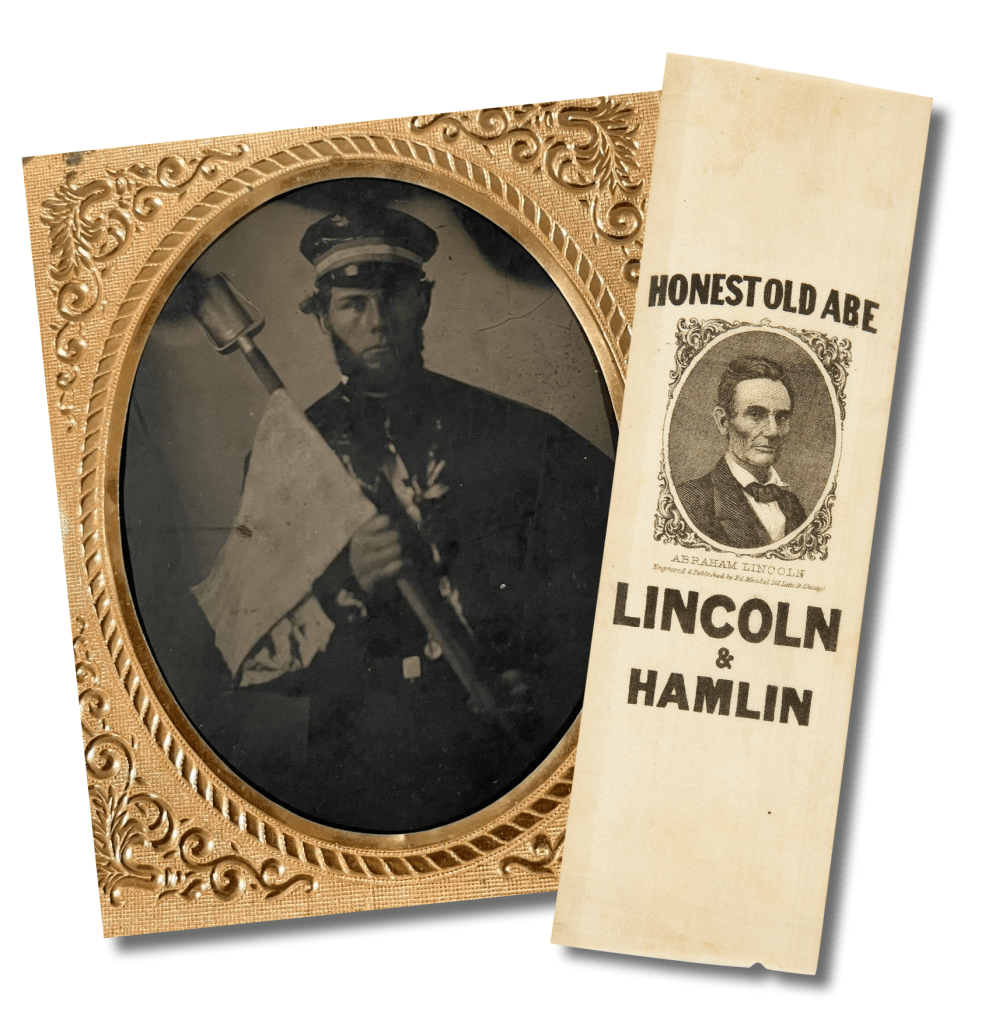
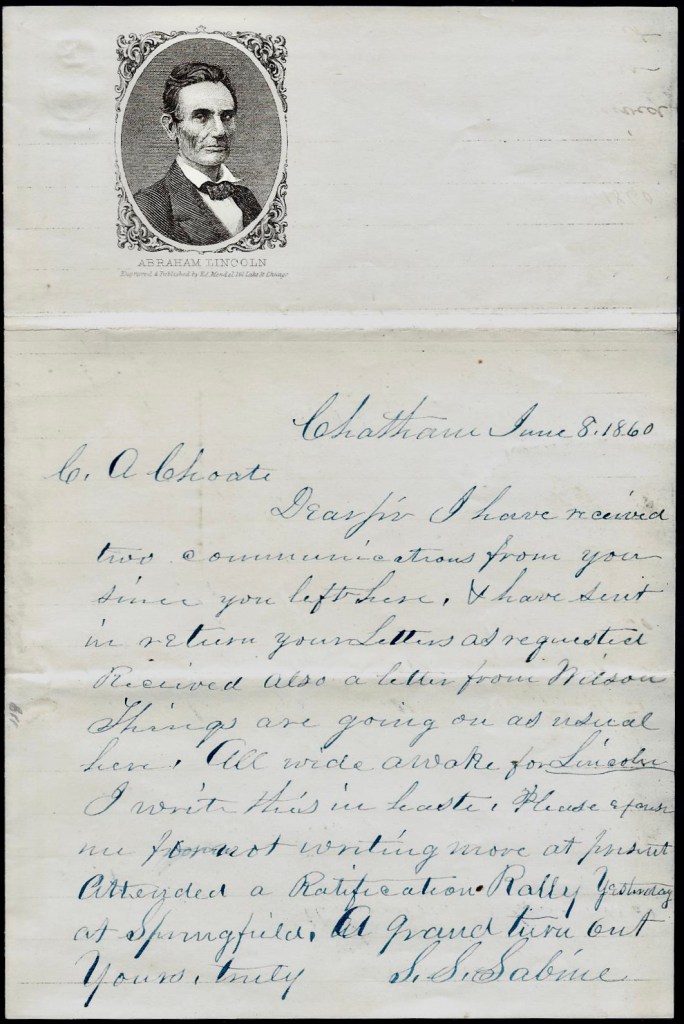
This brief letter was written on extremely rare stationery incorporating an engraving of Abraham Lincoln by the well-known Chicago engraver, Edward Mendel. 1 I have seen this engraving on a campaign ribbon, poster, and an envelope but not on stationery previously. For most voters, this was the image of Lincoln that served to introduce him to the American public.

Unfortunately I cannot confirm the identity of the correspondents but believe them to be Sheridan S. Sabine and Charles Augustus Choate—both patriotic youths of Illinois who would have been the kind to have campaigned for Lincoln and participated in Wide Awake torchlight parades. Twenty-one year-old Sheridan (1839-1876) was a joiner in Chatham whose father was postmaster, allowing himself and family to send mail without paying postage (a perk of the postal employees). When the new President called for soldiers, Sheridan took the oath as a volunteer on 27 July 1861, as a corporal in Co. A, 3rd Illinois Cavalry. He served out his full three years with the company, mustering out on 5 September 1864.

Eighteen year-old Charles A. Choate (1842-1915) was a young college-bound student whose father, Charles Choate, was an 1823 graduate of Bowdoin College and physician who settled down as a farmer in Montebello township, Hancock county, Illinois, when his heath failed—his home on a bluff overlooking the Mississippi river.

An 1860 Lincoln Campaign Ribbon with Mendel’s engraving of Lincoln and an unidentified Wide Awake torch bearer from the personal collection of Adam O. Fleischer

Transcription

Chatham [Sangamon county, Illinois]
June 8, 1860

C. A. Choate
Dear Sir,

I have received two communications from you since you left here & have sent in return your letters as requested. Received also a letter from Wilson. Things are going on as usual here. All wide awake for Lincoln. I write this in haste. Please excuse me for not writing more at present. Attended a Ratification Rally yesterday at Springfield. A grand turn out. 2

Yours truly, — S. S. Sabine

1 “Edward Mendel, for many years a lithographer in this city, and known as a man who has been closely identified with Chicago’s business  interests for over a quarter of a century, died at his residence, No. 2321 Wabash avenue, yesterday evening at 7:30 o’clock. For many  months the insidious but deadly Bright’s disease had been assailing his system, and at last the foe became the victor. Mr. Mendel was  born in Berlin, Germany, in 1828, receiving his education in that country and learning the trade of a mapcarver. When 22 years of  agehe came to America. Engaged for a short time at his trade in Cincinnati, he soon came further West and ere long was at work in  Chicago, and was also employed for a while on a surveying corps.

About the year 1853 be began the work of lithographing. He started in this business on Lake street; near La Salle, occupying the old  John Link Building. His business began to enlarge, and about three years before the great fire he moved into the First National Bank  Building, located at the southwest corner of State and Washington streets. There the fire found him and there the fire left him, well nigh penniless at best, so far as his business interest was concerned. Not daunted by adversity, he again began business at the corner  of State and Twenty-second streets, afterward moving down to the Hoffman Building on Fifth avenue, between Madison and Monroe  street. He rapidly regained his former position and again moved, this tie to the fourth floor of the Times Building on Fifth avenue, which  latter place he occupied up to the time of his death.


As a man of close attention to business, of industry, of loyal devotion to the work which claimed much of his time and talent, Mr.  Mendel was known by a large circle of business friends. A man of native reticence and averse to courting society he yet left a strong  impression of his own individuality upon those who knew him. Mr. Mendel had become the possessor of a good deal of valuable city  property, owning the Mendel Block, on the northeast corner of Pacific avenue and Van Buren street, a number of houses on Wabash  avenue aside from his residence, and other property which would perhaps bring wealth close up to a half a million dollars. In 1863  Mr. Mendel was married in this city to Miss Sarah Joy, by whom he has had three children, Edward and Albert, two of them now living,  the eldest on now nearing manhood. Thirty years of active business life in Chicago, conducted upon the careful and conservative  principles which governed his life, could not but have won Mr. Mendel many friends, who will join their sympathy to the sorrow of the  bereaved family.” [Obituary posted in Inter Ocean, April 5, 1884]

2 A “Ratification Rally” was merely a campaign rally to endorse the Republican nominee for President of the United States.

1860: Peter J. Miller to George Miller

This letter was written by Peter J. Miller (1841-1910) who married Anna N. Warstler (1838-1910) on 6 September 1860 in Stark county, Ohio. In the 1860 US Census, taken in June, Peter was enumerated in the household of Mrs. M. Shellenberger of Marlboro, Stark county, Ohio. Peter’s occupation was given as “laborer.” Anna was enumerated in the same village living with her parents, Jonas and Elizabeth Warstler. By the time of the 1870 Census, Peter and Anna had relocated from Ohio to Monroe, Kosciusko county, Indiana, where Peter earned his living as a farmer.

Peter appears to have been the son of John P. Miller (b. 1813) and his wife Maria (b. 1819), both natives of Pennsylvania who resided in Bethlehem, Stark county, Ohio, in 1860.

Peter wrote the letter to his uncle George Miller (1804-1867) who was married to Lydia Newhard (1811-1890). George and Lydia had several children, to include: Christianna (b. 1837), Tilghman P. (b. 1939), William (b. 1841), Eli (b. 1844), and Peter (b. 1849). The couple lived out their days there, raising at least seven children.

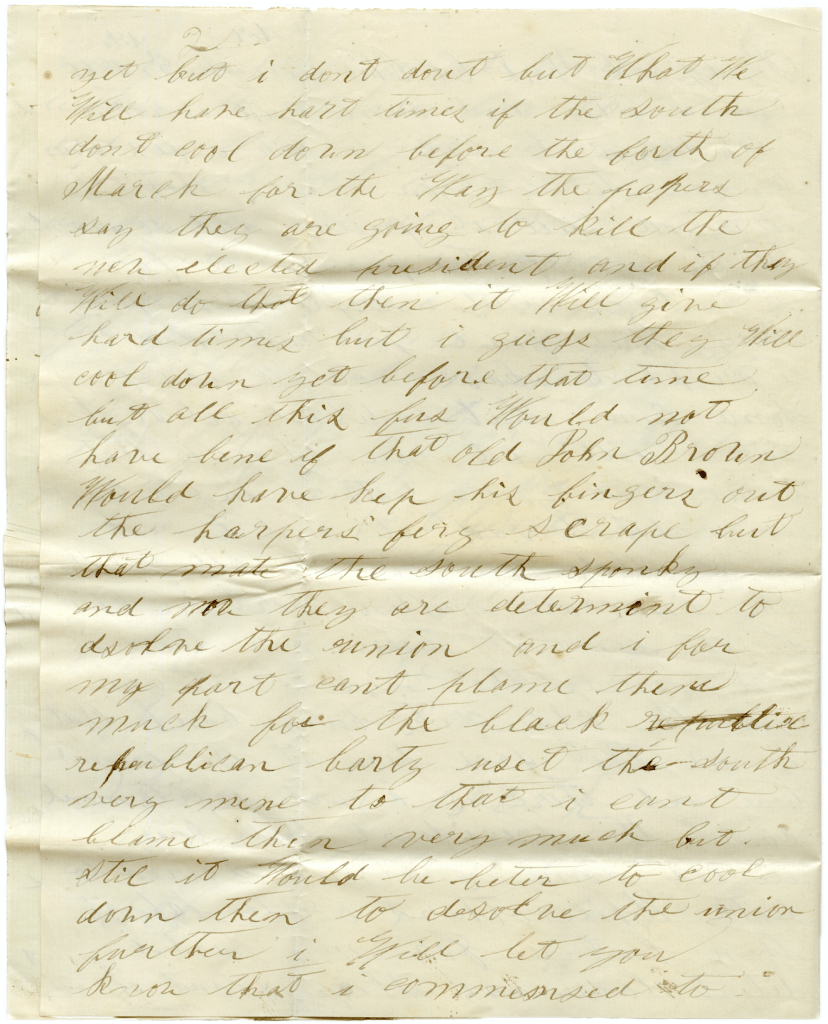
Peter’s letter to his paternal uncle and family shares a reaction of Ohioans to the election of Abraham Lincoln and expresses some fear that the country will face “hard times” if the South does not “cool down” before the President’s inauguration. He informs them that the life of the president-elect has been threatened and suggests that Old John Brown is to be blamed for making the South “spunky” and emboldened them to carry out their threats of dissolution.

[This letter is from the private collection of Adam Ochs Fleischer and has been published on Spared & Shared by express consent.]

Transcription

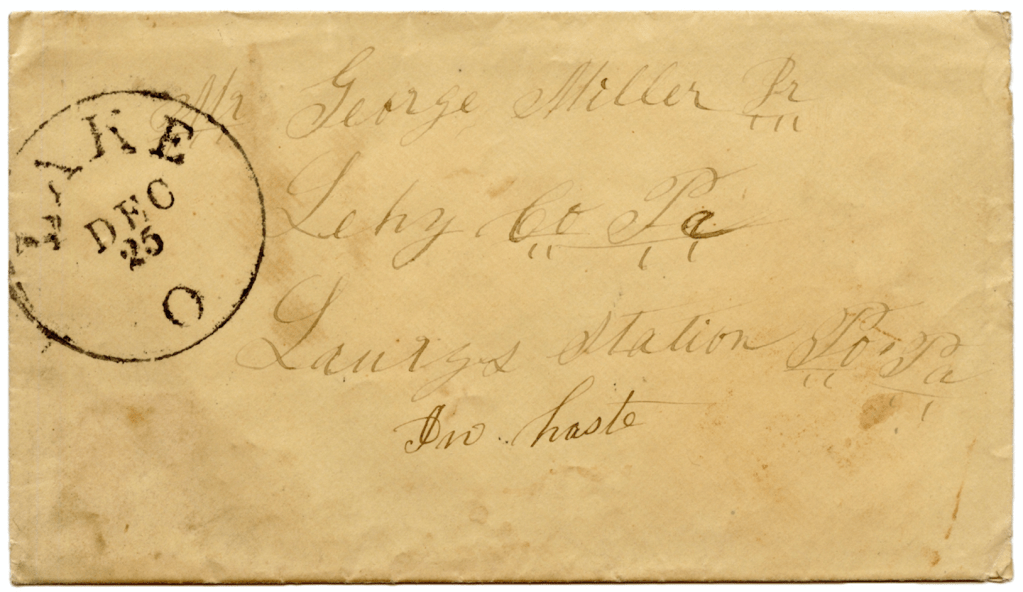
Addressed to Mr. George Miller, Jr., Laurys Station, Lehigh County, Pa.
Postmarked Lake County, Ohio

Bridgeport, Stark County, Ohio
December 23, 1860

Dear Uncles and Aunts and Cousins,

I sit down to try to write a few lines to you to let you know that we are all well at present and so are all the rest of the friends as far as I know. And I hope these few lines will find you all well. I ought to have write to you for some time but I didn’t get at it. But I will let you know that I received your letter and I was very glad to read it and to read in it that you were all well for the times are mighty hard in Ohio at the present time for there is no money that goes except Ohio and the Old Pittsburgh Bank. That is all that goes here at the present time.

And there is a great excitement about the President that was elected. Some are almost scared to death while others only laugh at them. But for my part, I didn’t lose any sleep about it yet. But I don’t know but what we will have hard times if the South don’t cool down before the fourth of March for the way the papers say, they are going to kill the new[ly] elected President and if they will do that, then it will give hard times. But I guess they will cool down yet before that time. But all this fuss would not have been if that Old John Brown would have kept his fingers out of the Harper’s Ferry scrape. But that made the South spunky and now they are determined to dissolve the Union, and I, for my part, can’t blame them much for the black republican party used the South very mean so that I can’t blame them very much. But still it would be better to cool down than to dissolve the Union.

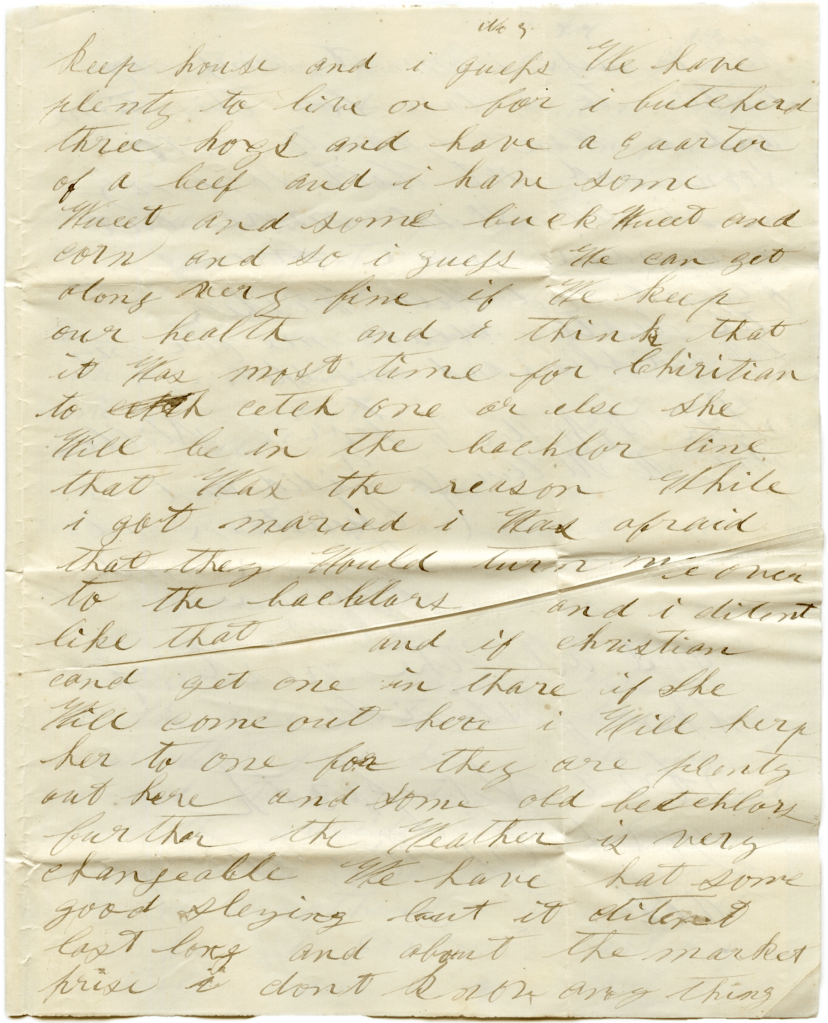
Further, I will let you know that I commenced to keep house and I guess we have plenty to live on for I butchered three hogs and have a quarter of a beef and I have some wheat and some buckwheat and corn. And so I guess we can get along very fine if we keep our health. And I think that it was most time for Christian[na] to catch one or else she will be in the bachelor line. That was the reason why I got married. I was afraid that they would turn me over to the bachelors and I didn’t like that. And if Christian[na] can get one in there if she will come out here, I will help her to [find] one for they are plenty here—and some old bachelors [too].

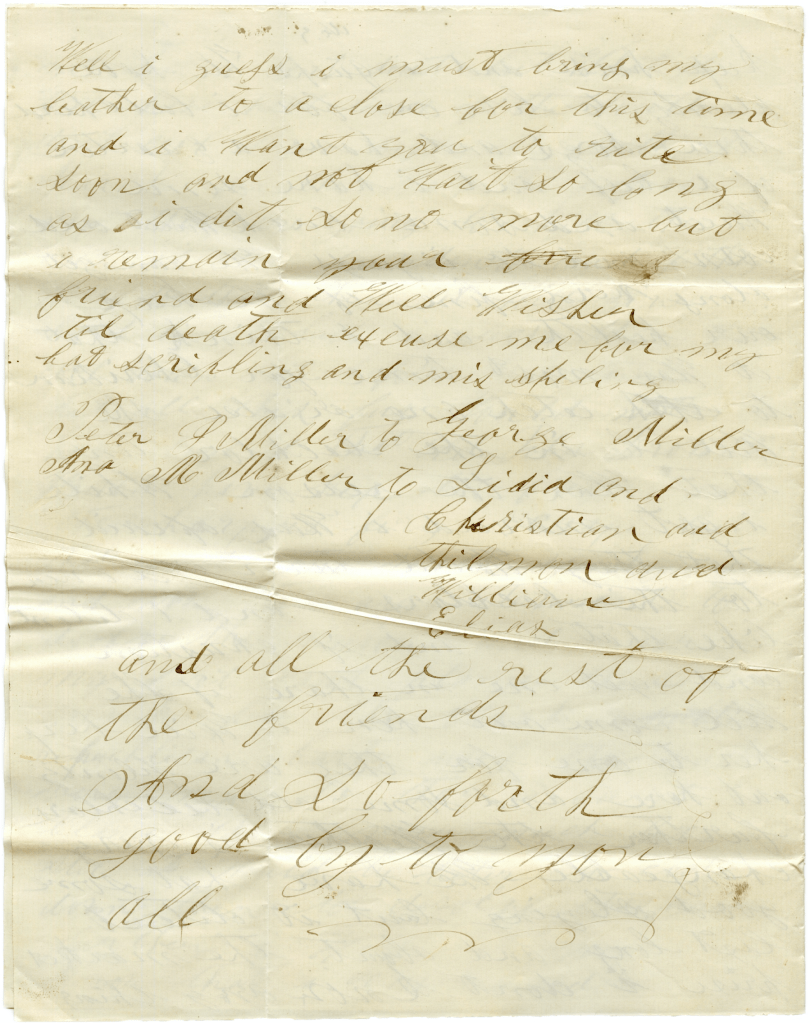
Further the weather is very agreeable. We have had some good sleighing but it didn’t last long and about the market prices, I don’t know anything. Well I guess I must bring my letter to a close for this time and I want you to write soon and not wait so long as I did. So no more but I remain your friend and well wisher till death. Excuse me for my bad scribbling and misspelling.

Peter J. Miller to George Miller
Ana M. Miller to Lydia and Christian[na] and Tilghman and William and Elias.

And all the rest of the friends and so forth. Goodbye to you all.

1860: Benjamin Field to John Houston Bills

This letter was written by 40 year-old Benjamin Field (1820-1876), a partner with Thomas F. Langstroth (1815-1879) in the Philadelphia hardware merchant who kept a store at 440 Market Street. His home was, at the time, located at 321 S. Third Street in the Society Hill District. The Field, Langstroth & Co. was advertised in the 1860 Philadelphia City Directory as a “Hardware & Cutlery, Importers of, and Wholesale Dealers in” firm located at 440 Market Street.

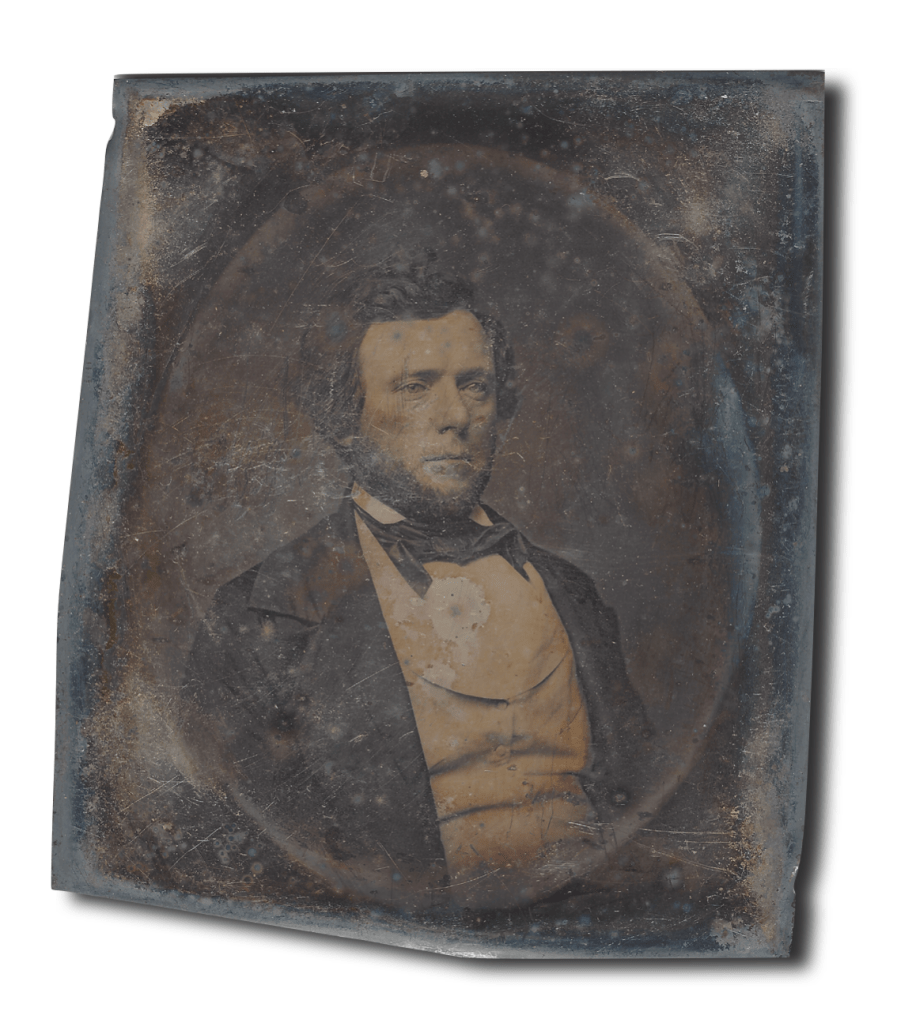
We have no image of Benjamin Field so I have used an Ambrotype from my collection of a middle-aged man who looks like a wealthy Eastern merchant.

According to the Death Certificates Index, Benjamin Field (Hardware Merchant) died in Philadelphia on 29 April 1876 and was buried in North Laurel Hill Cemetery. His last known residence was at 1116 Walnut Street. Benjamin was a Quaker and attended the Philadelphia Monthly Meeting.

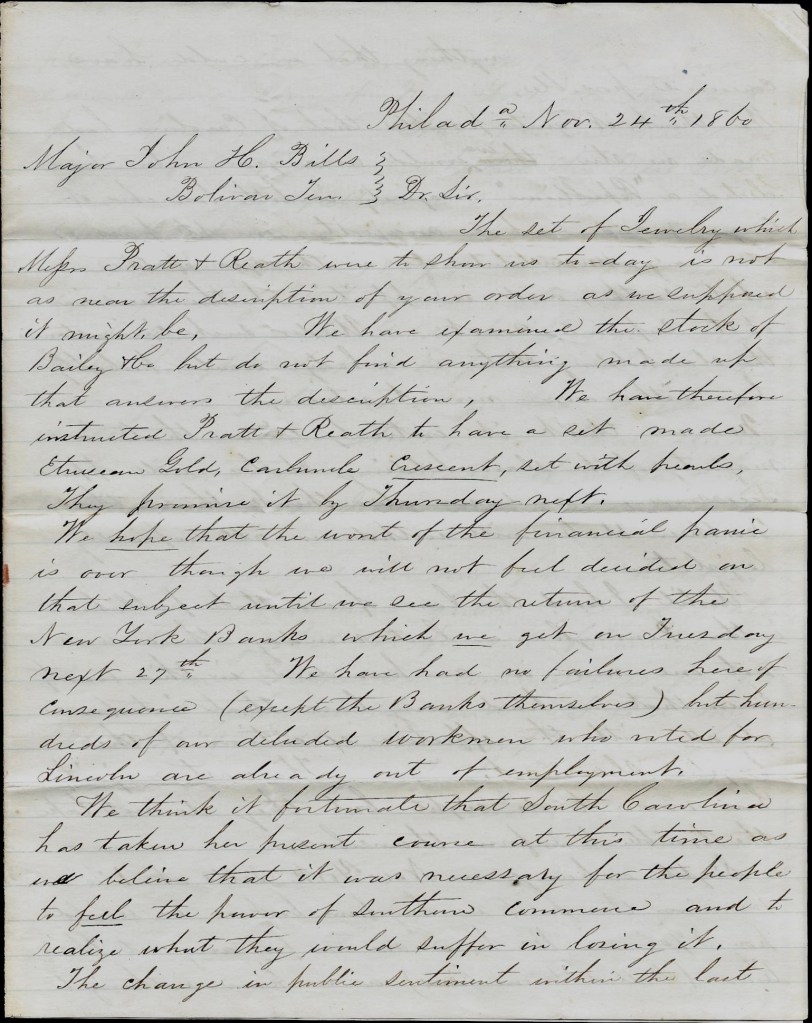
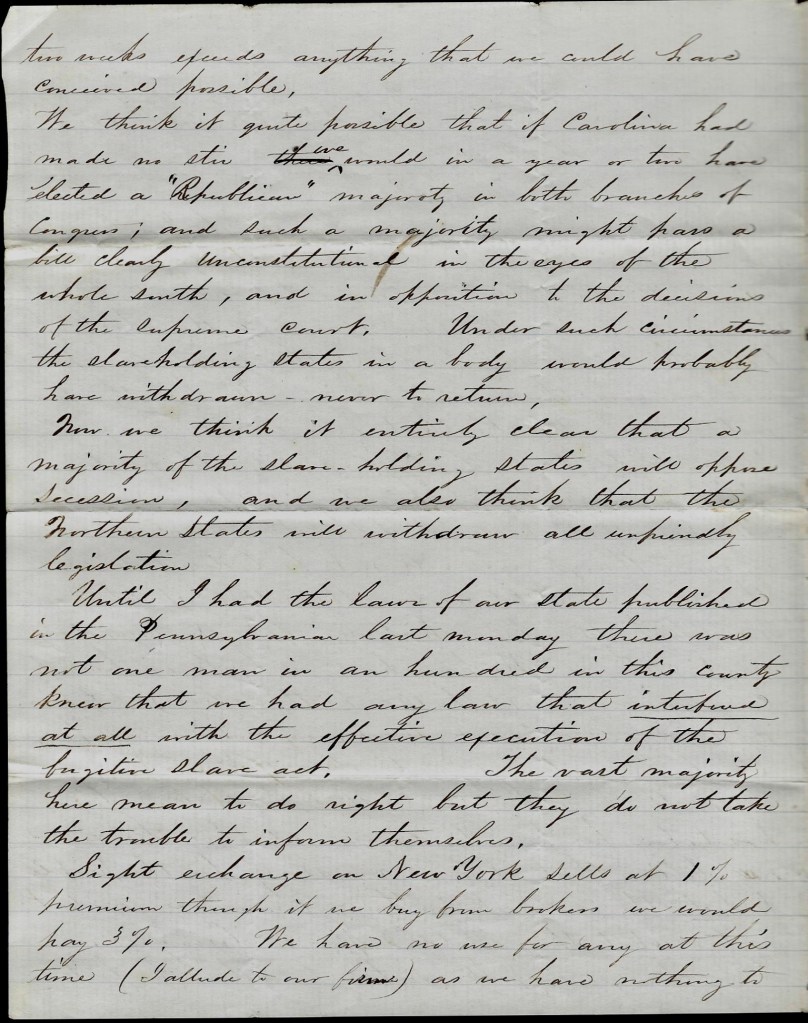
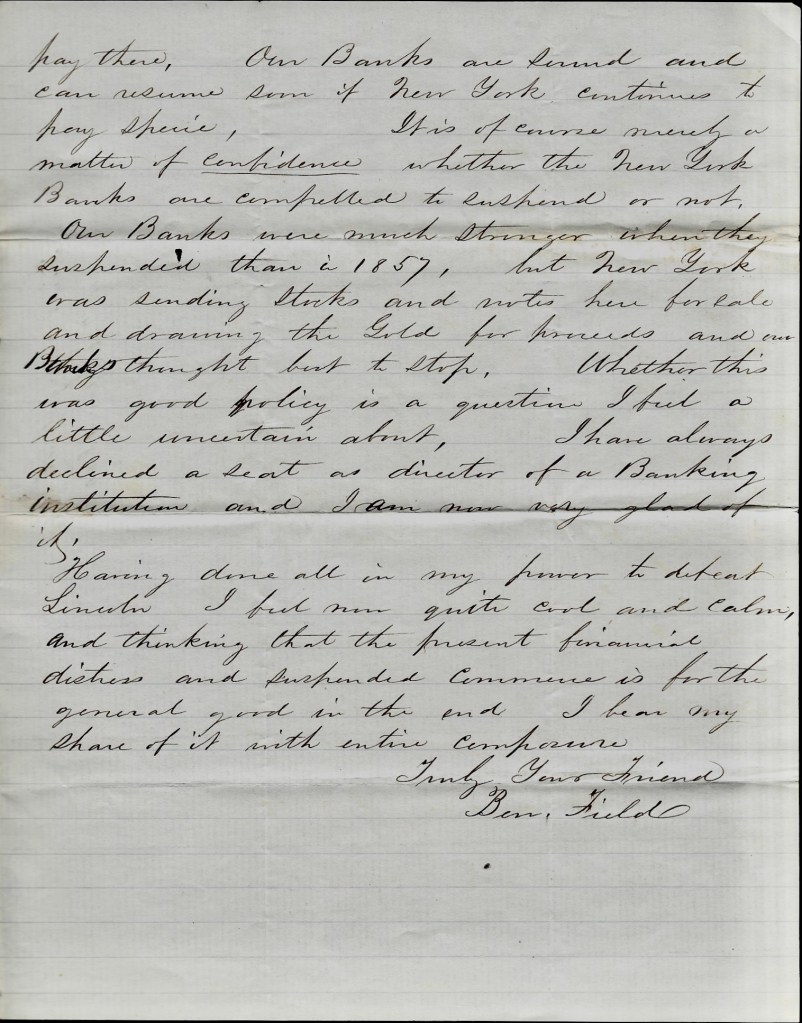
Benjamin wrote the letter to a client and friend named Maj. John Houston Bills, a wealthy planter residing in Bolivar, Tennessee—not far from Nashville. The purpose of the letter was to convey information pertaining to the intended purchase of jewelry by Major Bills but Benjamin using the opportunity to share his thoughts on the recent election of Abraham Lincoln as the next President. The “present course” of South Carolina mentioned in the letter of course refers to the calling of a convention to secede from the Union. That convention was subsequently convened and South Carolina seceded on 20 December 1861. Benjamin states in his letter that he supported South Carolina’s action thinking that only such a bold move will awaken the northern populace to the potential economic impact of disunion with the southern states and prevent the election of yet more Republicans in both houses of Congress who would pass laws that did not honor the existing Constitution.

Transcription

Philadelphia [Pennsylvania]
November 24, 1860

Major John H. Bills
Bolivar, Tennessee

Dear Sir,

The set of jewelry which Messers. Pratt & Reath were to show us today is not as near the description of your order as we supposed it might be. We have examined the stock of Bailey & Co. but do not find anything made up that answers the description. We have therefore instructed Pratt & Reath to have a set made Etruscan Gold, Carbuncle Crescent, set with pearls. They promise it by Thursday night. We hope that the worst of the financial panic is over though we will not feel decided on that subject until we see the return of the New York Banks which we get on Tuesday next 27th. We have had no failures here of consequence (except the Banks themselves) but hundreds of our deluded workmen who voted for Lincoln are already out of employment.

We think it fortunate that South Carolina has taken the present course at this time as we believe that it was necessary for the people to feel the power of southern commerce and to realize what they would suffer in losing it. The change in public sentiment within the last two weeks exceeds anything that we could have conceived possible.

We think it quite possible that if Carolina had made no stir, we would in a year or two have elected a “Republican” majority in both branches of Congress; and such a majority might pass a bill clearly unconstitutional in the eyes of the whole South, and in opposition to the decisions of the Supreme Court. Under such circumstances, the slaveholding states in a body would probably have withdrawn—never to return. Now we think it entirely clear that a majority of the slave-holding states will oppose secession, and we also think that the Northern States will withdraw all unfriendly legislation.

Until I had the law of our state published in the Pennsylvania last Monday, there was not one man in an hundred in this county knew that we had any law that interfered at all with the effective execution of the Fugitive Slave Act. The vast majority here mean to do right but they so not take the trouble to inform themselves.

Sight exchange on New York sells at 1% premium though if we buy from brokers we would pay 3%. We have no use for any at this time (I allude to our firm) as we have nothing to pay there. Our Banks are sound and can resume soon if New York continues to pay specie. It is of course merely a matter of confidence whether the New York Banks are compelled to suspend or not. Our Banks were much stronger when they suspended than in 1857, but New York was sending stocks and notes here for sale and drawing the Gold for proceeds and our Banks thought best to stop. Whether this was good policy is a question I feel a little uncertain about. I have always declined a seat as director of a Banking Institution and I am now very glad of it.

Having done all in my power to defeat Lincoln, I feel now quite cool and calm, and thinking that the present financial distress and suspended commerce is for the general good in the end, I bear my share of it with entire composure.

Truly your friend, — Ben. Field