

The following letter/poem was written by Albert Curtis Matthews (1826-1902), the son of Thomas Matthews (1799-1868) and Mercy Cady Curtis (1800-1889) of New Hampshire, later Cataract, Wisconsin. Albert was married in 1849 to Elizabeth (“Libbie”) Ferris (1826-1918). At the time of the Civil War, the couple had three children—Ellen (b. 1849, Curtis Earl (b. 1854), and Herbert Carl (b. 1860).
Albert served in the 18th Wisconsin Infantry, entering as a corporal and leaving as 1st Sergeant of Company D (“the Northwestern Rangers”). On June 5, 1863, he was discharged for promotion to 2nd Lieutenant of Co. H in the 8th Louisiana Colored Troops (47th USCT), joining the regiment at Milliken’s Bend. He resigned that commission in February 1864 after an extended illness.
The 18th Wisconsin wasn’t mustered into the service until 30 March 1862 when they left the state for Pittsburg Landing and reached there April 5, the day before the Battle of Shiloh. There, on Sunday morning, with absolutely no instruction in the manual of arms and but little drill, it was ordered to check the enemy’s advance. In one of his blog posts, author Dan Masters informs us that the men of the 18th Wisconsin “were assigned to Gen. Benjamin Prentiss’s Division who dispatched the Badgers to the right of his line in the woods just north of Spain Field. The men had spent the past week aboard river steamers and diarrhea had afflicted many of the men; meals had been sparse and the men’s digestive systems, used to good home cooked meals, struggled to adjust to the harsh army diet of hardtack and poorly cooked meat.” The regiment fought bravely but lost 24 killed, 82 wounded and 174 taken prisoners. To read more of the 18th Wisconsin at Shiloh, see: “Outright Murder: The 18th Wisconsin at Shiloh.”
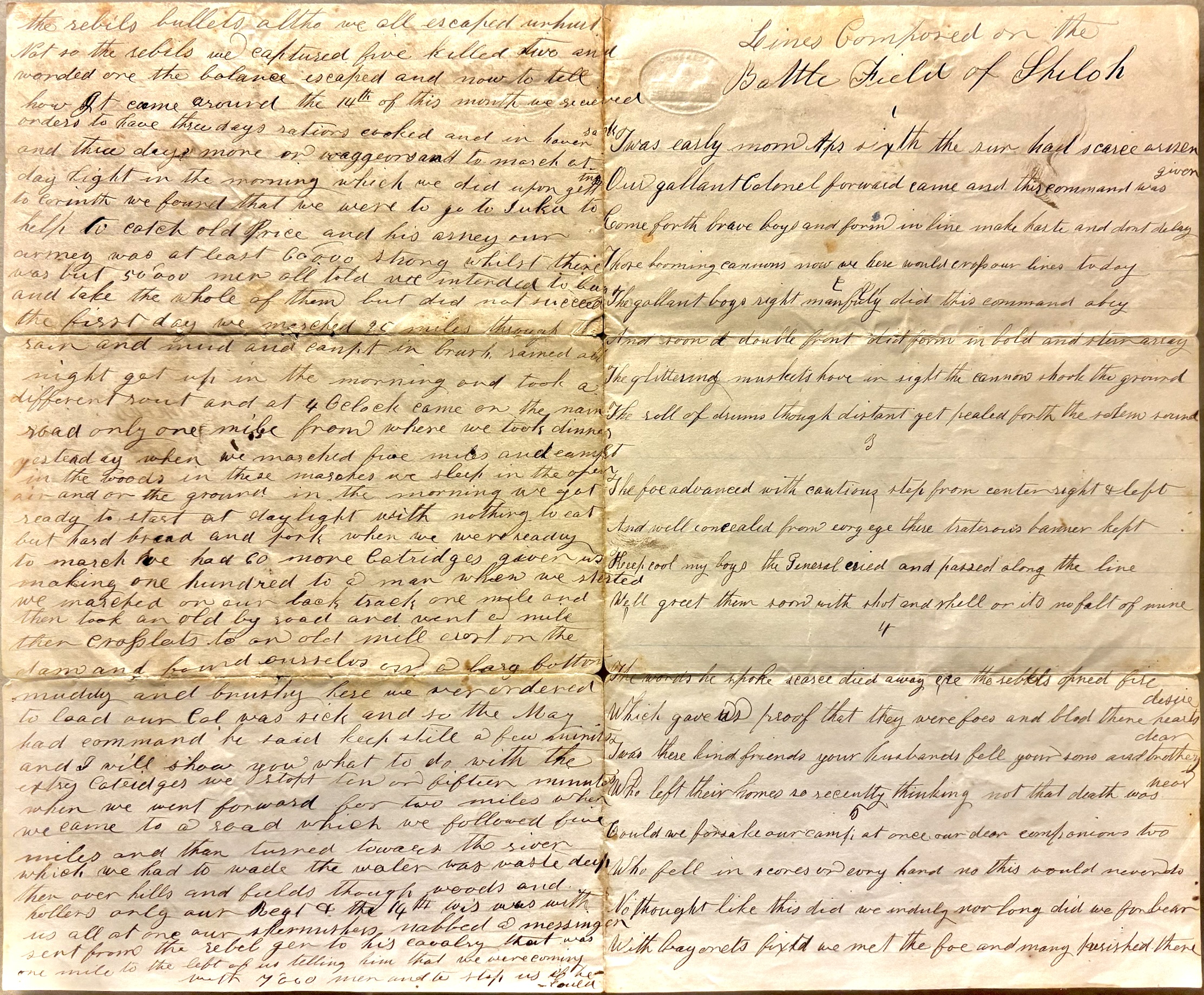
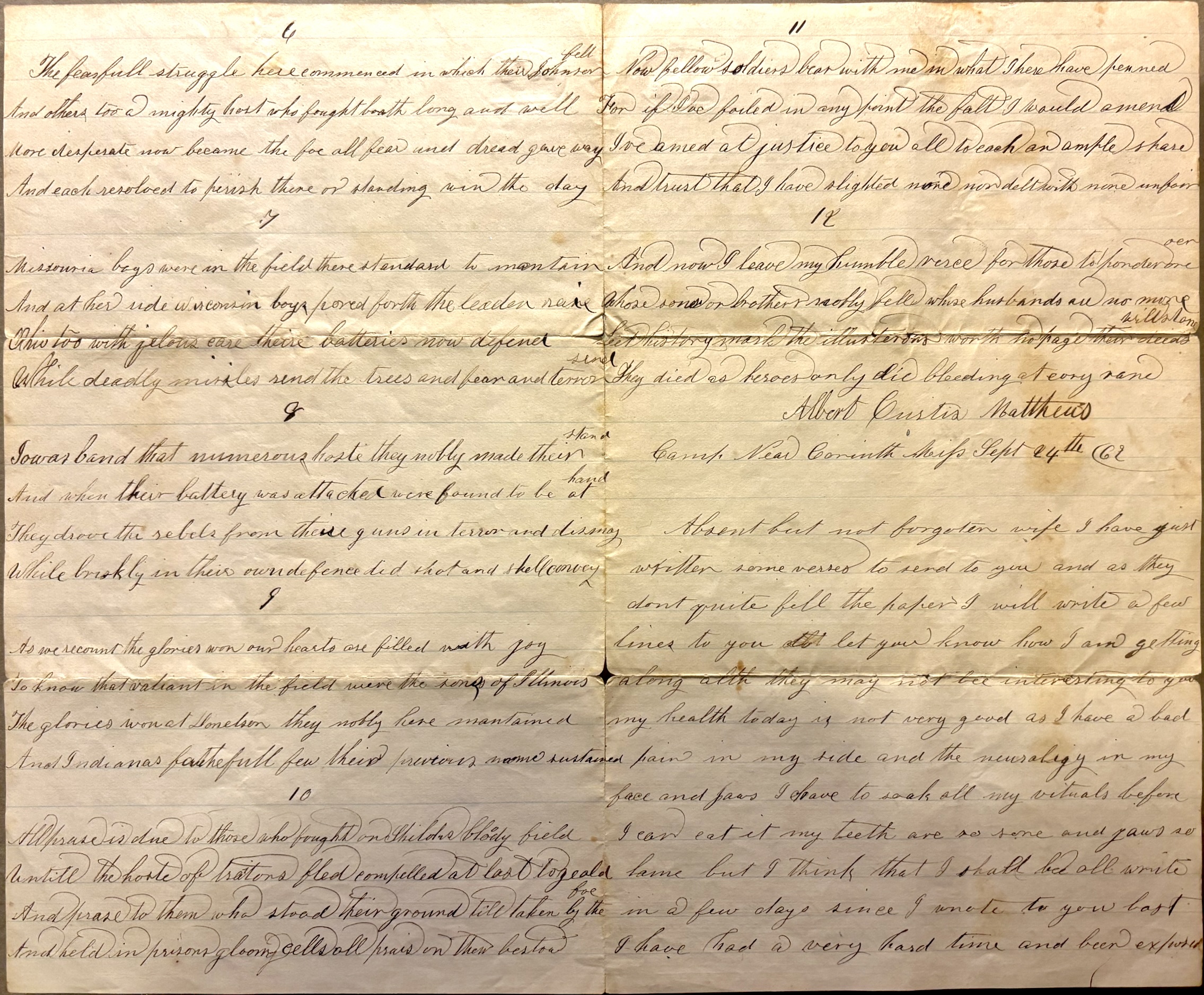
[Editor’s Note: The following poem/letter was made available for transcription and publication on Spared & Shared by James Kirchberg who has determined to donate it to the Wisconsin Veteran’s Museum. He sent it to me with the following description: “In 1999, I inherited a 4-page handwritten letter by a 35 year old sergeant named Albert Custis Matthews who served in the 18th Wisconsin during the American Civil War. The letter was dated September 24, 1862. The letter is folded in half to make four separate pages and was written to his wife in Cataract, Wisconsin. The first portion is a 12-stanza poem is about the Battle of Shiloh in which his regiment participated. That portion encompasses the first two and one-half pages. The last portion is about his experiences during the subsequent five months. His unit operated and fought in the area around Corinth and Iuka, Mississippi.” I have sometimes seen cases where soldiers would copy poems printed in newspapers and pass them off as their own. If Albert did this, I could not find the poem, or any portion of it, published in books or newspapers at the time. Albert claims it as original and I have no reason to question it. Unlike most transcriptions I publish, I have left Albert’s spelling intact. ]
T R A N S C R I P T I O N
Lines Composed on the Battle Field of Shiloh
1
Twas early morn Aps sixth the sun had scarce arisen
Our gallant Colonel forward came and this command was given
Come forth brave boys and form in line make haste and don’t delay
Those booming cannons now we here would cross our lines today
2
The gallant boys right manfully did this command obey
And soon double front did form in bold and stern array
The glittering muskets hove in sight the cannon shook the ground
The roll of drums though distant yet pealed forth the solem sound.
3
The foe advanced with cautious step from center, right and left
And well concealed from evry ege there traterous banner kept
Keep cool my boys the General cried and passed along the line
We’ll greet them soon with shot and shell or it’s no fault of mine.
4
The words he spoke scarce died away ere the rebels opened fire
Which gave us proof that they were foes and blod there hearts desire
Twas there kind friends your husbands fell your sons and brothers dear
Who left their homes so recently thinking not that death was near.
5
Could we forsake our camp at once, our dear companions too
Who fell in scores on every hand—no this would never do
No thought like this did we unduly nor long did we forbear
With bayonets fixed we met the foe and many perished there.
6
The fearful struggle here commenced in which their Johnson fell
And others too a mighty host who fought both long and well
More desperate now became the foe, all fear and dread gave way
And each resolved to perish there or standing win the day.
7
Missouria boys were in the field, there standard to maintain
And at her side Wisconsin boys pored forth the leaden rain
Ohio too with jelous care their batteries now defend
While deadly missiles rend the trees and fear and terror send.
8
Iowa’s band that numerous host, they nobly made their stand
And when their battery was attacked were found to be at hand
They drove the rebels from their guns in terror and dismay
While briskly in their own defence, did shot and shell convey.
9
As we recount the glories won, our hearts are filled with joy
To know that valiant in the field were the sons of Illinois
The glories who at Donelson they nobly here maintained
And Indiana’s faithful few their previous name sustained.
10
All prase is due to those who fought on Shiloh’s bloody field
Until the host of traitors fled compelled at last to yield
And raise to them who stood their ground till taken by the foe
And held in prisons, gloomy cells all prais on them bestow.
11
The fellow soldiers bear with me in what I here have penned
For if I’ve foiled in any point the fall I would amend
I’ve amed at justice to you all to each an ample share
And trust that I have slighted none nor delt with none unfair.
12
And now I leave my humble verse for them to ponder o’er
Whose son or brother nobly fell whose husbands are no more
But history mark the illusterous worth no page their deeds will stane
They died as heroes only die, bleeding at every vane.
— Albert Curtis Matthews
Camp near Corinth, Mississippi
September 24th 1862
Absent but not forgotten wife, I have just written some verses to send to you and as they don’t quite fill the paper, I will write a few lines to you to let you know how I am getting along although thy may not be interesting to you. My health today is not very good as I have a bad pain in my side and the neuralgy in my face and jaws. I have to soak all my victuals before I can eat it. My teeth are so sore and jaws so lame but I think that I shall be all write in a few days. Since I wrote to you last, I have had a very hard time and been exposed [to] the rebel’s bullets although we all escaped unhurt. Not so the rebels. We captured five, killed two, and wonded one. The balance escaped.
And now to tell how it came around. The 14th of this month we received orders to have three days rations cooked and in haversacks and three days more on waggeons and to march at day light in the morning which we did. Upon getting to Corinth we found that we were to go to Iuka to help catch Old Price and his army. Our army was at least 60,000 strong whilst theres was but 50,000 men all told. We intended to [ ] and take the whole of them but did not succeed. The first day we marched 25 miles trough the rain and mud and campt in brush. Rained all night. Got up in the morning and took a different rout and at 4 o’clock came on the main road only one mile from where we took dinner. Yesterday when we marched five miles and campt in the woods.
In these marches we sleep in the open air and or the ground. In the morning we got ready to start at daylight with nothing to eat but hard bread and pork. When we were ready to march, we had 60 more cartridges given us making one hundred to a man when we started. We marched on our back track one mile and then took an old by road and went a mile, then cross lots to an old mill, crost on the dam ad found ourselvs on a larg bottom, muddy and bushy. Here we were ordered to load. Our Colonel was sick and so the Maj[or] had command. He said keep still a few minutes and I will show you what to do with the extry cartridges. We stopt ten or fifteen minutes when we went forward for two miles when we came to a road which we followed five miles and then turned toward the river which we had to wade. The water was waste deep. Then over hills and fields thorough woods and hollers. Only our regiment and the 14th Wisconsin was with us. All at onc our skermishers nabbed a messenger sent from the rebel gen. to his cavalry that was one mile to the left of us telling him that we were coming with 7000 men and to stop us if he could…[rest of letter missing]
 Spared & Shared 23