
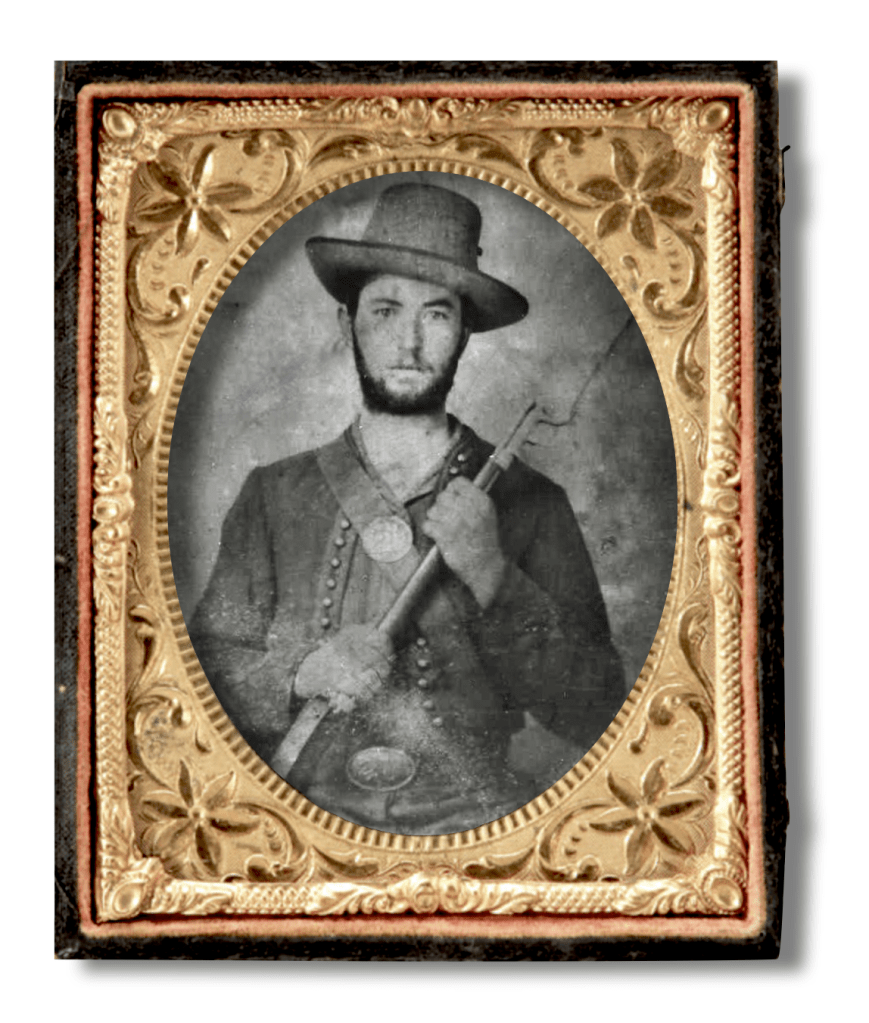
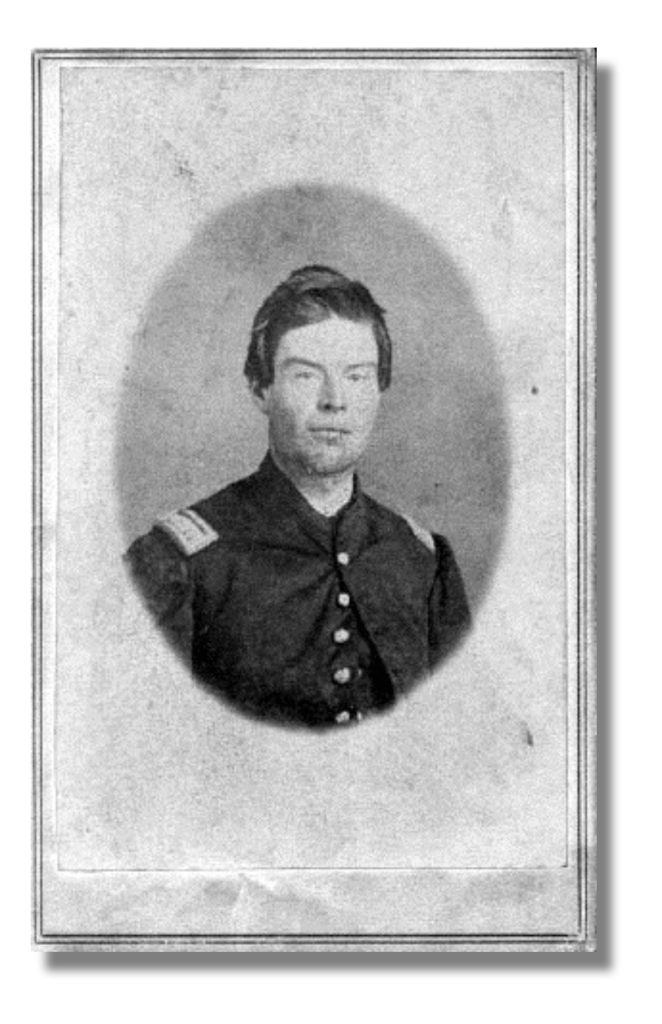
The following letters were written by Thomas Wright Oziah (1836-1908) of Co. B., 19th Illinois Infantry. Company B was raised in Stark county, Illinois, most of the members mustering into State service in May 1861 and into the United States Service for three years on 17 June 1861.
At the time that Thomas mustered into the regiment, he was described as a 25 year-old, brown-haired, blue-eyed “Miller” who towered over his comrades at 6 foot, 1 inch. During a portion of his time in the service, Thomas was detailed to the 14th Army Corps Headquarters to serve as a clerk for General Thomas.
After the war, Thomas married in 1867 to Hannah I. Meredith, and resumed his employment as a miller in Stark county. His parents were Anthony Oziah (1793-1848) and Anna Jayne (1797-1876). In his letter, Thomas mentions two brothers—James K. Oziah (1839-1879) who served in Co. I, 65th Illinois Infantry, and David Jayne Oziah (1819-1895), Co. B, 47th Illinois Infantry. Another brother, George W. Oziah (1832-1863) of Toulon, served in Co. F, 112th Illinois Infantry and died on 14 March 1863 at a hospital in Lexington, Kentucky.
Letter 1
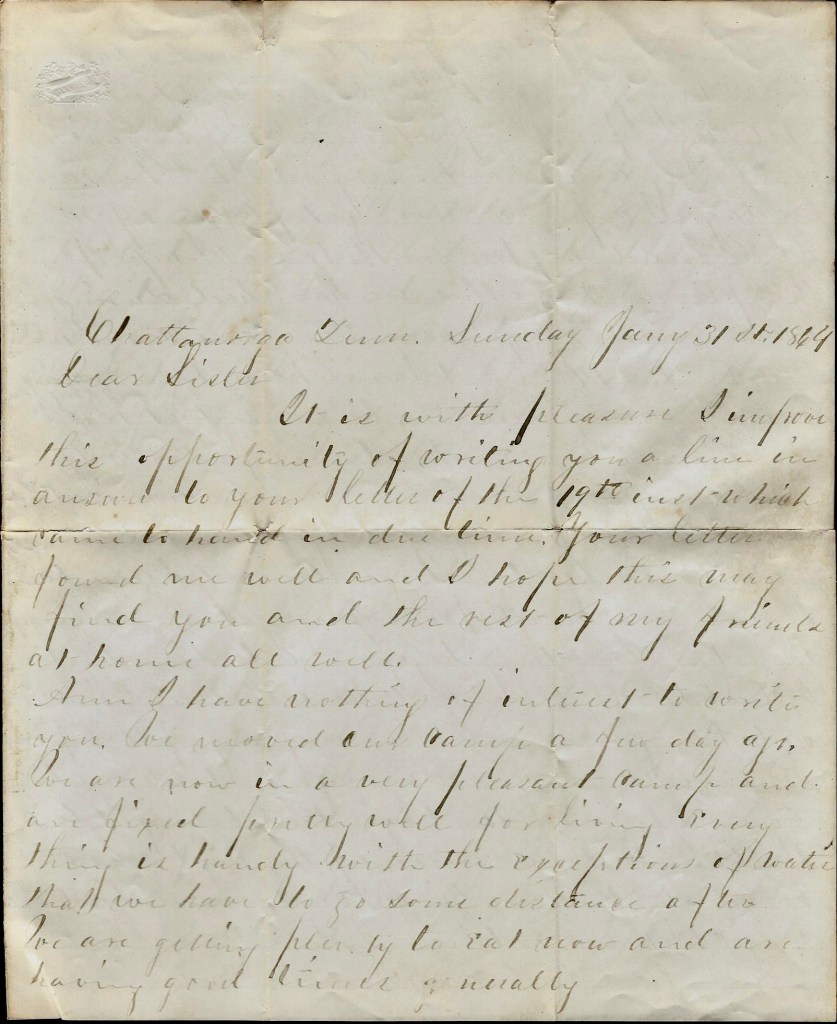
Chattanooga, Tennessee
Sunday, January 31, 1864
Dear Sister,
It is with pleasure I improve this opportunity of writing you a line in answer to your letter of the 19th inst. which came to hand in due time. Your letter found me well and I hope this may find you and the rest of my friends at home all well.
Ann, I have nothing of interest to write you. We moved our camp a few days ago. We are now in a very pleasant camp and are fixed pretty well for living. Everything is handy with the exception of water that we have to go some distance after. We are getting plenty to eat now and are having good times generally.
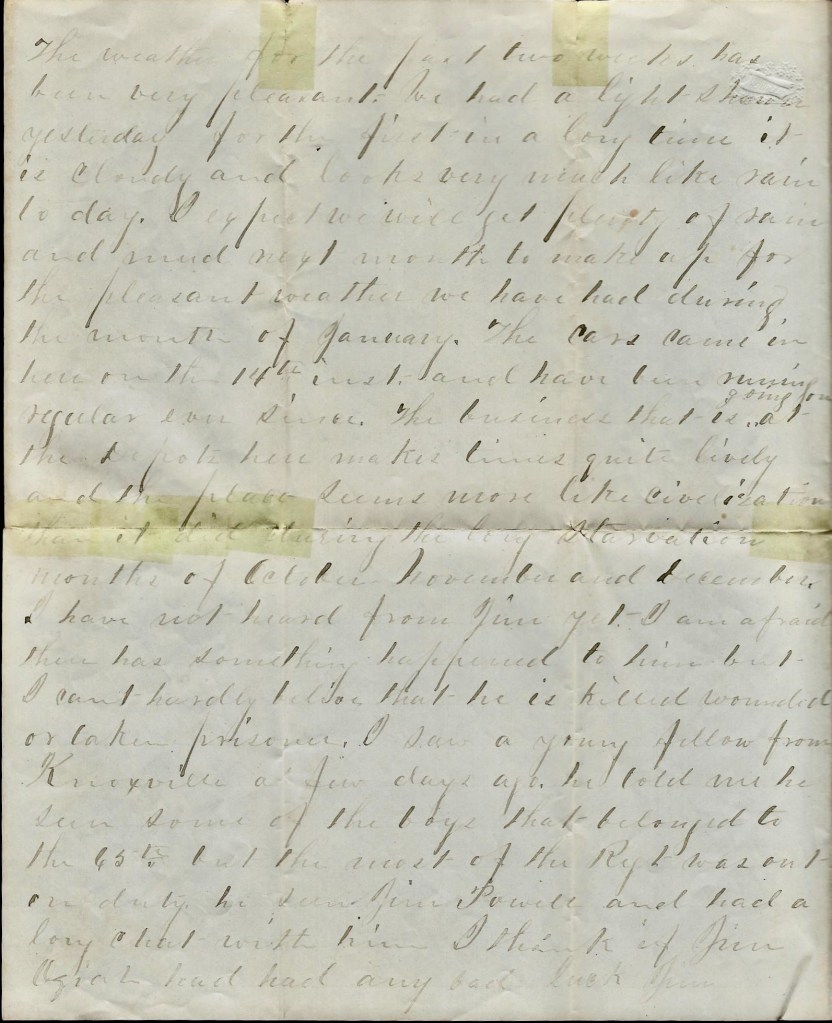
The weather for the past two weeks has been very pleasant. We had a light shower yesterday for the first in a long time. It is cloudy and looks very much like rain today. I expect we will get plenty of rain and mud next month to make up for the pleasant weather we have had during the month of January.
The cars came in here on the 14th inst. and have been running regular ever since. The business that is going on at the Depots here makes times quite lively and the place seems more like civilization than it did during the long starvation months of October, November, and December.
I have not hear from Jim yet. I am afraid there has something happened to him but I can’t hardly believe that he is killed, wounded, or taken prisoner. I saw a young fellow from Knoxville a few days ago. He told me he seen some of the boys that belonged to the 65th but the most of the regiment was out on duty. He saw Jim Powell and had a long chat with him. I think if Jim Oziah had had any bad luck, Jim Powell would have said something about it to this fellow. It was about four weeks ago that he seen Jim Powell.
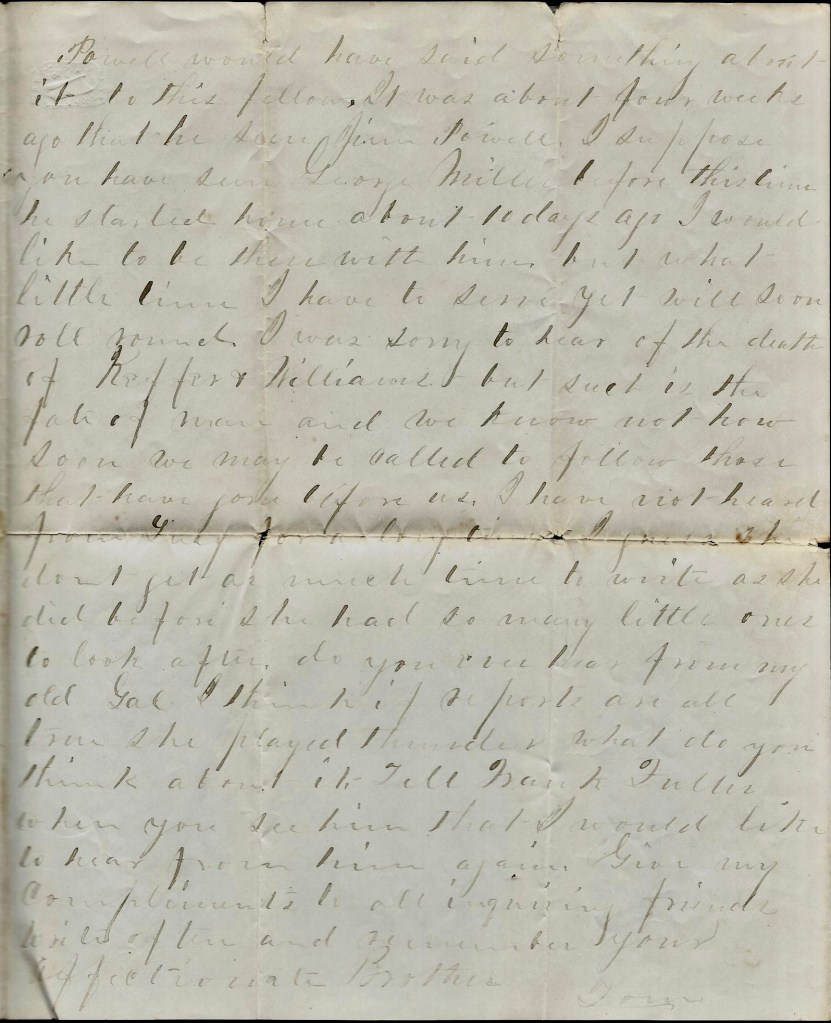
I suppose you have seen George Miller before this time. He started home about 10 days ago. I would like to be there with him but what little time I have to serve yet will soon roll round. I was sorry to hear of the death of Keffer &Williams but such is the fate of man and we know not how soon we may be called to follow those that have gone before us. I have not heard from Lucy for a long time so I guess she don’t get as much time to write as she did before. She had so many little ones to look after. Do you ever hear from my old gal? I think if reports are all true, she played thunder. What do you think about it?
Tell Frank Fuller when you see him that I would like to hear from him again. Give my compliments to all inquiring friends. Write often and remember your affectionate brother, — Tom
Letter 2
Graysville, Georgia
March 12th 1864
Dear Sister,
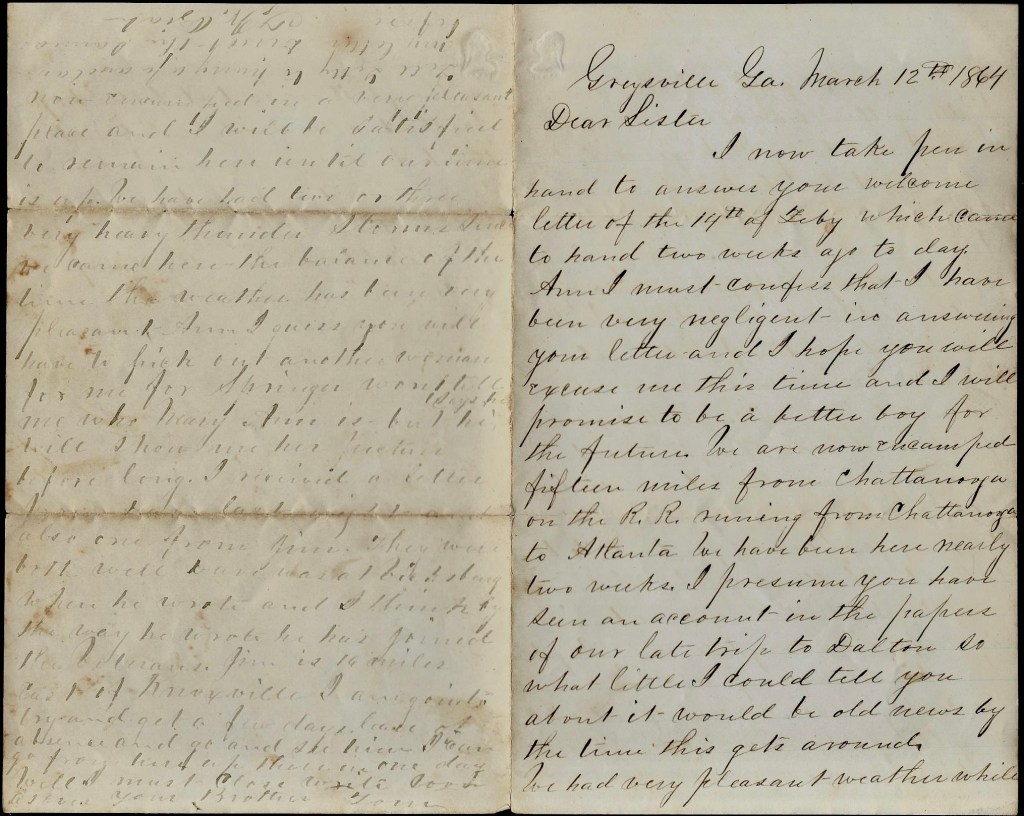
I now take my pen in hand to answer your welcome letter of the 14th of February which came to hand two weeks ago today. Ann, I must confess that I have been very negligent in answering your letter and I hope you will excuse me this time and I will promise to be a better boy for the future.
We are ow encamped fifteen miles from Chattanooga on the railroad running from Chattanooga to Atlanta. We have been here nearly two weeks. I presume you have seen an account in the papers of our late trip to Dalton so what little I could tell you about it would be old news by the time this gets around.
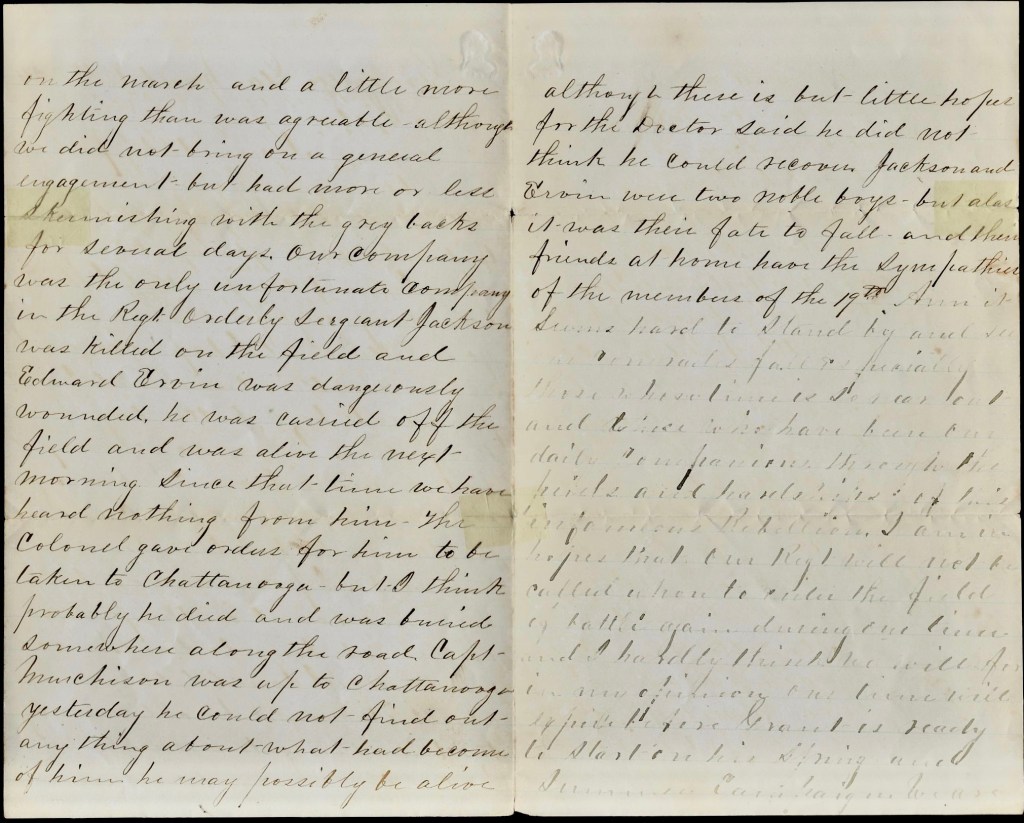
We had very pleasant weather while on the march and a little more fighting than was agreeable although we did not bring on a general engagement but had more or less skirmishing with the gray backs for several days. Our company was the only unfortunate company in the regiment. Orderly Sergeant [James] Jackson was killed on the field and Edward Ervin was dangerously wounded. He was carried off the field and was alive the next morning. Since that time we have heard nothing from him. The Colonel gave orders for him to be taken to Chattanooga but I think probably he died and was buried somewhere along the road. Capt. [Alexander] Murchison was up to Chattanooga yesterday. He could not find out anything about what had become of him. He may possibly be alive although there is but little hope for the doctor said he did not think he could recover. Jackson and Ervin were two noble boys. But alas, it was their fate to fall and their friends at home have the sympathies of the members of the 19th.
Ann, it seems hard to stand by and see our comrades fall—especially those whose time is so near out and those who have been our daily companions through the trials and hardships of this infamous rebellion. I am in hopes that our regiment will not be called upon to enter the field of battle again during our time and I hardly think we will for in my opinion our time will expire before Grant is ready to start on his spring and summer campaign.
We are now encamped in a very pleasant place and I will be satisfied to remain here until out time is up. We have had two or three very heavy thunder storms since we came here. The balance of the time the weather has been very pleasant. Ann, I guess you will have to pick out another woman for me for Springer won’t tell me who Mary Ann is but he will show me her picture before long. I received a letter from Dave last night and also one from Jim. They were both well. Dave was at Vicksburg when he wrote and I think by the way he wrote, he has joined the Veterans. Jim is 16 miles east of Knoxville. I am going to try and get a few days leave to go from here up there in one day.
Well, I must close. Write soon. As ever, your brother, — Tom
Tell Letty to hurry up and answer my letter. Direct the same as before. — T. W. Oziah

 Spared & Shared 23