This letter was written by George Lincoln Dow (1836-1892) of Co. G, 19th Maine Infantry. George enlisted in August 1862 when he was 26 years old and was discharged for disability in February 1863. George was the son of Benjamin Dow (1810-1895) and Eliza A. Lincoln (1812-1888) of China, Kennebec county, Maine. He addressed the letter to his sister, Amanda Jane Dow (1839-1903) and mentions other siblings, Charles (b. 1832), William (b. 1834), Everett (b. 1842) and Roscoe (b. 1846) which helped to confirm his identity given that the signature was cryptic.
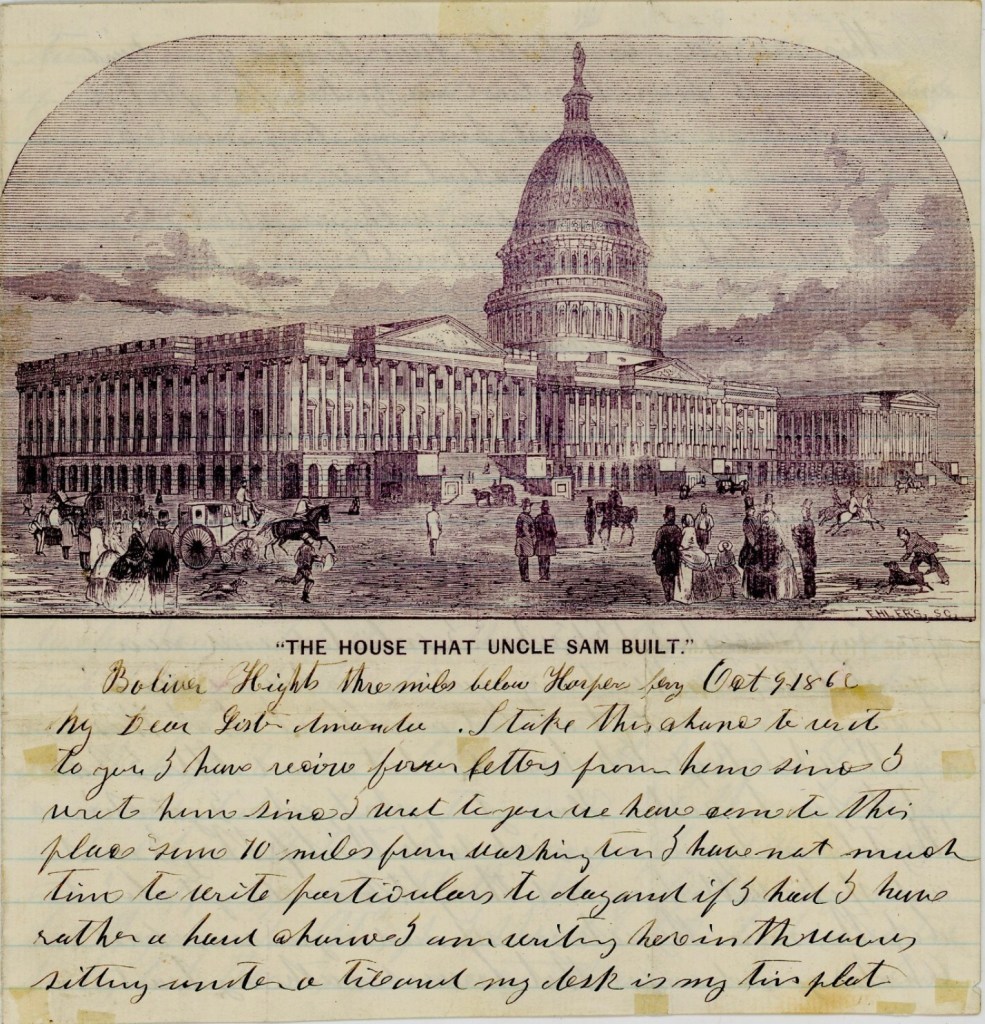
Bolivar Heights Three miles below Harpers Ferry October 9, 1862
My dear sister Amanda,
I take this chance to write to you. I have received four letters from home since I wrote home. Since I wrote to you, we have come to this place some 70 miles from Washington. I have not much time to write particulars today and if I had, I have rather a hard chance. I am writing here in the woods sitting under a tree and my desk is my tin plate turned sunny side up in my lap.
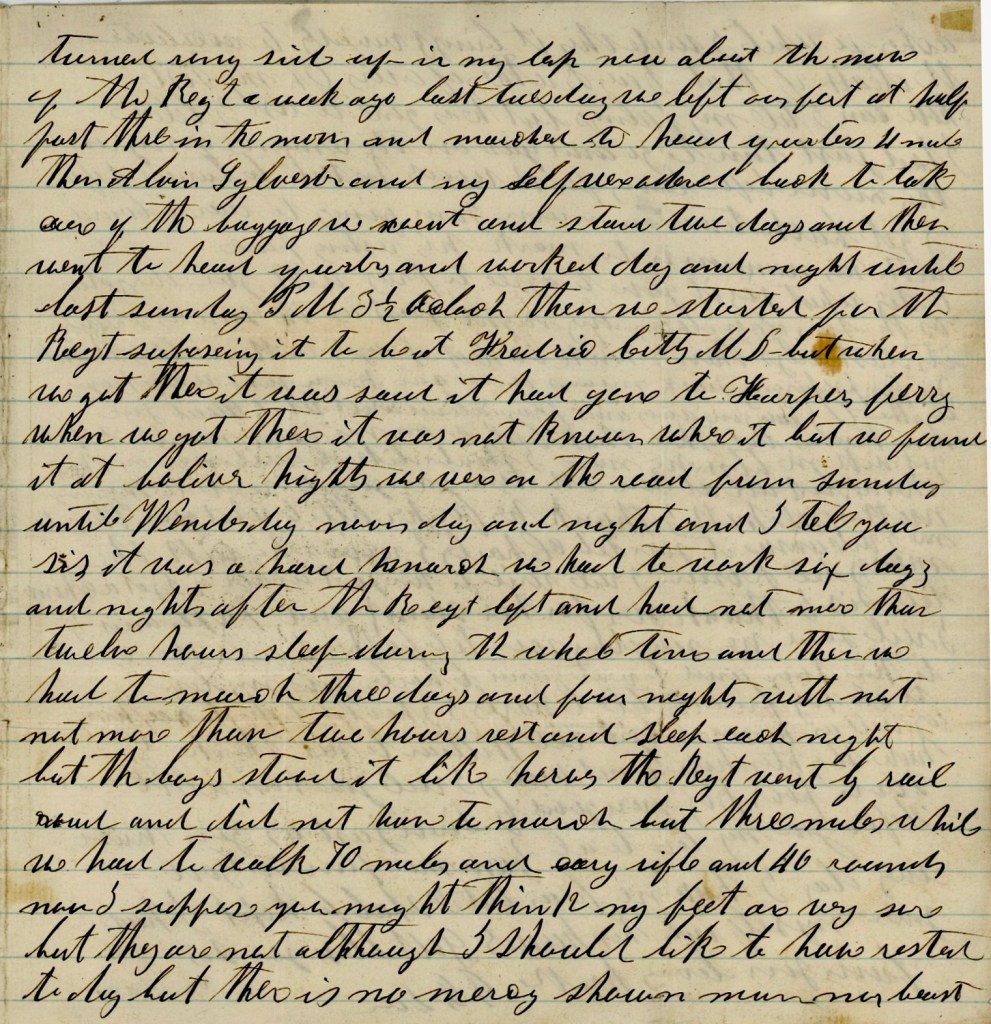
Now about the men of the regiment, a week ago last Tuesday we left our fort at half past three in the morn and marched to headquarters 4 miles. Then Alvin Sylvester 1 and myself were ordered back to take care of the baggage. Went and stayed two days and then went to headquarters and worked day and night until last Sunday p.m. 3.30 o’clock. Then we started for the regiment, supposing it to be at Frederick City, Maryland. But when we got there, it was said it had gone to Harpers Ferry. When we got there, it was not known where it was but we found it at Bolivar Heights. We were on the road from Sunday until Wednesday noon, day and night, and I tell you, Sis, it was a hard march. We had to work six days and nights after the regiment left and had not more than twelve hours sleep during the whole time and then we had to march three days and four nights with not more than two hours rest and sleep each night. But the boys stood it like heroes.
The regiment went by railroad and did not have to march but three miles while we had to walk 70 miles and carry rifle and 40 rounds. Now I suppose you. might think my feet are very sore but they are not although I should like to have rested today. But there is no mercy shown man nor beast here. This morn we was detailed to camp [ ] regiment connected with four hundred New Yorkers for picket duty so after one night’s rest from my long march, I had to come here this morn about three miles. Near here in the woods six hundred of us within a short distance of the Rebs but have fears of trouble from them. The prospect is they say we are to hold this place—that is, where the brigade is. We have 46 thousand men here, most old regiments. This is to be our position. We’re on the old battlefield where Col. Miles surrendered to the Rebs. I will give you all the minute moves when I have a chance. Suffice now for me to say that I am first best [ ] if you can english such language.
I have gained 16.5 pounds since I came into this show as they say. I weighed 155 when I enlisted and now I weigh 171.5 without any coat on. We have loads to carry now. We left all but our blankets at Washington—the whole regiment.
Oh, Amanda, what a sad letter I have got to pen to sister Harrington. Yesterday when I got here, they told me Myron was sick with the diphthey. I went and spoke with him and thought he get over it but this morning they woke me up and Myron was dead. Oh sis, go and comfort that [ ] Mother. My heart aches so while I write this. It brings vividly to recollection the death of that dear brother of ours. Oh my sister, how can I tell my feelings. But he is gone to rest. I believe I have just time to go and gaze on the remains of Myron this morn before leaving for the woods. He will be buried before I get back tomorrow morn. I am going to [ ] a board with his name on it to mark his resting place. 2
Oh sis, what joy it gives to agree to pray with you every day as the sun goes down every night just as the sun is shedding its last rays, then I sink in deep prayer with you. Oh, I thank you for prosing such means to see to our [ ] sake by praying together…I should like to write more on this theme but will at some other time. I am going to write to Mryon’s mother.
Tell Mother I thank her for her letter. Oh what good they do me. I will answer it soon. Tell Charley I received his with the money. Tell Roscoe I will write to him just as soon as I get a chance. Tell Sis I thank her for her stamp and paper and I will send her something soon. Tell Father I will write to him soon and Everett and Charles. Give my love to all the family. Tell Charles I should like to see him as well as he would me. Tell William to not think I have slighted him by not writing. I will give him a letter soon, poor boy. Now goodbye. Direct just as you have before. Give my love to all. I am more form in God every day. I have no fear but I shall be kept. I have given myself into his hands. God bless you, Sis. From your loving brother, — G. L. Dow
1 Alvin Sylvester was 39 years old when he enlisted in Co. G, 19th Maine Infantry. He was hospitalized in mid-June 1863 and transferred to Co. F, 24th Veteran Reserve Corps, He mustered out of the service on 23 April 1864. He was also from China, Maine.
2 Myron Clarke Harrington (1844-1862) of Co. C, 19th Maine Infantry was the son of Brazilla Harrington (1819-1885) and Lucy Ann Adams Bean (1823-1906) of China, Kennebec county, Maine. He died of diphtheria on 9 October 1862 on Bolivar Heights, [West] Virginia.
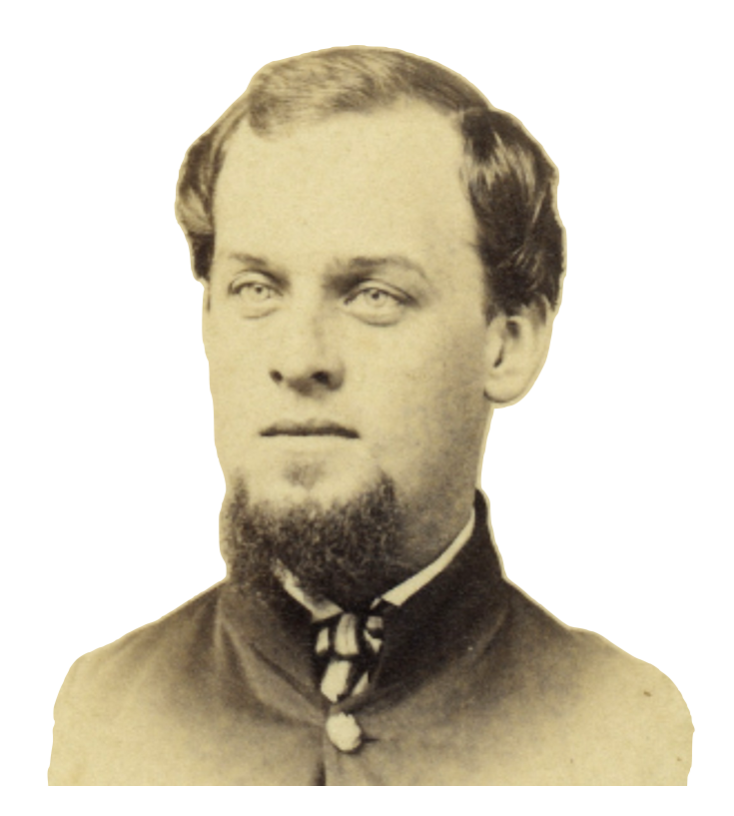
Corporal Warren B. Thorndyke of the 19th Maine Infantry
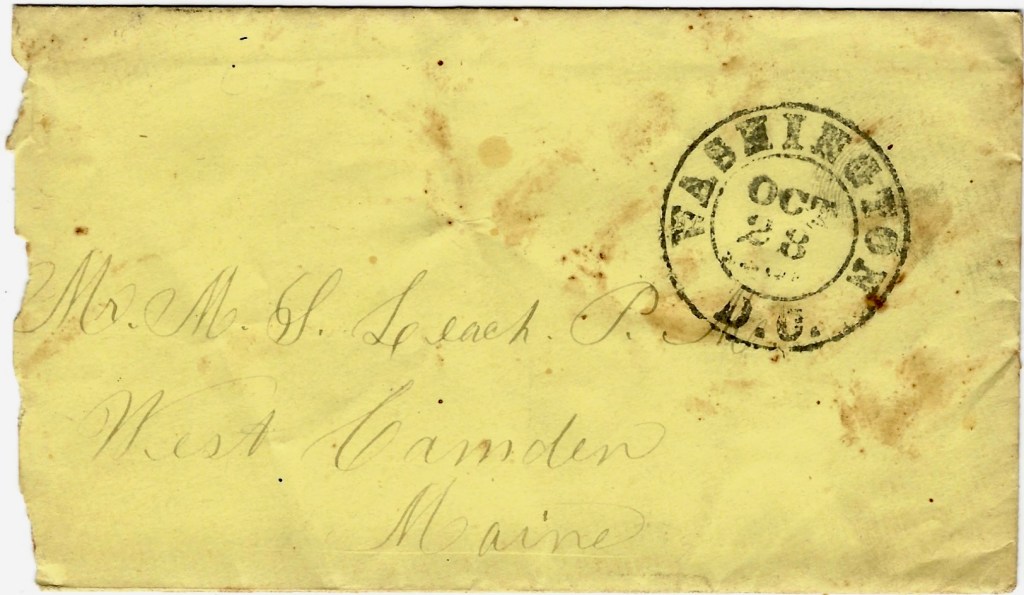
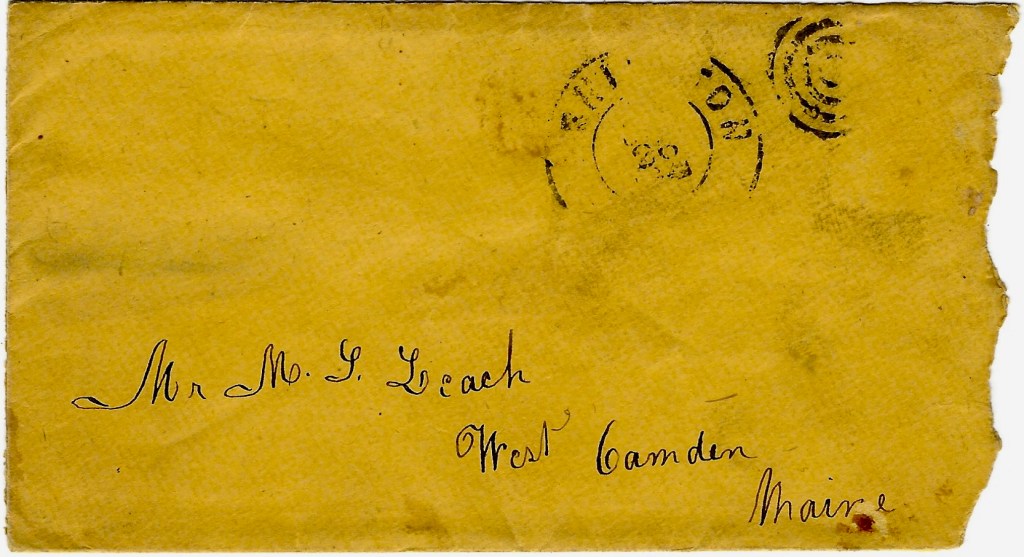
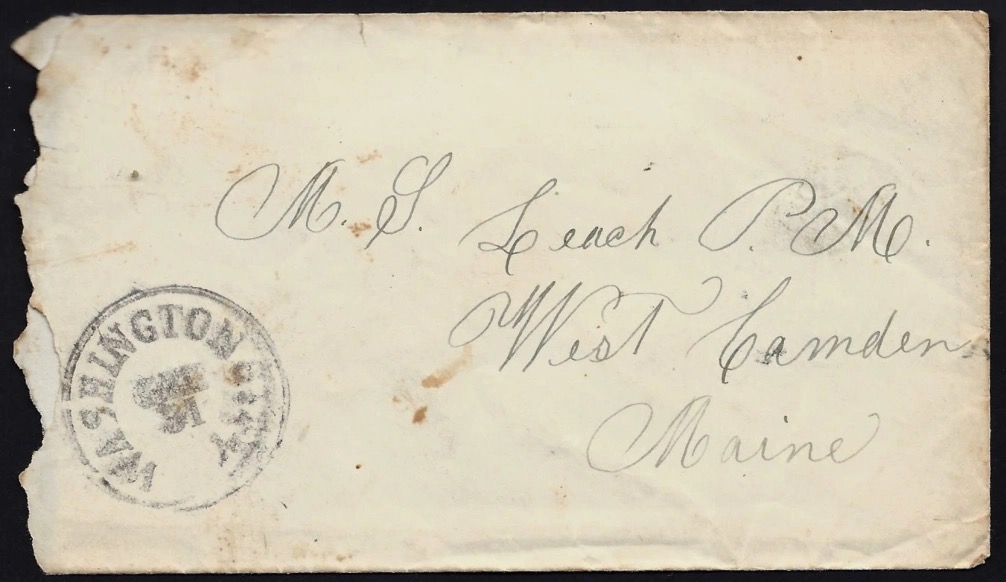
These letters were written by Cpl. Warren B. Thorndike (1840-1865) of Co. I, 19th Maine Volunteer Infantry. Warren was the son of Larkin Thorndike (1809-1893) and Abigail (Hall) Grant (1804-1863) of Camden, Knox county, Maine. He wrote the letters to members of his family, including his sister, Harriet Eleanora Thorndike who married Roscoe “Miles” Carter in March 1863, and to his brother-in-law, Miles.
As a member of the 19th Maine, Thorndike saw action at Fredricksburg, Chancellorsville, Bristoe Station, Gettysburg, the Wilderness, Spotsylvania, the North Anna River and Cold Harbor. On June 23, 1864, Cpl. Thorndike and 133 other Union soldiers were taken prisoner along the Jerusalem Plank Road near Petersburg and marched off to Andersonville Prison. He died of scorbutus in March 1865 and is buried at Andersonville National Cemetery—grave marker 12716.
[Note: Most of these letters are from the private collection of Greg Herr and were made available for transcription and publication on Spared & Shared by express consent.]
Letter 1
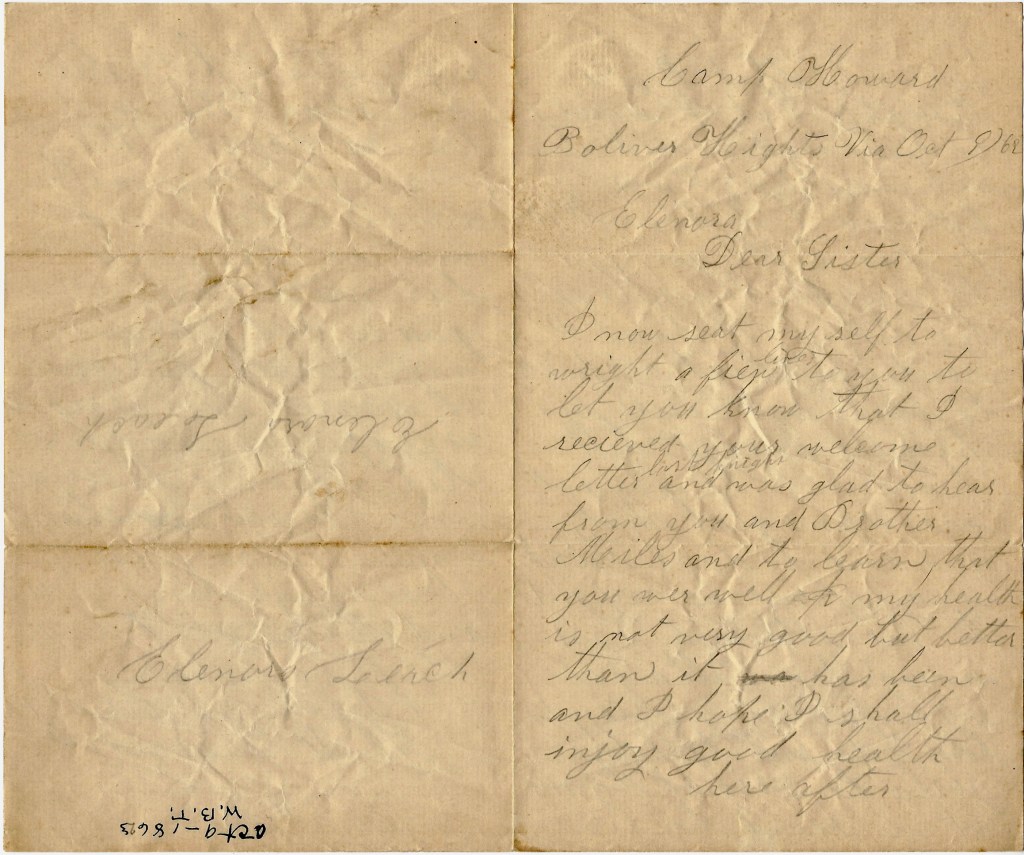
Camp Howard Bolivar Heights, Va. October 9th 1862
Dear Sister Eleanora,
I now seat myself to write a few lines to you to let you know that I received your welcome letter last night and was glad to hear from you and brother Miles and to learn that you were well. My health is not very good but better than it has been and I hope I shall enjoy good health hereafter.
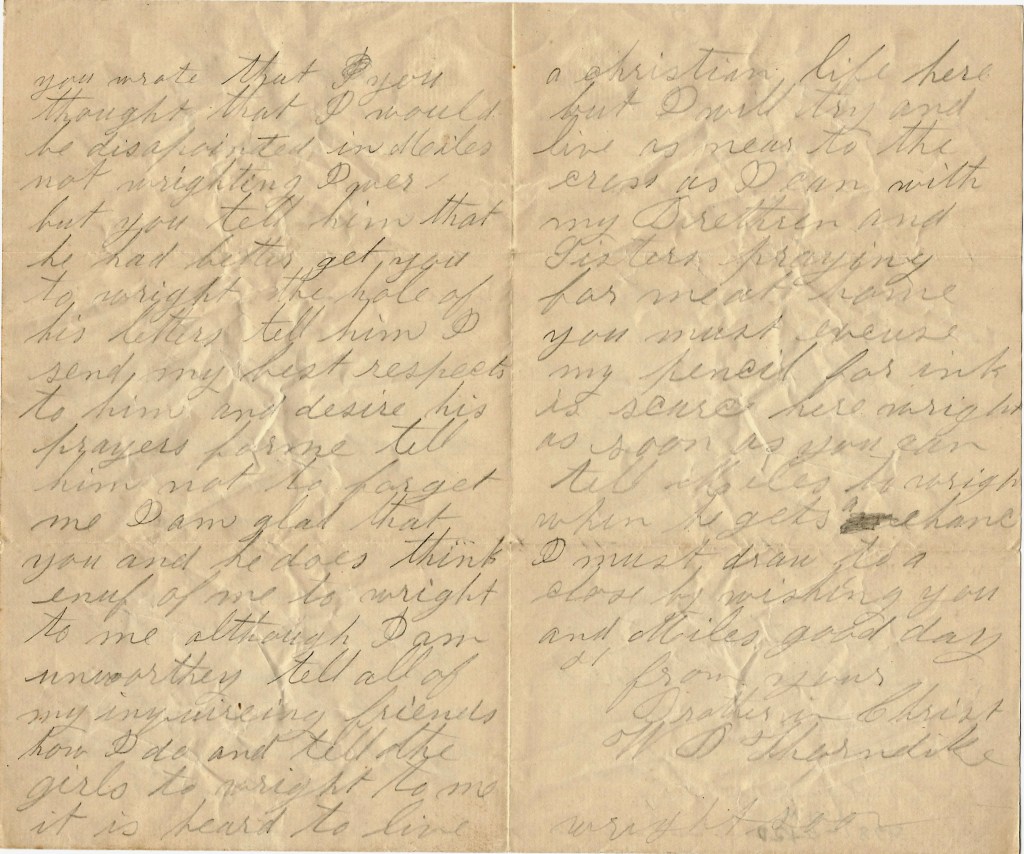
You wrote that you thought that I would be disappointed in Miles’ not writing. I was but you tell him that he had better get you to write the whole of his letters. Tell him I send my best respects to him and desire his prayers for me. Tell him not to forget me. I am glad that you and he does think enough of me to write to me although I am unworthy. Tell all of my inquiring friends how I do and tell the girls to write to me.
It is hard to live a Christian life here but I will try and live as near to the cross as I can with my brethren and sisters praying for me at home. You must excuse my pencil for ink is scarce here. Write as soon as you can. Tell Miles to write when he gets a chance. I must draw to a close by wishing you and Miles good day. From your brother in Christ, — W. B. Thorndike
Letter 2
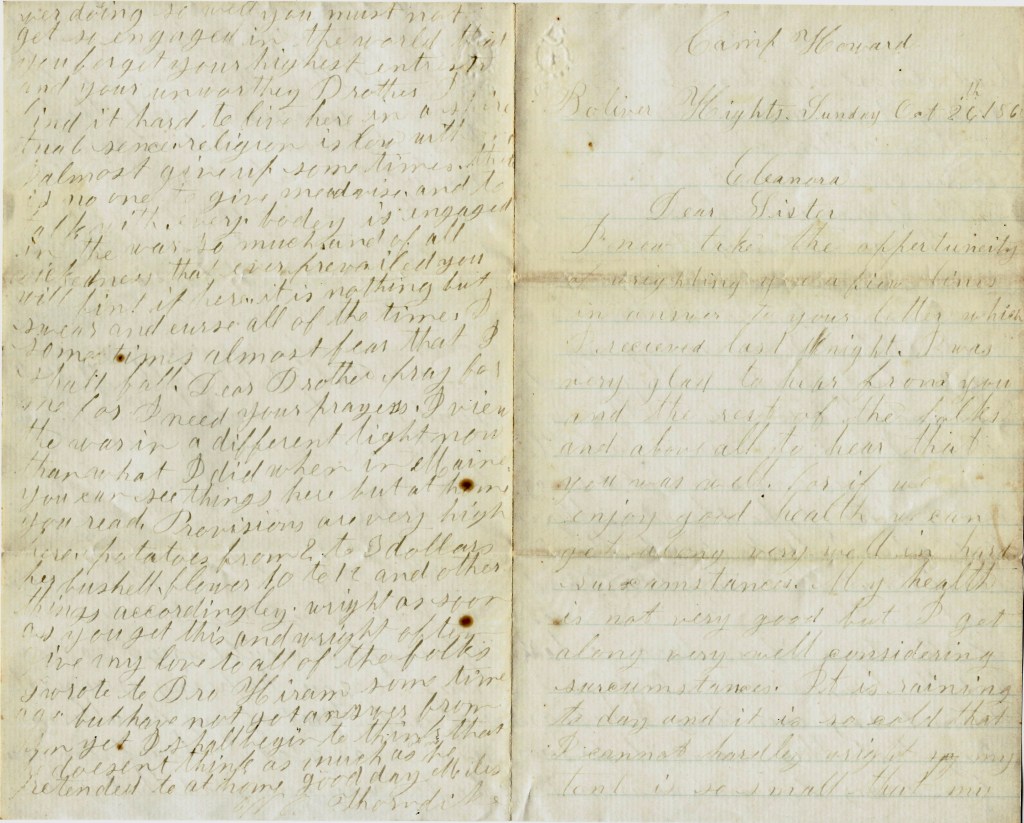
Camp Howard Bolivar Heights, [Virginia] Sunday, October 26th 1862
Eleanora, dear sister,
I now take the opportunity of writing you a few lines in answer to your letter which I received last night. I was very glad to hear from you and the rest of the folks and above all to hear that you was well for if we enjoy good health, we can get along very well in hard circumstances. My health is not very good but I get along very well considering circumstances. It is raining today and it is so cold that I cannot hardly write. My tent is so small that my head almost reaches the top sitting down and it is made of thin cotton cloth and it is rather cold some of the time. I wish you could see me sitting on the ground writing for that is the way I have to do it. Seems so strange to what I have been used to. When I was eating my supper last night, I thought of you and Miles. I will tell you what I had for supper—a little piece of fresh meat about two [ ] and a piece of hard bread as big, and that, when I broke it up, the crumbs scrambled all over my plate. And that is the way we live most of the time. It is hard to bear and the laws are very strict so I dare not say anything. I hope and pray that this war will soon close. Pray for me. We are not allowed to was sometimes for a week. It seems hard to go hungry and dirty both. I have not been in battle yet but they think we shall go soon. You may think that I am homesick but it is not so. But I am about sick of this war. There is no news of any importance that can be relied on. I am glad to hear from you by the way and glad that you are doing so well. You must not get so engaged in the world that you forget your highest interest and your unworthy brother. I find it hard to live here in a spiritual sense. Religion is low with us. I almost give up sometimes. There is no one to give me advice and to talk with. Everybody is engaged in the war so much and of all wickedness that ever prevailed you will find it here. It is nothing but swear and curse all of the time. I sometimes almost fear that I shall fall. Dear brother, pray for me for I need your prayers. I view the war in a different light now than what I did when in Maine. You can see things here but at home you read. Provisions are very high here. Potatoes from two to three dollars per bushel, flour 10 to 12, and other things accordingly. Write as soon as you get this and write often. Give my love to all of the folks. I wrote to Bro. Hiram some time ago but have not got answers from him yet. I shall begin to think that he doesn’t think as much as he pretended to at home. Good day, Miles. — W. B. Thondike
Letter 3
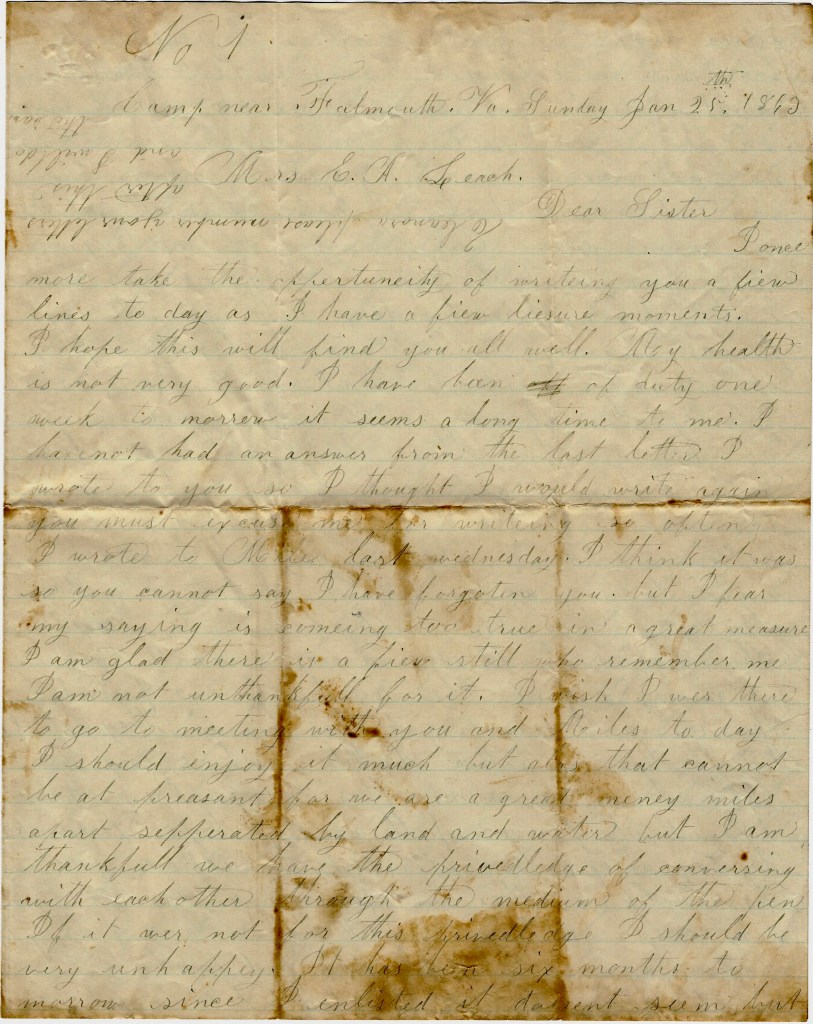
Camp near Falmouth, Virginia Sunday, January 25, 1863
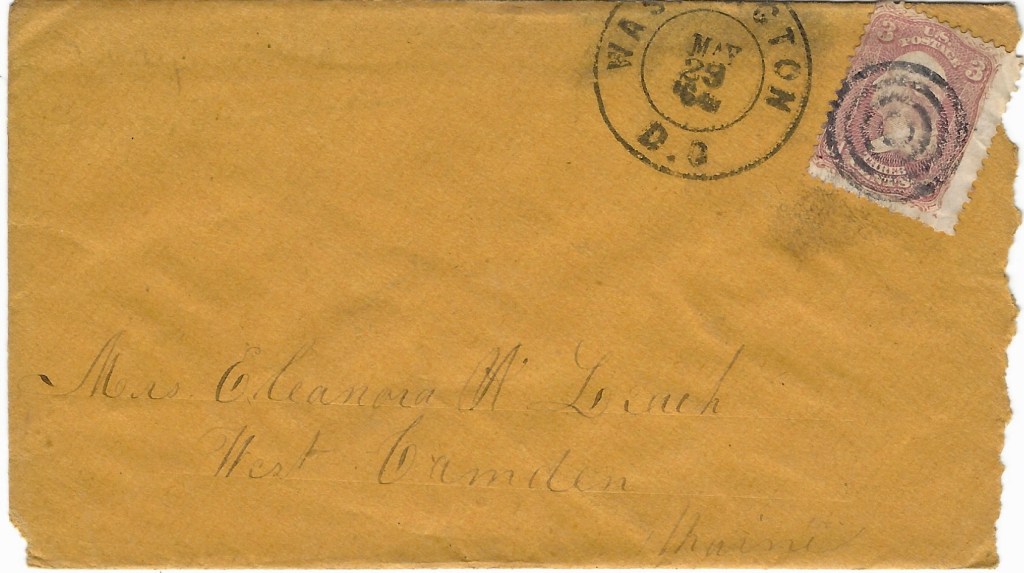
Mrs. E. A. Leach,
Dear sister, I once more take the opportunity of writing you a few lines today as I have a few leisure moments. I hope this will find you all well. My health is not very good. I have been off duty one week tomorrow. It seems a long time to me. I have not had an answer from the last letter I wrote to you so I thought I would write again. You must excuse me for writing so often. I wrote to Miles last Wednesday I think it was, so you cannot say I have forgotten you. But I fear my saying is coming too true in a great measure. I am glad there is a few still who remember me. I am not unthankful for it. I wish I was there to go to meeting with you and Miles today. I should enjoy it much but alas, that cannot be at present for we are a great many miles apart, separated by land and water. But I am thankful we have the privilege of conversing with each other through the medium of the pen. If it were not for this privilege, I should be very unhappy.
It has been six months tomorrow since I enlisted. It don’t seem but a few days to look back upon. I haven’t but two years and a half longer to stay. That isn’t a great while. It will soon pass away and then, oh the joy of meeting once more. But whether we shall meet on earth again or not, who can tell. But sister, I hope we shall meet in realms above. Oh the joy of meeting there where there will be no parting nor sorrow. I wish I were there to dine with you today for all we have to eat is hard bread today. It is rather hard. To think that there is a plenty to eat at home and we have to go hungry. But these days will not always last.
I haven’t got your box yet but expect to in two or three days. I long for the time to come. How I shall enjoy it. I shall write to you again when I get it. I am glad you thought enough of me to take the pains to do so. I never shall forget it in you and the rest of my friends. The reason I did not get the box is they calculated to have another battle but owing to the storm or some other cause, they have delayed it for a spell and I hope forever,
Today is quite pleasant. I suspect you have cold weather in Maine. We do not have very cold weather here. I was reading your paper you sent me today and wishing I had a later one to read. I should like to get home in the spring time to go to Sabbath School but that is improbable. It causes me to sigh when I think of it. Sister pray for me that I may be spared to get home once more. I think I can be contented to do so.
I wish you could see my house I live in. I guess you would laugh. Give my love and best respects [to] your Mother and Father and Henry and Fanny and all the folks. Tell Miles I want his prayers for me. Tell him to write to me punctually. You must write often, Eleanora, for I like to hear from you. Tell Edward and Emily I send my love to them. When you write, tell me all the news you can think of for I like to hear what is going on at home. Tell all of the folks to write for I should be happy to hear from them. I sometimes almost get discouraged and ready to give up but that will never do. I find it never will do to look on the dark side. Religion is low with me but still I have a hope in God’s mercy and hope I shall never be left to deny the cause [of] Christ.
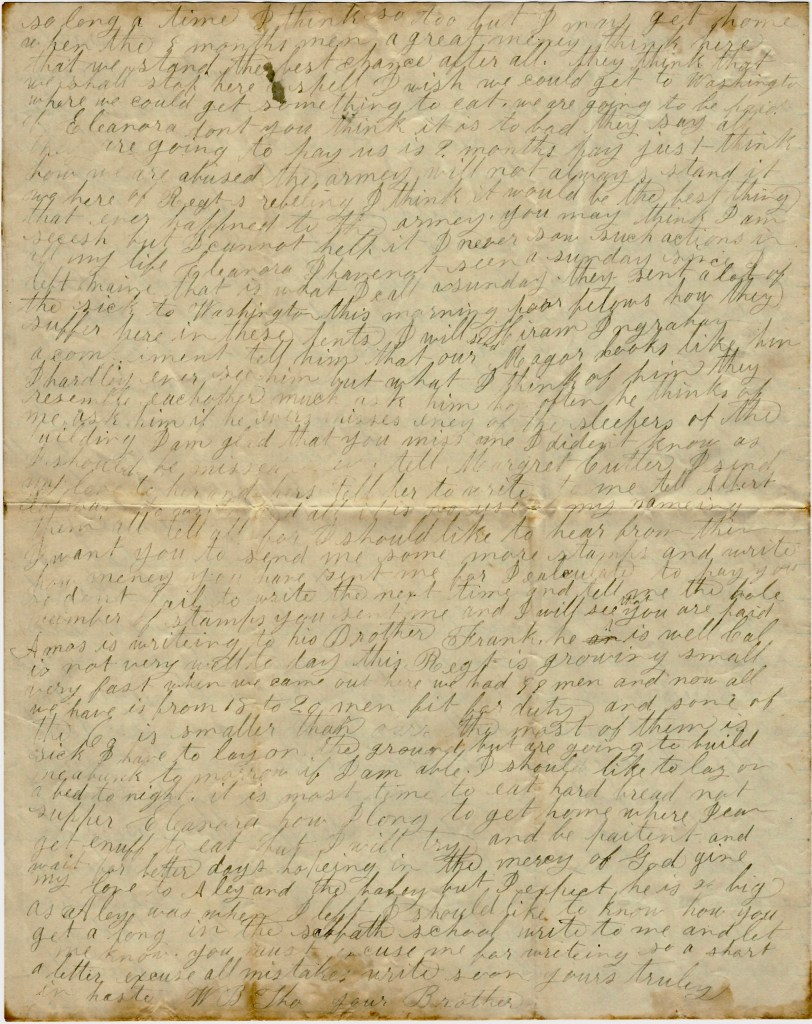
I had a letter from Mrs. Jane Ingraham last week and was glad to hear from her. She spoke about my box. I also had a letter from Roscoe Carter the same day. He thought I was foolish for enlisting for so long a time. I think so too but I may get home when the 9 months men [do]. A great many think here that we stand the best chance after all. They think that we shall stay here a spell. I wish we could get to Washington where we could get something to eat. We are going to be paid off. Eleanora, don’t you think it is too bad they say all they are going to pay us is two months pay? Just think how many are abused. The army will not always stand it. We har of regiments rebelling. I think it would be the best thing that ever happened to the army. You may think I am secesh but I cannot help it. I never saw such actions in all my life.
Eleanora, I have not seen a Sunday since I left Maine—that is, what I call a Sunday. They sent a lot of the sick to Washington this morning. Poor fellows. How they suffer here in these tents. I will send Hiram Ingraham a compliment. Tell him that our Major looks like him. I hardly ever see him but what I think of him—they resemble each other much. Ask him how often he thinks of me. Ask him if he ever misses any of the sleepers of the gilding. I am glad that you miss me. I didn’t know as I should be missed. Tell Margaret Cutler I send my love to her and hers. Tell her to write to me. Tell Albert [illegible].
I want you to send me some more stamps and write how many you have sent me for I calculated to pay you so don’t fail to write the next time and tell me the whole number of stamps you sent me and I will see that you are paid. Amos is writing to his brother Frank. He is well. Cal is not very well today, This regiment is growing small very fast. When we came out here we had 99 men [in our company] and now all we have is from 18 to 20 men fir for duty and some of the [ ] is smaller than we are. The most of them is sick. I have to lay on the ground but we are going to build knee bunks tomorrow if I am able. I should like to lay on a bed tonight.
It is most time to east hard bread—not supper. Eleanora, how I long to get home where I can get enough to eat but I will try and be patient and wait for better day, hoping in the mercy of God. Give my love to Alex and the baby but I expect he is as big as Alex was when I left. I should like to know how you get along in the Sabbath School. Write to me and let me know. You must excuse me for writing such a short letter. Excuse all mistakes. Write soon. Yours truly. In haste. Your brother — W. B. Tho
Letter 4
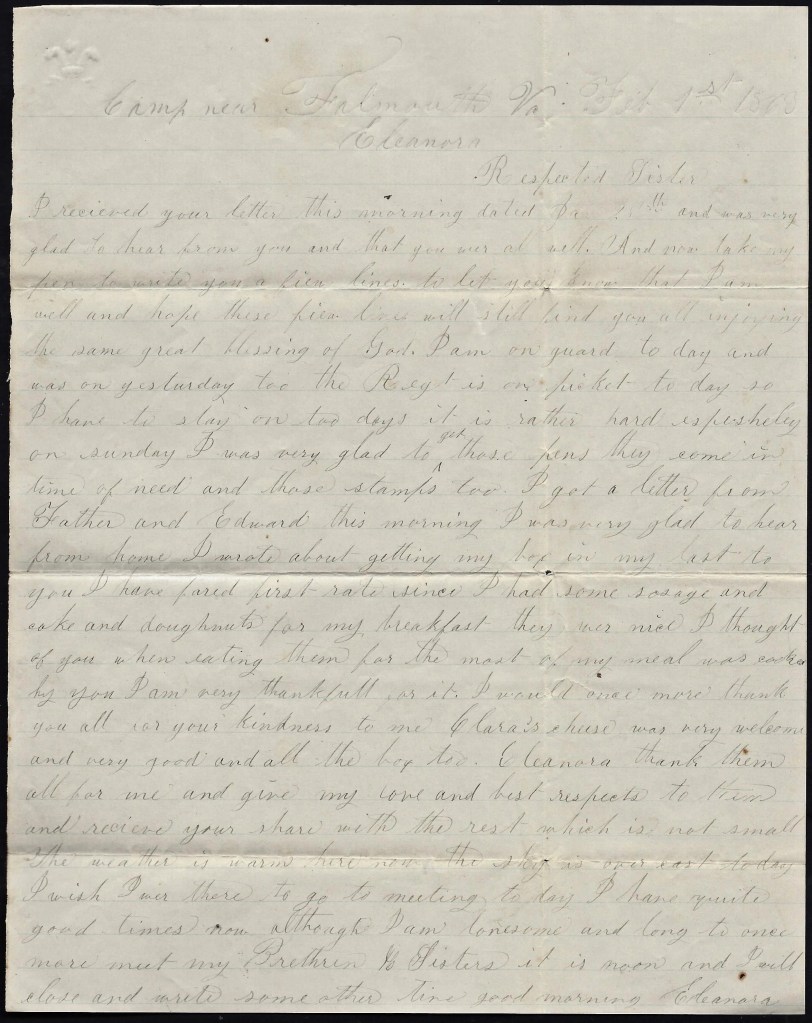
Camp near Falmouth, Va. February 1, 1863
Eleanora — respected sister,
I received your letter this morning dated January 28th and was very glad to hear from you and that you were all well. And now take my pen to write you a few lines to let you know that I am well and hope these few lines will still find you all enjoying the same great blessing of God.
I am on guard today and was on yesterday too. The regiment is on picket today so I have to stay on two days. It is rather hard — especially on Sunday. I was very glad to get those pens. They will come in time of need and those stamps too. I got a letter from Father and Edward this morning. I was very glad to hear from home. I wrote about getting my box in my last to you. I have fared first rate since I had some sausage and doughnuts for my breakfast. They were nice. I thought of you when eating them for the most of my meal was cooked by you. I am very thankful for it. I would once more thank you all for your kindness to me. Clara’s cheese was very welcome and very good and all the box too. Eleanora, thank them all for me and give my love and best respects to them and receive your share with the rest which is not small.
The weather is warm here now. The sky is overcast today. I wish I was there to go to meeting today. I have quite good times now although I am lonesome and long to once more meet my brethren and sisters. It is noon and I will close and write some other time. Good morning, Eleanora.
Sunday afternoon, Feb. 1st.
I take my pen to write a few more words. I have been on guard since I wrote this forenoon. It rains now. I shall not have to stand guard tonight in the rain. Hain’t I lucky? I am as fat as a pig [and] enjoying myself well. Coming home in the spring if not greatly mistaken. Why did you not write how many stamps you had sent me? The next time you write, tell me how many and you can have your pay. Tell Miles to remember me. Tell him I send my love to your mother and the rest of the folks. Good afternoon sister, — W. B. Tho.
Monday morning, Feb. 2nd
Sister Eleanora,
Good morning. I should like to see you this morning but [it is] impossible. The weather is cold today. I have just been to breakfast. I had hard bread, apple sauce and butter and doughnuts. I fared nicely. You must excuse me for so short a letter for I have 4 letters to write and finish before the mail goes so good day. Write soon. Yours in haste.
— W. B. T.
Send me some stamps.
Letter 5
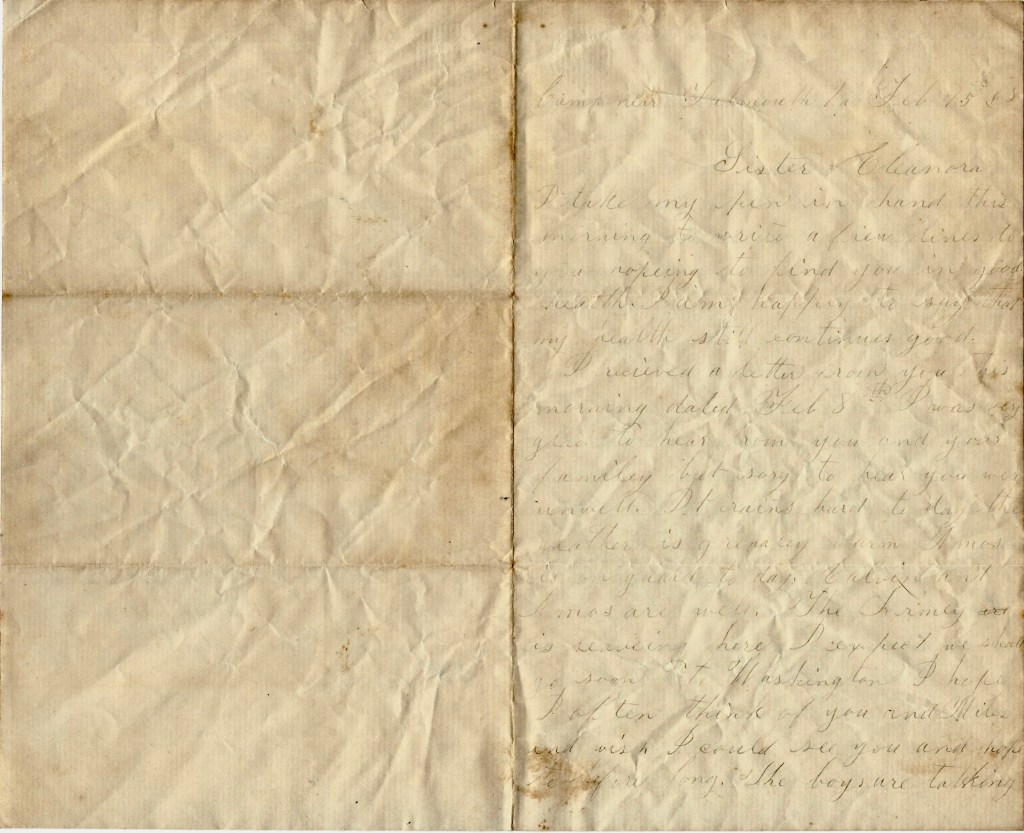
Camp near Falmouth, Va. February 15th 1863
Sister Eleanora,
I take my pen in hand this morning to write a few lines to you hoping to find you in good health. I am happy to say that my health still continues good. I received a letter from you this morning dated February 8th. I was very glad to hear from you and your family but sorry to hear you were unwell. It rains hard today. The weather is generally warm. Amos is on guard today. Calvin and Amos are well.
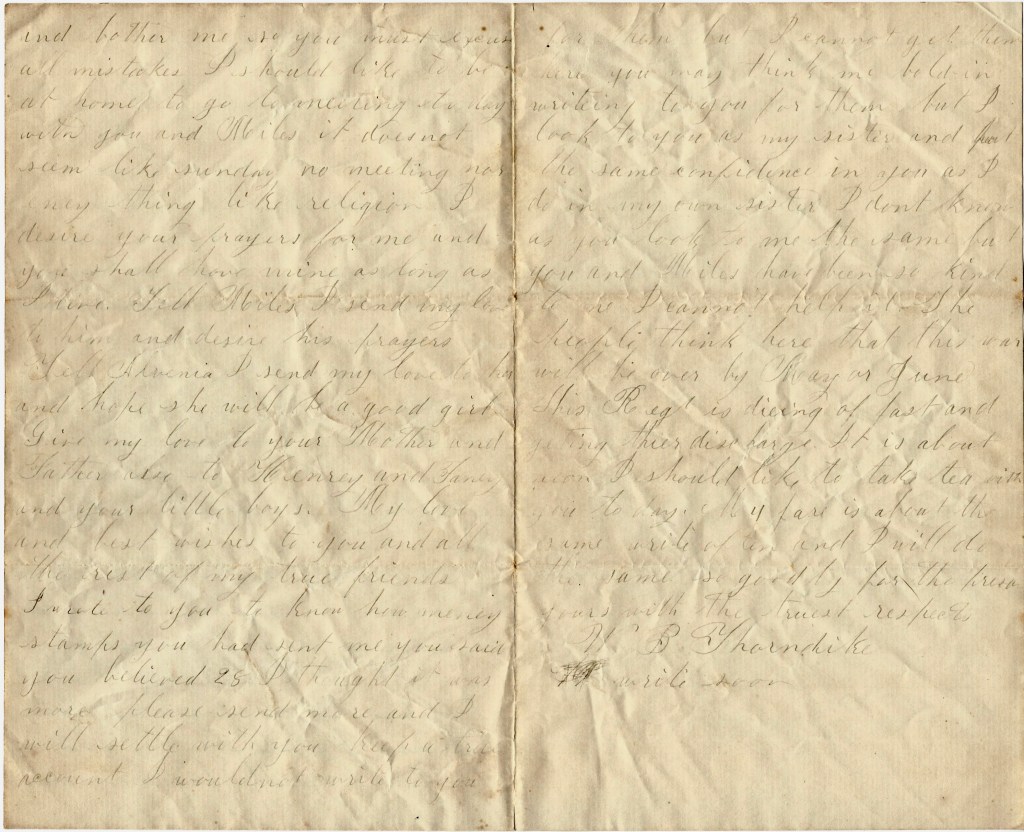
The army is leaving here. I expect we shall go soon to Washington, I hope. I often think of you and Miles and wish I could see you and hope to before long. The boys are talking and bother me so you must excuse all mistakes. I should like to be at home to go to meeting today with you and Miles, It does not seem like Sunday. No meeting nor anything like religion. I desire your prayers for me and you shall have mine as long as I live. Tell Miles I send my love to him and desire his prayers. Tell Alvenia I send my love to her and hope she will be a good girl. Give my love to your Mother and Father, also to Henry and Fannie and your little boys. My love and best wishes to you and all the rest of my true friends.
I write to you to know how many stamps you had sent me. You said you believed 28. I thought it was more. Please send more and I will settle with you. Keep a true account. I wouldn’t write to you for them but I cannot get htem here. You may think me bold in writing to you for them but I look to you as my sister and put the same confidence in you as I do in my own sister. I don’t know as you look to me the same but you and Miles have been so kind to me, I cannot help it.
The people think here that this war will be over by May or June. This regiment is dying off fast and getting their discharge. It is about noon. I should like to take tea with you today. My fare is about the same. write often and I will do the same. So goodbye for the present. Yours with the truest respects, — W. B. Thorndike
Write soon.
Letter 6
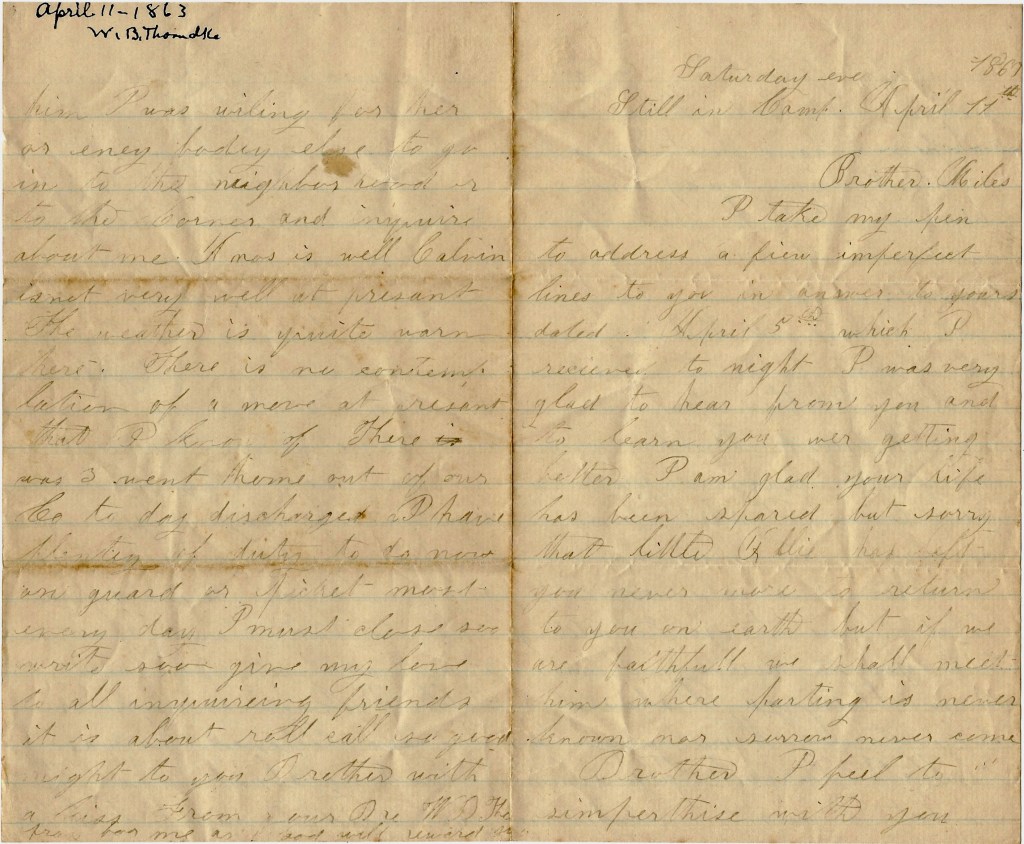
Still in Camp Saturday evening, April 11th 1863
Brother Miles,
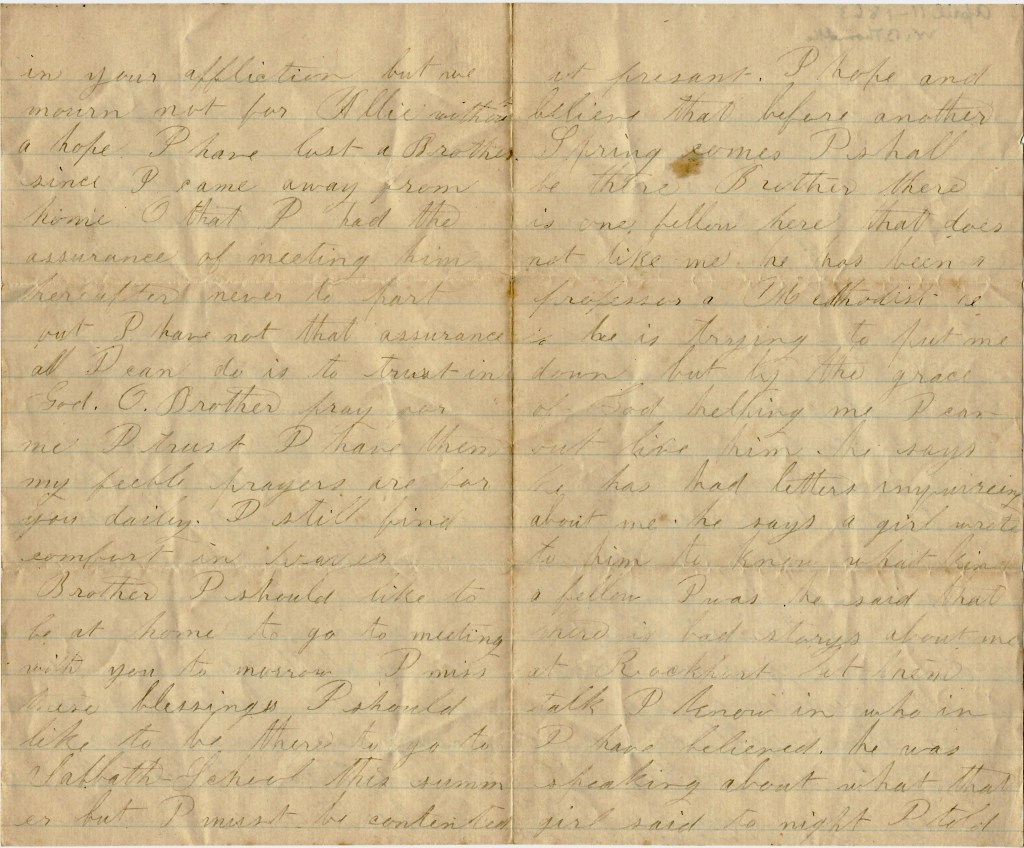
I take my pen to address a few imperfect lines to you in answer to yours dated April 5th which I received tonight. I was very glad to hear from you and to learn you were getting better. I am glad your life has been spared but sorry that little Allie has left you never more to return to you on earth. But if we are faithful we shall meet him where parting is never known nor sorrow never comes. Brother, I feel to sympathize with you in your affliction but we mourn not for Allie without a hope. I have lost a brother since I came away from home. Oh that I had the assurance of meeting him hereafter never to part but I have not that assurance. All I can do is to trust in God. Oh brother, pray for me. I trust I have them. My feeble prayers are for you daily. I still find comfort in Heaven.
Brother, I should like to be at home to go to meeting with you tomorrow. I miss these blessings. I should like to be there to go to Sabbath School this summer, but I must be contented at present. I hope and believe that before another spring comes, I shall be there. Brother, there is one fellow here that does not like me. He has been a professor—a Methodist. He is trying to put me down but by the grace of God helping me, I can out live him. He says he has had letters enquiring about me. He says a girl wrote to him to know what kind of a fellow I was. He said that there is bad stories about me at Rockport. Let them talk. I know in who in I have believed. He was speaking about what that girl said tonight. I told him I was willing for her or anybody else to go in to the neighborhood or to the corner and enquire about me.
Amos is well. Calvin is not very well at present. The weather is quite warm here. There is no contemplation of a move at present that I know of. There was three went home out of our company today discharged. I have plenty of duty to do now in guard or picket most every day. I must close so write soon. Give my love to all enquiring friends. It is about roll call so good night to you, Brother. With a kiss from your brother, — W. B. Tho.
Letter 7
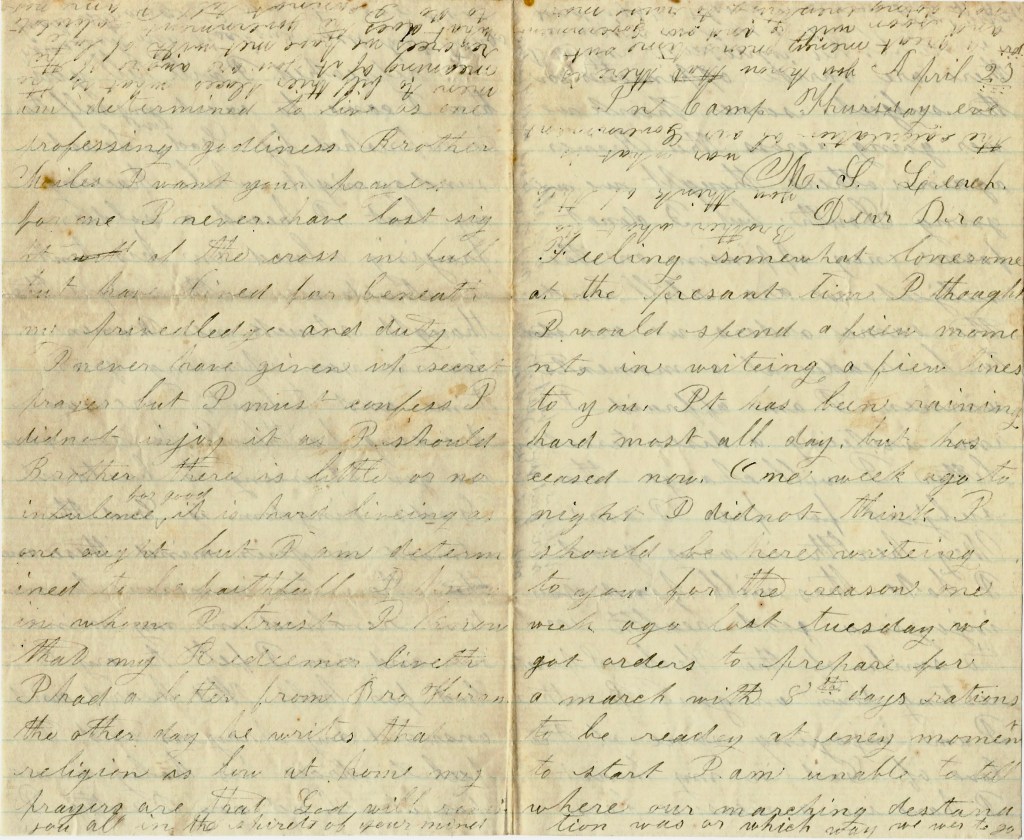
In Camp Thursday Eve, April 23rd 1863
M. L. Leach,
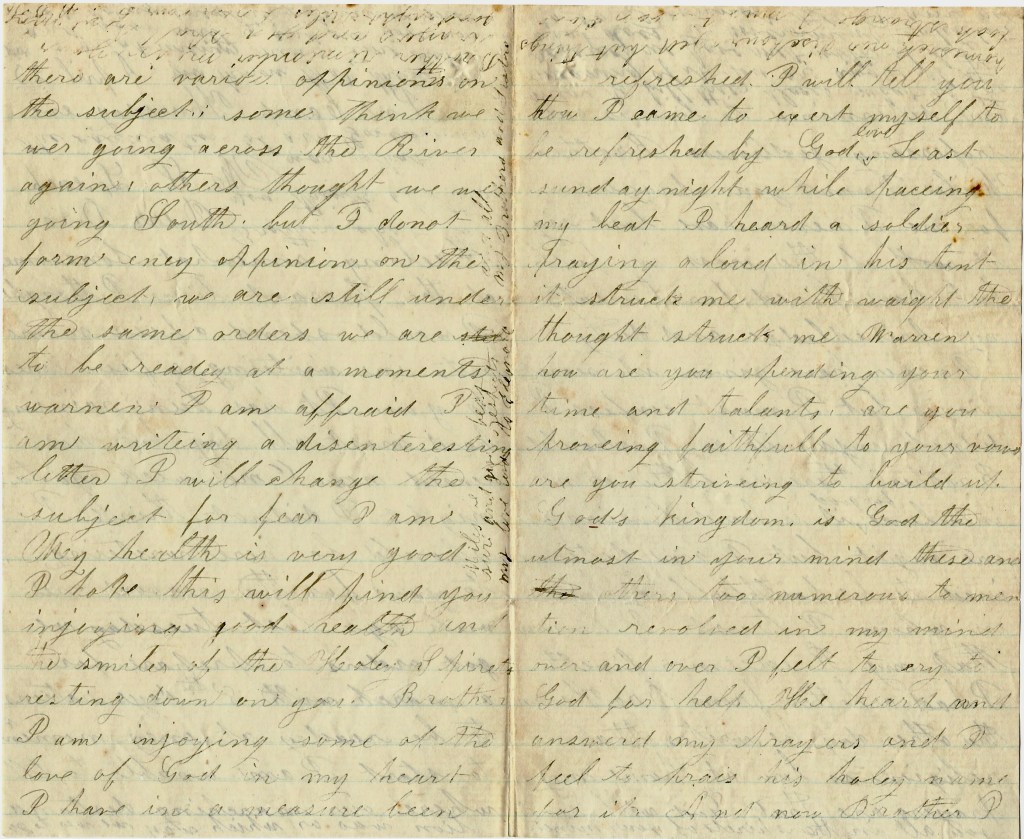
Dear brother. Feeling somewhat lonesome at the present time, I thought I would spend a few moments in writing a few lines to you. It has been raining hard most all day but has ceased now. One week ago tonight I did not think I should be here writing to you for the reason one week ago we got orders to prepare for a march with 8 days rations to be ready at any moment to start. I am unable to tell where our marching destination was or which way we were to go. There are varied opinions on the subject. Some think we were going across the [Rappahannock] river again. Others thought we were going south but I do not form any opinion on the subject. We are still under the same marching orders. We are to be ready at a moment’s warning. I am afraid I am writing a disinteresting letter. I will change the subject for fear I am.
My health is very good. I hope this will find you enjoying good health and the smiles of the Holy Spirit resting down on you. Brother, I am enjoying some of the love of God in my heart. I have in a measure been refreshed. I will tell you how I came to exert myself to be refreshed by God’s love. Last Sunday night while pacing my beat, I heard a soldier praying aloud in his tent. It struck me with weight. The thought struck me, “Warren, how are you spending your time and talents? Are you proving faithful to your vows? Are you striving to build up God’s Kingdom? Is God the utmost in your mind?” These and others too numerous to mention revolved in my mind over and over. I felt to cry to God for help. He heard and answered my prayers and I feel to praise His holy name for it.
And now, brother, I’m determined to live as one professing Godliness. Brother Miles, I want your prayers for me. I never have lost sight of the cross in full but I have lived far beneath my privilege and duty. I never have given up secret prayer but I must confess I didn’t enjoy it as I should. Brother, there is little or no [ ] for good. It is hard living as one ought but I am determined to be faithful. I know that my Redeemer liveth.
I had a letter from Bro. Kiran [?] the other day. He writes that religion is low at home. My prayers are that God will reach you all in the spirits of your mind.
There is a great many men’s time out and soon will go and our government is not doing anything to raise more men to fill their places. What is the meaning of it> You are aware of the reverses we have met with of late. What does the government [plan] to do. I cannot tell. I am not homesick nor discouraged yet but things look strange. I must soon close… — W. B. Tho.
Letter 8
Friday Morning, April 24, 1863
Dear brother Miles,
I should like to see you this morning. It has cleared off quite cool. I go on picket tomorrow. I hear that Bro. J. G. __berton has got home. Give my love to him. Tell him to write to me. I hope you will have a good Sabbath School this summer. I should like to attend but I have other duties to attend to at present. Calvin has gone to the hospital. Amos is well. I have faith to believe that I shall one day get home and I wish so to live that you will not be ashamed to call me brother.
Tell Eleanora I remember her in my prayers. Give my love and best respects to Mr. and Mrs. Howard and to Edward and all enquiring friends and accept a Bro. for yourself from me. Write soon and all the news. I will close by wishing you good health and the love of God in your heart.
From your brother and friend, — W. B. Thorndike
Letter 9
Sunday, May 10th, 1863
M. S. Leach, dear brother,
I take my pen to write you a few lines to let you know that I am well and hope these few lines will find you in good health. It is Sunday and I am on picket. It seems a good deal different what it does to go to meeting, I tell you. I should like to be at home to go to meeting today. I thinkI could enjoy it. I said I was well. I am—all but a bad headache. My hand trembles so I cannot hardly write atall. It is very warm today and marching down here almost beat me out. I find I am not so tough as I was in the winter. I am losing flesh every day. Warm weather does not agree with me and we have very sudden changes in the weather here. My head aches so I guess I will stop for the present. So good day, bro. Miles
In camp abreast of Fredericksburg May 11th, 1863
Bro. Miles, I again take my pen to write you a few more lines. It is now about 6 o’clock in the afternoon. Our regiment moved this morning at half past 6 o’clock so we are in new camp now. It is very pleasant here. I have been very busy in washing and fixing my tent. I should like to see you very much tonight. I feel as well as common. I wish you could see us in camp here. You would laugh I guess. I am a sitting in the back of my tent now. Has the Sabbath School begun yet? I hope you will have a good school.
We are within a few rods of headquarters and also of the railroad. Bro., I still am trying to struggle on in the way of well doing. Eleanora wrote that you told her to tell me you thought there was some signs of a revival. My prayer is that it may be so. It would be a great encouragement to me to hear so good news. Bro., labor hard to aid it on and may God bless your endeavors. Give my love and best wishes to Sister Eleanora. Also to Mr. and Mrs. Howard and Henry & Fanny and to all enquiring friends and receive a unworthy bro. to yourself.
It would be useless to write anything about the battle for you know more by this time that I do about it. I will close by asking your prayers for me. Good night. From your brother in [ ] and fellowship. — W. B. Tho.
P. S. Give my love to all the Brethren and Sisters. Tell them to pray for me. Good night, bro.
Letter 10
Bakersville [Maryland, near the Potomac river] July 10th 1863
Sister Eleanora,
Reuben D. Martin of Co. H, 19th Maine, was wounded in the thigh and back in the fighting late in the evening of 2 July 1862 in front of the Codori House.
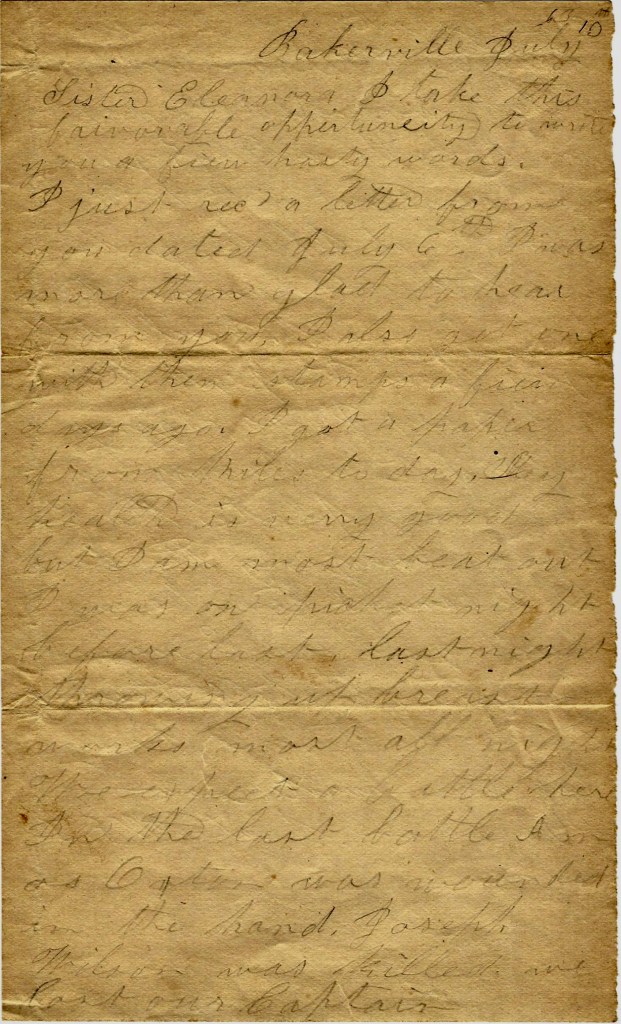
I take this favorable opportunity to write you a few hasty words. I just received a letter from you dated July 6th. I was more than glad to hear from you. I also got one with them stamps a few days ago. I got a paper from Miles today.
My health is very good but I am most beat out. I was on picket night before last, last night throwing up breastworks most all night. We expect a battle here. In the last battle Amos [B.] Oxton was wounded in the hand. Joseph [W.] Wilson was killed. We lost our captain, two sergeants, and two men besides Wilson and a lot wounded. We went into battle with 45 guns and came out with 19. [Sergt.] William [E.] Barrows of Blackings Corner was killed. I have not time to write much. I will tell you how I spent the 4th of July. I was digging rifle pits with my bayonet and plate. The evening I was burying the dead. Oh, I cannot describe my feelings there.
Give my love to all, Tell them to write to me. Pray for me. Write soon. Yours in haste, — W. B. T.
Letter 11
In Camp near Culpeper, Va. September 14, 1863
Brother Miles,
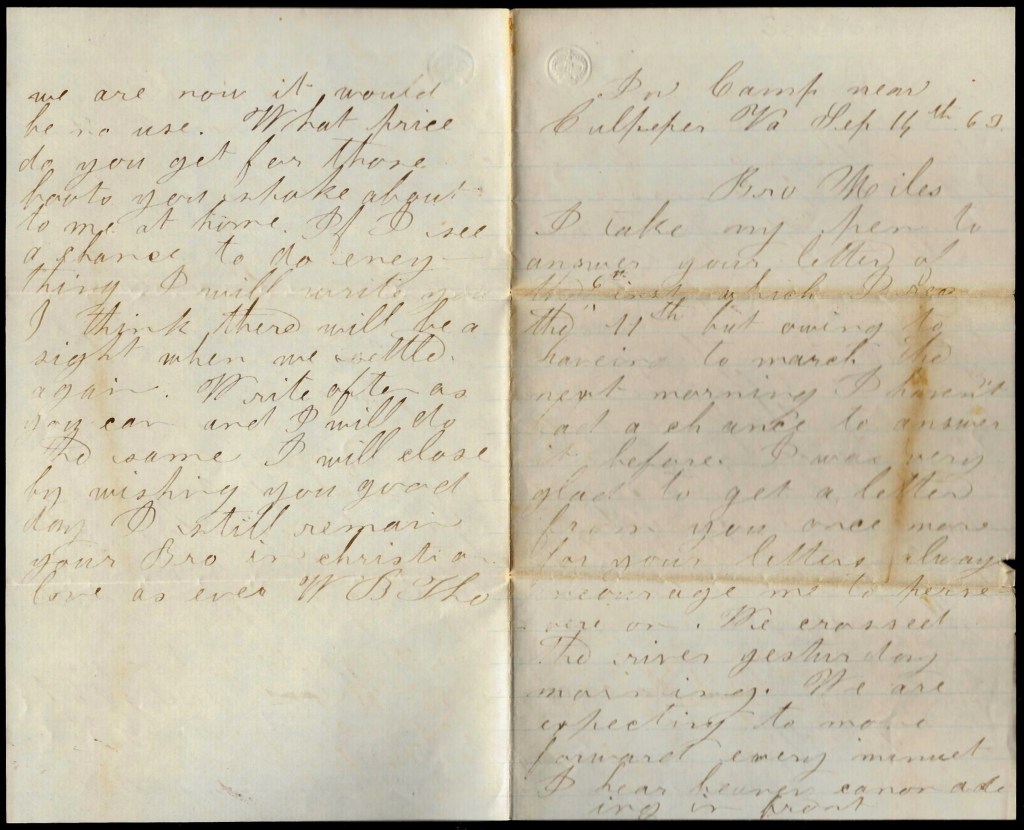
I take my pen to answer your letter of the 6th inst., which I received the 11th, but owing to having to march the next morning, I haven’t had a chance to answer it before. I was very glad to get a letter from you once more for your letters always encourage me to persevere on.
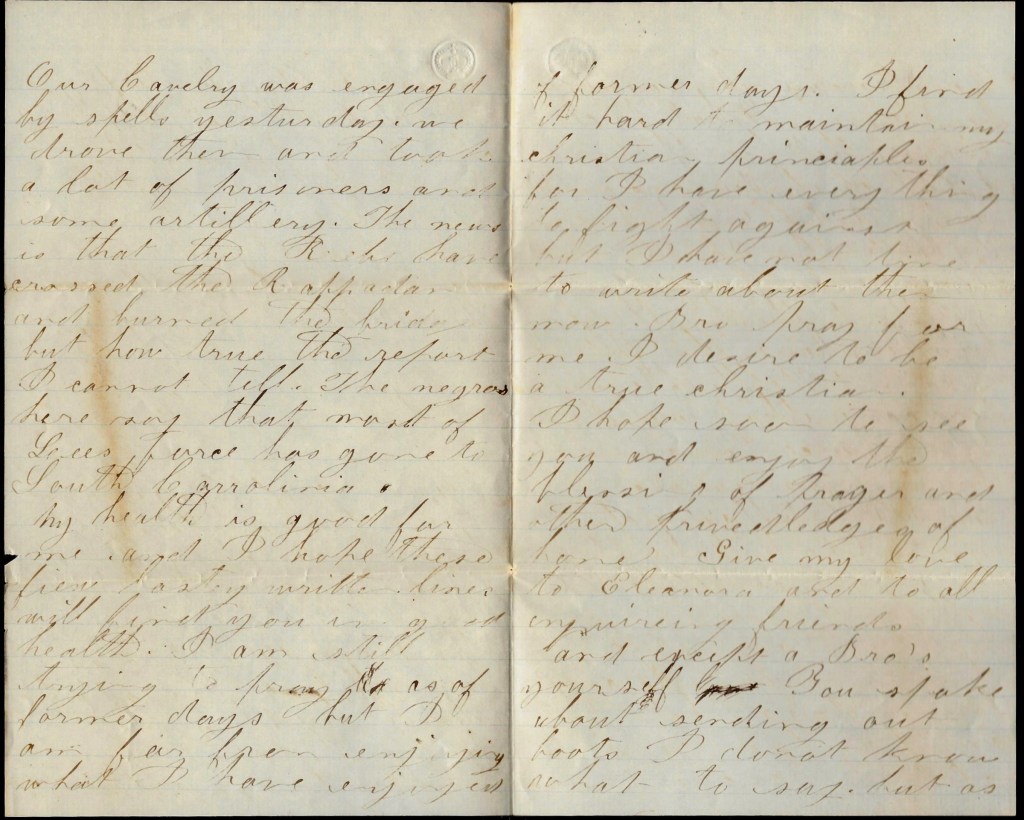
We crossed the river yesterday morning. We are expecting to move forward every moment. I hear heavy cannonading in front. Our cavalry was engaged by spells yesterday. We drove them and took a lot of prisoners and some artillery. The news is that the Rebs have crossed the Rapidan and burned the bridge but how true the report, I cannot tell. The negroes here say that most of Lee’s force has gone to South Carolina.
My health is good for me and I hope these few hasty written lines will find you in good health. I am still trying to pray as of former days but I am far from enjoying what I have enjoyed of former days. I find it hard to maintain my Christian principles for I have everything to fight against but I have not time to write about that now. Brother, pray for me. I desire to be a true Christian. I hope soon to see you and enjoy the blessing of prayer and other privileges of home. Give my love to [sister] Eleanora and to all enquiring friends and accept a brother’s [love] yourself.
You spoke about sending out boots. I don’t know what to say but as we are now, it would be no use. What price do you get for those boots you spoke about to me at home? If I see a chance to do anything, I will write you. I think there will be a sight when we settle again. Write often as you can and I will do the same. I will close by wishing you good day.
I still remain your brother in Christian love, as ever—W. B. Tho.
Letter 12
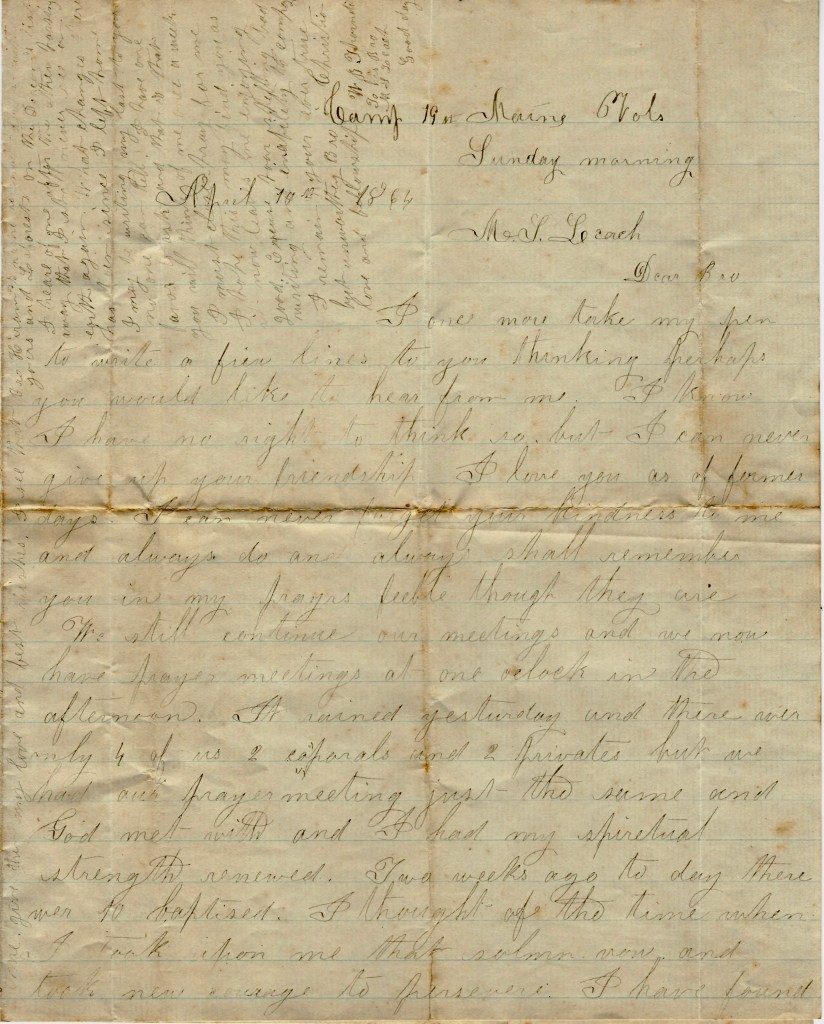
Camp 19th Maine Vols. Sunday morning, April 10th 1864
M[iles] L. Leach,
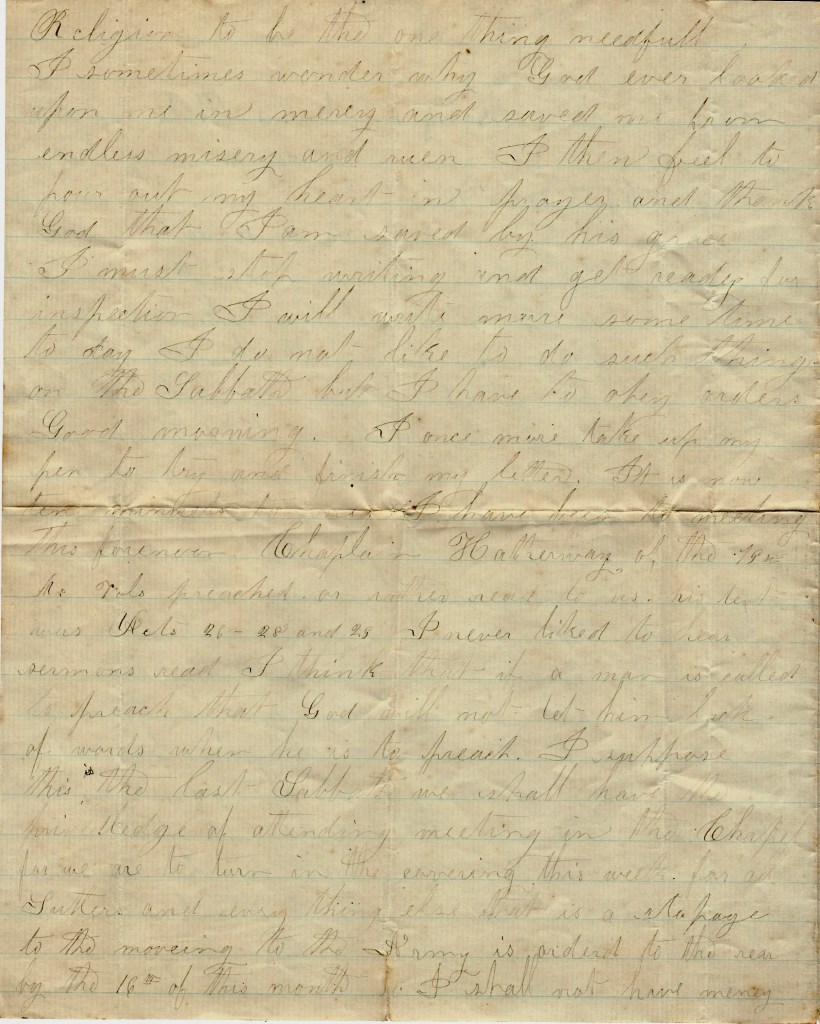
Dear Brother, I once more take my pen to write a few lines to you thinking perhaps you would like to hear from me. I know I have no right to think so but I can never give up your friendship. I love you as of former days. I can never forget your kindness to me and always so and always shall remember you in my prayers, feeble though they are. We still continue our meetings and we now have prayer meetings at one o’clock in the afternoon. It rained yesterday and there were only four of us, two corporals, and two privates, but we had our prayer meeting just the same and God met with and I had my spiritual strength renewed. Two weeks ago today there were 10 baptized. I thought of the time when I took upon me that solemn vow, and took new courage to persevere. I have found religion to be the one thing needful. I sometimes wonder why only God ever looked upon me in mercy and saved me from endless misery and when I then feel to pour out my heart in prayer and thank God that I am saved by His grace.
I must stop writing and get ready for inspection. I will write more some time today. I do not like to do such things on the Sabbath but I have to obey orders.
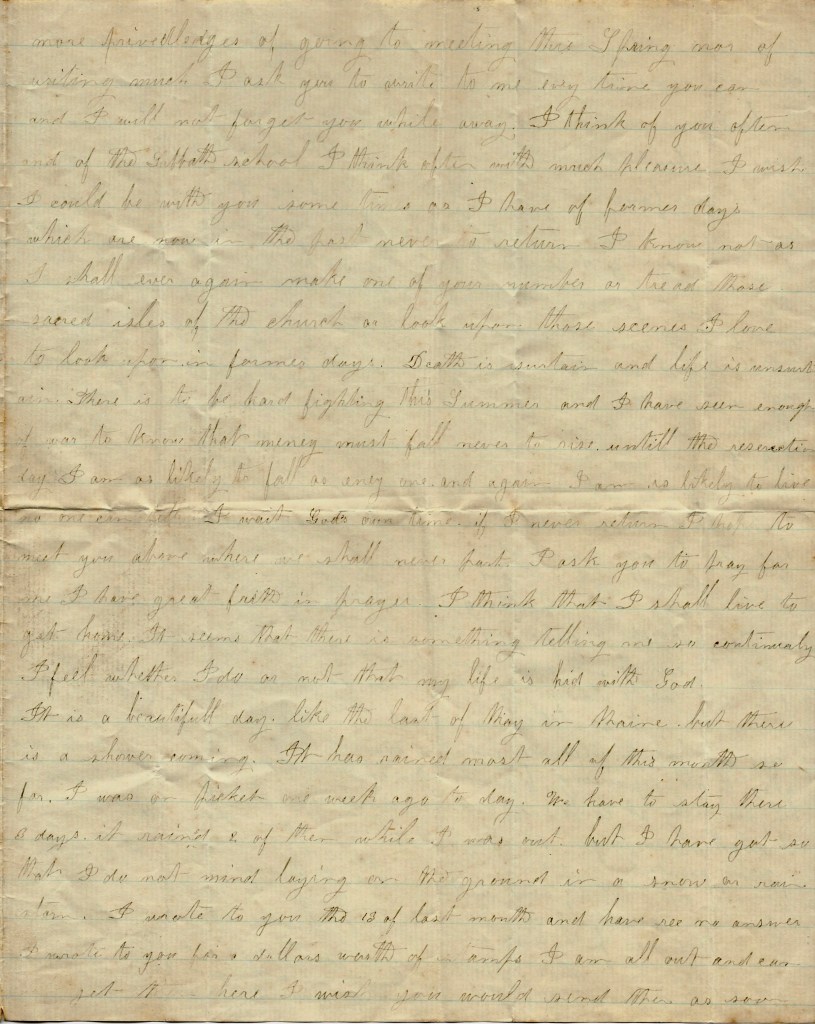
Good morning. I once more take up my pen to try and finish my letter. It is now ten minutes to one. I have been to meeting this forenoon. Chaplain Hathaway of the 19th Maine Volunteers preached, or rather read to us. His text was Acts 26-28 and 29. I never liked to hear sermons read. I think that if a man is called to preach, that God will not let him lack of words when he is to preach. I suppose this the last Sabbath we shall have the privilege of attending meeting in the chapel for we are to turn in the covering this week for a all sutlers and everything else that is a stoppage to the moving too. The army is ordered to the rear by the 16th of this month. I shall not have many more privileges of going to meeting this spring nor of writing much. I ask you to write to me every time you can and I will not forget you while away. I think of you often and of the Sabbath School. I think often with much pleasure. I wish I could be with you some time as I have of former days which are now in the past, never to return. I know not as I shall ever again make one of your number or tread those sacred aisles of the church or look upon those scenes I love to look upon in former days. Death is certain and life is uncertain.
There is to be hard fighting this summer and I have seen enough of war to know that many must fall, never to rise until the resurrection day. I am as likely to fall as anyone and again I am as likely to live. No one can sit and wait God’s own time. If I never return, I hope to meet you above where we shall never part. I ask you to pray for me. I have great faith in prayer. I think that I shall live to get home. It seems that there is something telling me so continually. I feel whether I do or not that my life is hid from God.
It is a beautiful day like the last of May in Maine. But there is a shower coming. It has rained most all of this month so far. I was on picket one week ago today. We have to stay there three days. It rained two of them while I was out. But I have got so that I do not mind laying on the ground in a snow or rain storm.
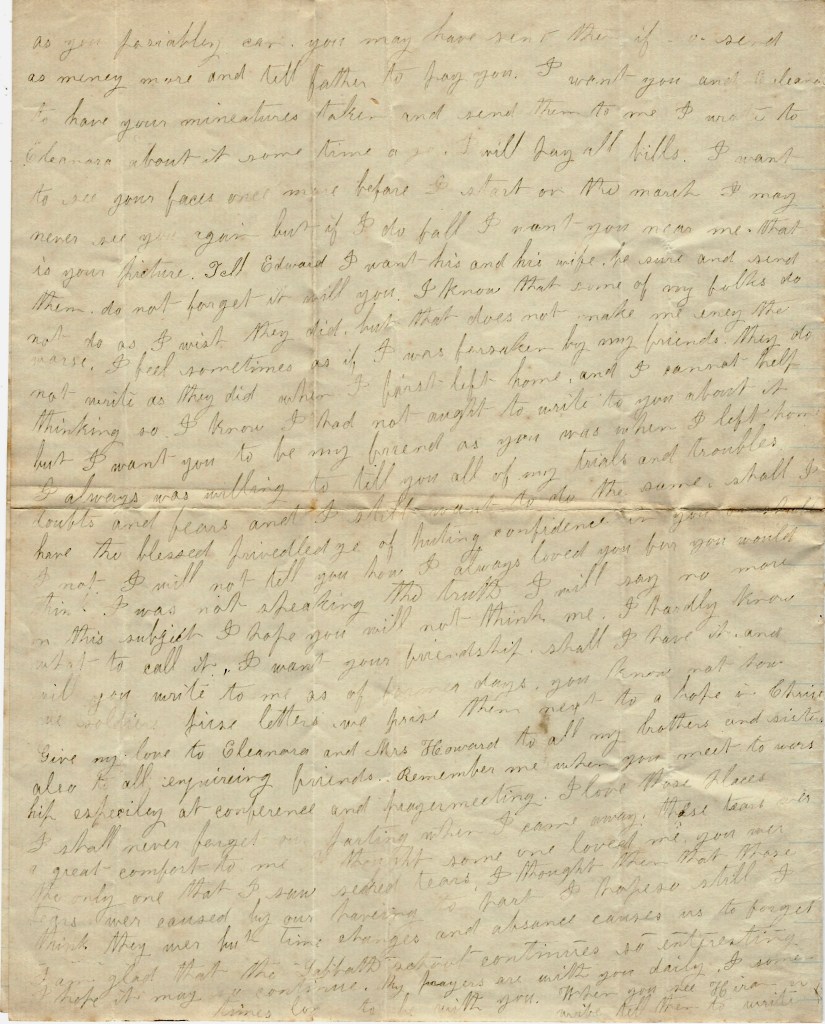
I wrote to you the 13th of last month and have received no answer. I wrote to you for a dollar’s worth of stamps. I am all out and cannot get them here. I wish you would send them as soon as you possibly can. You may have sent them. If so, send as many more, and tell father to pay you. I want you and Caleana to have your minatures taken and send them to me. I wrote to Eleanora about it some time ago. I will pay all bills. I want to see your faces once more before I start on the march. I may never see you again, but if I do fall, I want you near me—that is, your picture. Tell Edward I want his and his wife. Be sure and send them. Do not forget, will you? I know that some of my folks do not do as I wish they did, but that does not make me any the worse. I feel sometimes as if I was forsaken by my friends. They do not write as they did when I first left home and I cannot help thinking so. I know I had not ought to write to you about it but I want you to be my friend as you was when I left home. I always was willing to tell you all of my trials and troubles, doubts and fears, and I still want to do the same. Shall I have the blessed privilege of putting confidence in you? …
Give my love to Eleanora and Mrs. Howard, to all my brothers and sisters; also to all enquiring friends. Remember me when you meet to worship—especially at conference and prayer meeting. I love those places. I shall never forget our parting when I came away…. [W. B. Tho.]
Letter 13
Camp 19th Maine Vols. Thursday, April 14th [1864]
Bro. Miles
I thought I would write a few lines to you to let you know that I am well and on praying ground. Roll call is over. It is now 8 o’clock. I should like to see you much tonight. Everything is all astir here now. We were paid off today and the sutlers are getting ready to leave tomorrow and the next day for they have got to all leave by the 16th. I have just ate my supper. I bought it to the sutler’s. I will give you a few of their prices. Butter 60 cents, ham 30 cents, eggs 50 and 60 per dozen, apples 5 cents apiece, oranges 10 cents and everything accordingly.
Yesterday there was a Brigade Review. Today General Inspection, Tomorrow Division Review, and next day Corps Review, and I cannot tell what will follow that. There was not any meeting tonight. There was a lyceum instead. There is a fellow here that wants me to get him a dollar’s worth of stamps so I thought I would write to you. I will send the money in this and you will greatly oblige by sending the stamps by the next mail.
My trust is still in God and in Him also do I trust. I shall have to close for it is taps. I will write more tomorrow if I get time. Good night, — W. B. Tho.
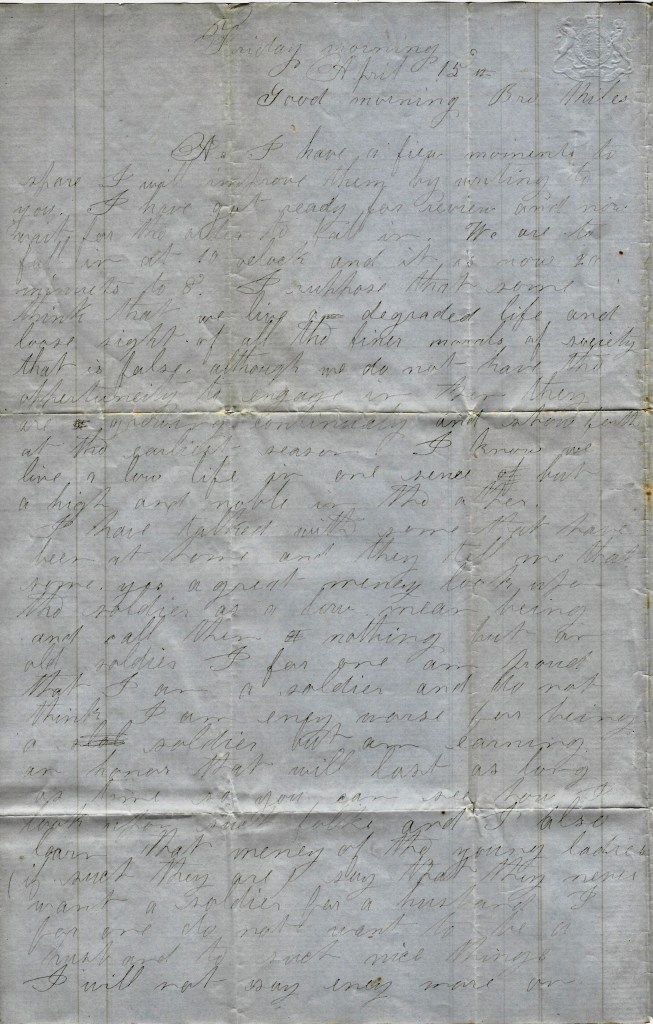
Friday morning, April 15th
Good morning Bro. Miles,
As I have a few moments to spare, I will improve my time by writing to you. I have got ready for review and now wait for the order to fall in. We are to fall in at 10 o’clock and it is now 20 minutes to eight. I suppose that some think that we live a degraded life and lose sight of all the finer morals of society. That is false…I have talked with some that have been at home and they tell me that a great many look upon the soldier as a low, mean being and call them nothing but an old soldier. I for one am proud that I am a soldier and do not think I am any worse for being a soldier, but am earning an honor that will last as long as time. So you can see how I look upon such talk and I also learn that many of the young ladies (if such they are) say that they never want a soldier for a husband. I for one do not want to be a husband to such nice things. I will not say any more on this subject.
I wish you could see our company this morning. We look nice, I tell you. I pride myself that we look the best in the regiment. Our boots and everything we wear that is proper to black is blacked and we make a fine appearance. You may think me a brag but I speak the truth.
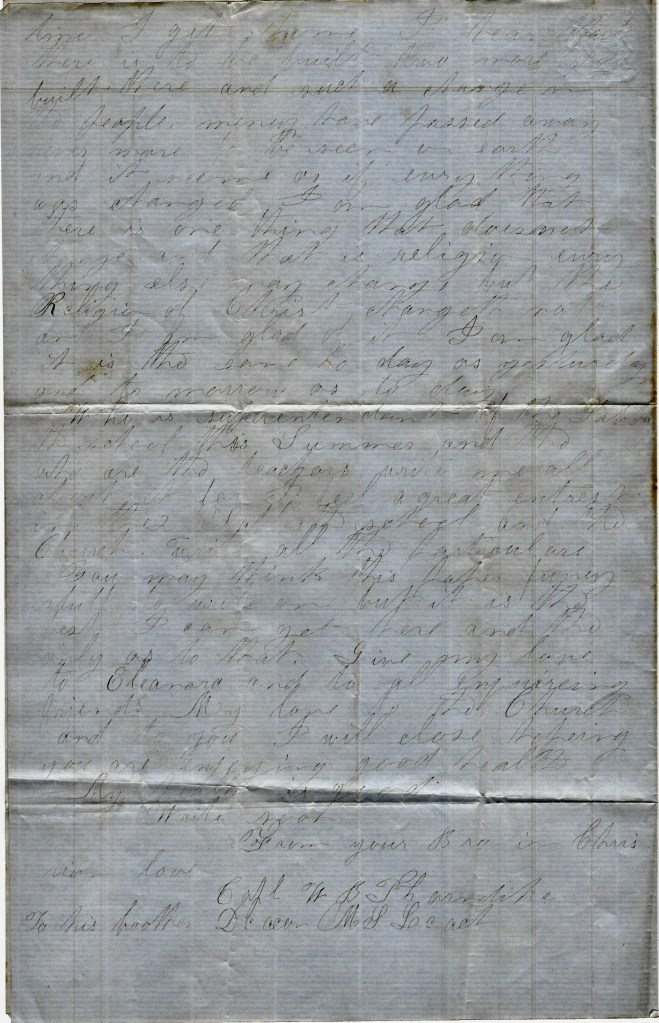
I should like to be at home tonight to go to meeting with you. I should enjoy them better than any other meeting we have. I have made the acquaintance of a nice young man out here. He has experienced religion this winter. He belongs to this regiment. I think much of him. He is a sergeant and belongs to Co. D. I should like to see you all but we are separated far from each other and may never meet. If we do, it will be a happy meeting, and if we do not meet here on earth. I hope and trust we shall clasp hands on the other shore and sing the song of deliverance forever. If I do meet you again, it will not be long before that time will come—only 16 months and a few days longer, and that will soon pass away. I expect that I shall hardly know West Candor by the time I get home. I hear that there is to be built two more stores there and such a change in the people. Many have passed away never more to be seen on earth. and it seemed as if everything was changed…
Give my love to Eleanora and to all enquiring friends. My love to the Church and to you. I will close by hoping you are enjoying good health. My health is good. Write soon. From your Bro. in Christ, — Corp. W. B. Thorndike
Letter 14
Co. I, 19th Maine Vols, On picket at Po River, Va. May 19th 1864
Sister Eleanora,
I received your [letter] today. I was glad to hear that you were well. My health is good. I have but a few moments to spare as the mail soon goes out. I have been in several fights but as yet unharmed I remain. I suppose you have heard of John Leach’s death. I cannot describe my feelings. I sympathize with you all. I saw Henry last Sunday. He was not very well then. We have lost most all of our regiment. I am acting Orderly of my company so you see we must be very small.
I got 8 letters today. I must soon close. Pray for me, My love to all. Your bro. in great haste, — W. B. Thorndike
Letter 15
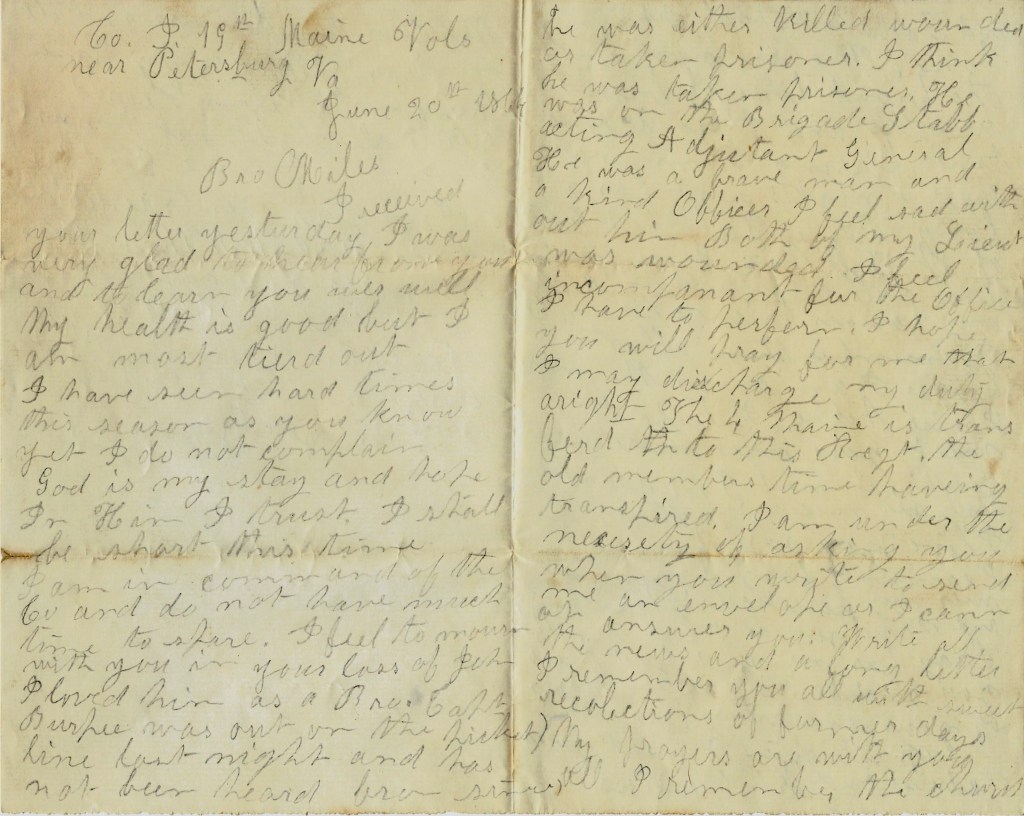
Co. I, 19th Maine Vols. near Petersburg, Va, June 20th 1864
Bro. Miles,
I received your letter yesterday. I was very glad to hear from you and to learn you were well. My health is good but I am most tired out. I have seen hard times this season, as you know. Yet I do not complain. God is my stay and hope. In Him, I trust.
I shall be short this time. I am in command of the company and do not have much time to spare. I feel to mourn with you in your loss of John. I loved him as a brother. Capt. Burpee was out on the picket line last night and has not been heard from since. He was either killed or wounded or taken prisoner. I think he was taken prisoner. He was on the Brigade staff acting Adjutant General. He was a brave man and a kind officer. I feel sad without him. Both of my lieutenants was wounded. I feel incompetent for the officer I have to perform. I hope you will pray for me that I may discharge my duty aright.
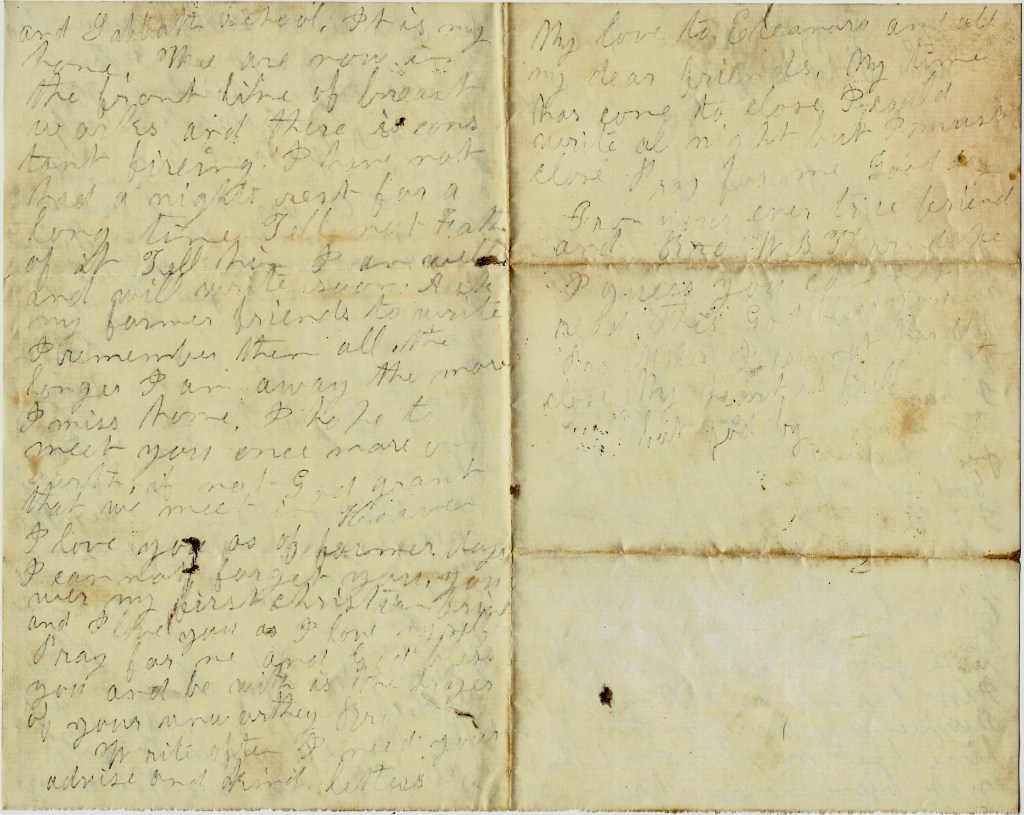
The 4th Maine is transferred to this regiment, the old members time having transpired. I am under the necessity of asking you when you write to send me an envelope or I cannot answer you. Write all the news and a long letter. I remember you all with sweet recollections of former days. My prayers are with you all. I remember the church and sabbath school. It is my home.
We are now in the front line of breastworks and there is constant firing. I have not had a night’s rest for a long time. Tell not father of it. Tell him I am well and will write soon. Ask my former friends to write. I remember them all the longer I am away the more. I miss home. I hope to meet you once more on earth. If not, God grant that we meet in Heaven. I love you as if former days. I cannot forget you. You were my first Christian friends and I loved you as I love myself. Pray for me and God bless you and be with you is the prayer of your unworthy bro. Write often and send your advice and kind letters. My love to Eleanora and all my dear friends. My time has come to a close. I could write all night but I must close. Pray for me. Goodbye.
From your ever true friend and bro., — W. B. Thorndike
Letter 16
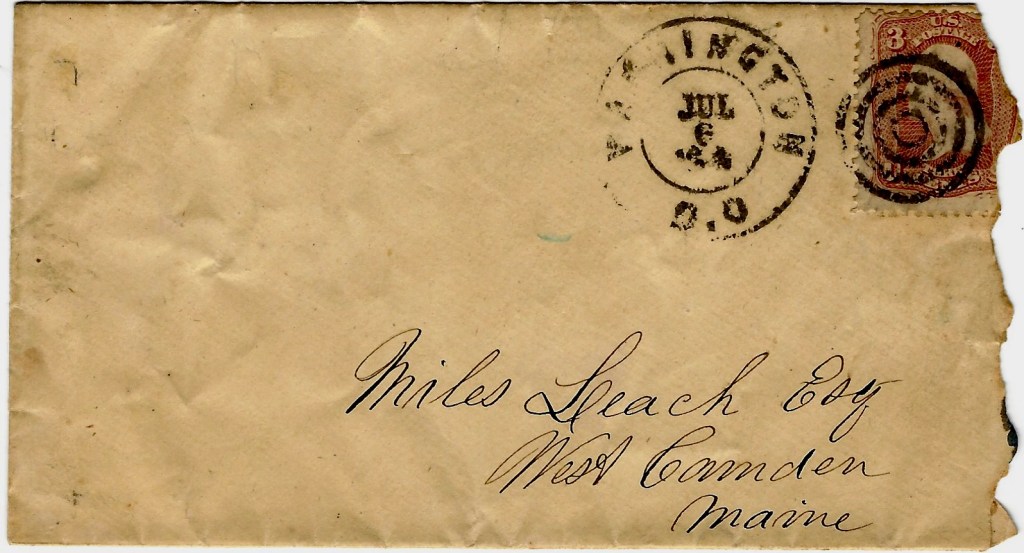
Armory Square Hospital (Ward I) Washington July 5, 1864
Mr. Leach—Sir,
I received intelligence from my company on Saturday of the capture of some of my comrades and death of others. Among those taken prisoners was an intimate friend and tent mate, Warren B. Thorndike. My informant, Francis Carver, said he was the only one of the original boys in Co. I which was present at the time he wrote and I felt it a duty due my comrade and his friends at home to forward the unpleasant news believing that, however sad it may be to hear of his misfortune, it is better than suspense. Carver did not mention any circumstances but the mere announcement that he was taken prisoner.
I trust he may soon be exchanged or recaptured and enjoy the blessings which he has so nobly and faithfully [ ] his comfort and life. With respect, — Wm. H. Little, Jr.
Letter 17
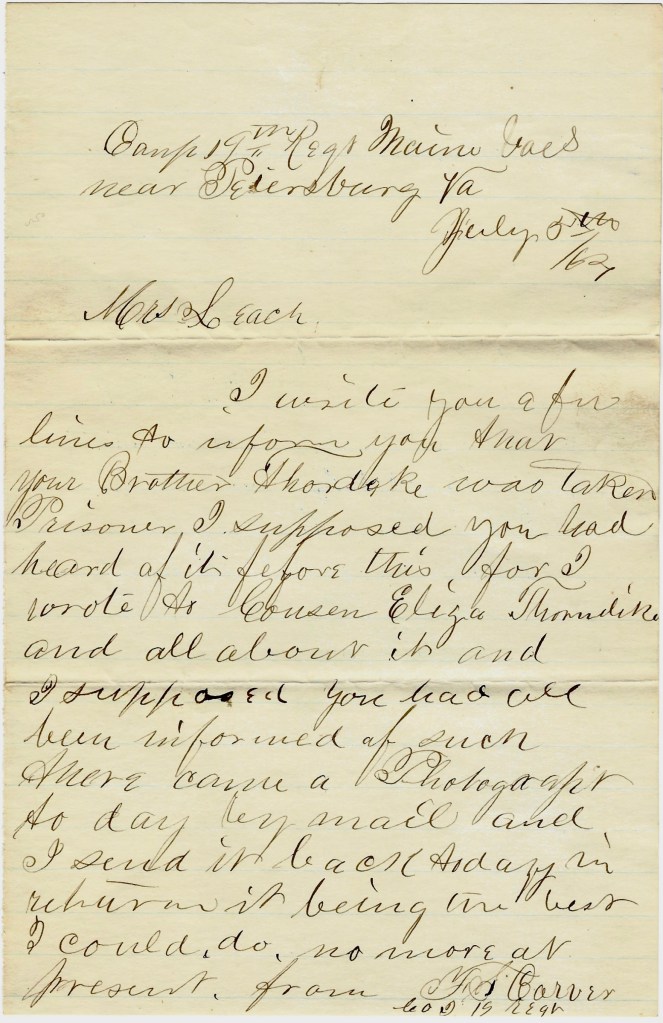
Camp 19th Regiment Maine Vols near Petersburg, Va. July 5, 1864
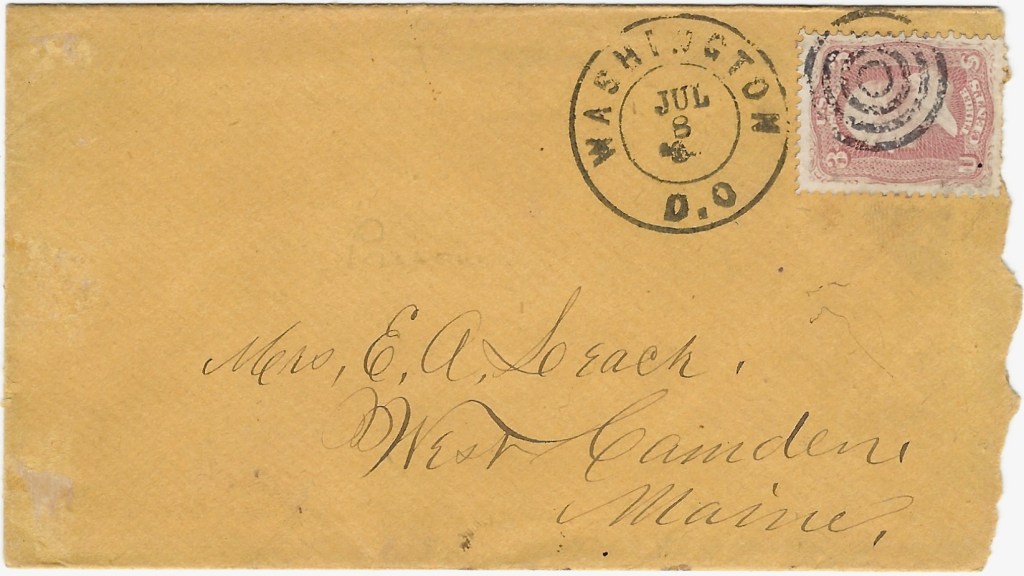
Mrs. Leach,
I write you a few lines to inform you that your brother Thorndike was taken prisoner. I supposed you had heard of it before this for I wrote to cousin Eliza Thorndike and all about it and I supposed you had all been informed of such. There came a photograph today by mail and I send it back today in return., it being the best I could do. No more at present. From F. S. Carver, Co. I, 19th Regt.
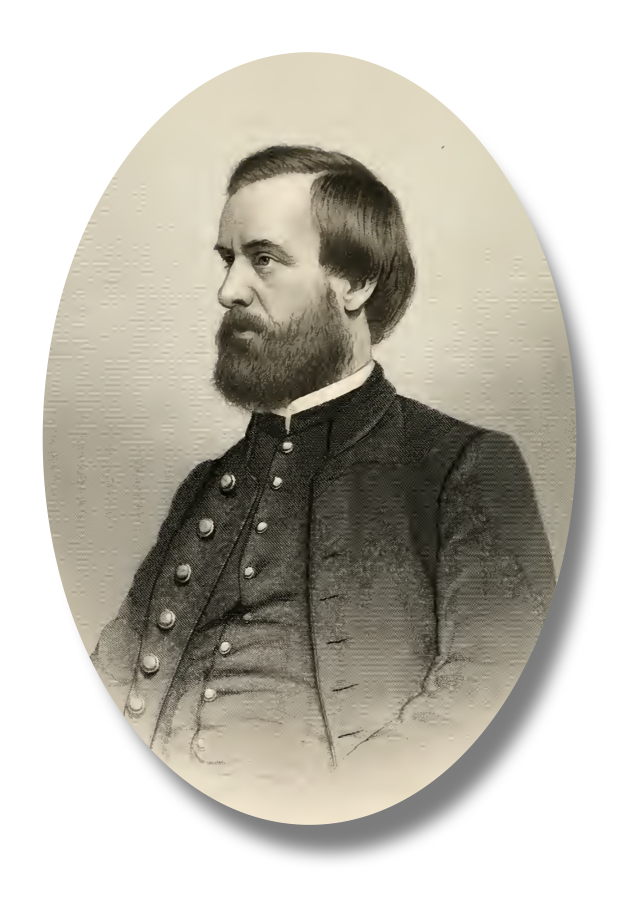
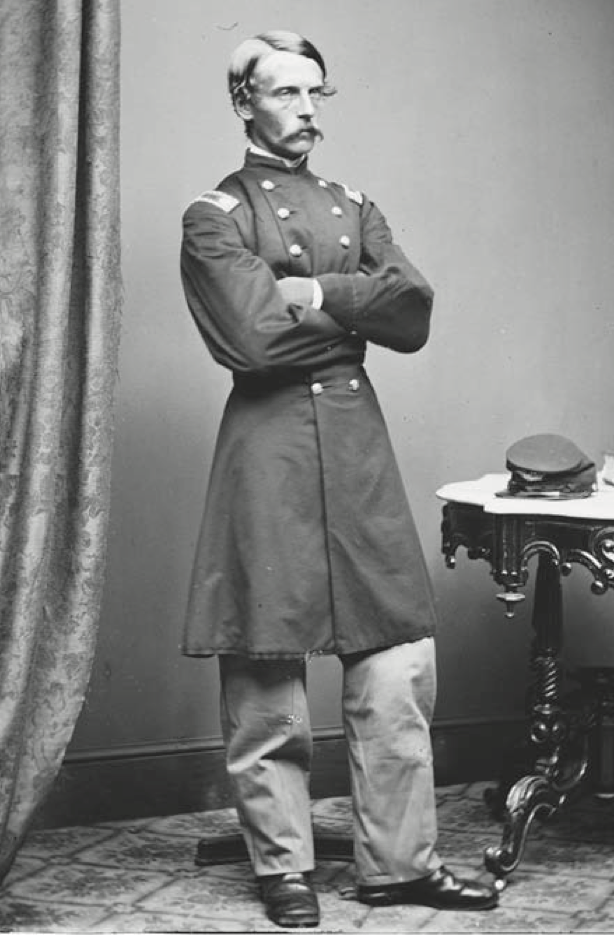
Edgar A. Burpee, Co. I, 19th Maine Infantry Maine State Archives
This incredible letter was written by Edgar Alphonso Burpee (1839 – 1919) of Rockland, Maine, who enlisted in Co. I, 19th Maine Infantry on August 25, 1862. He was mustered in as a corporal and rose in rank to captain of his company in 1863. He was wounded at Gettysburg, and later in the war, while mapping out the enemy’s location, he was captured (June 1864) and was imprisoned at Macon, Georgia, and at Camp Asylum, Columbia, South Carolina. Exchanged and mustered out of the service, he returned to Rockland, married Annie Farwell, and resumed his painting business. Eventually he joined his family’s furniture business.
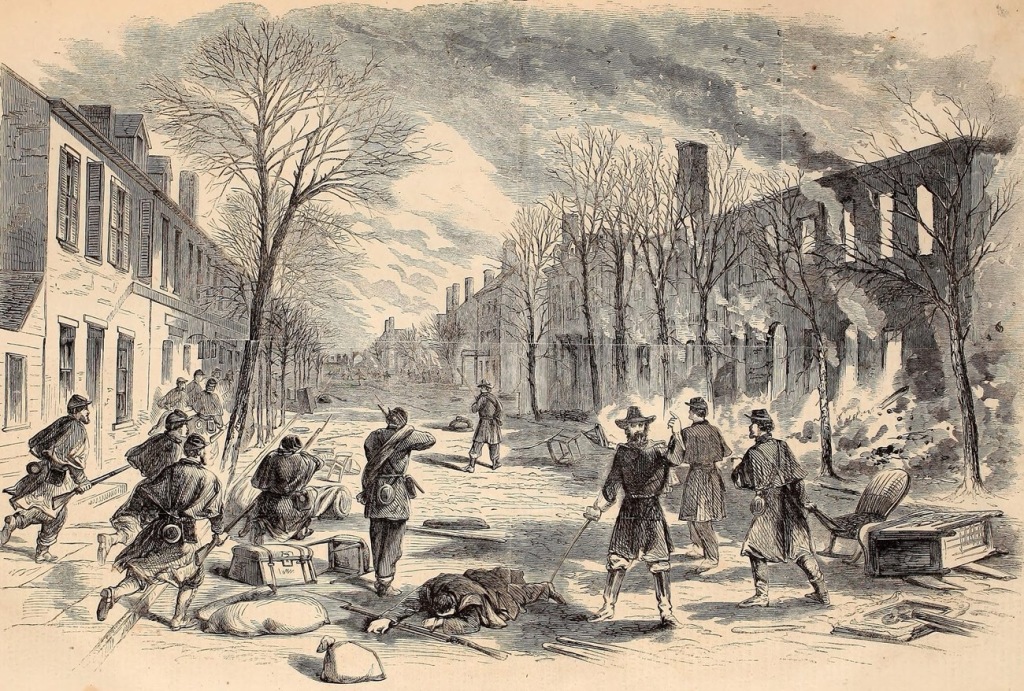
US soldiers fight in the streets of Fredericksburg on 11 December 1862 Harpers Weekly
[Note: This letter is from the private collection of Derrick Williams who made it available for transcription and publication on Spared & Shared by express consent.]
Transcription
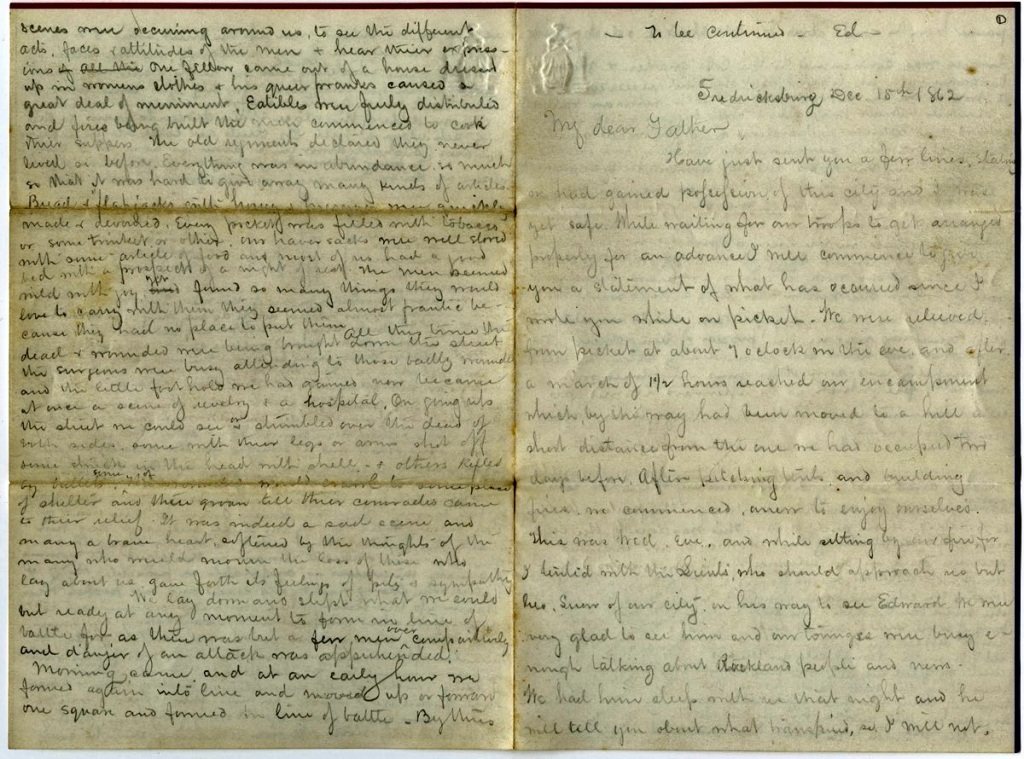
Fredericksburg [Virginia] December 15th 1862
Dear Father,
Have just sent you a few lines stating we had gained possession of this city and I was yet safe. While waiting for our troops to get arranged properly for an advance, I will commence to you a statement of what has occurred since I wrote you while on picket. We were relieved from picket at about 7 o’clock in the eve and after a march of 1.5 hours reached our encampment which, by the way had been moved to a hill a short distance from the one we had occupied two days before. After pitching tents, and building fires, we commenced anew to enjoy ourselves. This was Wednesday evening and while sitting by our fire for I tented with the Lieutenants, who should approach us but Geo. Green of our city on his way to see Edward. We were very glad to see him and our tongues were busy enough talking about Rockland people and news. We had him sleep with us that night and he will tell you about what transpired so I will not pause here to write about it.
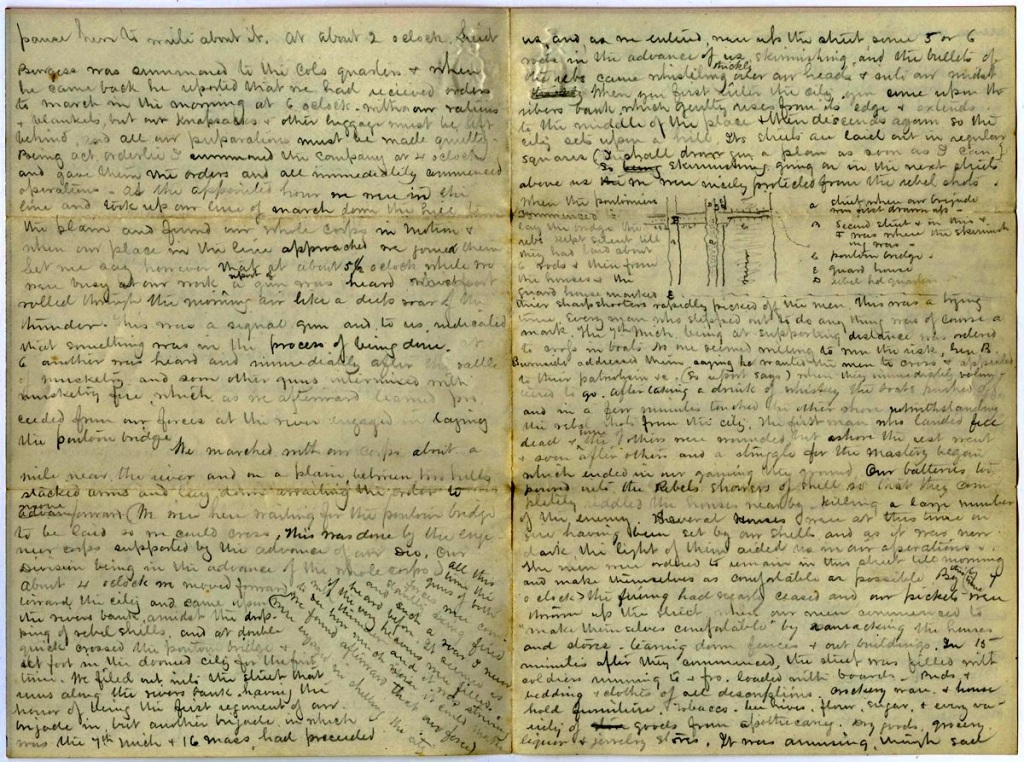
At about 2 o’clock, Lieut. [Gershom F.] Burgess was summoned to the Colonel’s quarters and when he came back he reported that we had received orders to march in the morning at 6 o’clock with our rations and blankets but not knapsacks & other baggage must be left behind, and all our preparations must be made quietly. Being acting orderly, I summoned the company at 4 o’clock and gave them the orders and all immediately commenced operations. At the appointed hour we were in the line and took up our line of march down the hill to the plain and found our whole corps in motion & when our place in the line approached, we found them. Let me say, however, that at about 5:30 o’clock, while we were busy at our work, the report of a gun was heard which rolled through the morning air like a deep roar of the thunder. This was a signal gun and to us indicated that something was in the process of being done. At 6 another was heard and immediately after the rattle of musketry and some other guns intertwined with musketry from our forces at the river engaged in laying the pontoon bridge.
We marched with our Corps about a mile near the river and on a plain between the two hills stacked arms and lay down awaiting the order to move forward. We were here waiting for the ponton bridge to be laid so we could cross. This was done by the Engineer Corps supported by the advance of our division (our division being in the advance of the whole corps). All this time the guns of both forces were constantly being fired and such a roar I never heard before. It seems as if the very heavens were filled with thunder and it was striving to see how much noise it could make. We found afterward that our force were engaged in shelling the city.
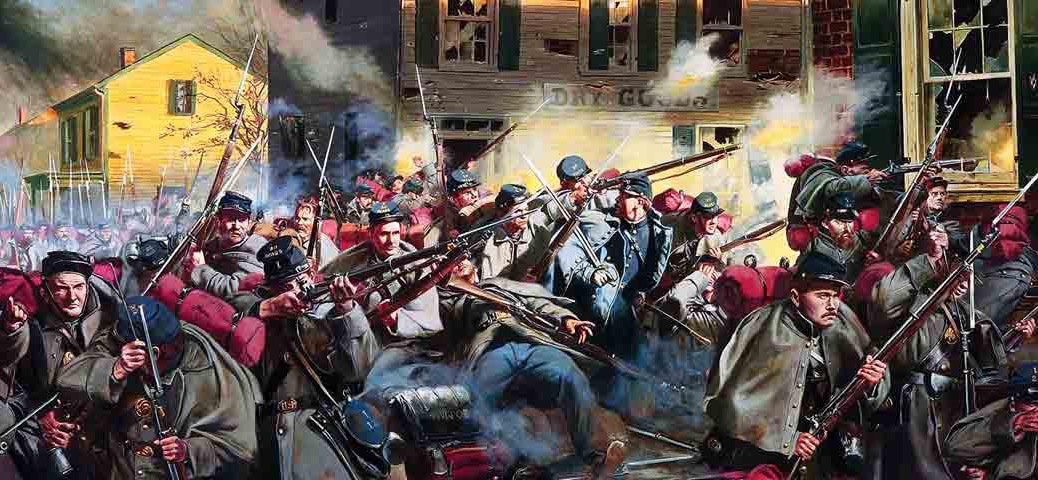
About 4 o’clock we moved forward toward the city and came upon the river bank amidst the dropping of rebel shells, and at double quick crossed the pontoon bridge & set foot in the doomed city for the first time. We filed out into the street that runs along the river’s bank, having the honor of being the first regiment of our brigade in, but another brigade, in which was the 7th Michigan & 16th Massachusetts had preceded us, and as we entered, ran up the street some 5 or 6 rods in the advance of us skirmishing and the bullets of the rebs came whistling thickly over our heads and into our midst.
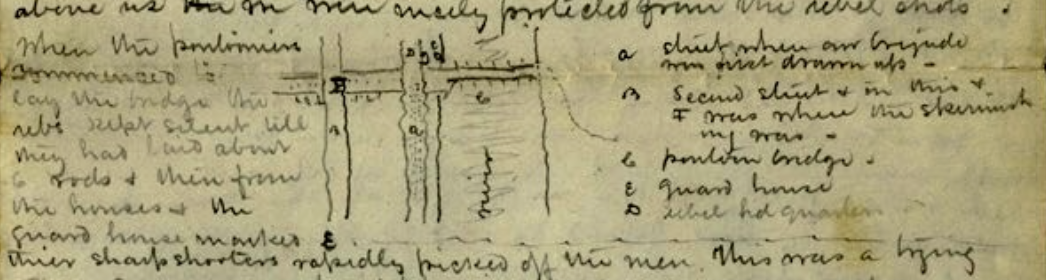
When you first enter the city, you come upon the river’s bank which gently rises from its edge and extends to the middle of the place & then descends again so the city sits upon a hill. Its streets are laid out in regular squares (I shall draw you a plan as soon as I can). Some skirmishing going on in the next street above us. The men nicely protected from the rebel shots.
When the pontooniers commenced to lay the bridge, the rebs kept silent till they had laid about 6 rods & then from the houses & the guard house marked [on sketch], their sharpshooters rapidly picked off the men This was a trying time. Every man who stepped out to do anything was of course a mark. The 7th Michigan being at supporting distance was ordered to cross in boats. No one seemed willing to run the risk. Gen. Burnside addressed them saying he wanted the men to cross & appealed to their patriotism &c. (so report says) when they immediately volunteered to go. After taking a drink of whiskey, the boats pushed off and in a few minutes touched the other shore notwithstanding the rebel shots from this city. The first man who landed fell dead & some of the others were wounded but ashore the rest went & soon after others and a struggle for the mastery began which ended in our gaining the ground.
The laying of the pontoon bridge over the Rappahannock
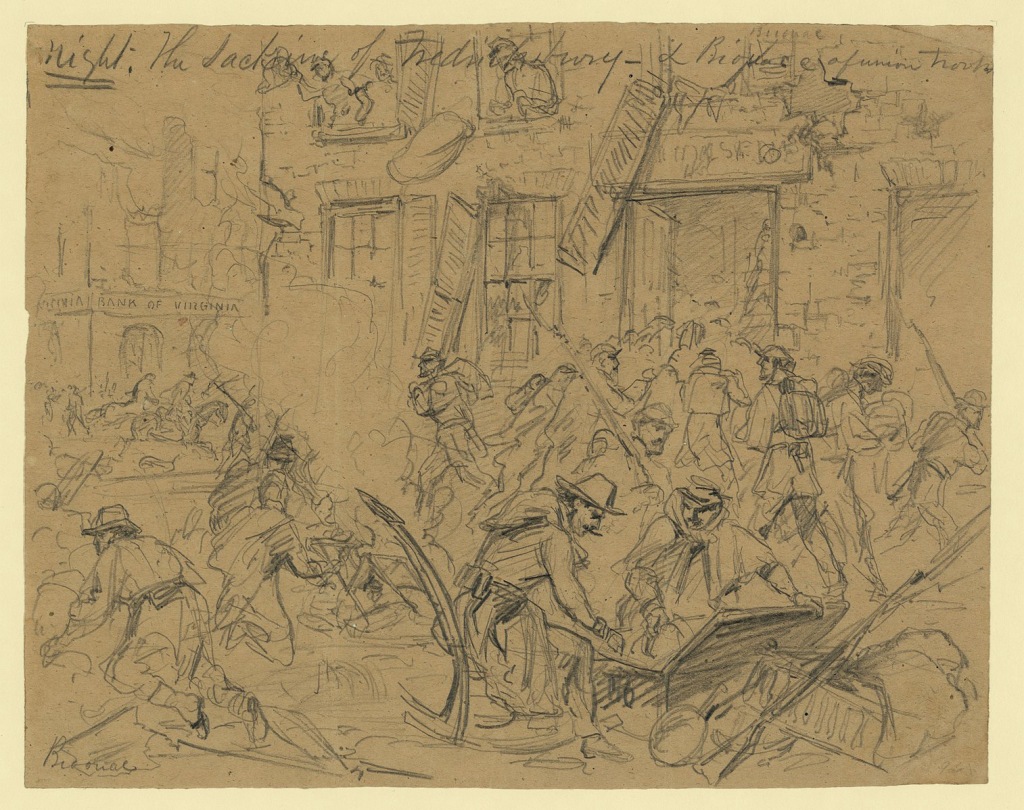
Our batteries too poured into the Rebels showers of shell so that they completely riddled the houses nearby killing a large number of the enemy. Several houses were at this time on fire having been set by our shells and as it was near dark, the light of them aided us in our operations. The men were ordered to remain in this street till morning and make themselves as comfortable as possible. By 7 o’clock the firing had nearly ceased and our pickets were thrown up the street when our men commenced to making themselves comfortable by ransacking the houses and stores, tearing down fences and out buildings. In 15 minutes after they commenced, the street was filled with soldiers running to and fro, loaded with boards, beds and bedding and clothes of all descriptions, crockery ware and household furniture, tobacco, bee hives, flour, sugar, and every variety of goods from apothecary, dry goods, grocery, liquor, and jewelry stores. It was amusing though sad scenes were occurring around us, to see the different acts, faces & attitudes of the men & hear their expressions. One fellow came out of a house dressed up in women’s clothes & his queer pranks caused a great deal of merriment. Eatibles were freely distributed and fires being built them men commenced to cook their suppers.
The ransacking of Fredericksburg by Union troops
The old regiments declared thy never lived as before. Everything was in abundance, so much so that it was hard to give away many kinds of articles. Bread and flapjacks with honey & preserves were quickly made and devoured. Every pocket was filled with tobacco or some trinket or other. Our haversacks were well stored with some article of food and most of us had a good bed with a prospect of a night of rest. The men seemed wild with joy, yet found so many things they would love to carry with them they seemed almost frantic because they had no place to put them.
All this time the dead and wounded were being brought down the street. The surgeons were busy attending to those badly wounded and the little foothold we had gained now became at once a scene of revelry & a hospital. On going up the street we could see & stumbled over the dead of both sides, some with their legs or arms shot off, some struck in the head with shell, and others rifled by bullets. Some of the wounded would crawl to some place of shelter and there groan till their comrades came to their relief. It was indeed a sad scene and many a brave heart softened by the thoughts of the many who would mourn the loss of those who lay about us gave forth its feelings of pity and sympathy.
We lay down and slept what we could but ready at any moment to form in line of battle for as there was but few men over comparatively and danger of an attack was apprehended. Morning came and at any early hour we formed again into line and moved up or toward one square and formed in line of battle. By this we advanced toward the enemy and at the same time made space for more who came after, to form in our rear to support us. Thus we moved forward, one square at a time, the enemy at times shelling us at a furious rate—especially when they saw our troops pass by the streets. We were ordered to lie low or march in a stooping position so that we were often covered from the enemy by the houses or fences.
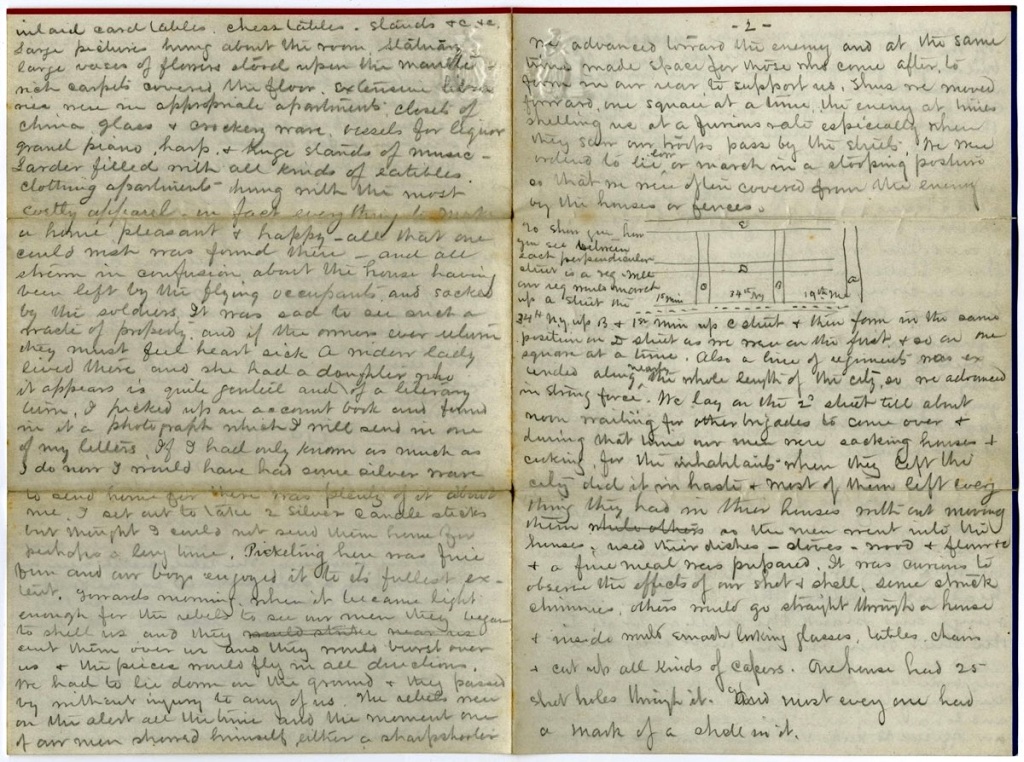
To show you how you see between each perpendicular street is a regiment. Our regiment marched up A street, the 34th New York up B, 1st Minnesota up C street, and then form in the same position in D street as we were on the first, and so on, one square at a time. Also a line of regiments was extended along nearly the whole length of the city so we advanced in strong force. We lay on the 2nd street till about noon waiting for other brigades to come over and during that time our men were sacking houses & cooking, for the inhabitants, when they left the city, did it in haste and most of them left everything they had in their houses without moving them. As the men went into the houses, used their dishes, stoves, wood, and flour, &c. and a fine meal was prepared. It was curious to observe the effects of our shot and shell. Some struck chimneys, others would go straight through a house & inside would smash looking glasses, tables, chairs, and cut up all kinds of capers. One house had 25 shot holes through it. And most every one had a mark of a shell in it.
Chaplain A. B. Fuller, 16th Mass. Regt.
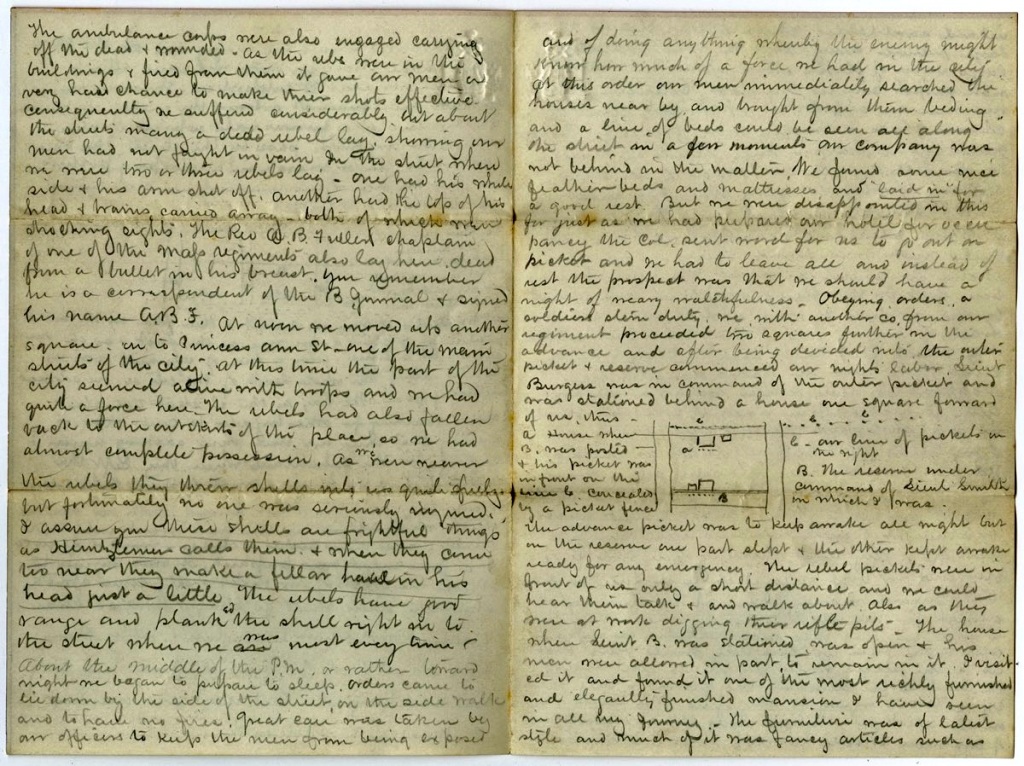
The ambulance corps were also engaged carrying off the dead and wounded. As the rebs were in the buildings & fired from them, it gave our men a very hard chance to make their shots effective. Consequently we suffered considerably. All about the streets, many a dead rebel lay, showing our men had not fought in vain. In the street where we were two or three rebels lay; one had his whole side and his arm off, another had the top of his head and brains carried away—both shocking sights. The Rev. A[arthur] B[uckminster] Fuller, chaplain of one of the Mass. Regiments also lay here dead from a bullet in his breast. You remember he is a correspondent of the Boston Journal and signed his name A. B. F.
At noon we moved up another square in to Princess Ann Street—one of the main streets of the city. At this time the part of the city seemed alive with troops and we had quite a force here. The rebels had also fallen back to the outskirts of the place so we had almost complete possession. As we were nearer the rebels they threw shells into us quite freely but fortunately no one was seriously injured. I assure you these shells are frightful things as [Gen.] Heintzelman calls them and when they come too near they make a feller haul in his head just a little. The rebels have good range and plunked the shell right into the street where we was most every time.
About the middle of the p.m., or rather toward night, we began to prepare to sleep. Orders came to lie down by the side of the street, on the sidewalk, and to have no fires. Great care was taken by our officers to keep the men from being exposed and of doing anything whereby the enemy might know how much of a force we had in the city. At this order our men immediately searched the houses nearby and brought from them bedding and a line of beds could be seen all along the street in a few moments. Our company was not behind in the matter. We found some nice feather beds and mattresses and “laid in” for a good rest. But we were disappointed in this for just as we had prepared our hotel for occupancy, the Colonel sent word for us to go out on picket and we had to leave all and instead of rest, the prospect was that we should have a night of weary watchfulness.
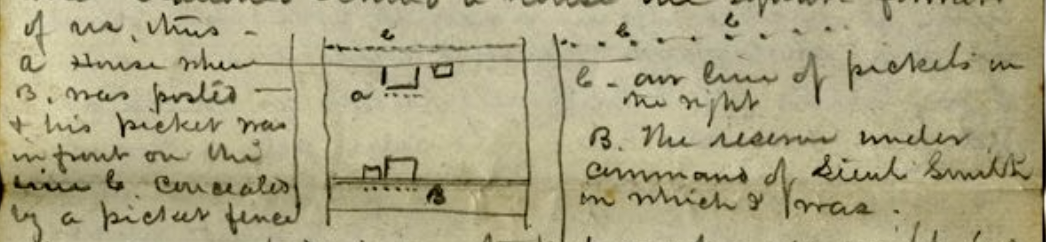
Obeying orders—a soldier’s stern duty—we with another company from our regiment proceeded two squares further in the advance and after being divided into the outer picket and reserve, commenced our night’s labor. Lieut. Burgess was in command of the outer picket and was stationed behind a house one square forward of us thus [sketch]
The advance picket was to keep awake all night but in the reserve one part slept and the other kept awake, ready for an emergency. The rebel pickets were in front of us only a short distance and we could hear them talk & walk about. Also as they were at work digging their rifle pits. The house where Lieut. Burgess was stationed was open and his men were allowed in part to remain in it. I visited it and found it one of the most richly furnished and elegantly finished mansion I have seen in all my journey. The furniture was of latest style and much of it was fancy articles such as inlaid tables, chess tables, stands, &c. &c. large pictures hung about the room, statuary, large vases or flowers stood upon the mantle, rich carpets covered the floor, extensive libraries were in appropriate apartments, closets of china, glass and crockery ware, vessels for liquor, grand piano, harp, and huge stands of music. Larder filled with all kinds of eatables. Clothing apartments hung with the most costly apparel. In fact, everything to make a home pleasant & happy—all that one could wish was found there—and all strewn in confusion about the house having been left by the flying occupants and sacked by the soldiers. It was sad to see such a waste of property, and if the owners ever return, they must feel heart sick.
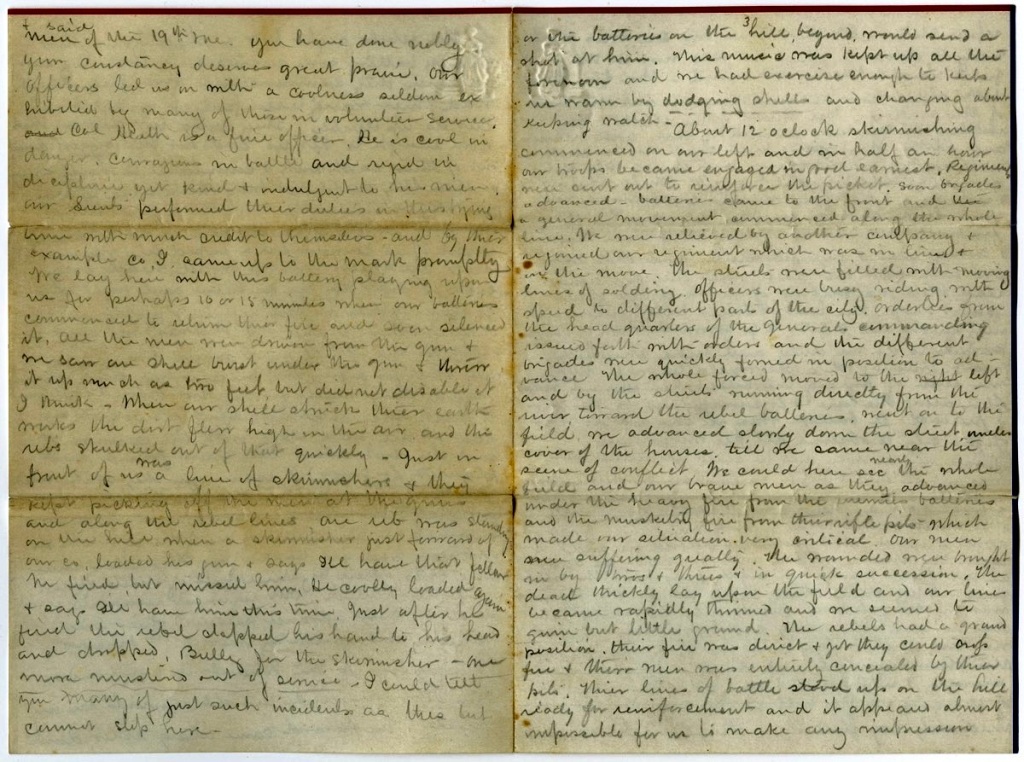
A widow lady lived there and she had a daughter who it appears is quite genteel and of a literary turn. I picked up an account book and found in it a photograph which I will send in one of my letters. If I had only known as much as I do now, I would have had some silver ware to send home for there was plenty of it about me. I set out to take 2 silver candle sticks but thought I could not send them home for perhaps a very long time. Picketing here was fine fun and our boys enjoyed it to its fullest extent. Towards morning when it became light enough for the rebels to see our men, they began to shell us and they sent them over us and they would burst over us and the pieces would fly in all directions. We had to lie down on the ground and they passed by without injury to any of us. The rebels were on the alert all the time and the moment one of our men showed himself, either a sharpshooter or the batteries on the hill beyond would send a shot at him. This music was kept ip all the forenoon and we had exercise enough to keep us warm by dodging shells and changing about keeping watch.
About twelve o’clock skirmishing commenced on our left and in half an hour our troops became engaged in good earnest. Regiments were sent out to reinforce the picket. Some brigades advanced. Batteries came to the front and a general movement commenced along the whole line. We were relieved by another company & rejoined our regiment which was in line and on the move. The streets were filled with moving lines of soldiers. Officers were busy riding with speed to different parts of the city. Orderlies from the headquarters of the generals commanding issued forth with orders and the different brigades were quickly formed in position to advance. The whole force moved to the left and by the streets running directly from the river toward the rebel batteries, went onto the field. We advanced slowly down the street under cover of the houses till we came near the scene of conflict. We could here see nearly the whole field and our brave men as they advanced under the heavy fire from the enemy’s batteries and the musketry fire from their rifle pits which made our situation very critical. Our men were suffering greatly.
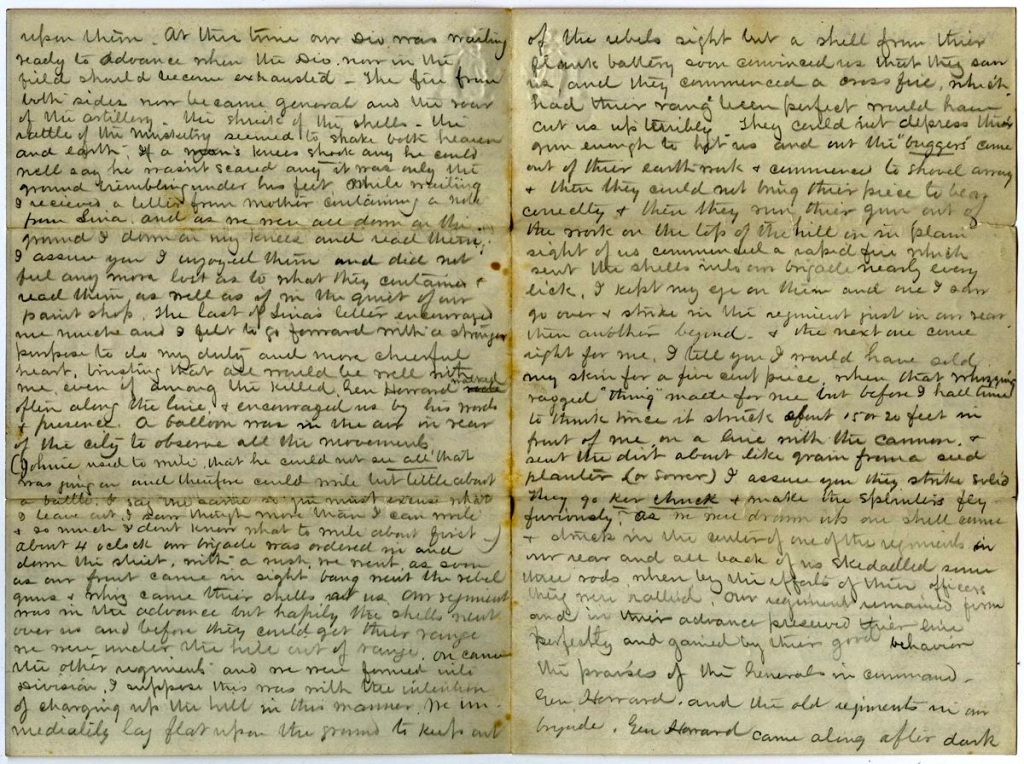
The wounded were brought in twos and threes and in quick succession. The dead thickly lay upon the field and our lines became rapidly thinned and we seemed to gain but little ground. the rebels had a grand position. Their fire was direct and yet they could cross fire and their men was entirely concealed by their pits. Their lines of battle stood up in the hill ready for reinforcement and it appears almost impossible for us to make any impression upon them. At this time our division was waiting ready to advance when the division now in the field should become exhausted. The fire from both sides now became general and the roar of the artillery, the shriek of the shells, the rattle of the musketry, seemed to shake both heaven and earth. If a man’s knees shook any, he could well say he wasn’t scared any—it was only the ground trembling under his feet. While waiting, I received a letter from Mother containing another from Sina and as we were all down on the ground, I [got] down on my knees and read them. I assure you, I enjoyed them and did not feel any more lost as to what they contained & read them as well as if in the quiet of our paint shop. The last of Sina’s letter encouraged me much and I felt to go forward with a stronger purpose to do my duty, and more cheerful heart, trusting that all would be well with me, even if among the killed.
Gen. [Oliver O.] Howard walked often along the line & encouraged us by his words and presence. A balloon was in the air in rear of the city to observe all the movements. (Johnnie used to write that he could not see all that was going on and therefore could not write but little about a battle. I say the same so you must excuse what I leave out. I saw though more than I can write & so much I don’t know what to write about first.)
About 4 o’clock our brigade was ordered in and down the street with a rush we went. As soon as our front came in sight, bang went the rebel guns and whiz came their shells at us. Our regiment was in the advance but happily the shells went over us and before they could get their range, we were under the hill out of range. On came the other regiments and we were formed into division. I suppose this was with the intention of charging up the hill in this manner. We immediately lay flat upon the ground to keep out of the rebels sight but a shell from their flank battery soon convinced us that they saw us and they commenced a cross fire which had their range been perfect, would have cut us up terribly. They could not depress their gun enough to hit us and out the “buggers” came out of their earthwork and commence to shovel away and then they could not bring their piece to bear correctly and they they run their gun out of the work on the top of the hill and in plain sight of us, commenced a rapid fire which sent the shells into our brigade nearly every lick. I kept my eye on them and one I saw go over and strike in the regiment just in our rear, then another beyond, & the next one came right for me. I tell you, I would have sold my skin for a five cent piece when that whizzing, ragged thing made for me. But before I had time to think twice, it struck about 15 or 20 feet in front of me on a line with the cannon & sent the dirt about like grain from a seed planter (or sower). I assure you, they strike solid. They go ker chuck and make the splinters fly furiously.
Col. Francis E. Heath, 19th Maine Infantry—“cool in danger—courageous in battle.”
As we were drawn up, one shell came and struck in the center of one of the regiments in our rear and all back of us skedaddled some three rods, when by the efforts of their officers they were rallied. Our regiment remained firm and in their advance preserved their line perfectly and gained by their good behavior the praises of the general in command. Gen. Howard and the old regiments in our brigade. Gen. Howard came along after dark and said, “Men of the 19th Maine, you have done nobly. Your constancy deserves great praise.” Our officers led us in with a coolness seldom exhibited by many of those in volunteer service. Col. [Francis E.] Heath is a fine officer. He is cool in danger. Courageous in battle and rigid in discipline yet kind and indulgent to his men. Our lieutenants performed their duties in this trying time with much credit to themselves and by their example, Co. I came up to the mark promptly.
We lay here with this battery playing upon us for perhaps 10 or 15 minutes when our batteries commenced to return their fire and soon silenced it. All the men were driven from their gun & we saw one shell burst under the gun & there it up much as two feet but did not disable it, I think. When our shells struck their earthworks, the dirt flew high in the air and the rebs skulked out of that quickly. Just in front of us a line of skirmishers kept picking off the men at their guns and along the rebel lines. One reb was standing on the hill when a skirmisher just forward of our company loaded his gun and days, “I’ll have that fellow.” He fired but missed him. He cooly loaded again and says, “I’ll have him this time.” Just after he fired, the rebel clapped his hand to his head and dropped. Bully for the skirmisher. One more mustered out of service. I could tell many of just such incidents as this but cannot. Stop here. —-Ed
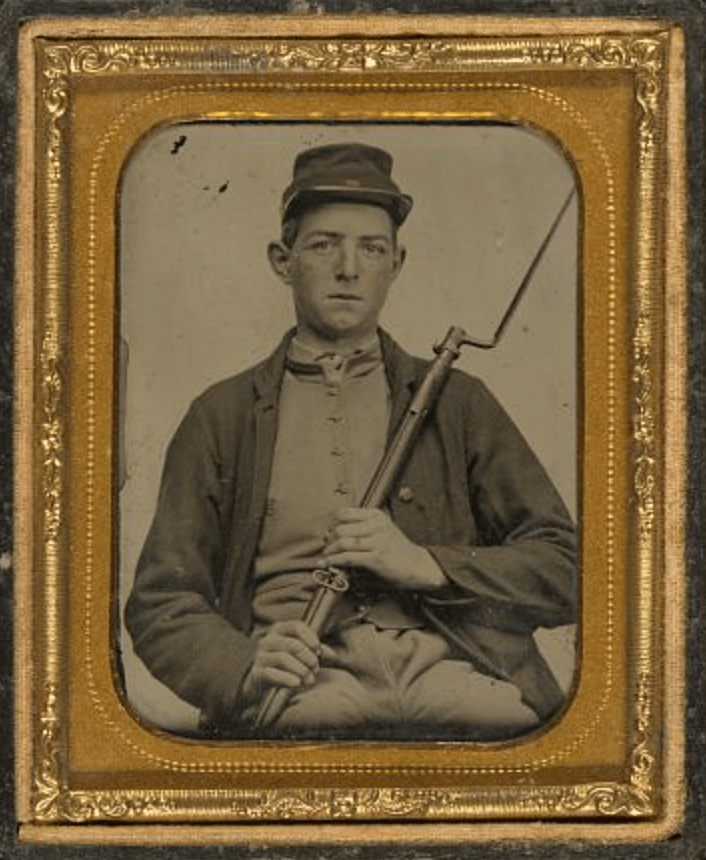
I could not find an image of Eben but here is one of John A. Hartshorn of Co. A, 19th Maine Infantry (LOC)
This letter was written by Ebenezer (“Eben”) Eastman Colby (1844-1892) of Belfast, Maine, while serving in Co. G, 19th Maine Infantry. Eben was wounded on 5 May 1864 while fighting in the opening stages of the Wilderness Campaign and was transferred to 1st Main Heavy Artillery on 15 December 1864, and later still to the 14th Veteran Reserve Corps (VRC). Before joining the 19th Maine, Eben had previously served in the 2nd Maine Infantry, Co. K, for two years, his enlistment being witnessed by his father, Charles S. Colby, who attested that his son was at least 18 years of age. At the time of his enlistment, Eben was described as five foot six inches tall, with blue eyes and brown hair. But Eben was no alone in his enlistment—his father also enlisted in the same company as his son but did not survive the war. He was killed at the Battle of Gaines’ Mill on 27 June 1862.
Following the war, though Eben did not leave the country as he threatened to do in the following letter, he relocated to Santa Cruz, California, where he could resume his blacksmith trade as far away from the liberated Negroes he obviously despised. He was married to Flora A. Collins (1847-1941) on 11 September 1864 in Liberty, Waldo county, Maine.
To read letters by other members of the 19th Maine Infantry that I have transcribed and published on Spared & Shared, see:
Camp near Catlett Station, Virginia October 25, 1863
Olive,
I will pen you a few lines today as I have nothing to do. We have got marching orders and we don’t know when we will have to go but go wnen or where they will, I am with them.
Olive, I have nothing very new to write today. Everything is quiet along the lines. The rebels are not far from here but what there is near us are peaceable as can be.
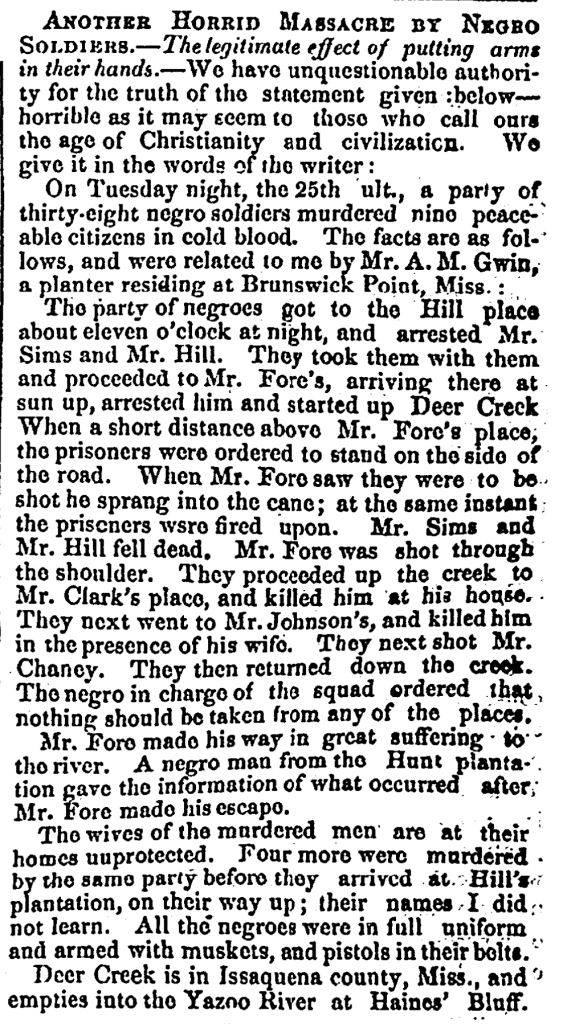
Eben was most likely reacting to this article appearing in the Daily Eastern Argus (or some other Maine paper) published on 14 September 1863
Olive, if you take the Belfast Journal, I wish you would send me one once and a while for I am fond of reading papers. If you will send me one every week, I will pay all postage on them, I was reading a piece in one that a fellow had in our company. It was about some of Abraham’s negro soldiers where they murdered—or rather massacred—a whole family of whites. Damn ’em. They all ought to be burned at the stake. What in hell will this country come to if the negroes are all free.
Olive, I never mean to help free them anymore than I have. I mean to leave the army one of these days and then let them whistle if they get me. I am going to leave this country one of these days. I wish to God that Abraham and all of his followers was in hell. This war would be stopped shortly, I suppose. If some of the damned abolition curses down there was to hear me say what I have written, they would be mad enough to hang me. I wish I was down there—I would tell them what I think of Abraham and his black brethren. Damn ’em.
Olive, I will close this short letter for I have written more that you will want to read. No more today. Goodbye. Ever your friend, — E. E. Colby
P. S. Please write soon and write all the news. Give my love to Ed and all the folks.




















 Spared & Shared 23