The following letter was written by John Peak Cushing (1836-1881). He enlisted in Co. A of the 8th Massachusetts Infantry (3 months) early in the war but later reenlisted as a corporal in Co. H, 19th Massachusetts and later, in December 1861, transferred to Co. I. He was wounded in action on 30 June 1862 during the Battle at Glendale, Henrico County, Virginia; mustered out with disability on 29 November 1862 at Washington, D. C.
John’s parents were Nathaniel Cushing (1809-1857) and Olive Wade (1804-1887) of Scituate, Plymouth county, Massachusetts. At the time of the 1860 US Census, John’s mother was considered “insane 30 years.” John was employed as a blacksmith at the time—a trade that he learned from his father—and he had two older sisters and an older brother named Nathaniel G. Cushing.
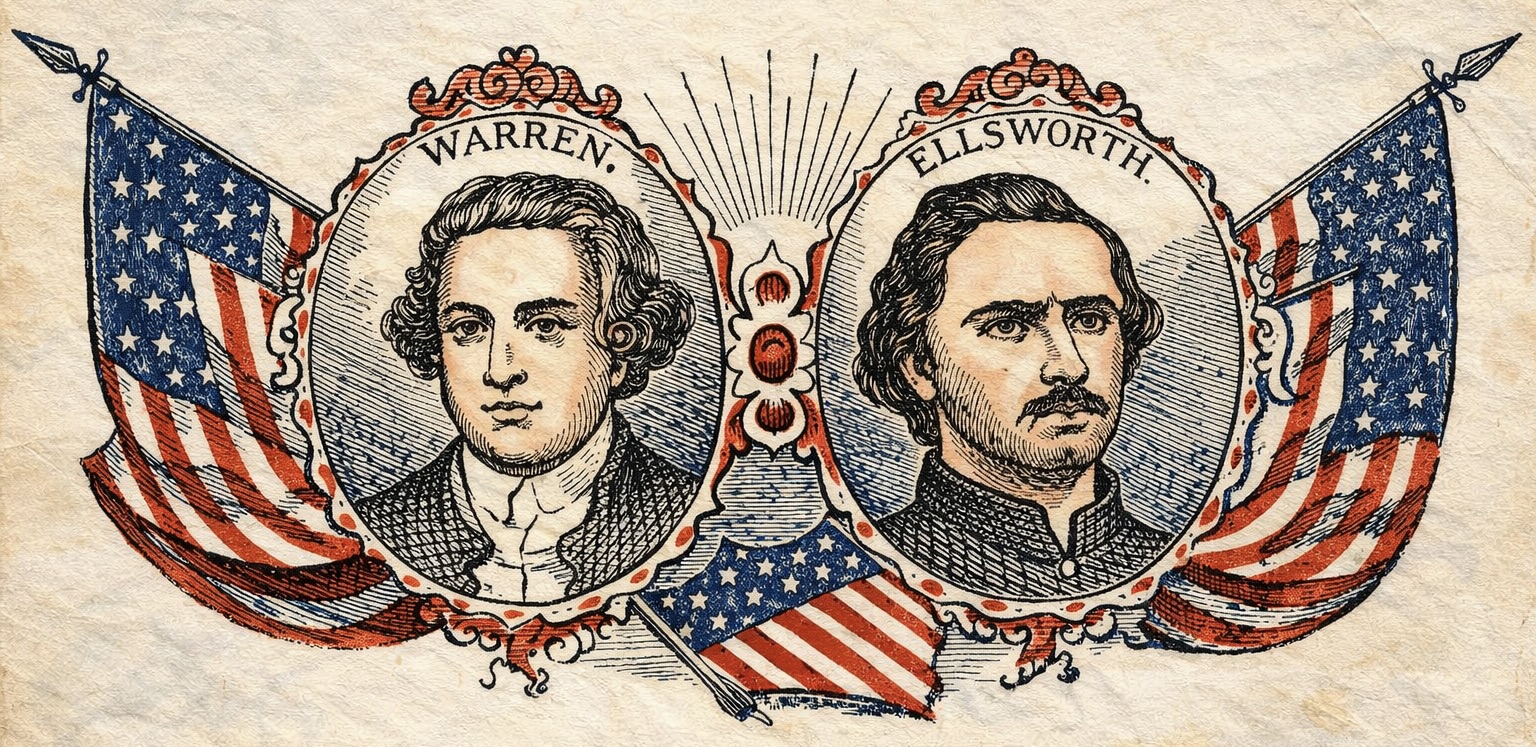
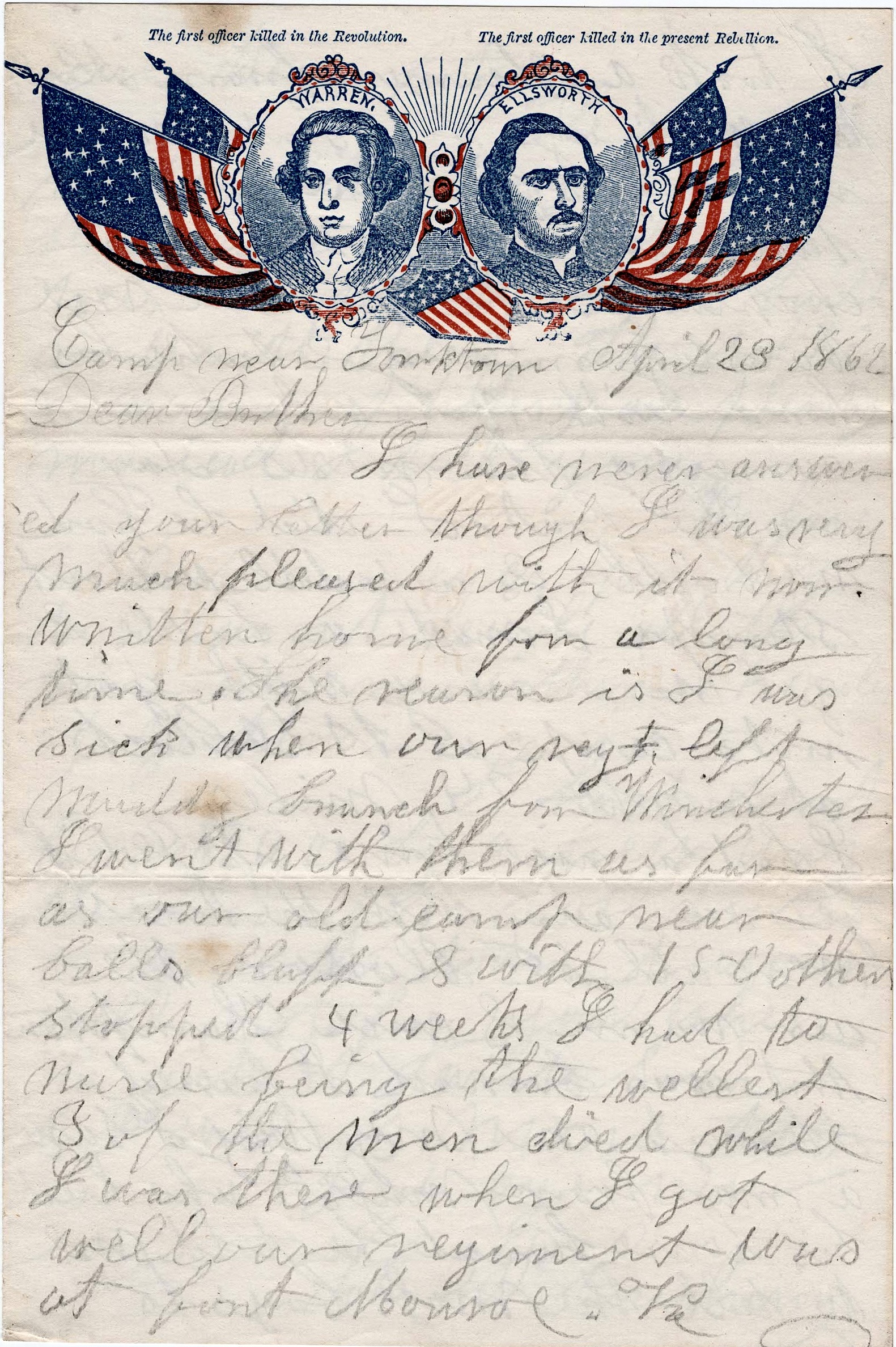
Cushing’s letterhead has a patriotic image that honors Warren as the first officer killed in the Revolution, and Ellsworth as the first officer killed in the present rebellion.
T R A N S C R I P T I O N
Camp near Yorktown April 23, 1862
Dear Brother,
I have never answered your letter though I was very much pleased with it nor written home for a long time. The reason is I was sick when our regiment left Muddy Branch for Winchester. I went with them as far as our old camp near Balls Bluff & with 15 others stopped 4 weeks. I had to nurse, being the wellest. Three of the men died while I was there. When I got well, our regiment was at Fort Monroe, Virginia.
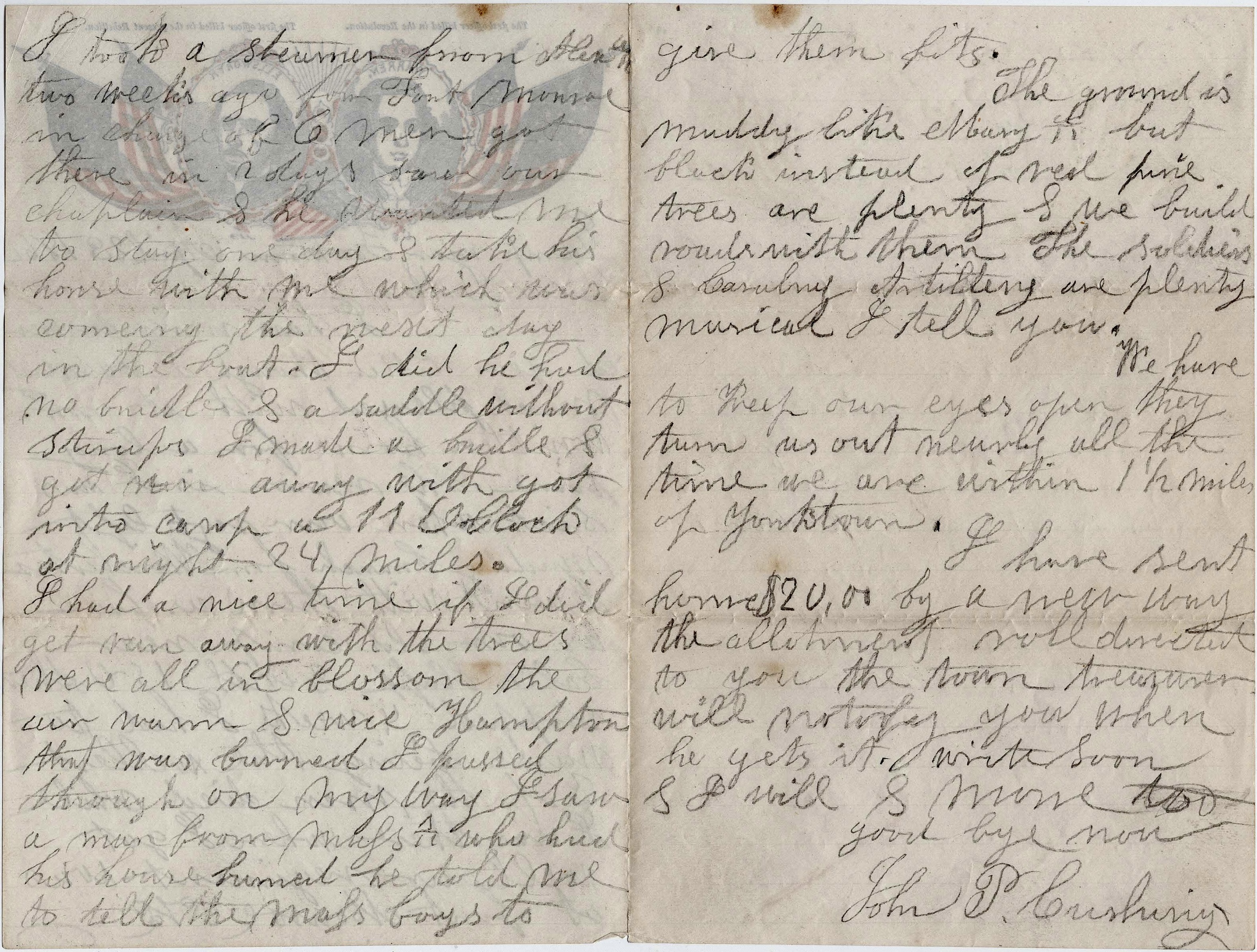
I took a steamer from Alexandria two weeks ago for Fort Monroe in charge of six men. Got there in two days. Saw our chaplain & he wanted me to stay one day and take his horse with me which was coming the next day in the boat. I did. He had no bridle and a saddle without stirrups [so] I made a bridle and got run away with. Got into camp at 11 o’clock at night—24 miles.
I had a nice time if I did get run away with. The trees were all in blossom, the air warm & nice. Hampton that was burned I passed through on my way. I saw a man from Massachusetts who had his house burned. He told me to tell the Massachusetts Boys to give them fits.
The ground is muddy like Maryland but black instead of red. Pine trees are plenty & we build roads with them. The soldiers & cavalry artillery are plenty musical, I tell you. We have to keep our eyes open. They turn us out nearly all the time. We are within one and a half miles of Yorktown.
I have sent home $20 by a new way. The allotment roll directed to you. The town treasurer will notify you when he gets it. Write soon & I will & more too. Goodbye now. — John P. Cushing
George W. Palmer (1838-1863) was a 23 year-old barber of Lynnfield, Essex county, Massachusetts, when he enlisted in the fall of 1861 as a private in Co. A, 19th Massachusetts Infantry. He was slightly wounded in the Battle of Antietam in September 1862 but fell ill in the winter of 1862-63. He died of “disease” at the USA Hospital on Islington Lane in Philadelphia on 26 February 1863 leaving a wife, Louisa (Mansfield) Palmer, and their five year-old daughter, Carrie, to grieve his loss. The disease was undoubtedly smallpox as the Hospital on Islington Lane was reserved for those soldiers suffering from contagious, or “eruptive” diseases. Such “loathsome” diseases may have also included measles, erysipelas, or scarlet fever, but the surgeon’s description of George’s symptoms point to smallpox. The purplish color of the skin is a sure symptom. Likewise. the surgeon’s concern with sending George’s personal effects home to his wife that might result in the transmission of the disease to her and her child also points to smallpox. It may even be that George’s wife was prohibited from visiting him in the hospital due to his being quarantined.
How common was smallpox during the Civil War? According to the National Museum of Civil War Medicine, “from May 1861 to June 1866, there were 12,236reported cases of smallpox among white troops in the Union army, or 5.5 per thousand men annually. In addition, there were 6,716 cases among the U.S. Colored Troops, or 36.6 per thousand men annually. The death rates from the disease were approximately 23 percent for the white troops and 35 percent for the colored troops.”
The Islington Lane Hospital was located one-third of a mile north of Ridge avenue and beyond the Old Glenwood Cemetery where George was first laid to rest. Prior to its being turned into a hospital, the 33 acre property was occupied by the Fleming family. The hospital was sited in the three-story stone building and a stone barn was used as an annex. Glenwood Cemetery was a 20-acre cemetery founded in 1850 at the corner of Ridge Road and Islington Lane in North Philadelphia. During the Civil War, Glenwood, along with other cemeteries in the city, became the resting place for Union soldiers who died in Philadelphia’s military camps and hospitals, with around 700 interred in Glenwood alone. In 1888, more than two decades after the end of the war, all of these soldiers’ remains, along with others, were moved to the newly formed Philadelphia National Cemetery.
Attending George as the Surgeon-in-charge of that hospital was Dr. Patterson—the sole physician—as well as one Matron, one Ward Master, and ten other subordinates. [Source: Sunday Dispatch, 18 October 1863. I could not find a biographical sketch for Dr. James V. Patterson although it appears he was a life-long resident of Philadelphia, having been born there about 1825, and he was working as a physician there when the war began, his office located at the corner of Chestnut and 13th Streets near the city center.
What is most incredible about these three letters is the sensitivity displayed by the physician pertaining to just one case of the hundreds of patients he must have seen during the war. I’ve seen similar letters but none that convey such compassion, and rarely penned by a physician as opposed to a matron or nurse.
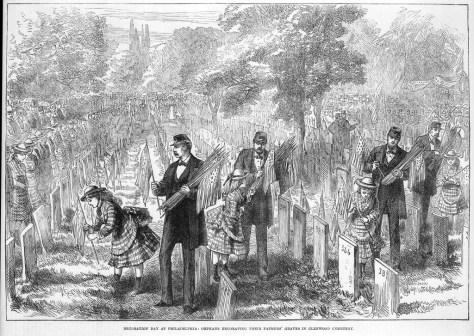
Orphans decorating their fathers’ graves in Glenwood Cemetery, Philadelphia, on Decoration Day. The Illustrated London News, June 24, 1876. Courtesy of the Library of Congress.
Note: These letters are from the personal collection of Greg Herr and were offered for transcription and publication on Spared & Shared by express consent.
Letter 1
U. S. A. Hospital Islington Lane, Philadelphia February 25, 1863
Mrs. Louisa Palmer,
My dear Madam, it is with great anxiety I pen you these lines. When I last wrote your husband was doing as well as could be expected & I hoped for his recovery but within the last two days unfavorable symptoms have set in. His lungs are becoming congested. His face today has a purple color showing obstruction to the circulation & his whole appearance betokens anxiety and distress. I would not deceive you but tell you candidly & frankly that he is in a very critical condition.
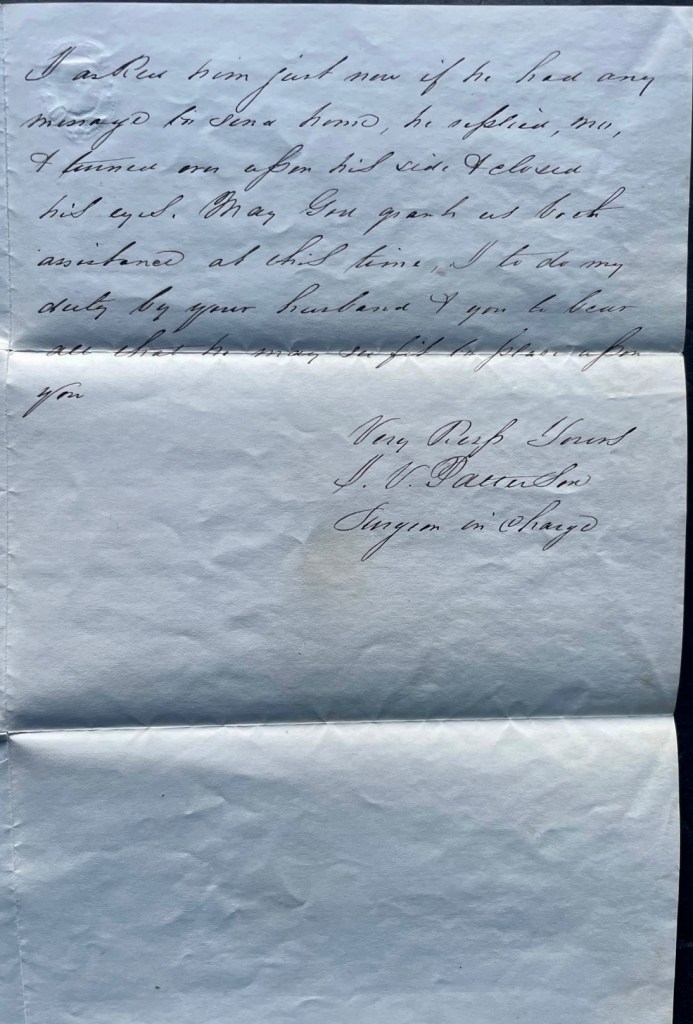
My heart feels for you, deprived as you are of the consolation of being at his bedside & ministering to his wants. I asked him just now f he had any message to send home. He replied, no, and turned over upon his side and closed his eyes. May God grant us both assistance at this time. I, to do my duty by your husband, & you to bear all that he may see fit to place upon you.
Very respectfully yours, — J. V. Patterson, Surgeon in charge
U. S. A. Hospital Islington Lane, Philadelphia February 26, 1863
Mrs. Louisa Palmer,
My dear Madam, I mailed you a letter yesterday informing you of the critical condition of your husband. I have still a harder task today. My worst fears are realized. Your beloved husband is no more. He died this morning about 2 o’clock very quietly & with little suffering. The Matron read to him yesterday a couple of letters from home & he seemed much affected. She asked him if she should write for him, he dictating the words. He said, “Yes, tomorrow, not now.” Poor fellow, his tomorrow never came. Before that came round, his spirit had winged its immortal flight. Death has entered the happy circle of your household & taken away a loved one. In this dark hour of your better trial, heart-stricken & bereaved, there is but one source of consolation. We are in our Heavenly Father’s hands. “Even so Father, for so it seemeth good in thy” sight. The ways of Providence are mysterious & past finding out, but when we shall come to trace for ourselves in the mass of time the wisdom of all his inscrutable dealings, we shall be able to say, “Righteous art thou, oh Lord.”
I shall look over the personal effects of your husband and those that can be safely sent away from the Hospital without the fear of conveying the infection, I will carefully pack up & hold them subject to your further order.
Be pleased to accept my warmest sympathy for you & yours in this hour of sadness, & believe me, very truly yours, — J. V. Patterson, Surgeon in charge.
Letter 3
Addressed to Mrs. Louisa Palmer, Lynnfield, Essex county, Massachusetts
U. S. A. Hospital Islington Lane, Philadelphia March 13th 1863
Mrs. Louisa Palmer,
My dear Madam, I send you by Adams Express the personal effects of your late husband which I judge there will be no danger in transmitting to you. You will be kind enough to sign the receipt for the articles & transmit it by mail to me.
The remains of your husband have been interred in Glenwood Cemetery & his grave is numbered, “Section N, Row A, Grave No. 64” so that perhaps in some future time you may be permitted to look upon his last earthly resting place. Very sincerely yours, — J. V. Patterson, Surgeon in charge




 Spared & Shared 23