The following letter was written by Augustus (“Gus”) Dilley (1835-1906) of Hubbard, Trumbull county, Ohio. Gus was raised in the same community as Lyman and Festus Tylee, two brothers roughly the same age as himself. In 1860, Gus married their younger sister, Martha Tylee (1840-1887). When the Civil War began, Gus joined with Lyman in Co. B, 19th Ohio Volunteer Infantry (OVI). Lyman was killed at the Battle of Stones River in January 1863. Not long after, Festus enlisted in Co. C, 125th OVI. Gus states in his letter that he never had the opportunity to meet Festus’ wife who, when he married Harriet M. Downing in 1858, lived in another community in Trumbull county.
Gus wrote the letter from the camp of the 19th OVI on 6 September, less than a week after the fighting before Atlanta that resulted in its capture. Both the 19th OVI and the 125th OVI served in the 3rd Division of the IV Corps during the Atlanta Campaign.
T R A N S C R I P T I O N
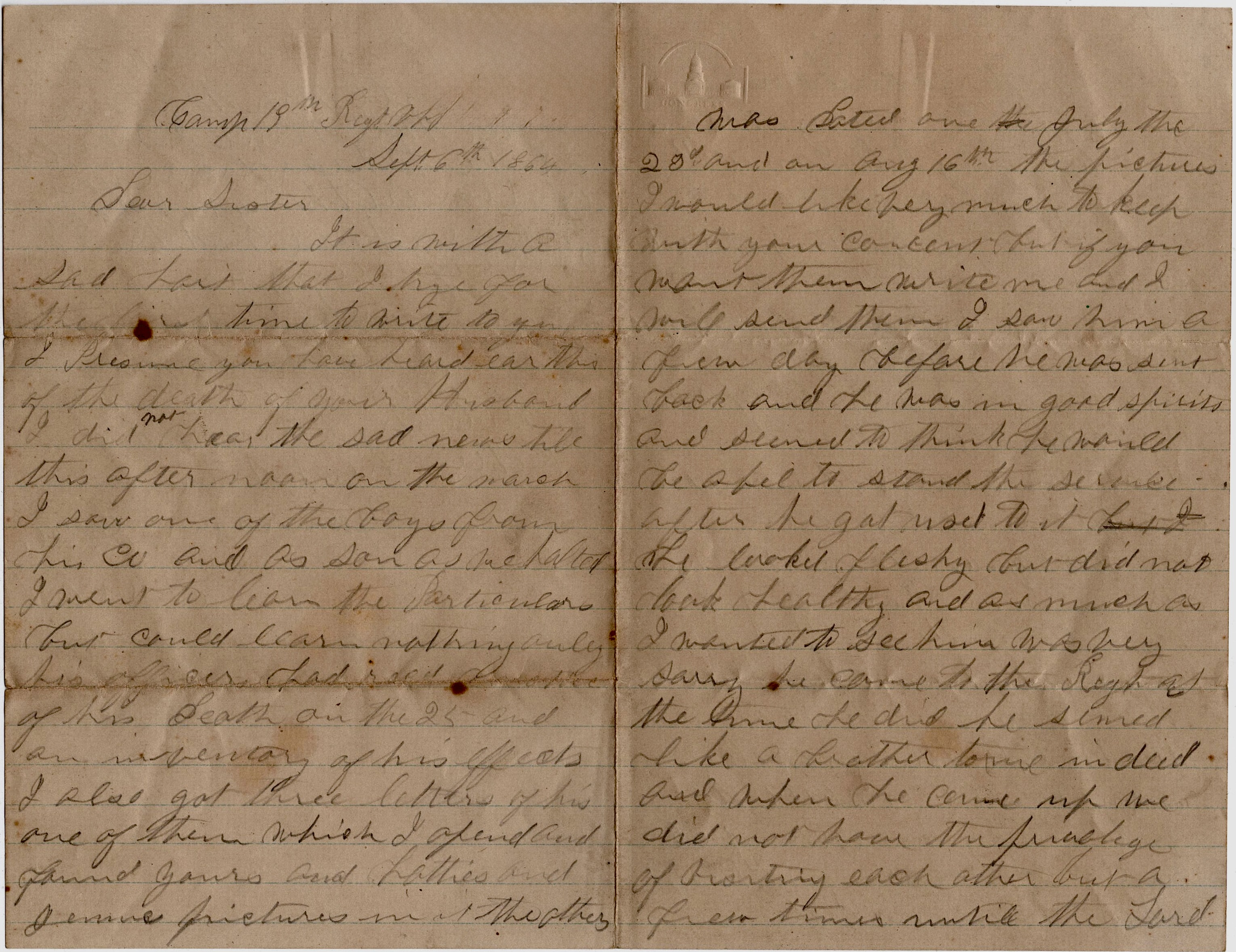
Camp 19th Regt. O. V. I. September 6th 1864
Dear Sister,
It is with a sad heart that I try for the first time to write to you. I presume you have heard ere this of the death of your husband. I did not hear the sad news till this afternoon on the march. I saw one of the boys from his company [Co. C, 125th OVI] and as soon as we halted, I went to learn the particulars but could learn nothing—only his officers had received a notice of his death on the 25th and an inventory of his effects. I also got three letters of his, one of them which I opened and found yours and Hattie’s and Jennie’s pictures in. The others was dated on July 20th and August 16th. The pictures I would like very much to keep with your consent but if you want sent, write me and I will send them.
I saw him a few days before he was sent back and he was in good spirits and seemed to think he would be able to stand the service after he got used to it. He looked fleshy but did not look healthy and as much as I wanted to see him, was very sorry he came to the regiment at the time he did. He seemed like a brother to me indeed. And when he came up we did not have the privilege of visiting each other but a few times until the Lord seen fit to take him away.
His company mourns his loss. They all seemed to be very much attached to him. It is getting dark and we have to move tonight and I will be obliged to make my letter short. What can I say to cheer the heart of one that has lost as dear a husband as he must have been. My acquaintance with him was short but I am confident that he put his trust in Him that was able to save and doeth all things well. May we be enabled to profit by his example and not mourn as those that have no hope.
It is so dark that I will have to close for this time. I would like to hear from you often although I have never had the pleasure of seeing you. You seem like a sister to me. Please excuse this poor letter and I will try and do better next time. Your in haste, — Gus
P. S. He was at Murfreesboro hospital when he died. — Gus
These letters were written by Lyman Tylee (1838-1863) who enlisted at age 23 as a private in Co. B, 19th Ohio Volunteer Infantry (OVI) on 13 September 1861 and rose in rank to Sergeant Major and transferred to Field & Staff on 1 July 1862. He was killed in action at Stones River, Tennessee, with other brave officers and men on 2 January 1863, “while gallantly performing their duties.” He was erroneously carried on the roster under the name Lyman Tyler at times.
Lyman was the son of Samuel Tylee (1798-1875) and Harriet Giddings (1805-1860) of Hubbard, Trumbull county, Ohio. He wrote these letters to his brother, Festus Giddings Tylee (1834-1864), who married Harriett Muriel Downing (1835-1921) in 1858 and was farming in Medina county, Ohio, at the time these letters were written in 1862.
Letter 1
Near Corinth, Mississippi May 27, 1862
Dear Brother,
Though I have written you twice since I received any news from you, I will today drop you a few lines. We are now much closer to the enemy’s lines than when I last wrote. Are daily skirmishing a little. We (the 19th) go on picket every four days. Came in this morning from picket. Last Thursday we were on the outposts and the Rebels shelled us wounding five men seriously. Yesterday all passed off quietly. Our pickets and theirs talked together some and there was but little firing done.
A few days since I received a letter from Amelia Tylee stating that Augustus (who was wounded at the Battle of Shiloh) was improving slowly. He was of Co. H, 45th Illinois Colunteers. Was wounded in the knee about 4 p.m. Sunday (6th) and was sent home in about a week after the battle. 1
Gus is not very well but is improving and the rest of the boys are well except Cal[vin] Clingan who has been sick for several months most of the time and was discharged and started on his way home on Sunday. Charles Hume was detached from our company and was Clerk for Gen. Boyle. His health was quite poor and he disappeared a week after the battle and since then we have not heard from him. He called to see us in the morning and left us saying he would go back to Boyle’s Headquarters (where he stayed) and would call again in the evening. He did not go back to the General’s quarters and all efforts to find him have been without success.
I saw Lt. P. W. Chase of Medina. He was taking care of Dr. Spillman who was very sick. I called again to see them and was told Chase had gone to Cincinnati, Ohio, with Dr. Spillman. Have they got to Medina?
If you see Chase, tell him I am well and would like to hear from him. Write soon. Write long and oblige your brother, — Lyme
1 Augustus Adams Tylee (1837-1909) was the son of William Tylee (1807-1884) and Juliet Hulbert (b. 1807) of Trumbull county, Ohio. Gus served as a corporal in Co. H, 45th Illinois Infantry. Military records show him under the name of Augustus A. Tyler.
Letter 2
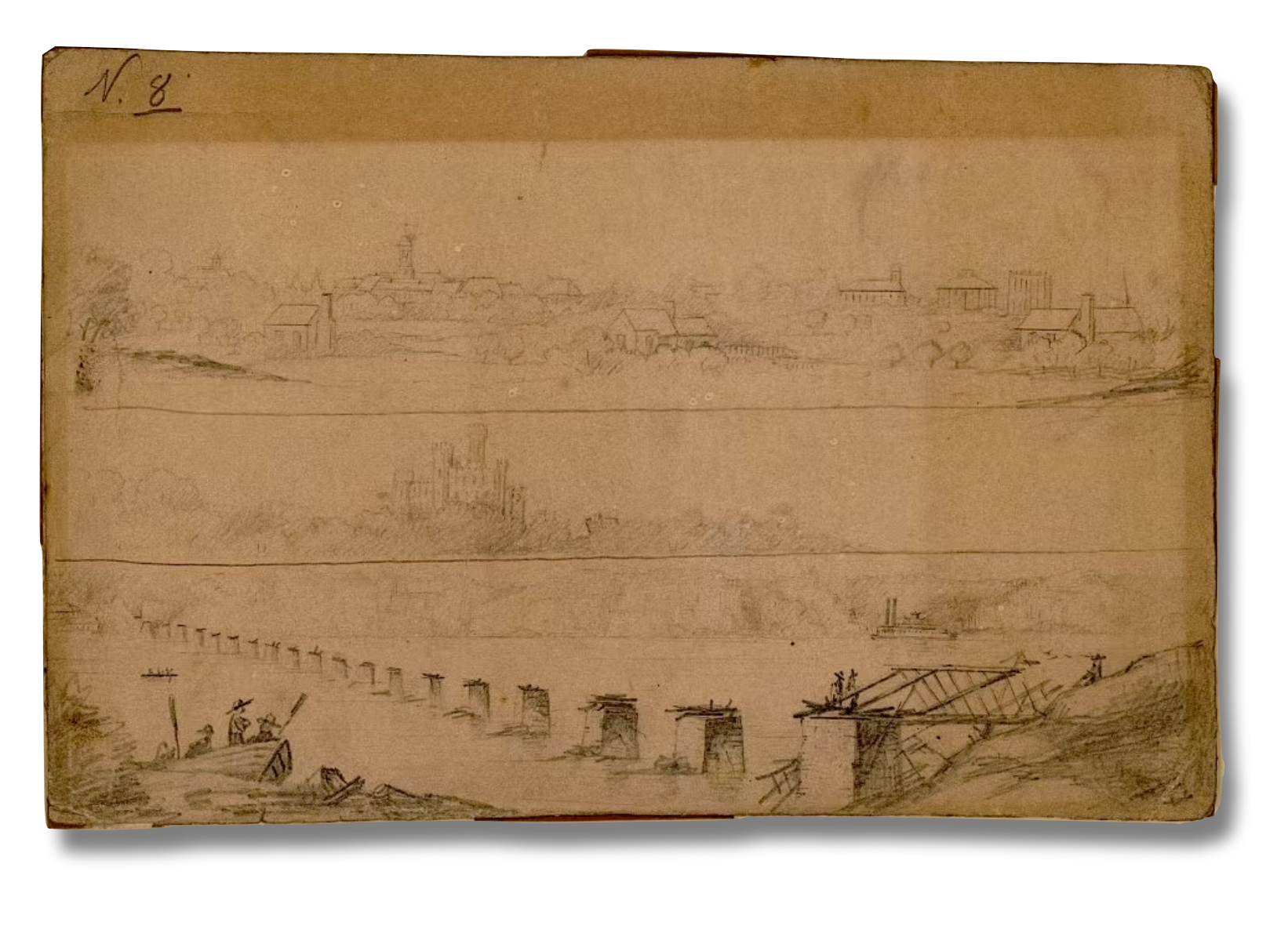
Some scenes of Florence, Alabama, and the Tennessee River drawn by Adolph Metzner on 22, June 1862
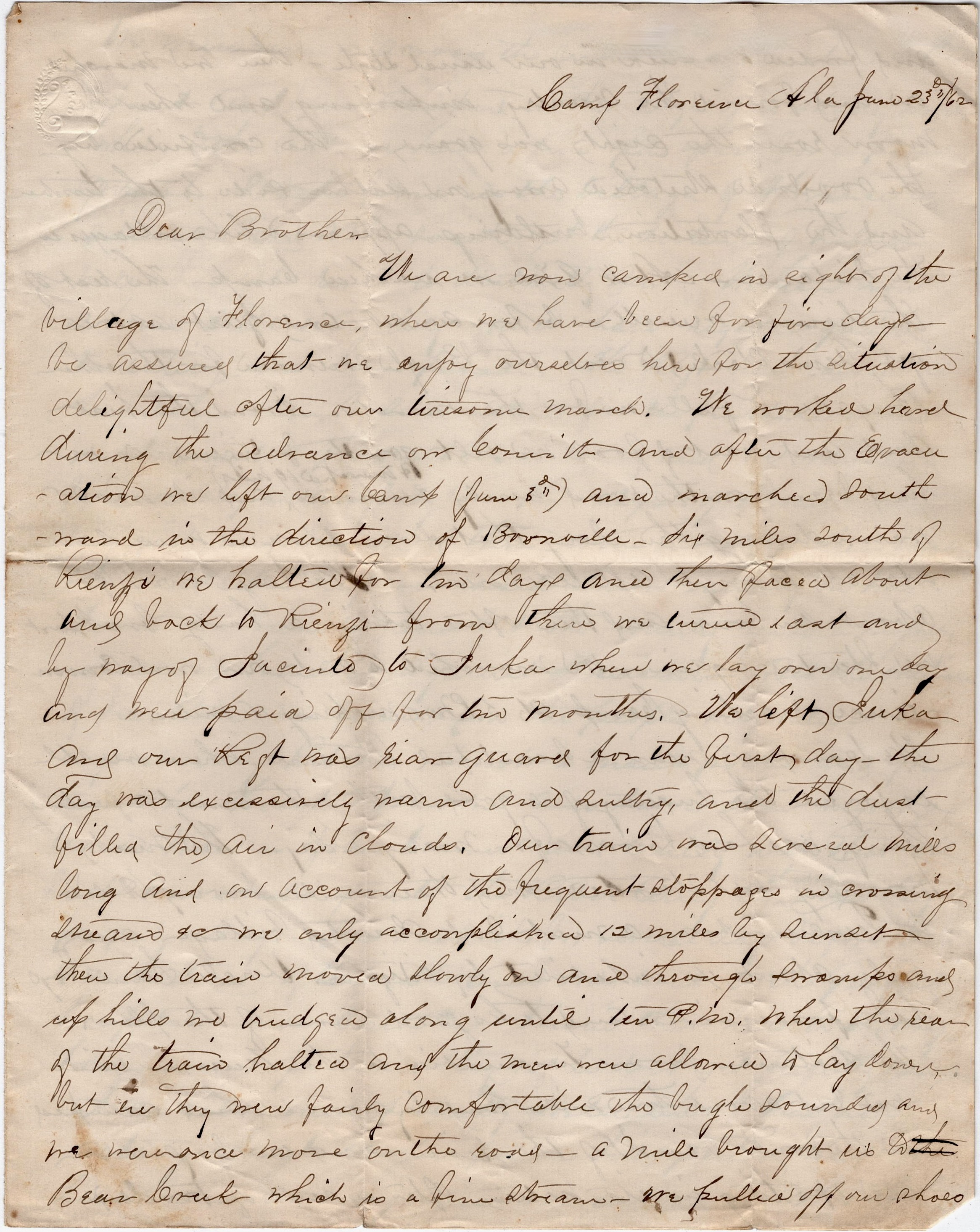
Camp Florence, Alabama June 23, 1862
Dear brother,
We are now camped in sight of the village of Florence where we have been for five days. Be assured that we enjoy ourselves here for the situation is delightful after our tiresome march. We worked hard during the advance on Corinth and after the evacuation we left our camp (June 3rd) and marched southward in the direction of Booneville. Six miles south of Rienzi we halted for two days and then faced about and back to Rienzi. From there we turned east and by way of Jacinto to Iuka where we lay over one day and were paid off for two months.
We left Iuka and our regiment was rear guard for the first day. The days was excessively warm and sultry and the dust filled the air in clouds. Our train was several miles long and on account of the frequent stoppages in crossing streams &c., we only accomplished 12 miles by sunset. Then the train moved slowly on and through swamps and up hills we trudged along until ten p.m. when the rear of the train halted and the men wrestled allowed to lay down. But ‘ere they were fairly comfortable, the bugle sounded and we were once more on the road. A mile brought us to Bear Creek which is a fine stream. We pulled on our shoes and forded the creek in our usual style, then we marched on and found the country improving and when the moon rose, the sight was grand. The cornfields by the roadside stretched away on either side to the timber and the plantation buildings appeared like villages in the distance.
After 4 a.m. we reached camp. The rest of the division were all in before sunset and just as we got arms stacked to rest, the bugle sounded for the other Brigade to fall in for the march. From the heat, dust, and want of food, we felt greatly fatigued as we had been on the road nearly 24 hours and marched 19 miles and it was so warm during the day that several men were sun struck though all recovered. We lay down for about an hour and then, after taking a hearty breakfast, we started again. We marched to suit our own convenience, reaching camp at 5 p.m. making 15 miles.
We camped near a beautiful stream where we all enjoyed the luxury of a good bath—the most refreshing thing we had known for many a day. The next morning we started and three miles brought us to Tuscumbia [Alabama]—a neat but deserted village and only about one quarter inhabited by citizens. Uncle Sam’s boys have possession and take good care of the place. The distance from Tuscumbia to the Tennessee River was about three miles and by noon we had camped on the south bank of the river and our boys were all sporting in its waters. After a rest of two days, we were ferried across the river and marched to this point and are camped in the edge of a shady wood while to the east we have a fine open space for a parade ground. 80 rods from us the village of Florence is situated and to the south at the distance of half a mile, the noble river is distinctly seen.
We have now two hours drill every day and have regular guard mounting and dress parade. The regiment has raised a handsome sum by subscription for the purchase of new instruments for our brass band and we will then feel as big as “anybody.” The citizens of Florence are very quiet and several of them come out to see dress parade, &c. A rebel regiment was raised almost entirely in this town and vicinity and yet the county gave a majority of several hundred against secession. After the Ordinance of Secession was forced upon the people, self interest made a great many rebels. Touch a man’s pocket and you reach his heart. I saw one cuss that is about as good a Union man as John Crainer and heartily wish that all such men would go into the Rebel army as that is where they properly belong.
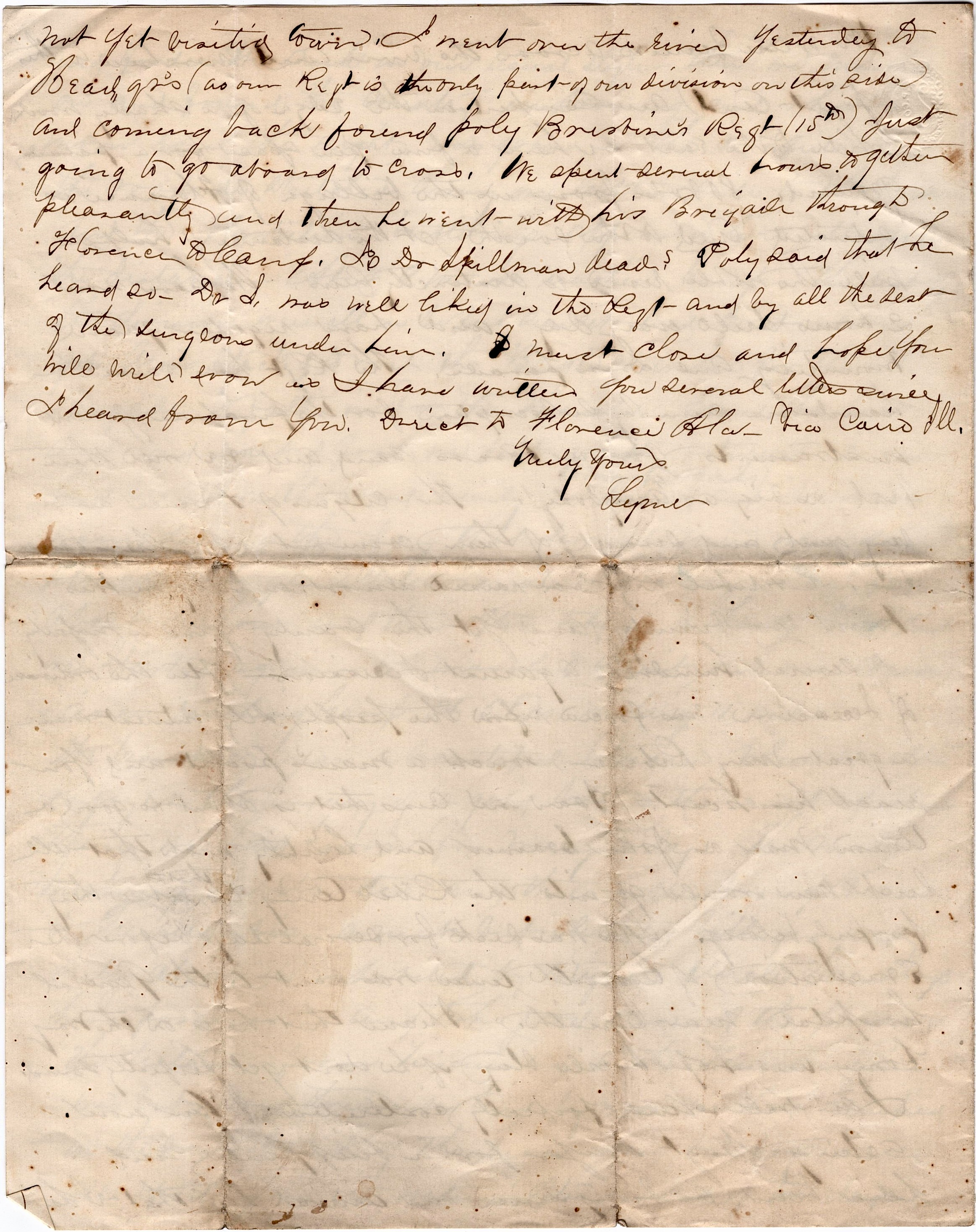
Gus [Dilley] was sick for several days before the evacuation of Corinth and was sent to the General Hospital near Corinth. I learn that he is on the way home and hope he will stay if he don’t get perfectly sound. I am well and perfectly contented. I am now Acting Sergt. Major for a brief period and have been so busy since our arrival here that I have not yet visited town. I went over the river yesterday to Headquarters (as our regiment is the only part of our division on this side) and coming back found Poly Brisbine’s Regt. (15th) just going to go aboard to cross. We spent several hours together pleasantly and then he went with his brigade through Florence to camp.
Is Dr. Spillman dead? Poly said that he heard so. Dr. Spillman was well liked in the regiment and by all the rest of the surgeons under him. I must close and hope you will write soon as I have written you several letters since I heard from you. Direct to Florence, Alabama via Cairo, Illinois.
Truly yours, — Lyme
Letter 3
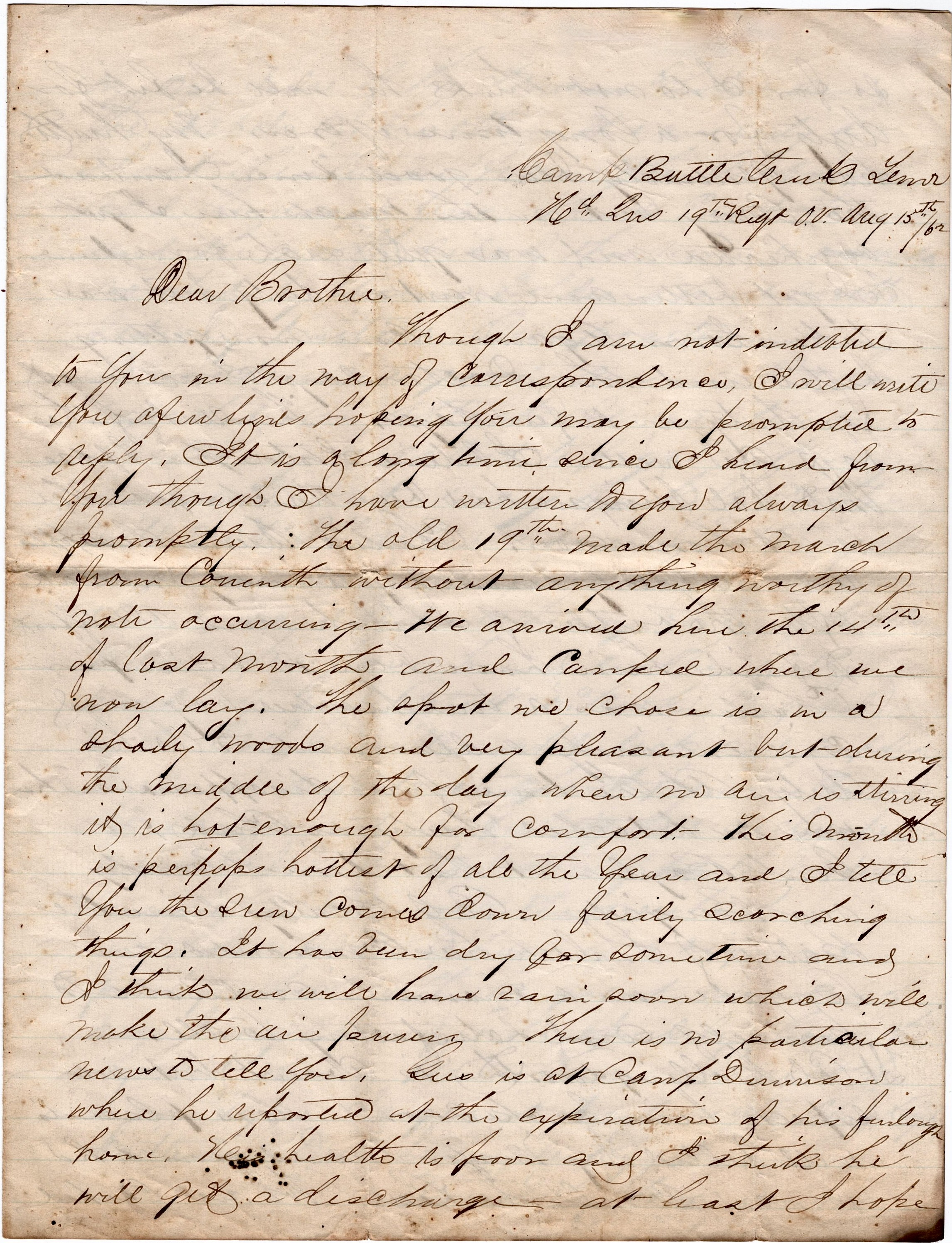
Camp Battle Creek, Tennessee Headquarters 19th Regiment O. V. August 15, 1862
Dear Brother,
Though I am not indebted to you in the way of correspondence, I will write you a few lines hoping you may be prompted to reply. It is a long time since I heard from you though I have written to you always promptly.
The Old 19th made the march from Corinth without anything worthy of note occurring. We arrived here the 14th of last month and camped where we now lay. The spt we close is in a shady woods and very pleasant but during the middle of the day when no air is stirring, it is hot enough for comfort. This month is perhaps hottest of all the year and I tell you, the sun comes down fairly scorching things. It has been dry for some time and I think we will have rain soon which will make the air purer. There is no particular news to tell you. Gus [Dilley] is at Camp Dennison where he reported at the expiration of his furlough home. His health is poor and I think he will get a discharge—at least I hope so for I do not think he will be fit for duty for a long time, if ever. My health has generally been good since I entered the army but on the march here I got overheated and was quite sick for a time. I got better and went on duty but was taken down again. Am now getting better and the Doctor says I will be fity for duty in a few days.
I believe I told you before that Cal[vin] Clingan had been discharged. He is at home now. Charlie Hume disappeared suddenly and mysteriously one eek after the Battle of Shiloh and all efforts to find him have been in vain. Poor Charlie was a true-hearted boy and conscientiously endeavored to do his duty. At the time of his disappeareance, he was on detached duty as clerk for Gen. [Jeremiah T.] Boyle, at that time commanding our brigade. Col. [Samuel] Beatty since the Battle of Shiloh has commanded our brigade in a manner creditable to himself and satisfactory to all.
Lt. Col. [Elliott Woodbridge] Hollingsworth is absent but we expect him back soon. His place is well filled by Major [Charles F.] Manderson who is now commanding the regiment. We are camped on one side of the Tennessee River and the Rebels on the other. We are only a short distance from the Alabama and Tennessee line. This is East Tennessee and the north side of the river is watched by Union soldiers and south side by traitors. Our position is considered a good one. We have expected an attack several times and may be called to fight at any moment, but many think that the Rebels will not attack us here. Chattanooga is about 25 miles from here and there is said to be a heavy force of Rebels there.
You have heard ‘ere this of the murder of Gen. Robert McCook (Brig. Gen.) by the Rebel guerrillas while sick and compelled to ride in ambulance apart from his command. It causes intense feeling here as elsewhere. Maj. Gen. McCook (brother of the murdered man) is in command of the forces here.
I hope soon to hear of a vigorous policy which with the great number of men being raised will speedily close this horrid war. Write soon. Direct to Lyme Tylee, Sergeant Major, 19th Ohio Regt., [Thomas L.] Crittenden’s Division, Louisville, Ky.
The following letter was written by Moses Ludwick Hower (1837-1923), the son of Adam Hower (1800-1881) and Rachel Ludwick (1798-1886) of Plain Township, Stark county, Ohio. Moses was 23 years old when he enlisted as a private in Co. A, 19th Ohio Infantry. He remained with the regiment until 20 August 1863 when he was transferred into the Veteran Reserve Corps.
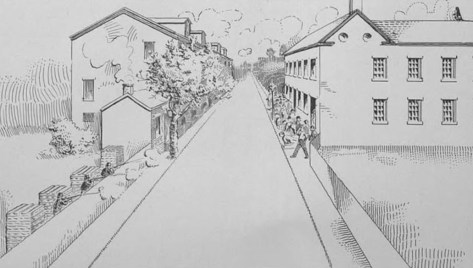
Moses wrote the letter on 11 June 1862 from Henderson, Kentucky, which was lightly garrisoned by soldiers from the Louisville Provost office and Andrew’s Michigan Battery. Moses clearly disliked Henderson, thinking it “as hard a secesh town as I was in yet. No stars and stripes to be seen.” As anxious as he was to leave it, there’s a good chance he was no longer in the town a few days afterward when three Confederates soldiers crept into the town at night on 29 June 1862 and fired on unsuspecting Federals lounging on the porch of the National Hotel before slipping away in the darkness. The only casualty was an unfortunate sow caught in the crossfire.
Artist’s rendering of the 3 Confederate soldiers firing on the Federals in front of the National Hotel in Henderson, Kentucky
Transcription
Patriotic letterhead on Moses’ letter, “The Whole Union, Forever”
Henderson, Kentucky June 11th 1862
Dear Brother and friends,
I will try and write a few lines to you. I would a wrote sooner but I dis not expect that I would stay here as long as I have. When they took me away from the regiment, they told me that the boat would take me to Cincinnati and there we could get furloughs to go home, but they did not do that. But they run us off here and this is as hard a secesh town as I was in yet. No stars and stripes to be seen in the breadth here and that is not near all. I could stay here for I am not afraid of the rebels but our fare is so poor. This is the hardest living I ever had. We get corn meal mixed with water and then dried so that when we break it apart, it all crumbs up. And coffee—as they call it—but I cannot call it coffee for it looks more like dishwater. And about once a week a little meat, but the pieces are so small that I cannot taste what it is. But we had something extra for dinner today. We had onion soup with tops and all cut in and some lettuce.
Now I will stop all that and give you a history as near as I can of my sickness. I took sick the twenty-first of April. At first I had the diarrhea and then we got orders to march and I was very weak. But as we did not march far, I got along, but the next day I got the chill fever and then our doctor—or Butcher as we call him—gave me a lot of quinine which took me down so that I cannot get over it as it seems. I was then put in the hospital at Hamburg and from there they took me here. I am now about well al[though] I am weak yet. But if I had the money that the Government owes me, I think I could walk.
I can see Indiana but the Ohio river is between me and Indiana. But I could easy get across if I only had my money. That is about all for this time. I do not know how long I will have to stay here yet and I cannot tell you to write for I will leave the first opportunity I can get. That is all. Your brother truly, — Moses L. Hower
P. S. You can give this to Isaac’s and all other friends to read it. — M. L. Hower
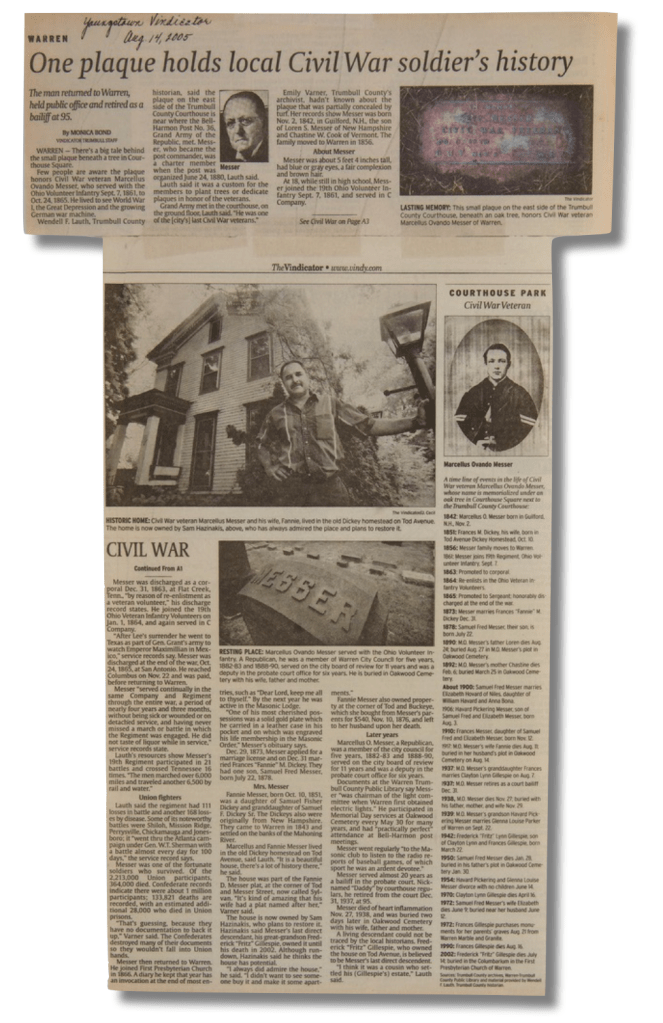
The following letter was written by Cpl. Ovando M. Messer (1842-1938) of Co. C, 19th Ohio Infantry. Ovando was the son of Loren Sanborn Messer (1816-1890) and Chestina Waterbury Cook (1815-1892) of Warren, Ohio.
Marcellus Ovando Messer (who variously signed his letters Ovando Messer, Ovando M. Messer, or M. Ovando Messer) was born on 2 November 1842 in Guilford, Belknap County, New Hampshire. In 1856 he moved with his family to Warren, Trumbull County, Ohio, and in September 1861 was mustered in to Company C, 19th Ohio Volunteer Infantry. He would remain with Co. C of the 19th Ohio to the end of the war (and beyond), serving in the Army of the Ohio (to November1862), the Army of the Cumberland (to October 1863), IV Corps (to August 1865), and the Department of Texas (to October 1865), reenlisting on January 1, 1864.
Messer served in many of the major campaigns of the war’s western theater, mainly in Tennessee and Georgia. He was present at a number of significant engagements, including the battles of Shiloh, Murfreesboro, Chickamauga, and Nashville. He served in Sherman’s Atlanta campaign. In the summer of 1865 he and the 19th Ohio were among the troops sent to Texas to keep an eye on Emperor Maximilian I in Mexico. He was mustered out in San Antonio on 21 October 1865. Though Messer’s letters report a number of close calls, he concluded his four years of service without serious injury or illness. He married Frances M. “Fannie” Dickey in 1873 and remained in Warren, Ohio until his death on 27 November 1938.
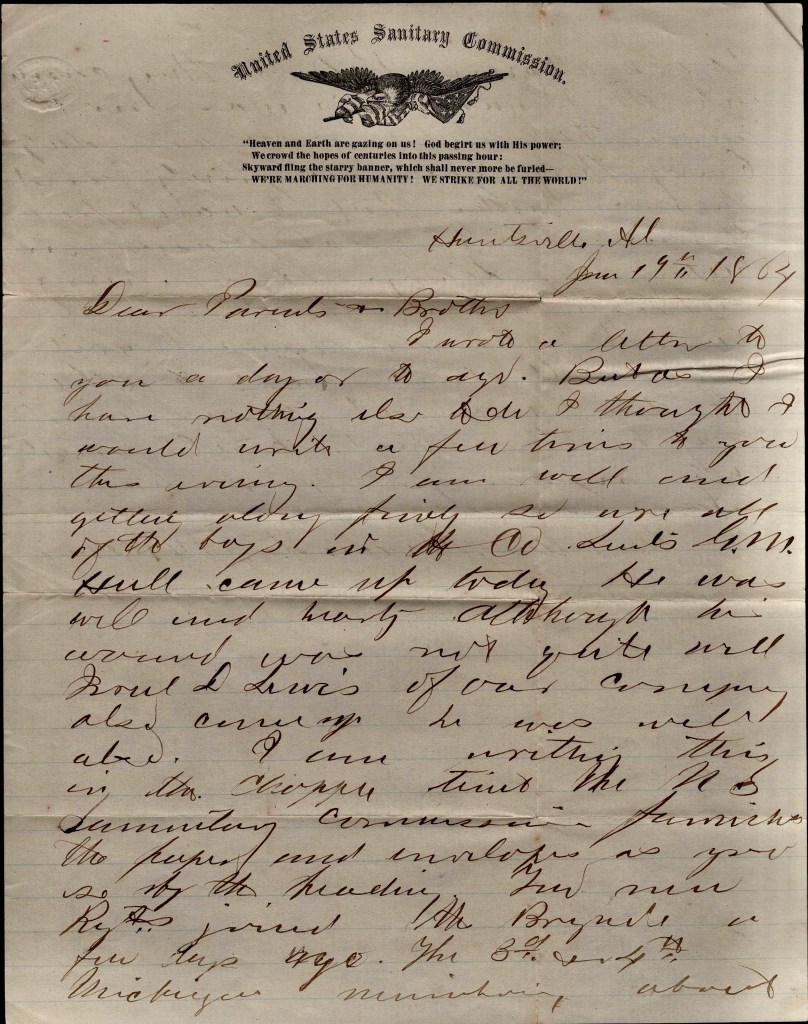
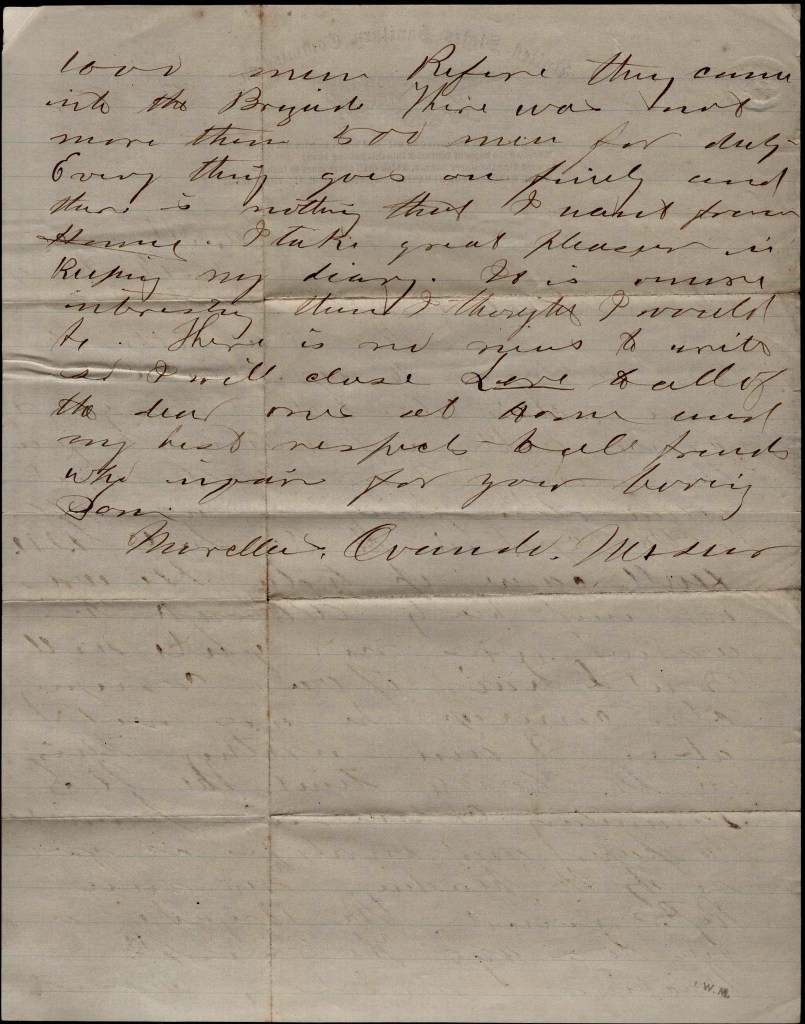
I wrote a letter to you a day or two ago, but as I have nothing else to do, I thought I would write a few lines to you this evening. I am well and getting along finely. So are all the boys in the company. Lieut. G. M. Hull came up today. He was well and hearty although his wound was not quite well. Israel D. Lewis of our company also came up. He was well also. I am writing this in the chapel [ ]. The U.S. Sanitary Commission furnishes the paper and envelopes as you see by the heading. Two new regiments joined the Brigade a few days ago—the 3rd & 4th Michigan—numbering about 1,000 men. Before they came into the Brigade, there was not more than 500 men [fit] for duty. Everything goes on finely and there is nothing that I want from home.
I take great pleasure in keeping my diary. It is more interesting than I thought it would be. There is no news to write so I will close.
Love to all of the dear ones at home and my best respects to all friends who enquire for your boring son. — Marcella Ovando Masur
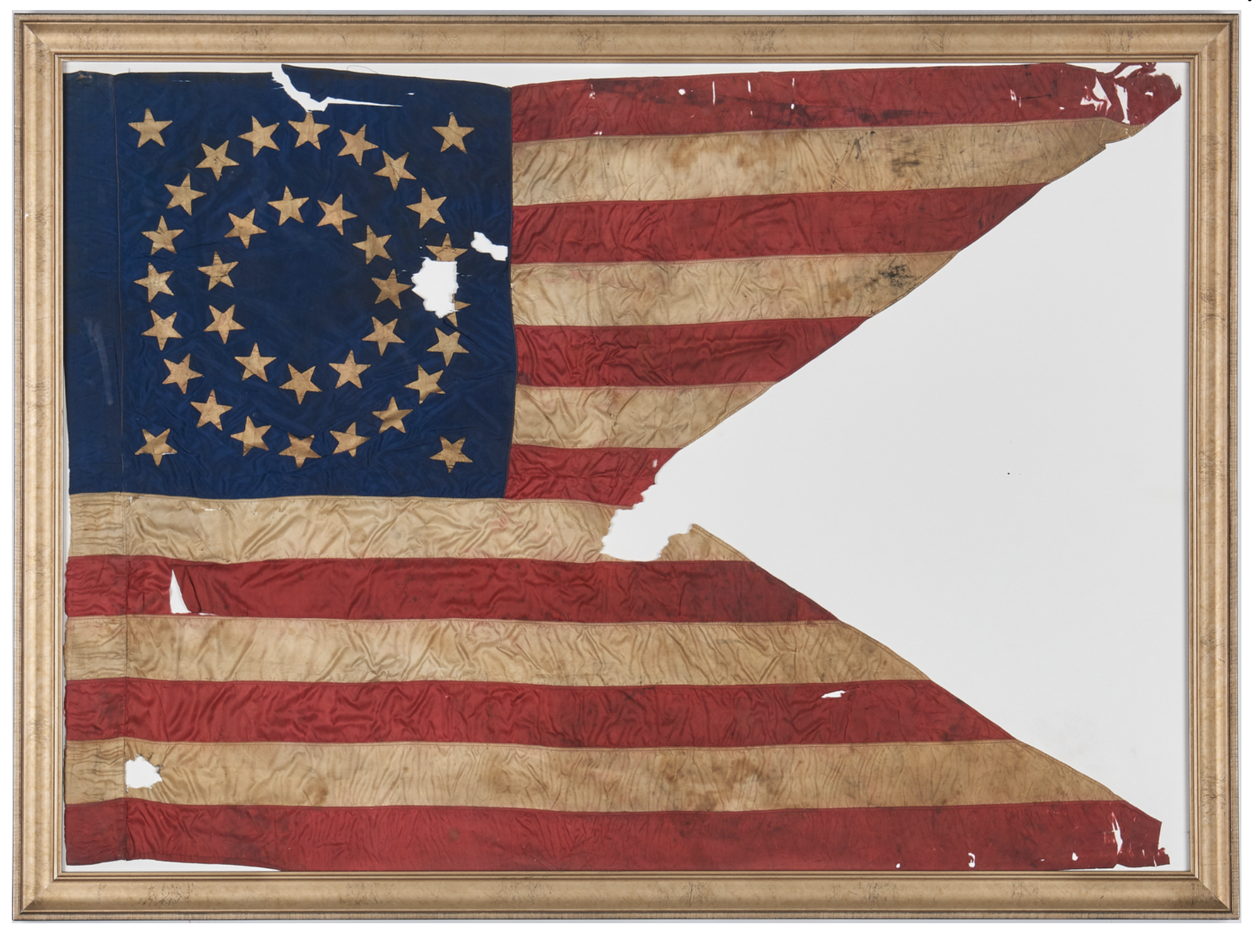
Civil War Union Cavalry Swallowtail Guidon Flag belonging to Corporal Marcellus Ovando Messer (1842-1938), 19th Regt., Ohio Volunteer Infantry, Company C. The silk flag has a double wreath of 35 gilt-painted stars, indicating use between the admission of West Virginia as a state in 1863, and the admission of Nevada in 1865; canton and stripes are pieced and treadle-sewn. 26 14″ x 36 3/4″ sight, 30″ x 40″ framed. Note: according to flag historian Greg Biggs, the U.S. contracted for more of these guidons than the cavalry could use, so standards like this one were issued to infantry regiments as guide flags, which were placed on the left and right flanks of the regiment to help form their line of battle. The battles in which the 19th Ohio engaged were among the war’s most infamous and included Shiloh, Missionary Ridge, and Chickamauga. They also participated in the Atlanta campaign, under General William Tecumseh Sherman. In all, the 19th regiment participated in 21 battles and crossed Tennessee 16 times, marching over 6,000 miles and traveling another 6,500 by rail and water. Cpl. Messer was born Nov. 2, 1842 in Guilford, New Hampshire. His family moved to Warren, Ohio when he was 14. When the Civil War broke out, Messer joined the 19th Ohio Volunteer Infantry, Company C., on Sept. 7, 1861 and was promoted to Corporal in 1863. According to his discharge record, he was discharged as a corporal on Dec. 31, 1863 at Flat Creek, Tennessee “by reason of re-enlistment as a veteran volunteer” and again served in C Company.
After Lee’s surrender, he went to Texas as part of General Grant’s army to monitor Mexican Emperor Maximillian. He was discharged Oct. 24, 1865 at San Antonio. According to his records, he “served continually in the same Company and Regiment through the entire war… without being sick or wounded or on detached service, and having never missed a battle in which the regiment was engaged. He did not taste of liquor while in the service.”
After the war, Messer returned to Warren, Ohio, and married Frances “Frannie” M. Dickey. They had one son and lived in the old Dickey homestead. Messer, a Republican, went on to serve as a member of the city council for five years in the 1880s and on other municipal boards. He also served as a bailiff in the Probate Court for more than 20 years.
Note: Some of this biographical information comes from a newspaper article on Messer in the Youngstown OH Vindicator newspaper, August 14, 2005. A copy of the article is included with this lot. Provenance: by descent in the Messer family to present consignor. Note: remnants of a box formerly used to store the flag bore this inscription: “A regimental flag of the 19 O.V.I. carried during Nov. 1861-65.” CONDITION: 4 1/4″ tear upper center canton, with two holes – 2″ diameter and 1 1/2″ L – at center right edge of canton. Two 1″ to 1 1/2″ L holes to stripes along sleeve. Center with 3″ hole/loss; each tip with losses and fraying. Several other small holes and slits; light fading, staining, discoloration and creasing throughout. Flag has been mounted (not glued down) atop white matting, under acrylic, and framed in a molded giltwood frame.
The following letter was written by Charles (“Charlie”) Frederick Frink (b. 1842), the son of James Frink and Martha Goodhue Prescott of New Haven, Connecticut,
Charles was a 19 year-old clerk in the mercantile establishment of J. E. Wesener & Co. in Akron, Ohio, at the time he enlisted on 22 April 1861 in Co. G, 19th Ohio Volunteer Infantry (OVI)—a three-month’s regiment. He mustered out of the regiment on 31 August 1861.
In the New Haven city directory of 1863, it appears that Charles had returned East and went into partnership in the grover business with his brother, Nathan C. Frink (N. F. & C. F. F.), their establishment located at Green & Hamilton in New Haven.
Charles wrote the letter to his sister, Adelaide A. (Frink) Everit (1831-1910), the wife of William Lyon Everit (1826-1915) who were living in Akron, Ohio, in 1861. The “Mattie” and “Willie” mentioned in the final paragraph were Adelaide’s children.
The Battle of Rich Mountain
Transcription
Camp Buchanan Buchanan, Upshur county, Virginia July 6th 1861
My dear sister,
I received your very welcome letter yesterday and was quite vexed to think that that any of the boys had wrote that I was sick. I never was better in my life than I have been for the last two weeks and if I continue so to be, I shall be perfectly satisfied with my three months service in the Army of the U. S. and the State of Ohio.
We had an inspection of arms yesterday which resulted favorably for the whole regiment and especially for Co. G. The report is that we are to be paid off in a few days. Whether it is true or not, I do not know but think it probable. There was also a trial to see how many men would go for three years or during the war. There was fifteen men out of Co. G., Lieutenant [Gilbert S.] Carpenter heading the list, and I heard the Colonel [Samuel Beatty] remark that there was about 150 or 175 men in the regiment that would probably go for the war.
We have had pretty hard times for the last seven or eight days and the boys are looking forward with a good deal of feeling for the end of their three months and I think will be perfectly satisfied to remain at home for some time to come.
I had a letter from mother at Clarksburg. She wished me to return home as soon as my three months expired and come to think it over, I think it will be the best thing I can do for the present at least for if I returned to Akron, I should not want to go back to J[oseph] E. Wesener & Co. and I cannot see any other chance for the present. I shall write to Will and have him see if he cannot get me some kind of a place in New York.
If you please, you may pack my trunk and somewhere near the time my term expires—say three or four days—you may send it out by Express to New Haven.
If we get paid off and I ever get into any civilized town, I will send you a picture of Charles F. Frink with arms, equipments, and uniform so that you can see what kind of a child he is. Perhaps he would look better if he would have a dried cracker and an old tin cup in his hand but he will dispense with that for the present.
I wish you would ask William to send me a Cleveland and New York paper as soon as he can as we get nothing of that kind here—that is, nothing that is new.
As there is a call for drill, I will close and wishing you to bid goodbye to all Akron folks for me, I remain your affectionate brother, — Charlie
P. S. Love to Mattie & Willie and you must excuse this writing and the mistakes as I am writing on an old tin plate. — Charlie
Beverly July 14th 1861
Dear sister,
I have just received this letter from one of the boys. I sent it from Buchanan by one of Co. H boys and he lost his knapsack on his way home and it was picked up and returned to our camp this morning.
On Thursday morning the 11th of June [should be July] we arose at 2 o’clock and marched about 12 miles across the mountain to the Rebel camp at Rich Mountain. They had it very strongly fortified but we attacked them in the rear and completely routed them taking about 50 prisoners and killing and wounding as many more. We took 4 pieces of cannon and about 100 stand of arms and all their camp equipage. It is valued at about $50,000. [See Battle of Rich Mountain]
I think we will return home very soon now as there seems nothing more to do this side of Richmond. — Charlie
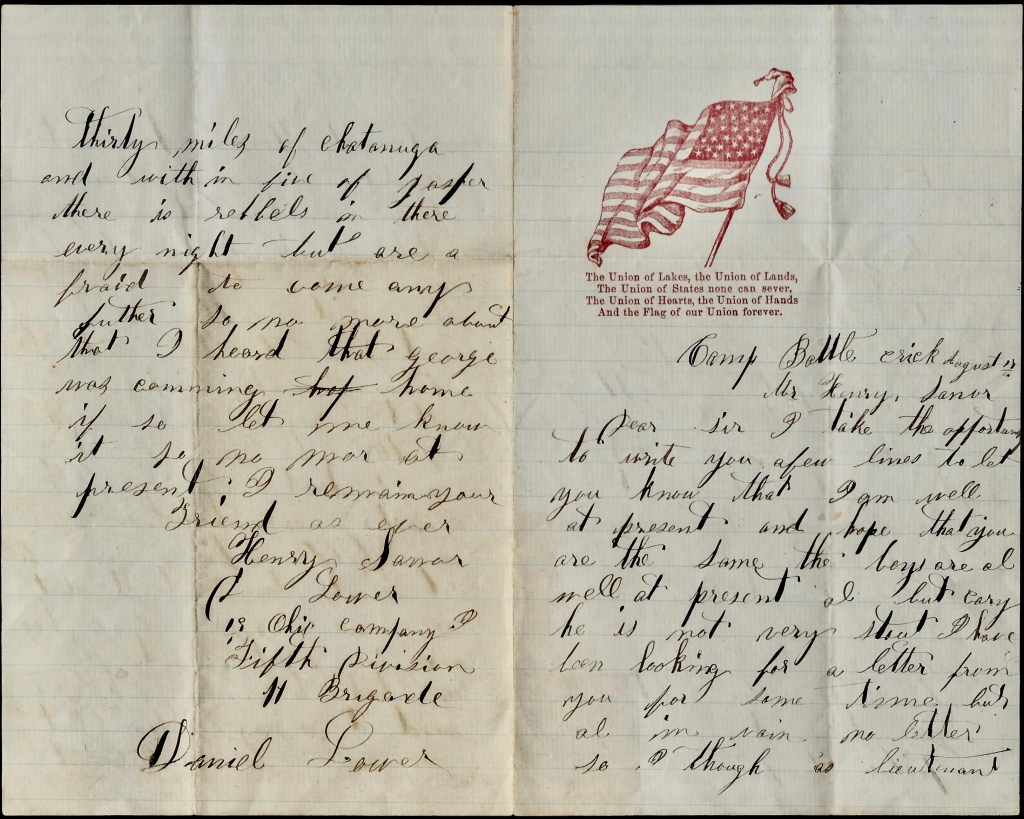
The following letter was written by Daniel Lower of Co. I, 19th Ohio Infantry. He was mustered into the regiment for three years service and mustered out in August 1864 at Marietta, Georgia. The regiment was organized at Alliance, Ohio, and once mustered, attached to the 11th Brigade, Army of the Ohio, to December 1861. In August 1862 when this letter was penned, the regiment was attached to the 11th Brigade, 5th Division of the Army of Ohio. This letter was datelined from the regiment’s encampment on Battle Creek in Northern Alabama following their long march in Buell’s Campaign in Northern Alabama and middle Tennessee.
Daniel C. Lower (1842-1905) was the orphaned son of George W. Lower (1806-1864) and Mary Beaman Beaumont (1808-1856) of Columbiana county, Ohio. The recipient of this letter was Henry Sanor. He was probably the Henry Sanor (1827-1893) that married Daniel’s older sister Betsy Lower (1830-1913). Henry was a farmer in West Township, Columbiana county, Ohio. It should be noted that Daniel’s surname appears as “Laueere” in the regimental record for some reason.
Transcription
Camp Battle Creek [Alabama] August 17, [1862]
Mr. Henry Sanor, dear sir,
I take the opportunity to write you a few lines to let you know that I am well at present and hope that you are the same. The Boys are all well at present—all but Cary. He is not very stout. I have been looking for a letter from you for some time but all in vain. No letter. So I thought as Lieutenant Firestone is coming home, I thought I would write and send a few lines with him.
We are encamped in sight of the rebels. The Tennessee [river] is between us so that we dare not shoot at them. Now I want to write and send your letter with Firestone and give me all the news in the neighborhood. I wrote in my last letter that I wanted you to send me a few postage stamps as we cannot get them here. It would be a great accommodation if you would send me a few. Tell J. H. to write to me as I think I wrote the last letter.
I have not much to write this time. [Isaac] Frank Rish us as stout as ever and much better. He weighs about one hundred and sixty. He is a bester [?]. We had to live on half rations for a while. It went damned hard but we came across a hog once in a while and then we had to run or kill it and it was very seldom that we ran. We are [with]in about thirty miles of Chattanooga and within five of Jasper. There is rebels in there every night but are afraid to come any further. So no more about that.
I heard that George was coming home. If so, let me know it. So no more at present. I remain your friend as ever, Henry Sanor.
[From] Daniel Lower, 19th Ohio, Company D. 5th Division, 11th Brigade
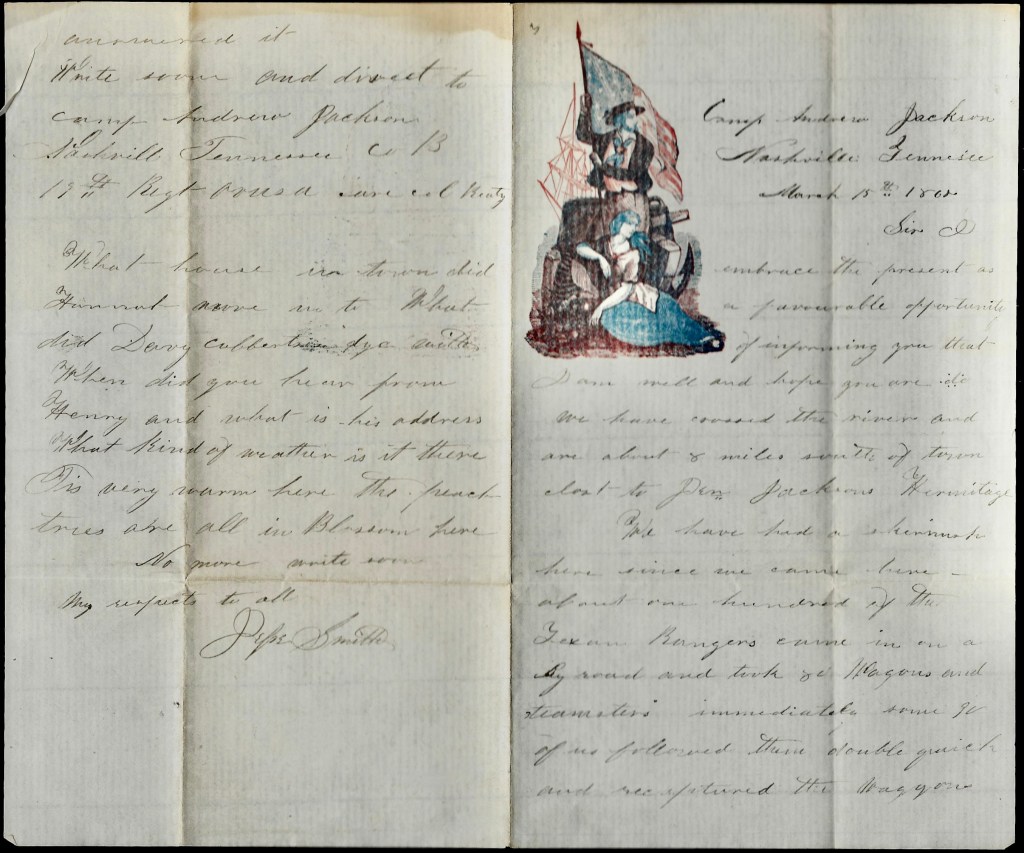
The following letter was written by Jesse Smith of Co. B, 19th Ohio Volunteer Infantry (OVI) who enlisted for three years in September 1861 but who died of dysentery at Nashville on 12 July 1863. He was buried in the Nashville National Cemetery in Grave E 763.
I can’t be absolutely certain but I believe Jesse was the 16 year-old son of Harvey B. Smith (1805-1873) and Paulina A. Brooks (1813-1854) of Bristol, Trumbull county, Ohio.
To read letters by other members of the 19th OVI I have transcribed and published on Spared & Shared, see:
Camp Andrew Jackson Nashville, Tennessee March 15th 1862
Sir,
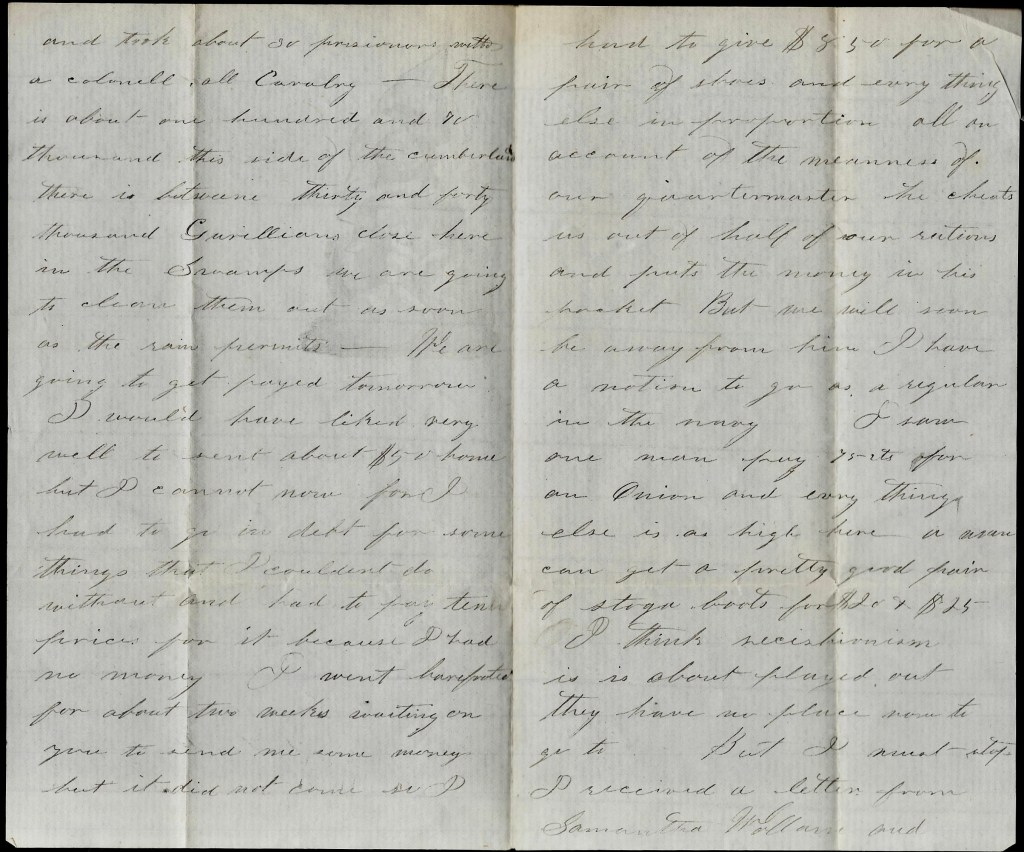
I embrace the present as a favorable opportunity of informing you that I am well and hope you are too. We have crossed the river and are about 8 miles south of town, close to Gen. Jackson’s Hermitage. We have had a skirmish here since we came here. About one hundred of the Texas Rangers came in on a by road and took 80 wagons and teamsters. Immediately some 90 of us followed them double quick and recaptured the wagons and took about 30 prisoners with a Colonel, all cavalry. There is about one hundred and 70 thousand this side of the Cumberland. There is between thirty and forty thousand guerrillas close here in the swamps. We are going to clean them out as soon as the rain permits.
We are going to get paid tomorrow. I would have liked very well to sent about $50 home but I cannot now for I had to go in debt for some things that I couldn’t do without and had to pay ten prices for it because I had no money. I went barefooted for about two weeks waiting on you to send me some money but it did not come so I had to give $8.50 for a pair of shoes and everything else in proportion, all on account of the meanness of our quartermaster. He cheats us out of half of our rations and puts the money in his pocket. But we will soon be away from him. I have a notion to go as a regular in the navy.
I saw one man pay 75 cents for one onion and everything else is as high here. A man can get a pretty good pair of stoga boots for $20 and $25. I think secessionism is about played out. They have no place now to go to. But I must stop. I received a letter from Samantha, William, and answered it. Write soon and direct to camp Andrew Jackson, Nashville, Tennessee, Co. B, 19th Regt. Ohio Vols., USA, care of Col. [Samuel] Beatty
What house in town did Hannah move into? What did Davy Culbertson die with. When did you hear from Henry and what is his address? What kind of weather is it there? Tis very warm here. The peach trees are all in blossom here. No more. Write soon. My respects to all. — Jesse Smith













 Spared & Shared 23