
The following letter was most likely the draft or copy of a letter sent to a gentleman residing in Baltimore, Maryland, asking for his assistance in finding and returning a young Negro boy, “not thirteen years old” who was taken against his will to serve in one of the USCT regiments being organized at Camp Birney in Baltimore. The author of the letter never identifies himself (the letter is unsigned), nor does he even given the name of the Negro boy who was in all probability his slave. The only names given in the letter are “Mr. Chapline” of Shephardstown—the author’s agent sent to Baltimore to recover the boy—and Col. Joseph Perkins of the 19th USCT, whose “intoxicated negro soldiers….forced away” the boy. The author’s version of the boy’s abduction and of his physical disabilities seems to stretch credulity.
In July 1863, Druid Hill in Baltimore became known as Camp Birney, after Secretary of War Edwin M. Stanton assigned Gen. William Birney, son of an abolitionist, to recruit African Americans for U.S. Colored Troops (USCT) regiments. Birney freed 16 shackled slaves from a Pratt Street slave pen when they promised to enlist. He also organized the 7th USCT here, as well as the 4th and 39th USCTs in 1864.
The following letter is from the private collection of Greg Herr and was transcribed and published on Spared & Shared by express consent.
Transcription
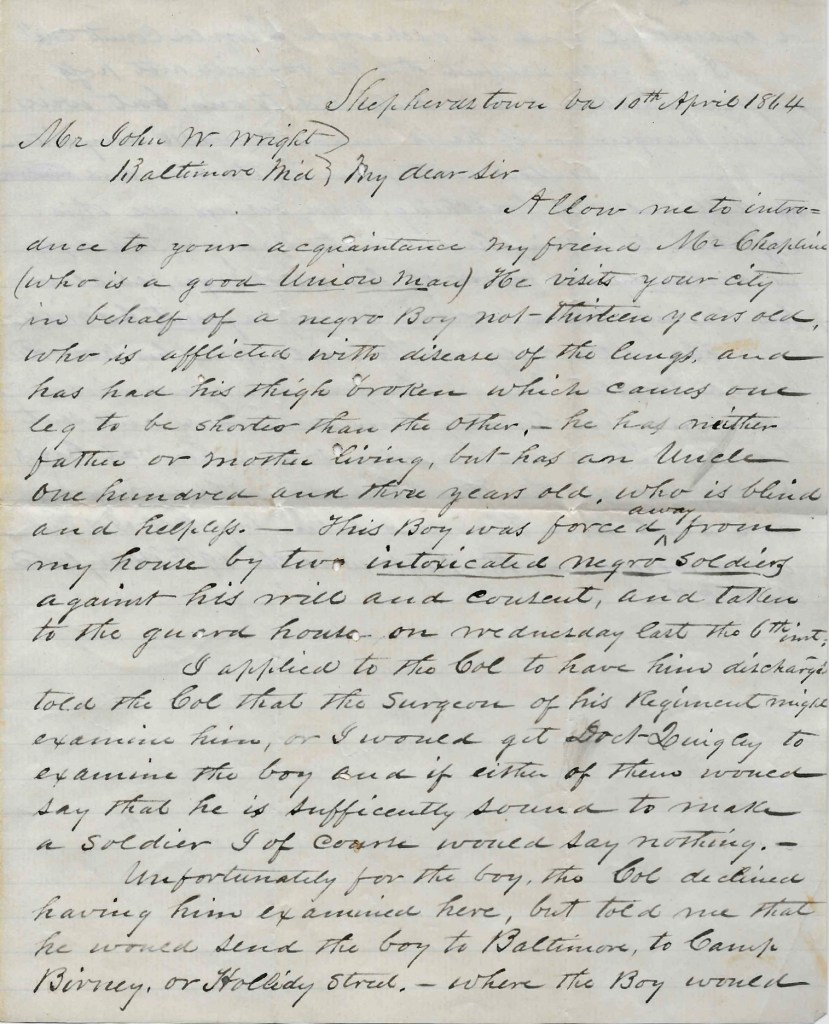
Shephardstown, [West] Va.
10th April 1864
Mr. John W. Wright, Baltimore, Maryland
My dear sir, allow me to introduce to your acquaintance my friend Mr. Chapline (who is a good Union man). He visits your city in behalf of a negro Boy not thirteen years old who is afflicted with disease of the lungs, and has had his thigh broken which causes one leg to be shorter than the other. He has neither father or mother living, but has an Uncle one hundred and three years old who is blind and helpless. This Boy was forced away from my house by two intoxicated negro soldiers against his will and consent, and taken to the guard house on Wednesday last the 6th inst.
I applied to the Colonel to have him discharged, told the Colonel that the Surgeon of his regiment might examine him, or I would get the Doct. [John] Quigley 1 to examine the boy and if either of them would say that he is sufficiently sound to make I soldier, I of course would say nothing. Unfortunately for the boy, the Colonel declined having him examined here, but told me that he would send the boy to Baltimore to Camp Birney, or Holliday Street, where the Boy would be examined and if discharged—“would count one.”
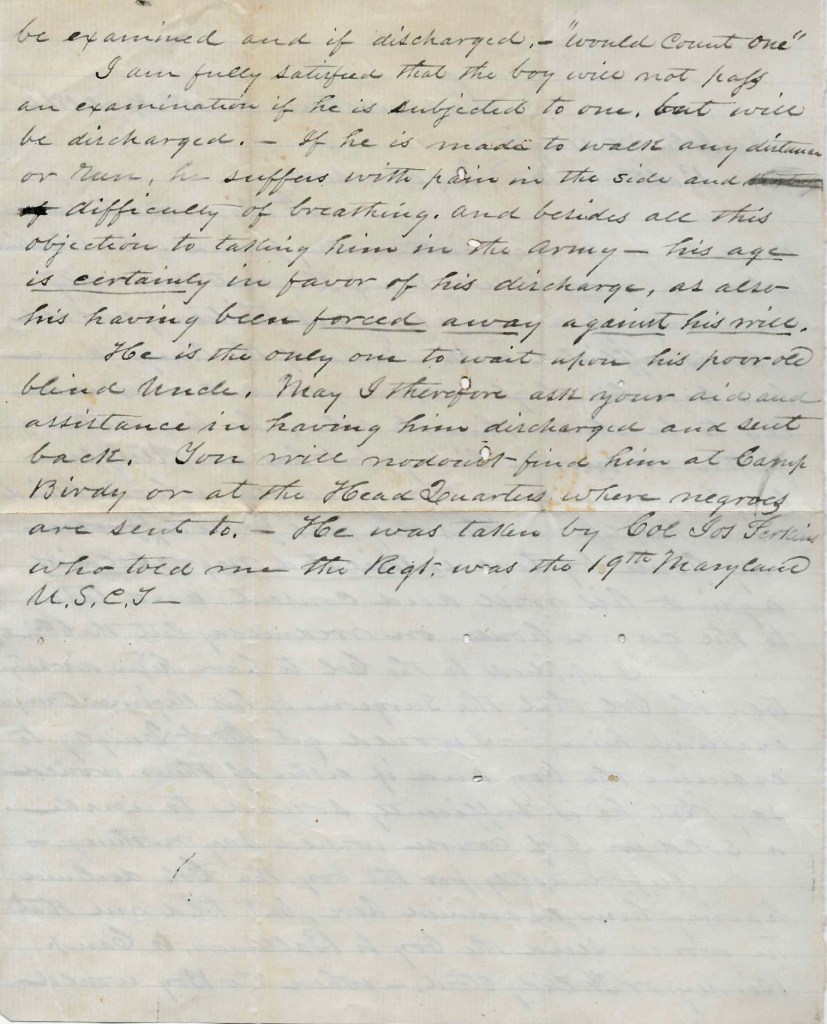
I am fully satisfied that the boy will not pass an examination if he is subjected to one, but will be discharged. If he is made to walk any distance or run, he suffers with pain in the side and difficulty of breathing. And besides all this objection to taking him in the army—his age is certainly in favor of his discharge, as also have been forced away against his will.
He is the only one to wait upon his poor old blind Uncle. May I therefore ask your aid and assistance in having him discharged and sent back? You will no doubt find him at Camp Birney or at the Headquarters where negroes are sent to. He was taken by Col. Jos. Perkins who told me the Regiment was the 19th Maryland U. S. C. T.
1 “John Quigley was a doctor in Shepherdstown in the 19th Century. He was born in 1802 in Shippinsburg, Pennsylvania and graduated from the University of Pennsylvania Medical School in 1823. He married Mary Swearingen of Shepherdstown in 1827 and practiced medicine here until his death in 1883. During the aftermath of the battle of Antietam, he and Mary took 34 wounded confederate soldiers into their home on German Street, and their children helped care for them.” [Source: Historic Shepherdstown & Museum]
 Spared & Shared 23