

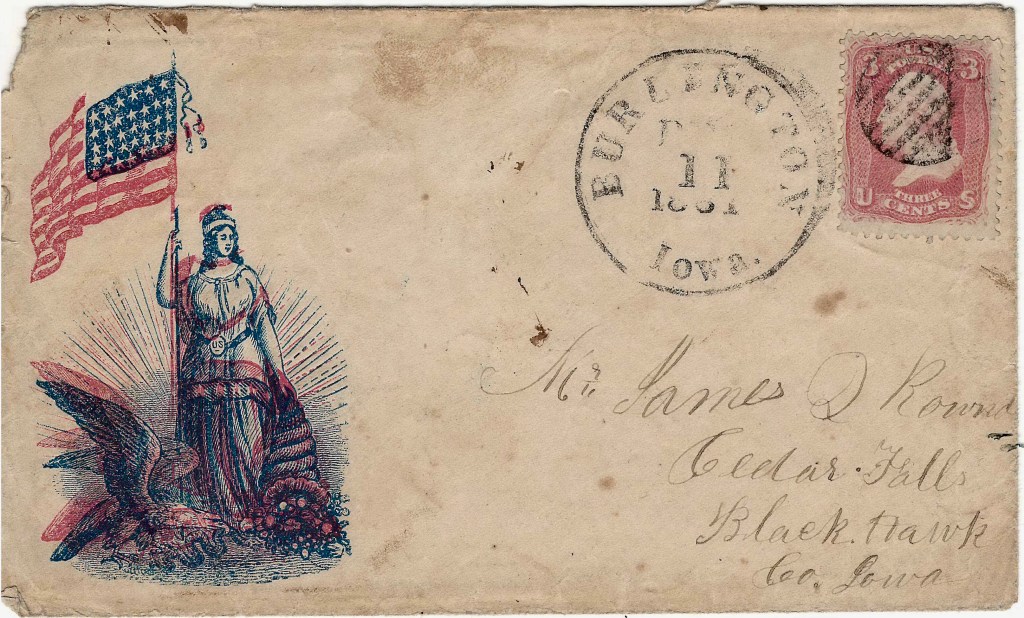
This letter was written by George W. Rownd (1842-1864), the son of James Quincy Rownd (1810-1905) and Caroline Brown (1817-1894) of Cedar Falls, Black Hawk county, Iowa. George’s surname name was entered in the Muster Rolls as “Round” when he was entered the 1st Iowa Light Artillery in August 1861. He was discharged for disability in late November 1863 and died early in 1864 at a Union Hospital in Helena, Arkansas.
George’s letter provides us with a great account of the Battle of Pea Ridge (or Elkhorn Tavern). A similar letter written by William Vanzant of the same Battery who wrote to his brother Henry and sister-in-law Nancy on March 14, 1862 from Arkansas’ Sugar Creek Camp. In the letter, William describes the Battle of Pea Ridge which took place during the early part of the Civil War in northwestern Arkansas. The letter is from the Van Zandt Family Papers. The collection’s description and finding aid is available online: https://www.scribd.com/document/84127758/Battle-of-Pea-Ridge-Letter-by-William-Vanzant-transcript

Transcription
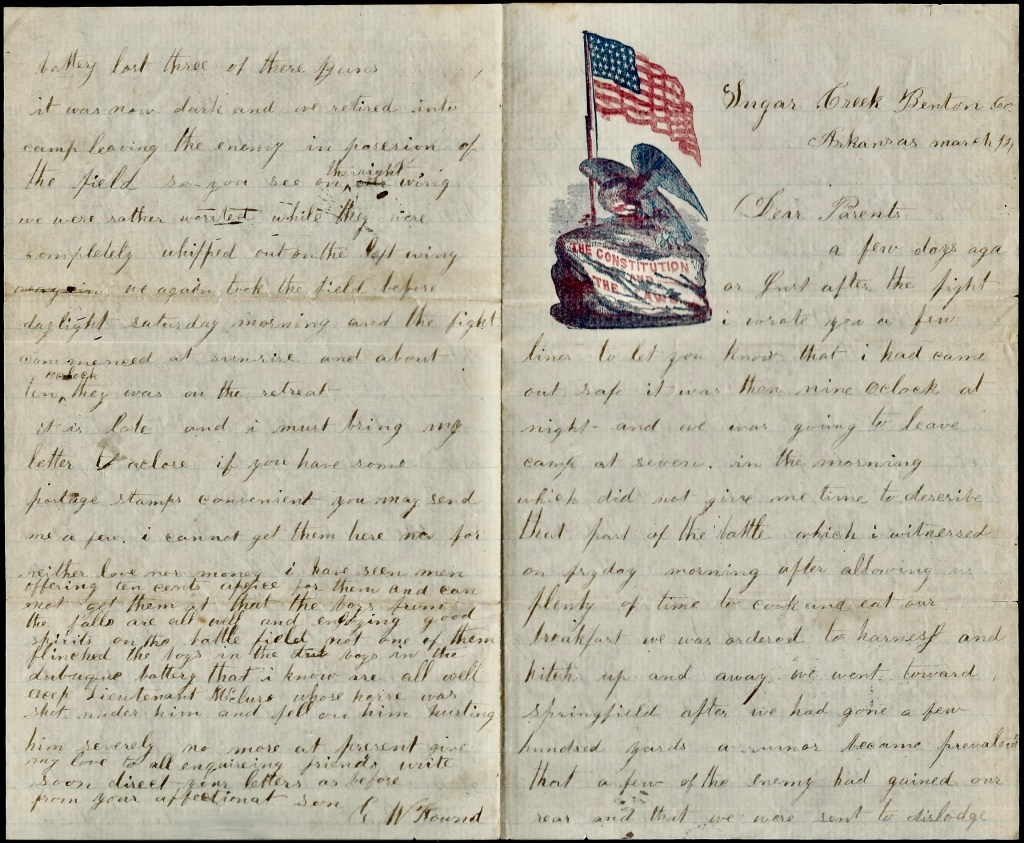
March 14 [1862]
Sugar Creek, Benton county, Arkansas
Dear Parents,
A few days ago or just after the fight, I wrote you a few lines to let you know that I had come out safe. It was then nine o’clock at night and we was going to leave camp at seven in the morning which did not give me time to describe that part of the battle which I witnessed.
On Friday morning, after allowing us plenty of time to cook and eat our breakfast, we was ordered to harness and hitch up and away we went toward Springfield. After we had gone a few hundred yards, a rumor became prevalent that a few of the enemy had gained our rear and that we were sent to dislodge them. We soon found out that their small force consisted of the whole force of Price’s army and some two thousand Indians.
Our battery set the ball a rolling if I except Sigel’s fight on Thursday. The fight commenced about eleven o’clock at the Elkhorn Tavern, the right section turned to the wast and the left section and center section kept on about four hundred yards north. At the Elkhorn, the center section got tangled up with some mule teams and the left section or two guns had to bear the fire of a full battery of six guns. But we were not idle. We were sending shot and shell amongst them in a hurry and they were sending shell, shot, and canister at us and they fell around us like hail. Kirk [W.] Henry, Captain Jones, Lieutenant Gambell, Sergeant [H. R.] Horr, William Seldon, William [F.] Conner, Clark Woodmancy, John Easton, Corp. [D. J.] Duval, Samuel Black, and some three or four more wounded. Reese Parkhurst 1 and Gustavis Gustavison 2 and William Hall were killed.
After fighting against three times our number for more than an hour, our four guns retired and the six guns of the Dubuque Battery marched into our places but they did not stay long during the day. They drove us back to some open fields south of the Elkhorn Tavern. Here we made a stand. Our infantry fell to the rear of the artillery and on came the rebels whooping and yelling, flags a waving. In fact, they made sure if having us all in their power. But a few well directed rounds from twelve guns sent them in search of timber and then the splinters sent them farther when we again took possession of the Elkhorn Tavern. But in a few moments they again drove us back and here the Dubuque Battery lost three of their guns.
It was now dark and we retired into camp leaving the enemy in possession of the field, So you see on the right wing we ewre rather worsted while they were completely whipped out on the left wing. We again took the field before daylight Saturday morning and the fight commenced at sunrise and about ten o’clock they was on the retreat.
It is late and I must bring my letter to a close. If you have some postage stamps convenient, you may send me a few. I cannot get them here for neither love nor money. I have seen men offering ten cents apiece for them and cannot get them at that. The boys from the Falls are all well and enjoying good spirits. On the battlefield, not one of them flinched. The boys in the Dubuque Battery that I know are all well except Lieutenant McClure whose horse was shot under him and fell on him, hurting him severely. No more at present. Give my love to all enquiring friends. Write soon. Direct your letters as before. From your affectionate son, — G. W. Round
1 The report of the Battery by its commander, Capt. Junius Jones, states that Reese Parkhurst was killed early in the action, a cannon ball taking off his leg, and another shot striking him in the head.
2 Gustavison had his right leg shot off by a solid shot and died of shock and amputation.

 Spared & Shared 23