The following letter was written by Samuel Ware (1835-1864), a 27 year-old farmer from Conway, Massachusetts, when he enlisted and was mustered into service on July 10, 1862 as a private in Co. H, 1st Massachusetts Cavalry. Samuel was the son of Willard Ware (1799-1845) and Anna Edson (1811-1891). He was married to Jane Elizabeth Payne (1836-1909) in 1855. At the time of the 1860 US Census, Samuel and his wife were enumerated in Buckland, Franklin county, Massachusetts. The couple had two children—Lucy War, born 19 September 1857, and Mary Ware, born 8 February 1860.
Samuel was taken prisoner at Parker’s Store on the Orange plank Road in western Spotsylvania county, Virginia, on 29 November 1863, Samuel was held a prisoner at Belle Island in Richmond, VA prior to being transferred to Andersonville where he died of diarrhea and scurvy on August 10, 1864 after nine months of captivity.
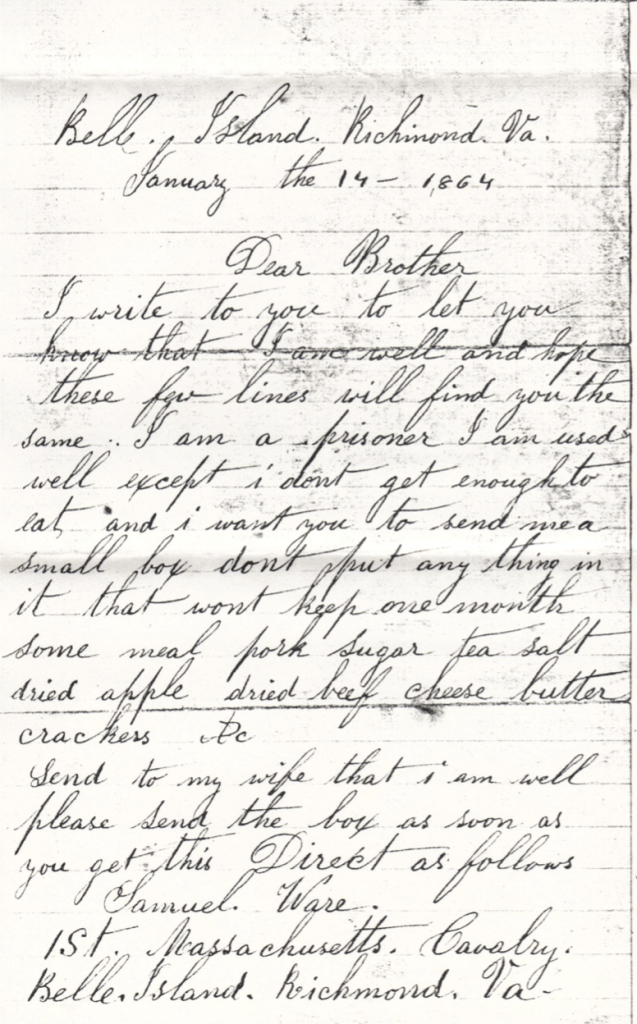
In the following letter, written from Belle Island where he was being held a prisoner, Samuel lets his brother-in-law, Alonzo Payne (1839-1886) know that he was well and but hungry and requests a box of victuals be sent to him. Confinement on Belle Isle would have been particularly brutal in the wintertime. As was customary with prisoner of war letters, it was limited to one page in length.
Belle Isle Prison on island in James River opposite Richmond, Virginia
[Note: The photocopy of the letter was sent to me for transcription and publication on Spared & Shared by Lin Robinson who is Samuel’s g-g-granddaughter.]
Transcription
Addressed to Mr. Alonzo Payne, Conway, Massachusetts
Belle Island, Richmond, Virginia January 14, 1864
Dear Brother,
I write to let you know that I am well and hope these few lines will find you the same. I am a prisoner. I am used well except I don’t get enough to eat and I want you to send me a small box. Don’t put anything in it that won’t keep one month. Some meal, pork, sugar, tea, salt, dried apple, drief beef, cheese, butter, crackers, &c.
Send to my wife that I am well. Please send the box as soon as you get this. Direct as follows: Samuel Ware, 1st Massachusetts Cavalry, Belle Island, Richmond, Virginia.
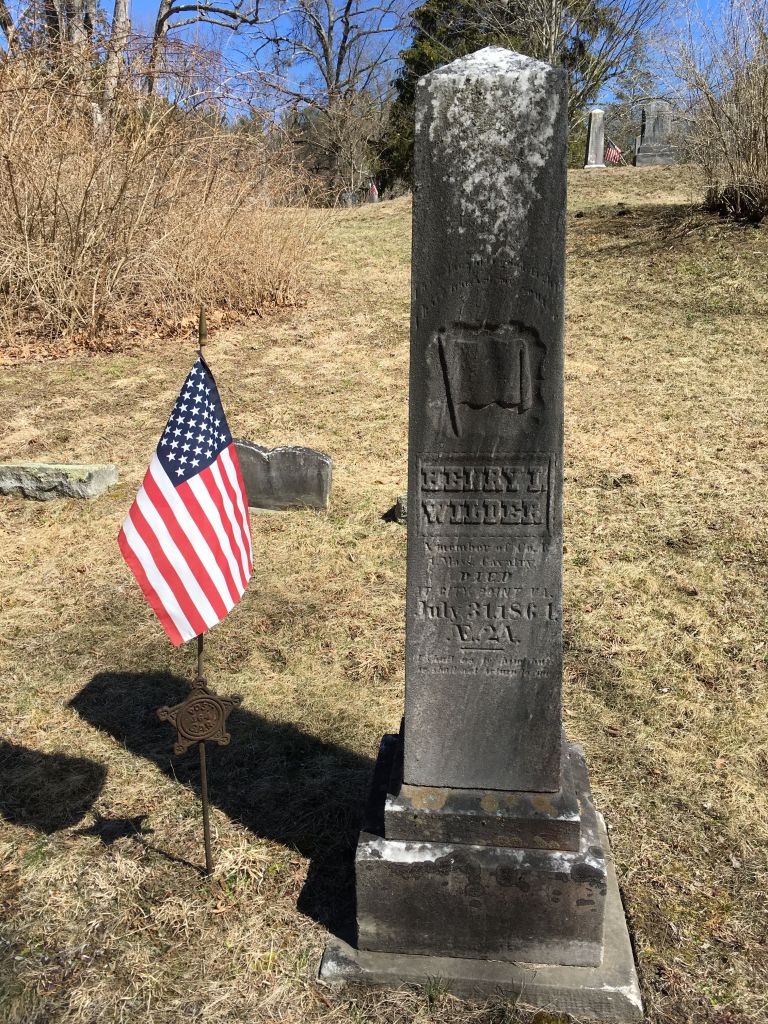
The following letter was written by Henry Israel Wilder (1840-1864), a 21 year-old farmer when he enlisted to serve as a private in Co. E, 1st Massachusetts Cavalry on 18 September 1861. He was wounded on 30 July 1864 in the small skirmish at Lee’s Mill, Virginia, and died the following day at City Point. The skirmish took place as Gregg’s 2nd Cavalry Division attempted to coordinate an attack on the rebel right as the Battle of the Crater took place.
Henry was the son of Israel and Mary (Childs) Wilder of Conway, Franklin county, Massachusetts. The loss to his parents would be sad enough but Henry was married while home on furlough to his hometown sweetheart Maria E. M. Graves on 7 March 1864—less than four months before his death.
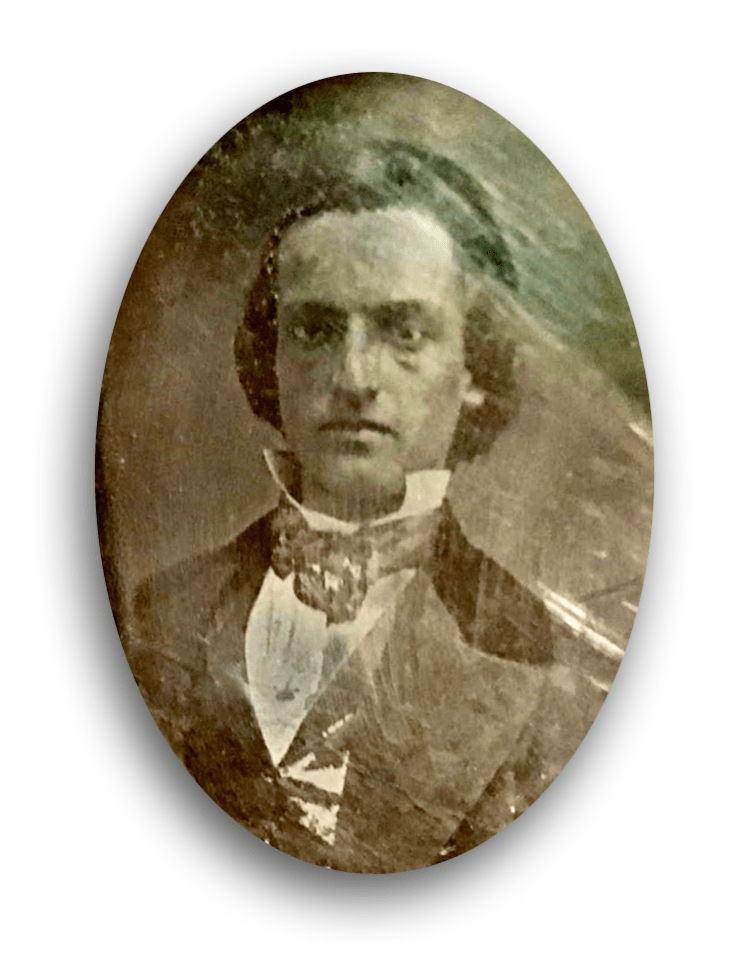
I could not find an image of Henry but maybe this sketch by Stanton P. Allen of the 1st Massachusetts Cavalry depicts Henry wielding his saber for the camera or peeking around the corner of the backdrop.
Transcription
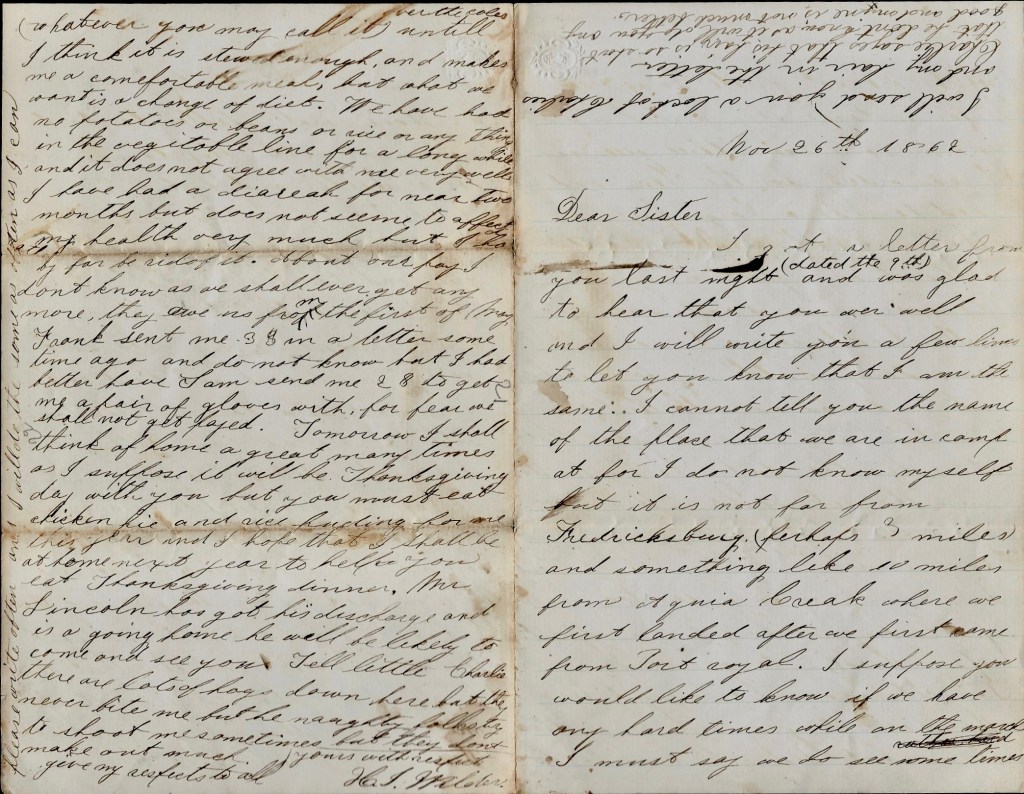
November 26, 1862
Dear Sister,
I got a letter from you last night (dated the 9th) and was glad to hear that you were well and I will write you a few lines to let you know that I am the same. I cannot tell you the name of the place that we are in camp at for I do not know myself but it is not far from Fredericksburg (perhaps three miles) and something like 10 miles from Aquia Creek where we first landed after we first came from Port Royal.
I suppose you would like to know if we have any hard times while on the march. I must say we do see some times which are not quite so agreeable. For instance, when we had a little snowstorm some two or three weeks ago, I was orderly fo the General and had to ride a large part of the time both night and day without any gloves or anything to wear on my hands which was rather cold riding. I was left an orderly until my horse failed up and now am with the company—out company being so small noew it makes the duty harder for the men that it would if they were all here. But we are expecting the new recruits and all the rest of them here today or in a day or two.
Yesterday we had to go off with Gen. Hooker to a review in Gen. Stoneman’s Corps and today they have gone out on another review but did not have to go as I am on other duty.
We have small shelter tents to cover us with. They do very well for a shelter and but little protection from the cold, although I have not suffered very much yet and hope that I shall not, and don’t think that I shall.
Our rations are very good such as they are, pork and hard tack, hard tack and pork, all the time with occasionally a little fresh beef and coffee for drink.
Perhaps you would like to know how I prepare my meals. We have these common tin plates which I take and fry my pork in over the fire and then I take my hard bread and soak them in water and then put them in the fat which I fry out of the meat with the water which I soak them in and then hold the mess (whatever you may call it) over the coals until I think it is stewed enough and makes me a comfortable meal, but what we want is a change of diet. We have had no potatoes or beans or rice or anything in the vegetable line for a long while and it does not agree with me very well. I have had a diarrhea for near two months but does not seem to affect my health very much. But I had by far be rid of it.
About our pay, I don’t know as we shall ever get any more. They owe us from the first of May. Frank sent me $3 in a letter some time ago and do not know but I had better have Sam send me $2 to get me a pair of gloves with for fear we shall not get paid.
Tomorrow I shall think of home a great many times as I suppose it will be Thanksgiving Day with you. But you must eat chicken pie and rice pudding for me this year and I hope that I shall be at home next year to help you eat Thanksgiving dinner. Mr. Lincoln has got his discharge and is a going home. He will be likely to come and see you. Tell little Charlie there are lots of hogs down here but they never bite me. But the naughty folks try to shoot me sometimes but they don’t make out much.
Yours with respect. Give my respects to all, — H. J. Wilder
Please write often as I will do the same as often as I can. I send you a lock of Charlie’s and my hair in the letter. Charlie says that his hair is so short that he don’t know as it will do you any good and mine is not much better.
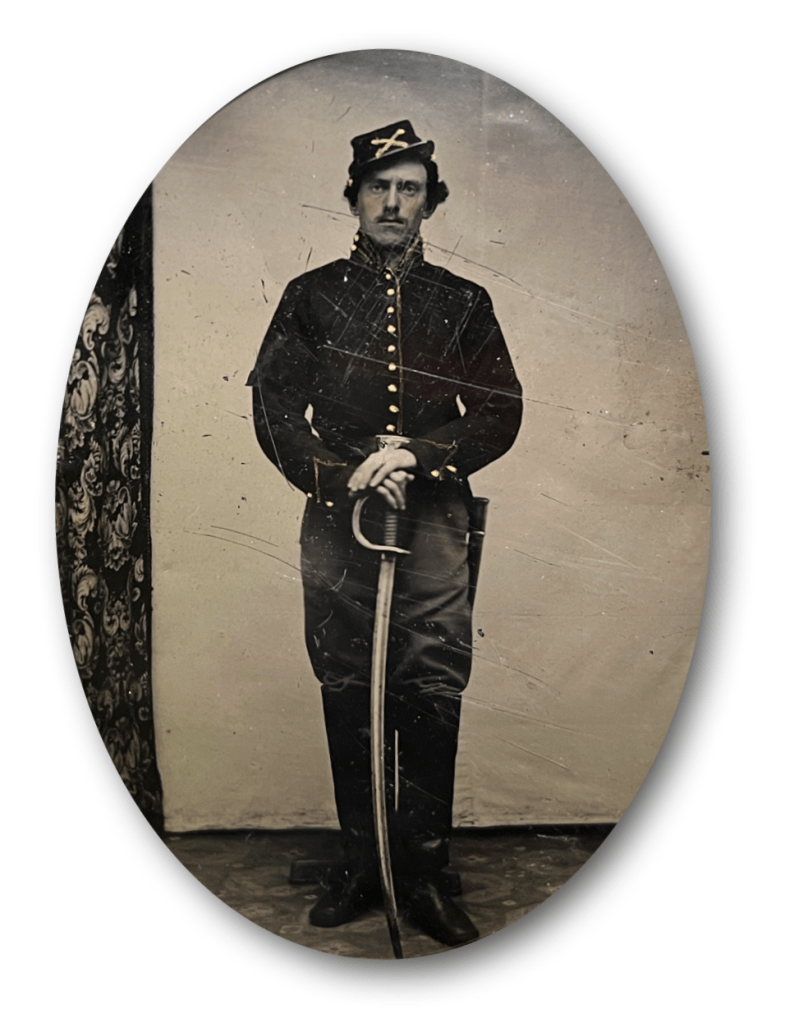
John Sowden, Co. K, 1st Massachusetts Cavalry, half-plate ferrotype (Rob Morgan Collection)
The following letters were written by John Sowden (1841-1917) who emigrated as a small child from England with his mother, Mary Ann Sowden (1808-1870)—a “matron”—and older siblings in August 1843 aboard the ship Stephen Whitney. John’s maternal grandfather’s surname may have been “Caser” or “Cazer.” Mary Ann settled her family in Lanesborough in the Housatonic River Valley of the Berkshire Mountains in western Massachusetts—a rural settlement that must have reminded her considerably of her native home.
From John’s letter we learn that his mother persuaded him to resist the temptation to give up his job as an engineer and enlist with his friends in the 1st Massachusetts Cavalry when it was first being formed in the fall of 1861. He was married to Harriet E. Stocking (1842-1905) in 1862; their firstborn of eventually eight children was born in May 1863. Finally, near the end of December 1863, John accepted a state bounty of $325 and enlisted as a private in Co. K of the 1st Massachusetts Cavalry where he served until 10 June 1865. John’s second letter includes a brief description of the cavalry fight at Jerusalem Plank Road on 16 September 1864, 12 days previous. In this ill-advised engagement, the regiment charged Rebel earthworks with artillery multiple times hoping to recapture a herd of cattle that had been carried off by Lee’s army the day before. The regimental history claims only two of their own troopers were killed, ten wounded, and nine missing.
After his discharge from the service, John returned to his family in Lanesborough where he was employed as a “blowers assistant” (glassblower presumably). By the 1880s, he had moved his family to Anoka county, Minnesota, where he worked in a planing mill. In 1900, the family resided in Minneapolis.
[Note: These letters are from the personal collection of Rob Morgan and were transcribed and published on Spared & Shared by express consent.]
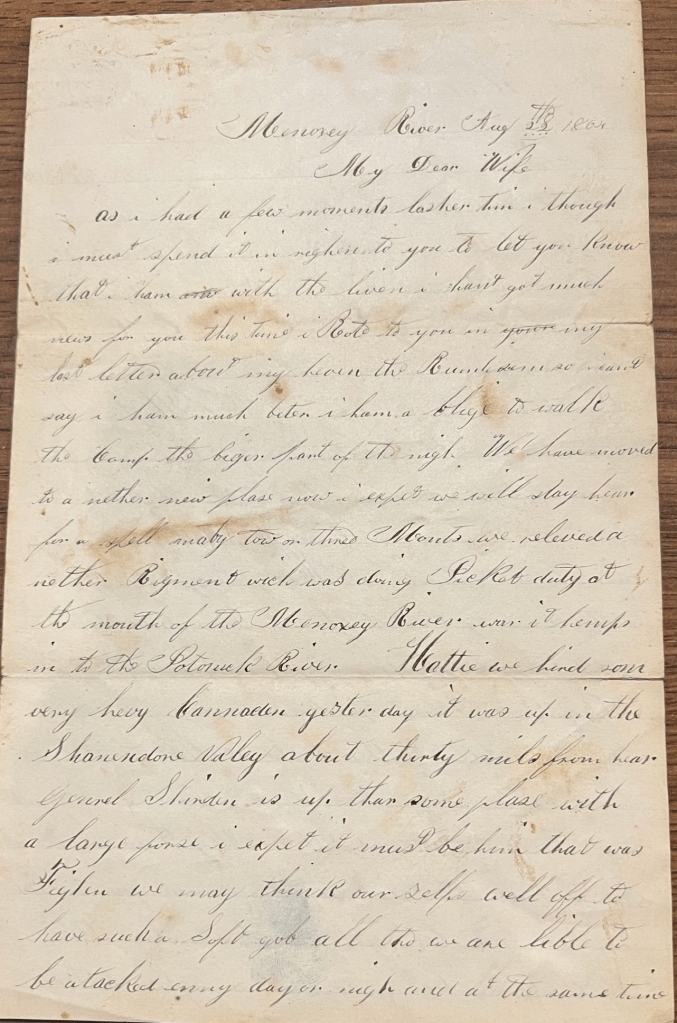
Letter 1
Monocacy River August 28, 1864
My Dear Wife,
As I had a few moments leisure time I thought I must spend it in writing to you to let you know that I am with the living. I hant got much news for you this time. I wrote to you in my last letter about my having the rheumatism. I can’t say I am much better. I am obliged to walk the camp the bigger part of the night.
We have moved to another new place now. I expect we will stay here for a spell—maybe two or three months. We relieved another regiment which was doing picket duty at the mouth of the Monocacy River where it empties into the Potomac River.
Hattie, we heard some very heavy cannonading yesterday. It was up in the Shenandoah Valley about thirty miles from here. General Sheridan is up there someplace with a large force. I expect it must be him that was fighting. We may think ourselves well off to have such a soft job although we are liable to be attacked any day or night and at the same time we might stay here three years and not be attacked.
Hattie, haven’t you heard from James yet? I saw a man from Camp Stoneman the other day. He told me that everyone that he was acquainted with had got back and I thought that everyone of them had got back. It is quite strange that he don’t write. I am a going to write to Camp Stoneman to see if I can find out anything about him. I shall write today. When you write again, let me know where Arthur Smith was when he wrote to his mother.
Hattie, I am a going to direct an envelope myself for you to send back and I want you to direct just like it as near as you can to see if it will make any difference in getting through. Henry Boggart was just sitting down by the side of me. He sends his best respects to you and all the rest who enquires after him.
My dear, I don’t think of any more to write this time. Tell Mother I should like to get a letter from her because I know it would be a good one for I must say she can write a good letter. My dear, I don’t want you to think that I have run down your letters for I do not but you must acknowledge that Mother can beat you a little on writing letters. But never mind that. Maybe when you have wrote as many letters as she has, you can compose a letter as good as she can. I can’t find any fault with your letters for your writing, spelling, and composing is much better than mine. But I do as well as I can considering the way I have to right. Often times I can’t find a piece of board to right on so I have to write on my blanket in any way I can but am writing on a little box this time. It seems quite good to get it to write on.
You must give my love to Father & Mother. Also the rest. Remember yourself whilst giving it out and remember them kisses sent to Jenny. How is the dear little thing getting along? If I could only see you for a few hours, what is there I would not give. But I feel in pretty good spirits if it was not for the pains I have in my shoulder. But I am in hopes it will wear off in a little while.
Well, my dear, I will bid you goodbye for this time. From your ever loving husband, — John Sowden
To Mrs. H. E. S.
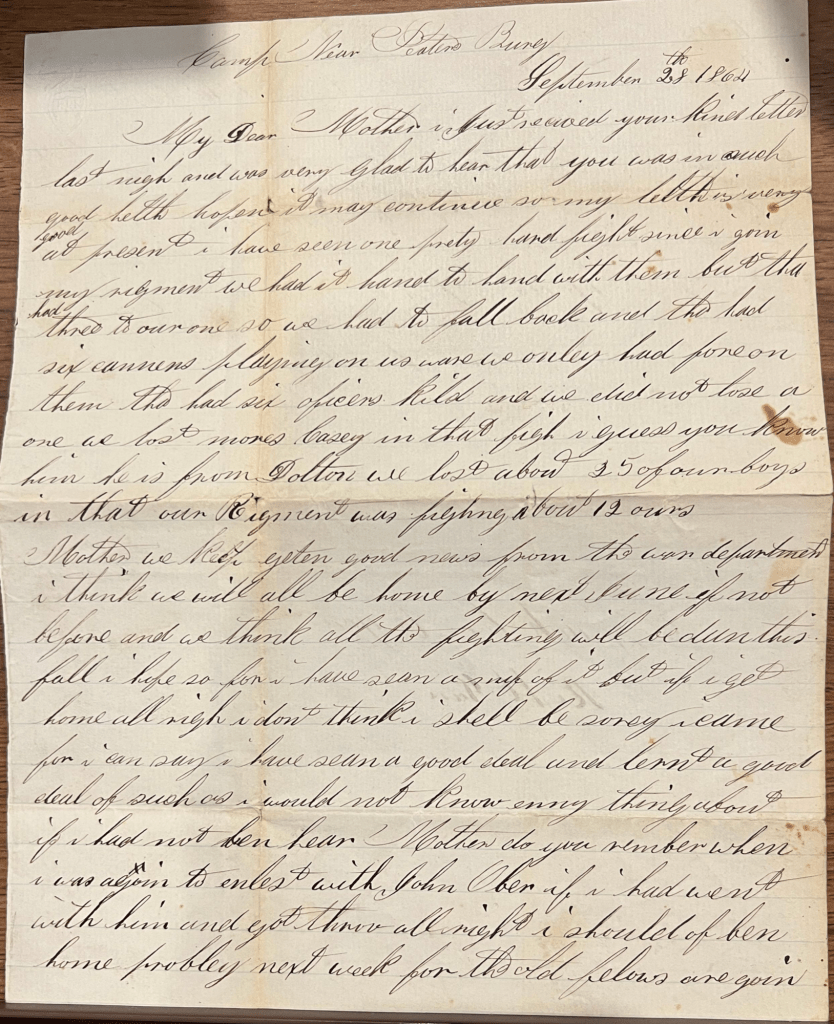
Letter 2
Camp near Petersburg [Virginia] September 28, 1864
My Dear Mother,
I just received your kind letter last night and was very glad to hear that you was in such good health, hoping it may continue so. My health is very good at present. I have seen one pretty hard fight since I joined my regiment. We had it hand to hand with them but they had three to our one so we had to fall back and they had six cannons playing on us where we only had four on them. They had six officers killed and we did not lose a one. We lost Maurice Casey in that fight. 1 I guess you know him. He is from Dolton. We lost about 25 of our boys in that [fight]. Our regiment was fighting about 12 hours.
Mother, we keep getting good news from the War Department. I think we will all be home by next June if not before and we think all the fighting will be done this fall. I hope so for I have seen enough of it. But if I get home all right, I don’t think I shall be sorry I came for I can say I have seen a good deal and learnt a good deal of such as I would not know anything about if I had not been here.
Mother, do you remember when I was a going to enlist with John Ober? If I had went with him and got through all tight, I should of been home probably next week for the old fellows are going home next week. John Ober came out when the regiment first came out. He got killed last June. 2
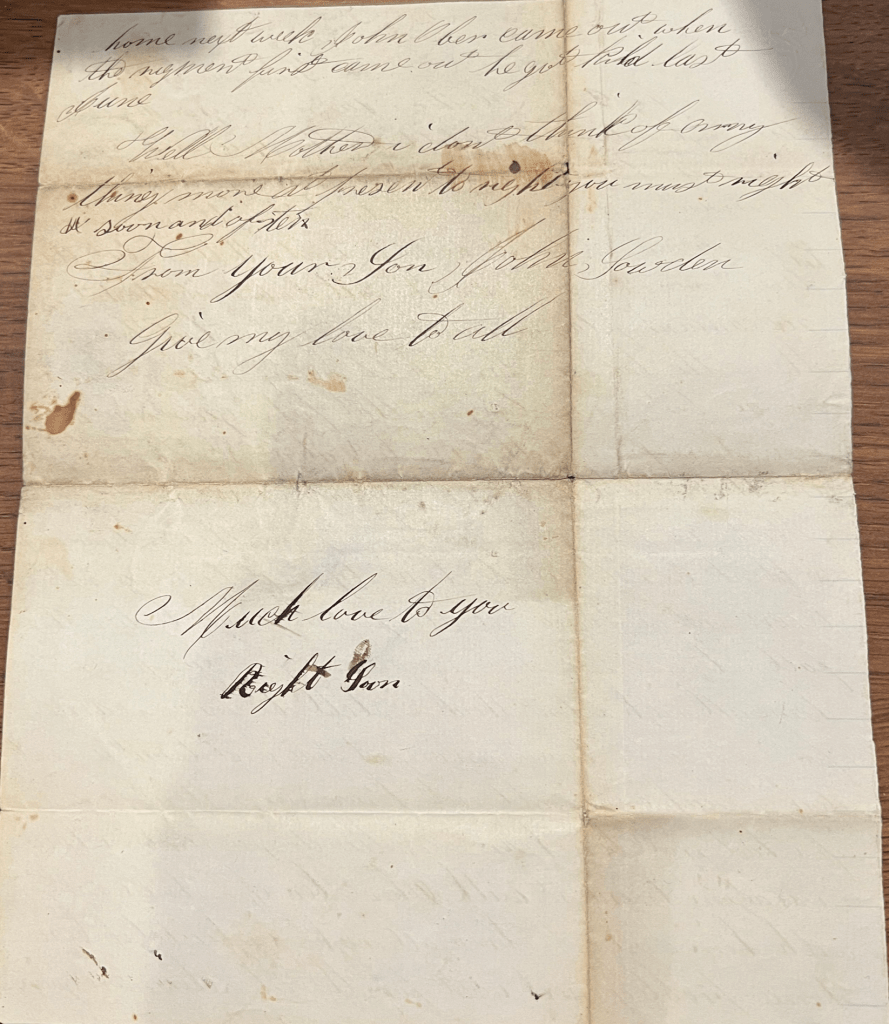
Well, Mother, I don’t think of anything more at present to write. You must write soon and often/ From your son, — John Sowden
Give my love to all. Much love to you. Write soon.
1 Maurice Casey of Pittsfield was 28 years old when he mustered into Co. K, 1st Massachusetts Cavalry on 14 January 1864. He was killed on 16 September 1864 in the fighting at Jerusalem Plank Road.
2 John P. Ober of Pittsfield was 26 years old when he mustered into Co. F, 1st Massachusetts Cavalry on 19 September 1861. He was killed on 17 June 1863 in the fighting at Aldie. See “Not for Gain or Glory: The 1st Mass. Cavalry at Aldie,” by Daniel Davis.
Alfred C. Belcher’s portrait in the Regimental History
This letter was written by Alfred Calhoun Belcher (1844-1911), the son of Alfred Belcher (1814-1891) and Julia Ann Stetson (1821-18xx) of Wemouth, Norfolk county, Massachusetts.
Lying about his age, Alfred was only 17 years old when he enlisted as a private on 19 September 1861 to serve in Co. K, 1st Massachusetts Cavalry. He remained in the service for three full years, mustering out in September 1864. Alfred served in Co. K which was one of four companies in the regiment that were left at Beaufort, S. C. in a “detached” battalion. In August 1863, they were permanently detached and made an Independent Battalion, Mass. Cavalry. Things were relatively dull for this battalion but this apparently suited Alfred as he remarked in this letter, “I don’t like the notion of fighting if I can help it.”
Alfred’s letter includes a story of a runaway who escaped Rebel hunting him down.
After the war, Alfred returned to Massachusetts where he found employment as a painter and as a letter carrier.
Transcription
Beaufort, South Carolina October 21st, 1863
Dear Uncle,
For the want of something to do, not because it is my turn, I sit down to pen you a few lines just to let you know that I am as well as usual and having good times [even] if I am a snoger [soldier].
There is not the least bit of news here so you must expect none in the letter; there has not been one bit of news here since I can remember—only what we have got by the way of New York, so you may imagine how dull it must be here as far as that is concerned. Almost all the excitement we have here is the now and then taking of a Rebel spy or by the advance pickets, of something of that kind, and we are all getting sick of doing nothing, I tell you. All but me, I should have said for I don’t like the notion of fighting if I can help it and most of the men want to go to Morris Island (where they are doing nothing).
I took a ride again last night with Mena Hale and Mrs. Slattery (a Southern Lady) and we went out in the country and had a fine time on one of the plantations. I wish you could have been there for we had any quantity of fun and funny folks too, I tell you.
I was out to our advance pickets last week and while I was there, there was a nigger come in that had just got away from the Rebs. They chased him and a little boy he had with him six night and five days with dogs (blood hounds) and he hid the last night in house and the dogs followed him there and they searched the house all over for them but could not find him. He was hid under some covert in the attic of the house and after they left he come out and came across the river to our side. And when he was about half way across, we saw the rebs trying to make the dogs follow the boat but they would not so they tried to shoot them but could not—they were so far off. When they got to us, they were so much exhausted that they could not stand and their feet were swollen so that they were as large as two common feet and the boy was so bad that they do not think he will live. He was about 10 years old. The man was taken while he was out fishing about eight months ago. He used to take care of my horse when I did picket duty at Barnwell’s Plantation. He said that he was kept in the same jail with one of our boys that was taken while on picket about a fortnight ago. I believe I told you about that before.
I don’t think of any more to write now so I will close. Yours truly, — Alfred C. Belcher








 Spared & Shared 23