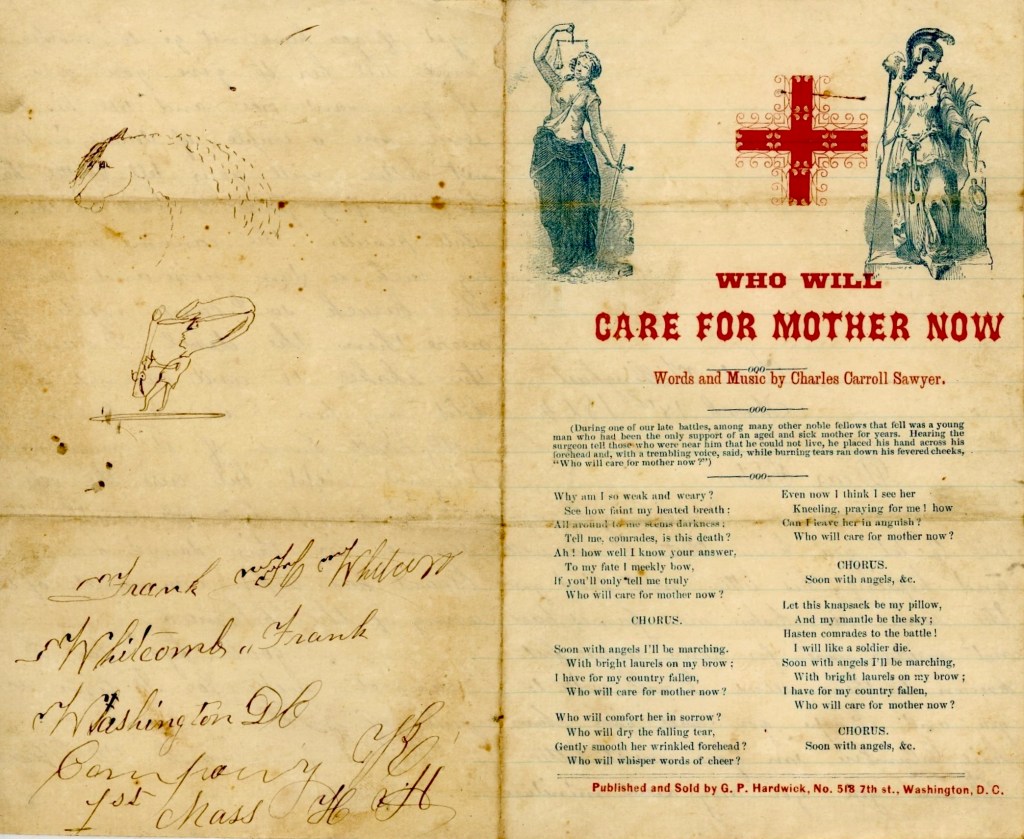
The following letter was written by Francis (“Frank”) Henry Whitcomb (1846-1904) who enlisted in December 1863 to serve as a private in Co. K, 1st Massachusetts Heavy Artillery. He was the son of Asa Whitcomb (1799-1868) and Adaline Augusta Hoar (1813-1892) of Bolton, Worcester, Massachusetts. Frank claimed he was 18 when he enlisted but he was really just 17. Frank mustered out of the regiment on 16 August 1865 at Washington D. C. and returned to Massachusetts where he became a shoemaker in Hudson. He later married Carrie Brigham (1850-1894).
T R A N S C R I P T I O N
Fort Tillinghast March 18th 1864
Dear Sister,
I now seat myself to let you know that I was well and hoping this letter will find you the same. As John nor James have not written me for some reason best known to themselves, I will write to you and I hope you will give them hail Columbia in your next letter.
Have you got my miniature yet? If you have not, go to Mother and tell her to give you one if you want one and tell her to send me a couple of dollars in her next letter, will you? Tell Nettie that he is a bully fellow to send me them slate pencils. The cannons are making such a damn noise and shake the barracks so I can’t write no more than the Devil. I have got the shakes too and cannot hardly hold my pen. We are having a pretty hard time of it now—work day and night—but cuss the odds. I hain’t got but 33 months to serve in this damned hole.
Grant has taken command of the Army of the Potomac. Goodbye for I cannot write for I am so full of [smudged] — Frank Whitcomb
Frank Whitcomb, Company K, 1st Mass. H. A., Washington D. C.
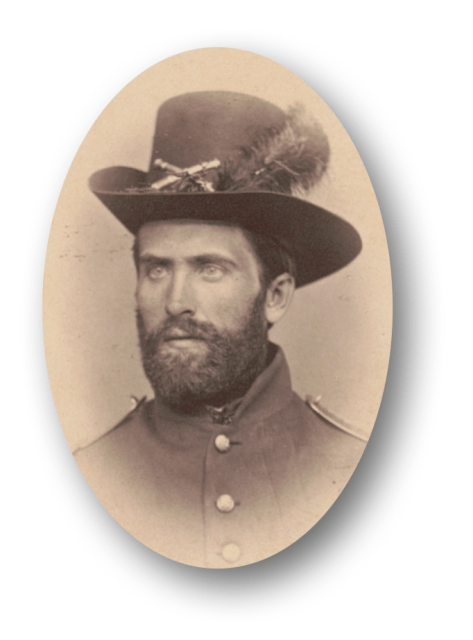
I could not find an image of Charles Howard but here is one of Charles Smith who served in the 1st Massachusetts Heavy Artillery, Battery C (Al and Claudia Niemic Collection)
The following letter was written by Charles E. Howard (1842-1868) who enlisted at Lawrence, Essex county, Massachusetts, to serve in Co. K, 14th Massachusetts (Infantry) Regiment on 5 July 1861. However, this regiment was converted to a Heavy Artillery unit on January 1, 1862. They were officially made the 1st Massachusetts Heavy Artillery as Charles writes in his letter. There were 2552 men that served in the regiment through the war. The unit suffered 486 fatalities; 215 KIA or mortally wounded, 115 died due to disease or accident, 156 died as POWs along with 4 MIAs presumed dead.
Charles was the son of a stonecutter named Eli Bangs Howard (1811-1851) and Rebecca Bartlett Dow (1810-1874). 17 year-old Charles was the only child living at home in Lawrence with his mother, a dressmaker, when the 1860 US Census was taken. Living in the same household was Rebecca’s mother Abigail (age 69). Charles survived the war but died of consumption in 1868 at age 26.
T R A N S C R I P T I O N
Headquarters Heavy Artillery 14th Mass. Regt., Co. K February 8, 1862
Dear Cousin,
I have a few leisure moments now to answer your letter which I received a week ago. You must excuse me for not writing before for I have not had much time. We are changed into heavy artillery so we do not have much time to write. We have just returned from drill and my arms are so tired that I can hardly handle the pen. We are called the 1st Massachusetts Heavy Artillery, Battery K, but we go by the name of the 14th Mass. Regt., Co. K. Our letters will come either way. We have to drill on the big guns every day that is fair. We have nothing but mud, mud. The mud in some places is two feet deep. That is the reason why the army do not make at attack. Our major and some more men have gone to Lawrence to recruit more men for this regiment. I think that we will all be at home next fall.
Ask aunt what she will sell me a whole cheese for. If she will sell me a whole cheese, mother will put it in my box and send it to me. How does grandfather get along? How does aunt sell her butter? I would like to see you and all of the folks. Tell aunt that if I live to get home, I will come and see her. Have you got much snow there? We have not more than one inch, if that. In some places the mud is 3 or 4 feet deep. You never, nor I never saw the mud so deep as it is in Virginia.
Tell Sumner that I want him to write to me. Tell him that I know Freeman Harley and his brother. Tell him that I see them most every day, sometimes work with him. Give my love to the girls that aren’t married yet. When are you a going to get married? Send me the marriage card when you get married so that I can see who you are married to. I do not know when I shall get married. There are plenty of Niggers out here and if Sumner wants a Nigger, send him out here and I will show him some.
The dinner has just come and you would laugh to see them run to get it. They run like pigs.
We have a shoemaker in our house so he mends all of our shoes but we have to pay him 50 cents for it. I will write a few lines to Olive Ann in this letter. Why does not Olive write to me? She has not answered my letter that i wrote her. Give my love to all. From your cousin, — C. E. Howard to C. J. H.
Dear Cousin, I now write a few lines to you hoping to hear from you soon. Have you. seen or heard of Abby yet? How does she get along? Tell her that I should like to see her. Tell her to write. I want to hear from her and you. very much, How does her mother get along? Tell Abby that I will answer her letter if she will write.
The Boys are eating dinner. I think that the war will all be over next November and we will all be at home. I heard that you. and Emeline went to the meadow and had a good time skating and then went to a party. I wish that I had been there. You must of had a splendid time. Was Abby there? When I read her letter and heard that you had a good time, I wished that I had been there. Tell Emeline that I wish that when she goes to a party, [ ] to have a good time for me. Won’t you write soon as you get this? From your cousin, — C. E. H.
I could not find an image of Ed but here is one of Frank Snell of Co. E, 1st Massachusetts Heavy Artillery (LOC)
Inspired by the patriotic celebrations in his hometown of Danvers, Massachusetts, on the 4th of July 1861, Edward Calahan walked into the local recruiting office the following day and enlisted in Co. I of the 1st Massachusetts Heavy Artillery. He enlisted as a private and later rose to corporal. He was with his regiment when they were sent to the Virginia battle front to participate in Grant’s Overland campaign, joining the action just before the Battle of Spottsylvania Court House. He survived the action there, at North Anna River, at Totopotomoy Creek and at Cold Harbor but was wounded on 18 June 1864 in the first assault on Petersburg. He mustered out of the regiment three weeks later at the expiration of his term of service. His surname appears variously as Calahan or Callahan though he used the former spelling in this letter.
A sketch of Fort Runyon as it appeared in August 1861.
Transcription
Addressed to Miss Caroline Post, Wenham, Massachusetts
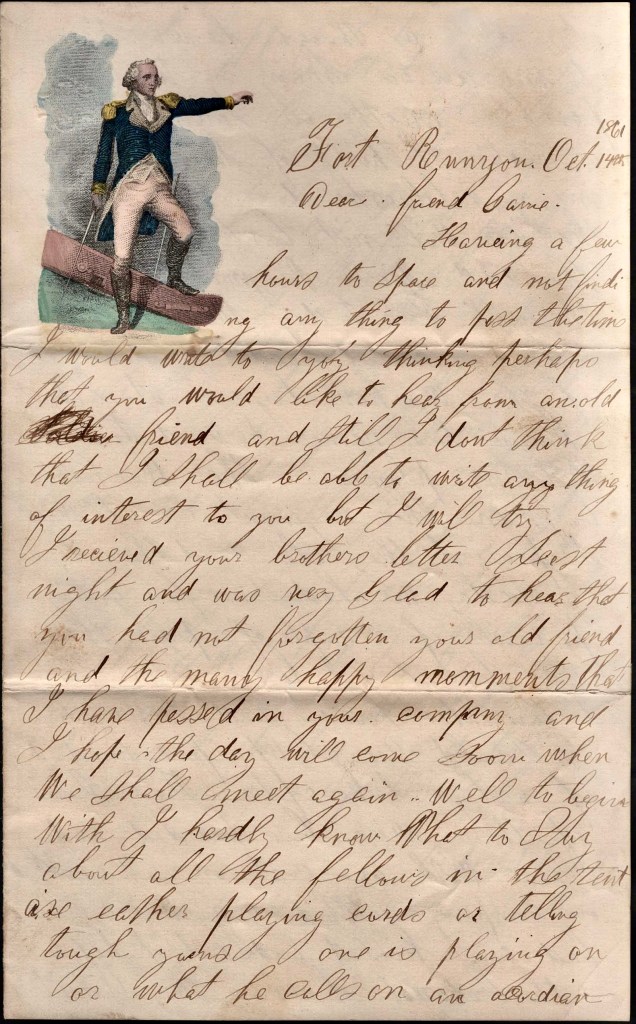
Fort Runyon 1 October 14th 1861
Dear friend Carrie,
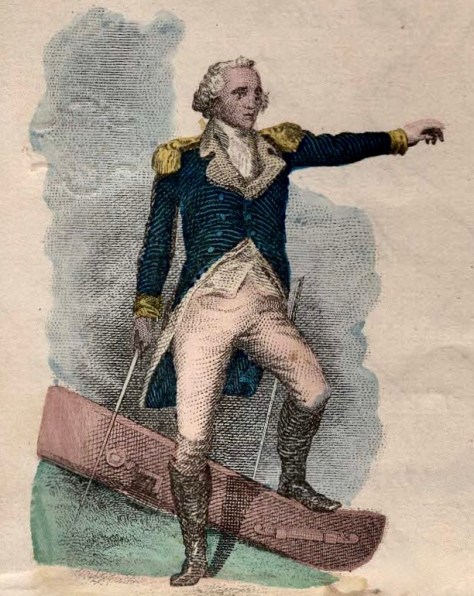
Patriotic letterhead on Ed’s stationery; Gen. George Washington holding sword with raised arm and foot on trail of cannon.
Having a few hours to spare and not finding anything to pass the time, I would write to you thinking perhaps that you would like to hear from an old friend and still I don’t think that I shall be able to write anything of interest to you—but I will try. I received your brother’s letter last night and was very glad to hear that you had not forgotten your old friend and the many happy moments that I have passed in your company. And I hope the day will come from when we shall meet again.
Well, to begin with, I hardly know what to say. About all the fellows in the tent are either playing cards or telling tough yarns. One is playing on what he calls an accordion [but] it seems as though he was trying to murder as many tunes as possible. Another is sawing on a violin. I think if he kills as many rebels as he does tunes, that the war will not last long.
“Another is sawing on a violin. I think if he kills as many rebels as he does tunes, that the war will not last long.”
— Edward Calahan, 1st Mass. H. A., 14 October 1861
The 22d Massachusetts Regiment passed through here today. They have gone to Baileys Cross Roads. I saw one of the Wenham boys in it. I don’t know his name. He used to live with Mr. Plummer. The Wenham boys in this regiment are all well at present. They all send their love.
Yesterday we had some fun getting possession of a couple of pigs. There was several got loose from the slaughter house and I wish you could see about five hundred of our boys take after them. Some of them were bare-headed and some with over coats on. We—our company—catched a good one. We had him killed and cut up before the Colonel knew anything about it. There, I suppose I have written enough on that strain yet. I don’t know what I shall write to interest [you].
There is some prospects of having a fight soon and I am glad of it for I want to have this settled as soon as possible for I am getting tired of laying still. I want you to write. I should like to hold correspondence with you. You and I always got along tip top together and I don’t see why we can’t continue to do so. Give my love to all the girls and fellows of my acquaintance and tell them to write. I must close now so good night and pleasant dreams—and believe me, I am your affectionate friend, — Edward Calahan
P. S. Please write soon as you get this.
1 Fort Runyon was built at the Virginia end of the Long Bridge to prevent access to Washington City by that route. The fort strategically sat astride two major thoroughfares, the Columbia and Washington-Alexandria Turnpikes, and adjacent to a major railroad line.
This letter was written by 23 year-old bootmaker, Joshua H. Tower of Hopkinton Massachusetts. Joshua enlisted on 4 August 1862 as a private in Co. F, 1st Massachusetts Heavy Artillery. This regiment began its service as the 14th Massachusetts Volunteer Infantry and garrisoned Fort DeKalb (later renamed Fort Strong) on Arlington Heights from August 1862 to June 1863.
I could not find an image of Joshua but here is one of William Full who served in Co. G of the 1st Mass. H. A. (Michael Gordon Collection)
Co. F remained on duty at forts in the Washington D. C. area until May 15-16 1864, when the regiment was ordered to Belle Plain, Virginia. From there they fought as infantrymen at Spotsylvania Court House, North Anna, Totopotomoy, Cold Harbor and Before Petersburg and Siege of Petersburg, beginning on Jun 16 1864, where Tower was taken prisoner.
Tower did not survive the war. He died of disease as a prisoner of war on 10 October 1864 at Savannah, Georgia. He had been taken prisoner on 22 June 1864 at Petersburg.
Joshua’s wife, Philena M. (Knowlton) Tower (1835-1908), filed for a pension (Certificate 62,413) but it was annotated that her surname was “now Nichols”—she having married Roswell Nichols sometime prior to 1870. Her parents were Marshall Knowlton and Mary Holmes.
Transcription
Fort DeKalb 1 December 13, 1862,
To my sister Kate,
I received a letter from you and was very glad to learn that you were all getting along so well in point of health. I too am in good health and weigh one hundred and sixty pounds which is about my usual weight when at home. I got a letter from wife last night and she writes me that she had a sore throat, but it is getting better of it now and is going to Tom’s as soon as she can. I expect that you are having a taste of winter at home but it is warm and pleasant here now. We had it cold enough the fore part of the week. The Potomac is frozen over above the aqueduct bridge, which don’t happen every winter. It snowed here a week ago last Friday, but it is all gone now. I think the weather is a great deal warmer here than at home, but it is as hard to bear as winter in Massachusetts. The changes are as great which makes it seem colder than it really is.
Monday the 15th. It is warm and pleasant as summer today, and we sit in our tents with the doors open. Quite different from the weather a week ago last Saturday. At the convalescent camp near Alexandria, six soldiers froze to death. They have got no fire nor means of getting any. Sam Bicknell 2 was there and came up to our fort and stayed a week. Said he should have died if he had stayed much longer. He went back yesterday. People may talk about the sufferings of the soldiers of the Revolution and one of these days they will tell about the soldiers of 1862.
“The Union forces under Gen. Burnside have got possession of Fredericksburg and are driving the rebels out of their fortifications but it will cost seas of blood to do it…”
— Joshua H. Tower, 1st Mass. Heavy Artillery, 15 December 1862
There is a battle being fought at Fredericksburg about sixty miles from here and about half way between here and Richmond. The papers say it will be the bloodiest battle of the century. Already there are five thousand sick and wounded in the hospitals from that fight. The Union forces under Gen. Burnside have got possession of Fredericksburg and are driving the rebels out of their fortifications but it will cost seas of blood to do it and then they will retreat into other fortifications to be still driven, unless some fortunate circumstance shall give us Richmond while Burnside is engaging the rebels at Fredericksburg.
17th. Since writing the above, news has arrived that Gen. Burnside has retreated across the Chickahominy [Rappahannock] and abandoned the fight after losing ten thousand men killed, wounded and missing. Burnside, in his dispatch to the general government, says he felt that the enemy’s works could not be carried and that a repulse would be disastrous to his army. Finally, I can’t tell anything about it when the war will end or which will come off victorious, but hope we shall come [out] top of the heap.
Give my love to all and write often and not wait for me to write every time you do. This from your affectionate brother , — J.
1 Fort DeKalb was constructed at the northern end of Arlington Heights for the purpose of guarding the roads and approaches to the canal aquaduct bridge (near present-day Key Bridge). The fort was three-quarters of a mile west of Fort Corcaran. It was a lunette with stockaded gorges. Rifle pits were dug outside the fort. It was later named Fort Strong.
2 Samuel Barrett Bicknell was a corporal in Co. B, 16th Massachusetts Infantry.He was a carpenter from Hopkinton, Middlesex, Massachusetts.









 Spared & Shared 23