Category Archives: 1st Rhode Island Cavalry

1862: Augustus Smith to Sister Jane

The following letter was written by Augustus Smith (1839-1864), the son of Harry Smith (1802-1887) and Almira Naramore (1806-1899). He was born in Underhill, Vermont.

Augustus was a single, 22 year-old farmer residing in New Ipswich, New Hampshire when he enlisted on 23 December 1861 in Co. M, 1st New England Cavalry (1st Rhode Island) under Capt. William P. Ainsworth. He was sick in General Hospital from May 1862 until Aug. 1862; June 18, 1863, taken prisoner near Middleburg, VA; subsequently paroled at Annapolis, MD; Jan. 5, 1864, re – mustered as a veteran volunteer at Catlett’s Station, VA and transferred to New Hampshire Cavalry by order dated Jan. 7, 1864; died Oct. 6, 1864 at Columbia Furnace, Shenandoah Co. VA, age 25y, 3m; burial at Church Street Cemetery, Swanton Franklin Co. Vermont.

Transcription

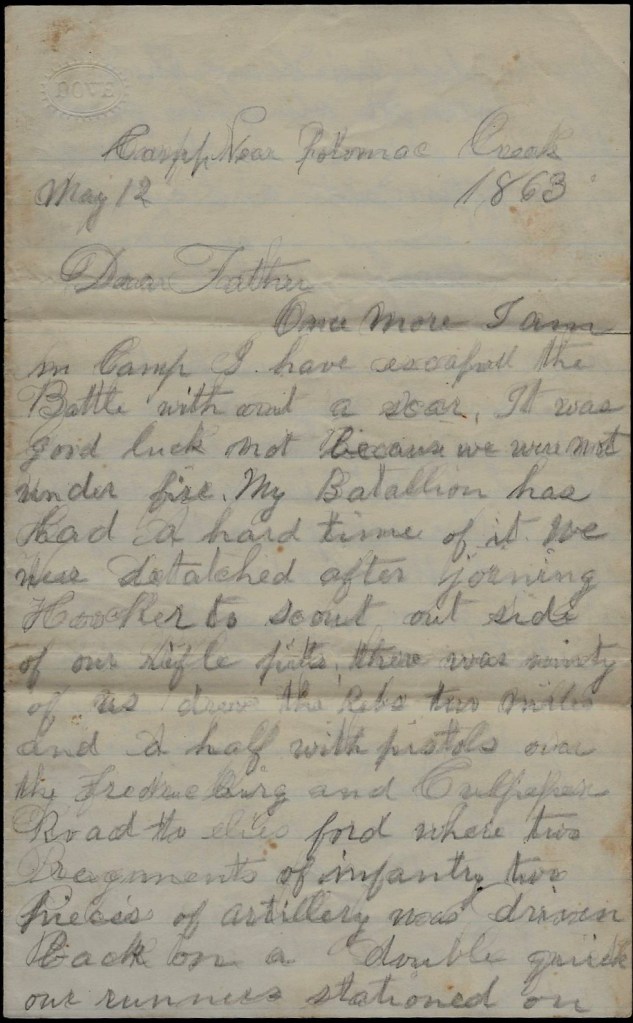
Camp Arnold
Pawtucket, Rhode Island
February 16, 1862

Sister Jane,

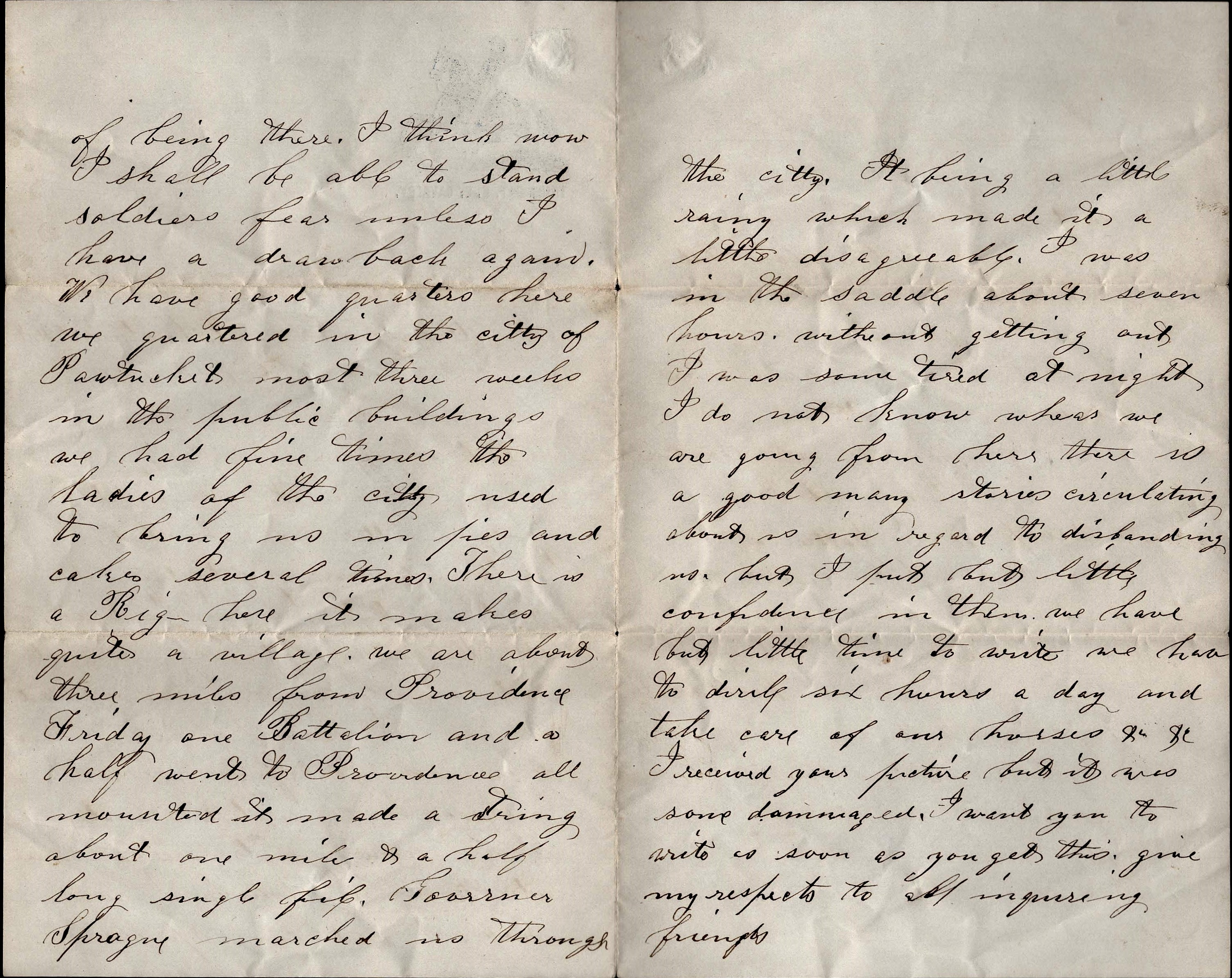
I received your letter of the 9th with pleasure yesterday. I had waited long and anxious. I have nothing to write but our camp news as that is all I hear. I have been sick about five weeks since I enlisted but am now quite well. I was at Rollins while I was sick. I had two spells of being there. I think now I shall be able to stand soldier’s fare unless I have a draw back again.

We have good quarters here. We quartered in the city of Pawtucket most three weeks in the public buildings. We had fine times. The ladies of the city used to bring us in pies and cakes several times. There is a regiment here. It makes quite a village. We are about three miles from Providence.

Friday one battalion and a half went to Providence all mounted. It made a string about one mile & a half long single file. Governor Sprague marched us through the city. It being a little rainy which made it a little disagreeable. I was in the saddle about seven hours without getting out. I was some tired at night. I do not know where we are going from here. There is a good many stories circulating about us in regard to disbanding us but I put but little confidence in them. We have but little time to write. We have to drill six hours a day and take care of our horses &c., &c.

I received your picture but it was some damaged. I want you to write as soon as you get this. Give my respects to all inquiring friends. Write all the news and a good long letter for that is what we soldiers like. Yours as ever, — Augustus

Address: Camp Arnold, Pawtucket, R.I. Troop M, 3rd Battalion, N.E. Cavalry, Commanded by Capt. Wm. P. Ainsworth

1863: Andrew Durfee to Stephen Durfee

This letter is written by Andrew Durfee (1840-1865), the son of Stephen Durfee (1812-1886) and Sarah Marshall (1816-18xx) of Fall River, Newport county, Rhode Island.

Andrew mustered into Co. D, 1st Rhode Island Cavalry as a private in mid-December 1861. He was captured at Middleburg, Virginia. where the regiment was badly routed on 18 June 1863, and paroled on 23 July 1863 at City Point, Virginia. He was captured again at Sulfur Springs, Virginia, on 14 October 1863. He spent the next 18 months at Libby and Andersonville, being paroled 27 February 1865 at N. E. Ferry, North Carolina, only to die of pneumonia in the General Hospital in Wilmington, North Carolina within a month.

I could not find an image of Andrew but here is Lyman Aylesworth of the 1st Rhode Island Cavalry. Lyman barely escaped capture at the Battle of Middleburg (VA) on June 17/18, 1863 when most of his comrades were taken prisoner. His family donated his uniform, sword, enlistment papers and other various accoutrements to the Varnum museum in the 1920s. His shell jacket has been recently conserved. — at Varnum Memorial Armory Museum.

Transcription

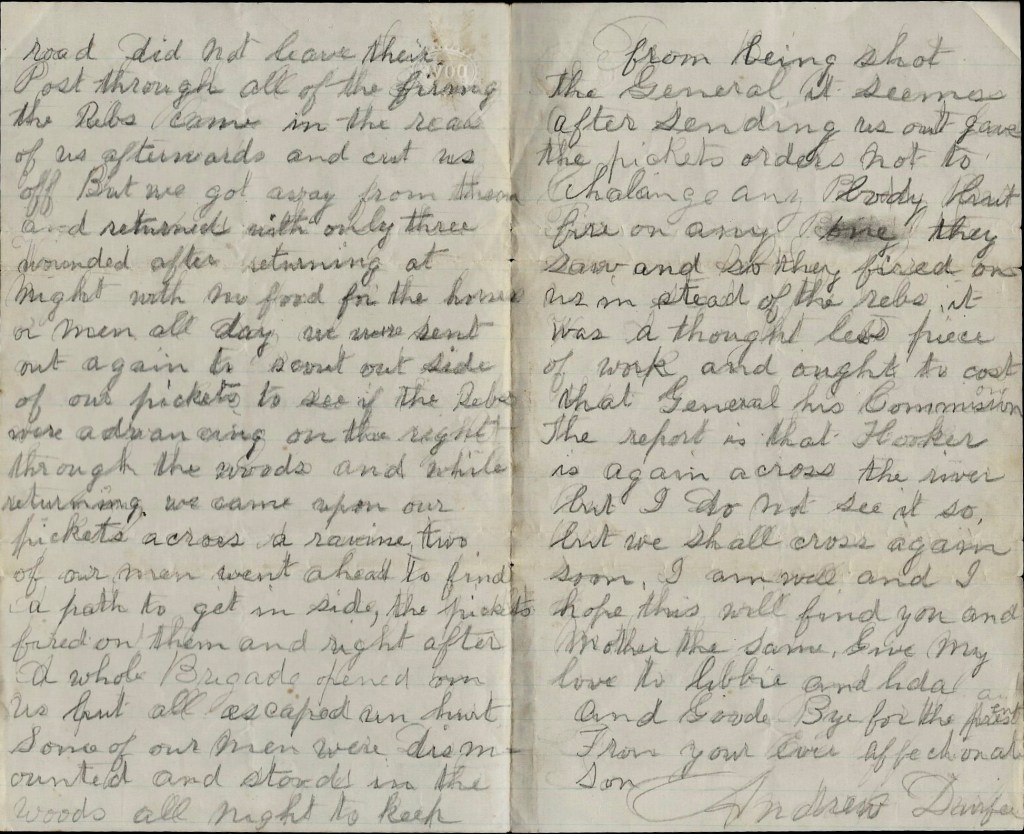
Camp near Potomac Creek
May 12, 1863

Dear Father,

Once more I am in camp. I have escaped the battle without a scar. It was good luck [and] not because we were not under fire. My battalion has had a hard time of it. We were detached after joining Hooker to scout outside of our rifle pits. There was ninety of us drove the Rebs two miles and a half with pistols over the Fredericksburg and Culpeper Road to Ely’s Ford where two regiments of infantry [and] two pieces of artillery was driven back on a double quick. Our runners stationed on the road did not leave their post through all of the firing. The Rebs came in the rear of us afterwards and cut us off but we got away from them and returned with only three wounded.

After returning at night with no food for the horses or men all day, we were sent out again to scout outside of our pickets to see if the Rebs were advancing on the right through the woods and while returning, we came upon our pickets across a ravine. Two of our men went ahead to find a path to get inside the [picket line when] the pickets fired on them and right after, a whole brigade opened on us but [we] all escaped unhurt. Some of our men were dismounted and stood in the woods all night to keep from being shot. The General, it seems, after sending us out, gave the pickets orders not to challenge anybody but fire on anyone they saw—and so they fired on us instead of the Rebs. It was a thoughtless piece of work and ought to cost that general his commission.

The report is that Hooker is again across the river but I do not see it so. But we shall cross again soon. I am well and I hope this will find you and Mother the same. Give my love to Libbie and Lida and goodbye for the present. From your ever affectionate son, — Andrew Durfee