The following letter was written by Robert Reid Hemphill (1840-1908), the son of Rev. William Ramsey Hemphill (1806-1876) and Hannah Smith Lind (1808-1895) of Abbeville, South Carolina. He first entered the service in June 1861 as a private in the 7th South Carolina Infantry. He was made the orderly for Gen. M. L. Bohnam and was present at 1st Manassas. In June 1862 he transferred to Co. G (“the Marshall Riflemen”), 1st South Carolina (Orr’s Rifles) where he eventually rose in rank to Sergeant Major (May 1864) in William McNeill Whistler’s unit, Orr’s Rifles, McGowan’s Brigade, Wilcox’s Division, Hill’s Corps, under General Robert E. Lee. He was wounded at Chancellorsville and at Gettysburg on 3 July 1863, taken a POW at Falling Waters on 14 July 1863 but exchanged soon afterwards, and surrendered at Appomatox.
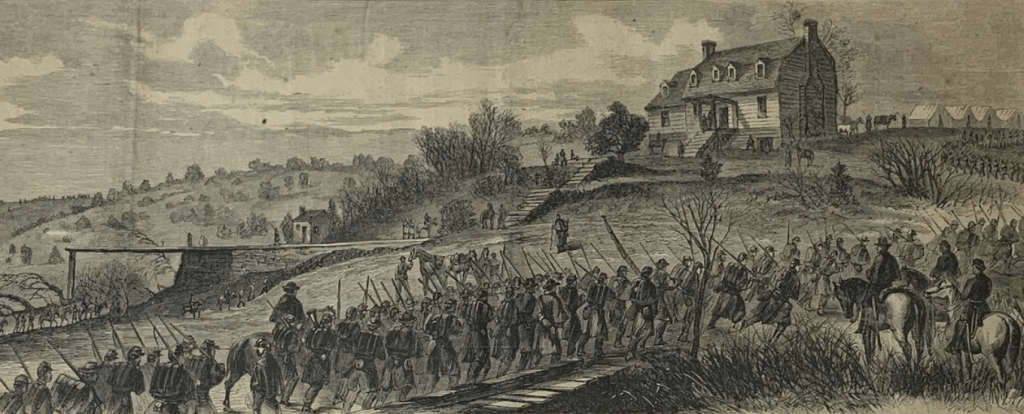
Robert’s letter gives us a good Confederate account of the Mine Run Campaign conducted in late November—early December 1862 in which Meade attempted to cross the Rapidan river and surprise Lee’s army but delays in river crossings and bad weather confounded his plans and he wisely withdrew before fully engaging with the Confederates who were well-fortified in breastworks.
Robert graduated from Erskine College in 1859 and married Eugenia Cornelia Brewton of Spartanburg county in 1870. He later served in the state legislature and became a judge.
Union troops at Germanna Ford during the Mine Run Campaign
[Note: This letter is from the personal collection of Greg Herr and was offered for transcription and publication on Spared & Shared by express consent.]
Transcription
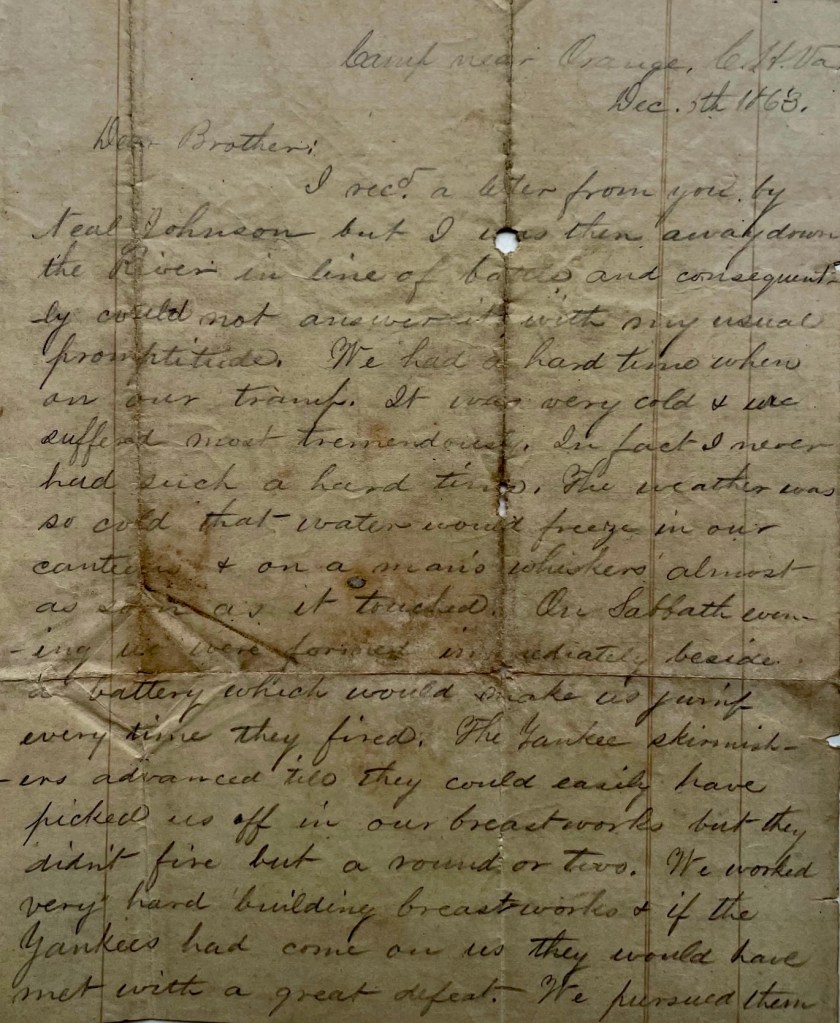
Camp near Orange Court House, Va. December 5th 1863
Dear Brother,
I received a letter from you by Neal Johnson but I was then away down the River in line of battle and consequently could not answer it with my usual promptitude. We had a hard time when on our tramp. It was very cold and we suffered most tremendously. In fact, I never had such a hard time. The weather was so cold that water would freeze in our canteens and on a man’s whiskers almost as soon as it touched. On Sabbath evening we were formed immediately beside a battery which would make us jump every time they fired. The Yankee skirmishers advanced till they could easily have picked us off in our breastworks but they didn’t fire but a round or two. We worked very hard building breastworks & if the Yankees had come on us, they would have met with a great defeat. We pursued them about six miles but they succeeded in getting across the [Rapidan] River. When we were fortifying, I found a white-handled knife—not much account but I will try to send it home & have a new blade put in it.
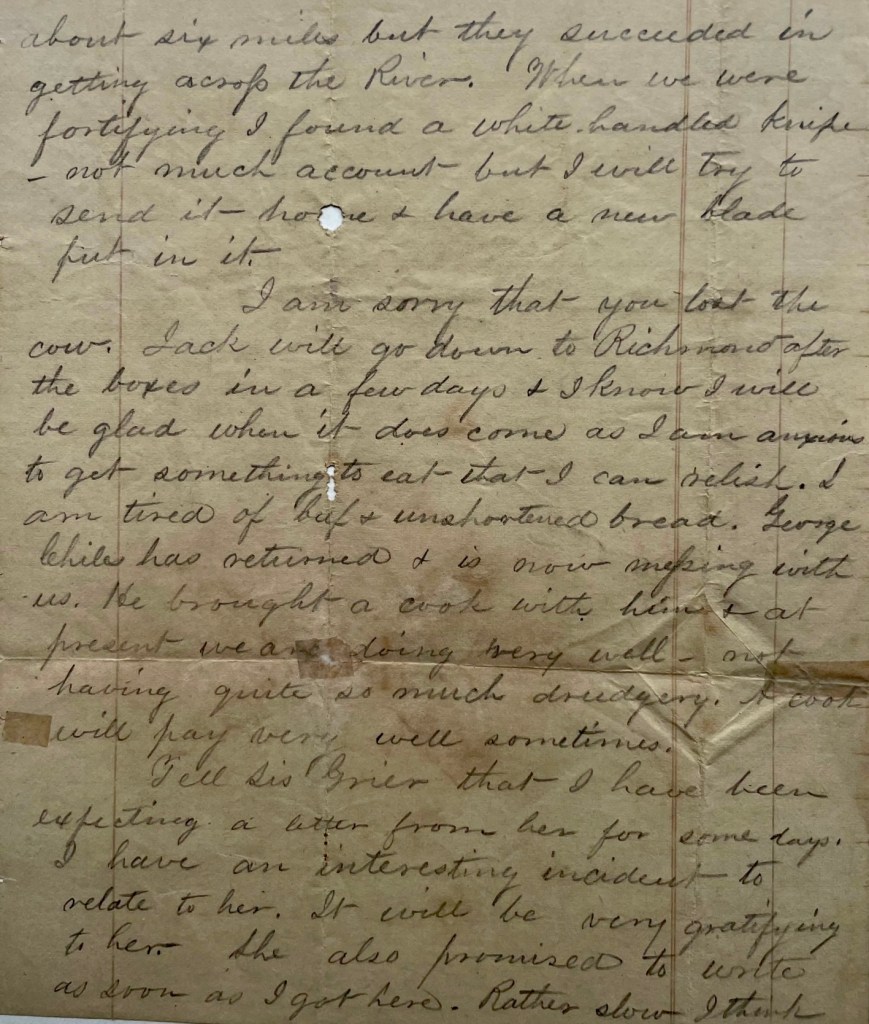
I am sorry that you lost the cow. Jack will go down to Richmond after the boxes in a few days & I know I will be glad when it does come as I am anxious to get something to eat that I can relish. I am tired of beef and unshortened bread. George Chiles has returned & is now messing with us. He brought a cook with him and at present we are doing very well—not having quite so much drudgery. A cook will pay very well sometimes.
Tell Sis Grier that I have been expecting a letter from her for some days. I have an interesting incident to relate to her. It will be very gratifying to her. She also promised to write as soon as I got here. Rather slow I think. I hate to make so many calls on you but I think John Simpson will be along at Christmas & would bring a supply of provisions. It would do well enough to put in a little meal or flour by way of variety. Also get a few goobers from Thom. Fair. I will leave the other articles to the judgement of the family, feeling assured that you will satisfy me. I came near starving last winter & I intend to try to guard against such suffering. You will have to excuse me.
What became of “this is the kind of corn we raise at ‘our house’?”
What about Brothers? Tell the folks at home to not interfere with things that don’t concern them. Next time they must refer to the English Grammar & Dictionary before they start another petition up to Gen’l Lee. The Gen’l received it and sent it down to Capt. Prato for his decision. I notice some names to it that were complaining when I was at home. I don’t see why Mother and Bella ever signed it knowing that Brothers in an unaccommodating speculation. He was not reported for extortion as the petition says, but so many complaints were sent on to members of Co. G in letters from home that Prato ordered him to report. If any more petitions are sent here about Brothers “asidulously laboring” “incalculating” services “volunteerly” rendered, we will indict the crowd for “murdering the King’s English.”
Old Andy ought to put two n’s in cannot. The President of the D. W. F. C. says that he (Brother) supplied “shoes too of a better quality than is furnished, &c.” He ought to take out the is and substitute are.
Love to all. Write soon & a long letter. Affectionately, — Robt. R. Hemphill
I want a pair of gloves as soon as I can get them.
The following letter was written by 21 year-old Henry Gray (1844-1900), the son William T. Gray (1814-1856) and Gracy Ann Bates (1815-Aft1865) of Gadsden, South Carolina. He wrote the letter to 18 year-old Unity Anne Gray (1846-1927), one of nine siblings ranging in age from 10 to 32 in 1865.
This unidentified South Carolina corporal has a Palmetto Tree embroidered on the top of his kepi. (Larry Munther Collection)
Not certain which South Carolina regiment Henry served in, I looked for Henry’s obituary, and found it published in a Columbia newspaper in July 1900. It informs us that “Mr. Henry Gray of lower Richland, a prominent citizen and successful planter, after a brief illness, died at his home in Gadsden…aged 56….He was a gallant soldier in the Confederate army…” No specific regiment identified. Since he mentioned a comrade named Frank Joiner in his letter. I searched for him and found Frank Joyner (1842-1910) of Gadsden whose obituary in 1910 claimed he was “a brave Confederate soldier and was wounded once during the war but fought until the surrender,” but again, no regiment was identified. Finally, in Fold3, I found J. F. Joyner, who enlisted on 8 April 1861 at Gadsden, So. Carolina, in Capt. Ray’s Co. H, 6th South Carolina Infantry. I could not find Henry on the roster with Frank so concluded they were not in the same regiment but obviously serving near each other in the Richmond defenses. By process of elimination, I concluded that Henry Gray must have served in Co. I, 1st South Carolina Infantry (Haygood’s) who manned the Confederate lines below Richmond—quartered in their log huts for winter at the time—but who fought to the bitter end at Appomattox. [See—Memoirs of the First South Carolina Regiment of Volunteer Infantry in the Confederate War for Independence from April 12, 1861 to April 10, 1865.]
In his letter, Henry expresses grave concern for his property in Richland county—some twenty miles southeast of Columbia, fearing that Sherman’s army might pass through there and “destroy my home.” While a portion of Sherman’s army marched through Orangeburg, they remained west of the Congaree river as they converged on Columbia. Henry also shares his thoughts on the Confederate Congress’s proposal to add Negroes to the ranks of their regiments and the dilemma it posed.
Transcription
Addressed to Miss Unity Ann Gray, Gadsden (P.O.) Richland District, South Carolina
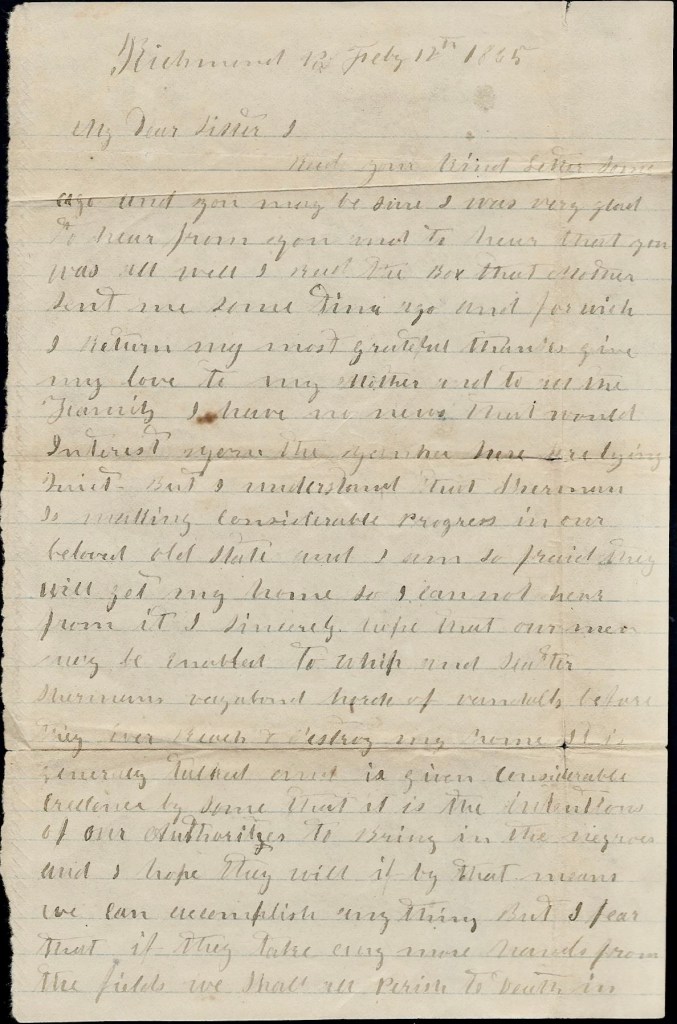
Richmond, Virginia February 12th 1865
My dear sister,
Received your kind letter some [days] ago and you may be sure I was very glad to hear from you and to hear that you was all well. I received the box that mother sent me some time ago and for which I return my most grateful thanks. Give my love to my mother and to all of the family.
I have no news that would interest you. The Yankees here are lying quiet, but I understand that Sherman is making considerable progress in our beloved old state and I am so afraid they will get my home so l cannot hear from it. I sincerely hope that our men can be enabled to whip and [ ] Sherman’s vagabond horde of vandals before they ever reach and destroy my home.
It is generally talked and is given considerable credence by some that it is the intentions of our authorities to bring in the negroes and I hope they will if by that means we can accomplish anything. But I fear that if they take any more hands from the fields we shall all perish to death in a heap together for I have not drawn but one quarter of a pound of meat in the last six days and the commissary says he does not know when we will get any more. If we cannot get enough to eat now, what will we do if they bring in the negroes? At that rate, it will all be the consumers & no producers. And again, if we do not bring the negroes in, the Yankees will overrun our country and destroy everything so that we would be forced to surrender.
I will let this dark matter rest and bring my short letter to a close by saying write soon while you have the chance to your affectionate brother, — Henry Gray
(P. S.) Frank Joiner is a going to have a box sent him from home and can you send me anything you wish by or in his box. I would be glad for you to send me a chicken or two anyhow. Nothing more. Write soon. — H. G.
The following letter was written by Washington Pinckney Shooter (1837-1864) of Marion county, South Carolina. “W. P.” commenced service in Marion District, August 1, 1861, as a 27 year old Lieutenant, in Co. K, “Meagher Guards” of Charleston, South Carolina 1st Infantry Volunteers. Later he was reorganized into Co. E, South Carolina 1st Infantry Regiment (McCreary’s), as Company Commander, Captain. He was present for all the major battlesof the regiment except Sharpsburg.
On January 4, 1864, he was promoted to Lieutenant Colonel, Regimental Commanding Officer but was killed in action at The Bloody Angle, Battle of Spotsylvania Court House, waving his sword while leading a counterattack. When some of his Regiment stopped to assist him, he told them to go forward and leave him, saying “I know that I am a dead man; but I die with my eyes fixed on victory!”
In this letter, W. P. wrote a letter to the father of one of the members of his company, 18 year-old Charles Reaves, who was killed in the charge of Perrin’s South Carolina Brigade on the 1st Corps’ last position on Seminary Ridge in front of the Lutheran Theological Seminary. W. P. gives all the particulars of Charles’ death as well as his burial location.
[Note: This letter is from the personal collection of Richard Weiner and was transcribed and published on Spared & Shared by express consent. The painting appearing in the banner of this post is Dale Gallon’s artwork entitled “Day’s End—July 1st”]
Transcription
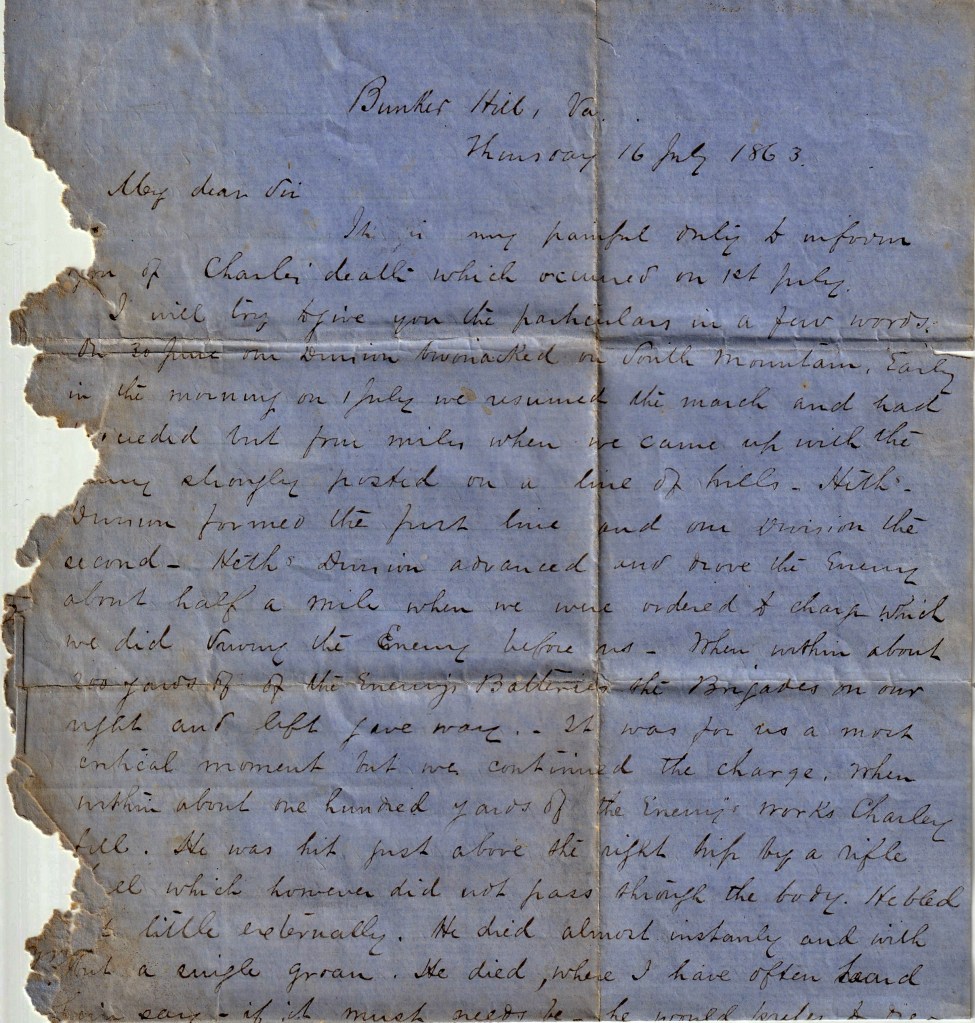
Bunker Hill, Virginia Thursday, 16 July 1863
My dear sir,
It is my painful duty to inform you of Charles’ death which occurred on 1st July. I will try to give you the particulars in a few words. On 30 June, our Division bivouacked on South Mountain. Early in the morning on 1 July, we resumed the march and had proceeded but four miles when we came up with the enemy strongly posted on line of hills. Heth’s Division formed the first line and our Division the second. Heth’s Division advanced and drove the enemy about half a mile when we were ordered to charge which we did, driving the enemy before us. When within about 200 yards of the enemy’s batteries, the brigades on our right and left gave way. It was for us a most critical moment but we continued the charge. When within about one hundred yards of the enemy’s works, Charley fell. He was hit just above the right hip by a rifle ball which, however, did not pass through the body. He bled but little externally. He died almost instantly and with but a single groan. He died where I have often heard him say—if it must needs be, he would write to me—on the field in a victorious charge. The last sound that ever fell upon his ears was the shout of victory of his comrades.
On the second (2nd) July, our Brigade was again engaged and we did not have an opportunity to bury him. On [the] 3rd, we found he had been buried by [the] Pioneer Corps. To be sure that it was his body, Lt. Z[ach B.] Smith & [Corp. William J.] Woodward dug down to the body and found it was his. He was buried where he fell, near the corner of a field and a park of [the] Gettysburg Female College. 1 His pocket book, &c. are in the possession of Lieut. Z. Smith who was badly wounded three days ago at Hagerstown and has been sent to the rear. 2
It is needless for me to try to express in words my grief at Charley’s death. It is equally needless for me to dwell upon his virtues or to praise him. I never saw a young man whom I more admired who was more worthy of admiration. A boy in years but in all else a man—a pure, noble, simple-hearted gentleman. In the graceful courtesies, tender humanities, and kindly charities of life, I never saw his superior. He did not talk but he lived [a] christian. He was beloved by everybody who knew him and was known by every officer and almost every man in the regiment. As a soldier, he had no superior. At all time and under all circumstances, he was ready to do his duty—always at his post and always cheerful and apparently happy and as brave as the bravest. We shall never cease to deplore his loss or fail to honor his memory. He had the mind and qualities to make a great and good man but his early promise has found a bloody grave. I beg you to remember in your sorrow that he died while fighting the battles of his country—and that for his youth, he never did a mean or dishonorable thing. I know the great loss you have sustained most heavily & I sympathize with you and yours. May God temper the afflictions of his family with recollections of his virtue and worth.
I am, my dear sir, most truly yours, — W. P. Shooter
P. S. I would have written much sooner but have been continuously on outpost duty since 1st July. This morning, I am so ill and feeble that I can scarcely stand up. The army got here last night—will resume the march, I expect, tomorrow. We have experienced a serious disaster but not a fatal one. The next victory will be ours.
1 Given A.P.’s description of the charge and when Charles was wounded, I have to believe that he meant the Lutheran Theological Seminary and not the “Gettysburg Female College.” There was a Young Ladies Seminary that operated in Gettysburg at the time of the battle, but it was located on the corner of High and Washington Streets.
2 Lt. Z. B. Smith of Co. E died of his wounds on 1 September 1863.
The following letters were written from Charles W. Reaves (1845-1863), the son of Robert Hodge Reaves (1813-1875) and Anna Louisa Grice (1825-1901) of Marion county, South Carolina. He wrote the letters to his younger brother, Robert Hodges Reaves (1846-1865) who later enlisted (March 1864) in Co. H, 21st South Carolina Infantry and was killed in action on 18 June 1864.
In August 1861, Charles enlisted in Co. E, 1st South Carolina Infantry (McCreary’s). Marion District. He was promoted to 4th Corporal between August 19, and December 31, 1861. The regiment completed its organization at Richmond, Virginia, in August, 1861. Most of the officers and men had served previously in the 1st South Carolina Volunteers, a six-month command, which was mustered out of service in late July. The men were from Charleston and Columbia, and the counties of Darlington, Marion, Horry, Edgefield (now Aiken), and Florence. Charles’ service record indicate he was with the regiment until the Battle of Gettysburg when he was killed in the first days action on Seminary Ridge. Charles made the charge in late afternoon with his regiment—and the rest of Abner Perrin’s South Carolina Brigade—on Union Cavalry Col. William Gamble’s cavalrymen who carried Sharps repeating rifles, making things hot for the foot soldiers in grey. Though Charles would not see the result, Perrin’s Brigade broke the 1st Corps Union line, regrouped, and then chased the Union soldiers into the streets of Gettysburg. The 1st South Carolina claimed to have been the first regiment to plant the Confederate flag on the town square.
[Note: These letters are from the private collection of Richard Weiner and were transcribed and published on Spared & Shared by express consent.]
Letter 1
Camp Jager Suffolk, Virginia October 12, 1861
Dear Brother,
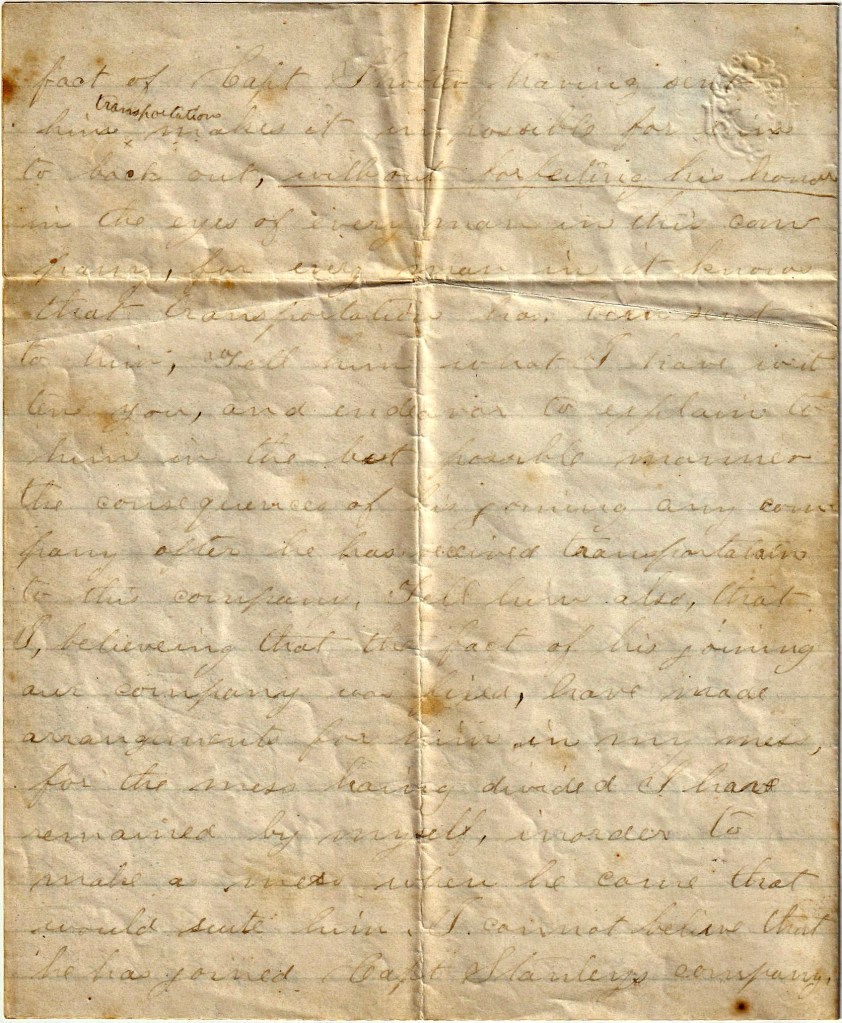
I received yours of the 5th with much pleasure for I had concluded that you had given out writing to me. I received a letter from Sarah yesterday by which I learned that Cousin Joe had joined Capt. Stanley’s company, but I think that surely it must be a mistake for he has irrevocably committed himself to our company, for he even went so far as to send for transportation which Capt. [Washington P.] Shooter sent him. He may have joined Stanley’s company before he received an answer from me after he had applied for transportation, in which case he will have to explain to Capt. Stanley for the fact of Capt. Shooter having sent him transportation makes it impossible for him to back out, without forfeiting his bonds in the eyes of every man in this company for every man in it knows that transportation has been sent to him. Tell him what I have written you, and endeavor to explain to him in the best possible manner the consequences of his joining any company after he has received transportation to this company. Tell him also that I, believing that the fact of his joining our company was fixed, have made arrangements for him in my mess, for the mess being divided I have remained by myself in order to make a mess when he came that would suite him. I cannot believe that he has joined Capt. Stanley’s company, but if he has under the circumstances, it can he settled by his telling Capt. Stanley that after joining his company, he received transportation to Capt. Shooter’s company and therefore he is hound more closely to Shorter than he is to him.
You say you heard that we had been given flintlock muskets. In part that is true, for we have borrowed about fifty flintlocks from the state of Virginia, but these muskets are not for our arms. We only borrowed them to drill with until we could get the rifles which the Secretary of War himself promised to Capt. Shooter in person. As long as we are here where we are in no danger flintlocks are as good as any to drill with. But you need give yourself no uneasiness about our being armed with them, for the men would not have them, and if they would, Capt. Shooter would not lead them into action with them. But there is no danger of our getting into action before next spring for there is no probability of our moving away from here before that time. There are several of our men sick with the measles, and two men from the Horry [Rebels] company [Co. F] died a few days ago. These are the deaths we have had among the soldiers of our regiment. Our regiment has been increased to eleven companies by arrival of the Carolina light infantry [Co. L] from Charleston. It has been a fine company and contains eighty-six members.
Our band also arrived a few days ago which is quite an addition for we now have good music. Your affectionate brother, — Charles
I could write more, but my paper will not allow it, so I must close. You must answer this immediately. Give my love to Grandma.
Letter 2
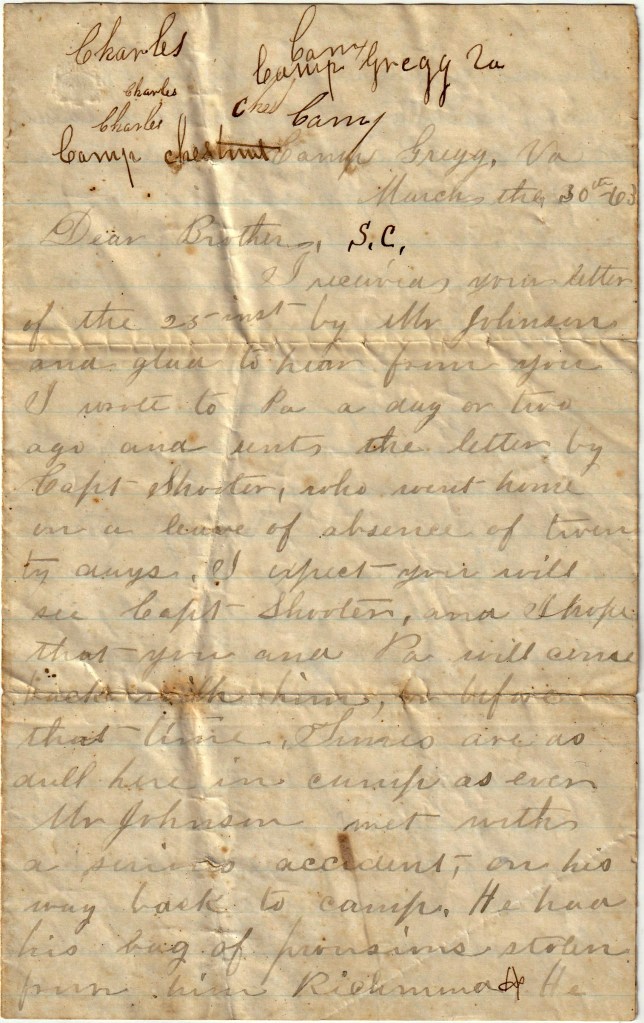
Camp Gregg, Virginia March 30, 1863
Dear Brother,
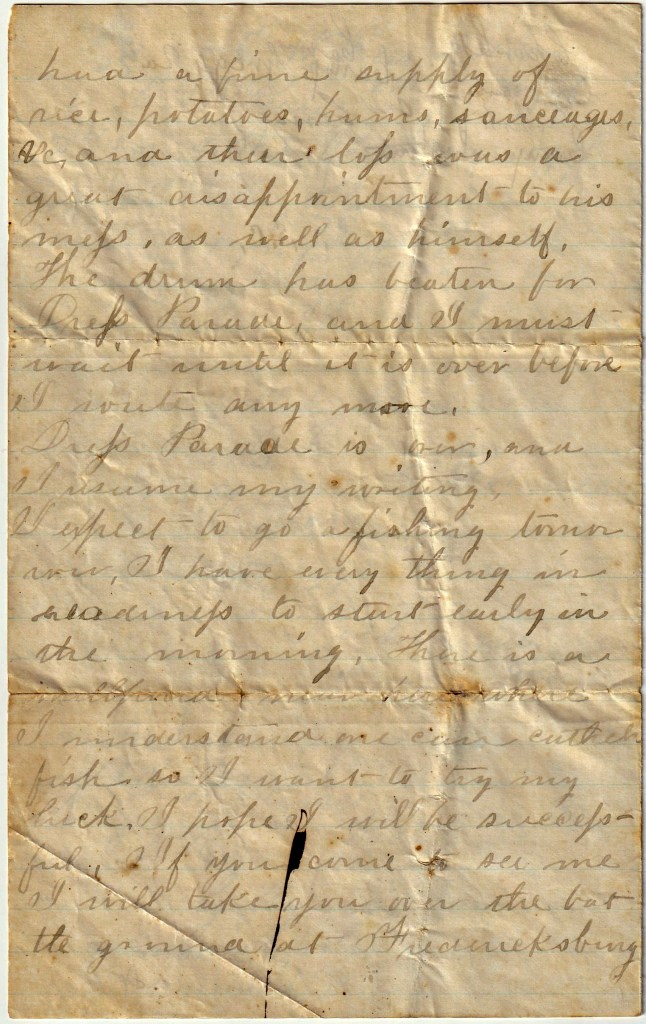
I received your letter of the 25 inst. by Mr. Johnson and glad to hear from you. I wrote to Pa a day or two ago and sent the letter by Capt. Shorter who went home on a leave of absence of twenty days. I expect you will see Capt. Shorter and I hope that you and Pa will come back with him, or before that time. Times are as dull here in camp as ever. Mr. Johnson met with a serious accident on his way back to camp. He had his bag of provisions stolen from him at Richmond. He had a fine supply of rice, potatoes, hams, sausages, team and their loss was a great disappointment to his mess, as well as himself. The drum has beaten for dress parade and I must wait until it is over before I write any more.
Dress parade is over, and I resume my writing.
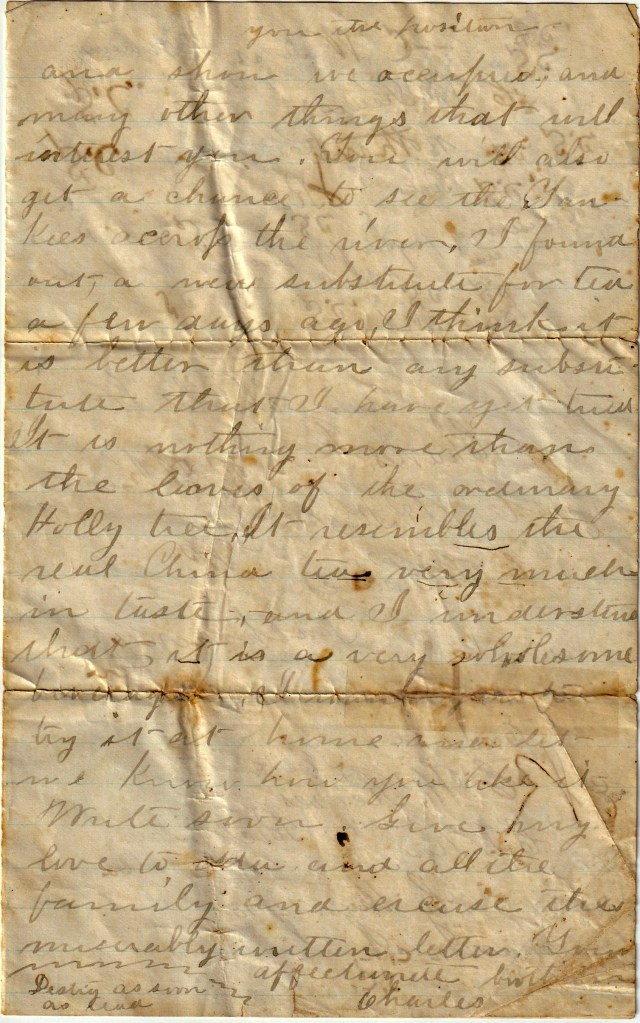
I expect to go fishing tomorrow. I have everything in readiness to start early in the morning. There is a millpond near here where I understand one can catch fish so I want to try my luck. I hope I will be successful. If you come to see me, I will take you over the battleground at Fredericksburg and show you the position we occupied, and many other things that will interest you. You will also get a chance to see the Yankees across the river. I found out a new substitute for tea a few days ago. I think it is better than any substitute that I have yet tried. It is nothing more than the leaves of the ordinary holly tree. It resembles the real China tea very much in taste, and I understand that it is a very wholesome beverage. I encourage you to try it at home and let me know how you like it. Write soon. Give my love to Ma and all the family and excuse the miserably written letter.
The following brief letter was written by Col. A. G. Rice of South Carolina who served as one of several aide-de-camps on the personal staff of General P. G. T. Beauregard. At the time of this letter, Beauregard was in command of the Dept. of South Carolina and Georgia which was created in 1861 to guard the coastal areas in those states as well as Florida. Most of the 23,000 men in this department were deployed in defending Charleston and Savannah.
The letter was addressed to Francis Wilkinson Pickens (1805-1869) who was the Governor of South Carolina and running for reelection but would be defeated by Gen. Milledge Luke Bonham on 17 December 1862.
The letter pertains to John Dunovant, Colonel of the 1st South Carolina, who was accused of drunkenness while on duty in late 1862. It led to a trial but the charges were eventually dismissed when it was concluded that the allegations had been exaggerated. President Davis reinstated Dunovant in July 1863 and he was made Colonel of the 5th South Carolina Cavalry at that time. He commanded the cavalry brigade during the Overland Campaign and and the early part of the Siege of Petersburg but was killed at the Battle of Vaughan Road on 1 October 1864.
Transcription
Headquarters Dept. of South Carolina & Georgia Charleston, [South Carolina] December 13, 1862
My dear Governor,
John Dunovant is anxious to get a letter from you to the Secretary of War. If you have no objection, I will be glad if you will forward his wishes. He begs me to say that Dr. Furman of the Senate will give you any information in reference to his affairs.
The impression in Charleston is that you have the track. May God speed. You have few more ardent followers in this contest that General Beauregard though he is extremely apprehensive of his military influence.
I could not find an image of J. L. Elliott but here is one of Willis Calloway Watkins of Co. D, 4th South Carolina (Photo Sleuth)
These five letters were written by John Lewis Elliott (1831-1863), the son of Lewis M. Elliott (1802-1881) and Winniford Weston Edgar (1805-1898). John was married to Ann Neal Caminade in 1853 and had five children by the time he enlisted to serve in Co. B, 1st South Carolina Palmetto Sharpshooters. He was wounded at the Battle of Wauhatchie on 29 October 1863, a relatively small affair which turned out to be the last best chance for the Confederates to prevent the Yankees from reinforcing Chattanooga. Elliott died of his wounds on 28 November 1863 at Oliver Hospital in LaGrange, Georgia. His remains now lie buried in the “Stonewall Confederate Cemetery” in LaGrange. In the 1860 US Census, John was enumerated in Shallowford, Anderson county, South Carolina.
Serving with him in the same battalion was his younger brother, Edward “Hardy” Elliott (1837-1864), mentioned throughout the letters. Hardy was killed at Spotsylvania, Virginia, on 11 May 1864.
Letter 1
Camp near Richmond July 11th 1862
Dear Wife,
I seat myself this morning to drop you a few lines to let you know that I have got well and I hope that this may come to hand in due time and find you and the children all well. I got your letter yesterday that you wrote the 3rd and I was glad to hear that you was all well but Tete. I was sorry to hear that she had the bowel complaint but I hope you are all well now.
I got a letter from Papa that was wrote the 4th and he said that Jane had got poisoned or something. I hope she is well and I hope and pray that you may all keep well until I get home, and then on.
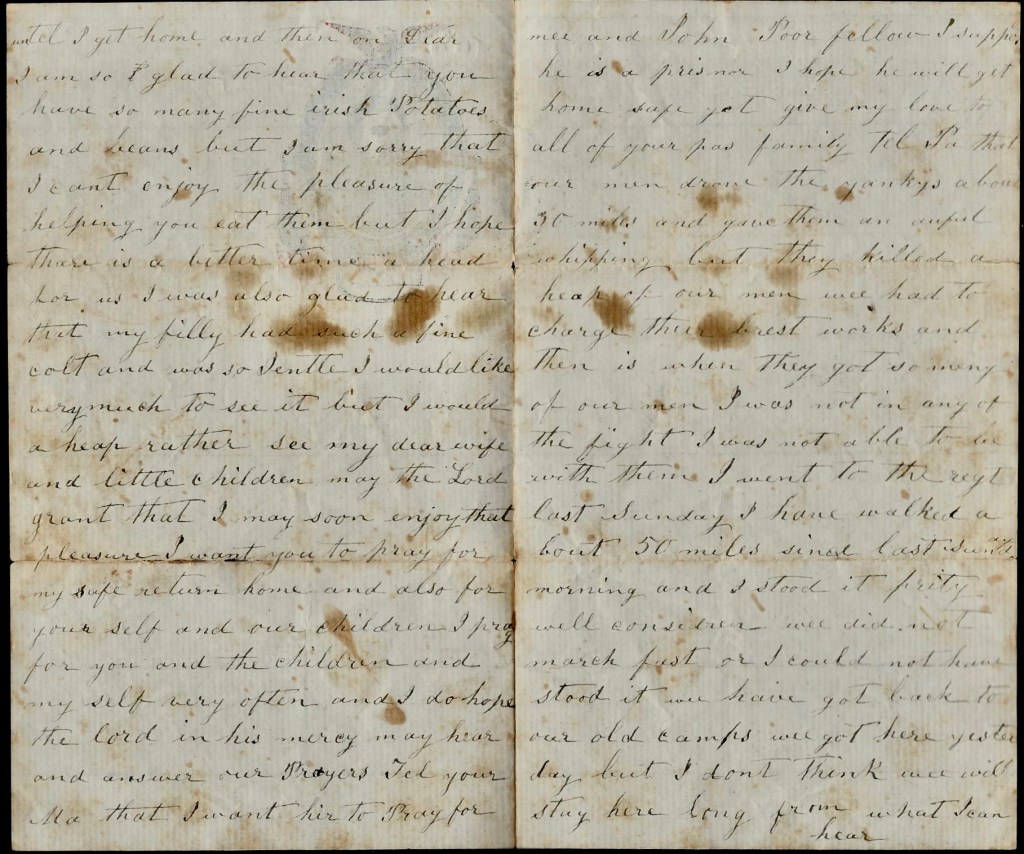
Dear, I am so glad to hear that you have so many fine Irish potatoes and beans, but I am sorry that I can’t enjoy the pleasure of helping you eat them. But I hope there is a better time ahead for us. I was also glad to hear that my filly had such a fine colt and was so gentle. I would like very much to see it but I would a heap rather see my dear wife and little children. May the Lord grant that I may soon enjoy that pleasure. I want you to pray for my safe return and also for yourself and our children and myself very often and I do hope the Lord in His mercy may hear and answer our prayers.
Tell your Ma that I want her to pray for me and John. Poor fellow—I suppose he is a prisoner. I hope he will get home safe yet. Give my love to all of your Pa’s family. Tell Pa that our men drove the Yankees about 30 miles and gave them an awful whipping but they killed a heap of our men. We had to charge their breastworks and then is when they got so many of our men. I was not in any of the fight. I was not able to be with them. I went to the regiment last Sunday. I have walked about 50 miles since last Sunday morning and I stood it pretty well considering we did not march fast or I could not have stood it. We have got back to our old camps. We got here yesterday but I don’t think we will stay here long from what I can hear.
Dear wife, I forgot to say that I was so glad to hear that our corn and watermelons look so well.
My dear, I do hope England and France will recognize us and stop the war shortly and let us poor fellows come home shortly to our families.
Dear wife, I will now close for this time with my best love and prayers for you and my little children. So farewell for this time. — J. L. Elliott to his wife, A. N. E.
P.S. Hardy is not well but I hope he will soon get well. He sends his best respects to you and the children. Derrick is not very well. He sends his love to you all.
Letter 2
Camp near Richmond, Va. July 4th 1863
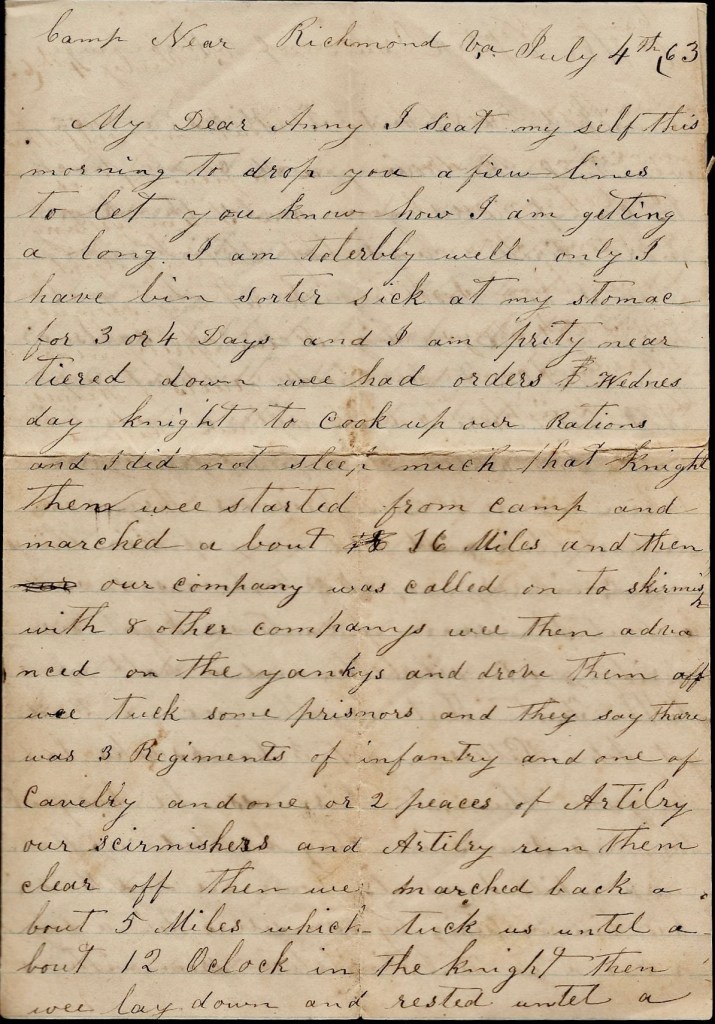
My Dear Anny,
I seat myself this morning to drop you a few lines to let you know how I am getting along. I am tolerably well—only I have been sorter sick at my stomach for 3 or 4 days and I am pretty near tired down. We had orders Wednesday night to cook up our rations and I did not sleep much that night. Then we started from camp and marched about 16 miles and then our company was called on to skirmish with 8 other companies. We then advanced on the Yankees and drove them off. We took some prisoners and they say there was three regiments of infantry and one of cavalry and one or two of artillery. Our skirmishers and artillery run them clear off. Then we marched back about 5 miles which took us until about 12 o’clock in the night. Then we lay down and rested until a little after sun up. Then we marched about 5 miles and then we took the train and come back to camp and you would think we were tired and not think far wrong.
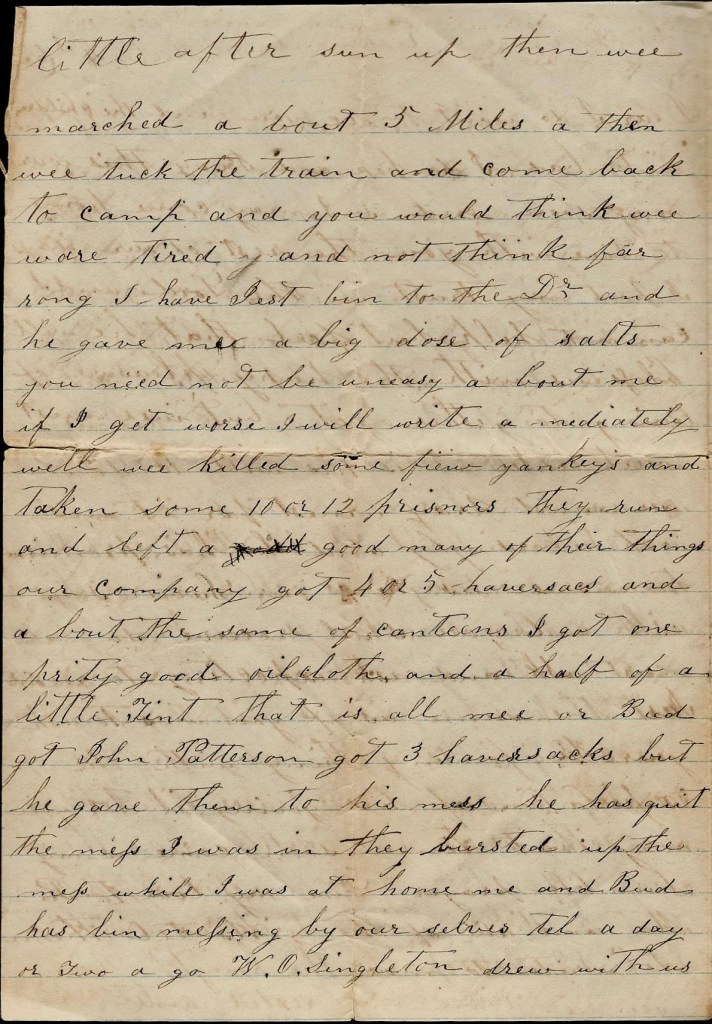
I have just been to the doctor and he gave me a big dose of salts. You need not be uneasy about me. If I get worse, I will write immediately.
Well we killed some few Yankees and taken some 10 or 12 prisoners. They run and left a good many of their things. Our cavalry got 4 or 5 haversacks and about the same of canteens. I got one pretty good oil cloth and a half of a little tent. That is all me or Bud got. John Patterson got three haversacks but he gave them to his mess. He has quit the mess I was in. They bursted up the mess while I was at home. Me and Bud has been messing by ourselves till a day or two ago. W. O. Singleton drew with us.
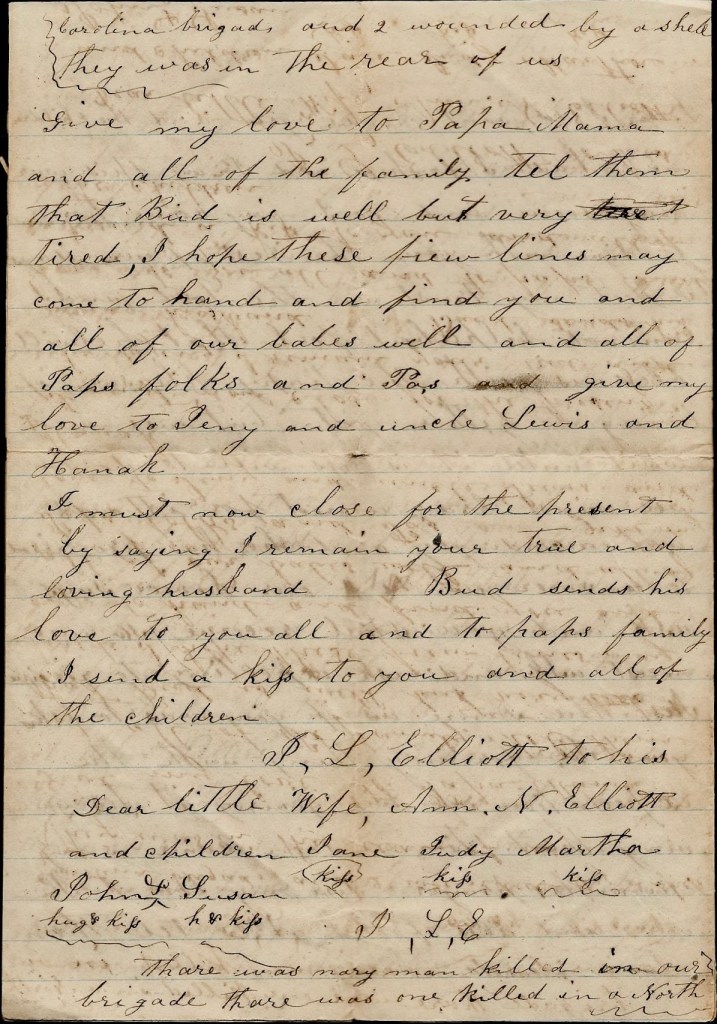
Dear, I do want to see you and the children mighty bad. I do hope and pray this war may soon end so I may come home to live with you the rest of our days. I put my trust in the Lord and I cannot help but feel that He will bless us with the happy pleasure of living together yet. But we must wait until it is His will to do so. We must pray earnest for it and act accordingly and He has promised to answer us. Our Savior says ask, and ask expecting to receive just the same as if you was to ask your Pa for anything with the expectation of his giving it to you. May that time soon come is my humble prayer. Give my love to Pa, Ma, and all of the girls. Tell them to write to me. Give my love to Papa, Mama, and all of the family. Tell them that Bud is well but very tired. I hope these few lines may come to hand and find you and all of our babes well and all of Pap’s folks and Pa’s. Give my love to Jenny and Uncle Lewis and Hannah.
I must now close for the present saying I remain your true and loving husband. Bud sends his love to you all and to Pap’s family. I send a kiss to you and all of the children.
— J. J. Elliott to his dear little wife, Ann N. Elliott and children, Jane, Judy, Martha, John & Susan.
There was nary man killed in our brigade. There was one killed in a North Carolina Brigade and two wounded by a shell. They was in the rear of us.
Letter 3
Camp near Lookout Mountain October 2d 1863
My Dear,
It is with pleasure I seat myself to drop you a few lines to let you know how I am getting along. I am well at this time and I hope these few lines may reach and find you and all the children enjoying the same good blessing. I have nothing new to write to you at this time—only I received a letter from you a few days ago and was very glad to hear you was all well and I was glad also to hear everything was getting along as well as it was. You said something about putting your hogs up early to fatten and you wanted to know what I thought about it. I think it the best to put them up as soon as you possibly can so as to kill about two weeks before Christmas, I am glad to hear Jenny and Hannah has got fodder enough pulled to do them. Tell them I want them to pick just as many peas as they possibly can. Tell them I have not forgot them. Give my love especially to Jenny and tell Lewis there is something else I must tell you. About a few days ago, we got out of bread and had to do without from one morning until the next day dinner and I got so hungry against it come to us I eat such a batch of the coarsest cornbread you ever saw and bacon that it made me right sick for awhile. But I have got over that. We eat our coarse cornbread, husk and all.
They say furloughing is stopped so I am afraid I will not get home soon unless Bud gets me a recruit. Give Bud my best respects. You said you wanted to know whether you ought to go to Papa’s or not without they asked you. My advise is not to go. If they are so mad, they will not ask you. I would not go where I was not wanted.
Our company went out on picket night before last and it rained on us all the time we was out. We was relieved yesterday evening and got a house to stay in for the night and it rained nearly all night. But his is a very pretty day. It has been very dry out here and dusty. I received a letter from Ma a day or two ago which gave me great pleasure. She says for me to write back forthwith but you must tell here to excuse me for I have no paper with me. I got this from E. H. I have not saw my knapsack since we left the railroad. E. H. sends his love to you and children. Give mine and Hardy’s love to Papa, Mama, and all of the family. Tell them Hardy is well. I will now close by giving my best love to you and the children. Give my love to all Pa’s family. — J. L. Elliott
Letter 4
Chattanooga, Tennessee October 20, 1863
My Dear,
I seat myself this morning to drop you a few lines in answer to one I received yesterday from you dated the 11th which gave me great pleasure to hear from you and hear you was all well. I hope you may all remain so. This leaves me well. all to the bellyache. I have got over my head and backache but I have got the bellyache. I reckon it is from eating too much fresh meat. The boys brought a fine chance with them the other day off of the mountain.
I have no news of interest to write to you as everything is quiet here. There is no advance being made on either side. I showed your letter to the captain and he says there is no chance for me to get a furlough. He is perfectly willing to give me a furlough but it is not in his power to do so. The captain says for me to tell you he would do anything in his power for us but it is impossible for him to do anything now. But he says there may be a chance this winter but he says if you could get anyone to come as a recruit for me, I could then get a furlough for forty days. He asked me if I knew anyone that I thought I could get. I told him about Robert Scruggs, if his mother would let him come, but I told him what you said about his Mother. I told him she would not let him come for the war to save all our lives. The captain asked me his age and I told him he was about sixteen and he says if she knew what was best, she would let him come for he says they will take him anyhow before long and and then they would send him just anywhere they pleased so she had better let him come here where he has some friends. So I will ensure her that if she will let him come here as a recruit for me, I will be a friend to him as long as we both live. So you can see Mrs, Scruggs and state the case to her and see what she says and let me know in your next letter. Tell Mrs. Scruggs that I do not wish her son to be obliged to go to the army but it is just as the captain says, he will be certain to have to go before long and it would be better for him to be where all South Carolinians are. Our whole brigade are South Carolinians. But just let her do as she pleases, but when she lets him be taken and they carry him to the coasts and takes sick and dies with disease, then she will wish she had let him come here in a healthy country. And if we leave here, we will be apt to go to Virginia where it’s healthy. We will be apt to be in a mountain country all of the time.
You said you wanted to know if I wanted the woolen shirts made. I don’t care anything much about them so you can make the cloth up for the children. I need some cotton shirts but you need not make any. I aim for the government to find me in clothes as you have so much hard work in getting your cloth wove. I like the color of your dresses very much. I want you to send me my overcoat by Bud when he comes and one pair of socks. Pa sent me two plugs of tobacco. Tell him I am glad he has not forgot me if he don’t write to me, and tell him I do thank him for them and tell him to write to me for I want to hear from him and tell him I want to know if he thinks this war will end any time soon. The most of the people out here think it will end this winter but I don’t know what is their reasons for thinking so without it is foreign intervention. I do hope and pray that it may end soon and that I may get home.
Tell Susan that John is well. He send his love to you all. Give my love to Papa’s family and also to Pa’s. I reckon you and Hardy and Papa has got the letters I sent you by A. J. Litton and I am in hopes Bud will be here soon to take my place for wahile. We will be apt to be through this fight before he gets here. I would like for him to be here now if I knew he would not get hurt. But if he was here, he should not take my place till this fight is over. I send a special kiss to you and also one to the children, — J. L. Elliott
to A. N. Elliott
Letter 5
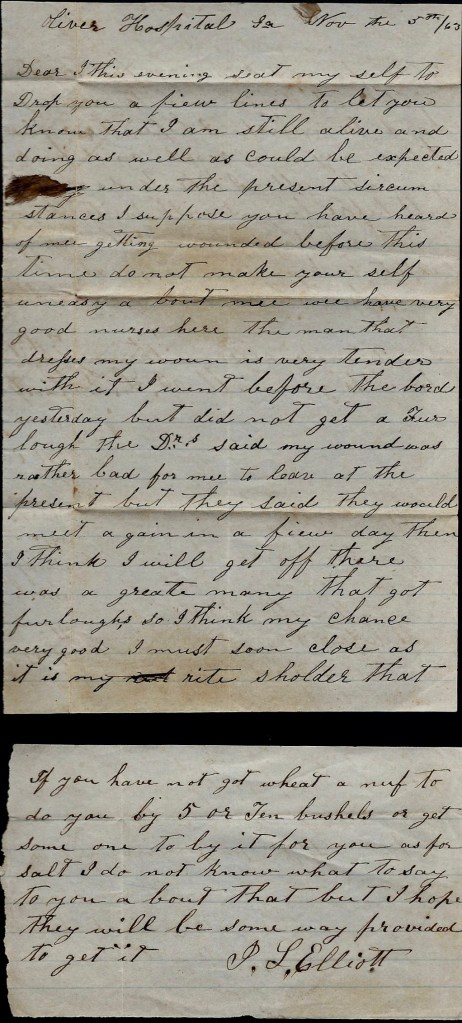
Oliver Hospital, Ga. November 5th 1863
Dear,
I this evening seat myself to drop you a few lines to let you know that I am still alive and doing as well as could be expected under the present circumstances. I suppose you have heard of me getting wounded before this time. Do not make yourself uneasy about me. We have very good nurses here. The man that dresses my wound is very tender with it. I went before the board yesterday but did not get a furlough. The doctors said my wound was rather bad for me to leave at the present but they saud they would meet again in a few days, then I think I will get off. There was a great many that got furloughs so I think my chance very good.
I must soon close as it is my right shoulder that is hurt and I am afraid it will not do for me to use my hand too much. I hope these few lines may soon reach and find you all well. I hope to see you all before long. I will write to you in three or four days again. I do not expect to hear from you at all unless E[dward] H[ardy Elliott] remails your letters.
I will now close with my best love to you all. — J. L. Elliott
If you have not got wheat enough to do you, buy 5 or ten bushels or get someone to but it for you. As for salt, I do not know what to say to you about that but I hope they will be some way provided to get it. — J. L. Elliott
This letter was written by John Calhoun Clemson (1841-1871), the son of Thomas Green Clemson (1807-1888) and Anna Maria Calhoun (1817-1875. John’s father was born in Philadelphia and educated at the Alden Partridge’s Military Academy in Vermont. He afterward studied agriculture in France and upon his return, he promoted agricultural education and engaged in farming in South Carolina. During the Civil War, he supported the Confederacy and even served in the Nitre & Mining Bureau of the CSA in the last couple years of the war. After the war, he donated land and money to the establishment of an agricultural college which evolved into Clemson University. John’s mother, Anna Maria, was the only daughter of South Carolina US Senator, John C. Calhoun.
John Calhoun Clemson
20 year-old John C. Clemson entered the state service in 1861 as a private in Capt. James M. Perrin’s Company, 1st Orr Rifles. In October he was detached to the staff of Roswell S. Ripley of the South Carolina militia who had previously commanded the garrison at Fort Moultrie during the Fort Sumter bombardment. In August 1861 Ripley was appointed a brigadier general and assigned command of the Dept. of South Carolina and its coastal defenses. From this December 1861 letter we learn that John Clemson had already been commissioned a Lieutenant in the state service and contemplated taking a commission in the Confederate army. Sometime in 1862 he appears to have taken a post with the Nitre & Mining Bureau of the War Department. He was taken prisoner in September 1863 at Bolivar, Mississippi, and was not released from the prison at Johnson’s Island until June 1865. When he was released from prison he was described as having dark hair, grey eyes, and standing 6 foot 4 inches tall—he could have looked Abraham Lincoln straight in the eye.
John C. Clemson survived the Civil War (including over two years in a Union prison) but he did not survive a train accident that took place when a passenger train collided with a lumber train on 10 August 1871 at Hunnicott Crossing where the Blue Ridge Railroad crossed the G&C Railroad in Oconee County.
John wrote the letter to an unnamed uncle but my hunch is that it was Col. Andrew Pickens Calhoun (1811-1865). All of John’s paternal uncles were living in Philadelphia at the time, and Andrew was the only maternal uncle still living in 1861. Besides, Andrew held a plantation in South Carolina (“Fort Hill”) and was attempting to operate a cotton plantation in Marengo county, Alabama, where he may have been attempting to introduce “sea island” cotton.
Transcription
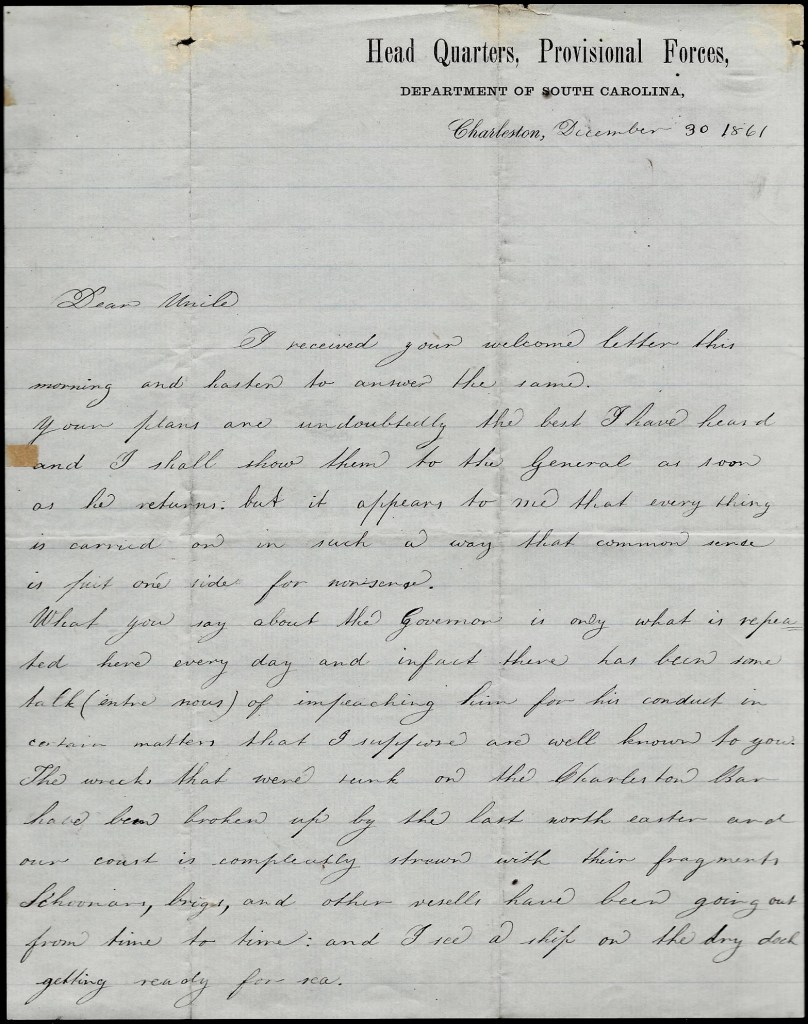
Headquarters Provisional Forces Department of South Carolina Charleston December 30, 1861
Dear Uncle,
I received your welcome letter this morning and hasten to answer the same. Your plans are undoubtedly the best I have heard and I shall show them to the General as soon as he returns. But it appears to me that everything is carried on in such a way that common sense is just one side of nonsense.
What you say about the Governor is only what is repeated here every day and in fact, there has been some talk (entre nous) 1 of impeaching him for his conduct in certain matters that I suppose are well known to you. 2 The wrecks that were sunk on the Charleston Bar have been broken up by the last north easter and our coast is completely strewn with their fragments. Schooners, brigs, and other vessels have been going out from time to time and I see a ship in the dry dock getting ready for sea. Some vessels have carried out cotton, and rice is the usual freight. I do not approve of our produce going out at all for the sooner we starve them out, the better.
Since I wrote you, I have received an appointment in the state service as Second Lieutenant and I have been nominated for a Second Lieutenant’s commission by the Secretary of War in the Confederate army. I wish I had time to run up and pay you a visit for a few days but I am so busy that I have not the face to ask the General for a leave of absence.
You do not tell me how you are, or how you are getting on. In your next, you must let me know if the sea plants are growing and the other plants. How are the negroes with you? They are very troublesome in these parts and the trouble is not confining itself to the coast but is spreading very rapidly. Many have run away as far as thirty miles from the enemy.
Give my love to all enquiring friends. Your affectionate nephew, — J. C. Clemson
1 “Entre nous” is French for “In Confidence” as you might have suspected.
2 The Governor of South Carolina was Francis Wilkinson Pickens (1807-1869. He held the office from 14 December 1860 until 17 December 1862.I am unaware of any attempt by the State of South Carolina to introduce impeachment proceedings against Gov. Pickens.
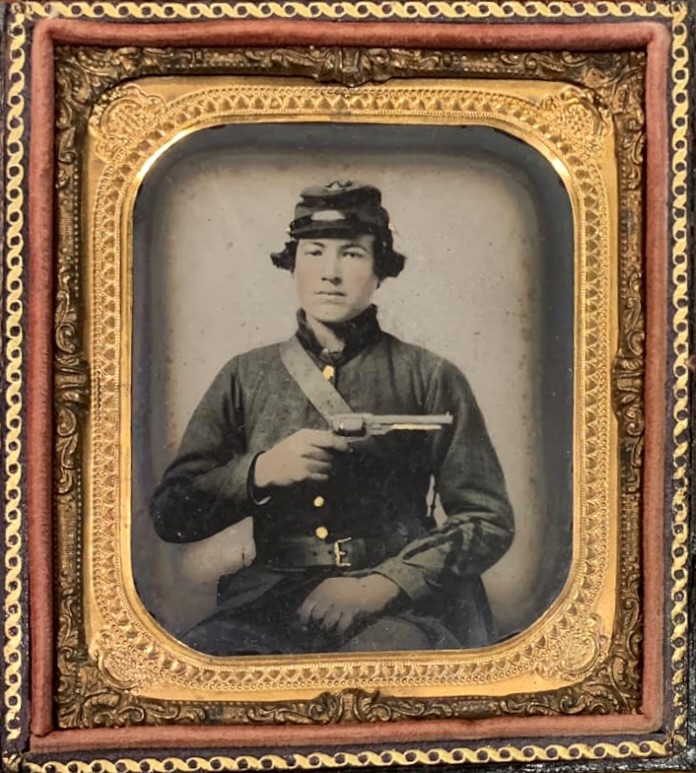
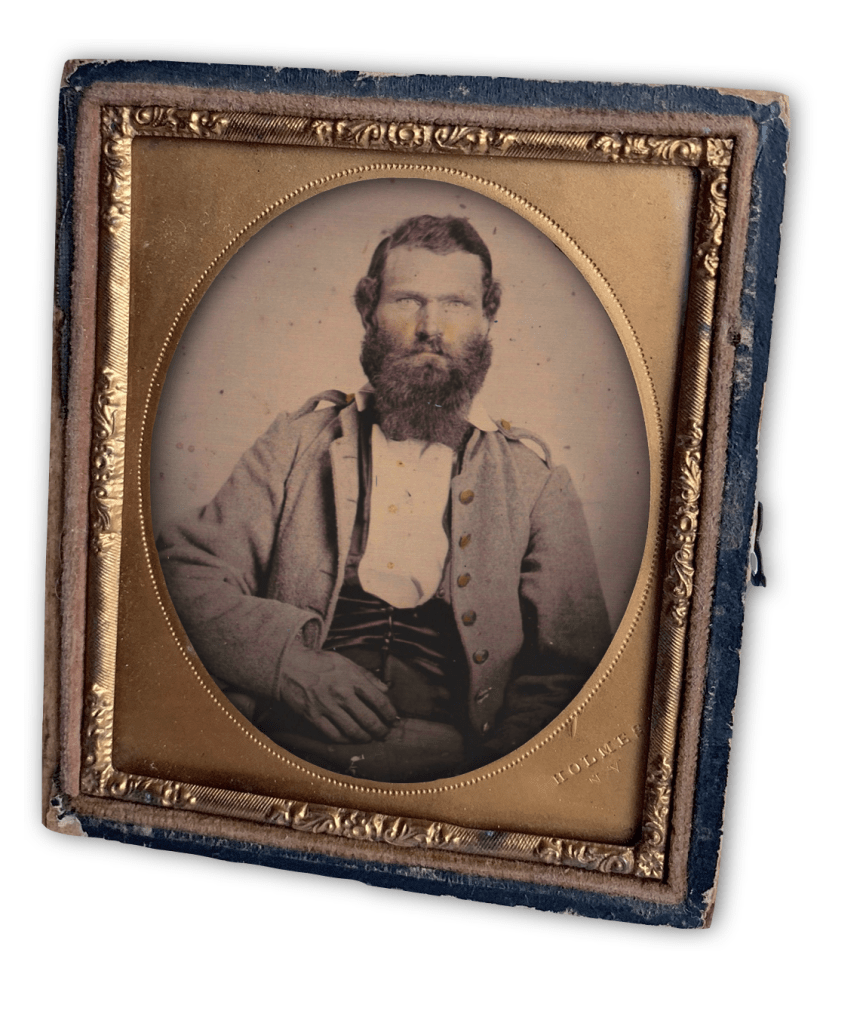
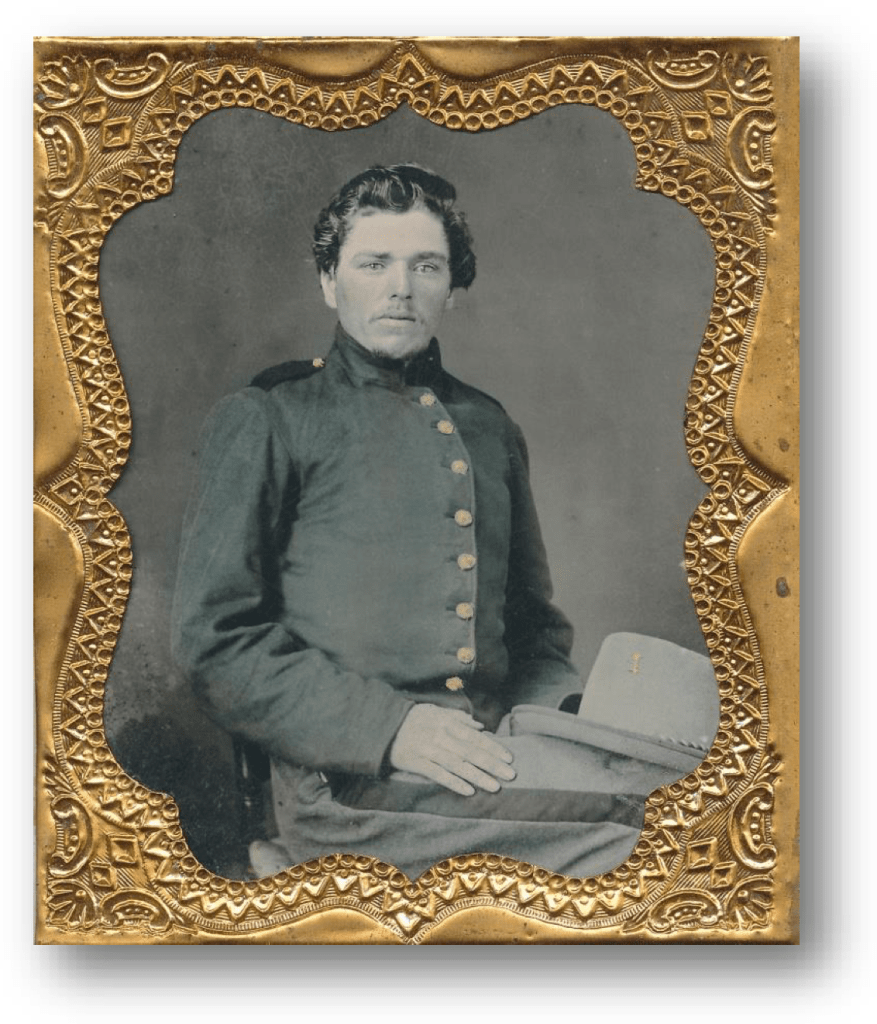
A Sixth-plate ambrotype of an unidentified member of Orr’s Rifles of South Carolina. He’s wearing the blue jacket with dark green shoulder straps and trim. By the time these letters were written in early 1862, a gray jacket had been substituted for the blue ones. He has a small brass palmetto tree pinned to the side of his hat.
These three letters were written by Joseph Richard (“Dick”) Sadler (1835-1864), the son of David Sadler (1812-1885) and Jane McLees (1813-1898). Joseph was 26 when he enlisted on 20 July 1861 at Camp Pickens as a corporal in Company D, 1st (Orr’s) South Carolina Rifles. He was elected Junior 2nd Lieutenant on 4 April 1863. During the Battle of the Wilderness, 5 May 1864 he was wounded. He was sent to the hospital in Staunton, Virginia, where he died on 7 October 1864 from his wounds. Joseph’s younger brother, John A. Sadler (1842-1862), also served the Confederacy. He died at a hospital in Richmond of typhoid fever on 4 October 1862. In two of his letters, Joseph mentions the purchase of a hat that he had trimmed as a gift for his younger sister Carline (“Carrie”) G. Sadler (1849-1871).
All three of these letters were written during a six week period early in the war and before Orr’s Rifles had seen “the elephant.” They suffered their first casualty at the Battle of Mechanicsville on 26 June 1862, and then were pounded at Gaines’ Mill the following day when they lost 81 killed and 234 wounded of the 537 men that took the field.
Letter 1
Sullivan’s Island April 14th, 1862
Dear Jule,
I was somewhat disappointed today by not getting a letter from home to let me know whether Jno. was coming or not and when he would be here. In short, I wanted to know all about it.
I heard Saturday that Jim Gray was going to start home yesterday. Well I wrote him Sunday that I would try to meet him in the city last night but yesterday morning I got the chance of going to spend the day and I went expecting to see Jim in the city. I knew it was very doubtful whether Col. [Jehu Foster] Marshall 1 would let me go to stay all night if Jim started home. I did not get to see him. I wanted to send Carrie’s hat with him. Mrs. Georgia Teasdale 2 got it and trimmed it for her. The day I went over to get it, I went there to ask them what sort of a thing to get. Mrs. Georgia proposed to get it for me if I would rather. I was very willing for her to get it. They asked me seven dollars for such hats or hats not as nice as that. They are called jockey hats. It cost five dollars and that is more than double the worth of it. Everything is more than double in that place.
Jule, I would have been powerful glad if you and Ett would have come with Eugenie Carlisle. Like got a letter today saying they would start tomorrow. They will get here day after tomorrow (Thursday).
If Jim Gray did not take Carrie’s hat, I will send it by cousin Jennie. Jule, tell Jno. to bring all the butter he can find. The next time any of you write, tell what the chance to get a pair of shoes is.
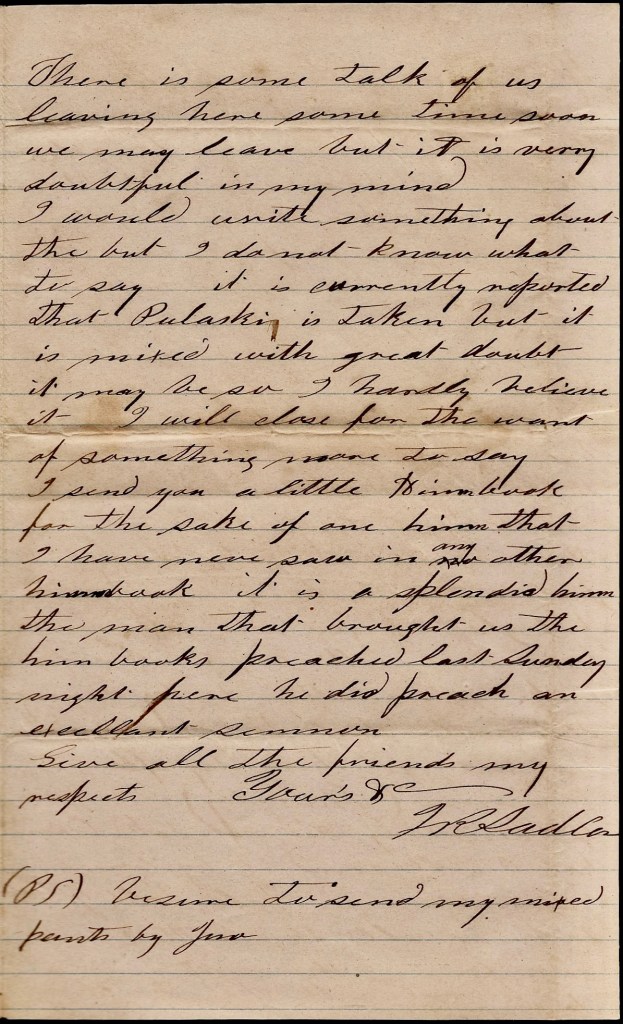
There is some talk of us leaving here sometime soon. we may leave but it is very doubtful in my mind.
I would write something about the [war] but I do not know what to say. It is currently reported that Fort Pulaski is taken but it is mixed with great doubt. It may be so [but] I hardly believe it.
I will close for the want of something more to say. I send you a little hymn book for the sake of one hymn that I have never saw in any other hymn book. It is a splendid hymn. The man that brought us the hymn books preached last Sunday night here. He did preach an excellent sermon.
Give all the friends my respects. Yours, &c. — J. R. Sadler
P. S. Be sure to send my mixed pants by Jim.
1 Col. Jehu Foster Marshall took command of the regiment during the winter of 1861-62 when Col. Orr resigned his commission and entered the Confederate Congress at Richmond. Marshall was killed during the Second Battle of Manassas in August 1862. The following website describes the Marshall Plantation Site in Marion county, Florida, where Marshall established a Sugar Plantation in 1855.
2 Mrs. Georgia (Wharton) Teasdale (1844-1900) was the 18 year-old wife of James Hamilton Teasdale (1835-1871) of Charleston, South Carolina.
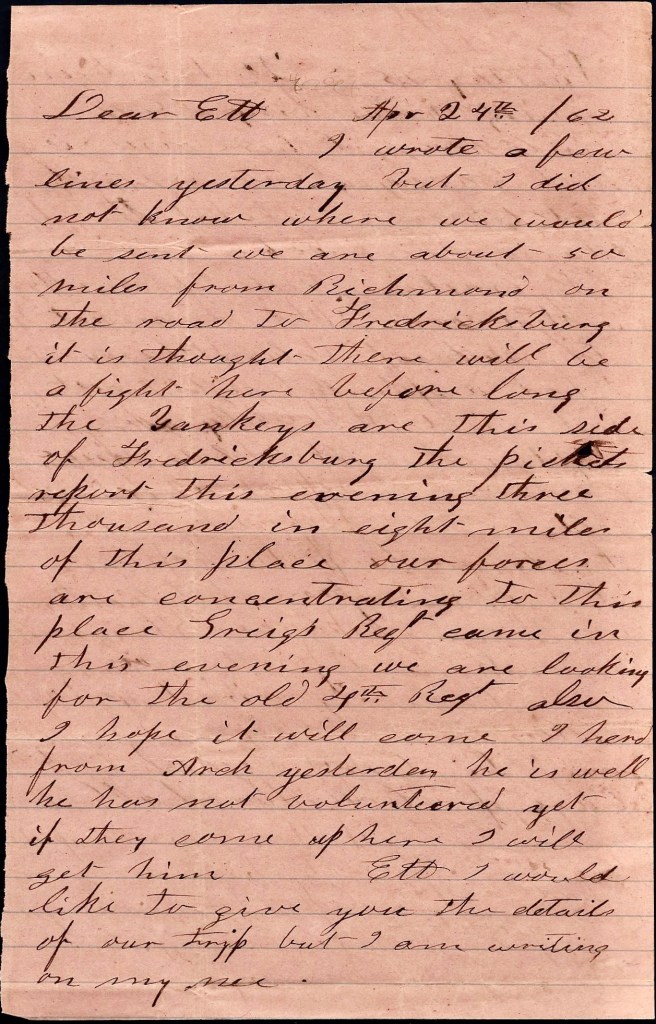
Letter 2
[On the road to Fredericksburg] April 24, 1862
Dear Ett,
I wrote a few lines yesterday but I did not know where we would be sent. We are about fifty miles from Richmond on the road to Fredericksburg. It is thought there will be a fight here before long. The Yankees are this side of Fredericksburg. The pickets report this evening three thousand [with]in eight miles of this place. Our forces are concentrating to this place. [Col. Maxcey] Gregg’s Regiment came in this evening. We are looking for the Old 4th Regt. also. I hope it will come.
I heard from Arch yesterday. He is well. He has not volunteered yet. If they come up here, I will get him. Ett, I would like to give you the details of our trip but I am writing on my knee.
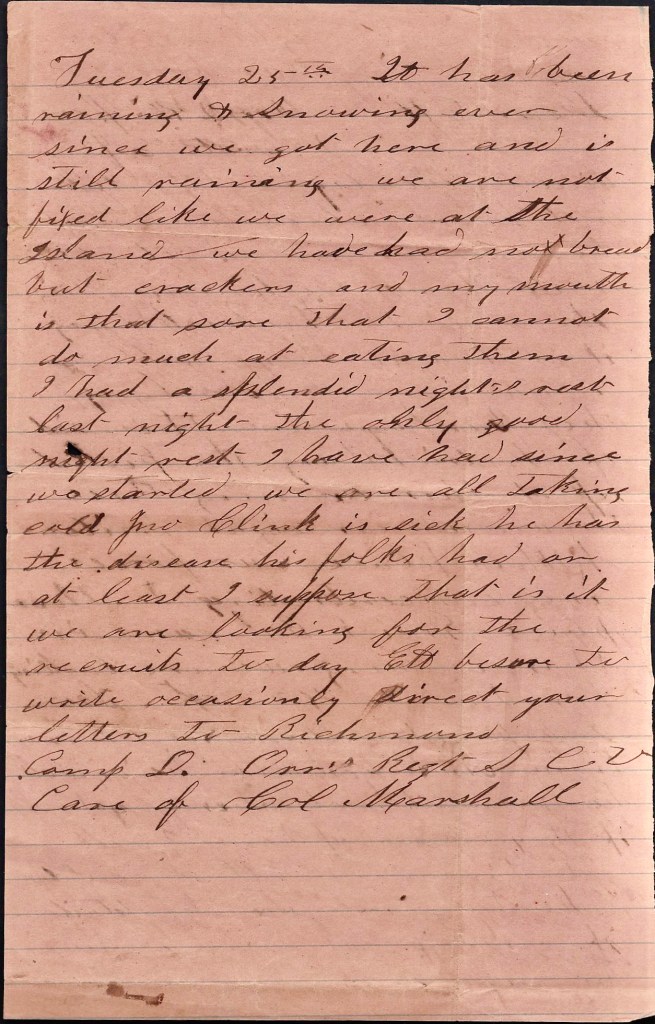
Tuesday, 25th
It has been raining & snowing ever since we got here and is still raining. We are not fixed like we were at the [Sullivan’s] Island. 1 We have had no bread, but crackers and my mouth is so sore that I cannot do much at eating them. I had a splendid night’s rest last night—the only good night’s rest I have had since we started. We are all taking cold. Jno. Clink is sick. He has the disease his folks had or at least I suppose that is it.
We are looking for the recruits today. Ett, be sure to write occasionally. Direct your letters to Richmond, Company D, Orr’s Regiment S. C. V., Care of Col. Marshall
Tuesday 25th
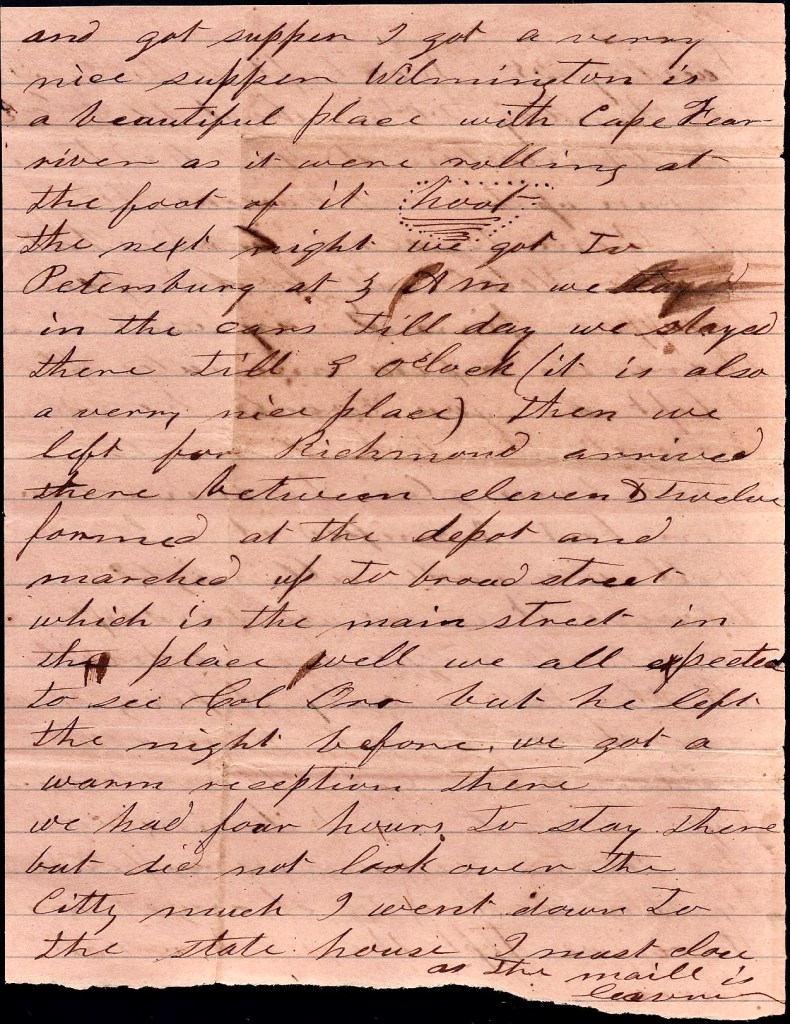
We left Sullivans Island Sunday the 20th about 11 o’clock. 2 Left Charleston at 4. I had time to run up to Mr. [George Cochran] Wharton’s to get them to send Carrie’s hat to the hotel to Jo Simpson. I suppose Jim Gray was there in a few minutes after I left so you would be sure to get the hat. I would have been glad to have seen Jim but I missed it.
Well, we rode all night. However, it is no use to say we road all night for we traveled all the time, only stopping now and then to get wood and water and let other trains pass. We got to Wilmington the second evening and hour by sun. We had to change cars there. We stopped there two hours or more and got supper. I got a very nice supper.
Wilmington is a beautiful place with Cape Fear River as it were rolling at the foot of it. Hoot.
The next night we got to Petersburg at 3 a.m. We laid in the cars till day. We stayed there till 3 o’clock (it is also a very nice place) then we left for Richmond. Arrived there between eleven and twelve, formed at the depot, and marched up to Broad Street which is the main street in the place. Well, we all expected to see Col. Orr but he left the night before. We got a warm reception there. We had four hours to stay there but did not look over the city much. I went down to the State House. I must close as the mail is leaving.
1 On Sullivan’s Island, the regiment was quartered in dwellings then standing on the island. Part of the regiment was quartered in the old Moultrie House.
2 According to J. W. Mattison of Co. G, Col. Marshall “received orders on April 19th, to report with his command at Richmond, Va., at once. Our surplus baggage was packed and sent home at once. On Sunday, April 20th, we left the Island rejoicing that we were going to the seat of war. The regiment was called by other troops ‘The pound cake regiment,’ because of our easy position [light duty] . Our trip to Richmond was slow and tedious. We left Charleston on the evening of April 20th. When we reached Florence we were delayed the balance of the night. Monday night we reached Wilmington and remained there all night. Tusday we made Weldon. Wednesday morning we took breakfast at Petersburg, Va., and reached Richmond about 12 o’clock noon. We left Richmond in the afternoon on the Fredericksburg road, reaching Guiney’s Station after night. Tents were pitched in short order and a good night’s rest obtained. The next morning (April 24th), when reville sounded we formed line in about three inches of snow. After remaining stationed a few days we were moved nearer Fredericksburg, to a point near Massaponax church, picketing the roads towards Fredericksburg. We remained in this camp [Camp Ledbetter] until the last week in May, when General Johnson evacuated Yorktown and Peninsula and withdrew his forces to around Richmond. The commands near Fredericksburg were ordered to Richmond.
Camp Ledbetter Spotsylvania Co., Va. May 25th 1862
Dear Jule,
I received your letter a few days ago and yesterday I received a letter from Buff McLees. He said he had seen some of you about Arch and told you all the particulars. He is in the hands of the Yankees but I trust he will get good attention. I heard from good authority that our surgeon and all that attended the hospital had gone to Williamsburg under a flag of truce to attend to our sick. I think the Yankees will try to show the people of Williamsburg that they have some humanity about them.
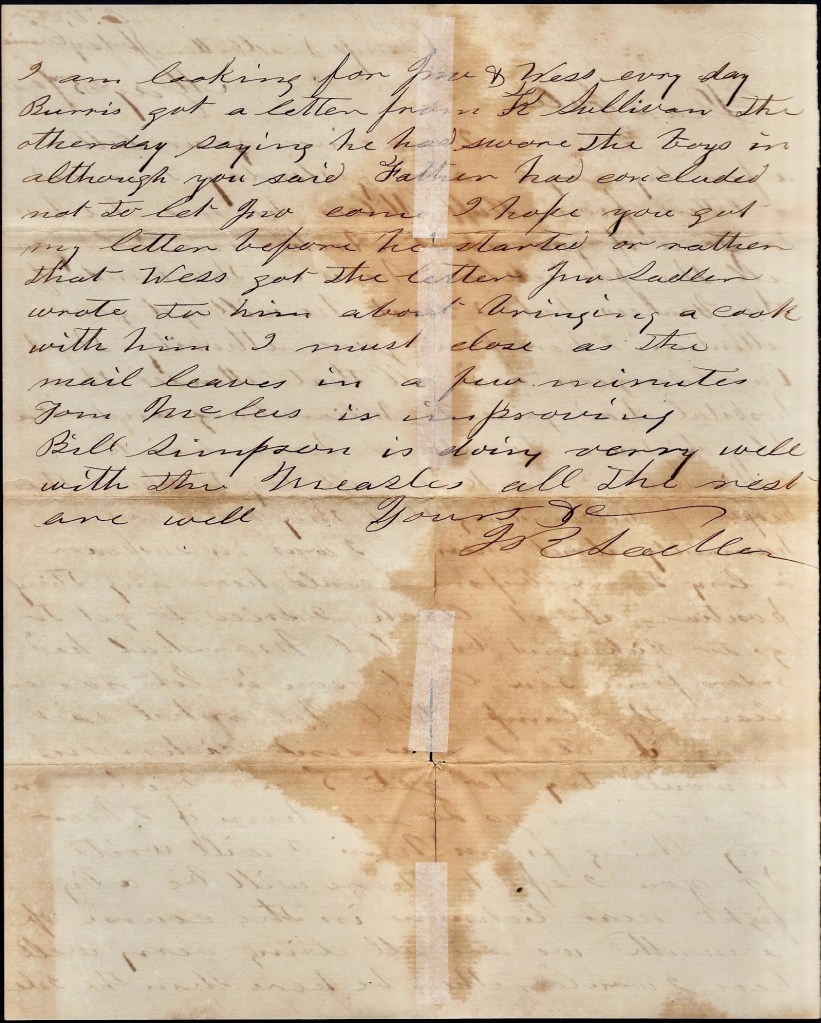
I was in suspense a long time before I could hear anything positive about Arch. I tried to get to go to Richmond but Col. Marshall had orders from Gen. Anderson to let no man leave the camp. Col. Marshall said though if Arch was sent to Richmond, he would try to get Gen. Anderson to let me go to see him. If I hear anything from him, I will write to you. I expect there will be a big fight near Richmond. We are all doing very well here. I would rather be here than the Isle.
I am looking for Jim & Wes every day. Burris got a letter from K. Sullivan the other day saying he had swore the boys in although you said father had concluded not to let Jno. come. I hope you got my letter before he started, or rather that Wes got the letter Jno. Sadler wrote to him about bringing a cook with him.
I must close as the mail leaves in a few minutes. Tom McLees is improving. Bill Simpson is doing very well with the measles. All the rest are well.























 Spared & Shared 23