Category Archives: 1st Vermont Heavy Artillery

1864: Benjamin Franklin Strong to his Children

This letter was only signed “Father” but the content reveals that he was most likely a member of Co. H, 1st Vermont Heavy Artillery. This company was at Fort Slocum till March, 1864, then at Fort Bunker Hill till May, 1864 when they were ordered to the Virginia battlefront to be used as infantrymen in Grant’s Overland Campaign. The regiment joined the 6th Army Corps at Spottsylvania Court House on 15 May 1864—little more than a week after Grant launched his campaign.

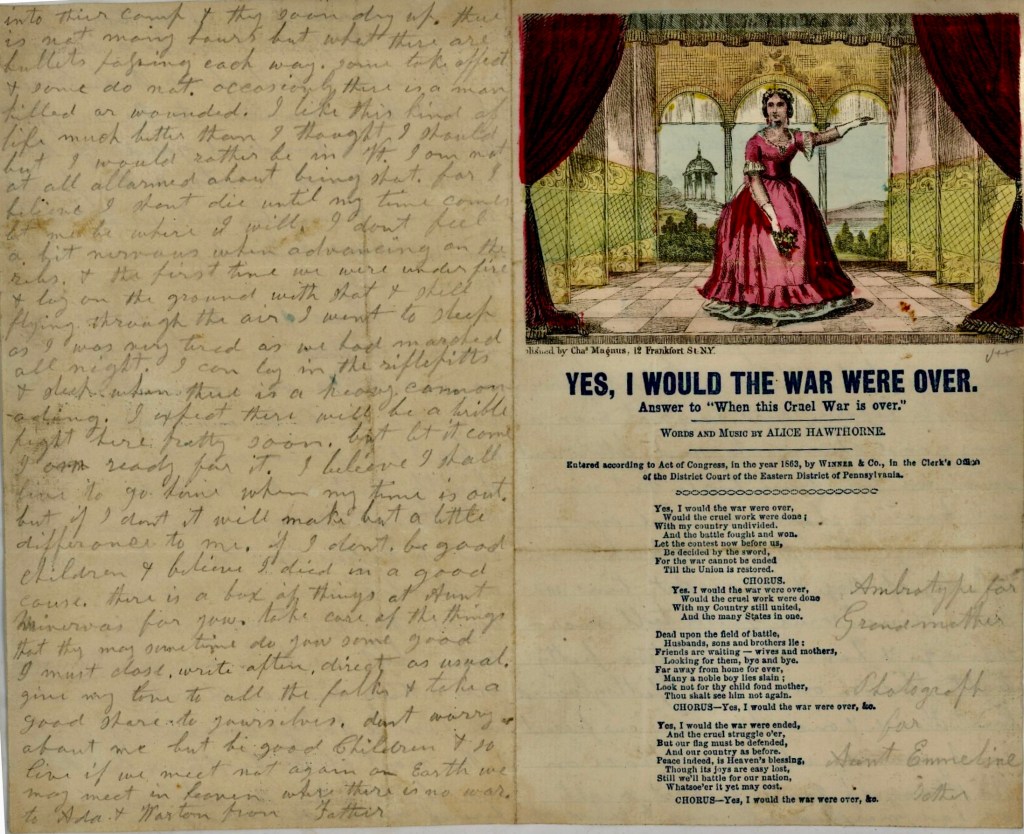
In his letter, he refers to Uncles Levi & Lyman who appear to be serving with him. Likewise he refers to an Aunt Minerva. Since the letter was written to his children, Ada and Walton, these aunts and uncles were most likely the author’s siblings or in-laws. The letter was written on stationery printed with the words to the tune by Alice Hawthorne entitled, “Yes, I would the war were over.” It is annotated in the margin, “Ambrotype for Grandmother, Photograph for Aunt Emeline. — Father.” These are articles that were presumably sent to Aunt Minerva in the box he mentions in the letter.

By posting this information on Spared & Shared Facebook, an astute subscriber named Amanda Champagne McCarty was able to locate a Vermont family that satisfied all of these relationships and I feel certain that the letter can now be attributed to Benjamin F. Strong (1825-1864) of Woodstock who was a 36 year-old mechanic when he entered the service in August 1862 with Levi F. Barnaby (1826-1873) and Lyman Aldrich. Levi was married to Minerva Strong (1836-1912), Benjamin’s sister. Lyman was married to Ellen Blaisdell, sister of Benjamin’s 1st wife Elvira Blaisdell (1833-1860). Benjamin’s and Elvira’s children were Ada Strong (1851-1919) and Frank Walton Strong (1855-1942). After Elvira died in February 1860, Benjamin took Esther D. deCamp (1840-1862) as his second wife and they had a child named Fanny but both mother and daughter died while Benjamin was in the service.

What is most chilling about this discovery, however, is that Benjamin was killed by an enemy sharpshooter on 9 June 1864—just two days after having written to his children: “I am not alarmed about being shot for I believe I shan’t die until my time comes, let me be where I will….I expect there will be a terrible fight here pretty soon, but let it come. I am ready for it. I believe I shall live to go home when my time is out. But if I don’t, it will make but a little difference to me. If I don’t, be good children & believe I died in a good cause.” No wonder the letter was cherished and the words on the song sheet all the more poignant:

Dead upon the field of battle,
Husbands, sons and brothers lie:
Friends are waiting—wives and mothers,
Looking for them, bye and bye.
Far away from home for ever,
Many a noble boy lies slain;
Look not for thy child fond mother,
Thou shalt see him not again.
Chorus—Yes, I would the war were over.

T R A N S C R I P T I O N

Camp in the field near Cold Harbor, Virginia
June 7th 1864

My dear children

As I have a little spare time this morning, I will write a few lines to let you know that I am yet alive & what is more, am well. Uncles Levi & Lyman are well. Uncle Lyman had a letter from home this morn. I received a letter from you a few days ago but I have not had time to write before. There has not been a very good chance to send letters out since we have been here, but now we have a chance to send every morning.

We left [Fort] Bunker Hill on the 12th day of May & since that time we have done some pretty tall marching & have been in two pretty tight places—once near Spottsylvania Court House and once here on our present campground which took place on the 1st day of June just at night. We had marched all day and came up with the main part of the Corps just in time to form and make a charge on the rebs. A part of our regiment, Cos. F, L. K, & H [the 1st Battalion], advanced to the very front to within a hundred yards of the rebel entrenchments & they poured the grape and canister into us like hail. But we were behind a small rise of ground & by laying flat down, we most of us escaped being killed or wounded. There were about 84 lost in our four companies—one man killed and 10 wounded in Co. H. One corporal lost a leg and one sergeant an arm. All have been sent to the General Hospital in Washington. In this last affray, our loss was pretty severe. They think more so than the rebs but we hold our position & are getting very well entrenched.

We have a large amount of artillery & the most of the fighting has been done by it. When the rebs commence firing on us, they send a few shells into their camp & they soon dry up. There is not many hours but what there are bullets passing each way. Some take effect and some do not. Occasionally there is a man killed or wounded. I like this kind of life much better than I thought I should but I would rather be in Vermont. I am not alarmed about being shot for I believe I shan’t die until my time comes, let me be where I will. I don’t feel a bit nervous when advancing on the rebs & the first time we were under fire & lay on the ground with shot and shell flying through the air, I went to sleep as I was very tired as we had marched all night.

I expect there will be a terrible fight here pretty soon, but let it come. I am ready for it. I believe I shall live to go home when my time is out. But if I don’t, it will make but a little difference to me. If I don’t, be good children & believe I died in a good cause. There is a box of things at Aunt Minerva’s for you. Take care of the things that they may some time do you some good.

I must close. Write often. Direct as usual. Give my love to all the folks and take a good share to yourselves. Don’t worry about me but be good children & so life if we meet not again on earth, we may meet in Heaven where there is no war.

To Ada & Walton, from Father

1863: Henry Wallace Warren to Roelzo Sanford Warren

The following letter was written by Henry Wallace Warren (1840-1908), the son of Noah S. Warren (18xx-1889), and Betsy Seaver (18xx-1840) of Stowe, Lamoille, Vermont. He wrote the letter to his younger brother, Roelzo Sanford Warren (1843-1921).

Henry enlisted in September 1862 to serve in the 11th Vermont Infantry but three months later it was re-designated as the 1st Vermont Heavy Artillery.

Transcription

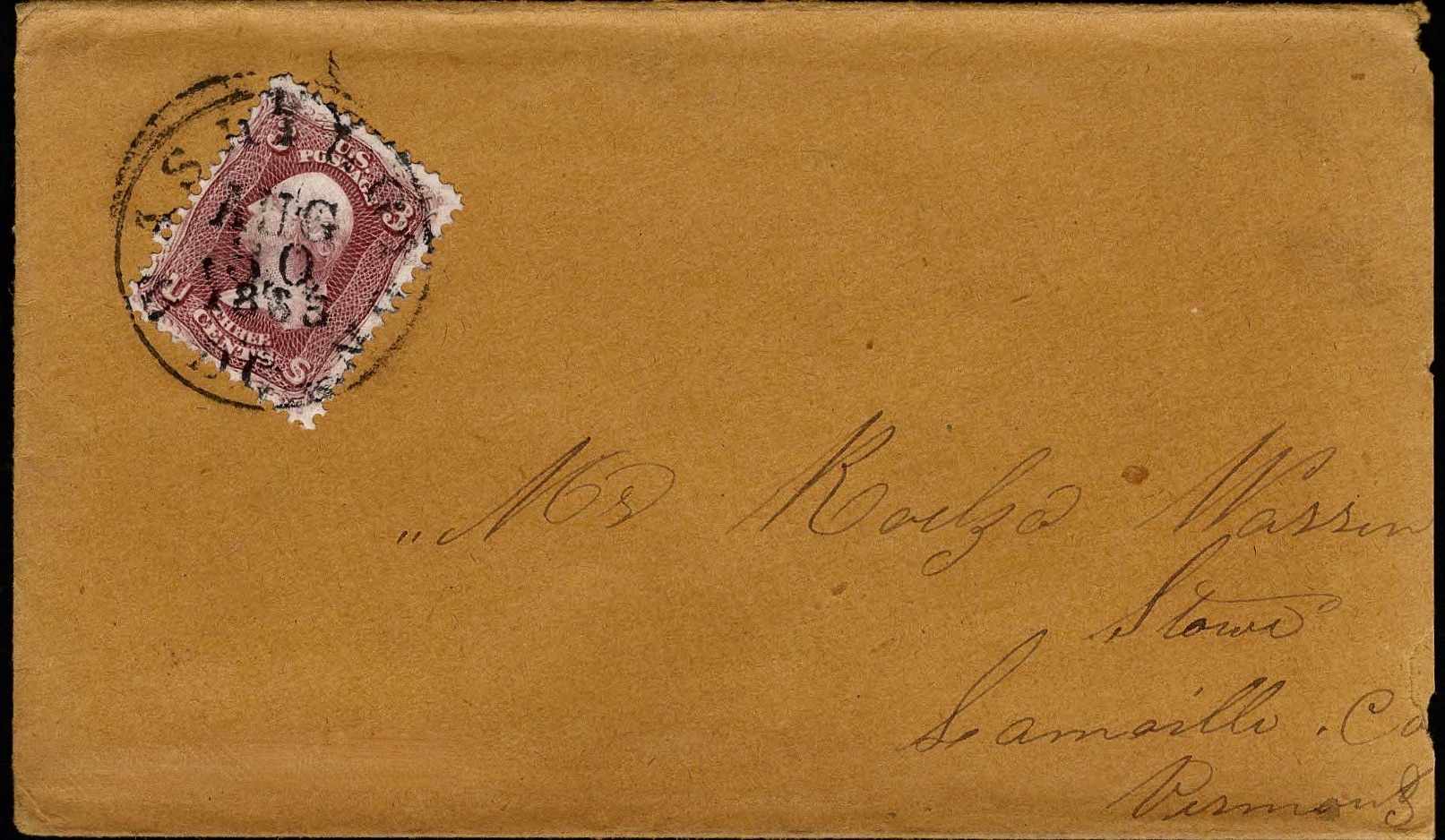
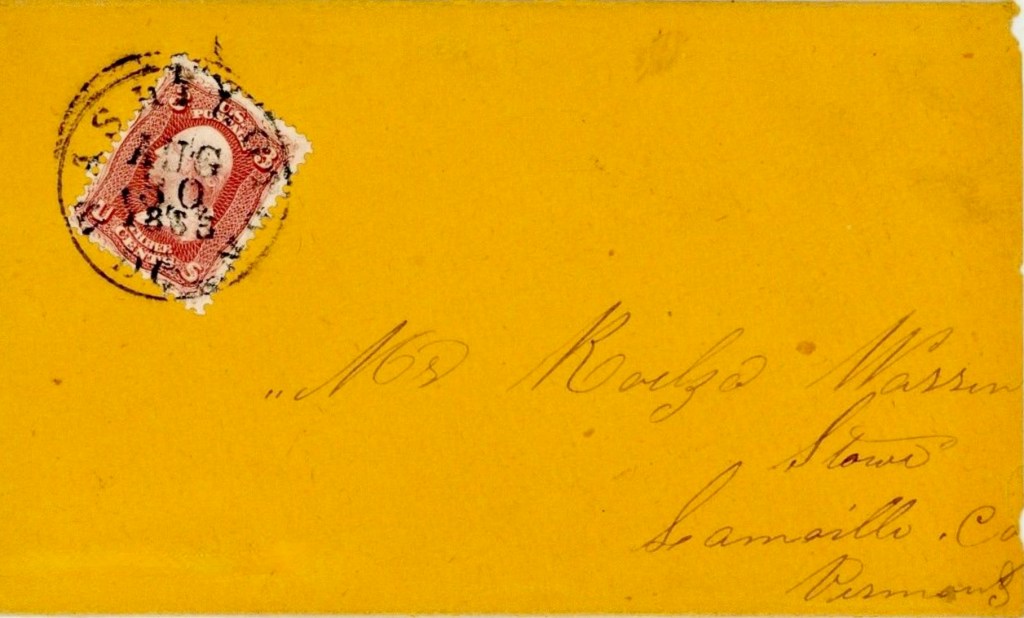
Addressed to Mr. Roelzo Warren, Stowe, Lamoille county, Vermont

Fort Stevens
August 29th [1863]

Brother Roelzo, kind sir.

I take my pen in hand to write a few lines to you. I am well at the present time, and I hope this letter will find you enjoying the same health as the rest of the folks. The Stowe boys are well with the exception of Bill. It looks a little like rain today and I hope it will make out before it gets through for we have not had any rain here for some time that has done any good.

We expect Captain Safford’s company here today and I am glad to hear they are a coming. It is no waste for them to come than it was for us to come. About the drafted men, I am glad to hear that they have got to come. If they won’t come one way, let them [come] another. It is no worse for them to leave their homes than it was for me or anyone else of the boys. It is getting to be cool weather here now and I hope the regiment will be more healthy than they have been through the summer. We have not lost a great many boys [by] death for some time. There has more deserted than any other way.

We are a having lots of work to do now for we are a going to build us some new barracks. We are a going to put them up next to the fort and we are a going to have some nice ones this time, I tell you. When we get them in, then you may come and see me and tell Father to come out too, and to come certainly if Mr. Waltz & Hodge comes.

About Holden’s going home, I [hope] he will get home safe and I wish I could get the same chance to go home but never mind, we can go home sometime. We can go in two years if not before. The citizens tell us we shall go before but I can’t see it just yet. We enlisted for three years and I think we shall have to stay our time out. I can’t [think] of much now to write about this time but will try to do better next time.

About the war news, I can’t tell you. I presume you hear more about the war than I do. If you get any news about anything, write and tell me. This from your brother, — Henry Warren

Battery L has come with a very good looking company. Lieut. Safford is Capt. He is the same as he was before he went home. I presume that you have seen him while at home. It is a very good company. They are a green set of Boys. Our boys have some fun with them.

Tell my folks than I am well and that that Battery L have got here. Tell Father Cheney’s folks that Henry said today that Bill is not as well as he has been or was when he left the hospital now.

1863: Henry Chandler Ware to Roelzo Sanford Warren

The following letter was written by Henry Chandler Ware (1836-1895), the son of Chandler Ware and Mariah Crofut of Wilmington, Windham county, Vermont. He enlisted on 12 August 1862 in Co. E, 11th Vermont Infantry (1st Vermont Heavy Artillery) and served until 24 June 1865. “He was one of the best soldiers ever sent from this town,” according to his obituary. He was married to Mary Jane Boyd (1841-1906) and had three children by the time he entered the service.

Also adding a note to the end of this letter was Henry Wallace Warren (1840-1908) of Co. D, 1st Vermont Heavy Artillery (same regiment as Chandler’s). Both soldiers addressed their letters to Henry W. Warren’s younger brother, Roelzo Sanford Warren (1843-1921).

The 1st Vermont Heavy Artillery was Vermont’s largest regiment, with a total of 2,320 officers and men.  It was originally organized as the 11th Vermont Infantry Regiment but was quickly converted to heavy artillery. Company E was originally assigned to Fort Totten in the circle of forts surrounding Washington D. C. In mid-November 1862 it was moved to Fort Slocum. They remained at their post until May 1864 when they were sent to Virginia to participate in Grant’s Overland Campaign as infantrymen.

Transcription

Addressed to Mr. Roelzo Warren, Stowe, Lamoille county, Vermont

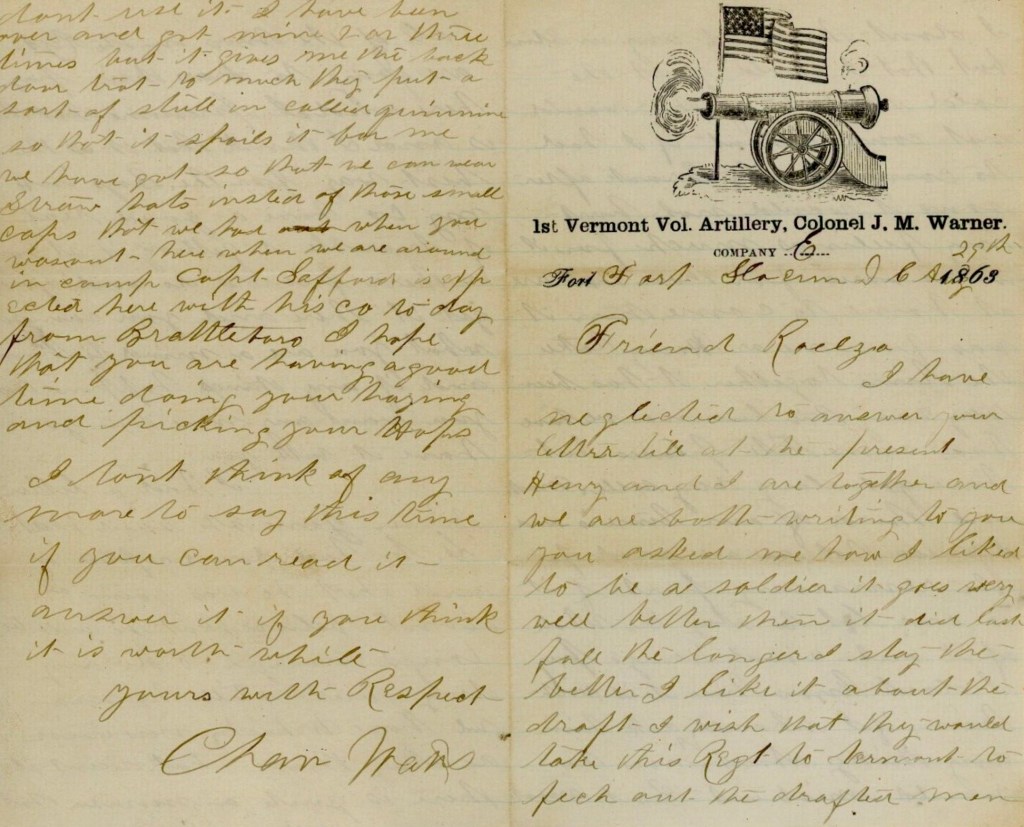
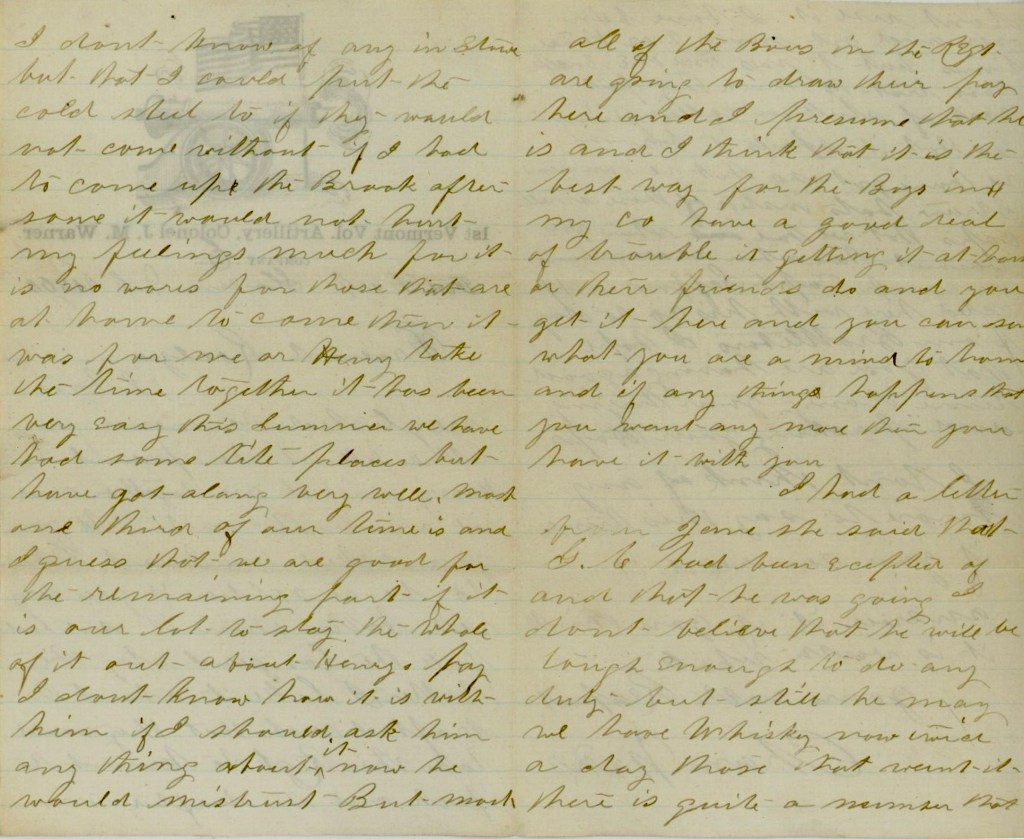
1st Vermont Volunteer Artillery, Col. J. M. Warner
Co. E, Fort Slocum, D. C.
August 29th 1863

Friend Roelzo,

I have neglected to answer your letter till at the present. Henry and I are together and we are both writing to you. You asked me how I liked to be a soldier. It goes very well—better than it did last fall. The longer I stay, the better I like it.

About the draft, I wish that they would take this regiment to Vermont to fetch out the drafted men. I don’t know of any in Stowe but that I could put the cold steel to if they would not come without if I had to come up the brook after some. It would not hurt my feelings much for it is no worse for those that are at home to come than it was for me or Henry. Take the time together, it has been very easy this summer. We have had some tight places but have got along very well. Most one third of our time is [up] and I guess that we are good for the remaining part if it is our lot to stay the whole of it out.

About Henry’s pay, I don’t know how it is with him. If I should ask him anything about it now, he would mistrust. But most all of the Boys in the regiment are going to draw their pay here and I presume that he is and I think that it is the best way for the Boys in my company have a good deal of trouble getting it home, or their friends do, and you get it get here and you can. So what you are a mind to home and if anything happens that you want any more, then you have it with you.

I had a letter from Jane. She said that G. C. had been accepted of and that he was going. I don’t believe that he will be tough enough to do any duty but still he may. We have whiskey now twice a day—those that want it. There is quite a number that don’t use it. I have been over and got mine two or three times but I gives me the backdoor trot too much. They put a sort of stull [?] is called quinine so that it spoils it for me.

We have got so that we can wear straw hats instead of those small caps that we had when you was out here when we were around in camp Capt. Safford is expected here with his company today from Brattleboro. I hope that you are having a good time doing your haying and picking your hops.

I don’t think of any more to say this time. If you can read it, answer it if you think it is worth while. Yours with respect, — Chan. Ware

Fort Stevens
August 29th [1863]

Brother Roelzo, kind sir,

I take my pen in hand to write a few lines to you. I am well at the present time and I hope this letter will find you enjoying the same health and the rest of the folks. The Stowe Boys are well with the exception of Bill. It looks a little like rain today and I hope it will make out before it gets through for we have not had any rain here for some time that has done any good.

I think we shall have to stay our time out. I can’t think of much now to write home this time but will try to do better next time About the war news, I can’t tell you. I presume you know about the war [more] than I do. If you get any news about anything, write and tell me. This from your brother, — Henry Warren

Tell my folks that I am well and that that Battery &c, have got here. Tell Father Cheney’s folks that Henry said today that Bill is not as well as he has been or was when…

1862: Willard Morse to Hobart Bradley Ford

I could not find an image of Willard but here’s a tintype of Almeron Bickford (1829-1904) who served in Co. E, 11th Vermont (1st Vermont Heavy Artillery).

The following letter was written by Pvt. Willard Morse (1833-1864) who enlisted in Co. F, 11th Vermont Infantry in the summer of 1862. Being assigned duty in the defenses of Washington D. C., this regiment was soon changed to heavy artillery and renamed the 1st Vermont Heavy Artillery. Once in Washington, this regiment remained for the next 20 months garrisoning Federal forts. Following the Battle of the Wilderness in May 1864, the regiment was sent sent to the field as infantrymen, joining the Old Vermont Brigade in Grant’s army at Spotsylvania.

Willard was the son of David Sunderland Morse (1805-1882) and Mary Willard (1805-1845). He was married to Martha “Elizabeth” Cummings (1838-1906) in October 1847, had two young daughters, and was living in Morgan, Orleans county, Vermont when he enlisted. He was taken prisoner “while on a raid on the Weldon Railroad near Petersburg” on 23 June 1864 and held at Andersonville Prison in Georgia where he died of chronic diarrhea and starvation some six weeks later on 3 August 1864. Willard’s death on 2 August was described in George W. Dewey’s diary.

The letter was addressed to Willard’s cousin whom he called “Ford.” I believe this was Hobart Bradley Ford (1826-1910) who married Lucy Ann Morse (1829-1908), Willard’s cousin.

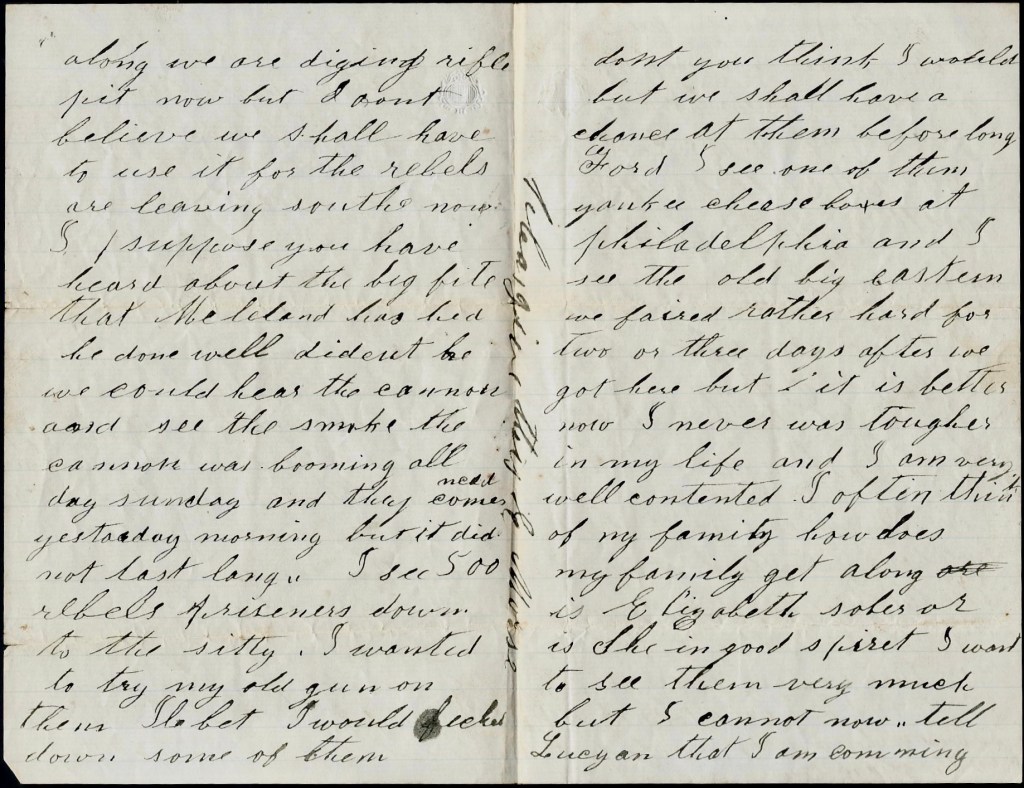
Willard’s letter was written from Fort Lincoln where they had recently been digging rifle pits to augment the fort’s defenses in the event that Lee’s army had turned on Washington rather than attacking Harper’s Ferry and heading into Western Maryland. Willard praises McClellan’s performance at South Mountain (“He done well, didn’t he?”) and describes seeing the smoke and hearing the artillery 70 miles away from their defenses at Fort Lincoln. Little could he have imagined the carnage that would occur at Sharpsburg the day after this letter was written.

Transcription

Fort Lincoln, Washington [City]
Tuesday morning, September 16, 1862

Absent cousin,

I now take my pen to write a few lines to you to let you know that I am yet alive and well and hope this will find you the same. I guess you began to think that I was not agoing to write to you but we have had so much to do that I could not write so you must excuse me this time. I guess Elizabeth has forgot me for I have not had a letter from her for a long time.

I suppose you want to know how we are getting along. We are digging rifle pits now but I don’t believe we shall have to use it for the rebels are leaving south now. I suppose you have heard about the big fight that McClellan has had. He done well, didn’t he. We could hear the cannon and see the smoke. The cannon was booming all day Sunday and they commenced yesterday morning but it did not last long. I see 500 rebel prisoners down to the city. I wanted to try my old gun on them. I’ll bet I would [have] fetched down some of them, don’t you think I would. But we shall have a chance at them before long.

Ford, I see one of them Yankee cheese boxes at Philadelphia and I see th old big Eastern. We fared rather hard for two or three days after we got here but it is better now. I never was tougher in my life and I am very well contented. I often think of my family. How does my family get along? Is Elizabeth sober or is she in good spirit? I want to see them very much but I cannot now tell Lucyann that I am coming in with my dirty feet to step on her clean floor. How does Orren and Townsend get along? I wrote to Orren and Elizabeth Sunday.

Well, Ford, I must close for we have got to go to work. Write as soon as you get this. Direct to Washington, 11th Regiment, Co. F, in care of Capt. [James] Rice. We have got the best captain in the regiment. The first day we dig rifle pits, they said we dug more than any regiment ever dug in 3 days and our captain told us if [we] worked so another day, he would put us in the guard house.

Goodbye, — W. Morse

Write soon.

1864: James Franklin Drenan to Clarissa (Bill) Drenan

This letter was written by James Franklin (“Frank”) Drenan (1847-1866), the son of James Drenan and Clarissa Bill, of Woodbury Vermont. Frank enlisted in Co. L, 11th Vermont Infantry in May 1863 and was mustered into the service on 11 July 1863. He was wounded in the fighting at Petersburg on 2 April 1865 and discharged for disability in August 1865. He died only a few months later.

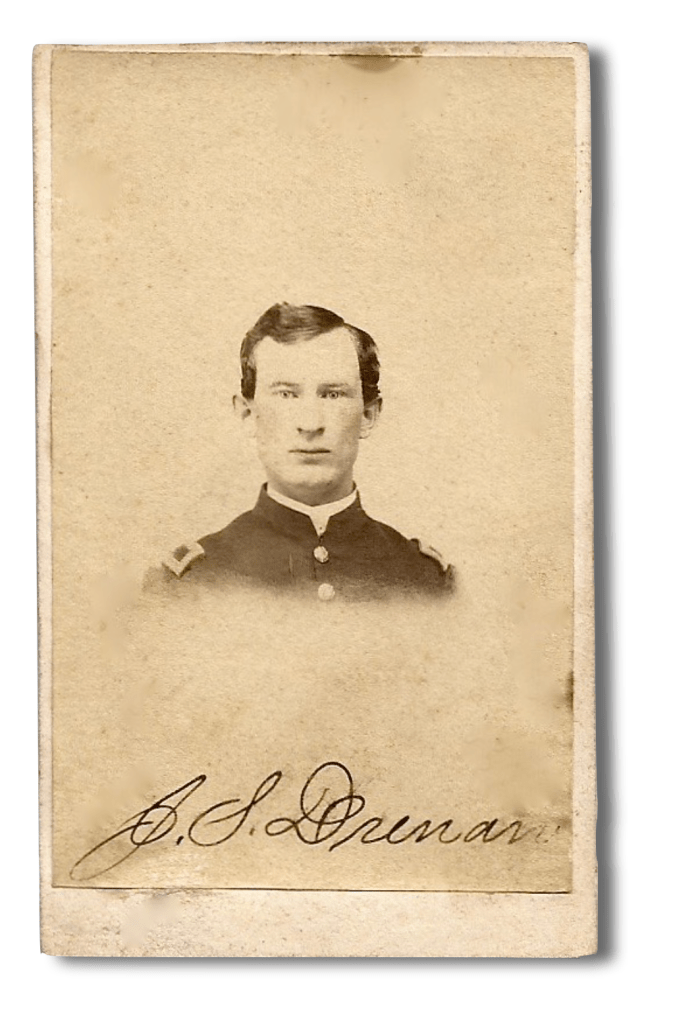
Lt. John Silas Drenan, 11th Vermont, 1st Vermont HA (Ed Italio Collection)

In this letter, Frank breaks the news to his mother of the capture of his brother, Lt. John Silas Drenan (1840-1894) who served with him in the 11th Vermont Infantry (also known as the 1st Vermont Heavy Artillery). He was taken prisoner on 23 June 1864 when the II Corps was ordered forward to retake its lost ground, but they found that the Confederates had already pulled back, abandoning the earthworks they had previously captured. Under orders from General Meade, the VI Corps sent out a heavy skirmish line after 10 a.m. in a second attempt to reach the Weldon Railroad. Men from Brig. Gen. Lewis A. Grant’s 1st Vermont Brigade were ordered to begin tearing up track and did not have their weapons handy when they were attacked by a larger force of Confederate infantry. Numerous Vermonters were taken prisoner and only about half a mile (0.8 km) of track had been destroyed when they were chased away. 

Readers are referred to the book entitled, “A Melancholy Affair at the Weldon Railroad: The Vermont Brigade, June 23, 1864” by David Farris Cross. The date 23 June 1864 came to be called “Black Thursday” in the Green Mountain State. “Cowardliness, negligence and inept behavior by multiple officers resulted in the needless capture of more than four hundred Vermonters” and many of the enlisted men were sent to Andersonville and later to other Confederate prisons where 60 percent of them perished.

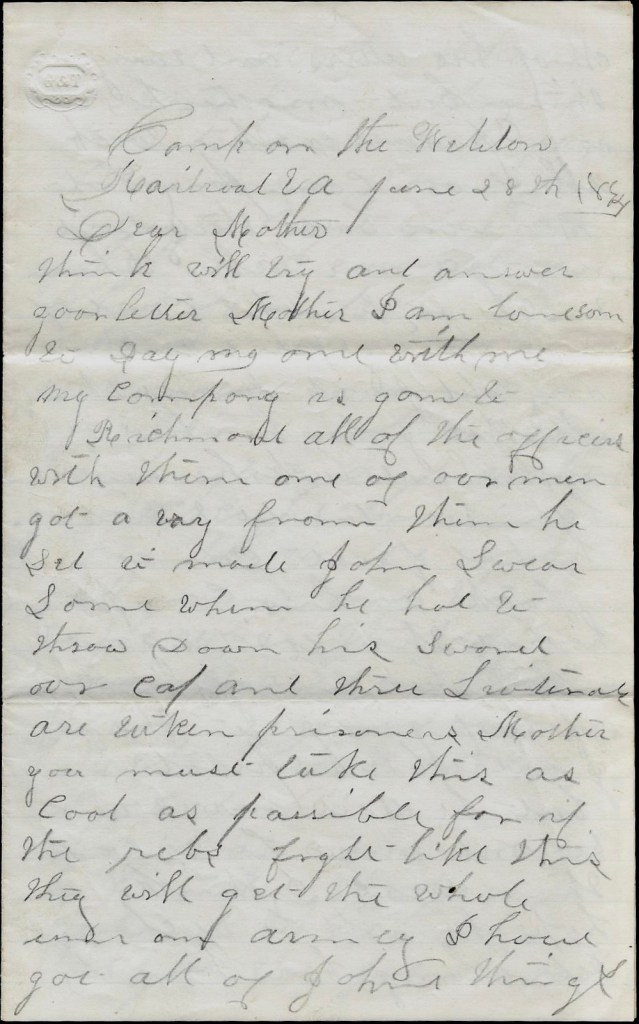
Transcription

Camp on Weldon Railroad, Va.
June 28th 1864

Dear Mother,

I think I will try and answer your letter. Mother, I am lonesome today. No one with me. My company is gone to Richmond—all of the officers with them. One of our men got away from them. He said it made John swear some when he had to throw down his sword. Our captain and three lieutenants are taken prisoners.

Mother, you must take this as cool as possible for if the rebs fight like this, they will get the whole of our army. I have got all of John’s things—all of his letters and everything—but mother, he is a prisoner. They took all of our company but 19 men but they did not get me. All I have to do is to care of their things and keep my old pack horse thins.

Mother, John has had rather hard luck. He has been wounded twice. He had just come back to his company. He had the offer of going to the general hospital but he did not want to go and now he is worse than deal, I think. Hope he will be exchanged before long. He may not.

Mother, I have sent home three or four times and you have not sent any. You can’t write as often as I would if I had stamps.

Mother, we had 17 hundred men when we started from Washington and we have got eight hundred left. The rest are all gone. This afternoon we are going on picket where the rebs shall be considerable. Send me some stamps. I opened that letter that you wrote John. — Frank