Category Archives: 20th Maine Infantry

1863: Lydia McKeen to Hiram Keay

The following letter was written by Lydia (McAllister) McKeen (1838-1933), the wife of James H. McKeen of Patten [post office], Aroostook county, Maine.

Lydia write the letter to Hiram Keay (1828-1907), the son of Thomas Keay and Rebecca Grant of Bowdoin, Maine. Hiram was 34 years old and residing in Island Falls, Maine, when he enlisted as a private in Co. H, 20th Maine Infantry on 29 August 1862. He was transferred to the 2nd Battalion, Veteran Reserve Corps in September 1863 due to the wound he received in his left hand. How of when Hiram was wounded is not stated in the letter but a Return of Casualties in Maine Regiments at the Battle of Fredericksburg shows that he was “wounded and missing.” Most likely Hiram was still hospitalized from that battle seven months earlier as the regiment did not participate in the Battle of Chancellorsville due to an outbreak of smallpox in the regiment.
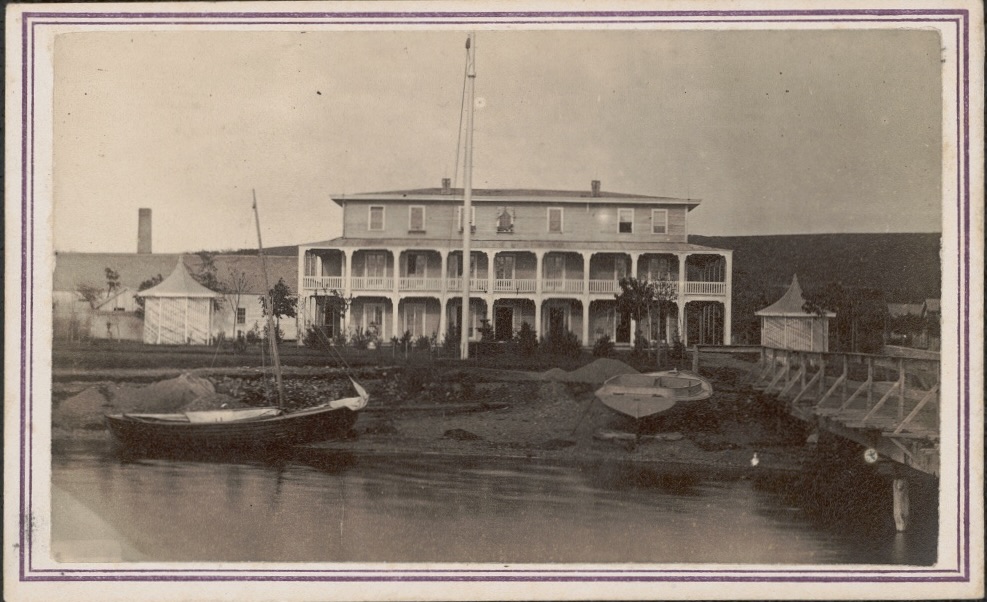
Lovell General Hospital, Portsmouth, Rhode Island, where Hiram Keay was being treated for his hand wound, received in the Battle of Fredericksburg. (LOC)

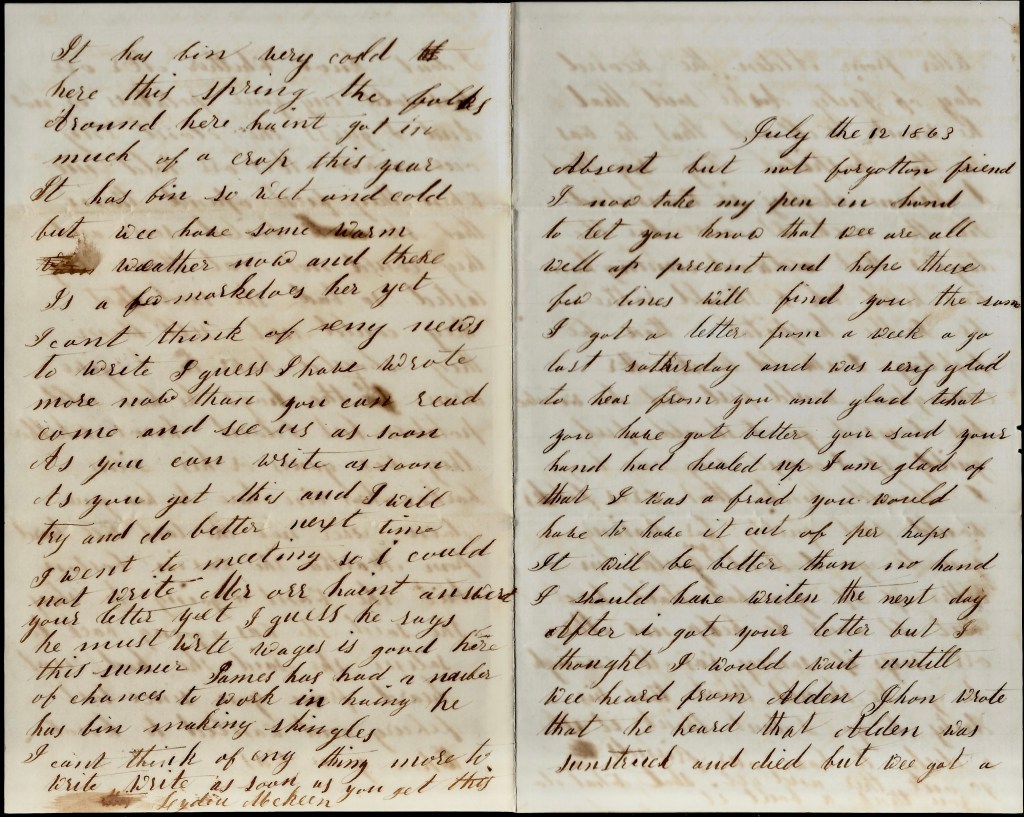
Transcription

Addressed to Mr. Hiram Keay, Esqr., Ward G, Lovell General Hospital, Portsmouth Grove, Rhode Island

July the 12th 1863

Absent but not forgotten friend,

I now take my pen in hand to let you know that we are all well at present and hope these few lines will find you the same. I got a letter from a week ago last Saturday and was very glad to hear from you and glad that you have got better. You said your hand had healed up. I am glad of that. I was afraid you would have to have it cut off. Perhaps it will be better than no hand.

I should have written the next day after I got your letter but I thought I would wait until we heard from Alden [Cunningham]. I have wrote that we heard that Alden was sun struck and died but we got a letter from Alden the second day of July and he said that he wasn’t well and that he was in the hospital. They say that Hiram Chesley 1 is wounded in the neck. It come in the dailies that Edward Cunningham was killed. 2 Oh, I should rather be in the hospital than be fighting. I should think Mr. Cunningham would feel bad. He wanted his boys to go. I should feel guilty if I coaxed anyone to go. I should think that Orr’s folks would feel guilty for teasing you to go. I think you would [have] been better off if you had stayed here. But it can’t be helped now. Mr. Orr says if Sammy [b. 1845] was old enough to go, he should think t’was his duty to go. I don’t think it is a duty to have our friends go out there and get shot. What do you think about it?

I don’t know whether Mr. [William D.] Orr has sold any of your potatoes or not and I guess they don’t anyone know. Mrs. Orr told me when they first opened them that she boiled some and they could not eat them—they tasted so bad. She said that they could not sell them. They should have to give them to the hogs. He has sold potatoes but I don’t know whether they was yours or his.

Silas Barker has been here. He has gone down river now. The last we heard from Martha she was in Boston but she wasn’t going to stay. She said she a going back to Salem. She said she had not heard from you since last February and wanted to know where you was.

It has been very cold here this spring. The folks around here haint got in much of a crop this year, it has been so wet and cold, but we have some warm weather now and there is a few mosquitoes here yet.

I can’t think of any news to write. I guess I have wrote more now than you can read. Come and see us as soon as you can. Write as soon as you get this and I will try and do better next time. I went to meeting so I could not write. Mr. Orr haint answered your letter yet, I guess. He says he must write. Wages is good here this summer. James has had a number of chances to work in haying. He has been making shingles.

I can’t think of anything more to write. Write as soon as you get this. — Lydia McKeen


1 Hiram H. Chesley, attorney, Louisville, was born in Aroostook County, Maine, September 8, 1844, and is a son of Bela H. Chesley, of Anoka, Minn., a native of Oxford County, Maine. Mr. Chesley served in the late war in Co. H, 20th Maine Volunteer Infantry, and participated in the battles of Antietam, Fredericksburg, the Wilderness, Gettysburg and others. He received a gunshot wound through the neck at Gettysburg, which crippled him for life. He lay paralyzed for eighteen months, entirely helpless, and has suffered untold misery ; not an hour passes until the present time that does not bring its pains. He came to Marion County, Ill., in September, 1865. He there read law, and was admitted to the bar in 1867. In April, 1870, he located in Louisville, where he still remains, engaged in the practice of his profession. He was married, January 23, 1868, to Mary E. Tubbs, daughter of Alva Tubbs (deceased). She was born in Jennings County, Ind.” Excerpt from “History of Wayne and Clay Counties, Illinois 1884

2 Private Edward Cunningham, orderly to Major General Abner Doubleday. A member of Company I, 1st Maine Cavalry, he was a resident of Patten, Maine. Cunningham was killed on July 3 and was buried in the Maine plot in Gettysburg’s National Cemetery. On his body was found a postage stamp, a comb, and $3.95 in cash. (Union Casualties at Gettysburg, by Travis W. Busey and John W. Busey, 1:20)
1864: Elisha Oaks Drake to Zibeah (Cary) Drake

The following letter was only signed “Elisha” but clues in the letter enabled me to confidently conclude that it was written by Elisha Oaks Drake (1821-1901), a former shoemaker residing in Livermore, Maine. Elisha was married to Zibeah Cary (1812-1892) in August 1845. Their 16 year-old son, William “Henry” Drake (1848-1930) is mentioned in this letter.

When he was 41 years old, Elisha enlisted on 29 August 1862 to serve as a private in Co. C, 20th Maine Infantry. One source gives his discharge date as 15 June 1864 but this must be an error because this and other letters I’ve found on-line written by Elisha were written after that date. The 1890 Veterans Schedule gives his discharge date as June 1865 indicating that he served two years and ten months.

Historians will recall that the 20th Maine was most famous for its defense of Little Round Top at the Battle of Gettysburg on 2 July 1863. Records indicate that Elisha was with his company that day and was not wounded.

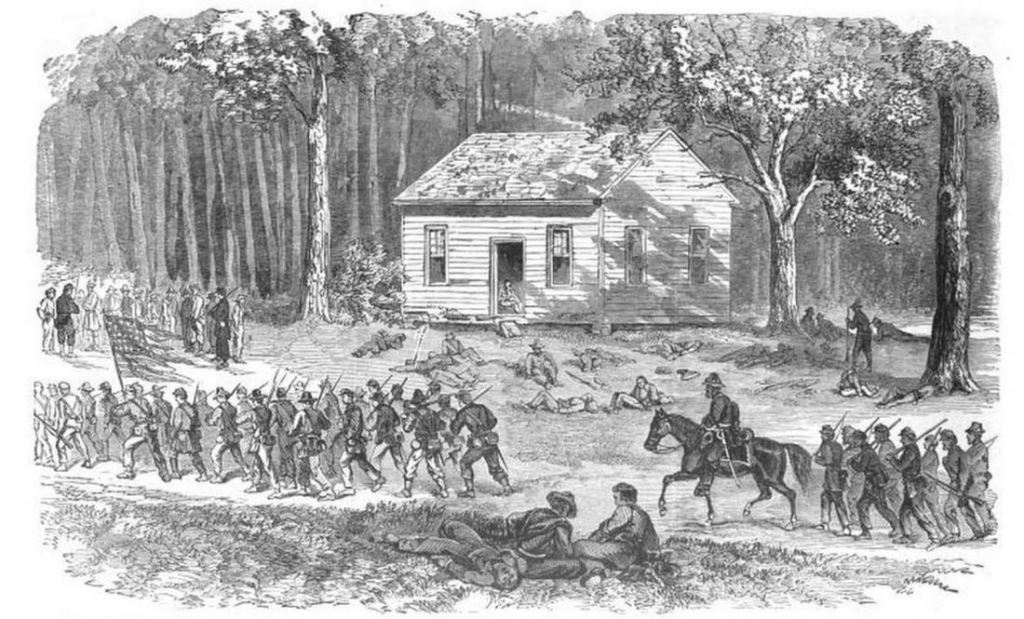
We learn from Elisha’s letter that the 20th Maine had just entered camp near the Poplar Grove Church (sometimes referred to as the Poplar Springs Church.

Poplar Springs Church, a Woodcut in Frank Leslie’s Oct 22, 1864 issue

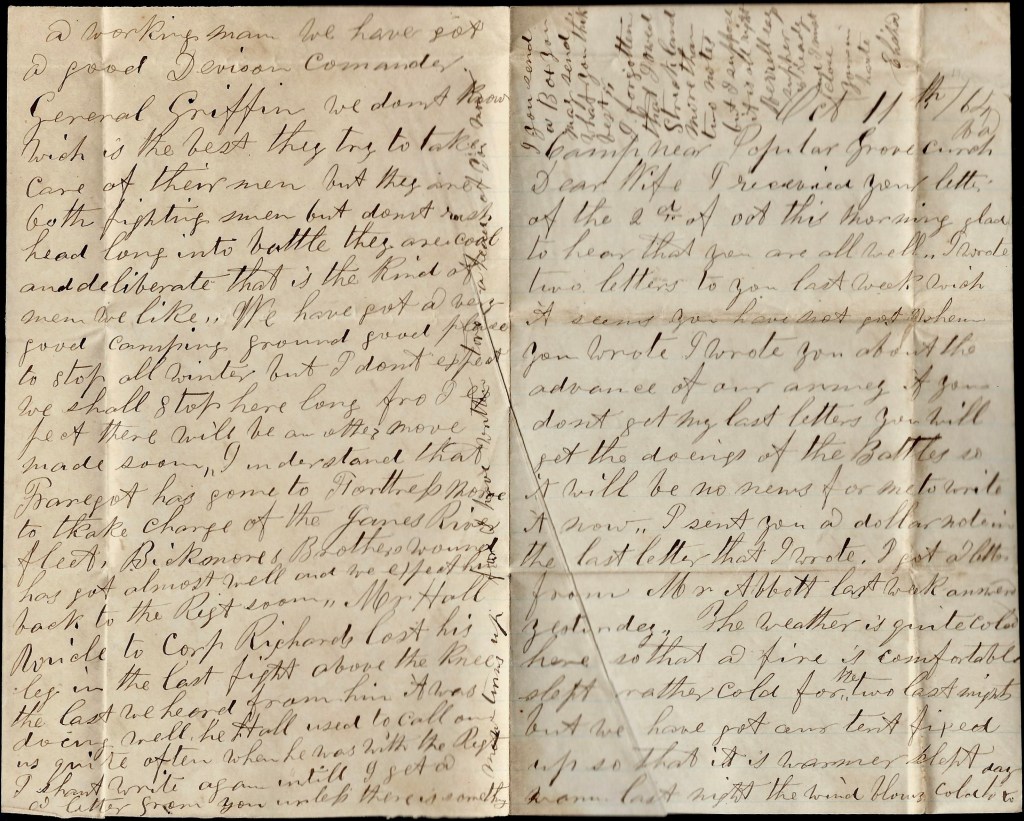
Transcription

Camp near Poplar Grove Church, Va.
October 11th 1864

Dear Wife,

I received your letter of the 2nd of October this morning. Glad to hear that you are all well. I wrote two letters to you last week which it seems you have not got when you wrote. I wrote you about the advance of our army. If you don’t get my last letters you will get the doings of the battles so it will be no news for me to write it now. I sent you a dollar note in the last letter that I wrote. I got a letter from Mr. Abbott last week. Answered yesterday.

The weather is quite cold here so that a fire is comfortable. Slept rather cold for the two last nights but we have got our tent fixed up so that it is warmer. Slept very warm last night. The wind blows cold. Frost last night. Will be tonight if the wind goes down.

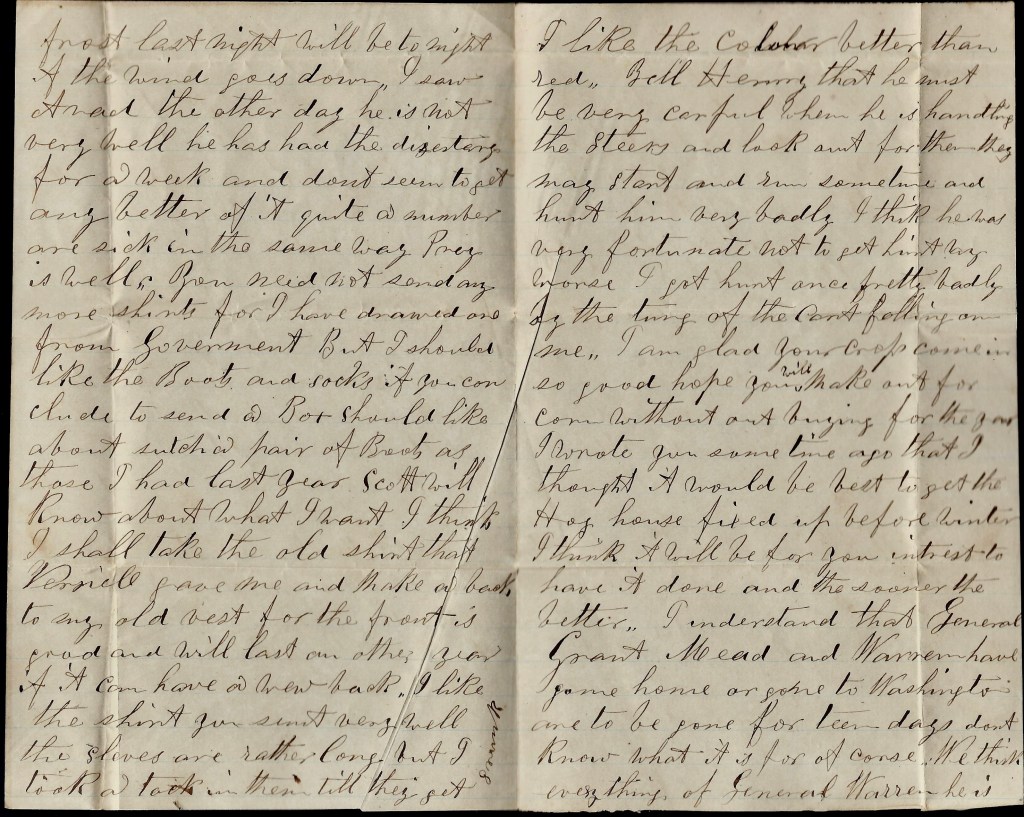
I saw Arad [Thompson] the other day. He is not very well. He has had the dysentery for a week and don’t seem to get any better of it. Quite a number are sick in the same way. Prez is well. You need not send any more shirts for I have drawed one from government. But I should like the boots and socks if you conclude to send a box. Should like about such a pair of boots as those I had last year. Scott will know about what I want. I think I shall take the old short that [Moses F.] Vernell gave me and make a back to my old vest for the front is good and will last another year if it can have a new back. I like the shirt you sent very well. The sleeves are rather long but I took a tack in them till they get shrunk. I like the color better than red.

Tell [our son] Henry that he must be careful when he is handling the steers and look out for them. They may start and run sometime and hurt him very badly. I think he was very fortunate not to get hurt any worse. I got hurt once pretty badly by the tung of the cart falling on me. I am glad your crop come in so good. Hope you will make out for corn without buying for the year. I wrote some time ago that I thought it would be best to get the hog house fixed up before winter. I think it will be for your interest to have it done and the sooner the better.

I understand that General Grant, Meade, and Warren have gone home or gone to Washington, Are to be gone for ten days. Don’t know what it is for of course. We think everything of General Warren. He is a working man, We have got a good Division Commander—General Griffin. We don’t know which is the best. They try to take care of their men but they are both fighting men but don’t rush head long into battle. They are cool and deliberate. That is the kind of men we like.

We have got a very good camping ground. Good place to stop all winter but I don’t expect we shall stop here long for I expect there will be a move made soon. I understand that Farragut has gone to Fortress Monroe to take charge of the James River fleet.

Bickmore’s brother’s wound 1 has got almost well and we expect him back to the regiment soon. Mr. Hall, uncle to Corp. Richards lost his leg in the last fight above the knee. The last we heard from him it was doing well. He (Hall) used to call on us quite often when he was with the regiment. I shan’t write again until I get a letter from you unless there is something more turns up for I have written two ahead of you now. If you send a box, you may send what you think best. I’ve forgotten that I owed Strickland more than two notes but I suppose it is all right. Derrell says supper is ready and I must close. Yours in haste, — Elisha

1 Most likely referring to Corp. Eli Bickmore of Co. I who was wounded at Cold Harbor on 3 June 1864.