Category Archives: 20th Massachusetts Infantry

1862: Ferdinand Dreher to John W. Le Barns

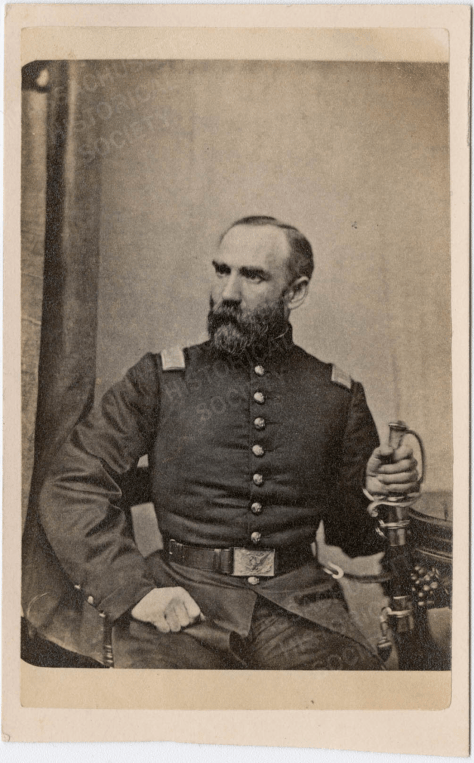
Capt. Ferdinand Dreher, Co. C. 20th Massachusetts (Mass. Historical Society)

The following letter was penned by Capt. Ferdinand Dreher (1821-1863) of Co. C, 20th Massachusetts Infantry. Ferdinand was an emigrant from Germany who married in Boston, Massachusetts, in 1857 to Margaret Lacroix. He was badly wounded at the Battle of Balls Bluff but returned to the regiment in time for the Peninsula Campaign. He was wounded again in the Battle of Fredericksburg and never recovered. He died of his wounds on 1 May 1863 as the Lieutenant Colonel of the regiment. Prior to his enlistment, Ferdinand was employed in Boston as a carriage painter.

Ferdinand wrote the letter to a former lieutenant of the regiment, John W. Le Barnes. He shares with him some of the internal politics and jealousies that were common in many regiments, but particularly in the 20th Massachusetts, sometimes called the “Harvard Regiment” because so many of its officers and enlisted men were Harvard men or from the privileged class of Boston society.

[Note: This letter is from the private collection of Greg Herr and was made available for transcription and publication on Spared & Shared by express consent.]

T R A N S C R I P T I O N

Bolivar Heights, Va.
October 8, 1862

Mr. Le Barns, dear sir!

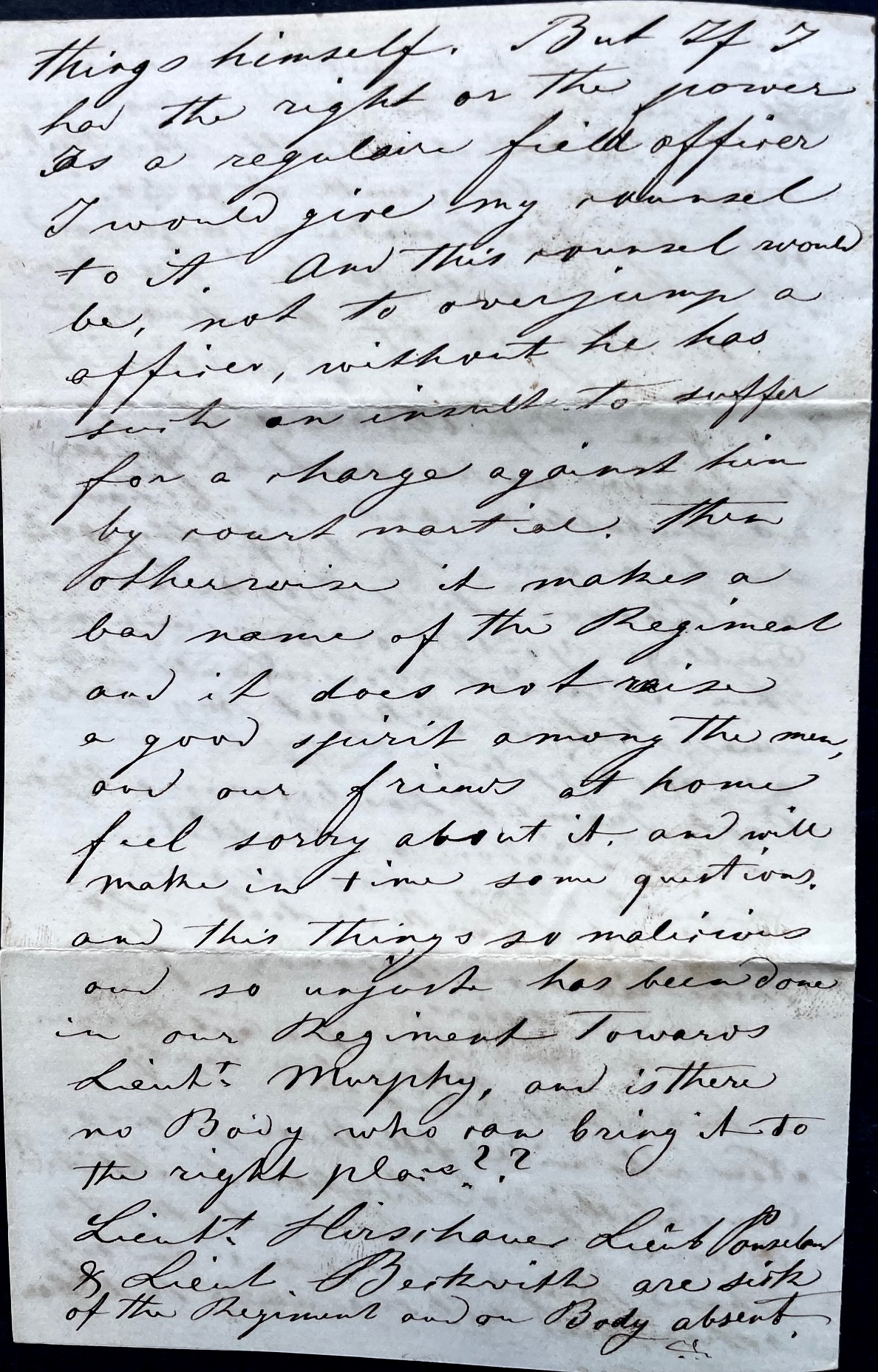
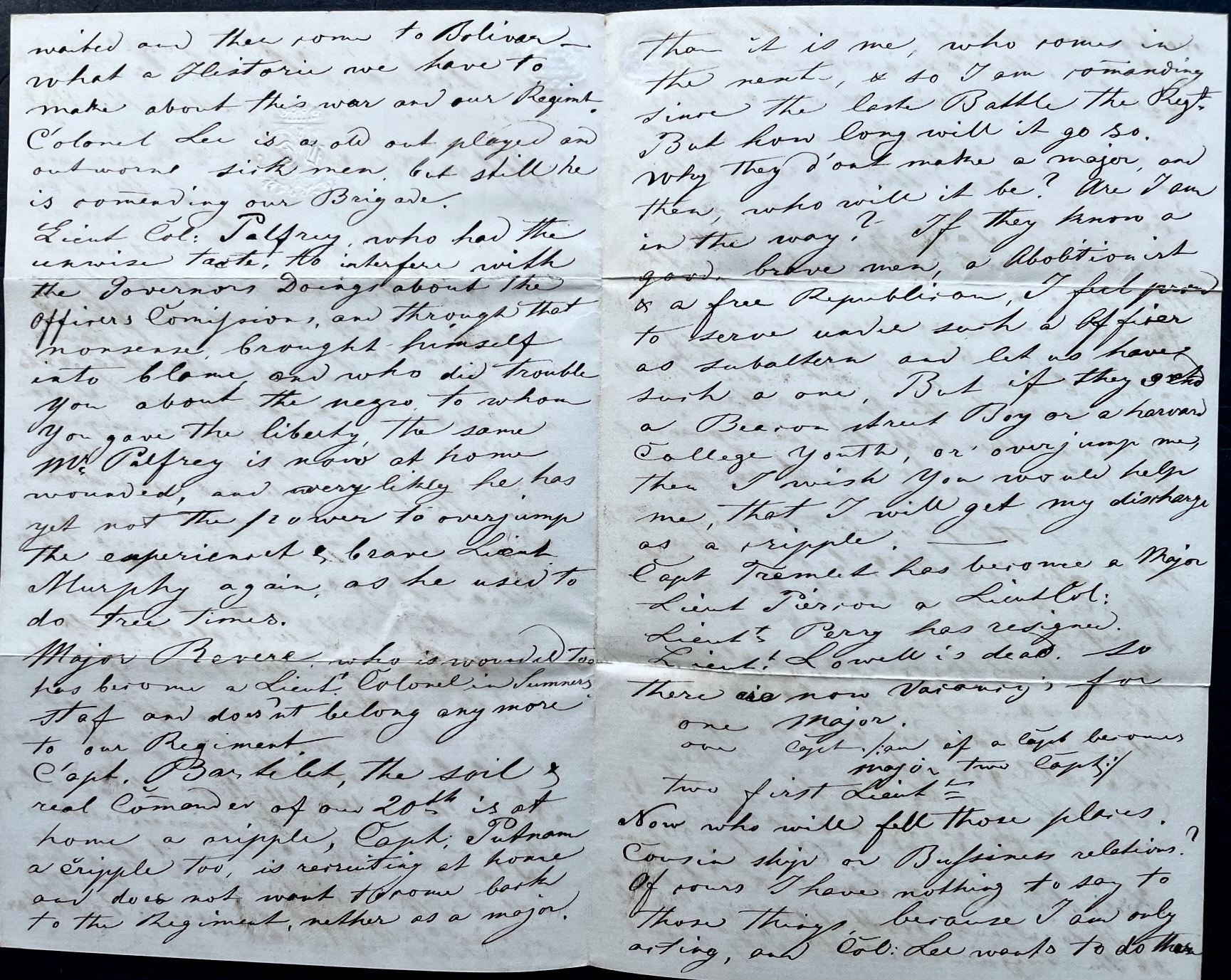
When I joined the regiment in the month of March last, it was in Bolivar and I did find you there in some disagreeable position which was anyhow honorable for you. Since that time I had to go home again to restore myself for another warfare, came back to the regiment, had to march to fight again and at present I find myself on the same place on which I have been six months ago. I suppose it would have been the same profit for me and the country if I had stopped in Boston, waited and then come to Bolivar. What a history we have to make about this war and our regiment. Colonel [William Raymond] Lee is an old, out-played and out-worn sick man but still he is commanding our Brigade.

Lieut. Col. [Francis Winthrop] Palfrey who had the unwise taste to interfere with the Governor’s doings about the officer’s commissions and through that nonsense brought himself into blame and who did trouble you about the negro to whom you gave the liberty, the same Mr. Palfrey is now at home wounded and very likely he has yet not the power to overjump the experienced & brave Lieut. Murphy again as he used to do tree times.

William Francis Bartlett—“the soul & real commander of our 20th” [Massachusetts Historical Society]

Major [Paul J.] Revere who is wounded too has become a Lieut. Colonel in Sumner’s staff and doesn’t belong anymore to our regiment. Capt. [William F.] Bartlett, the soul & real commander of our 20th is at home a cripple. Capt. [William Lowell] Putnam a cripple too, is recruiting at home and does not want to come back to the regiment, neither as a Major. Then it is to me who comes in the next & so I am commanding—since the last battle—the regiment. But how long will it go so. Why they don’t make a Major, and then, who will it be? Am I in the way? If they know a good, brave man, a abolitionist & a free Republican, I feel proud to serve under such an officer as subaltern and let us have such a one. But if they choose a Beacon Street boy or a Harvard College youth, or overjump me, then I wish you would help me that I will get my discharge as a cripple.

Capt. [Henry Martyn Tremlett has become a Major. Lieut. [Charles Lawrence] Pierson a Lieutenant-Colonel. Lieut. [George E.] Perry has resigned. Lieut. [James Jackson] Lowell is dead. So there are now vacancies for one Major; one Captain, or if Capt. becomes Major, two Captains; two First Lieutenants. Now who will fill those places? Cousinship or business relations? Of course I have nothing to say to those things because I am only acting, and Colonel Lee wants to do the things himself. But if I had the right or the power as a regular field officer, I would give my counsel to it. And this counsel would be not to overjump an officer without he has such an insult to suffer for a charge against him by court martial. Then, otherwise, it makes a bad name of the regiment and it does not raise a good spirit among the men and our friends at home feel sorry about it and will make in time some questions. And this thing so malicious and so unjust has been done in our regiment towards Lieut. Murphy and is there no body who can bring it to the right place??

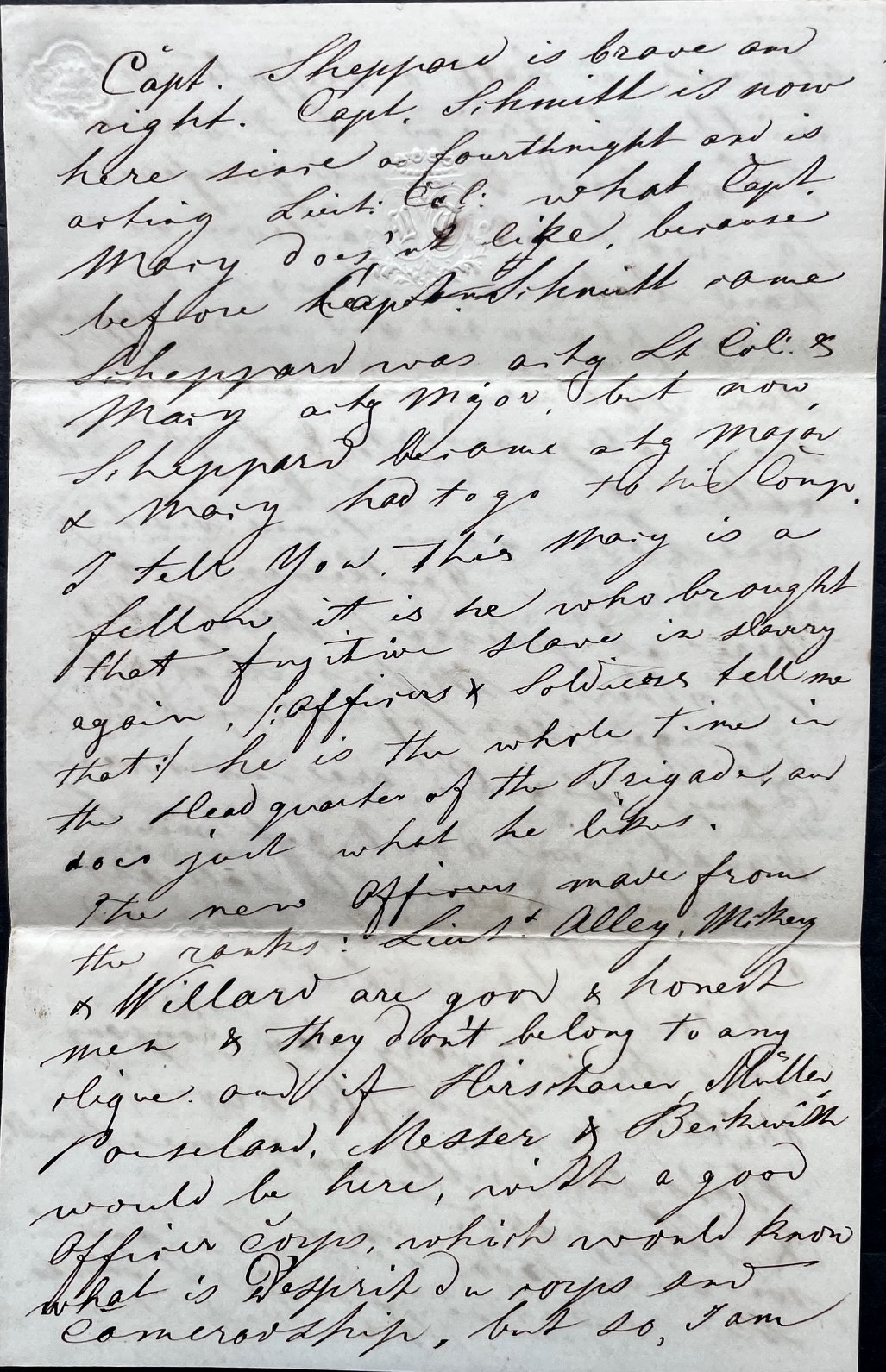
Lieut. Hirsthaver, Lieut. Panselar & Lieut. Berkwith are sick of the regiment and in body absent. Capt. [Allen] Shephard is brave and right. Capt. [George Adam] Schmitt is now here since a fortnight and is acting Lieut. Colonel. What Capt. [George N.] Macy doesn’t like because before Capt. Schmitt came, Shephard was acting Lieut. Colonel & Macy acting Major. But now Shephard became acting Major and Macy had to go to his company. I tell you, this Macy is a fellow. It is he who brought that fugitive slave in slavery again. Officers and soldiers tell me that he is the whole time in headquarters of the Brigade and does just what he likes.

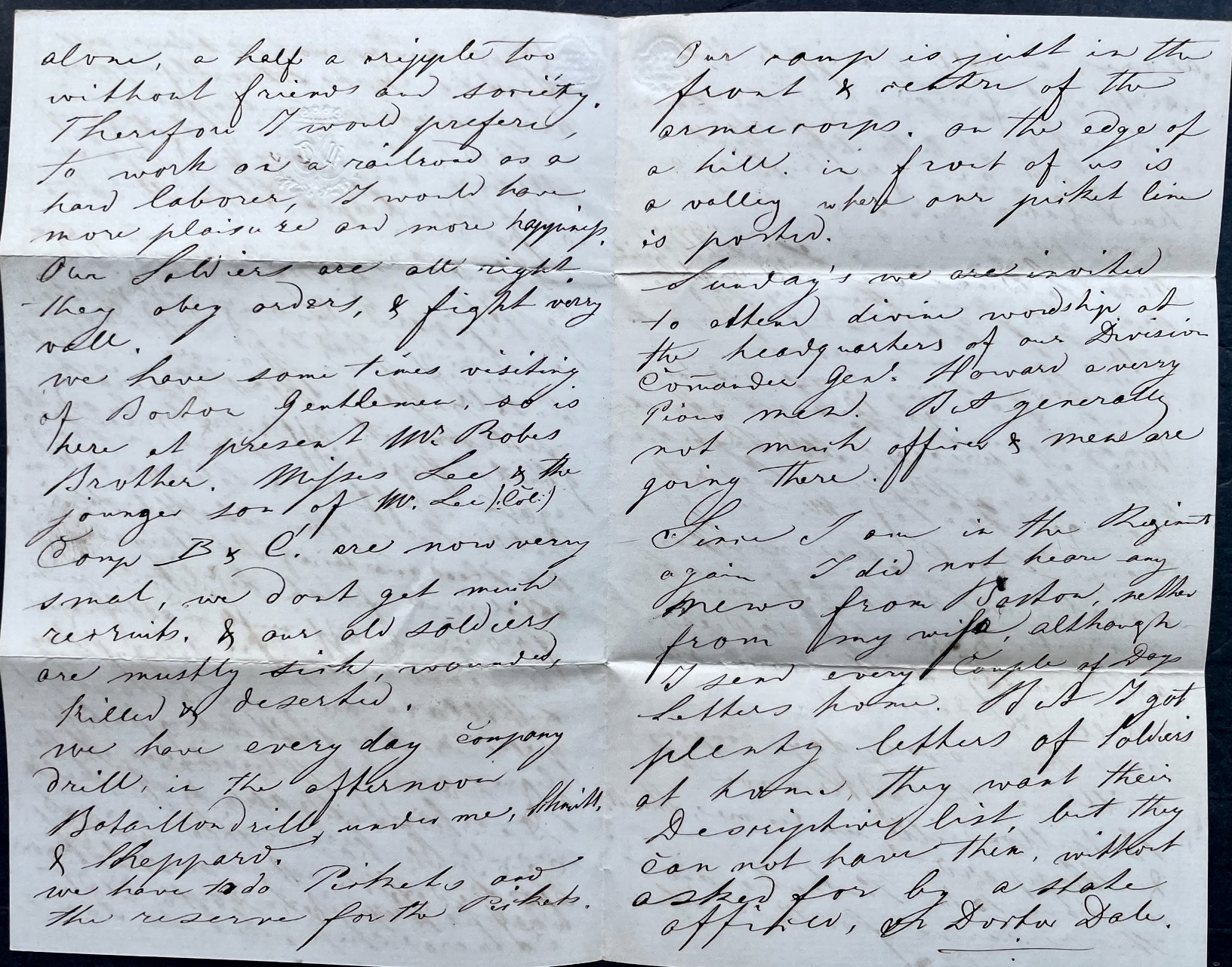
The new officers made from the ranks—Lieut’s. Alley, Mikey & Willard are good & honest men and they don’t belong to any clique. And if Hirsthouer, Miller, and Panselar, Messer & Beckwith would be here with a good officer corps, which would know what is d’esprit de corps and comradeship, but so I am alone, a half a cripple too with no friends and society. Therefore, I would prefer to work on a railroad as hard laborer. I would have more pleasure and more happiness. Our soldiers are all right. They obey orders & fight very well.

We have sometimes visiting of Boston gentlemen, so is here at present Mr. Rope’s brother, Misses Lee & the younger son of Mr. Lee (Col.)

Company B & C are now very small. We don’t get much recruits & our old soldiers are mostly sick, wounded, killed & deserted. we have every day company drill in the afternoon, Battalion drill under me, [ ] and Shephard. we have to do pickers and the reserve for the pickets.

Our camp is just in the front & centre of the Army Corps. On the edge of a hill in front of us is a valley where our picket line is posted. Sundays we are invited to attend divine worship at the headquarters of our Division Commander Gen. [O. O.] Howard—a very pious man. But generally not much officers & men are going there.

Since I am in the regiment again, I did not hear any news from Boston, neither from my wife, although I send every couple of days letters home. But I got plenty letters of soldiers at home. They want their Descriptive List but they cannot have them without asked for by a state officer or Doctor [William Johnson] Dale.

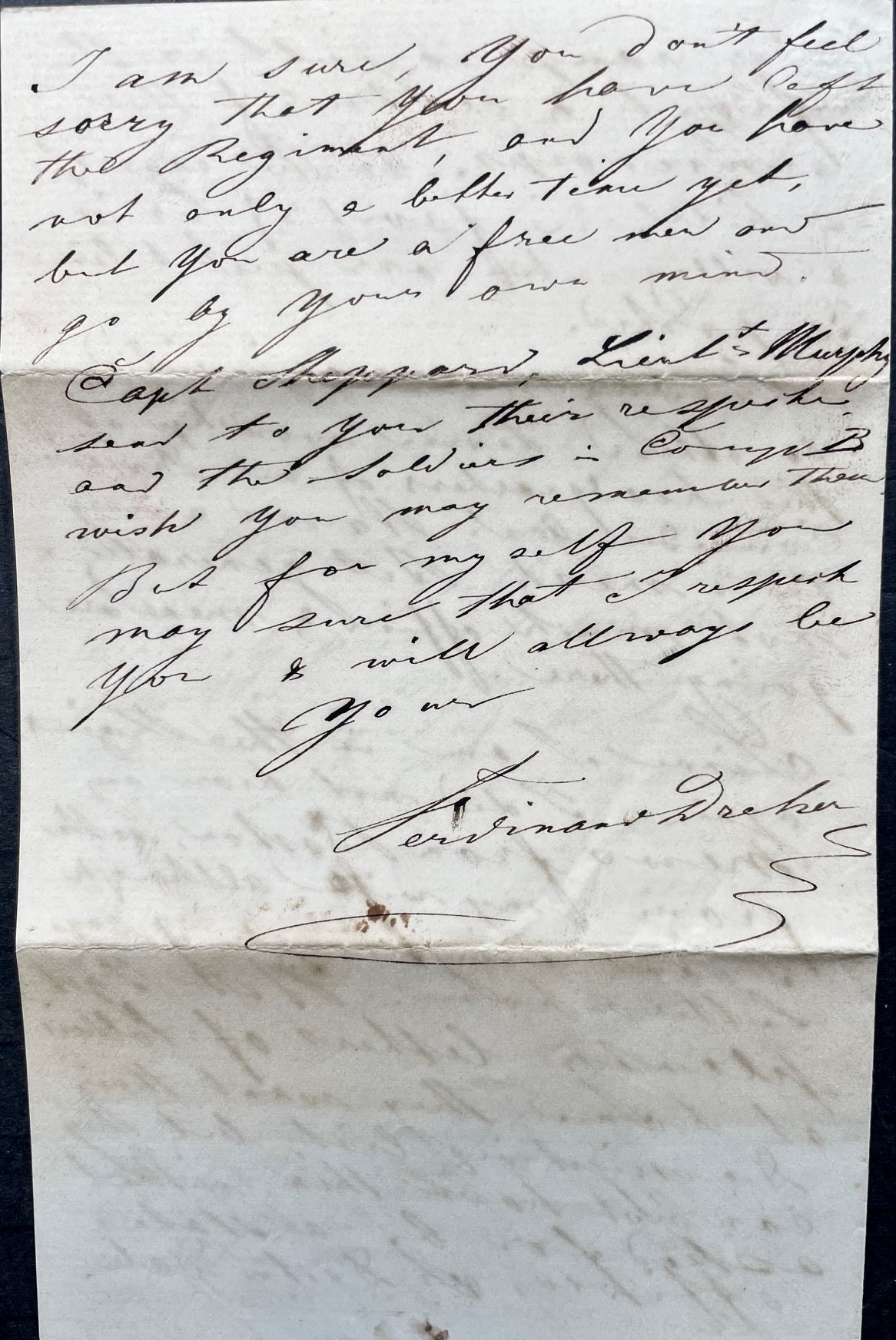
I am sure you don’t feel sorry that you have left the regiment and you have not only a better time yet, but you are a free man and go by your own mind.

Capt. [Allen] Shephard & Lieut. Murphy send to you their respects and the soldiers in Co. B wish you may remember them. But for myself, you may be sure that I respect you and will always be your, — Ferdinand Dreher

1861: Samuel Hamilton to John Hamilton

Samuel Hamilton was 20 years old when he enlisted on 28 August 1861 at Readville, Massachusetts, to serve three years in Congress. E, 20th Massachusetts Volunteers. According to muster rolls, he was wounded at Balls Bluff on 21 October 1861 (regimental history says he was captured). The only other entry in his muster rolls states that he deserted from Poolesville, Maryland on 15 January 1862, just five weeks after this letter was penned.

Samuel’s muster rolls do not state his place of residence. The regimental history gives his residence as “Chester, Delaware” which must mean Pennsylvania but I was unable to locate his family and there is no accompanying envelope to aid in further identification.

Transcription

Patriotic letterhead, “The Tomb and Shade of Ellsworth—His Spirit Lives”

Camp Benton 1
Poolville, Maryland
December 10, 1861

Dear Brother,

I received your last letter and I am very glad to hear that you are well and the rest of the family. We had a sham battle today and everything passed off without any accidents. I would have wrote to you sooner but I have been waiting for the certificate. Our colonel has gone off but as soon as he returns, I will get it off so as to send it next week.

Everything is very quiet round here. I do not think that our regiment will see any more fighting for there is but a few of us left. We are going to do picket duty this winter down to the river but our headquarters will be at the camp.

The last letter I received from sister, she wrote that she was going to send me some things but I have not received them yet. As soon as we get paid off I will send home every cent I get which will be the first of next moth.

Dear John, please tell Adam Sutton that I would like to hear from him. In my last letter I told you to tell him to write but I believe that you have delayed it for I have not heard from him. Tell sister that I have received but one paper from her yet. Tell her that I would like to have her send me the Ledger every week. Tell her when she writes again to put the direction on the letter very plain. I would like to hear from sister Elizabeth before I write to her.

Dear brother, I soon expect to be put in as a corporal. I am in very good health so far. You do not know how I would like to see you all which I hope will soon be. Give my love to Tommy. Tell him as soon as I get home I will give him a lot of pipes and tobacco. Give my love to father and mother and all the rest of the family. Tell them I would like to hear from them often.

Dear John, I will now close my letter by remaining your affectionate brother, Samuel Hamilton

My address is Samuel Hamilton, Company E, 20th Regt. M. V., Washington D. C.


1 Camp Benton was situated outside Poolesville, Maryland, on the east bank of the Potomac River, barely 35 miles from Washington. The camp was “laid out in a large wheat-field on the slope of a hill, surrounded by a beautiful running stream of clear, cold, water,—a healthy and lovely situation.” The regiment remained there for nearly six months.

1861: George Nelson Macy to Amasa Lyman Lincoln

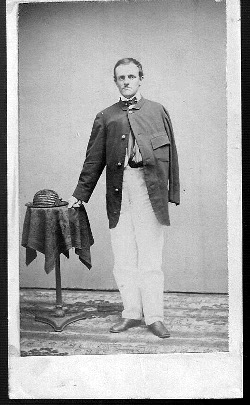
George Nelson Macy was born in Nantucket in 1837 to parents George Wendall and Lydia (Percival) Macy. In 1861, George was residing in Boston where he worked at a bank, when he heeded the call to join the Union Army during the U.S. Civil War. He was aged 23. He returned to Nantucket and recruited fellow islanders to join him in forming a company in the 20th Massachusetts Volunteer Infantry. In August 1861, George was commissioned 1st Lieutenant of Co. I.

Known as the “Harvard Regiment” due to the large number of Harvard graduates among its officers, the 20th Massachusetts played a major role in many of the most important battles of the Civil War, including Antietam, Fredericksburg, Chancellorsville, and Gettysburg, and was even present for General Robert E. Lee’s surrender at Appomattox. The Harvard Regiment also suffered the greatest number of casualties of any Massachusetts regiment, and ranked fifth in the Union Army overall, and became known as the “Bloody 20th.”

In one notable encounter when Union forces where routed at the Battle of Ball’s Bluff near Leesburg, Virginia, and forced to retreat across the Potomac River, George went in search for boats to ferry the wounded: “Lieutenant Macy now offered to swim over and see if there was a chance left for boats to be brought to the assistance of the others. Throwing off everything but his cap (in which he carried the miniature of his fiancé), and carrying his sword in his hand, he started and finally reached the island, but without his sword, which he was compelled to drop when nearly over. But not a boat of any kind was to be had.”

George Nelson Macy, after losing his hand at Gettysburg

George was wounded several times even losing his left hand at the Battle of Gettysburg but returned to service. He married Mary M. Hayden in Feb 1863 (between the first Battle of Fredericksburg and the Chancellorsville Campaign).

George served as Brevet General from August 1864.

After the war, George returned to work at a bank in Boston. Despite surviving the war, he was killed in 1875 by a gunshot wound, apparently accidentally self-inflicted with his own pistol. He was aged 37.

Throughout the war, George Macy maintained a correspondence with his friend Amasa Lyman Lincoln, a Boston banker. Lincoln kept these letters, as well as a scrapbook containing clippings relating to the 20th Massachusetts and other contemporary events. After the end of the Civil War, Amasa Lincoln and his family moved to Santa Barbara, California, where they established a hotel they called the Lincoln House. Today known as the Upham Victorian Hotel & Cottage Gardens, it is the oldest continuously operating hostelry in Southern California. The George N. Macy / Amasa L. Lincoln Papers (ca. 1779-1899) are held in the UC Santa Barbara Special Collections.

At the time this letter was written the 20th Massachusetts was performing outpost duty at Edwards Ferry (four companies) and at Camp Lee (two companies), five nights a week. Camp Benton was located outside Poolesville, Maryland, on the east bank of the Potomac river, 35 miles from Washington. It was occupied at the time by both the 19th and 20th Massachusetts.

[Note: This letter is from the personal collection of Jeremiah Bowers who asked for help in identifying the author on the public website, The American Civil War on 27 May 2024.]

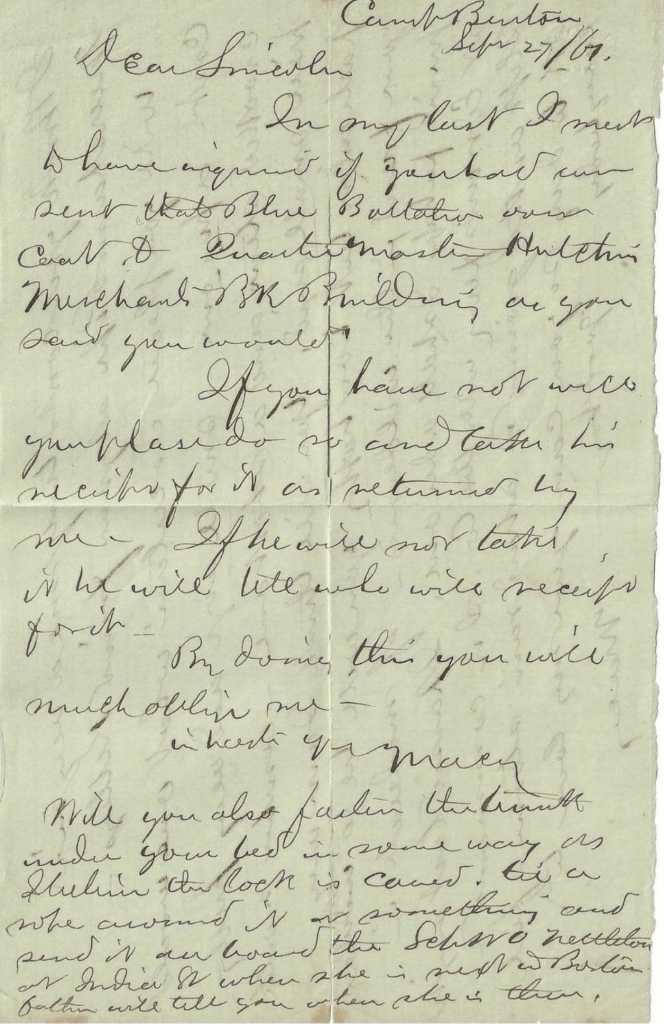
Transcription

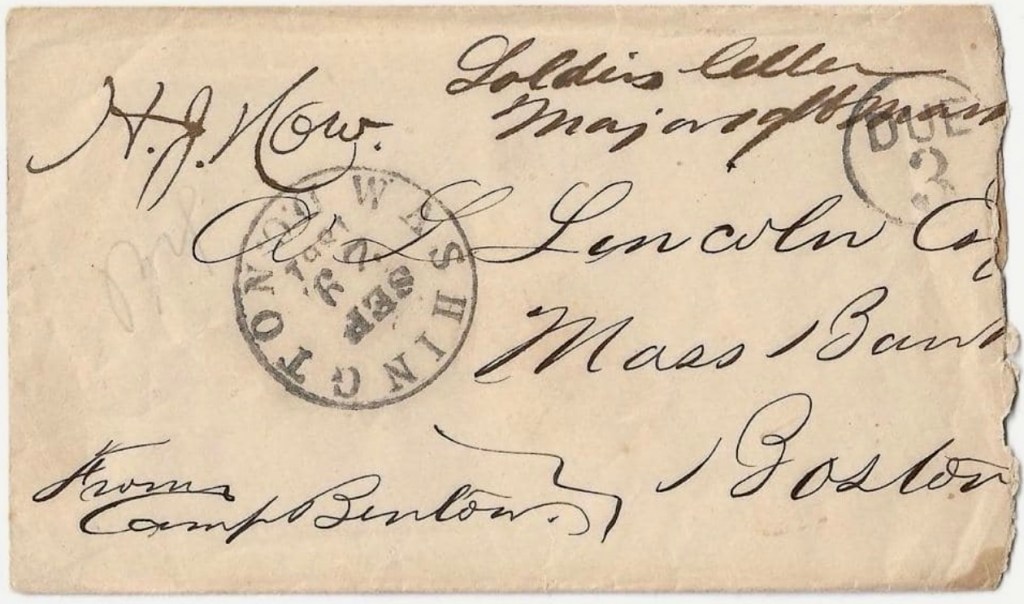
Addressed to A. L. Lincoln, Esq., Mass Bank, Boston
From Camp Benton

Camp Benton
September 27, 1861

Dear Lincoln

In my last I meant to have inquired if you had ever sent that Blue Battalion over coat to Quartermaster Hutchins, Merchants RR Building, as you said you would. If you have not, will you please do so and take his receipt for it as returned by me. If he will not take it, he will tell who will receipt for it. By doing this, you will much oblige me.

In haste, yours, — Macy

Will you also fasten the trunk under your bed is some way as I believe the lock is caved. Tie a rope around it or something and sent it on board the schooner Nettleboro at India St. when she is next in Boston. Father will tell you when she is there.

I think you could find me a very nice Meershaum Pipe at your friend Kelleys. Will you please ascertain what one would cost—a fine one—small size and very pretty, crooked stem and a short one–amber mouthpiece, small sized. You will think I am very particular but how happy you will be to indulge your friend in the wilderness. If moderate in price, perhaps I shall order one.

I passed last night at Edwards Ferry with the company—I in command. Slept on the ground in a hard rain storm—feel OK today. So you can give my love to everybody. Goodbye. — Macy