
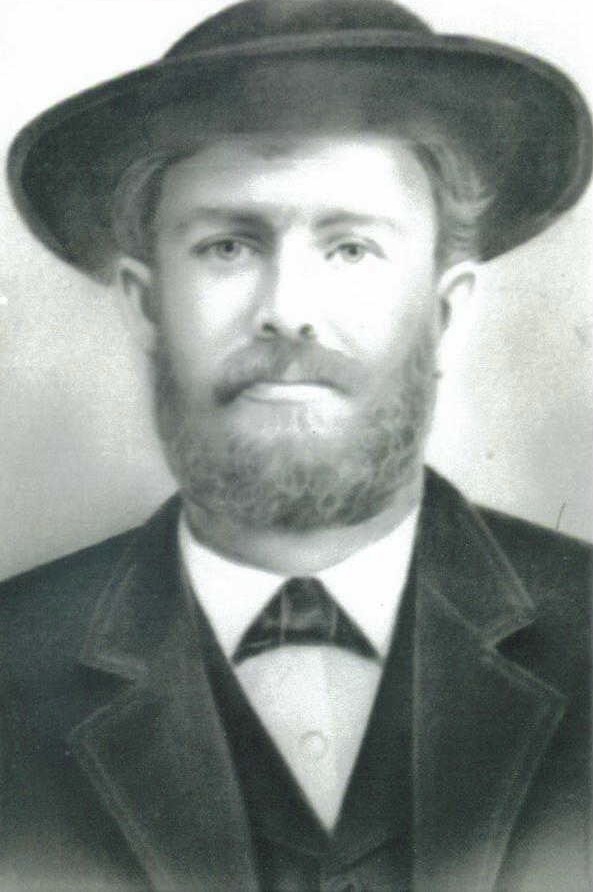
The following letter was written by Benjamin Milton Miller (1843-1877) while serving as a sergeant in Co. K, 21st Kentucky Infantry. Benjamin was the son of George Miller (1793-1848) and Louisa Yates (1820-1869) of Edmunton, Metcalfe county, Kentucky. He lays “claim” to a young woman named “Kate” in this letter who may very well be the woman he married in 1865, Eliza Catherine Kirkewall (1842-1929).
In his letter, Ben mentions that they have recently had an organizational change. Indeed, the 21st Kentucky had been part of the 21st Army Corps until October 1863 when they were reassigned to the 4th Army Corps.
Benjamin wrote the letter to his friend, James W. Pool (1838-1933) who was identified as a merchant clerk in 1860 in Edmunton.
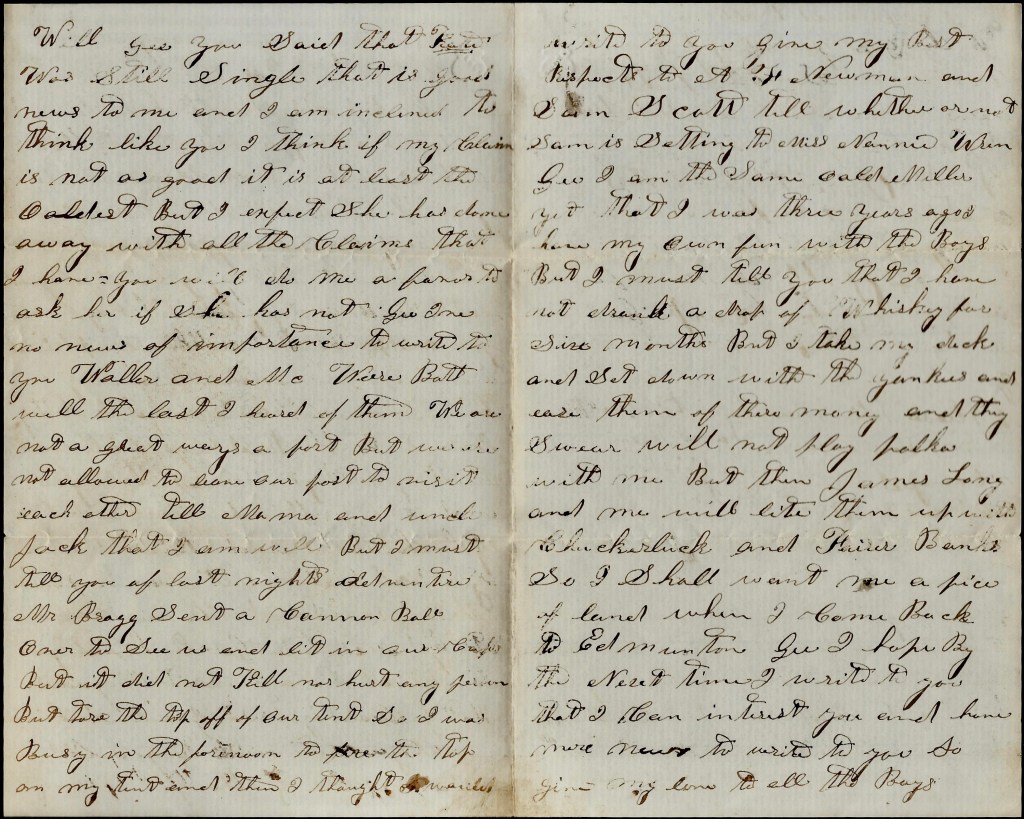
Transcription
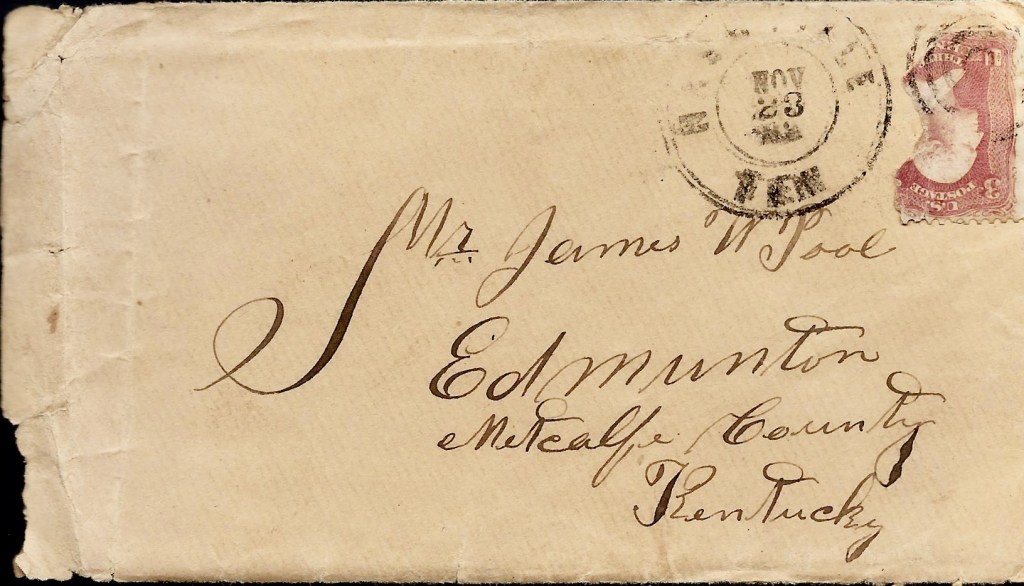
Camp on South Mountain of Walden’s Ridge
November 15th, 1863
Kind friend a old associate,
Yours of the 30th of last month came to hand a few days since. It found me in the enjoyment of good health. I was very glad to hear from you and I was somewhat surprised to hear of Ben Clark’s marrying but was not astonished to hear that S. R. W. Ried was still waiting to marry. But you said that you was still in good spirits about yourself as Ben was colder than you ever was. Well gee, it seems that there is and will be a chance for you and I both when such men as Ben and Sam could not call names until you was certain you could tell me who you thought it was.
Well gee, you said that Kate was still single. That is good news to me and I am inclined to think like you. I think if my claim is not as good, it is at least the oldest but I expect she has done away with all the claims that I have. You will do me a favor to ask her if she has not.
Gee, I’ve no news of importance to write to you. Waller and McWare [were] both well the last I heard of them. We are not allowed to leave our fort to visit each other. Tell Mama and Uncle Jack that I am well. But I must tell you of last night’s adventure. Mr. Bragg sent a cannon ball over to see us and lit in our camp. But it did not kill nor hurt any person. But tore the top off of our tent so I was busy in the forenoon to fix the top on my tent and then I thought I would write to you.
Give my best respects to A. F. Newman and Sam Scott. Tell whether or not Sam is setting to Miss Nannie Wren. Gee, I am the same old Miller yet that I was three years ago. Have my own fun with the Boys. But I must tell you that I have not drank a drop of whiskey for six months. But I take my deck [of cards] and sit down with the Yankees and ease them of their money and they swear [they] will not play poker with me. But then James Long and me will light them up with Chuckerluck [Chuck-A-Luck] 1 and Fairer Banks [“Farobank”] 2. So I shall want me a piece of land when I come back to Edmunton. Gee, I hope by the next time I write to you that I can interest you and have more news to write to you. So give my love to all the Boys and girls and to all my friends.
So I will close by saying write soon. I am your friend, — B. M. Miller
P. S. Direct your letter to 1st Brigade, 2nd Division, 4th Army Corps
Please tell ma how to direct her letters as we have been changed from our division since I wrote to her. — B. M. Miller
1 Chuck-a-luck is a game of chance and as such, favors the dealer rather than the players. No skill is necessary. The person hosting the game (dealer) has a cloth marked into six spaces numbered 1-6. This “playing board” can be traced into the dirt if one did not have a cloth. Players would select their number by placing their money on the appropriate square. The dealer then rolls three dice. If the player’s number comes up on one of the dice, he wins and gets his money back. If that number comes up on two dice, the player doubled his money; if the number comes up three times, one’s winnings are tripled. The odds, however, are in the dealer’s favor, because he got all the money left that did not come up on the dice.
2 The faro table was typically oval, covered with green baize, and had a cutout for the banker. A board with a standardized betting layout consisting of all cards of one suit pasted to it in numerical order, called the “layout”, was placed on top of the table. Traditionally, the suit of spades was used for the layout. Each player laid his stake on one of the 13 cards on the layout. Players could place multiple bets and could bet on multiple cards simultaneously by placing their bet between cards or on specific card edges. Players also had the choice of betting on the “high card” bar located at the top of the layout.



 Spared & Shared 23