
A 21 year-old farmer from Hardwick, Massachusetts—the son of Alonzo Emmons and Abigail Lawrence—Marcus A. Emmons enlisted for three years’ service in August 1861. Joining Co. K of the 21st Massachusetts Infantry, he was mustered into federal service late in the month and shipped out almost immediately for garrison duty in Annapolis. As part of Ambrose Burnside’s expedition to North Carolina beginning in January 1862, the 21st took part in several major engagements, including the battles of Roanoke Island, New Berne, and South Mills, before they were sent to Viginia during the summer to join the main body of the Army of the Potomac. Emmons’ regiment sustained heavy casualties in the long succession of battles (Bull Run, South Mountain, Antietam, and Fredericksburg), but particularly at Chantilly in September 1862, where they sustained 35% casualties.
Between March 1863 and January 1864, the 21st Massachusetts Infantry served in Kentucky and eastern Tennessee, but they returned to the Army of the Potomac for the spring campaigns of 1864. Emmons performed exceptionaly well in the military, earning promotion to Corporal (Nov. 10, 1862) and then Sergeant (Sept. 1, 1863), before his reenlistment in January 1864. His regiment, however, suffered heavily. Around the time that Emmons was killed in action at Bethesda Church (Battle of Cold Harbor) on June 2, 1864, the 21st had been reduced from around 1,000 men to barely 100, forcing them to consolidate into the 36th Massachusetts Infantry.
Emmons was described by his comrade, James Madison Stone, as “an awkward, unsoldierly appearing man, “but a man of considerable intellectual ability and a man of splendid character, and, so far as I ever saw, he was as brave as the bravest, without any show or parade, but always did his duty faithfully.” [Source: Marcus A. Emmons Papers, 1858-1864. Special Collections. Amherst.]
See also—1862: Samuel Ives Curtiss to Marcus A. Emmons published on Spared & Shared 6.
T R A N S C R I P T I O N
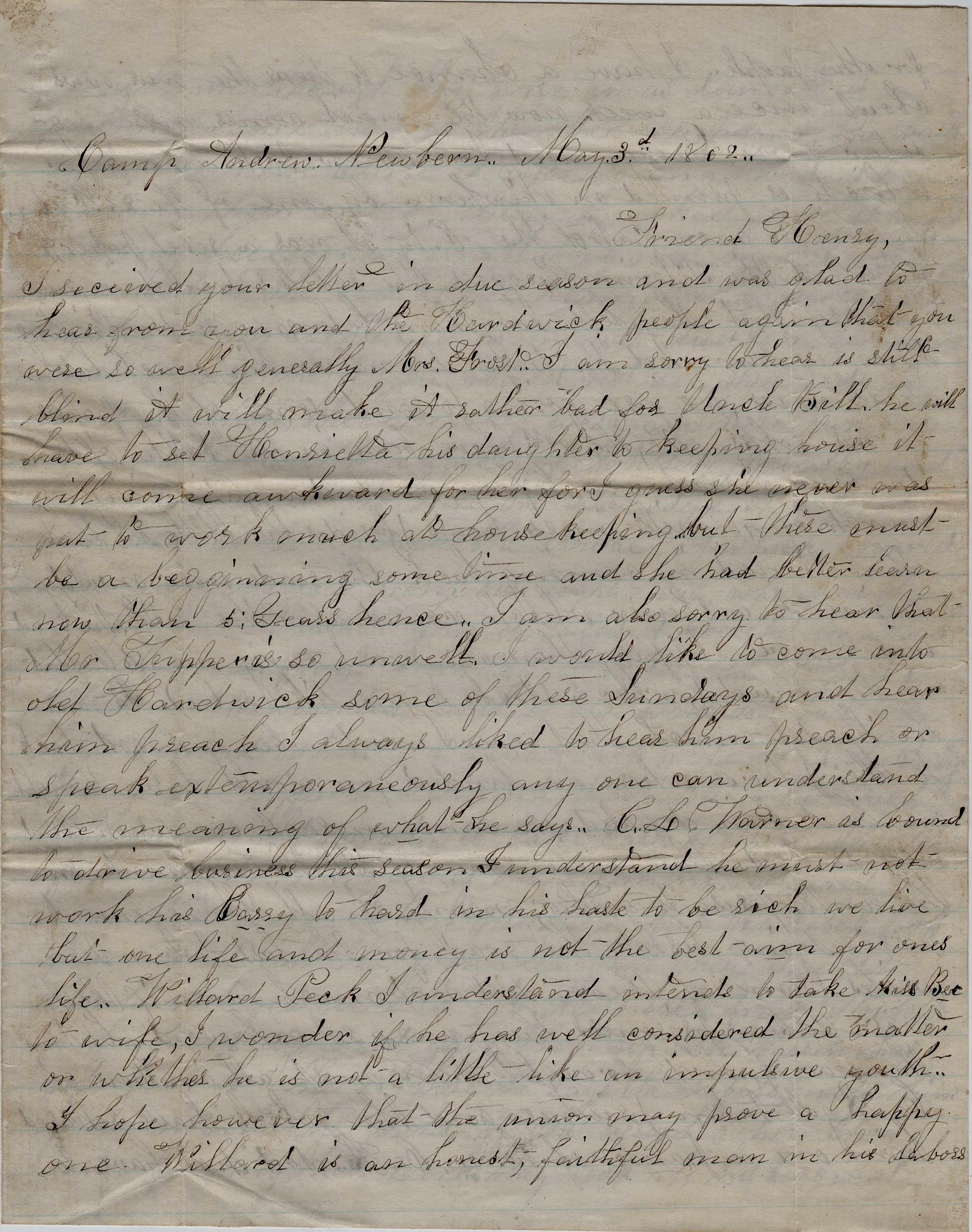
Camp Andrew, New Bern
May 3rd 1862
Friend Henry,
I received your letter in due season and was glad to hear from you and the Hardwick people again that you were so well generally. Mrs. Frost I am sorry to hear is still blind. It will make it rather bad for Uncle Bill. He will have to set Henrietta his daughter to keeping house. It will come awkward for her for I guess she never was put to work much at housekeeping but there must be a beginning sometime and she had better learn now that 5 years hence.
I am also sorry to hear that Mr. [Martyn] Tupper is so unwell. I would like to come into old Hardwick some of these Sundays and hear him preach. I always liked to hear him preach or speak extemporaneously. Anyone can understand the meaning of what he says. C. L. Warner is bound to drive business this season. I understand he must not work his Carry [?] too hard in his haste to be rich. We live but one life and money is not the best aim for one’s life.
Willard Peck I understand intends to take Miss Bec to wife. I wonder if he is not a little like an impulsive youth. I hope however that the union may prove a happy one. Willard is an honest, faithful man in his labors for other people.
I have a chance to hear the war news about once a week now. The mail comes more regular now. George and I am taking a paper which is printed in Newbern by one of the 25th Regiment Mass. Vols. who now patrol the city. It was a rebel paper & is called the Pilgrim Progress. The rebels retreated in such a hurry that they left everything belonging to the Printing Office unharmed. The paper does not contain much but local news. We are going to send some of the papers to our folks.
We, the 21st, have been in the Battle of Camden [South Mills] since I wrote you before. We had a fatiguing march of 40 miles in 24 hours (besides the battle in that time). In coming back the roads were muddy owing to a shower which occurred after the battle. The road was more slippery than ice. Most everyone fell flat in the mud (which sticks to one like salve). It was the hardest march that ever I went. When we got back to the place where we landed, you would have thought we had been defeated, we came in such confusion and were so tired. There were some of the regiments in the enterprise together. Many of all the regiments were lying beside the road for the last two or three miles. Some of them did not much care of they were taken prisoners, they were so exhausted. But the rear guard brought them most all in. One of Co. B got taken prisoner and the rebels have released him on a parole of honor.
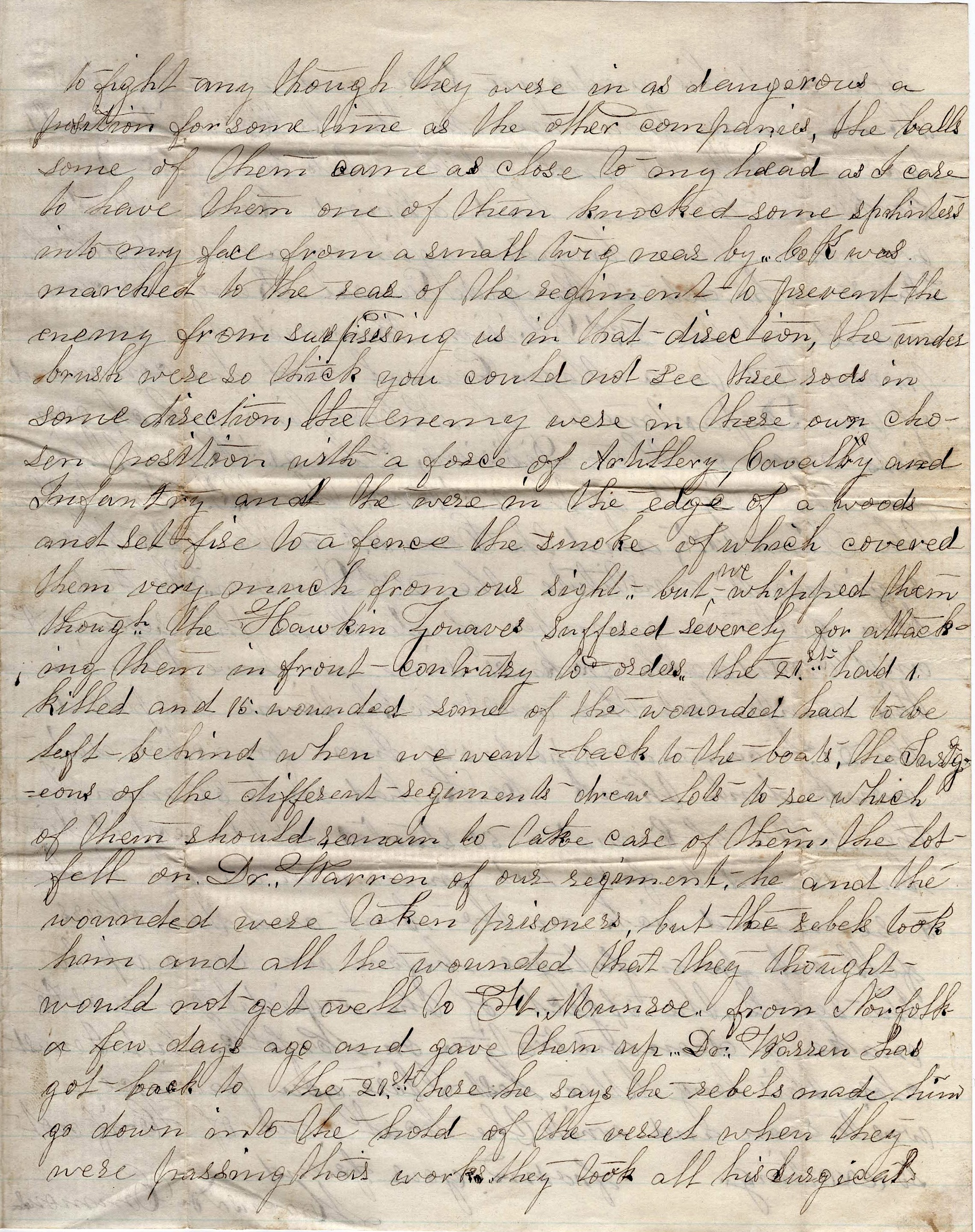
Co. K did not have to fight any though. They were in as dangerous a position for some time as the other companies. The balls—some of them—came as close to my head as I care to have them. One of them knocked some splinters into my face from a small twig nearby. Co. K was marched to the rear of the regiment to prevent the enemy from surprising us in that direction. The underbrush were so thick you could not see three rods in some direction. The enemy were in their own chosen position with a force of artillery, cavalry, and infantry and they were in the edge of a woods and set fire to a fence, the smoke of which covered them very much from our sight. But we whipped them through. The Hawkins Zouaves [9th New York Infantry] suffered severely for attacking them in front, contrary to orders. The 21st had 1 killed and 15 wounded.

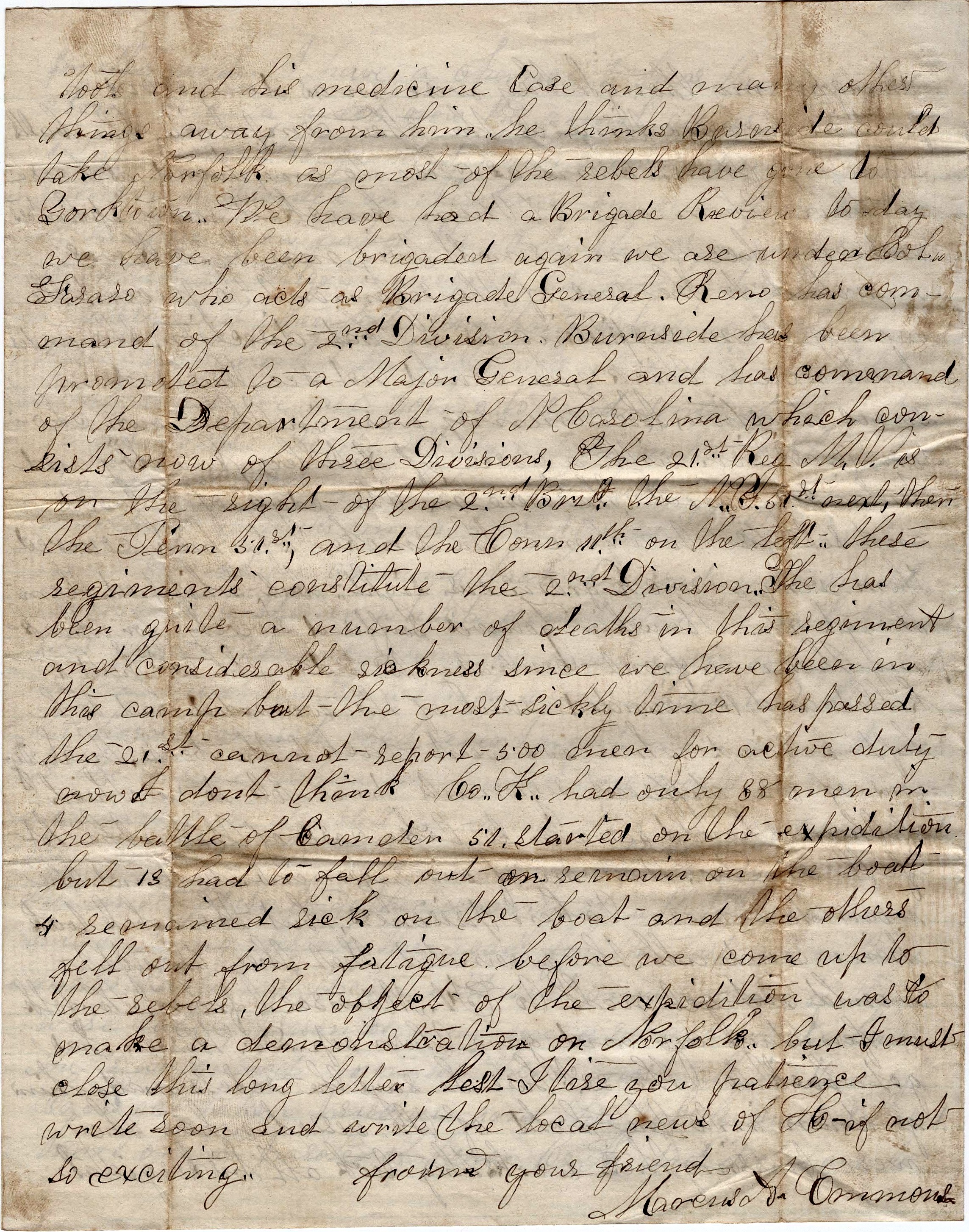
Some of the wounded had to be left behind when we went back to the boats. The surgeons of the different regiments drew lots to see which of them should remain to take care of them. The lot fell on Dr. Warren of our regiment. He and the wounded were taken prisoners but the rebels took him and all the wounded that they thought would not get well to Ft. Monroe from Norfolk a few days ago and gave them up. Dr. Warren has got back to the 21st here. He says the rebels made him go down into the hold of the vessel when they were passing their works. They took all his surgical tools and his medicine case and many other things away from him. He thinks Burnside could take Norfolk as most of the rebels have gone to Yorktown.
We have had a Brigade Review today. We have been brigaded again. We are under Col. Ferrero who acts as Brigade General. Reno has command of the 2nd Division. Burnside has been promoted to a Major General and has command of the Department of North Carolina which consists now of three divisions. The 21st Regt. M. V. is on the right of the 2nd Brigade, the New York 51st next, then the Pennsylvania 51st, and the Connecticut 11th on the left. These regiments constitute the 2nd Division.
There has been quite a number of deaths in this regiment and considerable sickness since we have been in this camp but the most sickly time has passed. The 21st cannot report 500 men for active duty now, I don’t think. Co. K had only 88 men in the Battle of Camden. 51 started on the expedition but 13 had to fall out or remain on the boat. Four remained sick on the boat and the others fell out from fatigue before we come up to the rebels. The object of the expedition was to make a demonstration on Norfolk.
But I must close this long letter lest I lose your patience. Write soon and write the local news of Hardwick if not so exciting. From your friend, — Marcus A. Emmons


 Spared & Shared 23