Category Archives: 21st Ohio Infantry

1863: John Bookman Zarbaugh to his In-laws

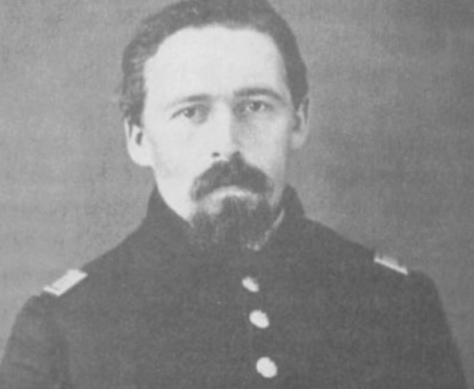
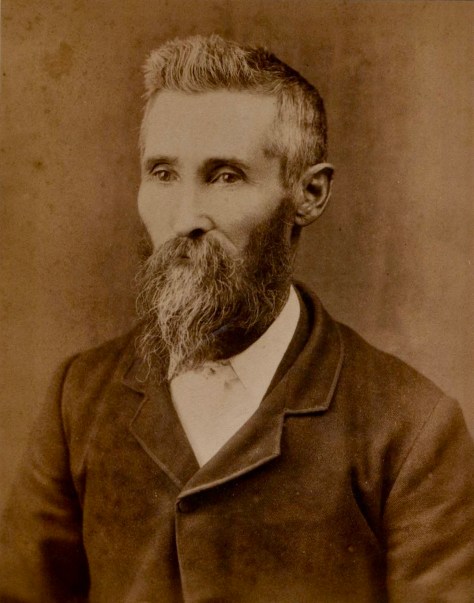
A post war image of John B. Zarbaugh of Co. G, 21st OVI

The following letter was written by John Bookman Zarbaugh (1837-1919), the son of John Zarbaugh and Mary Bookman of Canal Winchester, Franklin county, Ohio. John served as a private in Co. G, 21st Ohio Volunteer Infantry (OVI) from September 1861 to September 1864. John was married to Mary A. Noss in September 1858. Sometime before 1880, John moved with his family to Portage, Hancock county, Ohio, and by 1900 to North Star, Gratiot county, Michigan. He died in Ithaca, Michigan.

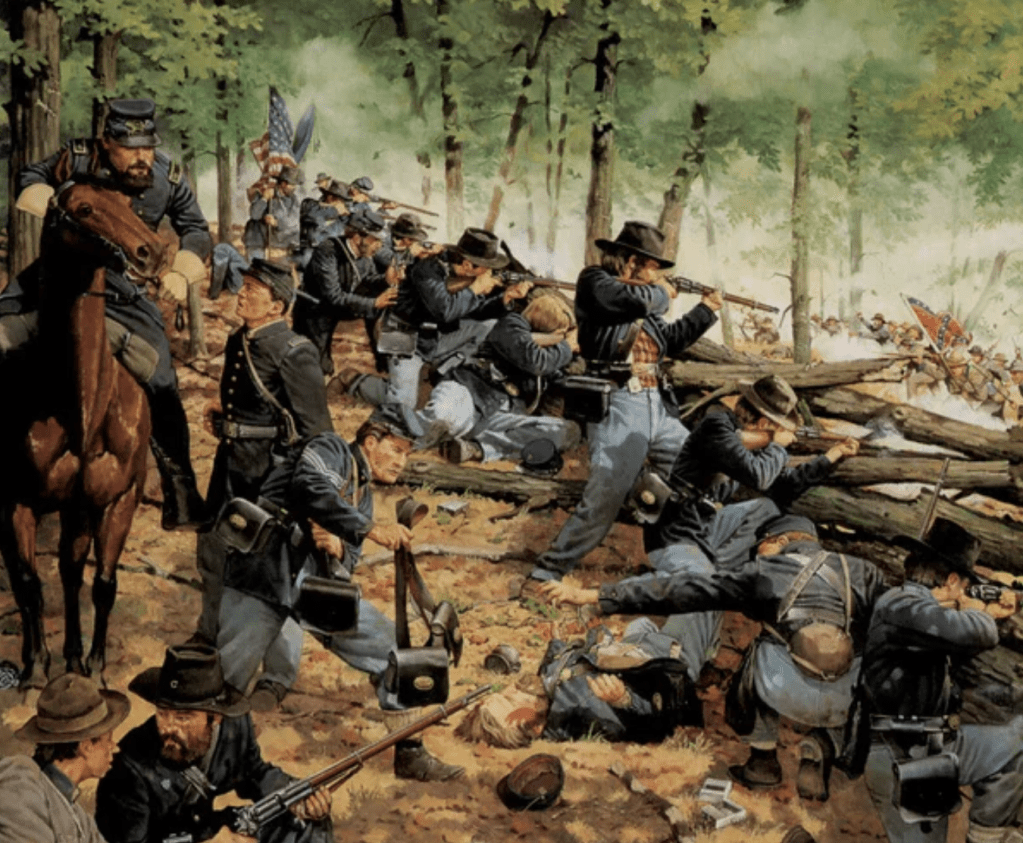
The 21st OVI had a long and glorious military record. They were engaged in many of the major engagements of the Western Theater, including Stones River, Chickamauga, the Atlanta Campaign, and Sherman’s March to the sea and Carolina Campaign. With their five-shot Colt Revolving Rifles, they could be counted on to deliver a murderous fire on any attacking column and helped to repel several assaults on Snodgrass Hill in the Battle of Chickamauga. However, they eventually ran out of ammunition and were surrounded, losing over half their men (243 of 561) to casualties and capture.
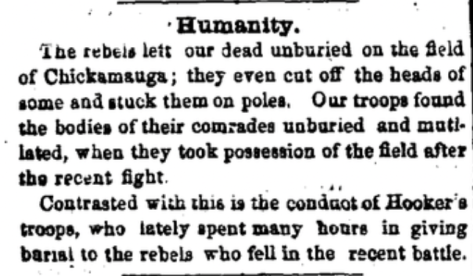
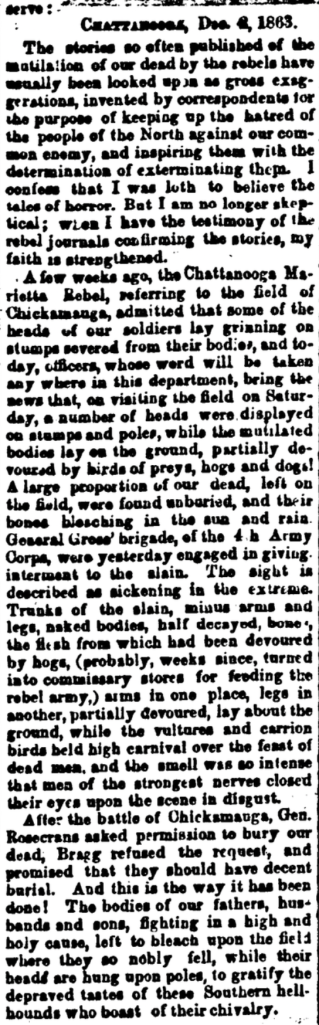
Example of reported atrocities. Hartford Evening Press, 4 December 1863

Loss of the field and Union retreat meant leaving dead and dying comrades on the field so the anguish expressed by Zarbaugh at the report of unburied and mutilated corpses was certainly understandable. Though Zarbaugh’s letter contains only hearsay, the reports of Rebel atrocities such as the dead left unburied for a couple of months on the battlefield, and the cutting off of heads and sticking them on stumps or poles was printed in many newspapers in December 1863.
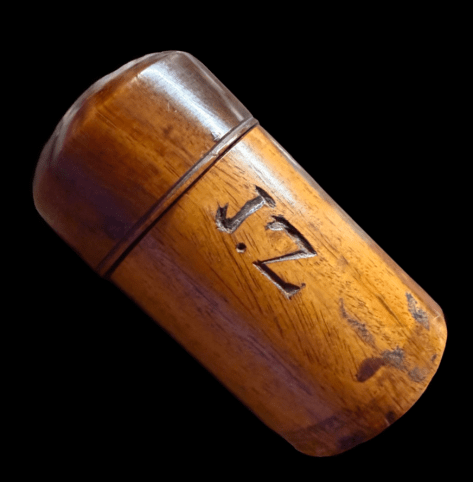
The inkwell used by John B. Zarbaugh during the Civil War.

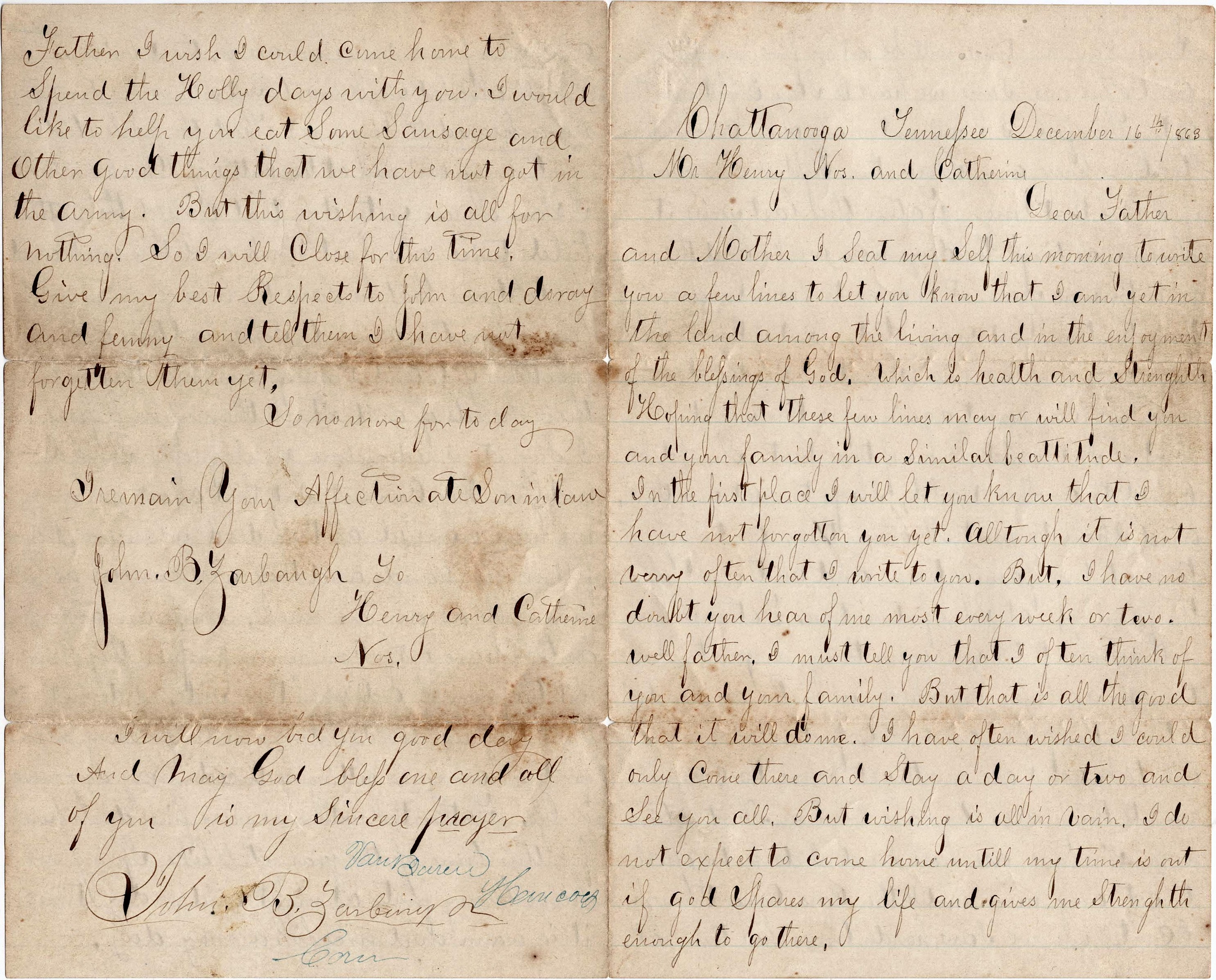
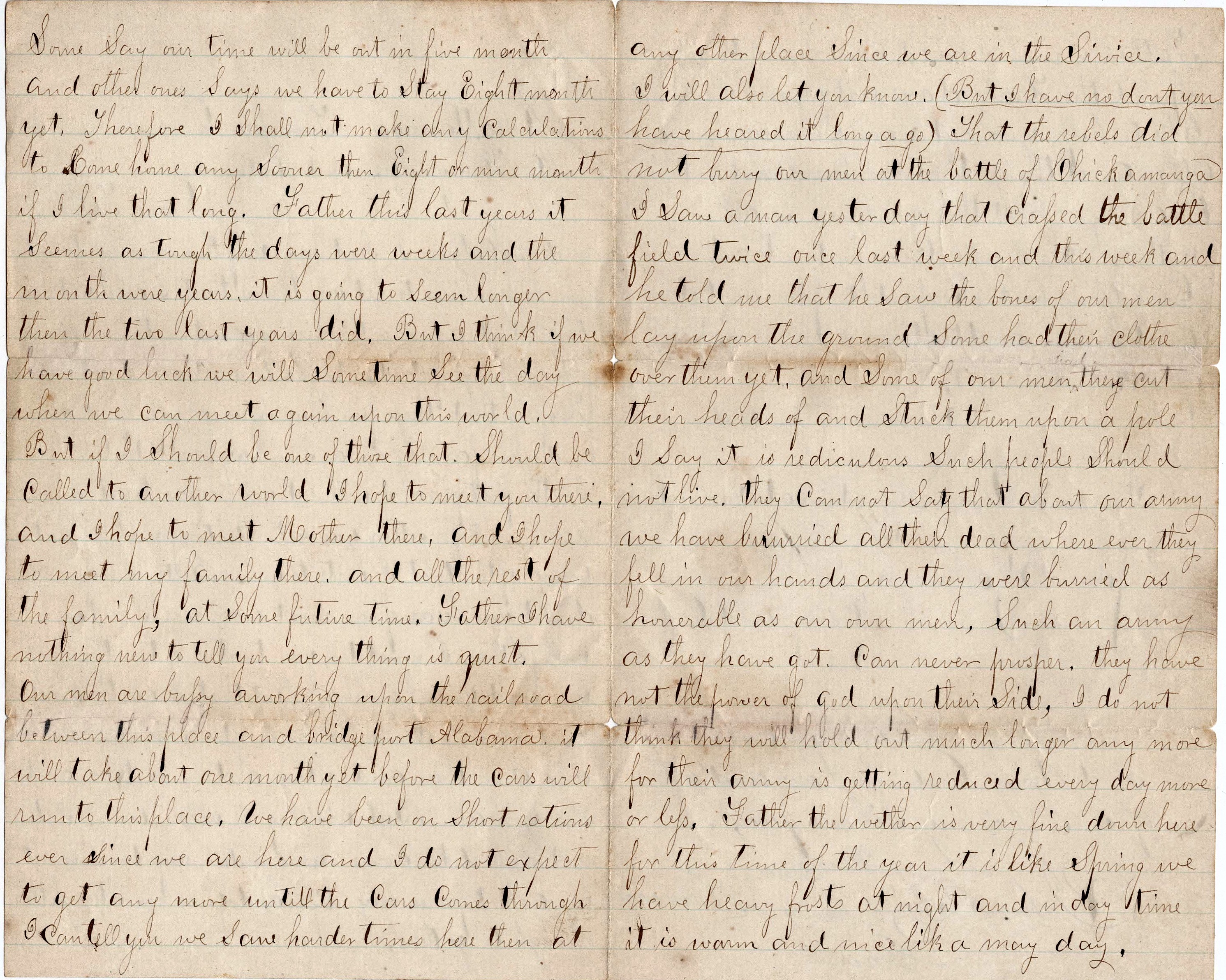
T R A N S C R I P T I O N

Chattanooga, Tennessee
December 16, 1863

Mr. Henry Noss and Catherine
Dear Father and Mother,

I seat myself this morning to write you a few lines to let you know that I am yet in the land among the living and in the enjoyment of the blessings of God, which is health and strength. Hoping that these few lines may or will find you and your family in a similar beatitude.

In the first place, I will let you know that I have not forgotten you yet, although it is not very often that I write to you. But I have no doubt you hear of me most every week or two. Well father, I must tell you that I often think of you and your family. But that is all the good that it will do me. I have often wished I could only come there and stay a day or two and see you all. But wishing is all in vain. I do not expect to come home until my time is out if God spares my life and gives me strength enough to go there.

Some say our time will be out in five months and other ones say we have to stay eight months yet. Therefore I shall not make any calculations to come home any sooner than eight or nine months—if I live that long. Father, this last year it seems as though the days were weeks and the months were years. It is going to seem longer than the two last years did. But I think if we have good luck, we will sometime see the day when we can meet again upon this world. But if I should be one of those that should be called to another world, I hope to meet you there and I hope to meet Mother there, and I hope to meet my family there and all the rest of the family at some future time.

Father, I have nothing new to tell you. Everything is quiet. Our men are busy a working upon the railroad between this place and Bridgeport, Alabama. It will take about one month yet before the cars will run to this place. We have been on short rations ever since we are here and I do not expect to get any more until the cars come through. I can tell you we saw harder times here than at any other place since we are in the service.

I will also let you know (but I have no doubt you have heard it long ago), that the rebels did not bury our men at the Battle of Chickamauga. I saw a man yesterday that crossed the battlefield twice—one last week and this week—and he told me that he saw the bones of our men lay upon the ground. Some had their clothes over them yet and some of our men, they cut their heads off and stuck them upon a pole. I say it is ridiculous. Such people should not live. They cannot say that about our army. We have buried all their dead wherever they fell in our hands and they were buried as honorable as our own men. Such an army as they have got can never prosper. They have not the power of God upon their side. I do not think they will hold out much longer anymore for their army is getting reduced every day, more or less.

Father, the weather is very fine down here for this time of the year. It is like spring. We have heavy frosts at night and in day time it is warm and nice like a May day. Father, I wish I could come home to spend the Holly days with you. I would like to help you eat some sausage and other good things tht we have not got in the army. But this wishing is all for nothing. So I will close for this time. Give my best respects to John and Doray and Fanny and tell them I have not forgotten them yet. So no more for today.

I remain your affectionate son-in-law, — John B. Zarbaugh

To Henry and Catherine Noss

I will now bid you good day and may God bless one and all of you is my sincere prayer. — John B. Zarbaugh
Another article on the subject of unburied corpses and mutilation of the dead Union soldiers. The Nashville Daily Union, 13 December 1863

1862: Edward M. Brown to friend John

This letter was written by Edward M. Brown of Co. E, 21st Ohio Volunteer Infantry. He was 22 years old when he enlisted on 29 August 1861 to serve three years. He was appointed Corporal on 17 July 1863 and taken prisoner at the Battle of Chickamauga on 20 September 1863. He died at Andersonville Prison on 2 October 1864 after a year’s confinement.

Edward wrote his letter from the company encampment at a guard post placed near a bridge on the Nashville & Decatur railroad between Elk River and Decatur, Alabama. Co. I was stationed at Elk River, Co. K at Decatur Junction, and Co. E four miles up the road from the Junction. The Headquarters of the regiment was at Athens, Alabama, at this time.

T R A N S C R I P T I O N

Fort Brewster, Swan Creek at RR Bridge
July 25, 1862

Friend John,

After some delay on account of having orders to be ready to leave in five minutes for the last 6 or 8 days. Yet I have not forgotten you nor never will John. I am well, also the boys in our company, and in good spirits. We are as yet at the RR bridge having good times under the circumstances, although as I said, we have been under marching orders for several days and that is one of the hardest ways of camp life—to be on suspense.

The weather is fine. We get rain every few days now. That makes it more pleasant in cooling the air. We are feasting as usual. We have all that is good for us to eat such as peaches, green corn, berries, &c. &c. and milk at 25 cents a gallon. You spoke of [Wilson S.] Musser. 1 He is well now. I told him about what Harley said and he laughed and said that he had written last to home and never received one from Harley a joke on Harley, ha ha ha. Wilson [Musser] has been unlucky for the last four or five months. Has been poorly most of the time but is quite hearty now and cheerful. Is well liked in the company.

Samuel Fletcher Cheney (1829-1911)

S[amuel] Hull is hearty and most of the boys from our parts. We are looking for our Lieutenant S[amuel] F[letcher] Cheney of Defiance who is at home on furlough. Also [Finlay] Britten and Warts of Hicksville. We are waiting patiently for their arrival, expecting to hear some good news from there. But supper is ready and I will finish afterward. Supper over. Had corn, coffee, and hard bread. And while eating, the train passed and Lieutenant S. F. Cheney came. On that account, I will not finish tonight. Boys are in swimming now and I must go in also as this is the hour appointed for swimming.

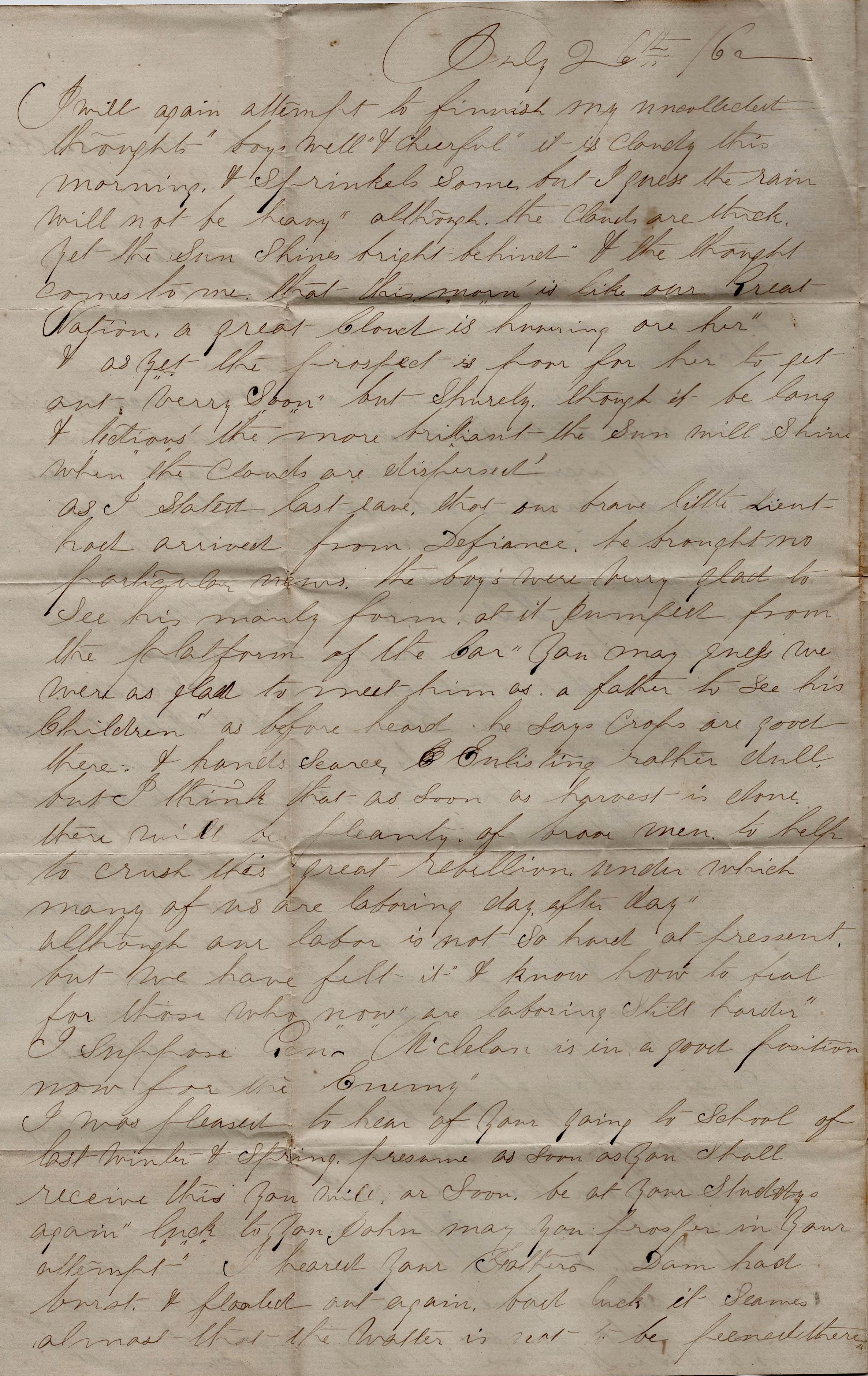
July 26, ’62. I will again attempt to finish my uncollected thoughts. Boys well and cheerful. It is cloudy this morning and sprinkles some but I guess the rain will not be heavy although the clouds are thick. Yet the sun shines bright behind and the thought comes to me that this morn is like our great nation. A great cloud is hovering over her and as yet the prospect is poor for her to get out very soon. But surely though it be long and tedious, the more brilliant the sun will shine when the clouds are dispersed.

As I stated last eve that our brave little lieutenant [Cheney] had arrived from Defiance, he brought no particular news. The boys were very glad to see his manly form as it jumped from the platform of the car. You may guess we were as glad to meet him as a father to see his children. As before heard, he says crops are good there and hands scarce. Enlisting rather dull, but I think that as soon as harvest is done, there will be plenty of brave men to help to crush this great rebellion under which many of us are laboring day after day. Although our labor is not so hard at present, but we have felt it and know how to feel for those who now are laboring still harder. I suppose General McClellan is in a good position now for the enemy.

I was pleased to hear of your going to school of last winter and spring and presume as soon as you shall receive this, you will—or soon be—at your studies again. Luck to you, John. May you prosper in your attempt. I heard your father’s dam had burst and floated out again. Bad luck. It seems almost that the water is not to be feared there.

It is now almost time for the morning train to come. There, I just heard the whistle some 4 miles south of here. The boys are in front of my little bush cot jumping, but the ground is rather hard, although the excitement must be kept up in some way—sometimes in jumping, running, wrestling, &c. as we have not much reading matter here. Sometimes get a paper. Sometimes can get some interesting book—[the] life of some of our old soldiers that have parted this life long, long ago.

The moral feeling in camp is about “as usual.” I have not heard a sermon in about eight months, yet, as ever, I am trying to live so that if my maker calls me, I can go with joy and not grief. I will be glad when they will come—when peace will again cover our beautiful land. When (soldiers), friends, and loved ones can enjoy the word of our heavenly master according to the dictates of our own conscience, none daring to molest or make us afraid. John, don’t you think it would be pleasant to arise Sabbath morn, dress and go to Sunday school and church, where the word of God is preached in its purity? Surely it would be. But not withstanding all these privations, I am willing to stay [and] endure the privations of a soldier’s life as long as needful and reap the rewards in some future day—that is, if I am permitted to live through. And that I trust to God, the father of all good.

The train just passed going towards Athens. Had some cannon on board. Capt. [Lewis E.] Brewster and Sergeant [George T.] Squire came after, having been at Huntsville on business.

The sun is beginning to shine. The air is cool and pleasant now and has been for several days. The weather is cooler there this summer than has been for many years. The thermometer has not been over 95 degrees since we have been here which is the 9th of May and Lieutenant Cheney said it stood at that in Defiance one day when he was there. And there is a cool breeze blowing most of the time which we do not have or so much so in Ohio.

The corn is coming out well since the rain we have had of late, so we have all we want to use. Can stand on the peak of some hill and see corn for miles. As for cotton, it is late for the time of the season but will produce a tolerable fair crop. It is in bloom now. There is not much of it raised this season. The so-called Pres. Davis ordered the planters to not plant more cotton than they wanted for their own use but put in plenty of grain to help the army. The wheat was nothing of importance, but here the corn will be very good and as Davis said, it will help the army—-but the USA instead of the CSA.

But fearing I am wearing your patience with my unconnected thoughts, I will close by saying remember me to all with respect. Hoping to hear from you soon. I remain yours truly, — E. M. Brown

Co. E 21st Regt. OVI USA, 9th Brig. 3rd Div., in care of Capt. S. B. Brewster, via Nashville TN.


1 Wilson S. Musser was 19 when he enlisted in Co. E, 21st OVI on 29 August 1861. He was killed on 31 December 1862 in the Battle of Stones River.

1862: Loyal Barber Wort to Susan (Hendershot) Wort

The following letter was written by Loyal Barber Wort (1830-1893), the son of Israel Brown Wort (1804-1840) and Susan B. Dubbs Miller (1808-18xx). Loyal was married in January 1853 to Susan Gardiner Hendershot (1834-1914) and was living in Hicksville, Definance county, Ohio, where he was employed as a shoemaker just before the Civil War.

According to muster rolls records, Loyal enlisted as a musician in Co. E, 21st Ohio Volunteer Infantry (OVI) on 27 August 1861 and he served a little over three years, mustering out in September 1864 as a private.

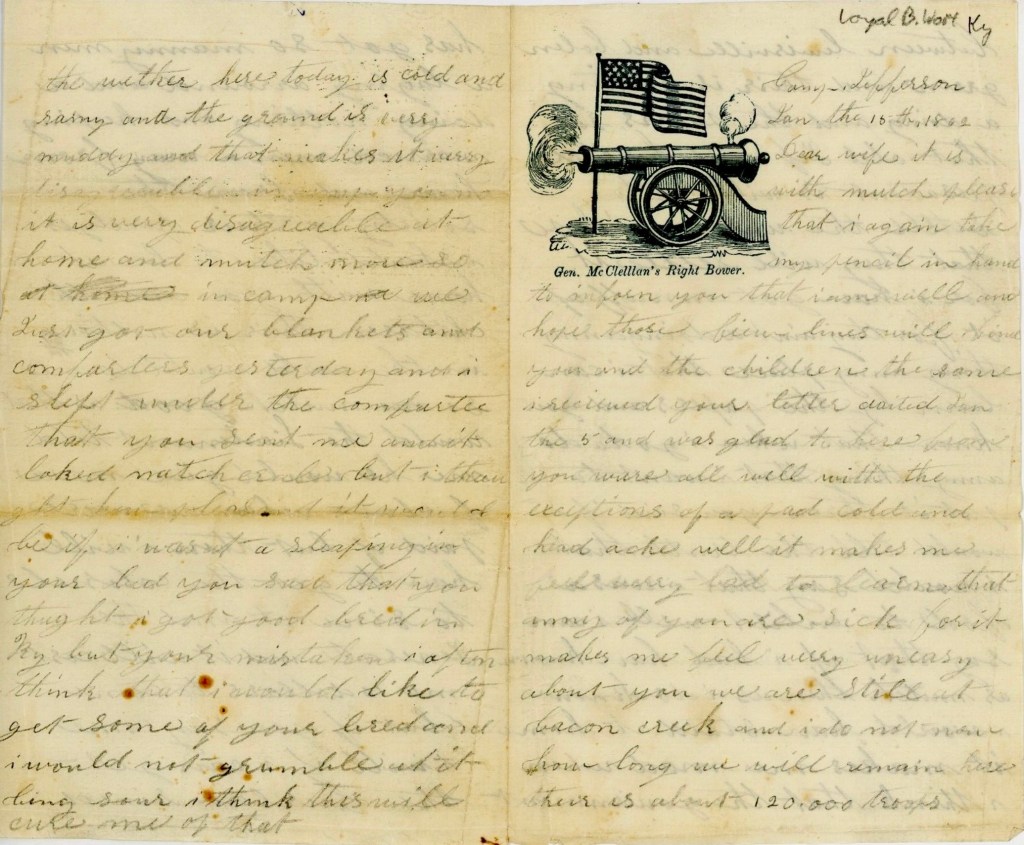
Patriotic stationery used by Loyal Barber. “Gen. McClellan’s Right Bower.”

Loyal’s Find-A-Grave biography includes the following entry includes the transcription of a letter he wrote following the Battle of Chickamauga where the regiment carried Colt Revolving Rifles that fired so rapidly they ran out of ammunition and had to make three bayonet charges. The letter read in part: “Our line of battle is formed at this place and whilst I write this our men are a skirmishing with the enemy and I think there will be a great battle fought at this place….We had a battle with them on last Sunday and it was a very hard one. All of our regiment was killed or wounded or taken prisoner except one hundred and eighty. Solomon Smith [Co. E.] was killed dead and John Kauffman [Co. E is wounded in the arm. There is but one Captain left in our regt. and five Lieutenants. Our Colonel is badly wounded…Our regiment got out of ammunition made three bayonet charges after all the ammunition was all gone and drove the Rebels and then they had to surrender, but some of the men would not stand it and they cut their way out and ran away….I think Dunafin is taken prisoner [He was and when released was killed in the explosion of the steamer ‘Sultana’ 4/27/65], there is only 15 men in our company. I tell you it makes me cry to think of it….I tell you, this battle beats Stone River. This was the hardest fighting ever known and it is not over yet. The Rebels throwed shells in our camp yesterday but they done no damage. The Rebs have a much larger force than we have. The prisoners say they have one hundred and fifty thousand. A part of their Richmond army is here….Through the providence of God I am still spared and I hope he will still continue his goodness to me….We were forced to fall back and leave the field so we did not get a chance to bury the dead and a great many of our wounded fell in the hands of the Rebs. It is heartrending to behold a battle scene.”

The 21st Ohio Infantry, equipped with colt revolving rifles, fends off confederate troops during the Battle of Chickamauga, 20 September 1863. “To the Last Round” by Keith Rocco.

Transcription

Camp Jefferson
January 15, 1862

Dear Wife,

It is with much pleasure that I again take my pencil in hand to inform you that I am well and hope these few lines will find you and the children the same. I received your letter dated January the 5th and was glad to hear you are all well with the exceptions of a bad cold and headache. Well, it makes me feel very bad to learn that any of you are sick for it makes me feel very uneasy about you.

We are still at Bacon Creek and I do not know how long we will remain here. There is about 120,000 troops between Louisville and Bowling Green and there is nothing a doing and the papers say that Old Jeff and his Vice President is willing to settle the war and I hope that they will settle it for I have got enough of it, for they ain’t doing anything any place that I can learn by the papers. And you know that when I go to do anything, that I want to put it through.

You said if I would tell the truth, that I would say that I was a fool to enlist. Well, I can say that if I had have known as much then as I do now, I would have stayed at home. It makes me mad when I think that the government has got so many men a laying around and a doing nothing and keeping married men away from home and from the society of their families. I should like to be at home with you and the children. There is nothing in the world would do me so much good as that would. The Lieutenant told me he would give me a furlough when we were paid off, but then I will have to get the Colonel to sign it and the General and it will cost me 10 dollars to come. But if you say come, I will if I can get the furlough signed.

The weather here today is cold and rainy and the ground is very muddy and that makes it very disagreeable in camp. You know it is very disagreeable at home and much more so in camp. We just got our blankets and comforters yesterday and I slept under the comforter that you sent me and it looked natural. But I thought how pleasant it would be if I was a sleeping in your bed. You said that you thought I got good bread in Kentucky but you’re mistaken. I often think that I would like to get some of your bread and would not grumble at it being sour. I think this will cure me of that.

1861-2: Samuel J. Marshall to Addis E. Smith

A squad from the 21st Ohio Infantry with their Colt Revolving Rifles
(David K. Parks Military Antiques posted on CW Faces)

These two letters were written by Samuel J. Marshall (1844-1864), the orphaned son of James Marshall (1816-1860) and Martha Jane Wartenbe (1825-1850) of Milford township, Defiance county, Ohio.

Samuel enlisted in Co. E, 21st Ohio Volunteer Infantry (OVI) when the company was formed in Defiance county in September 1861 and was with them until September 1863 when he was taken prisoner at the Battle of Chickamauga and died of dysentery ten months later, 26 July 1864, at Andersonville Prison in Sumter county, Georgia. He was a corporal at the time of his death, having been promoted in February 1863.

It’s worth noting that Samuel was only one of 96 prisoners who died at Andersonville on that date. At the time, the prison population was 31,693.

Samuel wrote the letters to his hometown friend Addis E. Smith who served in the 38th OVI and died of disease in April 1862 at Bardstown, Kentucky.

More more letters by members of the 21st OVI transcibed & published on Spared & Shared, see:

David Harness Randall, Co. D, 21st Ohio (1 Letter)
Levi M. Bronson, Co. E, 21st Ohio (1 Letter)
Joseph H. Hornback, Co. K, 21st Ohio (1 Letter)

Readers are also referred to Dan Master’s Civil War Chronicles:
Captured at Chickamauga with the 21st Ohio Infantry,” and “Off to War with the 21st Ohio Infantry in September 1861.”

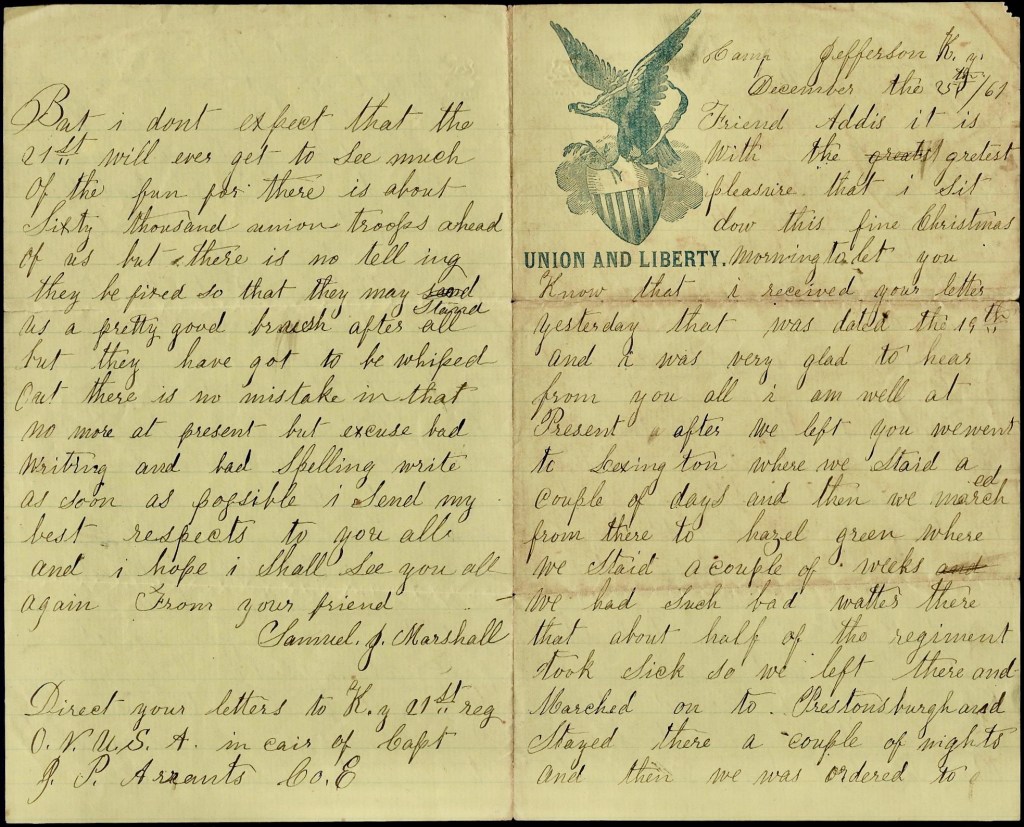
Letter 1

Camp Jefferson, Kentucky
December 25th 1861

Friend Addis,

It is with the greatest pleasure that I sit down this fine Christmas morning to let you know that I received your letter yesterday that was dated the 19h and I was very glad to hear from you all. I am well at present.

After we left you, we went to Lexington where we stayed a couple of days and then we marched from there to Hazel Green where we stayed a couple of weeks. We had such bad water there that about half of the regiment took sick so we left there and marched to Prestonsburg and stayed there a couple of nights and then we was ordered to Piketon and there we had a battle with the ornery cusses.

But when our artillerymen throwed some of them old bomb shells amongst them, it made them run like the devil. There was about seven hundred of the rebels and about four thousand of us and in crossing the river there was six horses drowned and the cannon went to the bottom. But they got the cannon and harness out again and then we marched down the Big Sandy about forty miles and then we took the steamboat and run down to the mouth of Big Sandy and then we took the boat there and run down the Ohio River and arrived at Cincinnati again—distance one hundred and fifty miles. And there we was ordered to get on to another boat and go to Louisville, Kentucky—one hundred and fifty miles further down the river—and there we camped two weeks.

And then we was ordered to march to Elizabethtown—distance forty miles further towards Green river. We stayed there one week and was paid off there and then we left there and went about twenty miles further down the railroad to this camp. We are now within eight miles of Green river. The Rebels burnt the railroad bridge at Green river and they are repairing it as fast as possible. They think they will finish it in a couple of weeks and then we calculate to try Old Buckner a crack.

But i don’t expect that the 21st will ever get to see much of the fun for there is about sixty thousand Union troops ahead of us. But there is no telling. They [may] be fixed so that they may stand us a pretty good brush after all. But they have got to be whipped out—there is no mistake in that.

No more at present but excuse bad writing and bad spelling. Write as soon as possible. I send my best respects to you all and I hope I shall see you all again. From your friend, — Samuel J. Marshall

Direct your letters to Kentucky, 21st Regiment, OV[I], USA in care of Capt. J[ames] P. Arrants, Co. E


Letter 2

Bacon Creek, Kentucky
January 1, 1862

Friend Addis,

I take a seat to inform you that I received your letter this evening of the 19th. I was very glad to ear from you all. I am as well as usual and have had a very Happy New Years. But I don’t expect to have as fine a sleigh ride or as good times tonight as we had together last New Years night as we had the privilege to cross the guard line backwards and forwards just as we pleased.

We went up the creek about a mile and went through a tunnel that was about sixty rods [330 yards] long. It was worth going to see, I can tell you. If I was to home tonight, I can tell you I would have better times than I expect to have tonight. But I am very well satisfied where I am.

The new bridge across the St. Joseph river is finished and the widow boy has had a bussing bee since the bridge was finished and all of the boys and girls in the neighborhood was there and they had a big time of it. But just wait, if we ever get home safe, won’t we have a jolly old time of it, though I think we will.

General Buell was here inspecting the different regiments. He was also down to Green river inspecting the regiments down there. I heard that we was to remain where we are for sixty days but I don’t [know] whether we will or not. But I think that we will move about the same time you do. But won’t we give Old Buckner the devil though I think we will.

We have very nice weather here at present. I send my best respects to you and all the boys that I am acquainted with. Write soon and oblige.

Your friend, — Samuel Marshal

Direct as before.