Category Archives: 22nd Illinois Infantry

1864: John Howell Phillips to Alice Phillips

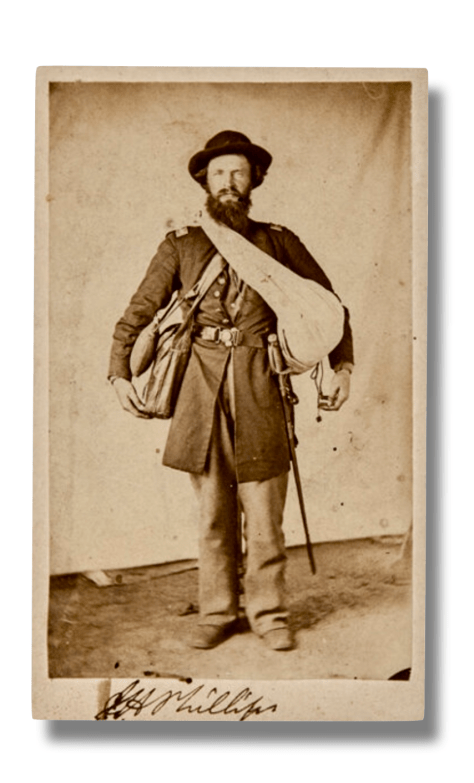
CDV of Capt. John Howell Phillips. Inscribed on the verso “Coming from picket, May 26th 1863” (Heritage Auctions)

This letter was written by John Howell Phillips (1832-1876) from the camp of the 22nd Illinois Infantry in March 1864 while serving as Captain of Co. D. There were 27 of his letters ranging in date from January 8, 1862 to May 24, 1865 sold at auction in 2015. It isn’t clear if this was one of them or not. They were all written to his mother or sister Alice (“Allie”). They were datelined from Corinth, Camp Lyon, Florence [Alabama], Nashville, Murfreesboro, Stone River, Bayou Pierre [Mississippi], Bridgeport [Alabama], Cairo [Illinois] and others.

In one of the letters he wrote, “The inspector on General Grant’s staff is to inspect us and I think he will find a ragged and dirty set as the regiment has been out on the tramp nearly all winter and have not had a chance of keeping themselves in any kind of decency… You have no doubt seen a great deal in the newspapers about the Rebels being nearly starved out and that they are deserting because they did not get enough to eat. But if they fare any worse than we men in this Department have this winter I pity the poor devils.”

John was born in Connellsville, Fayette county, Pennsylvania. He was the son of John Wesley Phillips (1803-1867) and Margaret Rice Connell (1808-1895). When John enlisted in June 1861, he gave his occupation as carpenter and his residence as Greenville, Bond county, Illinois. He was described as standing just over 5′ 9″ tall, with light hair and blue eyes. He claimed to be single but he was, more accurately, a widower. His wife, Mary Virginia Buie (1833-1859) died on 22 June 1859 after less than two years of marriage.

T R A N S C R I P T I O N

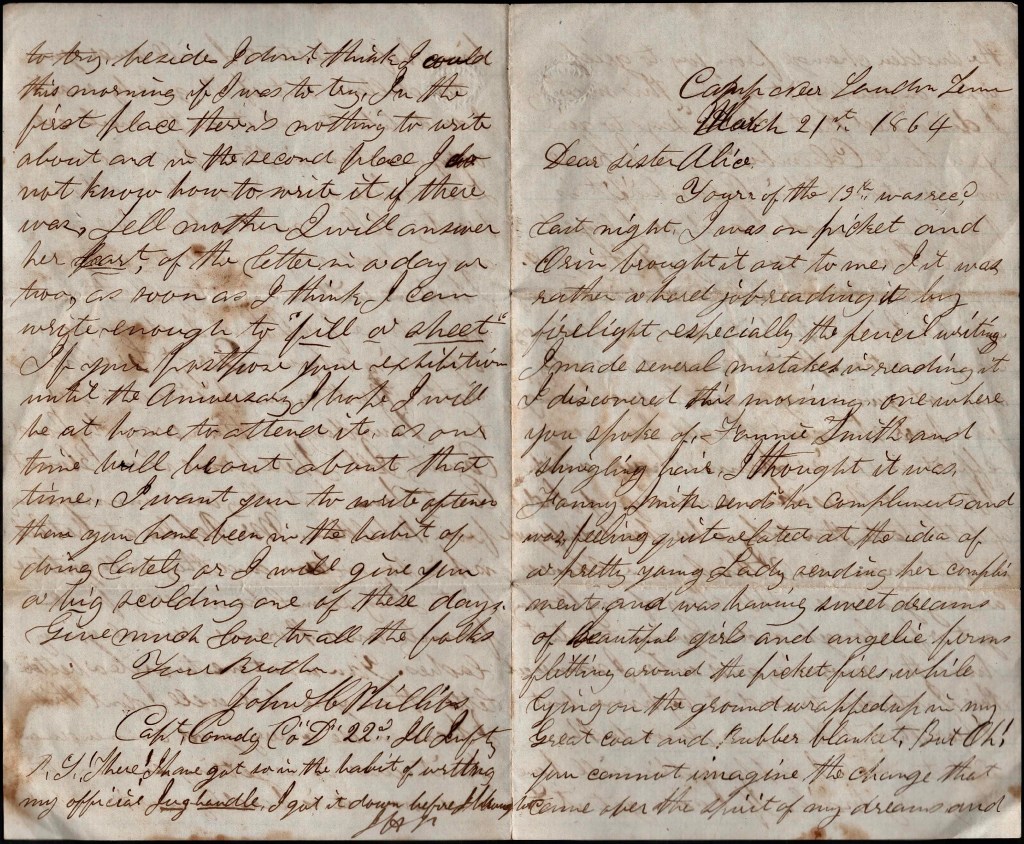
Camp near Louden, Tennessee
March 21st 1864

Dear sister Alice,

Yours of the 13th was received last night. I was on picket and Orin brought it out to me. It was rather a hard job reading it by firelight—especially the pencil writing. I made several mistakes in reading it. I discovered this morning one where you spoke of Fannie Smith and shingling hair. I thought it was Fanny Smith sends her compliments and was feeling quite elated at the idea of a pretty young lady sending her compliments and was having sweet dreams of beautiful girls and angelic forms flitting around the picket fires while lying on the ground wrapped in my great coat and rubber blanket.

An example of a short bobbed hairstyle for young ladies called “shingling” which was a radical departure from the long, elaborate hairstyles worn by women in the 1860s. It was more popular in the South than in the North. It was seen as a symbol of liberation.

But oh!! you cannot imagine the change to come over the spirit of my dreams and the sudden change from joy to grief when on reading it again this morning I discovered that it was, “says to give you Hail Columbia.” Now I have no objection to “Hail Columbia” if it is played by a good band or played on a piano and sung by a pretty girl. but when it comes in a letter and in the way this did, I do not think it means anything very complimentary. But I cannot see why my not giving my consent to you having your hair shingled should have any effect on Miss Fannie’s hair, and I thought Miss Fannie was a young lady of better taste than to have her head disfigured in that manner.

I think your likeness a very good one. Mr. [Joseph A.] Jay of my company got a furlough and is going to start home this morning and when I commenced this I intended to send it by him but I hear that he has gone down to the Depot and I suppose this will have to go by mail. If I can get it to him before he starts, I will send you ten dollars but if it goes by mail, I don’t like to risk it as the mails are very uncertain in these parts now.

Lee is here and is quite well and hearty. All is quiet about here now and no prospect of a move for us yet. I hope we will get to stay here the rest of our time for I have had enough tramping about. Sergt. [Archibald C.] Grisham’s father, mother, and sisters were here last Thursday on their way to Bond County, Illinois. Their home is in Blount county, Tennessee, but they are running away from Rebeldom. Mr. Peoples at Bethel is his son-in-law and they will go there first. They seem like a very fine family and there are several young ladies.

You want me to write a better letter than you did. Well, I don’t. think I have made a very good commencement for it and it is getting so near the end now it is hardly worthwhile to try. Beside, I don’t think I could this morning if I was to try. In the first place, there is nothing to write about. And in the second place, I do not know how to write it if there was. Tell mother I will answer her part of the letter in a day or two, as soon as I think I can write enough to “fill a sheet.”

If you postpone your exhibition until the Anniversary, I hope I will be at home to attend it, as our time will be out about that time. I want you to write oftener than you have been in the habit of doing lately or I will. give you a big scoulding one of these days. Give much love to all. the folks. Your brother, — John H. Phillips, Captain Commanding Co. D, 22nd Illinois Infantry.

P. S. There! I have got so in the habit of writing my official jug handle, I got it down before I thought. — J. H. P.
1861: John Seaton to Charlotte (Tuthill) Seaton

This letter was written by John Seaton (1834-1912), a son of John M. Seaton (1804-1847) and Elizabeth Jones (1810-18xx) of Cincinnati, Ohio. When John was three weeks old his parents removed from Cincinnati to Louisville, Kentucky, where his boyhood days were spent. He was eleven years of age when his father was killed on the field of battle in the War with Mexico. He attended school until he was fifteen years of age, and then began learning the trade of a machinist. A few years later finds him working as a journeyman machinist in St. Louis, Missouri. In 1856 with a cash capital of $2.50, John Seaton started a foundry at Alton, Ill. A natural aptitude for mechanics and machinery appliances, combined with pluck, energy and perseverance, enabled him to make a success … and the enterprise prospered. He was married in 1857 to Charlotte Ellen Tuthill (1840-1925), to whom he addressed this letter.

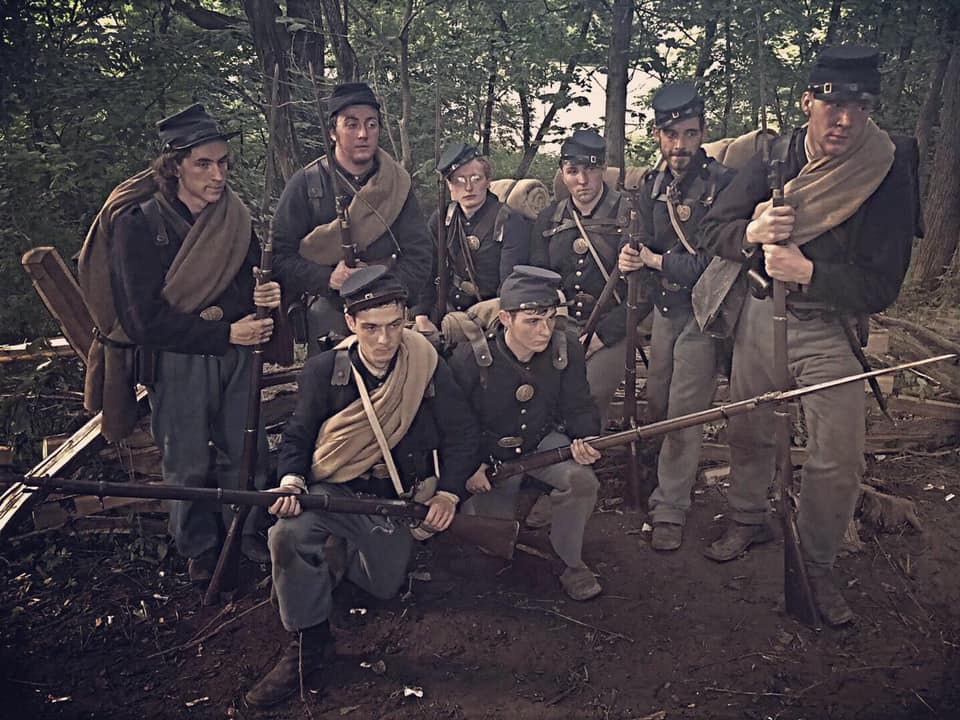
At the outbreak of the Civil War, John Seaton offered his services in defense of the Union and was commissioned a captain of Co. B, 22nd Illinois Infantry. The regiment trained in Belleville until 25 June 1861, outfitted in the grey uniform of the Illinois militia; and equipped with a .69 caliber converted flintlock musket that fired buck & ball.

Their first serious engagement was the Battle of Belmont (7 November 1861) under General Grant and Captain Seaton was in command of the skirmish line that opened this engagement. Before he advanced, Captain John Seaton of the 22nd Illinois told his men, ‘If I should show the white feather, shoot me dead in my tracks and my family will feel that I died for my country.’ [See Battle of Belmont on HistoryNet] One of the precious possessions of his family at this day is the personal letter he received from the famous commander, commending him for the efficient manner in which he performed the task allotted to his command. He served for one year and then resigned his commission and returned to Alton to take charge of his business.

A letter that John wrote to his wife following the Battle of Belmont and published in the Alton Telegraph on 15 November 1861 was beautifully summarized and transcribed by my friend Dan Masters on Civil War Chronicles under the title, Standing Up to the Work: A Captain’s View of Belmont.”

After the war, John Seaton remained in Alton in charge of his foundry until 1872, when he removed to Atchison, Kansas, with his entire force of fifty employees. In addition to general architectural work, he filled orders for the Santa Fe, Missouri Pacific and Ft. Scott and Gulf railroads, such as casting locomotive wheels, smoke stacks, steam cylinders, etc., …. The business of his large establishment in Atchison was built up until it amounted to over $250,000 annually, and the plant covered an area of 700×400 feet. Mr. Seaton was in business continually from 1856 until the time of his demise, January 12, 1912.

[Note: This letter is from the personal collection of Richard Weiner and is published on Spared & Shared by express consent.]

Transcription

Addressed to Mrs. John Seaton, Alton, Illinois

Camp Norfolk, Missouri
Sunday, September 15, 1861

My dear wife,

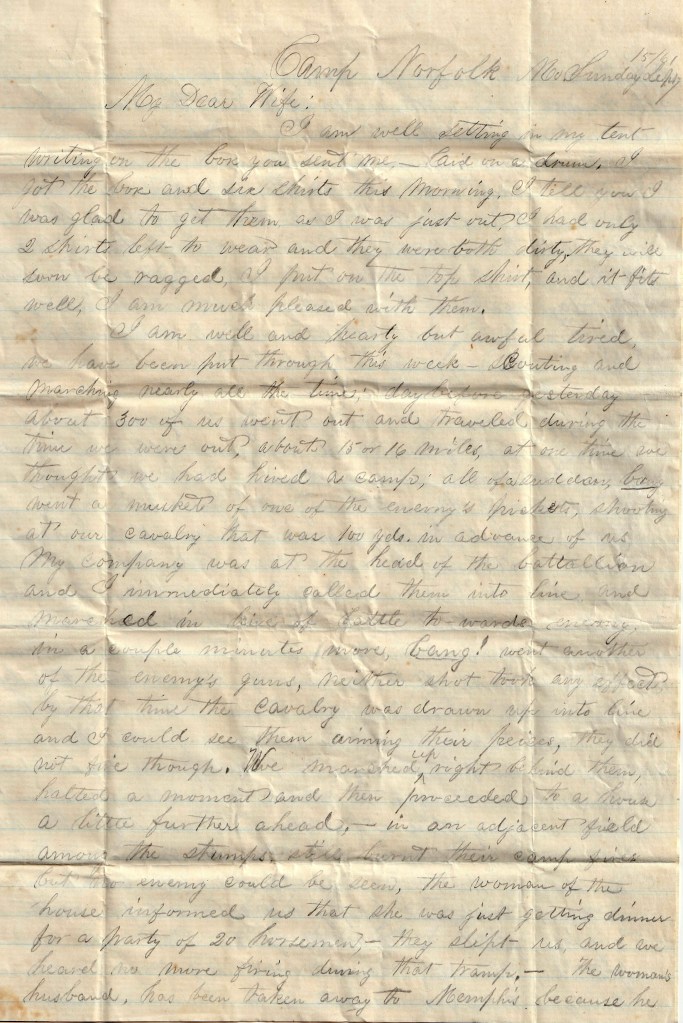
I am well sitting in my tent writing on the box you sent me laid on a drum. I got the box and six shirts this morning. I tell you I was glad to get them as I was just out. I had only two shirts left to wear and they were both dirty. They will soon be ragged. I put on the top shirt, and it fits well. I am much pleased with them.  

I am well and hearty but awful tired. We have been put through this week—scouting and marching nearly all the time. Day before yesterday about 300 of us went out and traveled. During the time we were out, about fifteen or sixteen miles, at one time we thought we had arrived to camp; all of a sudden, bang! went a musket of one of the enemy’s picket’s, shooting at our cavalry that was 100 yds. in advance of us. My company was at the head of the battalion and I immediately called them into line and marched in line of battle towards [the] enemy. In a couple minutes more, bang! went another of the enemy’s guns. Neither shot took any effect. By that time the cavalry was drawn up into line and I could see them aiming their pieces. They did not fire though.

We marched up right behind them, halted a moment, and then proceeded to a house a little further ahead. In an adjacent field among the stumps, still burnt their camp fires but no enemy could be seen. The woman of the house informed us that she was just getting dinner for a party of 20 horsemen. They slipped us and we heard no more firing during that tramp. The woman’s husband has been taken away to Memphis because he known to be a Union man. It is supposed he will be made away with or pressed into their army. He is a slaveholder too. We saw several of his negroes.

On our way coming back, we came around by another road and when within 2½ miles of Norfolk, we came to a fine large, white, two-story frame house. Here was the residence of another sound Union man by the name of Blanchard. He was seized upon about ten days ago, his house ransacked, and himself, Negroes, horses and cattle conveyed southward. His family, they say, have fled to Cairo. Here was a scene to nerve the patriotic arms of Union men to deeds of valor. A fine family living in a quiet place having a fine farm, and living in affluence, scattered to the four winds of heaven, property torn up, front door of house standing open, fine furniture laying scattered and broken, women’s garments of various kinds scattered here and there, beds look as though the sleepers had just turned out of them, the large cistern all torn off on top, dead cats and other articles thrown in the water, the front of the house riddled with bullets, some of the shingles torn by the leaden missiles, fine fields of corn left without one to take care of them, negroes quarters broken up, and in fact outrages on property of every conceivable shape meet the eye, no matter which way you turn. After stopping there a few moments we left. The place as we left was as silent as the grave, and looked as though the place might be haunted. 

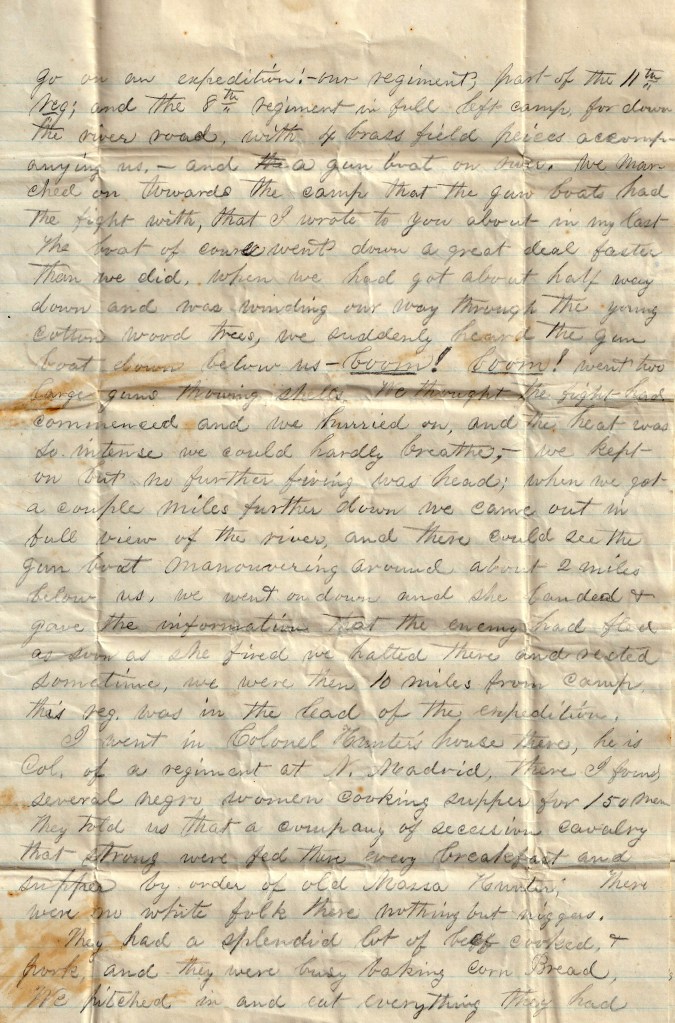
We came back to camp tired and hungry and eat our supper with a great gusto. We rested quietly that night and yesterday morning received orders to get our companies ready with 24 hours rations in their haversacks to go on an expedition. Our regiment, part of the 11th [Illinois] regiment, and the 8th [Illinois] regiment in full left camp for down the river road with 4 brass field pieces accompanying us, and a gun boat on river. We marched on towards the camp that the gun boats had the fight with, that I wrote to you about in my last. The boat of course went down a great deal faster than we did. When we had got about half way down and was winding our way through the young cottonwood trees, we suddenly hear the gun boat down below us—boom! boom!—went two large guns throwing shells. We thought the fight had commenced and we hurried on, and the heat was so intense we could hardly breathe. We kept on but no further firing was heard. When we got a couple miles further down, we came out in full view of the river and there could see the gun boat maneuvering around about 2 miles below us. We went on down and she landed and gave the information that the enemy had fled as soon as she fired. We halted there and rested some time. We were then 10 miles from camp. This regiment was in the lead of the expedition.

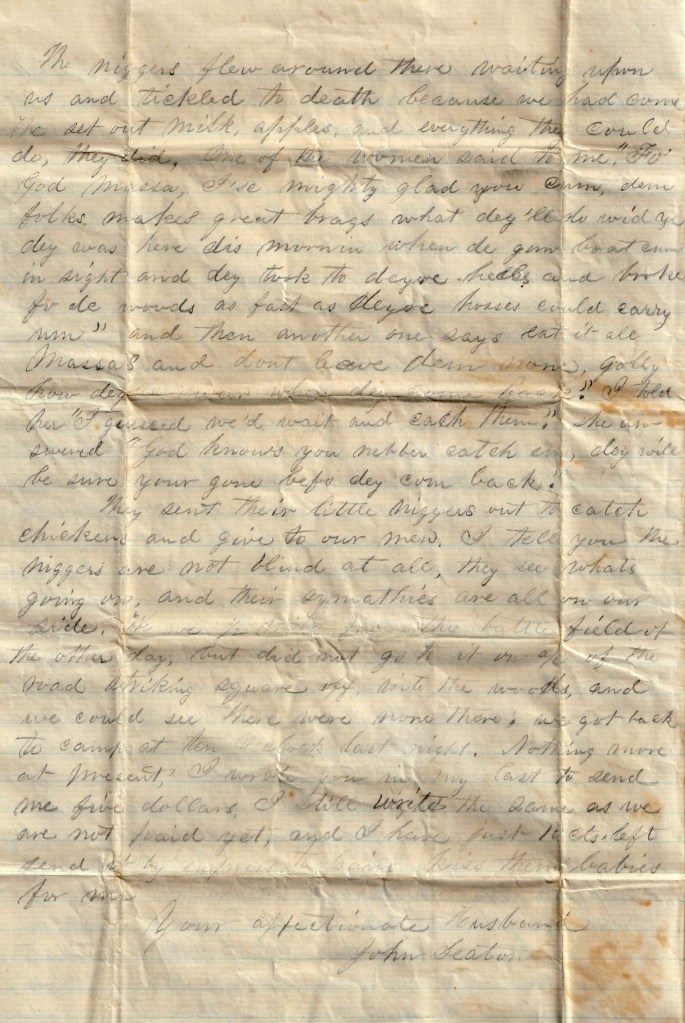
I went in Colonel Hunter’s house there. He is colonel of a regiment at New Madrid. There I found several negro women cooking supper for 150 men. They told us that a company of secession cavalry that strong were fed there every breakfast and supper by order of old Massa Hunter. There were no white folk there—nothing but niggers. They had a splendid lot of beef cooked and pork and they were busy baking corn bread. We pitched in and eat everything they had. The niggers flew around there waiting upon us and tickled to death because we had come. They set out milk, apples and everything they could do, they did. One of the women said to me, “Fo’ God, Massa, I’se mighty glad you cum. Dem folks makes great brags what dey’ll do wid yo. Dey was here dis mornin’ when de gun boat cum in sight and dey took to deyre heels and broke fo de woods as fast as deyre hosses could carry um.” And then another one says, “Eat it all, Massas, and don’t leave dem none. Golly how dey’ll swear wan dey come back.” I told her, “I guessed we’d wait and catch them.” She answered, “God knows you nebber catch em, dey will be sure your gone befo dey com back.”

They sent their little niggers out to catch chickens and give to our men. I tell you the niggers are not blind at all. They see what’s going on and their sympathies are all on our side. We are half mile from the battlefield of the other day, but did not go to it on account of the road striking square off into the woods, and we could see there were none there. We got back to camp at ten o’clock last night. Nothing more at present. I wrote you in my last to send me five dollars. I still write the same as we are not paid yet, and I have just 10cts left. Send it by express to Cairo. Kiss them babies for me.

Your affectionate husband, — John Seaton

1861: James C. Gosseline to Thurston J. Gosseline

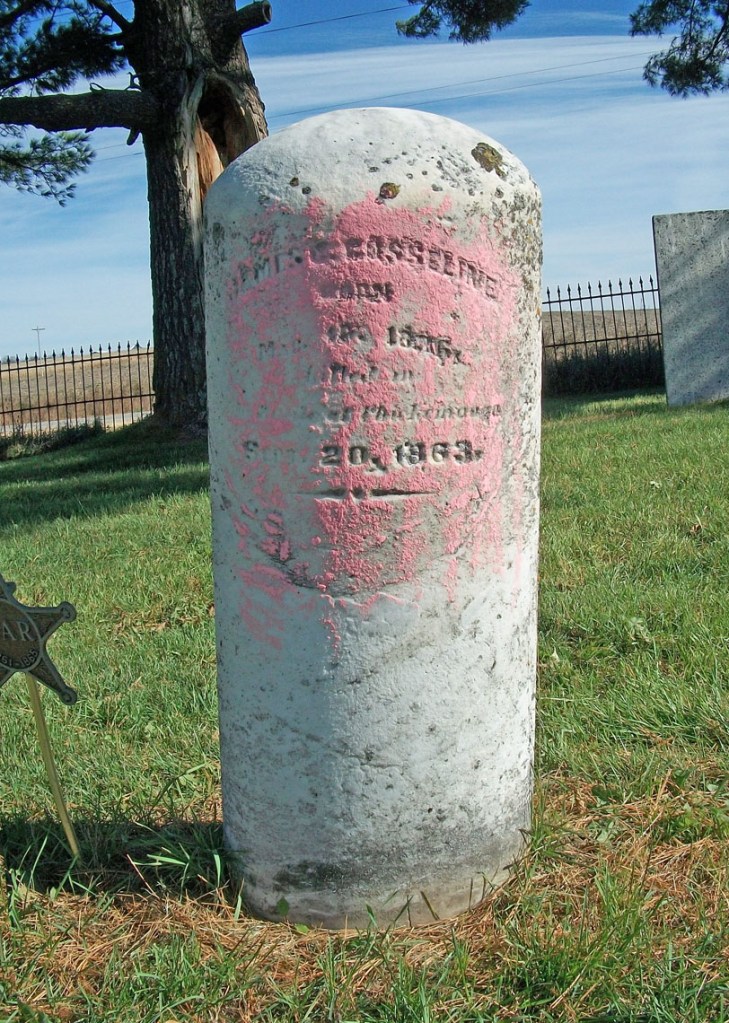
James’ headstone in Scotch Grove Cemetery, Jones county, Iowa

This letter was written by James C. Gosseline (1836-1863), the son of millwright Thurston J. Gosseline (1796-1878) and Mary (“Polly”) A. Cole (1807-1893) of New Bedford, Lawrence county, Pennsylvania. James mentions both of his younger sisters in the letter—Florence (“Flory”), born 1852; and May, born 1855.

Two months after he wrote the following letter, James enlisted at Caseyville, Illinois, as a private in Co. E, 22nd Illinois Infantry. At the time of his enlistment, he was described as standing 5′ 11″ tall, with light colored hair and blue eyes. He gave Pocahontas, Illinois, as his residence and his occupation as “painter.” Sadly, James did not survive the war. He was killed in action at the Battle of Chickamauga in Georgia on 19 September 1863. I don’t know if James’ body was sent home or not but there is a marker for him in the Scotch Grove Cemetery in Jones county, Iowa, next to his parents’ graves. Most likely he is not actually buried there as they did not move to Iowa until the 1870s.

This letter is remarkable for capturing the anxiety and chaos within the State of Missouri in the weeks leading up to the firing on Fort Sumter. In his letter, James informs his father, “all I can say now is that my life, and the life of every Republican, is in danger every moment. They (the disunionists) threaten to drive us out of the country….I have not went to bed a night for a long time without a Colt’s revolver under my head and in the daytime I am armed to the teeth and so are all of our party.”

[Note: This letter is from the personal collection of Richard Weiner and is published on Spared & Shared by express consent.]

Transcription

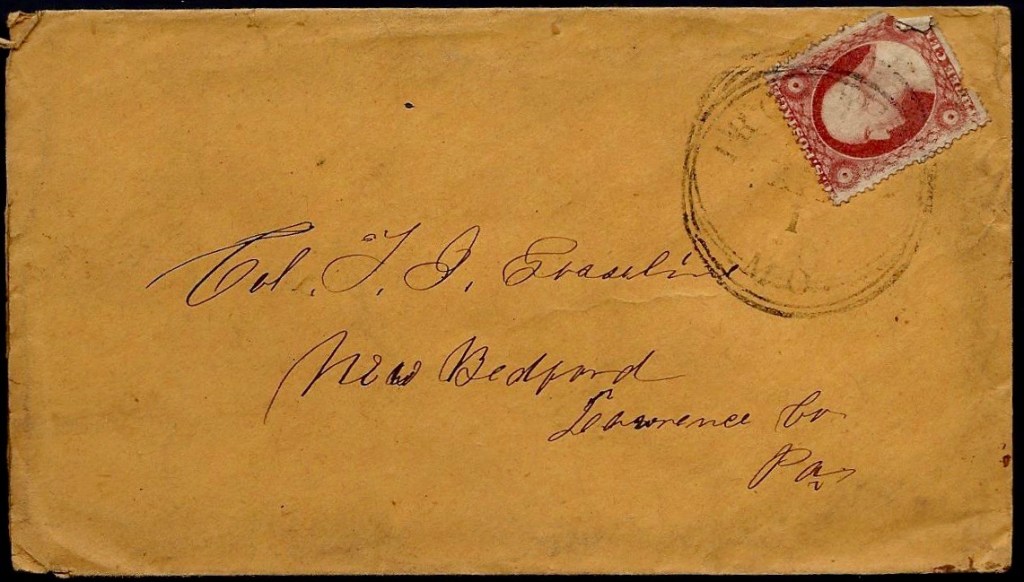
Addressed to Col. T. J. Gosseline, New Bedford, Lawrence county, Pennsylvania

Ironton, Missouri
April 14th 1861

Dear Father,

I have waited a long time to get something of importance to write but about all I can say now is that my life, and the life of every Republican, is in danger every moment. They (the disunionists) threaten to drive us out of the country. But rest assured that if any such diabolical attempt should be made, I will stand alongside of those that oppose them, ready to fight and die in the cause of. freedom, and I will not give one inch though I die by it.

I have not went to bed a night for a long time without a Colt’s revolver under my head and in the daytime I am armed to the teeth and so are all of our party. This evening I got word that at Pilot Knob 1 mile above here where there are a great many Republicans, that they were all engaged making cartridges and running balls ready for firm resistance.

The news of the bombardment of Fort Sumter has just reached here and caused some excitement. We shall have fun here soon—especially if they try to drive any Republicans out. If they do, it will cost a great deal of blood for we intend to fight to the last.

You need not write to me here for I do not know how how long I shall stay in this state for I want to go to some free state where I can join the Federal army. I am bound to fight for my country if the war continues. Give my love to all friends, — J. C. Gosseline

To Flory and May—dear sisters. I should be glad to hear from you but I cannot now. But when I leave here, you can write to me. I should be glad to see you dear girls. But now I have little hope that I ever shall—although I may see you soon. Everything is so uncertain with me now but you will hear from me again if nothing happens soon. So farewell. — J. C. G.

Dear mother—it is late in the night and I am very much fatigued and sleepy so please excuse my brief scratch. All of importance is addressed to father. All I can say is that I have done very little work for six months and am consequently pretty hard up. But it is a long road that has no turn. When I get into the army, I hope to make some money. Still hoping and praying for your comfort and happiness, I bid you farewell. Affectionately, — James