
Category Archives: 22nd New York Infantry

1861: Samuel Norcross to his Parents

The following letter was written by Samuel Norcross but which one? There were several soldiers by that name. Based on the location and date, I think it likely to be either Samuel Norcross of Co. G, 22nd New York Infantry, or Samuel Norcross of Co. E, 5th Vermont. The 22nd New York was encamped near Upton’s Hill at the time and the 5th Vermont was encamped near McLean, Virginia (Camp Griffin), some five miles further northwest. Balloon ascensions were being conducted regularly from Upton’s Hill to Vienna at the time. The camp of the 22nd New York was some five miles closer to Freestone Point where the firing on Union Vessels described occurred on 8 December 1861.

I note that the letter was addressed to his “father and mother” and since the soldier from Vermont lost his mother a couple years before the war, I’m going to attribute this letter to the soldier from the 22nd New York but without a high degree of confidence.

T R A N S C R I P T I O N

December 9, 1861

Dear father and mother,

I take my pen in hand to let you know that I am well at present and I hope that these few lines may find you the same.

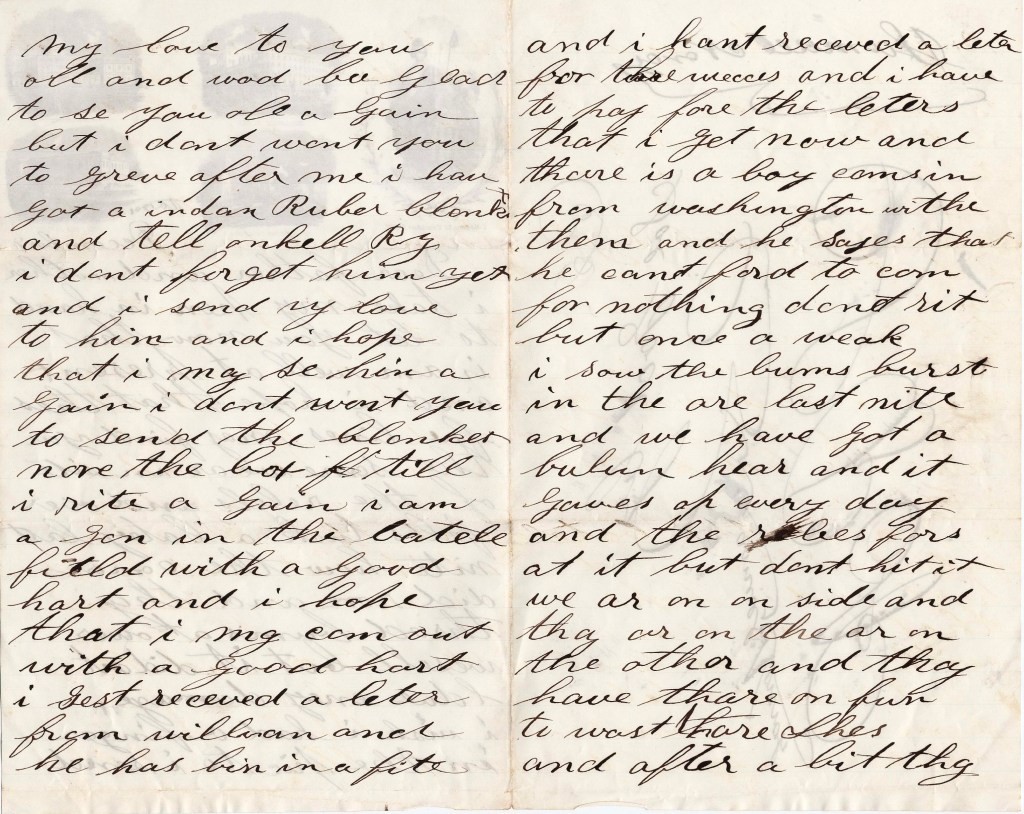
We are in sight of the rebels and our fellows took a battery last night. How the cannon did roar and they throwed bombs at our vessel but it didn’t do any damage. 1 I wish I had a finger in the pie too.

I send my love to you all and would be glad to see you all again but I don’t want you to grieve after me. I have got a Indian Rubber Blanket and tell Uncle Ry I don’t forget him yet and I send my love to him and I hope that I may see him again. I don’t want you to send the blanket nor the box till I write again. I am a going in the battlefield with a good heart and I hope that I may come out with a good heart.

I just received a letter from William and he has been in a fight and I han’t received a letter for three weeks and I have to pay for the letters that I get now. And there is a boy comes in from Washington with them and he says that he can’t afford to come for nothing. Don’t write but once a week.
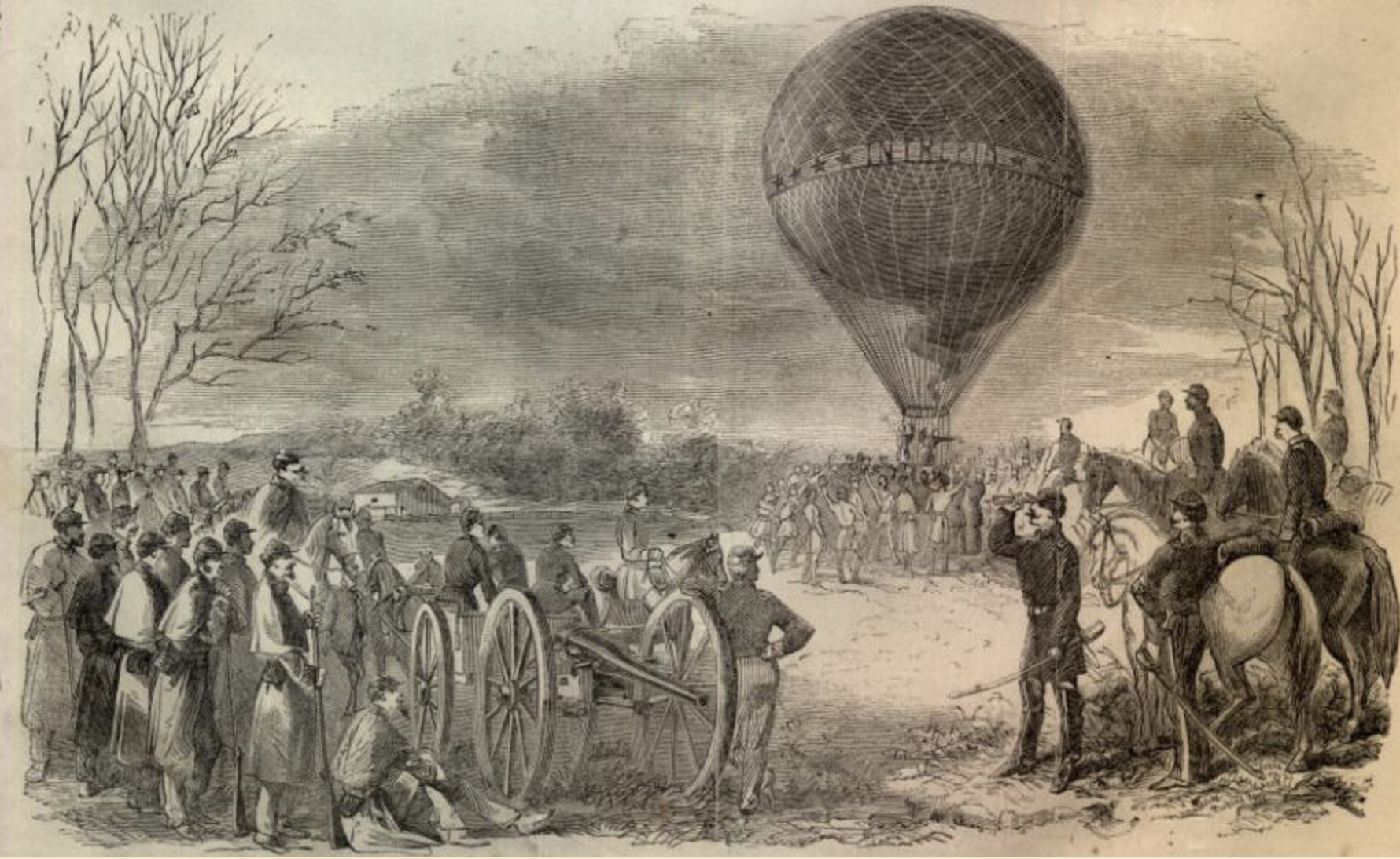
PROFESSOR LOWE MAKING A BALLOON ASCENSION ON A RECONNOITERING EXPEDITION TO VIENNA. Harper’s weekly, 14 December 1861

I saw the bombs burst in the air last night and we have got a balloon here and it goes up every day and the Rebels fire at it but don’t hit it. We are on one side and they are on the other and they have their own fun to waste theirselves, and after a bit they [rest of letter missing]

So goodbye, — Samuel Norcross


1 The Confederate firing on Union vessels may have been from Freestone Point, the northern most point of the Confederate blockade on the Potomac river. On December 8, 1861, The USS Anacostia and the USS Jacob Bell fired on Confederate troops near Freestone Point and they may have returned fire.

1861: Unidentified Soldier in 22nd New York Infantry to Friends at Home

The following unsigned letter was written by a member of the 22nd New York Infantry—a volunteer regiment formed with 800 men in 1861 and was placed in a brigade along with the 24th New York, 30th New York, 84th New York (14th Brooklyn) (also known as the 14th New York State Militia), and for a number of months, the 2nd U.S. Sharpshooters (a regiment under the respected Colonel Henry A. V. Post). The brigade was the First Brigade in the First Corps of the Army of the Potomac, and Colonel Walter Phelps and the regiments of the brigade referred to themselves as the Iron Brigade of the East and served with the Division’s more famous Fourth Brigade which would earn the title “Iron Brigade of the West” in September 1862 during Battle of South Mountain in the Maryland Campaign.

Colonel Walter Phelps was chosen as the original commander of the regiment, and after his promotion to the brigade commander, Major John McKie became regimental commander. The regiment suffered its first fatality when passing through Baltimore, when a man was killed by friendly fire during confusion among a mob. It would go on to serve in the Army of the Potomac’s I Corps and III Corps, and fight at the battles of Second Bull Run, South Mountain, Antietam, Fredericksburg, and Chancellorsville.

The regiment was mustered out of service on June 19, 1863, and those men who had signed three-year enlistments were transferred to the 76th New York and 93rd New York.

Some Boys from the 22nd New York in 1861

Transcription

Headquarters 22nd Regiment, Camp Graham
Arlington Heights, Virginia
September 16th [1861]

Friends at Home,

I received your letter after a while, but it was welcome if it was late and I am glad to hear that the factory is starting for I know it must be dull of they stop—especially the axe factory. By the way, has it started yet? And whether Father is doing anything or not? If not, how is he getting along? and how he manages to keep up his ends, &c.

We was reviewed day before yesterday and Gen. Keyes said we was the best looking regiment and had the cleanest quarters this side of the Potomac. Quite a puff for the 22nd. We have been ordered into the field andI think we will have a fight Tuesday or Wednesday. Things look as though they were drawing to a close. The Brigade is reviewed every Sunday by Gen. McDowell or McClellan. There is four regiments in our brigade—the 14th State Militia, 30th, 24th and 22nd, the three of which are volunteers. We don’t know our position in the brigade yet. Sometimes we are on the left, sometimes the third regiment, sometimes the 2nd. The fourteenth has the right and will hold it, I suppose, as it was in the Battle of Bull Run and is more experienced in the business. But whether they can stand fire any better than we can remains to be seen. But I hope New York State won’t be disgraced by the 2nd. I hope they will prove themselves soldiers worthy of the history pages both in discipline and braveness.

I would like to have Father go to Funk’s and tell him to make me a pair of shoes just like these I have. Tell him to make them the same size and just like them, only a great deal better. Make them out of heavy calf and nails in the soles and the seam on the back. Put a strip of leather and stitch it so it won’t break out as these have done. Tell him the shank has broken off next to the sole. Tell him to put in good leather—not such as he put in these. Tell him to make them good and I will pay him what he asks if he will make them good and out of good leather and the same size. Then I will be satisfied. You can send them by express. If you want to know how just go to Flanagan and he will tell you how to direct them. We get paid.

Tell Funk to make them high—say an inch and a half higher than these. Please send me a gold pen—that is, if you can get Dr. or Suzie to get one for me. Tell her to take it to Rice and he will tell whether it is a good one. You know if it isn’t a good one, I don’t want it for it is worse than none at all. Get a small one. None of these big things that take a log of wood to hold them. Get a fine one. You need not get a holder for I had rather have a wooden one. But then if you can get a nice wooden one, why I of course will accept it. I think it would be a nice present and a useful one and won’t cost a great deal and as I know how to use it, I will write often to them and keep them posted with the affairs of camp life, &c. (don’t forget).