
This diary was kept in 1864 by an unidentified Confederate soldier who was probably residing in the vicinity of Clinton, Kentucky where he enlisted in June 1861 to serve the Confederacy and his company was made a part of the 22nd Tennessee Infantry. As he states in his diary, he was with the 22nd Tennessee at the Battle of Belmont which was fought on 7 November 1861. The 22nd Tennessee was one of four Tennessee regiments with the 12th Arkansas and Betlzhoover’s Battery under Gen. Gideon Pillow’s command on the Missouri side of the Mississippi river when the battle began. They were caught in an open cornfield under heavy fire where they suffered heavy casualties.
The diarist apparently deserted his regiment at this point and returned to his home in Kentucky. According to the Goodspeed History of Tennessee, vol. 12, the only company from Kentucky joining the 22nd Tennessee was Co. F (“The Kentucky Braves”). It notes that many men from this company later became members of Co. M, 3rd Kentucky Infantry. While in the 22nd Tennessee, they were led by Captains Francis M. Stewart, William Lindsey, and J. Clay Horne.
Two and a half years later, in April 1864, he informs us that he enlisted a second time in the Confederate service, this time joining Co. M, 3rd Kentucky Infantry which became mounted infantry about that time. They became part of Maj. Gen. Hylan B. Lyon’s Brigade in Gen. Nathan Bedford Forrest’s Cavalry Corps.
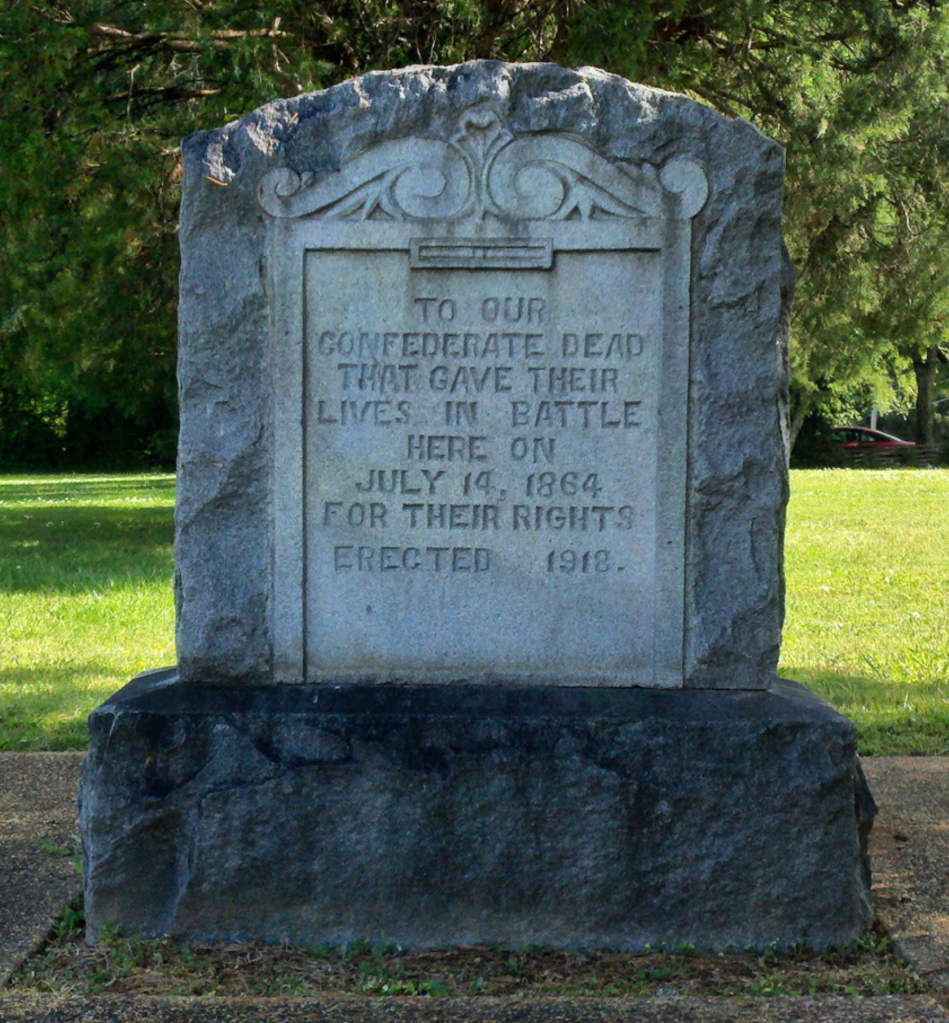
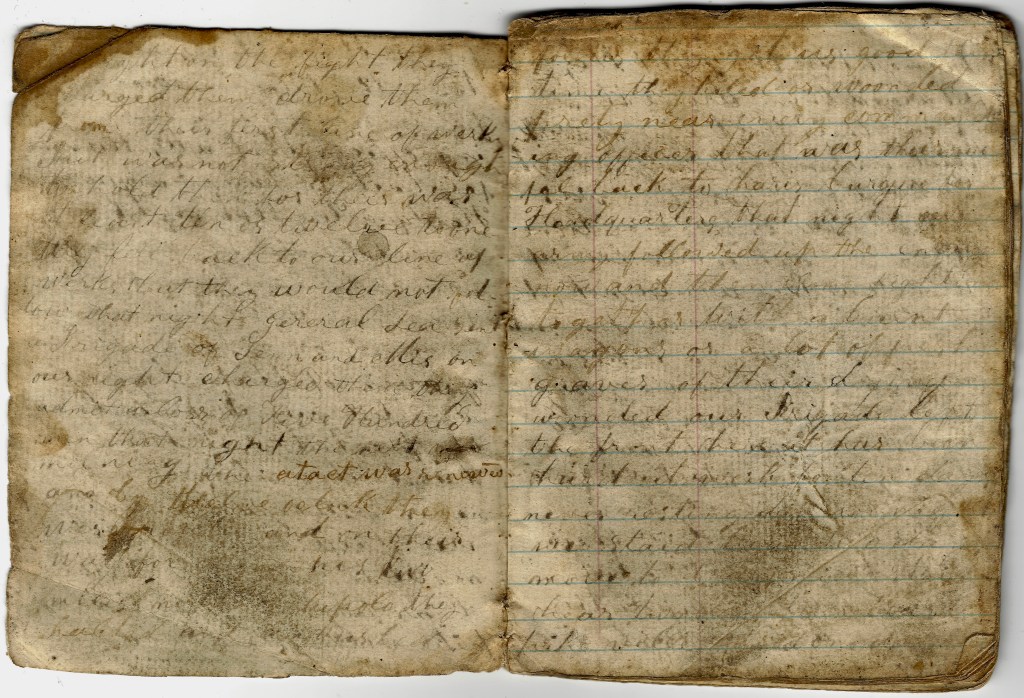
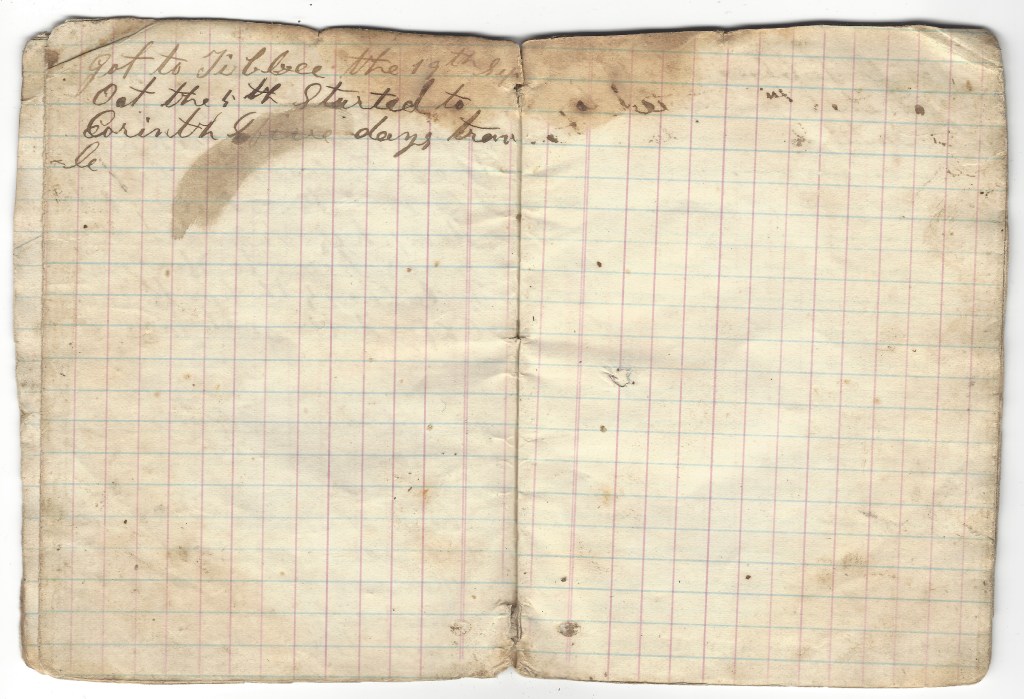
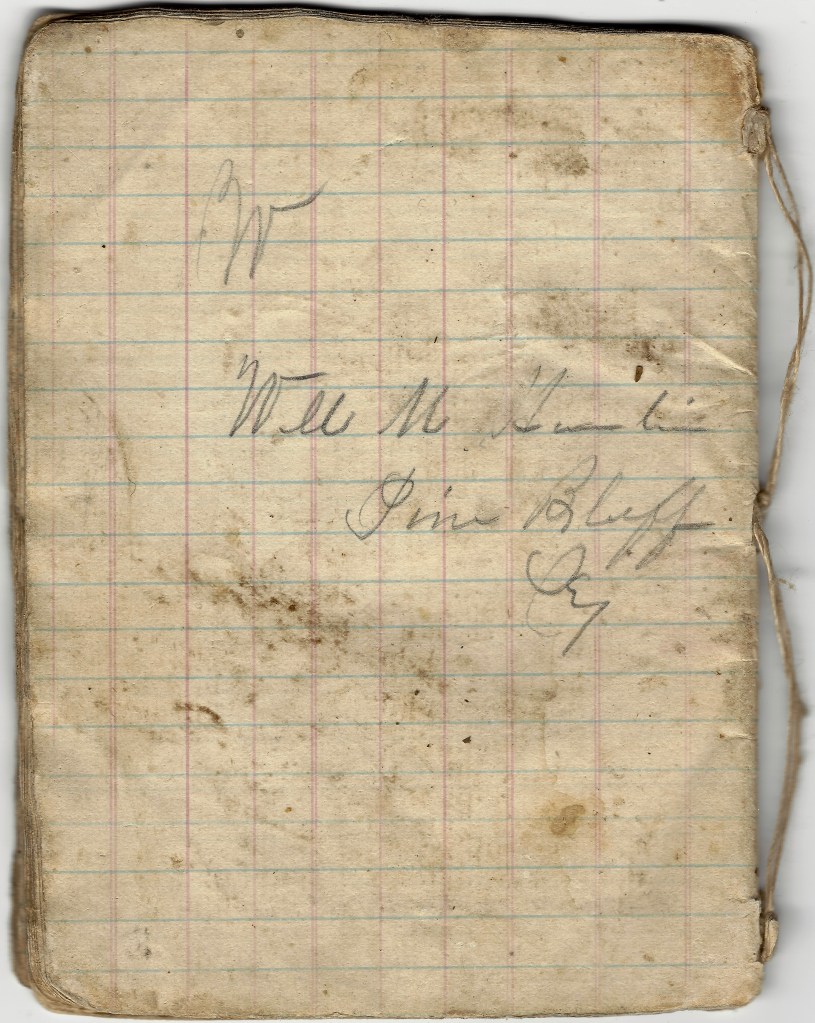
The diary itself is made from a ledger that has been cut into smaller pages and hand stitched with string. Most pages are blank but there are a few pages at the beginning describing the movements of the 3rd Kentucky Mounted Infantry including the mention of the Battle of Brice’s Crossroads and more particularly the Battle of Harrisburg, Mississippi—both attempts by Gen. Forrest to disrupt Gen. Sherman’s supply lines during the Atlanta Campaign. There are a few names of members of Co. M in the diary but I was unable to identify any of them as the author. There is a name on the back cover of the diary with Pine Bluff, Ky. but I could not match possible names against the regimental roster. I do not have the company rosters for both Co. F, 22nd Tennessee and Co. M of the 3rd Kentucky to compare them, however. Perhaps someone else can narrow it down further. The scanned pages of the diary are in the footnotes of this post.
It’s possible that the diarist did not survive the war given that the diary has many pages left unfilled and it ends abruptly in early October 1864. Perhaps he was killed at the Battle of Franklin a few weeks later.

[Note: This diary is from the personal collection of Greg Herr and was offered for transcription and publication on Spared & Shared by express consent.]
Transcription
Com[pany] M 3 Ky. Reg.
The travels of our company.
I joined at Clinton, Ky. 1861. June 15th was organized in 22nd Tenn. Regt. 18th July of the same year at Trenton, Tenn. Moved to Union City the 1st of August and moved to Columbus, Kentucky September 5th, to Matfield the 15th, back to Columbus 22nd, to Camp Beauregard 27th, back to Columbus November the 1st.
Battle of Belmont, Missouri. Two killed and four wounded. Here I left the company and rejoined at Clinton the second time in April 1864, from there to Jackson, Tennessee, and from that to Corinth. Here we joined the Third Kentucky Regiment.
May the 1st, 1864, to Tupelo, back to Corinth the 10th, and the 20th back to Tupelo the 28th. Little Bear River, Alabama, June the 1st. Back to Tupelo the 3rd. Boonville the 7th. On the 10th, the fight at Brice’s Crossroads. 1 killed, 3 wounded. To Guntown the 15th. Baldwin the 20th. Tupelo 23rd. Elizabethtown July the 7th, Pontotoc the 8th before Harrisburg the 13th, 14th, 15th—three days fighting, 1 killed, 2 wounded. Shannon Station 18th, Pikeville the 20th, Egypt Station 21st. Shannon Station 27th.
Review of troops at Okeana August 3rd to Pontotoc the 6th. Sarepta the 10th. Lafayette Springs the 14th, Oxford the 17th, 14 MS back cross the Yocking the 20th. Back to Oxford the 22nd. [Nathan B.] Forrest went to Memphis and returned to us here to Springdale the 25th, back to Oxford the 30th, to Water Valley September 1st. Grenada the 2nd. The 4th started to Verona. Got to Coffeeville the 5th, to Sarepta the 6th, to Pontotoc the 7th, Verona the 8th. The 13th started to Tibbee Station, to Shannon the 14th, to Pikeville 15th, to West Point the 16th. Stayed two days.
Got to Tibbee [Station] the 19th September. October the 5th started to Corinth. Five days travel.
…returned to Guntown and staid until we got the [ ] off of the battlefield. Then went to Baldwin Station and stayed one day and then come back to Tupelo. Staid there [ ] weeks and then Smith wants to try his hand [ ] in the saddle on the Elizabeth [ ] from Tupelo to Elizabethtown that day Smith and [illegible]…
[ ] to the west side of the town [Harrisburg] seven miles and stopped to skirmish with them and tried to bring on a regular engagement but he would not come out. We staid here three days. On the thirteenth we formed a line of battle and started in and soon found that they had left for Tupelo that morning before day. We then too the Verona road that runs about three miles south of the Tupelo road for twenty miles. Then it was who should get to Tupelo first. We had thirty-five miles to make while they had only twenty [illegible] hours the start of us. They was in as big hurry as we was. We run into them five miles southwest of Tupelo causing them to burn twenty of their wagons with one small brigade of Tenn. Bell’s Brigade. Fought their whole army for one hour. Our Kentucky Brigade came up in the time, dismounted and crossed the creek and charged them. They passed by and went to Harrisburg three miles west of Tupelo and made breastworks that night.
The next morning the two brigades—Bell’s Tennessee and [Hylan B.] Lyon’s Kentucky Brigade [carried] on the fight. They charged them, drove them from their first line of works but was not strong enough to hold them for there was at least ten or twelve to one. They fell back to our line of works but they [the Yankees] would not follow. That night General [Stephen D.] Lee’s Brigade of Tennessee and Mississippi on our right charged them. They admit a loss of five hundred men that night. The next morning the attack was renewed and by twelve o’clock there was [ ] and on their way for [illegible]…Tupelo. They halted and ambushed for us. They got us good this time. They killed or wounded pretty near every commanding officer that was there and fell back to Harrisburg for headquarters that night. Our army followed up the enemy now and then some fight to get here with burnt wagons or an awful lot of fresh graves of their dying wounded. Our Brigade left the front here. It has been hard work for tewm days, never resting day or night.
We staid [illegible] move to [ ] Station. Here [illegible]…from Pikeville to Egypt Station.






 Spared & Shared 23