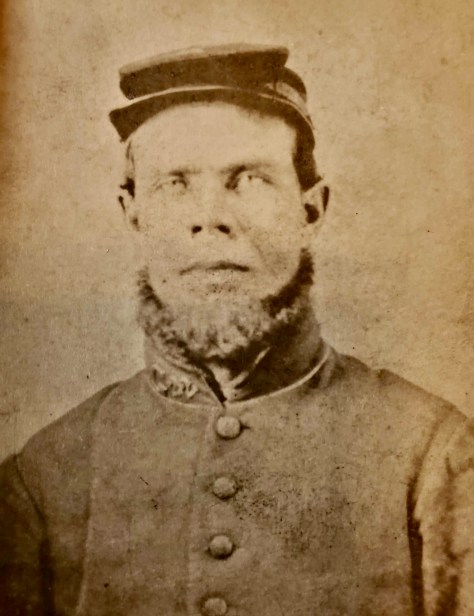
I could not find an image of Orson but here is one of Ole Erickson of Co. G, 22nd Wisconsin Infantry. Note insignia on collar. (Ancestry. com)
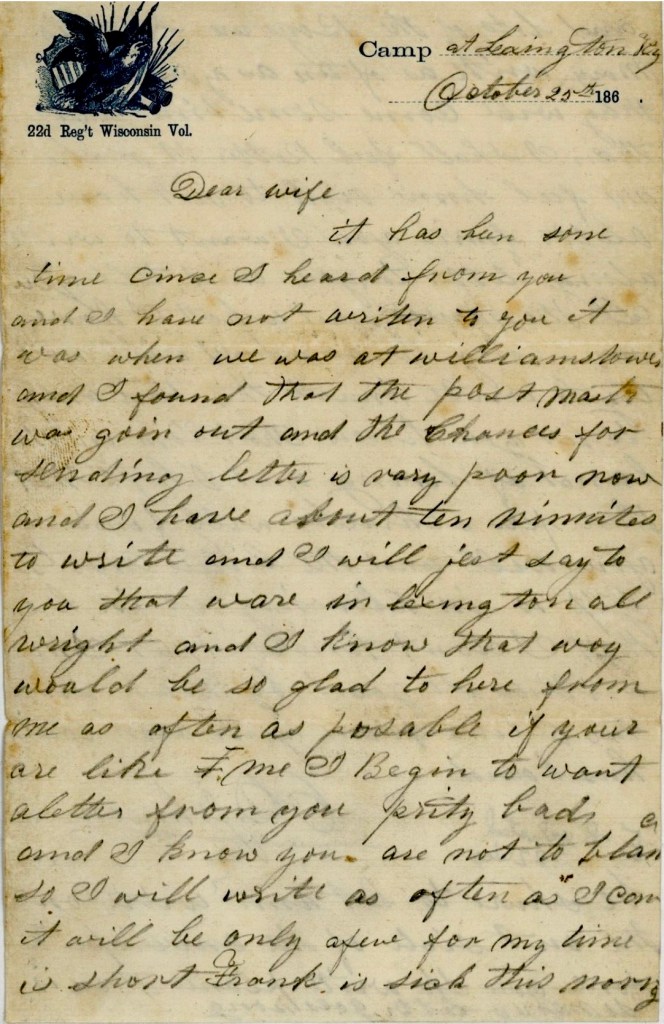
The following letter was written by Corp. Orson D. Johnson (1833-1869) of Darien who enlisted on 15 August 1862 to serve in Co. D, 22nd Wisconsin Infantry. Orson was discharged for disability on 20 January 1863 after only four months in the service. His Find-A-Grave memorial states that he was wounded in the Battle of Stones River but this is undoubtedly an error as the 22nd Wisconsin did not participate in that battle. He was married to Mary Louise Cullen (1835-1913) in September 1854 in Walworth county, Wisconsin..
Orson wrote this letter from Lexington, Kentucky, after having been on the march from Cincinnati since the 7th of October, moving every few days until arriving in Lexington. They were there until the 31st of October and then moved on to Nicholasville where they were assigned provost guard duty until mid-December.
Many of Orson’s Civil War letters are are archived at the William L. Clements Library at the University of Michigan.
T R A N S C R I P T I O N
Camp at Lexington, Kentucky October 25th [1862]
Dear wife,
It has been some time since I heard from you and I have not written to you. It was when we was at Williamstown and I found that the post master was going out and the chances for sending letter is very poor now and I have about ten minutes to write and I will just say to you that we are in Lexington all right and I know that you would be so glad to hear from me as often as possible if you are like me. I begin to want a letter from you pretty bad and I know you are not to blame so I will write as often as I can. It will be only a few [lines] for my time is short.
Frank is sick this morning and lots of the boys are sick too.
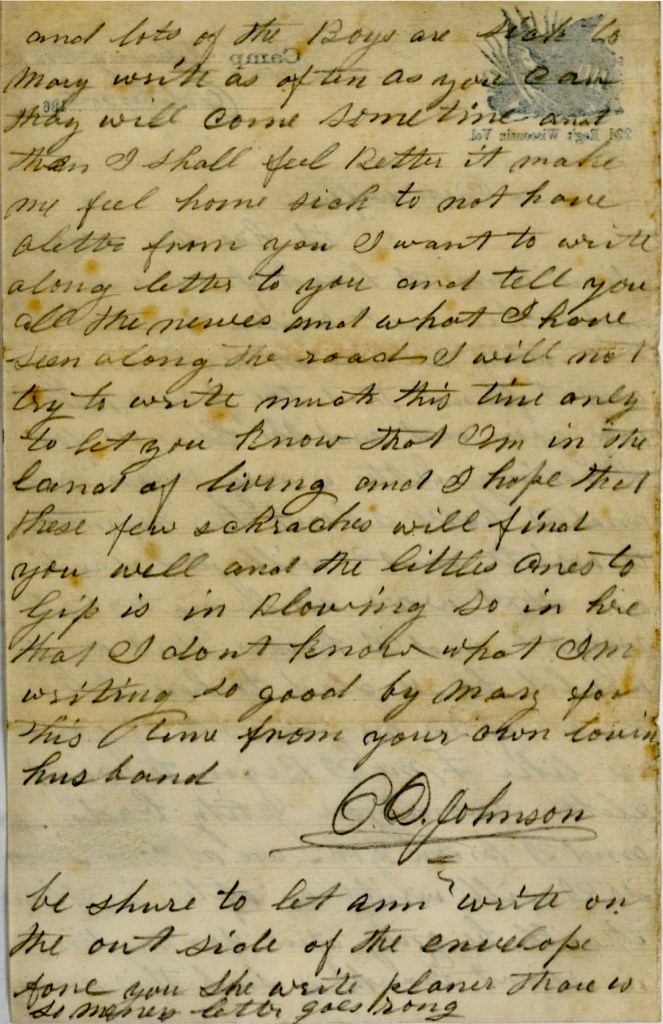
Mary, write as often as you can. They will come sometime and then I shall feel better. It makes me feel home sick to not have a letter from you. I want to write a long letter to you and tell you all the news and what I have seen along the road. I will not try to write much this time—only to let you know that I’m in the land of the living and I hope that these few scratches will find you well and the little ones too.
Gip is in blowing so in here that I don’t know what I’m writing. So goodbye, Mary, for this time. From your own loving husband, — O. D. Johnson
Be sure to let Ann write on the outside of the envelope for you. She writes plainer. There is so many letters goes wrong.
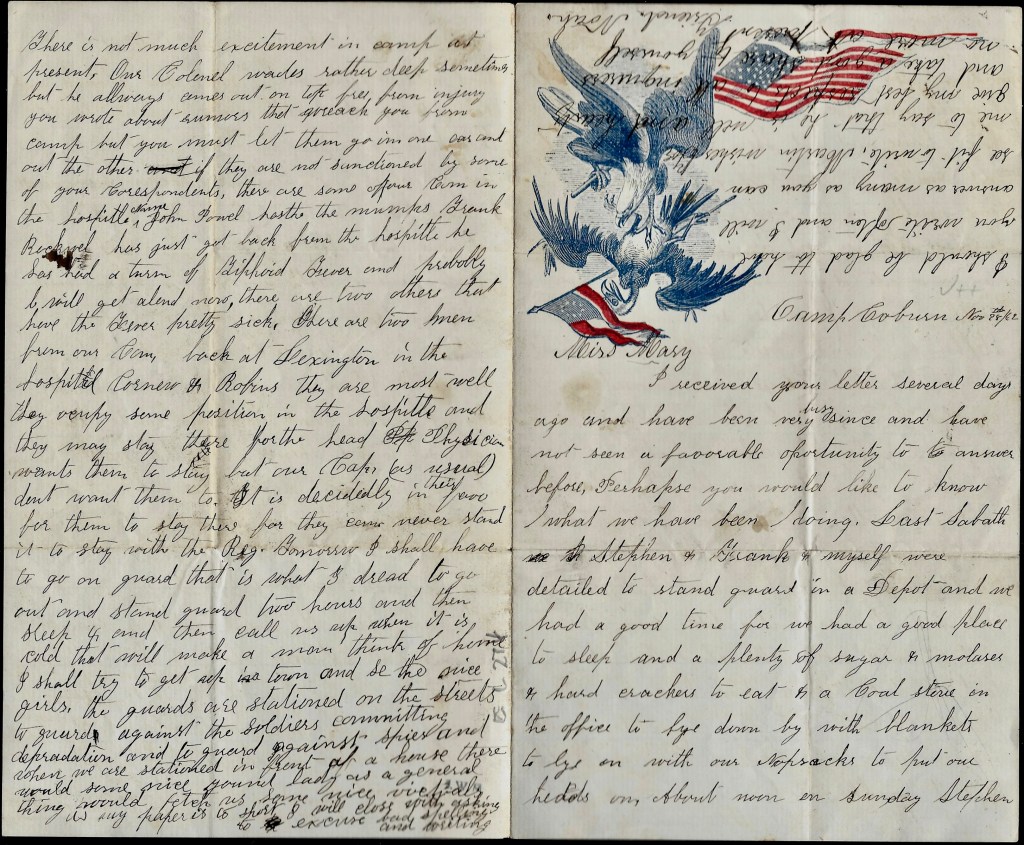
The following letter was written by Noah Merriam (1840-1927) of Linn, Wisconsin who enlisted as a corporal on 15 August 1862 in Co. C, 22nd Wisconsin Infantry—sometimes called the “Abolition Regiment.” Noah was taken a prisoner with some 200 others of his regiment in action at Thompson’s Station, Tennessee, on 5 March 1863 by Bragg’s Cavalry forces under Van Dorn but was exchanged after spending less than a month at Libby Prison. He mustered out on 12 June 1865.
Noah was the son of Allen Merriam (1797-1879) and Permelia Hutchins (1800-1871) of Linn, Walworth county, Wisconsin.
Transcription
Camp Coburn [Kentucky] November 28th 1862
Miss Mary,
I received your letter several days ago and have been very busy since and have not seen a favorable opportunity to answer before. Perhaps you would like to know what we have been doing.
Last Sabbath Stephen and Frank and myself were detailed to stand guard in a depot and we had a good time for we had a good place to sleep and a plenty of sugar & molasses & hard crackers to eat & a coal stove in the office to lie down by with blankets to lie on with our knapsacks to put our heads on. About noon Sunday, Stephen went back to camp (a distance of a mile) and got some beef and coffee and brought it back and went across the road to a slave’s house and got them to fry the beef and make us a cup of coffee and put some milk in it and we had a most luscious supper. And as we sat by the stove and ate our supper, it made us think of home firesides so much so that Stephen & Frank wrote letters home most all night while I lay and snoozed my regular four hours.
In the morning we bought a gallon of molasses and took it to the other boys in the mess. The other spare time aside from other duties we have been raising our tent with sods and building a stone fireplace which we have now fully accomplished and it makes it a little more like live as it is rather cool weather about these days.
Last Wednesday we had the extreme pleasure of eating a piece of wedding cake in remembrance of Skiler & Claire’s wedding but it would have given us more of we could have witnessed the said scene.
Frank M. Rockwell (right) of Co. C, 22nd Wisconsin Infantry, who is mentioned in this letter. (LOC)
For our Thanksgiving we listened to a short address from our Chaplain and pork and beans, good health and prosperity to be thankful for. Now there are nine in the tent, two of which are playing checkers (C. Beaure & [A.] J. Howe), three writing (E[zra W.] Button, J[ames] Weter, and your honorable servant), four are sick (C. Densmore with a cold, T[heron] Aiken with the mumps, D[wight] Allen a cold, J[ames] Holcomb with a fever, taken sick last night) but none dangerous. T. Merriam is a looker on the cry of letters has now come and Frank goes out to get them from the mess. Dwight gets one, Button three, Aiken one, Frank one, Weter one, N[oah] none. W[illiam] Bright sits in front of me eating hard crackers and beef. Seems to be happy. Martin [F. Ross] has just got back from the town and has brought a gallon of molasses. That makes us look sweet, you know. I wish all those nice gals that we left behind us could step in and see us. We would enjoy good smack, I’ll bet (please excuse the liberty but this is the fact).
There is not much excitement in camp at present. Our Colonel wades rather deep sometimes but he always comes out on top free from injury. You wrote about rumors that reach you from camp but you must let them go in one ear and out the other. If they are not sanctioned by some of your correspondents. There are some four in the hospital. John Powell has the mumps, Frank Rockwell has just got back from the hospital. 1 He has had a turn of typhoid fever and probably will get along now. There are two others that the fever pretty sick. There are two men from our company back at Lexington in the hospital. Cornew & Robbins, they are most well. The occupy some position in the hospital and they may stay there for the head physician wants them to stay but our captain (as usual) don’t want them to. It is decidedly in their favor for them to stay there for they can never stand it to stay with the regiment.
Tomorrow I shall have to go on guard. That is what I dread—to go out and stand guard two hours and then sleep 4 and then call us up when it is cold. That will make a man think of home. I shall try to get up in town and see the nice girls. The guards are stationed on the streets to guard against the soldiers committing depredations and to guard against spies, and when we are stationed in front of a house, there would be some nice young lady as a general thing would fetch us some nice victuals.
As my paper is too short, I will close with asking you to excuse bad spelling and writing. I should be glad to have you write often and I will answer as many as you can see fit to write. Martin wishes for me to say that he is well and hearty. Give my best respects to all inquirers and take a good share to yourself. No more at present. Friend, — Noah
1 See letter dated 8 December 1862 by Ezra Wilson Button to Harriett Emery on Spared & Shared 22, where Frank is visited by his father at Camp Coburn.
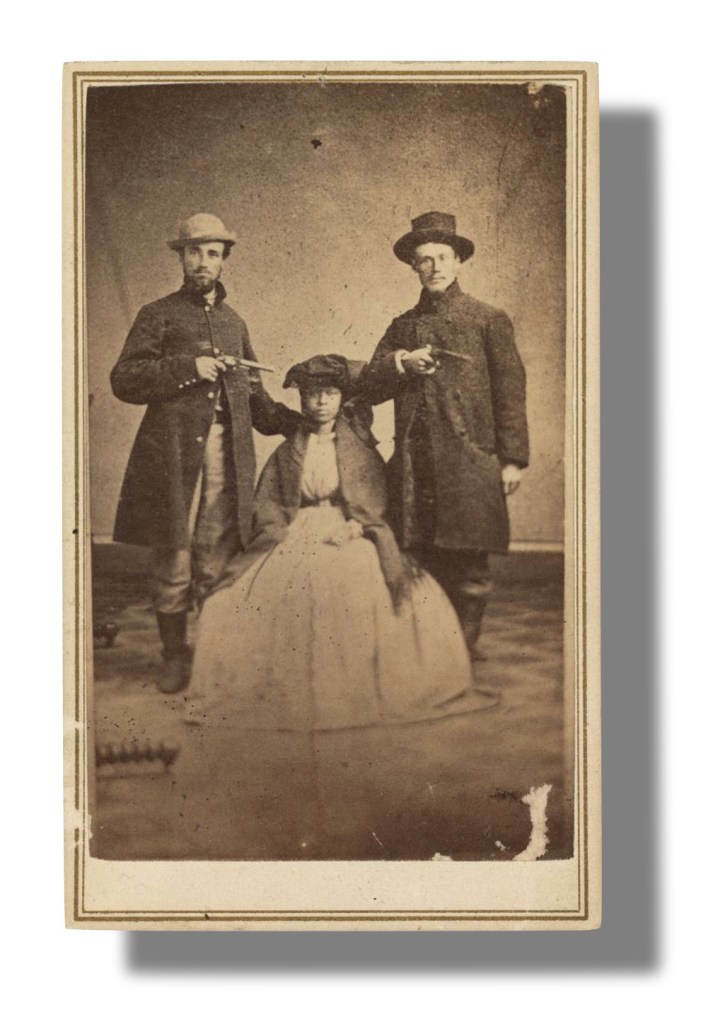
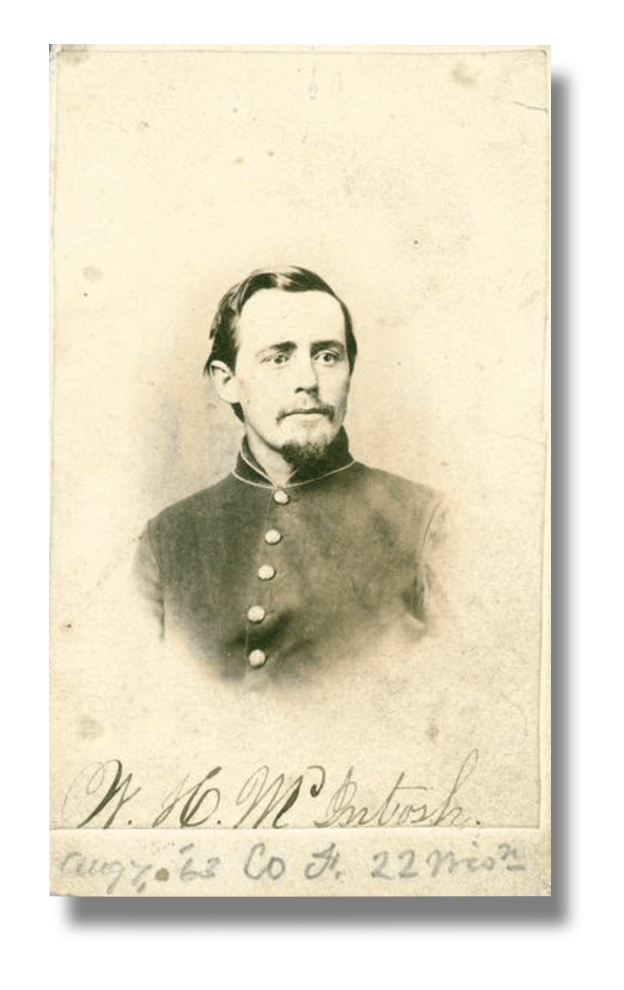
I could not find an image of John but here is a cdv of William H. McIntosh who served in Co. F, 22nd Wisconsin Infantry (WHS)
The following letter was written by John R. Siperly who was enumerated in his parents household in Delavan, Walworth county, Wisconsin at the time of the 1860 US Census, as a 23 year-old carpenter. John’s parent’s, Peter and Elizabeth (“Betsy”) Siperly, had relocated to Wisconsin prior to 1850 from the area around Rhineback, Dutchess county, New York.
John enlisted in August 1862 to serve as a private in Co. D, 22nd Wisconsin Infantry—sometimes referred to as “the Abolition Regiment.” He served a total of 2 years and 10 months, mustering out in June 1865. Though John wrote his father that he thought there were many signs for a “speedy close of this war” and even of peace negotiations, the heaviest days of fighting for the 22nd Wisconsin lay ahead of them, not behind them.
In 1867, John married Mary C. Church (1848-1906), and resumed in carpentry career in Walmouth county.
[Note: This letter is from the personal collection of Greg Herr and was transcribed and published on Spared & Shared by express consent.]
Transcription
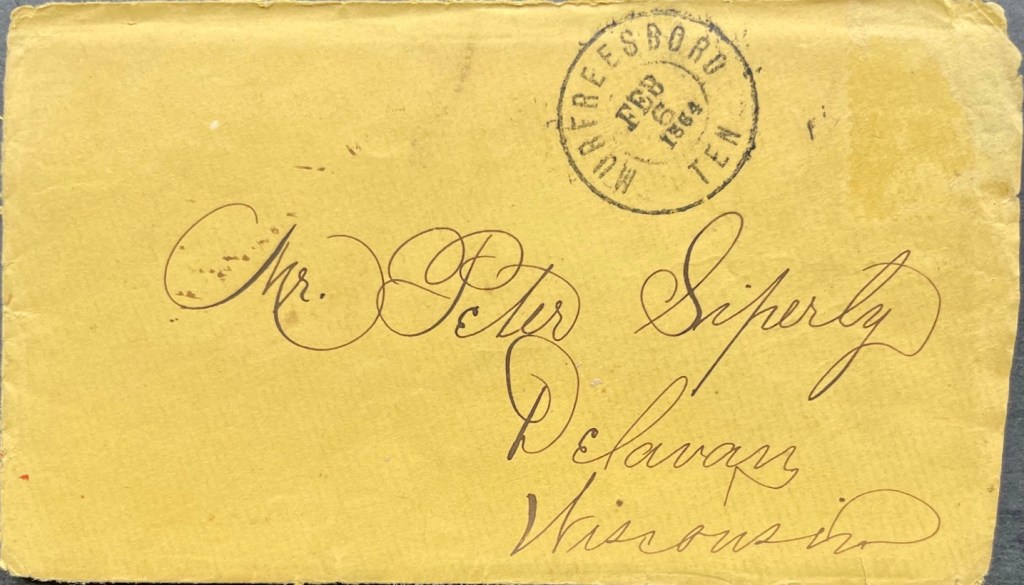
Addressed to Mr. Peter Siperly, Delavan, Wisconsin Postmarked Murfreesboro, Tennessee
Fort Overall February 4, 1864 10 o’clock at night
Mother & Father,
Well, I have been reading newspapers laying abed and killing mice tonight and the latter employment caused my mind to revert to the times I used to have at home sometimes at killing mice when the idea suggested itself to me that I had better scribble a few words for the remaining inmates of that home. Well, now it is darned late so you see I can’t say much—only to say that I am still well in the very best degree. We still have very pleasant weather though for the few last days it has been somewhat cooler and tonight looks like rain.
Important and encouraging [news] is being heard from different departments of the army—of desertions on a large scale in the rebel army; of mutinies, the most important one at Mobile; and grand victories of our forces, all of which betokens a speedy close of the war. It is a fact beyond a doubt that the majority of the men in the rebel army are fast seeing their mistake and would gladly give up if they could as many of them are doing.
A rumor is afloat now that the matter is being discussed at Richmond to the effect that if the president would extend his amnesty proclamation to the officers and leaders alike, they would lay down their arms and return to the Union. I can’t say how true this is but I don’t believe it. Neither do I care much, for rather than to see the hellish leaders of this rebellion receive one iota of pardon, or to have them escape a particle of the punishment they so justly merit, rather than that I would see this war continue five years yet. I feel perfectly willing to see all pardoned that comes within the scope of the President’s Proclamation and no further.
Tis thought some that a war with France is eminent—a thing that is not to be devoutly wished for. But if it must be, let it come. I don’t know that we will ever be better prepared than now.
Yesterday our regiment received orders to go to Nashville but has been countermanded again. Perhaps though we may go yet. I think, however, that we will soon be on the move. Tis hard telling where we will turn up next.
I hear that the weather is not as cold now in the North. I hope that is so. I sent a picture about two weeks ago. Did you get it? I hope there will be no further trouble about that money. Let me know when you get it. Good night. — John R. Siperly





 Spared & Shared 23