Category Archives: 23rd Massachusetts Infantry

1862: Charles L. Thompson to Sarah E. Morton

I could not find an image of Charles but here is one of Edward Hall who served in Co. A, 23rd Massachusetts Infantry (Photo Sleuth)

The following letter was written by Charles L. Thompson (1838-1890), a carpenter from New Bedford, Massachusetts, who volunteered to serve in Co. D, 23rd Massachusetts Infantry. He mustered in as a private on 28 September 1861 and rose in rank to sergeant, quartermaster sergeant, and finally to 2nd Lieutenant, though he was never mustered in as an officer before leaving the service in 1865.

Charles was the son of Amasa T. Thompson (1806-1865) and Betsy Maria Eaton (1811-1851). In 1850, the Thompson family was enumerated as farmers in Plymouth county, Massachusetts.

T R A N S C R I P T I O N

Addressed to Miss Sarah E. Morton, New Bedford, Mass., No, 35 Cove Street

Newbern [North Carolina]
September 24th 1862

Dear Cousin Sarah,

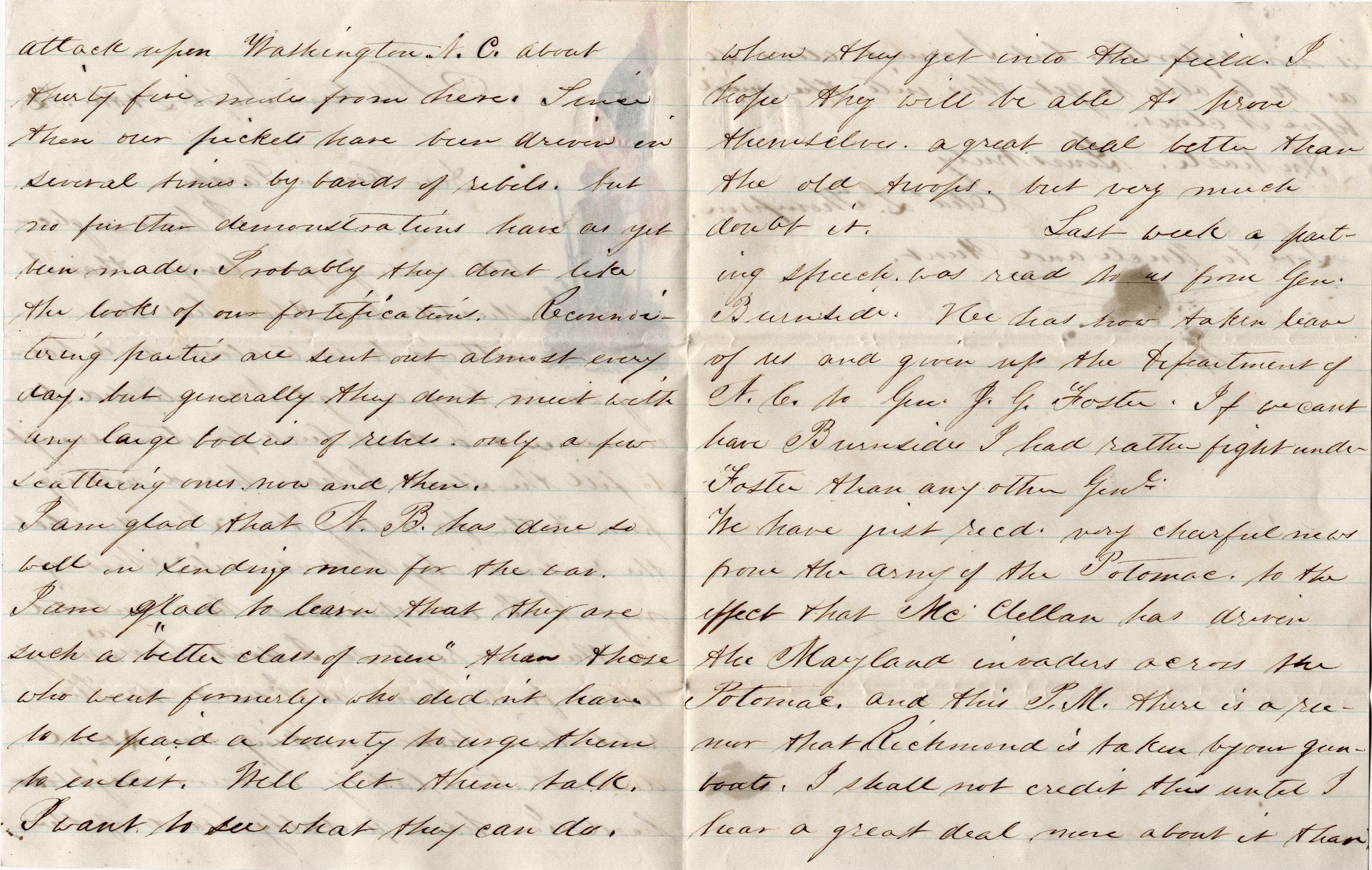
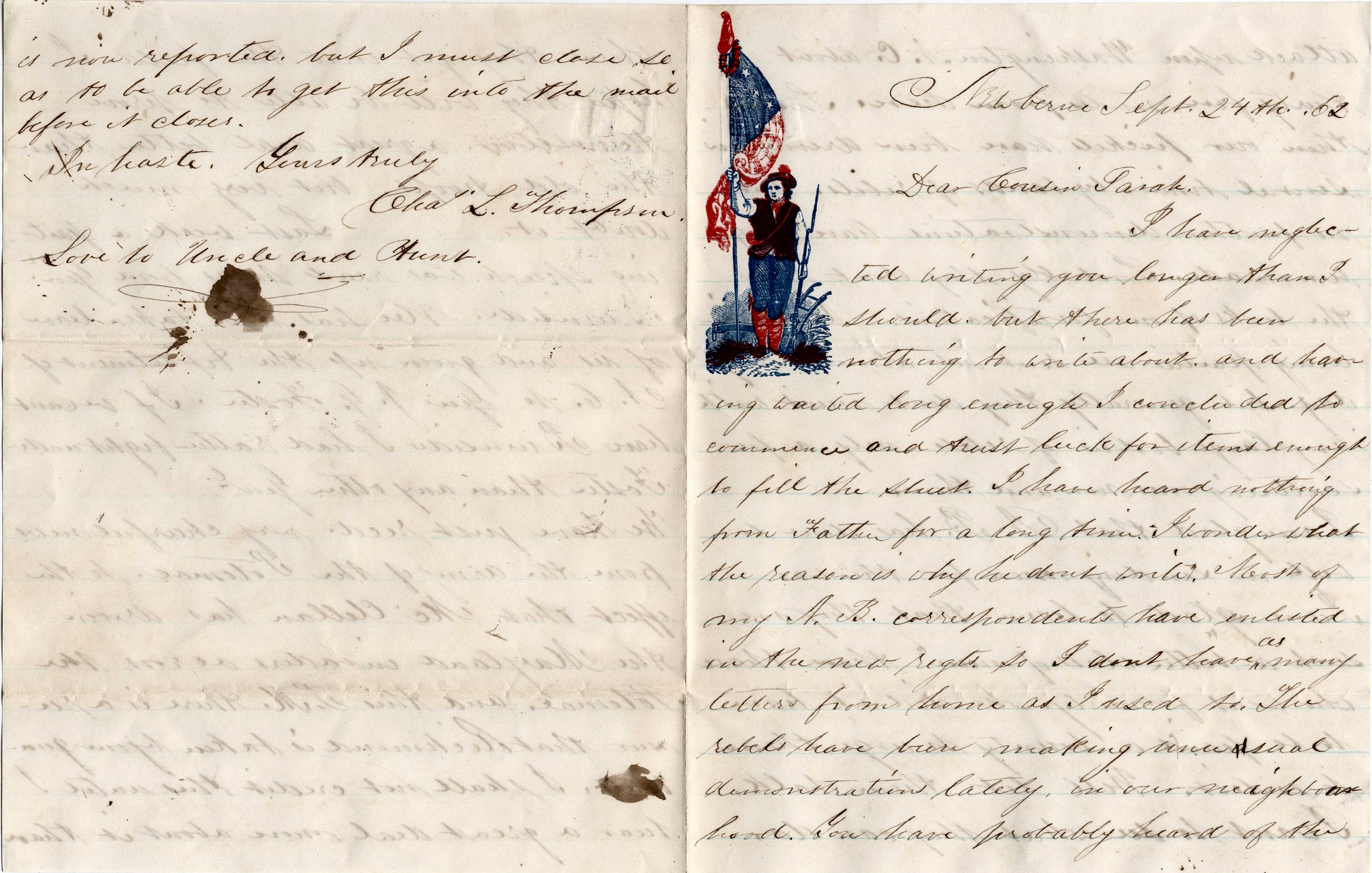
I have neglected writing you longer than I should but there has been nothing to write about and having waited long enough, I concluded to commence and trust luck for items enough to fill the sheet. I have heard nothing from Father for a long time. I wonder what the reason is why he don’t write? Most of my New Bedford [N. B.] correspondents have enlisted in the new regiments so I don’t have as many letters from home as I used to.

The rebels have been making unusual demonstrations lately in our neighborhood. You have probably heard of the attack upon Washington, N. C. about 35 miles from here. Since then our pickets have been driven in several times by bands of rebels, but no further demonstrations have as yet been made. Probably they don’t like the looks of our fortifications. Reconnoitering parties are sent out almost every day but generally they don’t meet with any large bodies of rebels—only a few scattering ones now and then.

I am glad that N. B. has done so well in sending men for the war. I am glad to learn that they are such a “better class of men” than those who went formerly who didn’t have to be paid a bounty to urge them to enlist. Well let them talk. I want to see what they can do when they get into the field. I hope they will be able to prove themselves a great deal better than the old troops, but very much doubt it.

Last week a parting speech was read to us from Gen. Burnside. He has now taken leave of us and given up the Department of North Carolina to Gen. J. G. Foster. If we can’t have Burnside, I had rather fight under Foster than any other general.

We have just received very cheerful news from the Army of the Potomac to the effect that McClellan has driven the Maryland invaders across the Potomac and this p.m. there is a rumor that Richmond is taken by our gunboats. I shall not credit this until I hear a great deal more about it than is now reported. But I must close so as to be able to get this into the mail before it closes.

In haste. Yours truly, — Chas. L. Thompson

Love to Uncle and Aunt.
1864: John Knight Dustin, Jr. to John K. Dustin, Sr.

I could not find an image of John but here is a CDV of Edwin Augustus Hall who served in Co. A, 23rd Massachusetts Infantry (Ancestry.com)

The following letter was written by John Knight Dustin (1843-1909), the son of John K. Dustin (1815-1898) and Angeline S. Heath (1816-1857) of Lanesville, Massachusetts. John enlisted on 20 September 1861 in Co. C, 23rd Massachusetts Infantry. Just previous to his enlistment, he was working as a clerk in Gloucester. He remained in the regiment his full term of three years, mustering out on 26 September 1864. After he left the service, he returned to Gloucester, married Lucy Low Davis (1847-1916), and settled into a life of book-keeping.

In this letter, John informs his father that Burnside’s return to command in North Carolina would be welcome. He also summarizes the New Year’s Day (1864) Emancipation celebration dinner given by the “colored Citizens” and the speeches in support of the reelection of “Old Abe.”

T R A N S C R I P T I O N

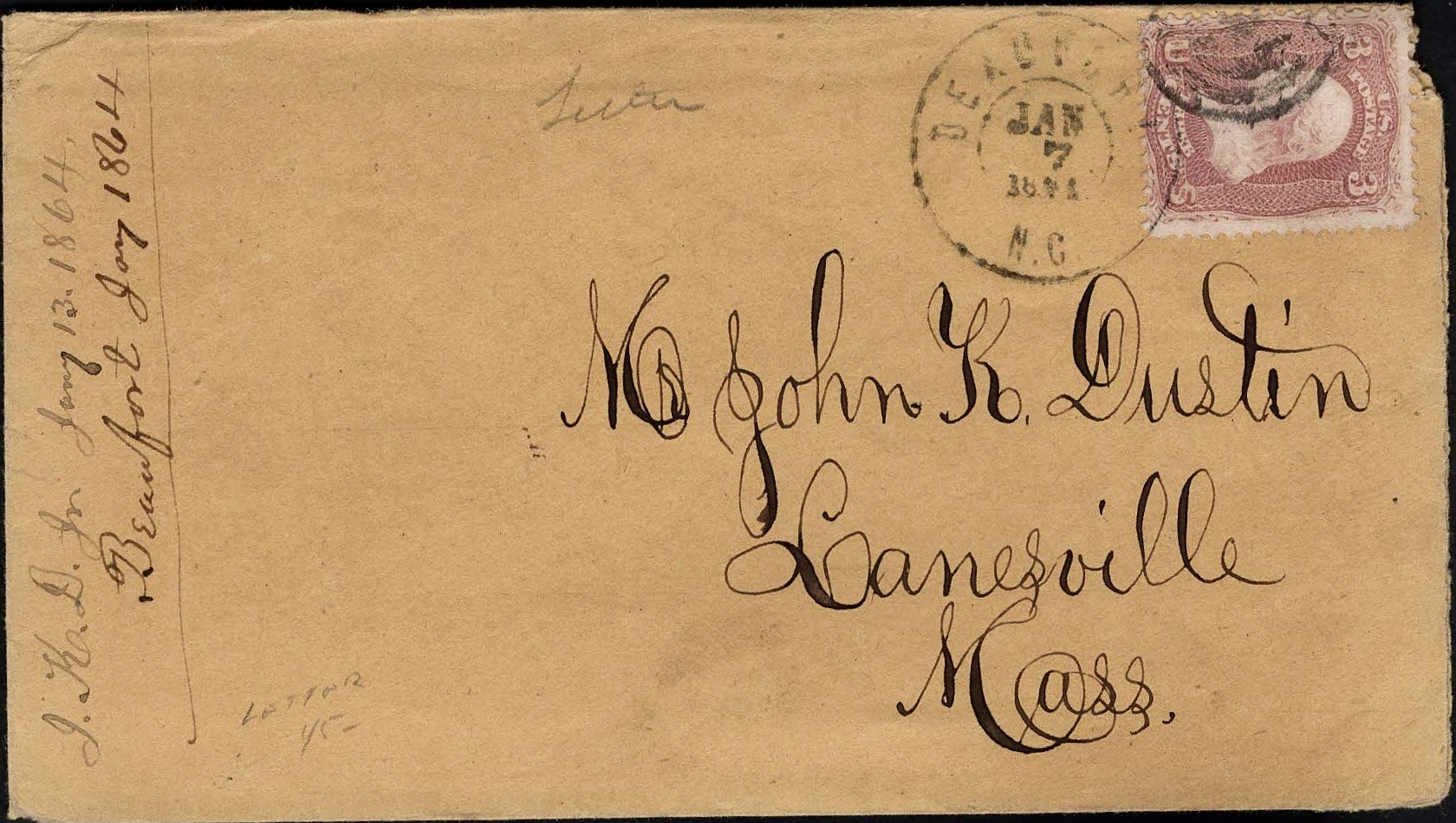
Addressed to Mr. John K. Dustin, Lanesville, Massachusetts

Hammond General Hospital 1
Beaufort, North Carolina
January 6, 1864

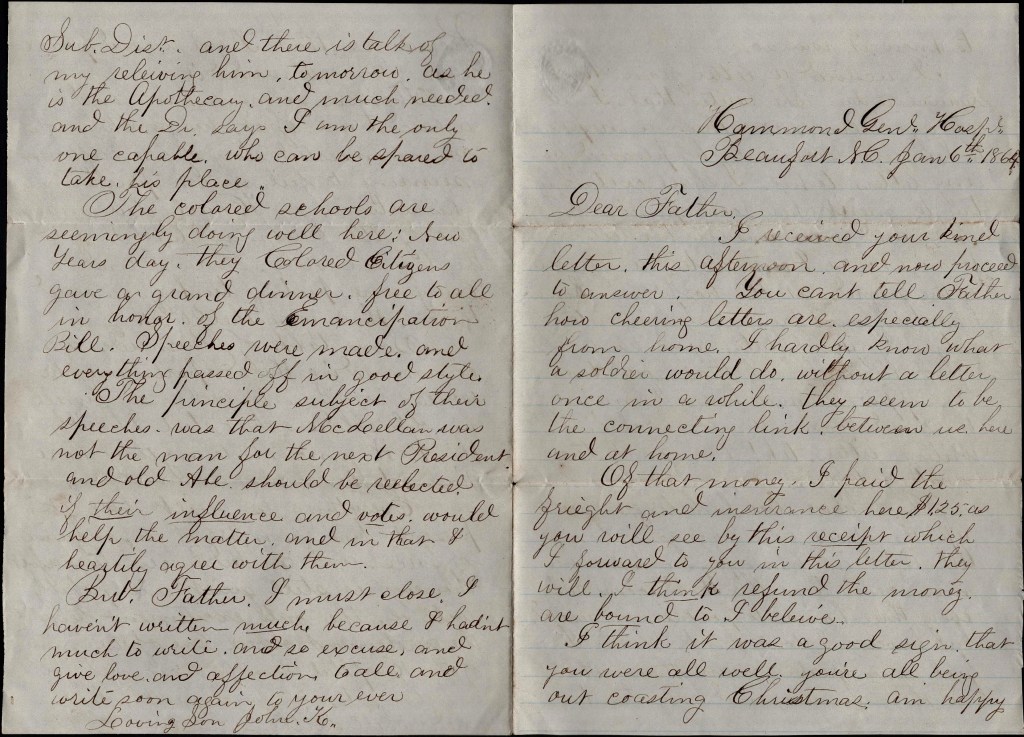
Dear Father,

I received your kind letter this afternoon and now proceed to answer. You can’t tell, Father, how cheering letters are—especially from home. I hardly know what a soldier would do without a letter once in a while. They seem to be the connecting link between we here and at home.

Of that money, I paid the freight and insurance here $1.25 as you will see by this receipt which I forward to you in this letter. They will I think refund the money—are bound to I believe.

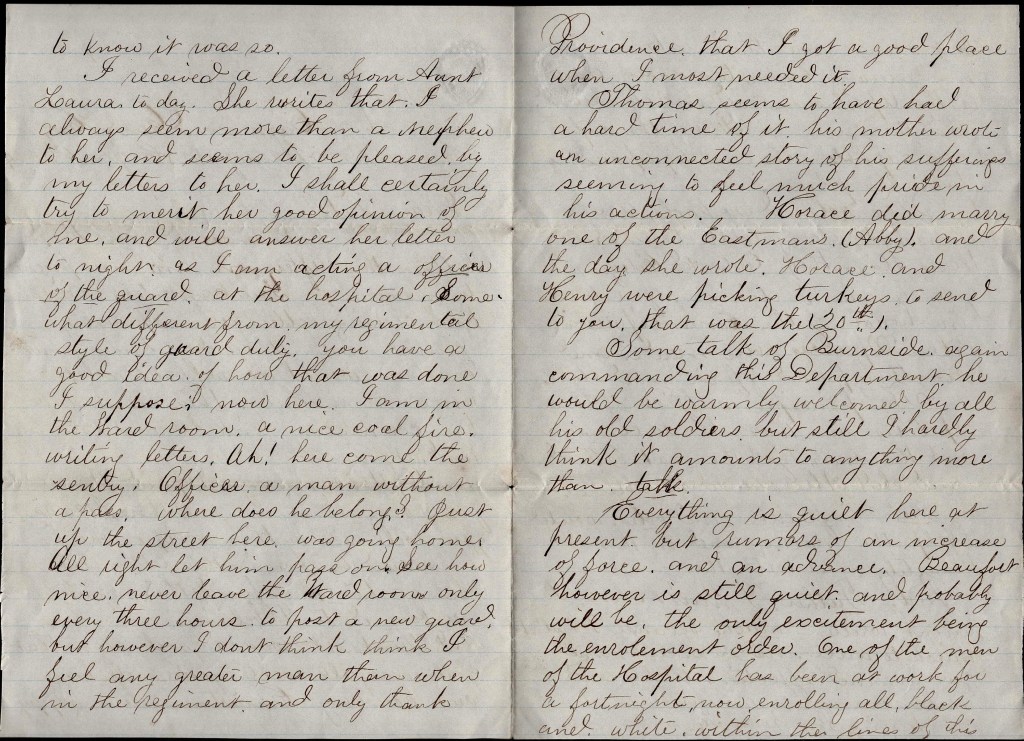
I think it was a good sign that you were all well, you’re all being out coasting Christas. Am happy to know it was so.

I received a letter from Aunt Laura today. She writes that I always seem more than a nephew to her and seems to be pleased by my letters to her. I shall certainly try to merit her good opinion of me and will answer her letter tonight as I am acting as Officer of the Guard at the hospital—somewhat different from my regimental style of guard duty. You have a good idea of how that was done, I suppose. Now here I am in the ward room [with] a nice coal fire writing letters. Oh! here comes the sentry. Officer, a man without a pass, where does he belong? Just up the street here, was going home. All right, let him pass on. See how nice. Never leave the ward room—only every three hours to post a new guard. But, however, I don’t think I feel any greater man than when in the regiment, and only tank Providence that I got a good place when I most needed it.

Thomas seems to have had a hard time of it. His mother wrote an unconnected story of his sufferings seeming to feel much pride in his actions. Horace did marry one of the Eastman’s (Abby) and the day she wrote Horace and Henry were picking turkeys to send to you, That was the 20th.

Some talk of Burnside again commanding this Department. He would be warmly welcomed by all his old soldiers but still I hardly think it amounts to anything more than talk.

Everything is quiet here at present but rumors of an increase of force and an advance. Beaufort, however, is still quiet and probably will be, the only excitement being the enrollment order. One of the men of the hospital has ben at work for a fortnight now enrolling all—black and white—within the lines of this Sub District and there is talk of my relieving him tomorrow. As he is the Apothecary and much needed, the Dr. says I am the only one capable who can be spared to take his place.

The colored schools are seemingly doing well here. New Year’s Day they—Colored Citizens—gave a grand dinner, free to all in honor of the Emancipation Bill. Speeches were made and everything passed off in good style. The principle subject of their speeches was that McClellan was not the man for the next President and Old Abe should be reelected if their influence and votes would help the matter, and in that I heartily agree with them.

But Father, I must close. I haven’t written much because I hadn’t much to write and so excuse and give love and affection to all, and write soon again to your ever loving son, — John K.


1 Hammond Hospital was a Civil War hospital set up in the ransacked Atlantic Hotel in Beaufort, North Carolina. Union General John Gray Foster brought in nine Catholic nuns to provide nursing for “200 wounded and sick soldiers.” Source: Wagoner, M. (2020). Column: Beaufort’s Civil War hospital nursed soldiers back to health. Carolina Coast Online. 


1862: Andrew Jackson Clark to his Brother

Andrew Jackson Clark, Co. H, 23rd Massachusetts

This letter was written by Andrew Jackson Clark (1837-1927) who served in Co. H, 23rd Massachusetts. Andrew was the son of Melzar Wentworth Clark (1812-1895) and Sabina Hobart Lincoln (1820-1906) of Hingham, Plymouth, Massachusetts. He was married in 1869 to Evelina M. Caine (b. 1847). Prior to the war, Andrew worked as a painter and as a volunteer fireman. After the war, he worked for a time as a painter, as a laborer in a rope factory, as a peddler, and as a janitor. He also spent 40 years as a fireman in Hingham.

According to his obituary, Andrew enlisted at President Lincoln’s first call for troops, stepping into the ranks of the Lincoln Light Infantry (Co. I, 4th Massachusetts Infantry) that served for three months. After that unit was discharged, he reenlisted in the 23rd Massachusetts and served until mustering out on 13 October 1864. “He was never wounded nor absent from duty on furlough.” He claimed to have participated in “the River and Sound Expedition; the rescue of Little Washington, N. C.; the battle of Portsmouth, Va.; the siege of Petersburg and the Battle of the Crater. Throughout Andrew’s letters are references to their suitability for publication in his hometown paper, the Hingham Journal, but I was not able to locate any on-line publications from that newspaper.

This partial letter came to me for transcription as an “unidentified author” but having transcribed several other letters by Clark in July, 2020 [see 1861-64: Andrew Jackson Clark to his Family], I was able to safely attribute the letter to him.

Transcription

Headquarters
Camp at Newbern
March 25, 1862

Dear Brother,

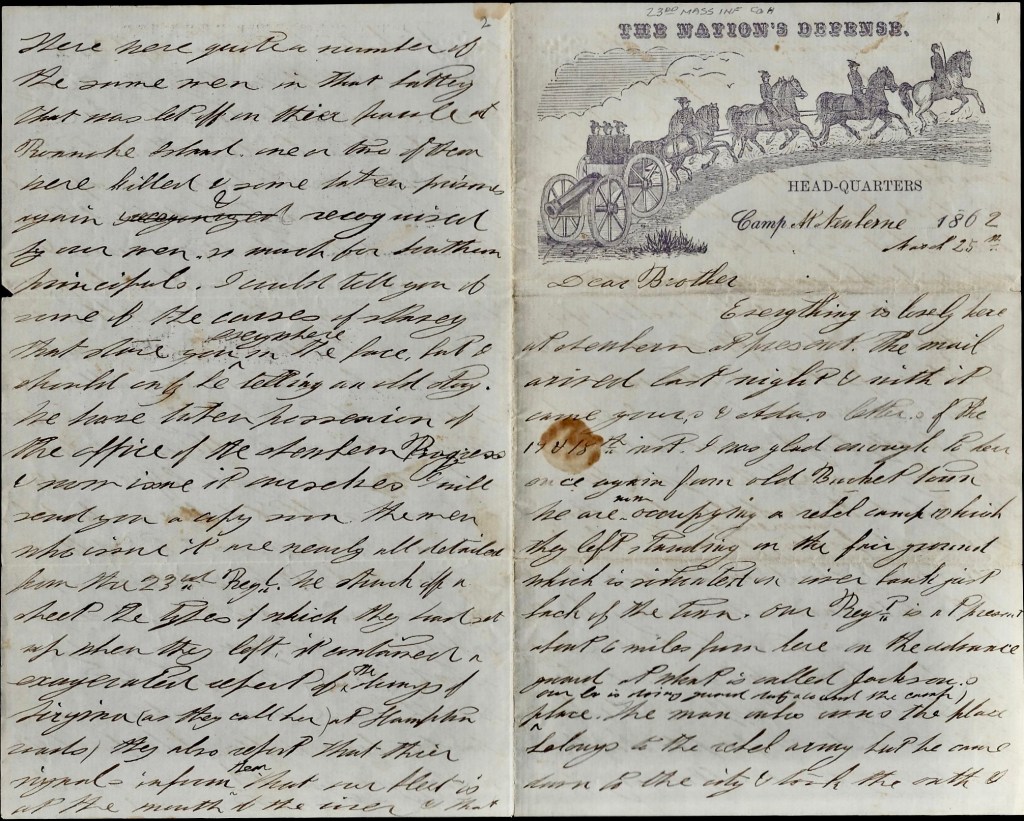
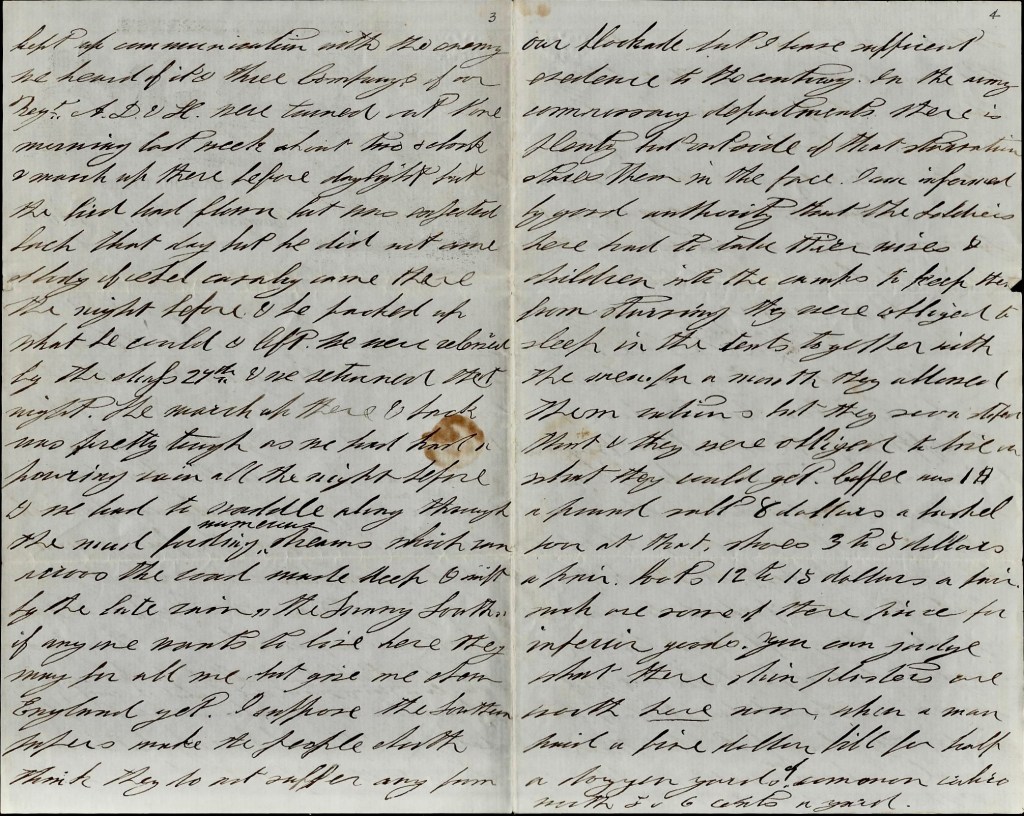
Everything is lonely here at Newbern at present. The mail arrived last night & with it came yours & Ada’s letters of the 17th and 18th inst. I was glad enough to hear once again from Old Bucket Town. We are now occupying a rebel camp which they left standing on the fair ground which is situated on river bank just back of the town. Our regiment is at present about 6 miles from here on the advance ground at what is called Jackson’s place. Our company is doing guard duty around the camp. The man who owns the place belongs to the rebel army but he came down to the city & took the oath and kept up communication with the enemy. We heard of it & three companies of our regiment—A, D, & H—were turned out lone morning last week about two o’clock & marched up there before daylight but the bird had flown but was expected back that day but he did not come. A body of rebel cavalry came there the night before & he packed up what he could & left. We were relieved by the Mass. 27th & we returned that night. The march up there and back was pretty tough as we had had a pouring rain all the night before & we had to waddle along through the mud fording numerous streams which ran across the road waist deep swollen by the late rain. The Sunny South—if anyone wants to live here, they may, but give me New England yet.

I suppose the southern papers make the people North think they do not suffer any from our blockade but I have sufficient evidence to the contrary. In the army commissary departments, there is plenty but outside of that, starvation stares them in the face. I am informed by good authority that the soldiers here had to take their wives and children into the camps to keep them from starving. They were obliged to sleep in the tents together with the men for a month. They allowed them rations but they soon stopped that and they were obliged to live on what they could get. Coffee was $1 a pound, salt 8 dollars a bushel—poor at that, shoes 3 to 5 dollars a pair, boots 12 to 15 dollars a pair. Such are some of their prices for inferior goods. You can judge what their shin plasters are worth here now when a man paid a five dollar bill for half a dozen yards of common calico with 5 or 6 cents a yard.

There were quite a number of the same men in that battery that was let off on their parole at Roanoke Island. One or two of them were killed & some taken prisoners again & recognized by our men. So much for southern principles. I could tell you of some of the curses of [ ] that stare you everywhere in the face, but I should only be telling an old story.

We have taken possession of the office of the Newbern Progress & now issue it ourselves. I will send you a copy soon. The men who issue it are nearly all detailed from the 23rd Regiment. We struck off a sheet the types of which they had set up when they left. It contained an exaggerated account of the Army of Virginia (as they call her) at Hampton Roads. They also report that their signals inform them that our fleet is up the mouth of the river and that….[rest of letter missing]