The following letter was written by John L. Dippy (1843-1864) of Co. H, 23rd Michigan Infantry. John enlisted at Antrim, Michigan, on 12 August 1862. He was killed in the fighting near Stone Mountain, Georgia, on 25 September 1864.
John was the son of John and Louisa (Pitts) Dippy of Bennington, Shiawassee, Michigan.
Bowling Green, Kentucky. Adolph Metzner drawings, Library of Congress
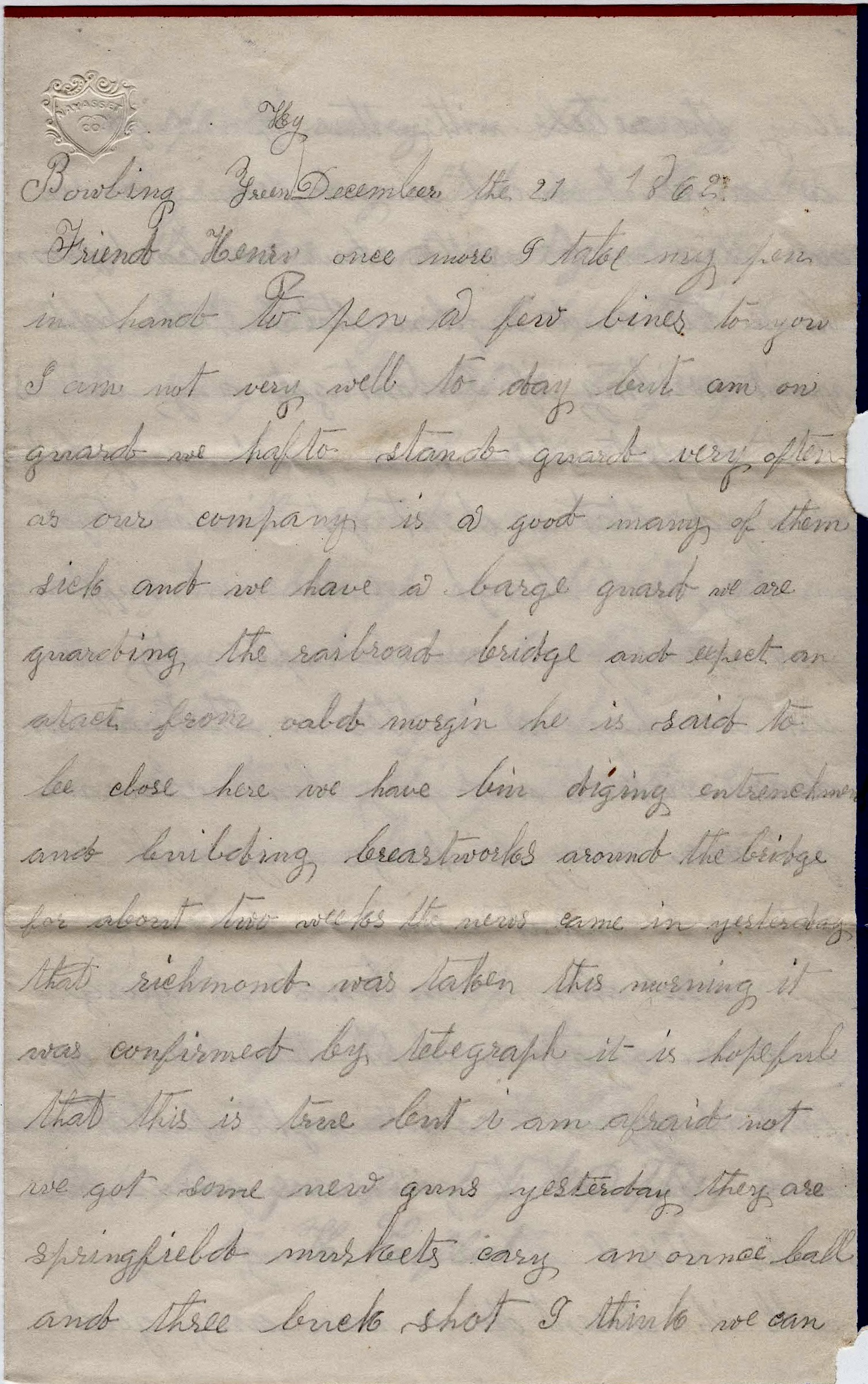
T R A N S C R I P T I O N
Addressed to Mrs. Henry Vanfleet, Pinckney, Livingston county, Michigan
Bowling Green, Kentucky December 21, 1862
Friend Henry,
Once more I take my pen in hand to pen a few lines to you. I am not very well today but am on guard. We have to stand guard very often as our company is a good many of them sick and we have a large guard. We are guarding the railroad bridge and expect an attack from Old Morgan. He is said to be close here. We have been digging entrenchments and building breastworks around the bridge for about two weeks.
The news came in yesterday that Richmond was taken. This morning it was confirmed by telegraph. It is hopeful that this is true but I am afraid not.
We got some new guns yesterday. They are Springfield [Model 42] muskets. [They] carry an ounce ball and three buck shot. I think we can slay the Rebels with these if we get a chance. 1
The Model 1842 Springfield smoothbore musket...very effective at short range.
I haven’t heard from you in over three weeks. Neither have we heard from home. Tell Aunt Angeline that I shall have to quit writing if I don’t get any letters but I expect there is a good many letters delayed that we don’t get. We haven’t got our pay yet though we are not suffering for money as we have plenty to eat. We have a sutler so that we can draw tickets and pay him when we get our pay. He charges very high for things. I haven’t run in debt any yet and don’t intend to.
George and me together kept ten dollars of our first pay and lent eight of that and used the rest to get some gloves for winter. This I think is doing very well. It doesn’t do a man any good to spend money in the army as things are very high and the doctors say the cakes and candy do the men more hurt than good.
I hope that I will see you all before long again but maybe not if we have an attack here. I will stand my chance to never see you although my health has been very good since I enlisted.
If McClellan has got Richmond, I think the fighting is about done. If Morgan makes an attack here, we will have lots of news to write for I think we will whip him. When you get these few lines of scribbling, please write me a good long letter. This from your friend, — J. L. Dippy
To H. Vanfleet
1 The regiment initially carried “Austrian” or Prussian Model 1809 muskets which had been converted to percussion firing. Since Dippy claims the new weapons fired a buck and ball, they must have been the Model 1842 smoothbore Springfield musket.
I could not find an image of Theodore but here is one of John Franklin Copenhaver who served in Co. G, 23rd Michigan. (Ancestry.com)
The following letter was written by Theodore P. Hoyt, Jr. (b. 1844), the son of Theodore P. Hoyt, Sr. (1815-1874) and Abigail Ann Bristol (1817-1890) of Maple Rapids, Clinton county, Michigan. Theodore was 18 years old when he enlisted in July 1862 to serve as a private in Co. A, 23rd Michigan Infantry. He mustered out of the regiment on 28 June 1865 at Salisbury, North Carolina.
The 23rd Michigan participated in the Atlanta Campaign, the battles of Jonesboro, Franklin and Nashville, and finally in the Campaign of the Carolinas. At Franklin, they repulsed an assault in a desperate hand to hand struggle. At Nashville, the regiment made “a daring assault the first day upon the enemy, posted behind a stone wall on a hill, carrying the position in a gallant manner and capturing more prisoners than there were men in the line of the regiment.” At war’s end, the regiment had suffered 3 officers and 70 enlisted men killed in action or mortally wounded and 4 officers and 257 enlisted men who died of disease, for a total of 334 fatalities.
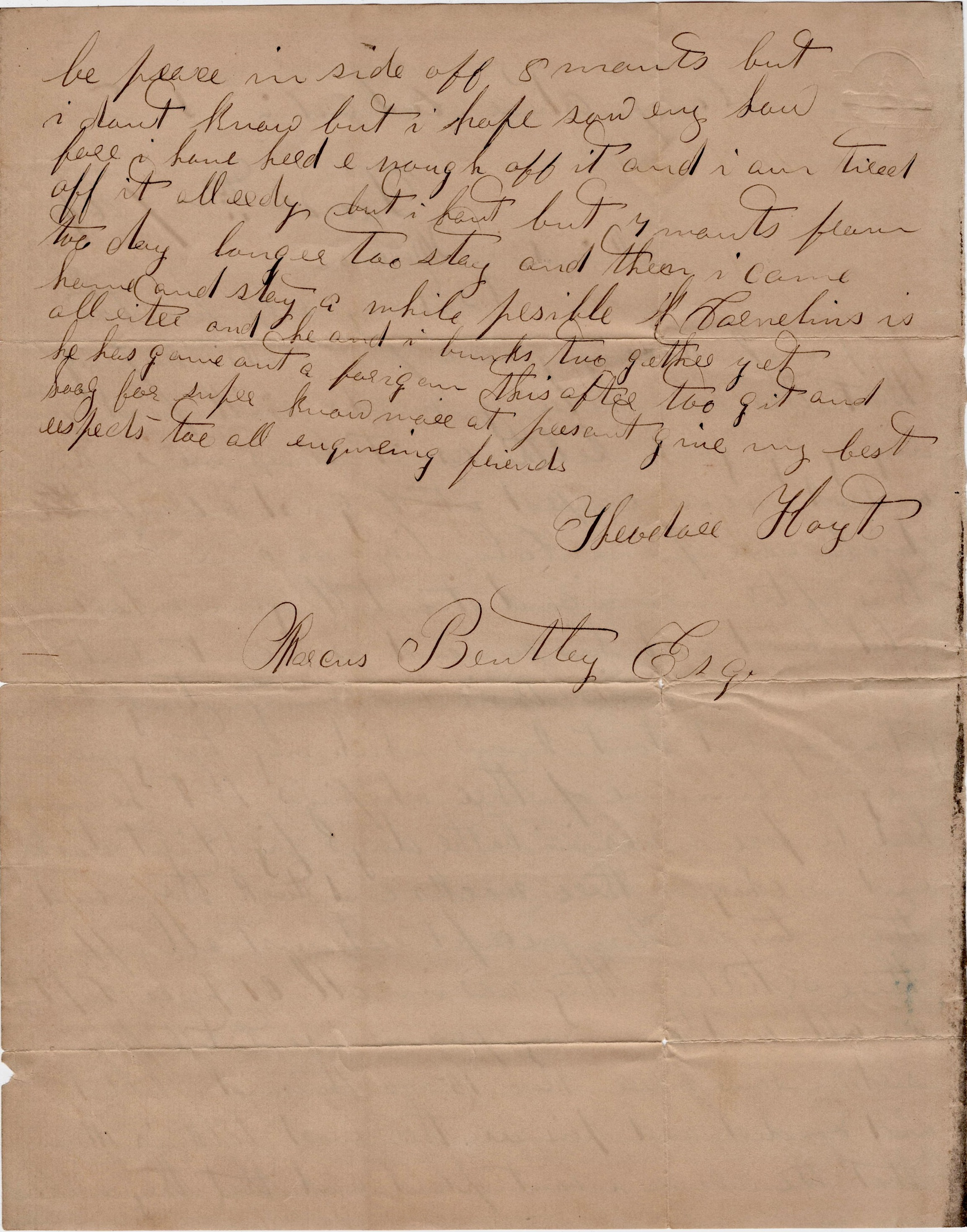
T R A N S C R I P T I O N
Addressed to Mr. Marcus Bentley, Maple Rapids, Clinton Co., Michigan
Camp near Columbia, Tennessee December 26th 1864
Friend Marcus,
I seat myself for the purpose of addressing you a few words hoping that these few scattered words will find you enjoying good health as it leaves me sick a bed. We are camped just across Duck river from Columbia. We came in here this afternoon and to tell you where Old Hood and his command is, I can’t, but is somewhere in this vicinity trying to get away but don’t know which way to go. We give him one the [best] whippings that he never had before. I was in both day’s fights at Nashville and we charged their works and took them and their two artillery. We captured most all of their artillery. They was in all 61 pieces captured in all and how many prisoners I can’t tell for certain—somewhere near 15,000 killed and wounded and prisoners.
The most talk is now that the rebs are about to played [out] and that there will be peace inside of 8 months but I don’t know. But I hope so anyhow for I have had enough of it and I am tired of it already. But I han’t but 7 months from today longer to stay and then I come home and stay awhile if possible. Cornelius is all right and he and I bunk together yet. He has hone out a foraging this after[noon] to get a hog for supper.
No more at present. Give my best respects to all enquiring friends, — Theodore Hoyt
I could not find an image of Oliver but her are three members of Co. D, 23rd Michigan Infantry. They are Sgt. A. Judson Slafter (1822 – 1863) in the middle; Cpl. Orson Ormes on the left; and Sgt. Nelson Hewes on the right. The three Tuscola men mustered into service on 12 September 1862 at Saginaw. Slafter was wounded in the battle at Campbell Station, Tennessee, on November 16, 1863, and was taken to a military hospital in Knoxville, where he died on December 31, 1863. Ormes survived the Civil War and returned to Tuscola County to farm. Hewes (1829 – 1864), was appointed Commissary Sergeant on March 30, 1863, and commissioned 2nd Lt. on December 25, 1863. He died of disease on March 4, 1864.(Ancestry.com)
This letter was composed by Oliver M. Able (1820-1883), the progeny of William Abel (1796-1880) and Alma Sager (1805-1861). In October 1842, Oliver entered into matrimony with Sally L. Ferris (1822-1900). The couple engaged in agriculture in Perry, Shiawassee County, Michigan, and by the time Oliver, then 42 years old, enlisted on 13 August 1862 as a private in Company H, 23rd Michigan Infantry, they had borne as many as eight children. In his letter, written three months into his three-year term of service, he conveyed his struggles with rheumatism, which compelled him to seek a disability discharge, ultimately granted on 20 February 1863 in Bowling Green, Kentucky.
The 23rd Michigan left Saginaw on the 18th of September 1862, under the command of Colonel Chapin, proceeding at once to Kentucky, its muster rolls showing a force of 983 officers and men. Soon after its arrival, it was assigned to the Tenth Division of General Rosecrans’ Army, then pushed forward to Bowling Green. While there a detachment of the Regiment was attacked by a superior force of Confederate guerrillas, but were repulsed. The 23rd remained at Bowling Green until May 29,1863, employed in guarding the trains.
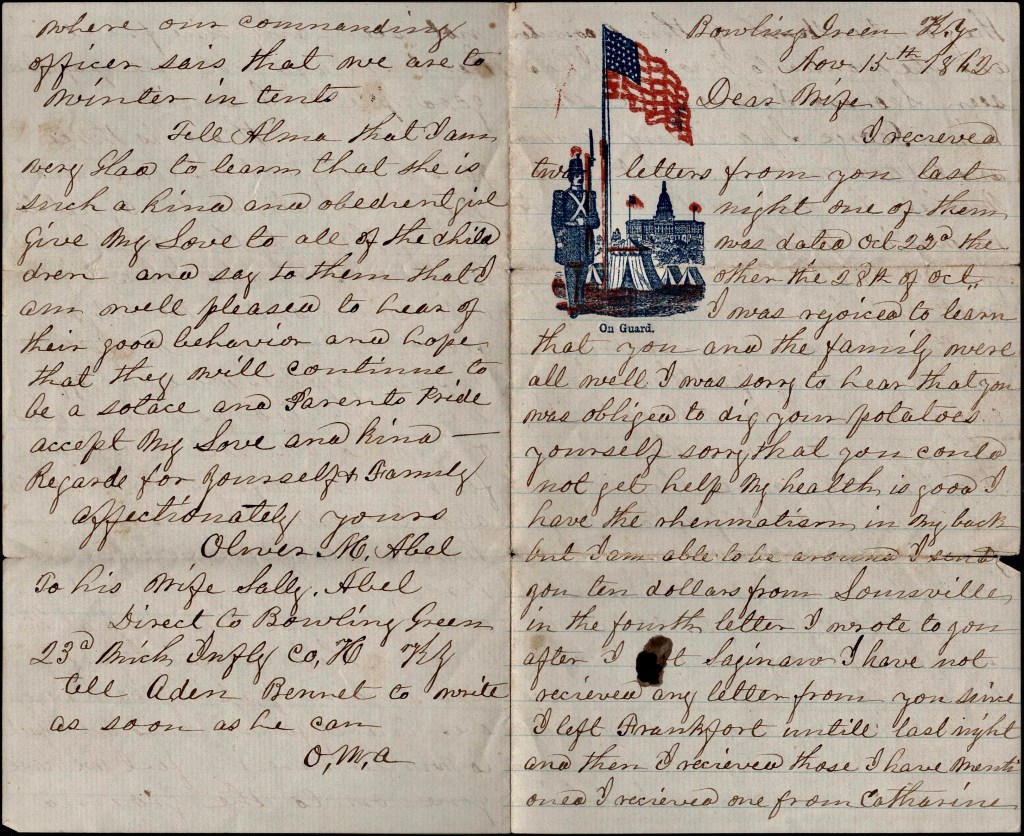
T R A N S C R I P T I O N
Addressed to Mrs. Sally Abel, Perry Center, Shiawassee county, Michigan
Bowling Green. Kentucky November 15th 1862
Dear Wife,
I received two letters from you last night. One of them was dated October 22nd. The other the 28th of October. I was rejoiced to learn that you and the family were all well. I was sorry to hear that you was obliged to dig your potatoes yourself. Sorry that you could not get help.
My health is good. I have the rheumatism in my back but I am able to be around. I sentr you ten dollars from Louisville in the fourth letter I wrote to you after I left Saginaw. I have not received any letter from you since I left Frankfort until last night and then I received those I have mentioned. I received one from Catharine the fourteenth of this November and she wanted to know if I had seen Leonard. I have not seen him. George Spaulding saw him and talked with him at New Market. He was well and hearty. He was in Michigan 2nd Cavalry.
You ask me how I like soldiering. Well only I do not like this lying in the dirt and being so dirty and smutty looking. If Father is going East and wants to sell you his things and you want them, why buy them of course. They are second hand things. Don’t pay too much for them. Keep in good courage as I am in the firm believe that I shall get to return to my family.
Bowling Green is quite a place for a Kentucky town. There is some very nice churches and dwellings and some splendid orchards here—that is, the trees grow very large and thrifty but I have not seen any nice fruit in Kentucky and not one passable good pie or biscuit.
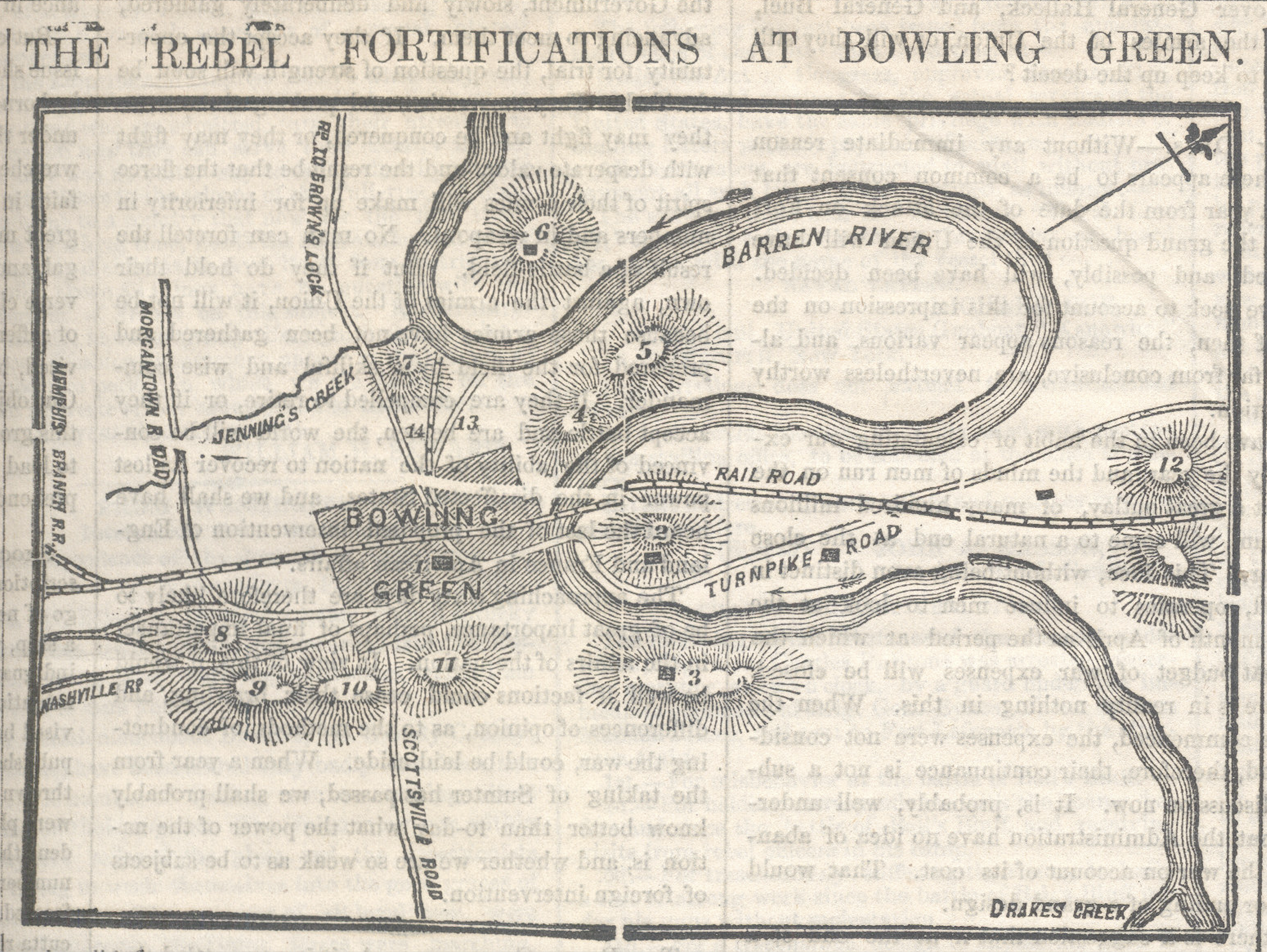
There is three fort or fortifications commanding. the place—all built by Rebels. One of them by the Rebel General [Simon] Buckner situated on a high hill commanding the city and all of its surroundings. 1 But his supplies were cut off by the Union troops and he was obliged to evacuate it too soon for his own safety as he was killed about eighteen miles from here. There is a railroad passing through here doing a large and extensive business at this time. There are certainly as many as six trains passing each way every twenty-four hours.
We expect to winter here. In fact, we have gone on to the ground where our commanding officer says that we are to winter in tents.
Tell Alma that I am very glad to learn that she is such a kind and obedient girl. Give my love to all of the children and say to them that I am well pleased to hear of their good behavior and hope that they will continue to be a solace and parents’ pride. Accept my love and kind regards for yourself & family. Affectionately yours, — Oliver M. Abel
To his wife Sally Abel.
Direct to Bowling Green, Kentucky, 23rd Michigan Infantry, Co. H
Tell Aden Bennett to write as soon as he can. — O. M. A.
Map from the New York Weekly Journal of Commerce for Thursday, Feb. 13, 1862; showing “Rebel” fortifications near Bowling Green; the news report accompanying map shows numbered areas 1-14, they are the courthouse, Webb and Price’s Hill, Underwood and Calvert’s Hills, McGoodwin and Grider’s Hills, College and Gossom’s Hills and the roads and railroads to the river. A description of the topography, water supply and general lay of the land is noted. (Kentucky Library Research Collections)
1 The two largest fortifications built by the Confederates were Fort C. F. Smith and Fort Baker. The former was built on Reservoir Hill south of town. The latter was built on a hill north of the city on the Barren River.









 Spared & Shared 23