Category Archives: 23rd North Carolina Infantry

1864: Franklin L. Stuard to Nathaniel Thomas Stuard

Franklin L. Stuard’s Headstone

The following letter was written by Franklin L. Stuard (1839-1865), the oldest son of Mathaniel Thomas Stuard (1817-1897) and Caroline Jane Robeson (1816-1896) of Lincolnton, Lincoln county, North Carolina.

According to Muster rolls, Frank enlisted in May 1861 as a private in Co. B, 23rd North Carolina Infantry. He was severely wounded two years later in the Battle of Chancellorsville and treated at Winder Hospital in Richmond but returned to his regiment in January 1864 when this letter was penned. It was the 23rd North Carolina that took the lead in Stonewall Jackson’s immortal night march that fell upon the unsuspecting right flank of Hooker’s army. Frank’s military record does not inform us of his death but his grave marker stated that he was killed on 5 April 1865, most likely in the Battle of Amelia Springs.

Transcription

Addressed to Mr. N. T. Stuard, Lincolnton, North Carolina

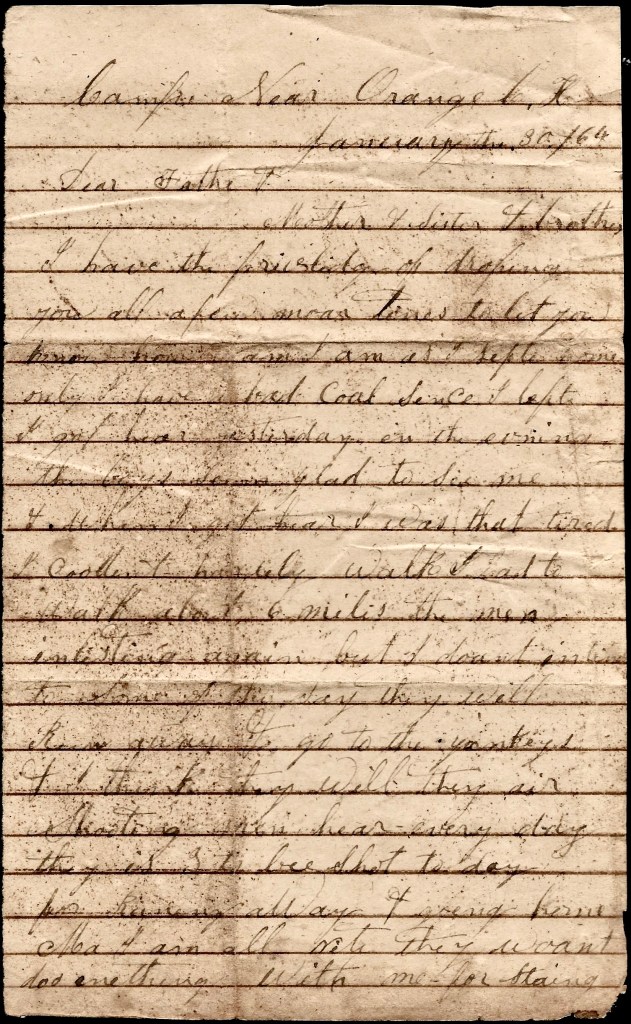
Camp near Orange Court House
January the 30th 1864

Dear Father & Mother & Sister & Brothers,

I have the privilege of dropping you all a few more lines to let you know how I am. I am as I left home only I have a bad cold since I left. I got here yesterday in the evening. The boys [were] some glad to see me & when I got here I was that tired, I couldn’t hardly walk. I had to walk about six miles. The men are enlisting again but I don’t intend to. Some of them say they will run away & go to the Yankees & I think they will. They are shooting men here every day. There is three to be shot today for running away & going home.

Ma, I am all right. They won’t do anything with me for staying at home without furlough but if I had of stayed any longer, they might of tried it. But as it is, they don’t say anything.

I haven’t any news to write that will interest you in the least. I [had] written to you all [the news] when I was at Richmond. I wrote on Thursday & I thought I would write a few lines today. Ma, I want you to write & tell me how Harriet is getting along. I want to see her mighty bad. I won’t say any more for the present—only I want you to write as soon as you get this & give me all of the news.

Direst your letters to Orange Court House, Va.

So I will stop for the present. So goodbye, — F. L. Stuard

To the Hoal [whole] family.
1864: James Nunn to Nancy E. (Bingman) Nunn

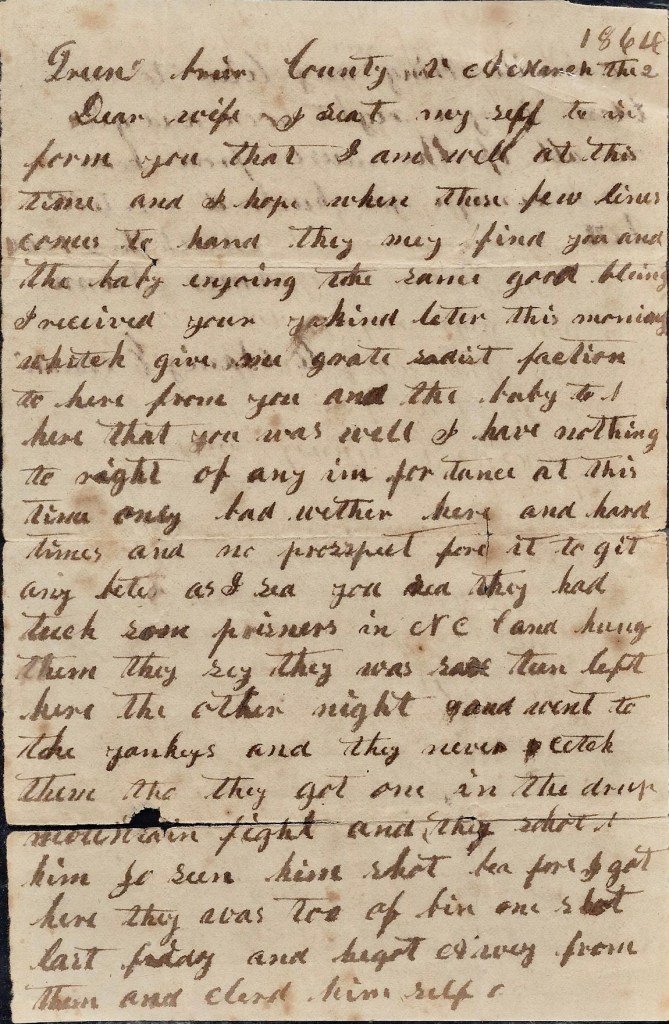
This letter was written by James Nunn (1838-1864), the son of James Nunn (1802-1886) and Ursula Usey East (1800-1892) of Stokes county, North Carolina. James was married to Nancy Elizabeth Bingman (1845-1917) in May 1861 and fathered two children prior to his enlistment as a private in Co. H, 23rd North Carolina Infantry in October 1862.

According to his service record, James was killed at the Battle of New Market, Virginia, on 15 May 1864 when his regiment with others—including the young cadets of the Virginia Military Institute (VMI)—were ordered by Gen. Breckinridge to attack Gen. Franz Sigel’s army as they advanced up the Shenandoah Valley with the objective of destroying the railroad and canal complex at Lynchburg.

One artist’s depiction of the VMI cadet’s charge at New Market where James Nunn of the 23rd North Carolina lost his life.

Transcription

Greenbrier county, Va.
March 2, 1864

Dear wife,

I seat myself to inform you that I am well at this time and I hope when these few lines comes to hand, they may find you and the baby enjoying the same good blessing. I received your kind letter this morning which gave me great satisfaction to hear from you and the baby to hear that you was well.

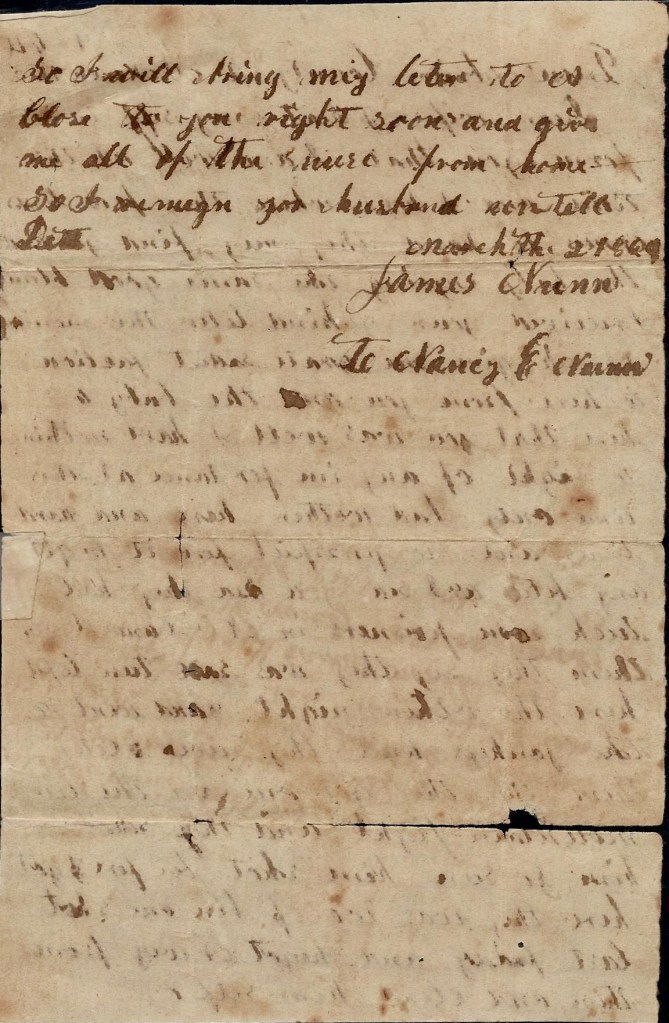
I have nothing to write of any importance at his time. Only bad weather here and hard times and no prospect for it to get any better as I see. You said they had took some prisoners in North Carolina and hung them. 1 They say there was sixteen left here the other night and went to the Yankees and they never catched them. Then they got one in the Droop Mountain fight and they shot him. Joe seen him shot before I got here. There was two [should] of been. One shot last Friday and he got away from them and cleared himself.

So I will bring my letter to a close to you. Write soon and give me all of the news from home. So I remain your husband until death.

— James Nunn

to Nancy E. Nunn


1 The hanging incident referred to in the letter was no doubt the execution of Union prisoners at Kinston, North Carolina, ordered by Gen. George Pickett during February 1864. See “Cloaked Vengeance: George Pickett and the Hanging of Union Prisoners,” by Ron Soodalter.