
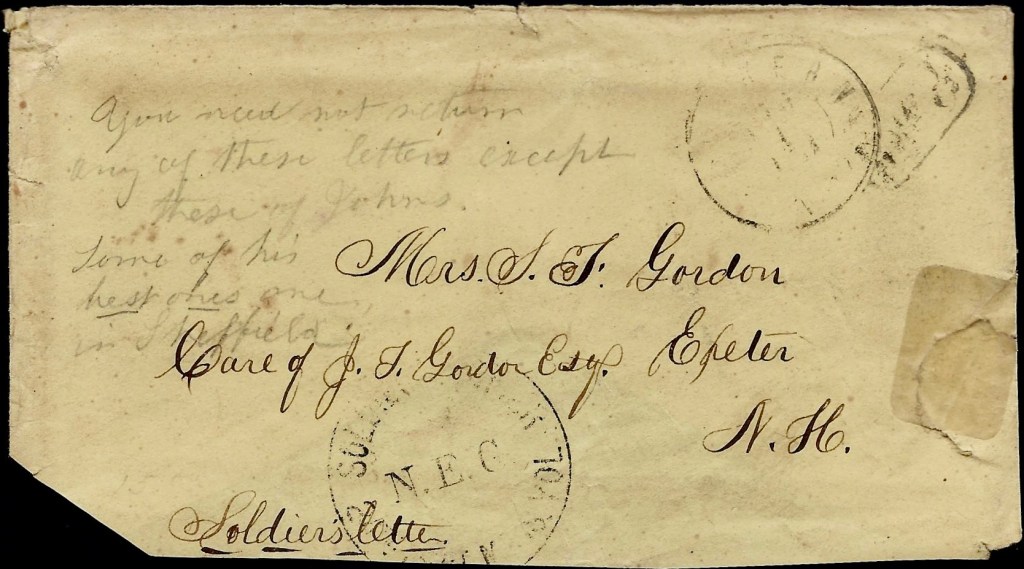
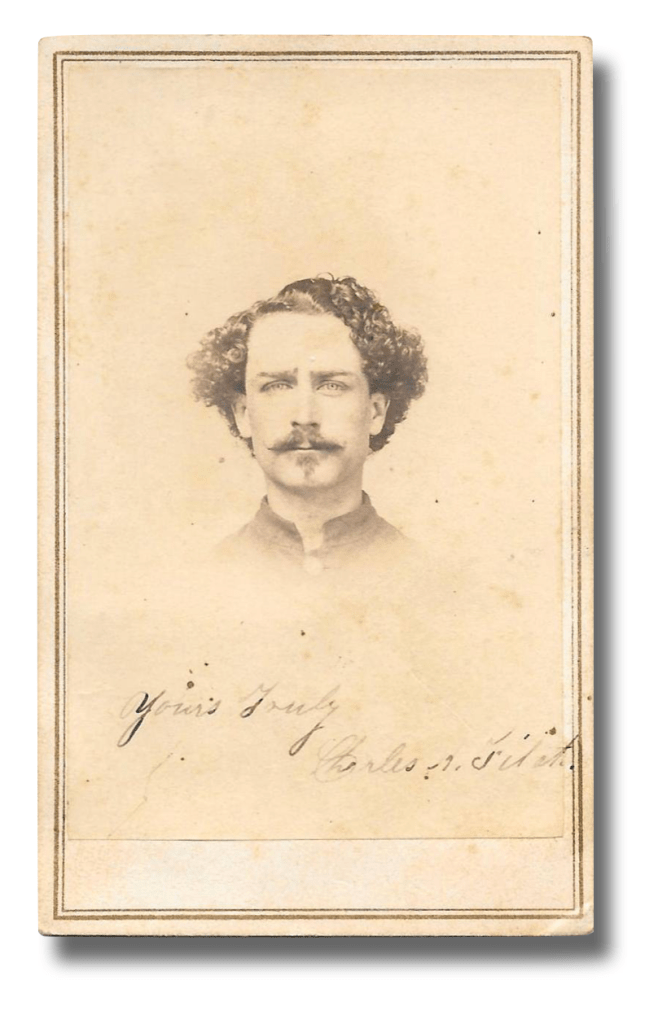
The following letter was written by John Gordon (1843-1925), the son of Dea. John T. Gordon (1792-1865) and Sarah Folsom (1802-1885) of Exeter, Rockingham, New Hampshire.

John was an 18 year-old student when he enlisted as a private in Co. C, 24th Massachusetts Infantry on 18 October 1861. He was promoted to a corporal on 5 December 1861 and was discharged from the regiment on 10 June 1863 to accept a commission as Captain of Co. I, 55th Massachusetts Infantry—a black regiment organized in 1863 by Massachusetts Governor John Andrew. After training at Camp Meigs near Readville, Mass., the 55th saw the bulk of its action in South Carolina. They served in the 1864 invasion of Florida where they took part in the Battle of Olustee in February. The 55th also saw action in battles once they returned to South Carolina, first on James Island in May, and later in July of 1864. John resigned his commission on 26 July 1864.
John’s letter to his mother describes the occupation of Seabrook Island in late March 1863 by Gen. Thomas Greely Stevenson’s Brigade (24th MA, 10th CT, 56th NY, and 97th PA regiments) and the destruction of the Seabrook Plantation main house.
To read other letters by members of Co. C, 24th Massachusetts I have transcribed and published on Spared and Shared, see:
Alexander M. Hayward, Co. C, 24th Massachusetts (1 Letter)
Josiah Alonzo Osgood, Co. C, 24th Massachusetts (20 Letters)
Transcription
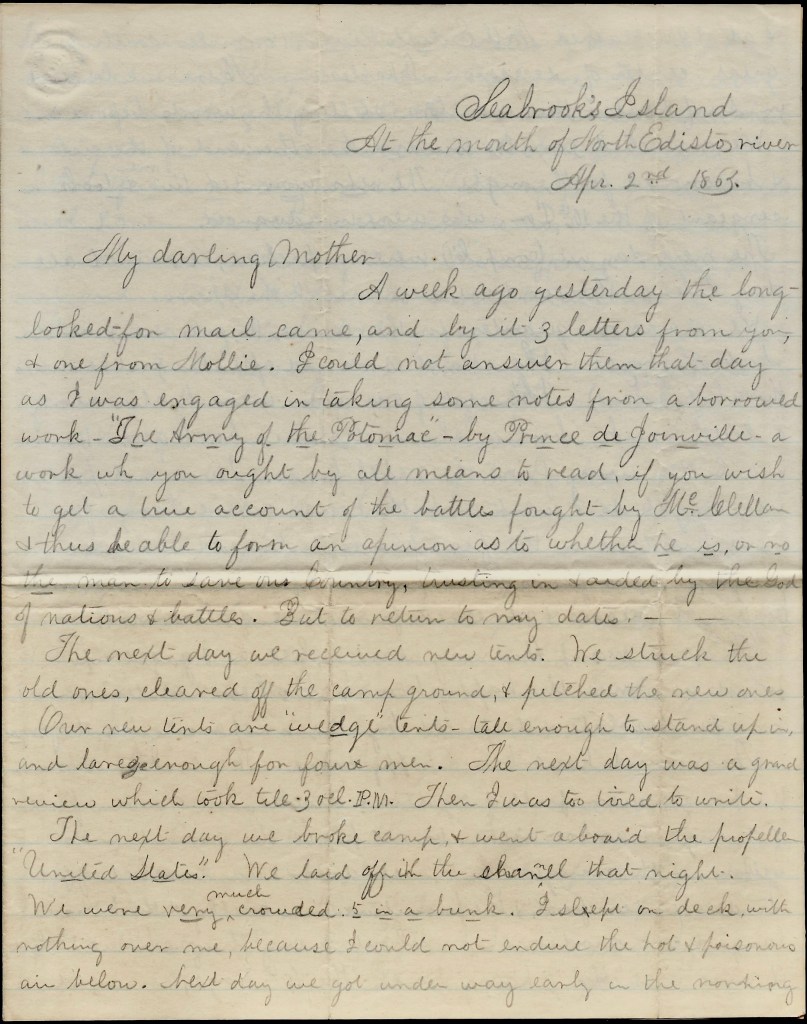
Seabrook Island
At the mouth of North Edisto river
April 2nd 1863
My darling Mother,
A week ago yesterday the long looked-for mail came, and by it 3 letters from you & one from Mollie. I could not answer them that day as I was engaged in taking some notes from a borrowed work: “The Army of the Potomac” by Prince de Joinville—a work which you ought by all means to read if you wish to get a true account of the battles fought by McClellan & thus be able to form an opinion as to whether he is, or no the man to save our Country, trusting in & aided by the God of nations & battles.
But to return to my dates. The next day we received new tents. We struck the old ones, cleared off the camp ground, & pitched the new ones. Our new tents are “wedge” tents—tall enough to stand up in, and large enough for four men. The next day was a grand review which took till 3 o’clock p.m. Then I was too tired to write.
The next day we broke camp & went aboard the propeller United States. We laid off in the channel that night. We were very much crowded—five in a bunk. I slept on deck with nothing over me because I could not endure the hot & poisonous air below.
Next day we got under way early in the morning & at 3 p.m. reached North Edisto River, 18 miles south of the great center of secession—Charleston. Here we landed in surf boats, two monitors shelling the woods before us. We marched three miles towards the other end of the island & bivouacked for the night. The “rebs” wounded two men & took a sergeant of the 10th Connecticut who were in advance.
The next day we (Co. C) were on picket. It rained all day like a shower & we were wet to the skin. We made our quarters for the reserve (15 or 16 men) in old Seabrook’s house (the island is named after him, and he owns the whole of it). 1 The rest of our men were posted along a little creek but a short distance back of the house & a little way from the rebel lines. I was not posted till night, so I went in to the house where large fires were kindled in the fireplaces & dried & warmed myself. Our fires were kindled & fed with solid mahogany bureaus & veneered furniture of all sorts!!
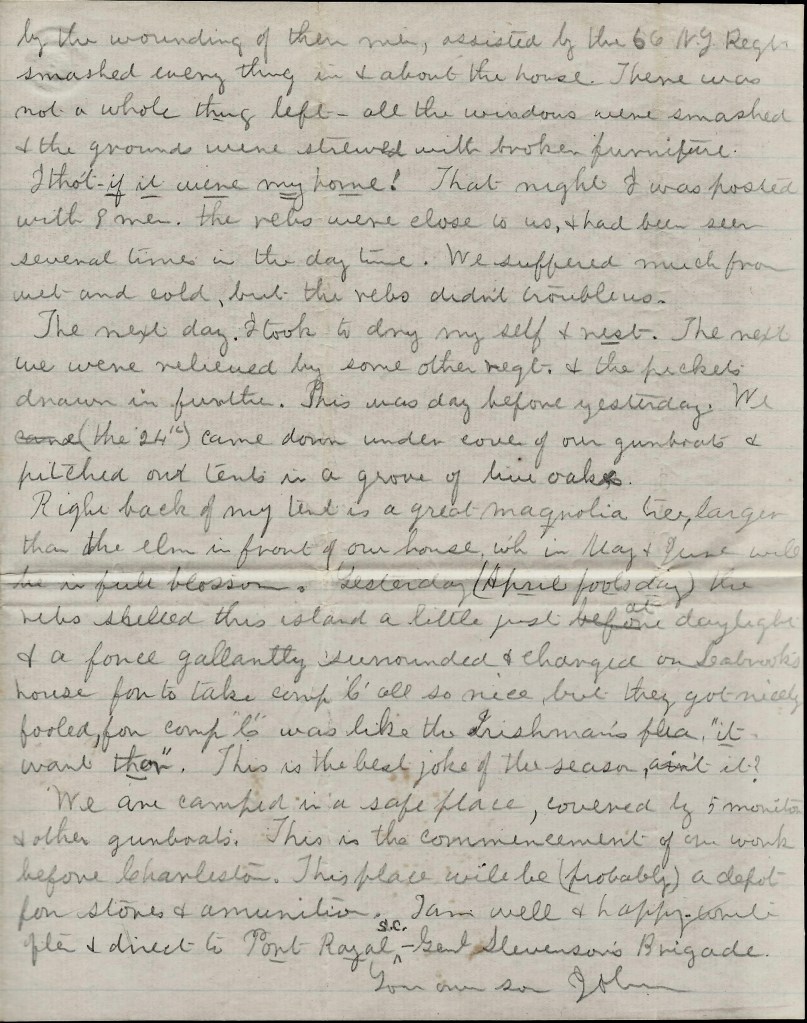
Oh war, war! How my heart ached as I gazed upon what was once the happy home of brothers & sisters, now made desolate & despoiled by the unsparing hand of war. This must have been a happy home. The creeks around the house were full of oysters & ducks, the garden full of orange & arbor vitae (in one place the ground was yellow with oranges which the soldiers had knocked off & trodden under foot). The furniture was costly, & the house large & commodious. In short, everything showed that it was once a happy home. The 10th [Connecticut] boys, enraged by the wounding of their men, assisted by the 56th New York Regiment smashed everything in & about the house. There was not a whole thing left. All the windows were smashed & the grounds were strewed with broken furniture. What if it were my home!
That night I was posted with 9 men. The rebs were close to us, & had been seen several times in the day time. We suffered much from wet and cold, but the rebs didn’t trouble us.
The next day I took to dry my self & rest. The next we were relieved by some other regiments & the pickets drawn in further. This was day before yesterday. We (the 24th [Mass. Infantry]) came down under cover of our gunboats & pitched our tents in a grove of live oaks. Right back of my tent is a great magnolia tree, larger than the elm in front of our house, which in May & June will be in full blossom. Yesterday (April fools day), the rebs shelled this island a little just at daylight & a force gallantly surrounded & charged on Seabrook’s house for to take Co. C all so nice, but they got nicely fooled, for Co. C was like the Irishman’s flea—“it warn’t there.” This is the best joke of the season, ain’t it?
We are camped in a safe place, covered by 5 monitors & other gunboats. This is the commencement of our work before Charleston. This place will be (probably) a depot for stores & ammunition. I am well & happy. Write often and direct to Port Royal, S. C., Gen’l Stevenson’s Brigade.
Your own son, — John
1 In a piece writtebn by Sue Holloman and Bob Guiffreda entitled “Seabrook Island Through the Year,” they claim that William Seabrook bought the island in 1816 and that the island was in the family’s possession until the Civil War. The Seabrook plantation house was located near Haulover Cut on the Johns Island side. In 1863, the Seabrook family sold the island to the Gregg family for $150,000 Confederate money. In that year Union troops took over the island and used it as a staging area.




 Spared & Shared 23