
The following letters were written by James B. Myers (1837-1863) who grew up in Perry City, Wyoming, New York, the son of Daniel and Mary Ann (Abell) Myers. He was living in Farmington, Oakland county, Michigan, at the time of the 1860 US Census, and was married to Angeline Defenderfer (b. 1845) on 17 August 1862, two weeks after he enlisted in Co. I, 24th Michigan Infantry.
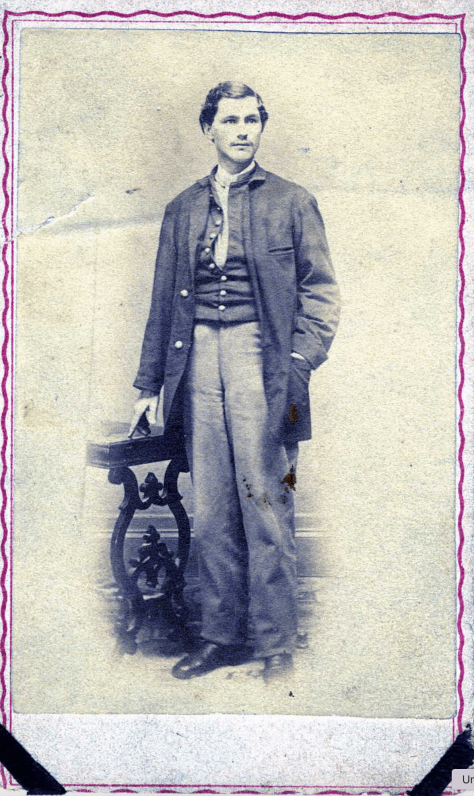
Shortly after the Battle of Antietam (September 1862), the 24th Michigan Infantry was assigned to the famous Iron Brigade in the Army of the Potomac. The brigade’s commander General John Gibbon had requested a new regiment be added to his command because its four original regiments (the 2nd, 6th, and 7th Wisconsin and the 19th Indiana) had been severely depleted by combat action and numbered less than 1000 men total by October 1862. He said that ideally it should be a Western regiment since the others were from that part of the country. Gibbon’s request granted, the 24th Michigan joined the brigade and saw its first action at Fredericksburg taking on a nuisance battery of Confederate horse artillery south of the town. The regiment would follow up its actions at Fredericksburg with a raid on Port Royal, Virginia and fighting at Fitzhugh Crossing. The 24th saw no major action during the Chancellorsville campaign, but at Gettysburg it “Went into action with 496 officers and men. Killed & mortally wounded: 89; Otherwise wounded: 218; Captured: 56; Total casualties: 363. Nine color bearers were killed or mortally wounded and two wounded, of 13 men to hold onto the flag during the first day of the battle, and all the color guard killed or wounded, a net loss of 80%. The 24th Michigan alongside the 1st Minnesota Infantry Regiment suffered the highest casualties of any Union forces that fought at Gettysburg.” One of those who gave his life at Gettysburg was James B. Myers of Co. I, killed instantly on the battlefield of the first day’s acton.
James wife later took Jacob H. Canfield as her second husband. He had served with James in the same company and was wounded severely in the left thigh during the third day of action at Gettysburg. Later, in the Wilderness, he received a gunshot wound to the right leg, below the knee but survived and served until the end of the war.

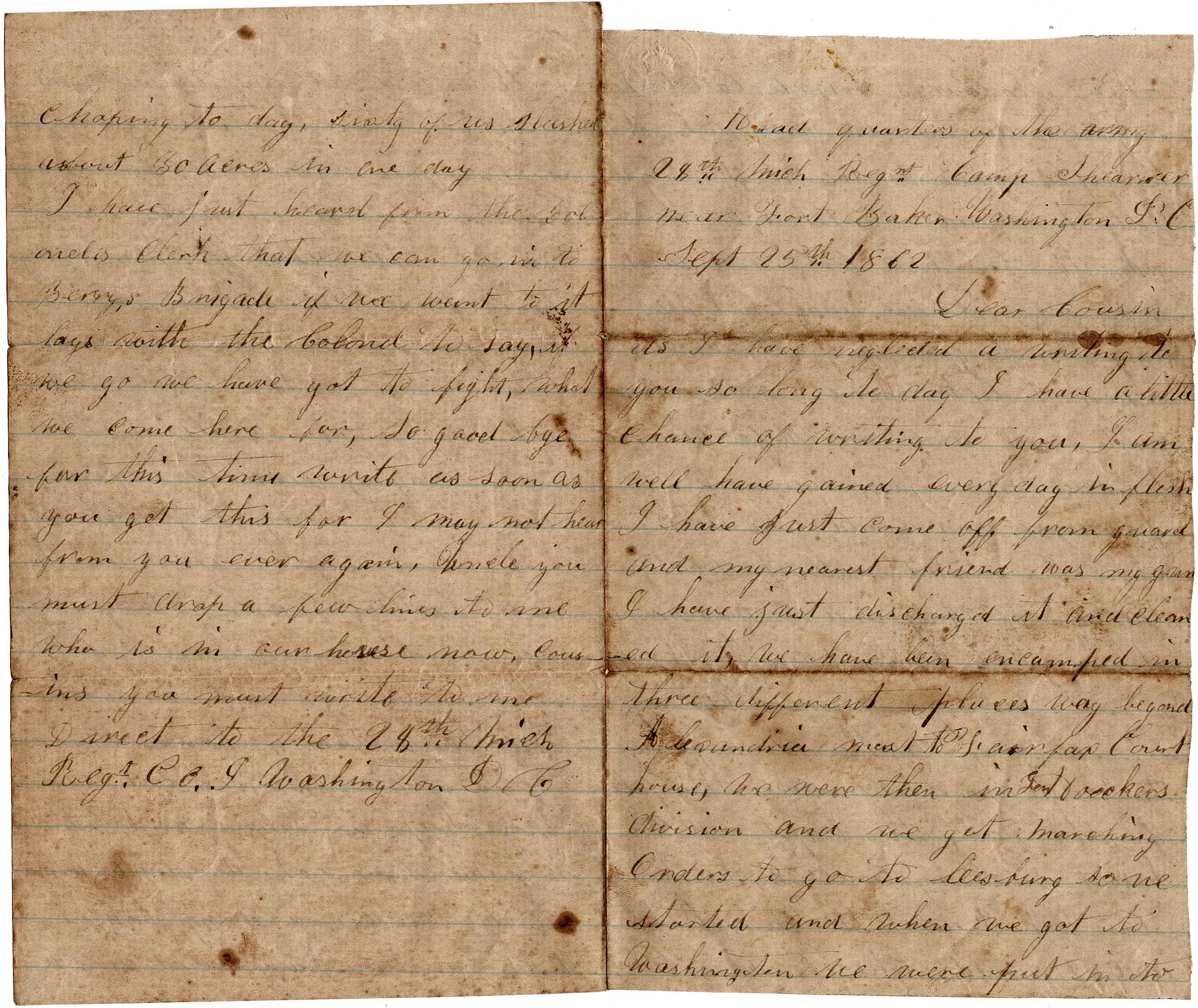
Letter 1
Headquarters of the 24th Michigan Regt.
Camp Shearer near Fort Baker
Washington D. C.
September 25, 1862
Dear cousin,
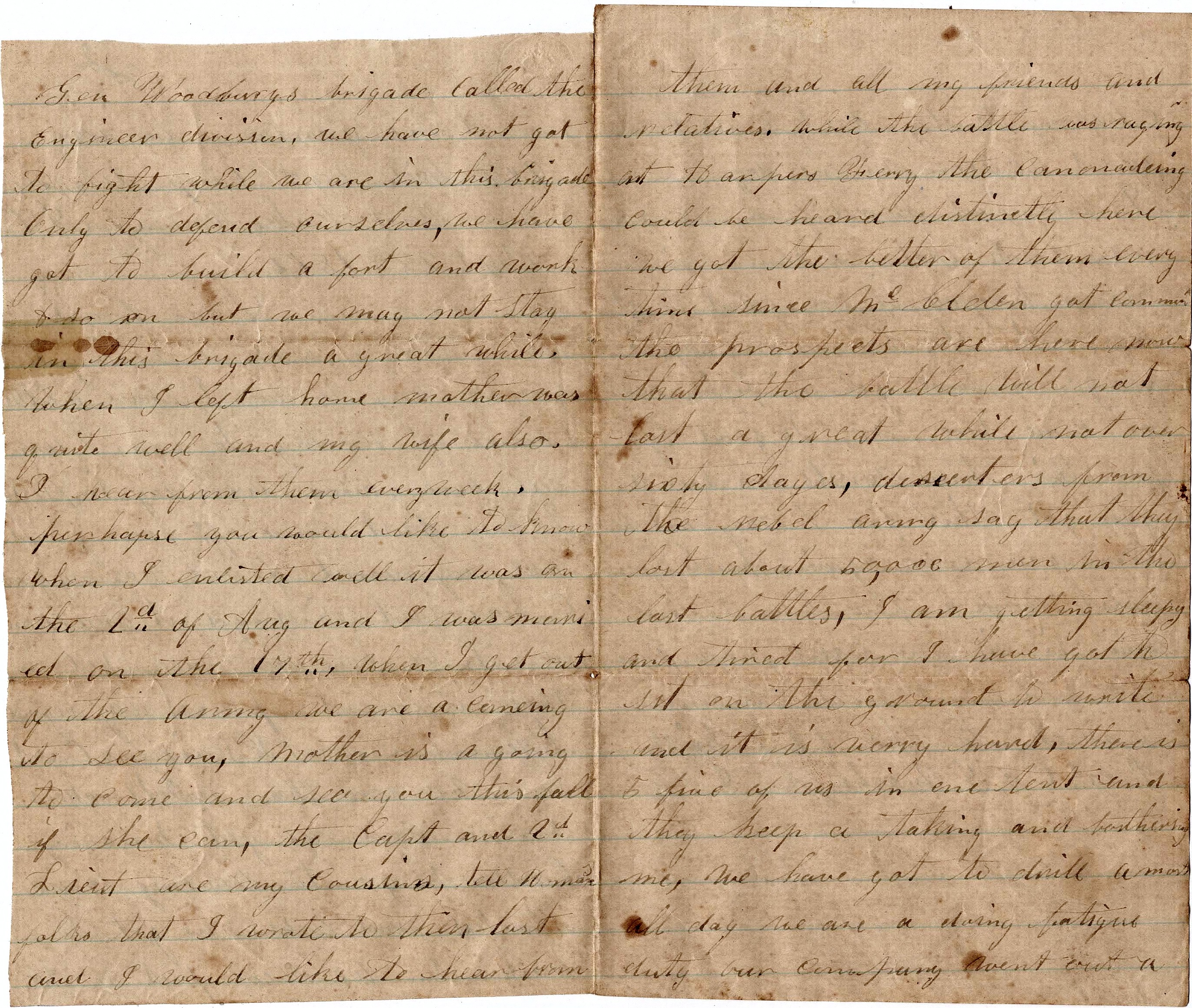
As I have neglected writing to you so long, today I have a little chance of writing to you. I am well. Have gained every day in flesh. I have just come off from guard and my nearest friend was my gun. I have just discharged it and cleaned it. We have been encamped in three different places way beyond Alexandria—most to Fairfax Court House. We were then in Gen. Hooker’s Division and we got marching orders to go to Leesburg so we started and when we got to Washington, we were put into Gen. Woodbury’s Brigade called the Engineer Division. We have not got to fight while we are in this brigade—only to defend ourselves. We have got to build a fort and work and so on but we may not stay in this brigade a great while.
When I left home, mother was quite well and my wife also. I hear from them every week. Perhaps you would like to know when I enlisted. Well it was on the 2nd day of August and I was married on the 17th. When I get out ofthe army we are a coming to see you. Mother is a going to come and see you this fall if she can. The Captain and 2nd Lieutenant are my cousins. Tell Homer’s folks that I wrote to them last and I would like to hear from them and all my friends and relations.
While the battle was raging at Harper’s Ferry, the cannonading could be heard distinctly here. We got the better of them every time since McClellan got command [again]. The prospects are here now that the battle [war] will not last a great while—not over sixty days. Deserters from the rebel army say that they lost about 50,000 men in the last battles.
I am getting sleepy and tired for I have got to sit on the ground to write and it is very hard. There is five of us in one tent and they keep a talking and bothering me. We have got to drill almost all day. We are a doing fatigue duty. Our company went out a chopping today. Sixty of us slashed about 30 acres [in front of Fort Baker] in one day.
I have just heard from the Colonel’s clerk that we can go into Berry’s Brigade if we want to. It lays with the Colonel to say. If we go, we have got to fight—what we came here for. So goodbye for this time. Write as soon as you get this for I may not hear from you ever again. Uncle, you must drop a few lines to me who is in our house now. Cousins, you must write to me. Direct to the 24th Michigan Regt., Co. I, Washington D. C.

Letter 2
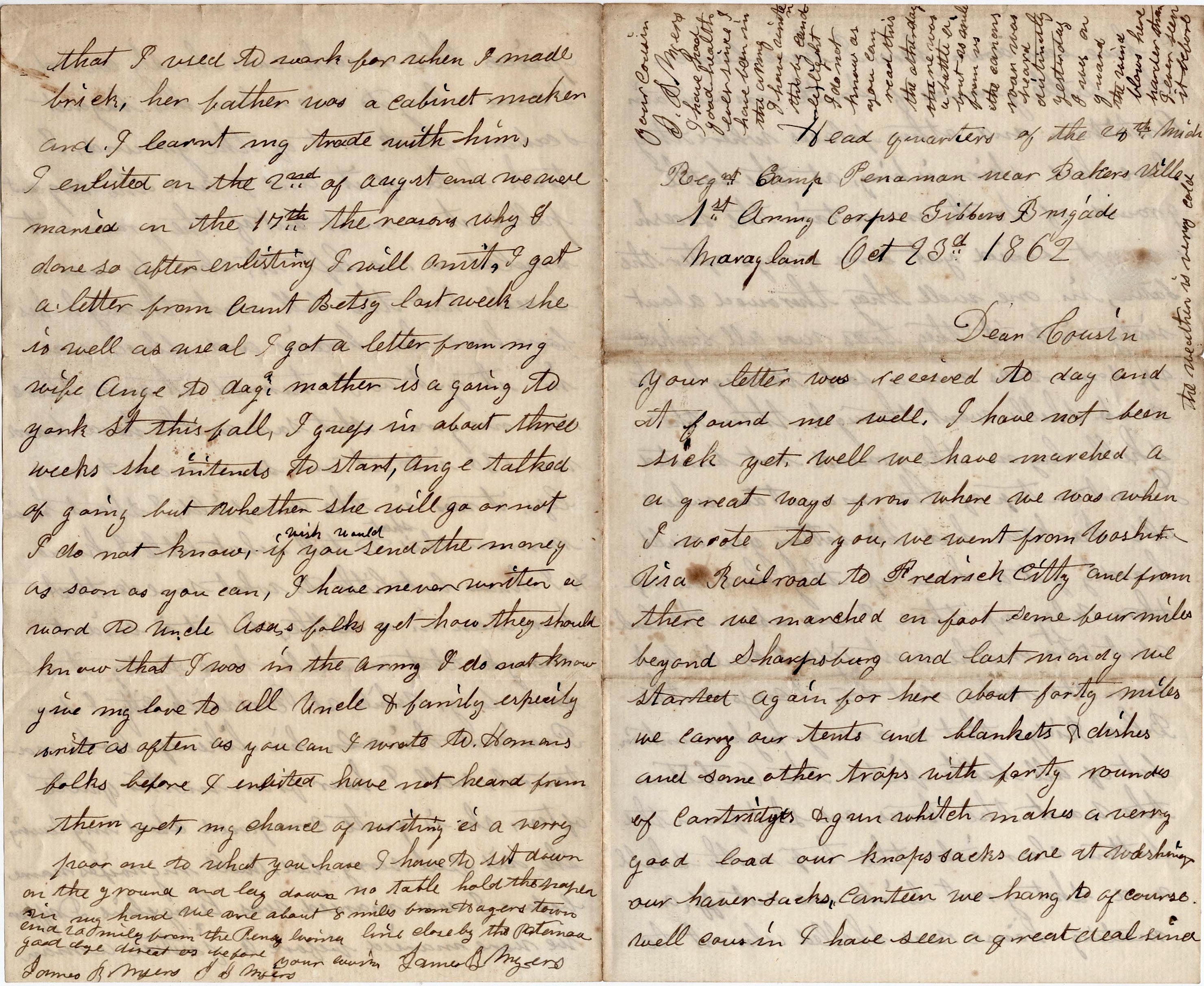
Headquarters of the 24th Michigan Regt.
Camp Penniman near Bakersville, Maryland
1st Army Corps, Gibbon’s Brigade
October 23d 1862
Dear Cousin,
Your letter was received today and it found me well. I have not been sick yet.
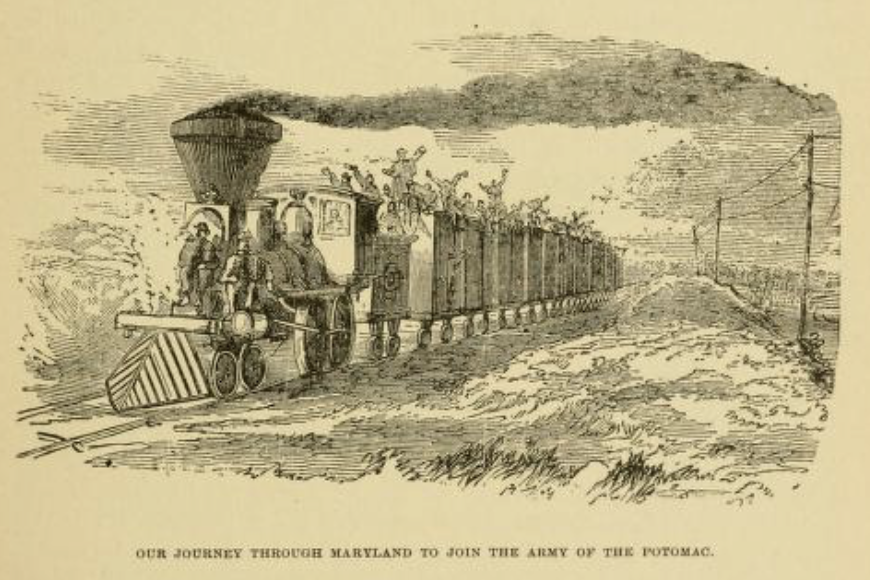
Well we have marched a great ways from where we was when I wrote to you. We went from Washington via railroad [in cattle cars] to Frederick City and from there we marched on foot some four miles beyond Sharpsburg and last Monday we stared again for here about forty miles. We carry our tents and blankets & dishes and some other traps with forty rounds of cartridges and gun which makes a very good load. Our knapsacks are at Washington. Our haversacks and canteen we hang on to, of course.
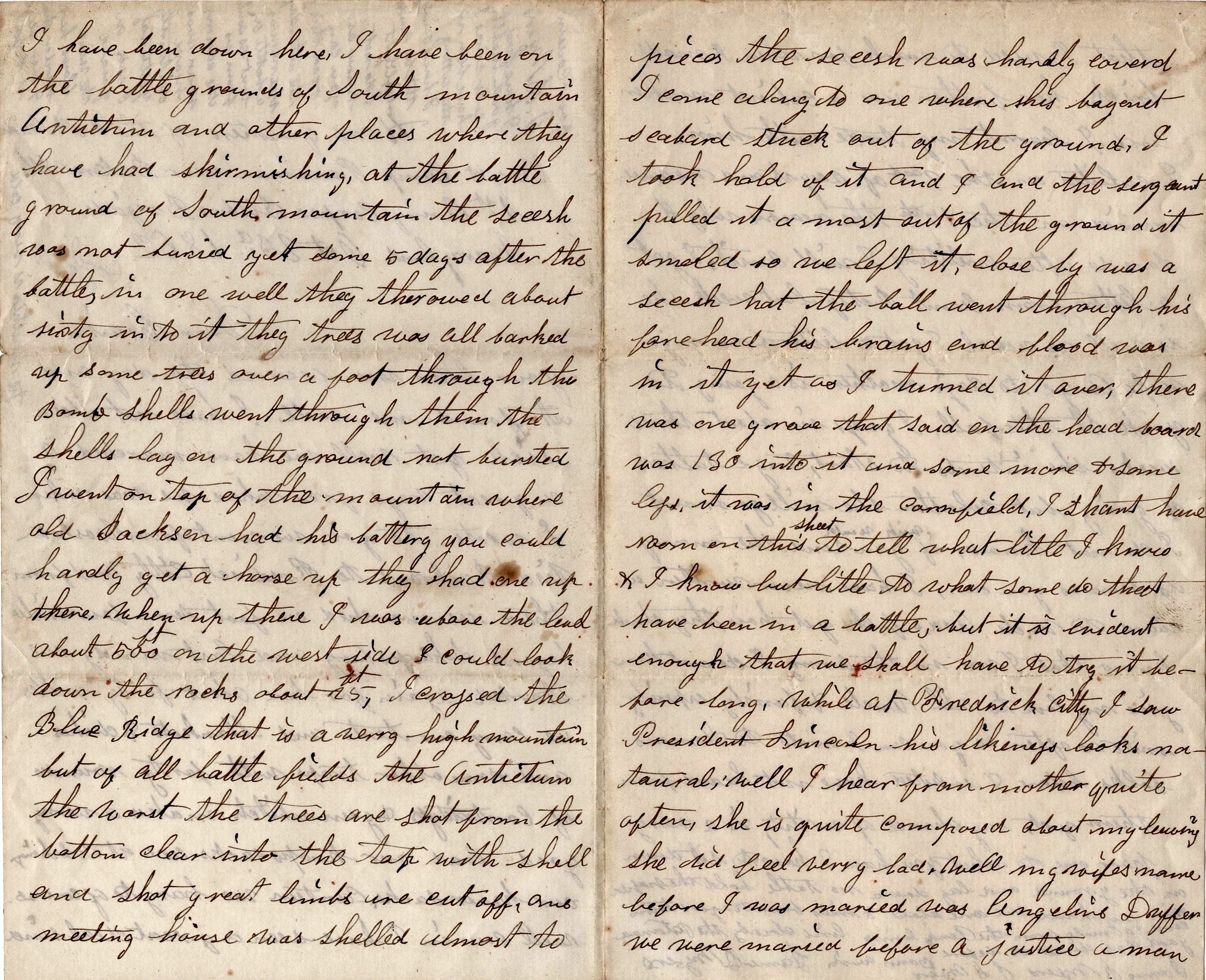
Well cousin, I have seen a great deal since I have been down here. I have been on the battle grounds of South Mountain, Antietam, and other places where they have had skirmishing. At the battle ground of South Mountain, the secesh was not buried yet some 5 days after the battles. On one well, they throwed about sixty into it. The trees was all barked up. Some trees over a foot through the bomb shells went through them. The shells lay on the ground not bursted. I went on top of the mountain where Old Jackson had his battery. you could hardly get a horse up. They had one up there. I was where the lead about 500 ft. on the west side. I could look down the rocks about 25 ft. I crossed the Blue Ridge—that is a very high mountain.
But of all battle fields the Antietam [was] the worst. The trees and shot from the bottom clear into the top with shell and shot. Great limbs are cut off. One meeting house was shelled almost to pieces. The secesh was hardly covered. I come along to one where his bayonet scabbard stuck out of the ground. I took hold of it and I and the sergeant pulled it almost out of the ground. It smelled so we left it. Closeby was a secesh hat. The ball went through his forehead. His brains and blood was in it yet as I turned it over.
There was one grave that said on the headboard was 130 into it and some more & some less. It was in the cornfield. I shant have room on this sheet to tell what little I know but little to what some do that have been in the battle. But it is evident enough that we shall have to try it before long.
Whilst at Frederick City I saw President Lincoln. His likeness looks natural. 1
Well, I hear from mother quite often. She is quite composed about my leaving. She did not feel very bad. Well, my wife’s name before I was married was Angeline Duffer. We were married before a justice [William A. Smith]—a man that I used to work for when I made brick. Her father was a cabinet maker and I learnt my trade with him.
I enlisted on the 2nd of August and we were married on the 17th. The reasons why I done so after enlisting I will omit. I got a letter from Aunt Betsy last week. She is well as usual. I got a letter from my wife Ange today. Mother is a going to York State this fall. I guess in about three weeks she intends to start. Ange talked of going but whether she go or not I do not know. I wish you would end the money as soon as you can. I have never written a word to Uncle Asa’s folks yet. How they should know that I was in the Army, I do not know. Give my love to all—Uncle and family especially. Write as often as you can. I wrote to Heman’s folks before I enlisted. Have not heard from them yet. My chance of writing is a very poor one to what you have. I have to sit down on the ground adn lay down. No table. Hold the paper in my hand. We are about 8 miles from Hagerstown and 20 miles from the Pennsylvania line close by the Potomac. Goodbye. Direct as before. Your cousin, — James B. Myers
I have good health ever since I have been in the army. I have written this by candle light. I do not know as you can read this. The other day there was a battle about 20 miles from us. The cannons’ roar was heard distinctly yesterday. I was on guard. The wind blows here harder than I ever seen it before. The weather is very cold.
1 According to the regimental history, President Lincoln passed the camp of the 24th Michigan near the railroad at Frederick City on October 4th on his return from a visit to the Antietam and South Mountain battlefields. Early in the day he visited wounded soldiers at Sharpsburg with McClellan. Midday he traveled to South Mountain to visit Gen. Israel B. Richardson lying mortally wounded in a farmhouse. He arrived in Frederick City about 4:45 p.m. and went to see Gen. George L. Hartsuff suffering from wounds received at Antietam. He then gave a short speech to a crowd at the railway station before leaving for Washington D. C. where he arrived about 10 p.m. (source: Lincoln Log)
Letter 3
[Editor’s Note: The following letter describes the Westmoreland Expedition in which Colonel Morrow led 1200 men from the Iron Brigade through King George and Westmoreland counties of Virginia with the objective of clearing the peninsula between the Potomac and the Rappahannock of any Confederate troops. Upon the conclusion of this expedition and with the visit of the Governor of Michigan, the 24th Michigan were issued the distinctive Black Hats worn by other members of the Brigade.]
Camp Way, Virginia
May 29th 1863
Dear Cousin,
Today I will drop a few lines to you to let you know that I am well & alive yet although I have been where danger was great. I was in the last battle the length of time it lasted. You know as well as I do we were very near used up towards the last, tired out with fatigue & traveling. And then such a scene I never want to witness again but will have to, I suppose, as we are under marching orders now to be ready in an hour’s notice to start.
Our brigade was called up last week Thursday morning to be ready to march in half an hour with three days rations. Well we hardly got our breakfast eat[en] when the word was (fall in) & we did so & we traveled 30 miles that day. Well we learnt that we was a going on a reconnoissance down the river Rappahanock. We we went some 60 miles & got our cavalry that was surrounded by the bush dodgers. We got the boys and the Rebel Colonel [Lt. Col. Critcher, 15th Va. Cavalry] & some others besides, bringing home some over one thousand mules & horses. I was very sick when I started, suffering with the bloody diarrhea but I had to go. Well, we lived first rate & a change of diet did me good—cured me. We went into every house we had a mind to & help[ed] ourselves to such as milk & butter, honey, flour, preserves, bread, chickens, turkeys, ducks, &c. &c. for they was secesh & took away their niggers & so on.
Pay master Gould is a paying us off today. He is the forerunner of another fight last night. Our Governor Blair of Michigan came to see us. We had dress parade at 6 o’clock & after that the Governor made us a speech. Oh, [regarding] our raid, we was gone six days & we traveled some 130 miles. Some of the boys was sun struck & fell in their tracks!
How is it about our rent? Is there no money a coming or become due to mother? She says she has wrote for it & you told me in your last letter that there was some money for her. Things look dark as long as that house has been rented & we get so little rent. Mother needs it very much. I am a going to write to Uncle Asa about this thing for the house may as well be burnt up as for the good it does mother. I don’t wish to offend any of you, but we do not get any satisfaction about the place nor hardly hear from you. I have written and written & no answer & now I will try it again. If there is any rent, send it, and if not, explain what has become of it. And furthermore, who is in the house now. Uncle tells us all. Write to mother or to me as you please. Mother’s health is not very good. My sister has been sick all winter and her health is very poor & henry has had the dropsy & they both have had the scarlet fever very hard. Give my love to all the family & friends if you see them. Direct to 24th Michigan Infantry, Co. I, Washington D. C., 1st Army Corps.
— James B. Myers
My wife is well or was when I last heard from her & that is almost every day. She is with mother now for company. I still remain your cousin. Our Colonel had charge of the brigade. He can do if anybody can. Gen. Meredith stayed at camp. Write soon & often & I will. Don’t wait.


 Spared & Shared 23